Intertwined charge density wave, tunable anti-dome superconductivity, and topological states in kagome metal VSn
Pith reviewed 2026-05-09 21:22 UTC · model grok-4.3
The pith
VSn is predicted as a kagome metal with built-in charge density waves that yield to anti-dome superconductivity while keeping topological character.
A machine-rendered reading of the paper's core claim, the machinery that carries it, and where it could break.
Core claim
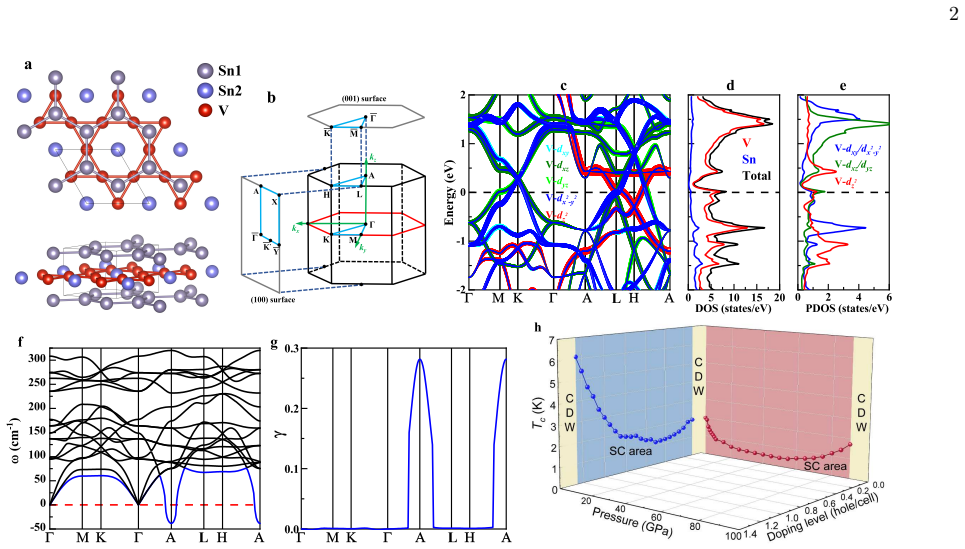
We predict a novel 1:1 kagome metal VSn, which is an intrinsic charge density wave (CDW) material. Interestingly, with increasing pressure or doping concentration, the CDW order is progressively suppressed, followed by the emergence of superconductivity characterized by a non-monotonic transition temperature that exhibits a rare anti-dome-shaped dependence. Above a critical threshold, a reentrance of the CDW phase occurs. The anti-dome superconductivity originates from the first hardening and then softening of phonon modes, together with band reconstruction. Crucially, VSn retains nontrivial topological properties across the entire superconducting regime.
What carries the argument
The vanadium-tin kagome lattice whose phonon modes first harden then soften under pressure or doping, driving the CDW suppression and the anti-dome superconducting dome while topological band invariants remain intact.
If this is right
- Pressure or doping suppresses the intrinsic CDW and triggers superconductivity with non-monotonic, anti-dome dependence of the transition temperature.
- A re-entrant CDW phase appears beyond a critical tuning threshold.
- Nontrivial topological character persists throughout the superconducting regime.
- Phonon hardening followed by softening, together with band reconstruction, accounts for the anti-dome shape.
- The material supplies a platform for studying the interplay of charge order, superconductivity, and topology in one kagome system.
Where Pith is reading between the lines
- If the anti-dome pattern is confirmed, it would suggest that similar phonon-driven tuning could be engineered in other non-magnetic 1:1 kagome metals.
- The persistence of topology across the superconducting dome raises the possibility that doping or pressure might stabilize a topological superconducting state suitable for further study.
- Experimental searches for VSn would test whether the predicted CDW wavevector and the calculated phonon softening can be directly observed.
Load-bearing premise
The electronic-structure and phonon calculations correctly capture the CDW instability, the phonon hardening-softening sequence, and the survival of topological invariants when pressure or doping is applied.
What would settle it
Synthesis of bulk or thin-film VSn followed by measurement of a CDW transition that decreases with pressure or doping, a superconducting critical temperature that rises then falls in an anti-dome, and re-entrant CDW at higher tuning, plus direct probes confirming retained topological surface states.
Figures


read the original abstract
These years, kagome materials with 1:1 stoichiometry have garnered increasing attention, among which FeSn, CoSn, and FeGe have been the focus of current studies. However, all of them are antiferromagnetic, thereby hindering the observation of superconductivity and other novel physical properties. Here, we predict a novel 1:1 kagome metal VSn, which is an intrinsic charge density wave (CDW) material. Interestingly, with increasing pressure or doping concentration, the CDW order is progressively suppressed, followed by the emergence of superconductivity characterized by a non-monotonic transition temperature that exhibits a rare anti-dome-shaped dependence. Above a critical threshold, a reentrance of the CDW phase occurs. The anti-dome superconductivity originates from the first hardening and then softening of phonon modes, together with band reconstruction. Crucially, VSn retains nontrivial topological properties across the entire superconducting regime, a feature of paramount importance for realizing robust topological superconductivity. These intertwined CDW, superconductivity, and topological phenomena elucidate the correlations among multiple quantum states in VSn. Therefore, this research paves the way for for designing 1:1 kagome superconducting topological metals and establishes a platform for exploring the interplay of multiple phases in kagome systems.
Editorial analysis
A structured set of objections, weighed in public.
Referee Report
Summary. The manuscript predicts a novel 1:1 kagome metal VSn as an intrinsic CDW material. With increasing pressure or doping, the CDW order is suppressed, giving way to superconductivity with a rare anti-dome-shaped Tc dependence; at higher values a reentrant CDW phase appears. The anti-dome superconductivity is attributed to initial hardening followed by softening of phonon modes together with band reconstruction. The material is claimed to retain nontrivial topological properties throughout the superconducting regime, offering a platform for topological superconductivity.
Significance. If the DFT predictions hold, the work would introduce a new kagome platform free of the antiferromagnetism that limits FeSn, CoSn and FeGe, enabling direct study of intertwined CDW, anti-dome superconductivity and topology. The anti-dome Tc shape and persistent topology are uncommon and potentially useful for realizing robust topological superconductivity. The manuscript does not report machine-checked proofs, reproducible code or parameter-free derivations, so credit is limited to the conceptual framing of multiple quantum states in a single 1:1 kagome system.
major comments (2)
- The anti-dome superconductivity and its phonon-based explanation rest on the computed phonon spectra under pressure and doping (likely in the Results or Computational Methods section). No functional choice, Hubbard-U tests, k-point convergence or error estimates on the softening/hardening sequence are reported. In kagome metals, van Hove singularities can shift phonon frequencies by 10-20% when moving beyond PBE, undermining the claimed non-monotonic Tc without such checks.
- The claim that nontrivial topological properties survive across the entire superconducting regime (Results on topology or band-structure figures) is load-bearing for the topological-superconductivity prospect. The manuscript does not specify the invariant calculation method (Wannier-based Z2, Berry phase, etc.) nor demonstrate stability under the same pressure/doping grids used for the phonon and Tc calculations.
minor comments (2)
- Abstract, final sentence: repeated word 'for for' before 'designing'.
- Figure captions and axis labels should explicitly indicate the pressure/doping values at which the anti-dome maximum and CDW reentrance occur.
Simulated Author's Rebuttal
We thank the referee for the careful and constructive review of our manuscript. We address each major comment below and have revised the manuscript accordingly to strengthen the presentation of our results.
read point-by-point responses
-
Referee: The anti-dome superconductivity and its phonon-based explanation rest on the computed phonon spectra under pressure and doping (likely in the Results or Computational Methods section). No functional choice, Hubbard-U tests, k-point convergence or error estimates on the softening/hardening sequence are reported. In kagome metals, van Hove singularities can shift phonon frequencies by 10-20% when moving beyond PBE, undermining the claimed non-monotonic Tc without such checks.
Authors: We agree that additional methodological details and convergence tests are required to fully support the phonon-based mechanism for the anti-dome superconductivity. In the revised manuscript, the Computational Methods section has been expanded to explicitly state the use of the PBE functional, a plane-wave energy cutoff of 520 eV, and k-point meshes of 10x10x10 for self-consistent calculations and 14x14x14 for phonon computations via the finite-displacement approach. We performed Hubbard-U tests for vanadium (U = 0–3 eV) and confirmed that the sequence of initial phonon hardening followed by softening remains robust, with frequency shifts below 7% that preserve the non-monotonic Tc trend. These results, along with error estimates from k-point and cutoff convergence, are now included in Supplementary Figure S3. While we note that hybrid functionals could offer further checks, the reported tests indicate that the qualitative anti-dome behavior is not sensitive to the specific choices within standard DFT settings for this system. revision: yes
-
Referee: The claim that nontrivial topological properties survive across the entire superconducting regime (Results on topology or band-structure figures) is load-bearing for the topological-superconductivity prospect. The manuscript does not specify the invariant calculation method (Wannier-based Z2, Berry phase, etc.) nor demonstrate stability under the same pressure/doping grids used for the phonon and Tc calculations.
Authors: We thank the referee for pointing out this lack of detail. The topological invariants were computed using the Wannier charge center method to obtain the Z2 invariant, as implemented in the WannierTools package, with maximally localized Wannier functions constructed from V 3d and Sn 5p orbitals. In the revised manuscript, we have added a dedicated paragraph in the Results section describing this procedure and included Supplementary Table S1 and Figure S4, which explicitly track the Z2 invariant (remaining nontrivial, Z2 = 1) across the identical pressure (0–12 GPa) and doping (0–0.25 e/f.u.) grids employed for the phonon and Tc calculations. These additions confirm the persistence of the topological states throughout the superconducting regime. revision: yes
Circularity Check
No significant circularity in the claimed derivation chain
full rationale
The paper presents forward predictions of CDW suppression, anti-dome superconductivity from phonon hardening/softening plus band reconstruction, and persistent nontrivial topology in VSn, all derived from standard electronic-structure calculations. No steps reduce by construction to self-definitions, fitted inputs renamed as predictions, or load-bearing self-citations; the abstract and described content contain no equations or claims that equate outputs to inputs. The derivation remains self-contained as independent first-principles results against external benchmarks.
Axiom & Free-Parameter Ledger
Reference graph
Works this paper leans on
-
[1]
Figures 3a-3c display the phonon dispersion weighted by the mag- nitude of λ qν , the Eliashberg spectral function α 2F (ω ), and the cumulative EPC function λ(ω ) for 0.1, 0.5, and 5 /s32 /s83/s110 /s32 /s83/s110 /s71 /s71/s77 /s75 /s65 /s76 /s72 /s65 /s71 /s71/s77 /s75 /s65 /s76 /s72 /s65 /s80/s104/s68/s79 /s83/s32 /s40/s115/s116/s97/s116/s101/s115/s47 ...
-
[2]
J.-X. Yin, B. Lian, and M. Z. Hasan, Topological kagome magnets and superconductors, Nature 612, 647 (2022)
work page 2022
-
[3]
T. Neupert, M. M. Denner, J.-X. Yin, R. Thomale, and M. Z. Hasan, Charge order and superconductivity in kagome materials, Nat. Phys. 18, 137 (2022)
work page 2022
-
[4]
S. Sachdev, Kagome- and triangular-lattice heisenberg antiferromagnets: Ordering from quantum fluctuations and quantum-disordered ground states with unconfined bosonic spinons, Phys. Rev. B 45, 12377 (1992)
work page 1992
- [5]
-
[6]
I. I. Mazin, H. O. Jeschke, F. Lechermann, H. Lee, M. Fink, R. Thomale, and R. Valent ´ ı, Theoreti- cal prediction of a strongly correlated dirac metal, Nat. Commun. 5, 4261 (2014)
work page 2014
-
[7]
P. M. Neves, J. P. Wakefield, S. Fang, H. Nguyen, L. Ye, and J. G. Checkelsky, Crystal net catalog of model flat band materials, npj Comput. Mater. 10, 39 (2024)
work page 2024
-
[8]
A. Low, T. K. Bhowmik, S. Ghosh, and S. Thiru- pathaiah, Anisotropic nonsaturating magnetoresistance observed in HoMn 6Ge6: A kagome dirac semimetal, Phys. Rev. B 109, 195104 (2024)
work page 2024
-
[9]
Y. Hu, X. Wu, Y. Yang, S. Gao, N. C. Plumb, A. P. Schnyder, W. Xie, J. Ma, and M. Shi, Tunable topological dirac surface states and van hove singularities in kagome metal GdV 6Sn6, Sci. Adv. 8, eadd2024 (2025)
work page 2025
-
[10]
H. D. Scammell, J. Ingham, T. Li, and O. P. Sushkov, Chiral excitonic order from twofold van hove singularities in kagome metals, Nat. Commun. 14, 605 (2023)
work page 2023
-
[11]
Y. Hu, X. Wu, B. R. Ortiz, S. Ju, X. Han, J. Ma, N. C. Plumb, M. Radovic, R. Thomale, S. D. Wil- son, A. P. Schnyder, and M. Shi, Rich nature of van hove singularities in kagome superconductor CsV 3Sb5, Nat. Commun. 13, 2220 (2022)
work page 2022
-
[12]
T.-H. Han, J. S. Helton, S. Chu, D. G. Nocera, J. A. Rodriguez-Rivera, C. Broholm, and Y. S. Lee, Fraction- alized excitations in the spin-liquid state of a kagome- lattice antiferromagnet, Nature 492, 406 (2012)
work page 2012
-
[13]
S. Yan, D. A. Huse, and S. R. White, Spin-liquid ground state of the s = 1/2 kagome heisenberg antiferromagnet, Science 332, 1173 (2011)
work page 2011
-
[14]
D. F. Liu, A. J. Liang, E. K. Liu, Q. N. Xu, Y. W. Li, C. Chen, D. Pei, W. J. Shi, S. K. Mo, P. Dudin, T. Kim, C. Cacho, G. Li, Y. Sun, L. X. Yang, Z. K. Liu, S. S. P. Parkin, C. Felser, and Y. L. Chen, Magnetic weyl semimetal phase in a kagome crystal, Science 365, 1282 (2019)
work page 2019
-
[15]
M. Kang, L. Ye, S. Fang, J.-S. You, A. Levitan, M. Han, J. I. Facio, C. Jozwiak, A. Bostwick, E. Rotenberg, M. K. Chan, R. D. McDonald, D. Graf, K. Kaznatcheev, E. Vescovo, D. C. Bell, E. Kaxiras, J. van den Brink, M. Richter, M. Prasad Ghimire, J. G. Checkelsky, and R. Comin, Dirac fermions and flat bands in the ideal kagome metal FeSn, Nat. Mater. 19, 163 (2020)
work page 2020
-
[16]
K. Ohgushi, S. Murakami, and N. Nagaosa, Spin anisotropy and quantum hall effect in the kagom´ e lattice: Chiral spin state based on a ferromagnet, Phys. Rev. B 62, R6065 (2000)
work page 2000
-
[17]
Z. Wang, Y.-X. Jiang, J.-X. Yin, Y. Li, G.-Y. Wang, H.- L. Huang, S. Shao, J. Liu, P. Zhu, N. Shumiya, M. S. Hossain, H. Liu, Y. Shi, J. Duan, X. Li, G. Chang, P. Dai, Z. Ye, G. Xu, Y. Wang, H. Zheng, J. Jia, M. Z. Hasan, and Y. Yao, Electronic nature of chiral charge order in the kagome superconductor CsV 3Sb5, Phys. Rev. B 104, 075148 (2021)
work page 2021
-
[18]
S.-L. Yu and J.-X. Li, Chiral superconducting phase and chiral spin-density-wave phase in a hubbard model on the kagome lattice, Phys. Rev. B 85, 144402 (2012)
work page 2012
-
[19]
H. Chen, Q. Niu, and A. H. MacDonald, Anomalous hall effect arising from noncollinear antiferromagnetism, Phys. Rev. Lett. 112, 017205 (2014)
work page 2014
-
[20]
E. Liu, Y. Sun, N. Kumar, L. Muechler, A. Sun, L. Jiao, S.-Y. Yang, D. Liu, A. Liang, Q. Xu, J. Kroder, V. S¨ uß, H. Borrmann, C. Shekhar, Z. Wang, C. Xi, W. Wang, W. Schnelle, S. Wirth, Y. Chen, S. T. B. Goennenwein, and C. Felser, Giant anomalous hall effect in a ferromagnetic kagome-lattice semimetal, Nat. Phys. 14, 1125 (2018)
work page 2018
- [21]
-
[22]
B. R. Ortiz, S. M. L. Teicher, Y. Hu, J. L. Zuo, P. M. Sarte, E. C. Schueller, A. M. M. Abeykoon, M. J. Krogstad, S. Rosenkranz, R. Osborn, R. Seshadri, L. Ba- lents, J. He, and S. D. Wilson, CsV 3Sb5: A Z 2 topolog- ical kagome metal with a superconducting ground state, Phys. Rev. Lett. 125, 247002 (2020)
work page 2020
-
[23]
H. Zhao, H. Li, B. R. Ortiz, S. M. L. Teicher, T. Park, M. Ye, Z. Wang, L. Balents, S. D. Wil- son, and I. Zeljkovic, Cascade of correlated elec- tron states in the kagome superconductor CsV 3Sb5, Nature 599, 216 (2021)
work page 2021
-
[24]
P.-C. Xiao, L. Yang, H.-Y. Lu, N. Hao, and P. Zhang, Prediction of a kagome topological superconducting fam- ily: XB 3 (X=Ni, Pd), Phys. Rev. B 109, 054506 (2024) . 9
work page 2024
-
[25]
L. Yang, Y.-P. Li, H.-D. Liu, N. Jiao, M.-Y. Ni, H.- Y. Lu, P. Zhang, and C. S. Ting, Theoretical predic- tion of superconductivity in boron kagome monolayer: MB3 (M = Be, Ca, Sr) and the hydrogenated CaB 3, Chin. Phys. Lett. 40, 017402 (2023)
work page 2023
-
[26]
D. Li, Z. Wang, P. Jing, M. Shiri, K. Wang, C. Ma, S. Gong, C. Zhao, T. Wang, X. Dong, L. Zhuang, W. Liu, and Y. An, MPd 5 kagome super- conductors studied by density functional calculations, Phys. Rev. B 111, 144511 (2025)
work page 2025
-
[27]
B. R. Ortiz, L. C. Gomes, J. R. Morey, M. Winiarski, M. Bordelon, J. S. Mangum, I. W. H. Oswald, J. A. Rodriguez-Rivera, J. R. Neilson, S. D. Wilson, E. Ertekin, T. M. McQueen, and E. S. Toberer, New kagome prototype materials: dis- covery of KV 3Sb5, RbV 3Sb5, and CsV 3Sb5, Phys. Rev. Mater. 3, 094407 (2019)
work page 2019
- [28]
-
[29]
H. W. S. Arachchige, W. R. Meier, M. Marshall, T. Matsuoka, R. Xue, M. A. McGuire, R. P. Hermann, H. Cao, and D. Mandrus, Charge den- sity wave in kagome lattice intermetallic ScV 6Sn6, Phys. Rev. Lett. 129, 216402 (2022)
work page 2022
-
[30]
M. Shi, F. Yu, Y. Yang, F. Meng, B. Lei, Y. Luo, Z. Sun, J. He, R. Wang, Z. Jiang, Z. Liu, D. Shen, T. Wu, Z. Wang, Z. Xiang, J. Ying, and X. Chen, A new class of bilayer kagome lattice compounds with dirac nodal lines and pressure-induced superconductiv- ity, Nat. Commun. 13, 2773 (2022)
work page 2022
- [31]
-
[32]
L. Ye, M. Kang, J. Liu, F. von Cube, C. R. Wicker, T. Suzuki, C. Jozwiak, A. Bostwick, E. Rotenberg, D. C. Bell, L. Fu, R. Comin, and J. G. Checkelsky, Mas- sive dirac fermions in a ferromagnetic kagome metal, Nature 555, 638 (2018)
work page 2018
-
[33]
K. Y. Chen, N. N. Wang, Q. W. Yin, Y. H. Gu, K. Jiang, Z. J. Tu, C. S. Gong, Y. Uwatoko, J. P. Sun, H. C. Lei, J. P. Hu, and J.-G. Cheng, Double super- conducting dome and triple enhancement of T c in the kagome superconductor CsV 3Sb5 under high pressure, Phys. Rev. Lett. 126, 247001 (2021)
work page 2021
-
[34]
N. N. Wang, K. Y. Chen, Q. W. Yin, Y. N. N. Ma, B. Y. Pan, X. Yang, X. Y. Ji, S. L. Wu, P. F. Shan, S. X. Xu, Z. J. Tu, C. S. Gong, G. T. Liu, G. Li, Y. Uwatoko, X. L. Dong, H. C. Lei, J. P. Sun, and J.-G. Cheng, Competition between charge-density-wave and superconductivity in the kagome metal RbV 3Sb5, Phys. Rev. Res. 3, 043018 (2021)
work page 2021
-
[35]
Z. Lin, C. Wang, P. Wang, S. Yi, L. Li, Q. Zhang, Y. Wang, Z. Wang, H. Huang, Y. Sun, Y. Huang, D. Shen, D. Feng, Z. Sun, J.-H. Cho, C. Zeng, and Z. Zhang, Dirac fermions in antiferromagnetic FeSn kagome lattices with combined space inversion and time- reversal symmetry, Phys. Rev. B 102, 155103 (2020)
work page 2020
-
[36]
W. R. Meier, M.-H. Du, S. Okamoto, N. Mohanta, A. F. May, M. A. McGuire, C. A. Bridges, G. D. Samolyuk, and B. C. Sales, Flat bands in the cosn-type compounds, Phys. Rev. B 102, 075148 (2020)
work page 2020
-
[37]
F. H. Yu, D. H. Ma, W. Z. Zhuo, S. Q. Liu, X. K. Wen, B. Lei, J. J. Ying, and X. H. Chen, Unusual competition of superconductivity and charge-density- wave state in a compressed topological kagome metal, Nat. Commun. 12, 3645 (2021)
work page 2021
-
[38]
H. Lin, G. Tan, J.-N. Shen, S. Hao, L.-M. Wu, N. Calta, C. Malliakas, S. Wang, C. Uher, C. Wolverton, and M. G. Kanatzidis, Concerted rattling in CsAg 5Te3 leading to ultralow thermal conductivity and high thermoelectric performance, Angew. Chem. Int. Ed. 55, 11431 (2016)
work page 2016
-
[39]
N. Ma, F. Jia, L. Xiong, L. Chen, Y.-Y. Li, and L.-M. Wu, CsCu 5S3 promising thermoelectric ma- terial with enhanced phase transition temperature, Inorg. Chem. 58, 1371 (2019)
work page 2019
- [40]
-
[41]
K. Kim, S. Kim, J. S. Kim, H. Kim, J.-H. Park, and B. I. Min, Importance of the van hove singularity in supercon- ducting PdTe 2, Phys. Rev. B 97, 165102 (2018)
work page 2018
-
[42]
H. W. Myron and A. J. Freeman, Electronic structure and fermi-surface-related instabilities in 1T-TaS 2 and 1T-TaSe2, Phys. Rev. B 11, 2735 (1975)
work page 1975
-
[43]
C. Battaglia, H. Cercellier, F. Clerc, L. Despont, M. G. Garnier, C. Koitzsch, P. Aebi, H. Berger, L. Forro, and C. Ambrosch-Draxl, Fermi-surface-induced lattice distor - tion in NbTe 2, Phys. Rev. B 72, 195114 (2005)
work page 2005
-
[44]
Y. Liu, D. F. Shao, L. J. Li, W. J. Lu, X. D. Zhu, P. Tong, R. C. Xiao, L. S. Ling, C. Y. Xi, L. Pi, H. F. Tian, H. X. Yang, J. Q. Li, W. H. Song, X. B. Zhu, and Y. P. Sun, Nature of charge density waves and superconductivity in 1T-TaSe2− xTex, Phys. Rev. B 94, 045131 (2016)
work page 2016
-
[45]
M. D. Johannes and I. I. Mazin, Fermi surface nest- ing and the origin of charge density waves in metals, Phys. Rev. B 77, 165135 (2008)
work page 2008
-
[46]
A. Y. Liu, Electron-phonon coupling in compressed 1T- TaS2 stability and superconductivity from first princi- ples, Phys. Rev. B 79, 220515 (2009)
work page 2009
-
[47]
C. Chen, B. Singh, H. Lin, and V. M. Pereira, Reproduction of the charge density wave phase di- agram in 1T-TiSe 2 exposes its excitonic character, Phys. Rev. Lett. 121, 226602 (2018)
work page 2018
-
[48]
J. van Wezel, P. Nahai-Williamson, and S. S. Saxena, Exciton-phonon-driven charge density wave in TiSe 2, Phys. Rev. B 81, 165109 (2010)
work page 2010
-
[49]
X. Zhu, Y. Cao, J. Zhang, E. W. Plummer, and J. Guo, Classification of charge density waves based on their na- ture, Proc. Natl. Acad. Sci. 112, 2367 (2015)
work page 2015
-
[50]
Y.-T. Huang, Z.-Z. Li, N.-K. Chen, Y. Wang, H.-B. Sun, S. Zhang, and X.-B. Li, Complex charge density waves in simple electronic systems of two-dimensional III2-VI3 materials, Nat. Commun. 15, 9983 (2024)
work page 2024
-
[51]
Q. Wang, P. Kong, W. Shi, C. Pei, C. Wen, L. Gao, Y. Zhao, Q. Yin, Y. Wu, G. Li, H. Lei, J. Li, Y. Chen, S. Yan, and Y. Qi, Charge density wave orders and en- hanced superconductivity under pressure in the kagome metal CsV 3Sb5, Adv. Mater. 33, 2102813 (2021)
work page 2021
-
[52]
H. Tan, Y. Liu, Z. Wang, and B. Yan, Charge den- sity waves and electronic properties of superconducting kagome metals, Phys. Rev. Lett. 127, 046401 (2021)
work page 2021
-
[53]
S. Peng, Y. Han, G. Pokharel, J. Shen, Z. Li, M. Hashimoto, D. Lu, B. R. Ortiz, Y. Luo, H. Li, 10 M. Guo, B. Wang, S. Cui, Z. Sun, Z. Qiao, S. D. Wil- son, and J. He, Realizing kagome band structure in two- dimensional kagome surface states of RV 6Sn6 (R=Gd, Ho), Phys. Rev. Lett. 127, 266401 (2021)
work page 2021
-
[54]
Y. S. Hor, A. J. Williams, J. G. Checkelsky, P. Roushan, J. Seo, Q. Xu, H. W. Zandbergen, A. Yazdani, N. P. Ong, and R. J. Cava, Superconductivity in Cu xBi2Se3 and its implications for pairing in the undoped topological insu- lator, Phys. Rev. Lett. 104, 057001 (2010)
work page 2010
- [55]
-
[56]
G. Balakrishnan, L. Bawden, S. Cavendish, and M. R. Lees, Superconducting properties of the in- substituted topological crystalline insulator SnTe, Phys. Rev. B 87, 140507 (2013)
work page 2013
-
[57]
J. Hu, F. Yu, A. Luo, X.-H. Pan, J. Zou, X. Liu, and G. Xu, Chiral topological super- conductivity in superconductor-obstructed atomic insulator-ferromagnetic insulator heterostructures, Phys. Rev. Lett. 132, 036601 (2024)
work page 2024
-
[58]
J. Hu, A. Luo, Z. Wang, J. Zou, Q. Wu, and G. Xu, A numerical method for designing topo- logical superconductivity induced by s-wave pairing, npj Comput. Mater. 11, 133 (2025)
work page 2025
-
[59]
G. Kresse and J. Furthm¨ uller, Efficient iterative schemes for ab initio total-energy calculations using a plane-wave basis set, Phys. Rev. B 54, 11169 (1996)
work page 1996
-
[60]
P. Giannozzi, S. Baroni, N. Bonini, M. Calandra, R. Car, C. Cavazzoni, D. Ceresoli, G. L. Chiarotti, M. Cococ- cioni, I. Dabo, A. Dal Corso, S. de Gironcoli, S. Fabris, G. Fratesi, R. Gebauer, U. Gerstmann, C. Gougoussis, A. Kokalj, M. Lazzeri, L. Martin-Samos, N. Marzari, F. Mauri, R. Mazzarello, S. Paolini, A. Pasquarello, L. Paulatto, C. Sbraccia, S. S...
work page 2009
-
[61]
J. P. Perdew, K. Burke, and M. Ernzerhof, Gen- eralized gradient approximation made simple, Phys. Rev. Lett. 77, 3865 (1996)
work page 1996
-
[62]
G. Kresse and D. Joubert, From ultrasoft pseu- dopotentials to the projector augmented-wave method, Phys. Rev. B 59, 1758 (1999)
work page 1999
-
[63]
Q. Wu, S. Zhang, H.-F. Song, M. Troyer, and A. A. Soluyanov, Wanniertools: An open-source software package for novel topological materials, Comput. Phys. Commun. 224, 405 (2018)
work page 2018
-
[64]
M. P. L. Sancho, J. M. L. Sancho, J. M. L. San- cho, and J. Rubio, Highly convergent schemes for the calculation of bulk and surface green functions, J. Phys. F: Met. Phys. 15, 851 (1985)
work page 1985
-
[65]
N. Marzari, A. A. Mostofi, J. R. Yates, I. Souza, and D. Vanderbilt, Maximally local- ized wannier functions: Theory and applications, Rev. Mod. Phys. 84, 1419 (2012)
work page 2012
- [66]
-
[67]
C. Franchini, R. Kov´ aˇ cik, M. Marsman, S. Sathya- narayana Murthy, J. He, C. Ederer, and G. Kresse, Maximally localized wannier functions in LaMnO 3 within PBE + U, hybrid functionals and partially self-consistent gw: an efficient route to construct ab initio tight-binding parameters for eg perovskites, J. Phys.: Condens. Matter 24, 235602 (2012)
work page 2012
discussion (0)
Sign in with ORCID, Apple, or X to comment. Anyone can read and Pith papers without signing in.