Chiral spin-textures in van der Waals heterostructures
Pith reviewed 2026-05-09 20:41 UTC · model grok-4.3
The pith
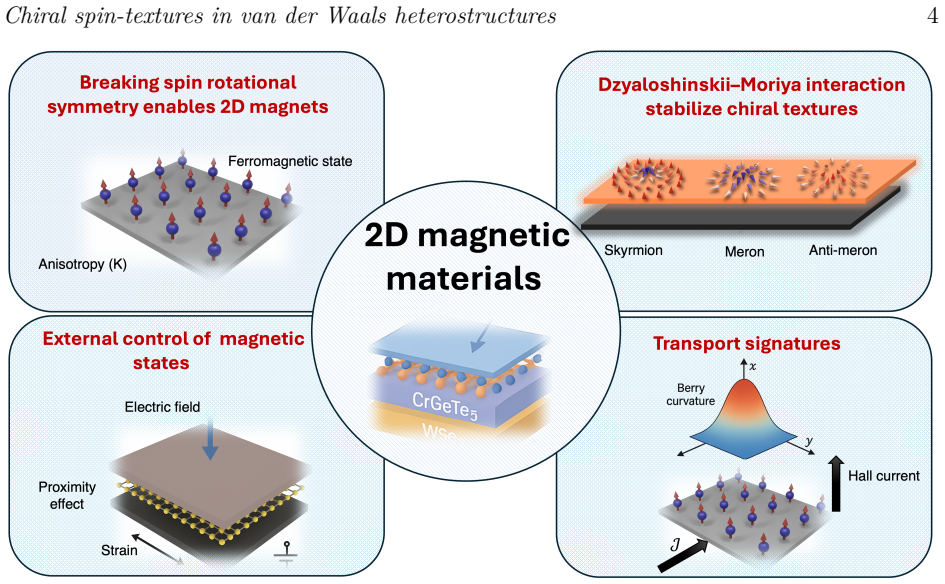
Van der Waals heterostructures stabilize chiral spin textures such as skyrmions through sharp interfaces and tunable symmetry breaking.
A machine-rendered reading of the paper's core claim, the machinery that carries it, and where it could break.
Core claim
Chiral spin textures form in van der Waals heterostructures because atomically sharp interfaces generate a strong Dzyaloshinskii-Moriya interaction while exchange, anisotropy, and dipolar terms can be tuned through layer stacking and symmetry breaking, producing stable nanoscale chiral states with potential low-power device applications.
What carries the argument
The Dzyaloshinskii-Moriya interaction generated at atomically sharp interfaces in van der Waals heterostructures, which imposes a preferred chirality on spin arrangements when combined with exchange and anisotropy.
If this is right
- Exchange, anisotropy, and dipolar effects can be balanced against the interface Dzyaloshinskii-Moriya interaction to set texture size and chirality.
- Transport signatures and dynamical response of the textures become accessible for device readout and switching.
- Symmetry breaking can be adjusted by stacking order or external fields to switch between different chiral states.
- The platform points toward integration into low-power spintronic circuits once temperature stability is reached.
Where Pith is reading between the lines
- Large-scale fabrication that preserves atomically sharp interfaces would directly test whether the reviewed mechanisms scale to wafer-level devices.
- Coupling these textures to other two-dimensional layers could add new control knobs such as gate-tunable spin-orbit strength.
- Measurements of skyrmion motion under current or thermal gradients in these stacks would clarify whether low-power operation is realistically attainable.
Load-bearing premise
The reviewed selection of mechanisms, experiments, and theories is representative and sufficient to indicate workable paths to robust room-temperature chiral textures without major unaddressed limitations elsewhere in the literature.
What would settle it
An experiment that finds chiral spin textures in a van der Waals heterostructure lose nanoscale stability or controllability at room temperature because of thermal fluctuations or interface disorder would falsify the central opportunity claimed.
Figures
read the original abstract
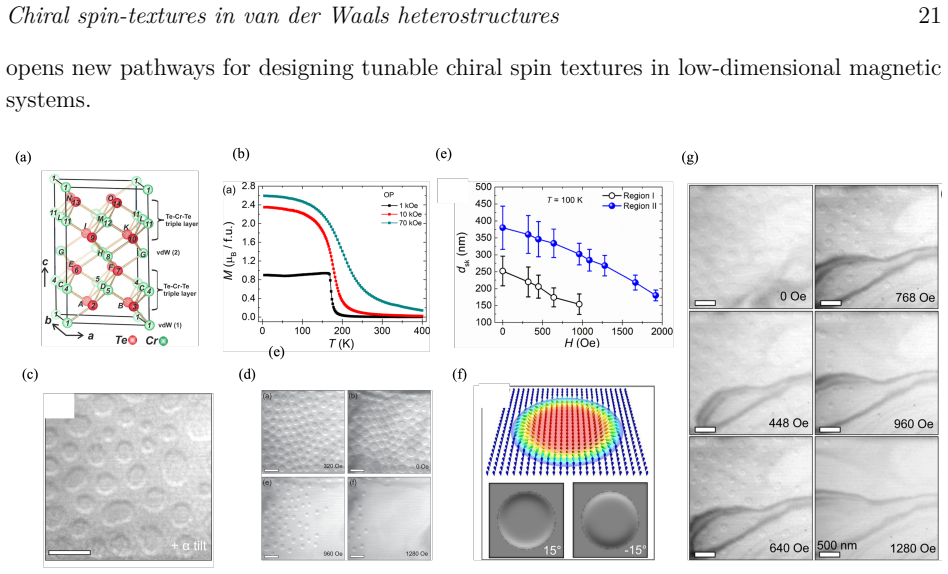
Chiral spin textures such as skyrmions have attracted considerable attention due to their nontrivial topology, chirality, stability at the nanoscale, and potential for low-power spintronic devices. The recent discovery of intrinsic magnetism in van der Waals (vdW) materials and the ability to engineer their heterostructures has opened a new platform to study and manipulate such textures. In these layered systems, atomically sharp interfaces, strong spin-orbit coupling, and tunable symmetry breaking provide unique opportunities to stabilize and control chiral magnetic states. This review summarizes the fundamental mechanisms underlying the formation of chiral spin textures in vdW heterostructures, including the roles of exchange interactions, magnetic anisotropy, Dzyaloshinskii-Moriya interaction, and dipolar effects. We highlight key experimental advances in the observation and manipulation of chiral textures, discuss their dynamical properties and transport signatures, while overviewing selected theoretical investigations. Finally, we outline current challenges and future directions toward realizing robust, room-temperature chiral spin textures for practical spintronic technologies.
Editorial analysis
A structured set of objections, weighed in public.
Referee Report
Summary. This manuscript is a review article summarizing mechanisms underlying chiral spin textures (e.g., skyrmions) in van der Waals heterostructures, including exchange interactions, magnetic anisotropy, Dzyaloshinskii-Moriya interaction (DMI), and dipolar effects. It highlights experimental observations and manipulation techniques, discusses dynamical properties and transport signatures, overviews selected theoretical work, and outlines challenges plus future directions for achieving robust room-temperature operation in spintronic devices. The central claim is that atomically sharp interfaces, strong spin-orbit coupling, and tunable symmetry breaking in these layered systems create unique opportunities to stabilize and control such textures.
Significance. As a timely synthesis of an emerging intersection between 2D materials and topological magnetism, the review could serve as a useful reference if its coverage proves balanced and representative. Explicit acknowledgment of limitations in thermal stability, scalability, and material quality strengthens the assessment by avoiding overstatement. No new derivations, predictions, or data are presented, so impact rests on the quality of the aggregation rather than novel contributions.
minor comments (3)
- The abstract and introduction would benefit from a brief quantitative statement on the number of vdW systems or heterostructures reviewed to better convey the scope of the synthesis.
- Notation for the DMI vector and anisotropy terms should be defined consistently upon first use and cross-referenced to avoid ambiguity in the mechanisms section.
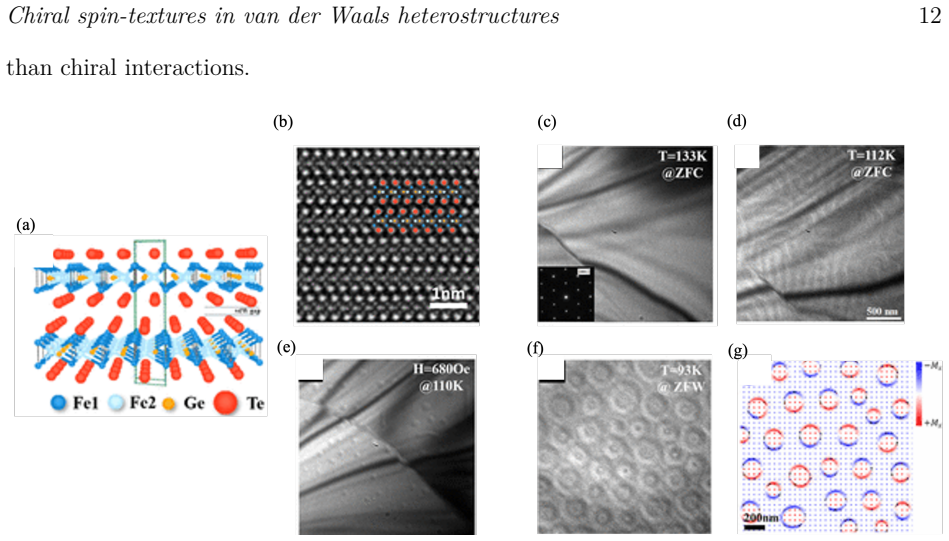
- Figure captions for experimental images of spin textures require explicit scale bars and labeling of key parameters (e.g., temperature, field) to improve clarity and reproducibility.
Simulated Author's Rebuttal
We thank the referee for their positive and constructive assessment of our review manuscript. We appreciate the recognition of its timeliness as a synthesis of the emerging field at the intersection of 2D materials and topological magnetism, as well as the note that explicit discussion of limitations strengthens the work. The recommendation for minor revision is noted, though no specific major comments were provided for point-by-point response.
Circularity Check
No significant circularity; review contains no derivations or predictions
full rationale
This is a review paper that aggregates and summarizes existing literature on mechanisms (exchange, anisotropy, DMI, dipolar), experimental observations, dynamical properties, and challenges for chiral spin textures in vdW heterostructures. No original equations, derivations, fitted parameters, or new predictions are presented. The abstract and structure explicitly frame the content as an overview of prior work with listed limitations, rather than a self-referential chain. No load-bearing steps reduce to self-definition, fitted inputs, or self-citation chains.
Axiom & Free-Parameter Ledger
Reference graph
Works this paper leans on
-
[1]
N. D. Mermin, H. Wagner, Absence of ferromagnetism or antiferromagnetism in one- or two- dimensional isotropic heisenberg models, Physical Review Letters 17 (1966) 1133–1136
work page 1966
-
[2]
J.-U. Lee, S. Lee, J. H. Ryoo, S. Kang, T. Y. Kim, P. Kim, C.-H. Park, J.-G. Park, H. Cheong, Ising-type magnetic ordering in atomically thin feps3, Nano Lett. 16 (2016) 7433–7438
work page 2016
-
[3]
A. R. Wildes, K. C. Rule, R. I. Bewley, T. J. Hicks, T. Chatterji, J.-G. Park, Magnetic structure of the quasi-two-dimensional antiferromagnet feps3, J. Phys.: Condens. Matter 29 (2017) 455801
work page 2017
-
[4]
B. Huang, et al., Layer-dependent ferromagnetism in a van der waals crystal down to the monolayer limit, Nature 546 (7657) (2017) 270–273
work page 2017
-
[5]
C. Gong, et al., Discovery of intrinsic ferromagnetism in two-dimensional van der waals crystals, Nature 546 (7657) (2017) 265–269
work page 2017
-
[6]
M. Gibertini, M. Koperski, A. F. Morpurgo, K. S. Novoselov, Magnetic 2d materials and heterostructures, Nature Nanotechnology 14 (2019) 408–419
work page 2019
-
[7]
K. S. Burch, D. Mandrus, J.-G. Park, Magnetism in two-dimensional van der waals materials, Nature 563 (2018) 47–52
work page 2018
-
[8]
K. F. Mak, J. Shan, D. C. Ralph, Probing and controlling magnetic states in 2d layered magnetic materials, Nature Reviews Physics 1 (2019) 646–661
work page 2019
-
[9]
J. F. Sierra, J. Fabian, R. K. Kawakami, S. Roche, S. O. Valenzuela, Van der waals heterostructures for spintronics and opto-spintronics, Nature Nanotechnology 16 (2021) 856–868
work page 2021
-
[10]
K. S. Novoselov, A. Mishchenko, A. Carvalho, A. H. Castro Neto, 2d materials and van der waals heterostructures, Science 353 (6298) (2016) aac9439
work page 2016
-
[11]
A. K. Geim, I. V. Grigorieva, Van der waals heterostructures, Nature 499 (7459) (2021) 419–425
work page 2021
-
[12]
I. Dzyaloshinsky, A thermodynamic theory of “weak” ferromagnetism of antiferromagnetics, Journal of Physics and Chemistry of Solids 4 (4) (1958) 241–255
work page 1958
-
[13]
T. Moriya, Anisotropic superexchange interaction and weak ferromagnetism, Physical Review 120 (1) (1960) 91–98
work page 1960
-
[14]
C.-M. Hung, et al., Enhanced magnetism and anomalous hall transport mediated by magnetic proximity effect in pt/ws2/fe oxide heterostructures, Nanomaterials 13 (4) (2023) 771
work page 2023
-
[15]
P. Rosenberger, et al., Proximity coupling induced two dimensional magnetic states at ferromagnet/euo interfaces, Preprint (2024)
work page 2024
-
[16]
B. Che, et al., Magnetic proximity effect inε-fe2o3/nbse2 van der waals heterojunctions, Chinese Physics B 33 (2) (2024) 027502
work page 2024
- [17]
- [18]
-
[19]
S. Shi, S. Liang, Z. Zhu, K. Cai, S. D. Pollard, Y. Wang, et al., All-electric magnetization switching anddzyaloshinskii–moriyainteractioninwte 2/ferromagnetheterostructures, NatureNanotechnology 14 (10) (2019) 945–949
work page 2019
-
[20]
Y. Wu, S. Zhang, J. Zhang, W. Wang, Y. L. Zhu, J. Hu, et al., Néel-type skyrmion in wte2/fe3gete2 van der waals heterostructure, Nature Communications 11 (2020) 3860. Chiral spin-textures in van der Waals heterostructures29
work page 2020
-
[21]
K. Zollner, M. Kurpas, M. Gmitra, J. Fabian, First-principles determination of spin–orbit coupling parameters in two-dimensional materials, Nature Review Physics 7 (2025) 255
work page 2025
-
[22]
G. Zheng, et al., Gate-tunable room-temperature ferromagnetism in two-dimensional fe3gete2, Nature Communications 11 (2020) 2543
work page 2020
-
[23]
X. Zhou, Y. Liu, W. Zhang, Z. Wang, X. Zhang, Strain-induced robust skyrmion lattice at room temperature in van der waals ferromagnet fe3gate2, Nature Communications 16 (2025) 1234
work page 2025
-
[24]
Y. Ren, P. Zhao, Z. Li, H. Yang, Q. Liu, Strain engineering of intrinsic ferromagnetism in 2d van der waals materials, Advanced Science 10 (24) (2023) 2301140
work page 2023
-
[25]
N. Abuawwad, et al., Crte2 as a two-dimensional material for topological magnetism in complex heterobilayers, Phys. Rev. B 108 (2023) 094409
work page 2023
-
[26]
Q. Tong, F. Liu, D. Xiao, W. Yao, Skyrmions in the moiré of van der waals 2d magnets, Nano Letters 18 (11) (2018) 7194–7199
work page 2018
- [27]
-
[28]
Jiang, et al., Optical manipulation of magnetic skyrmions, Nature Nanotechnology 15 (2020) 737– 743
W. Jiang, et al., Optical manipulation of magnetic skyrmions, Nature Nanotechnology 15 (2020) 737– 743
work page 2020
- [29]
-
[30]
N. Abuawwad, M. dos Santos Dias, H. Abusara, S. Lounis, Electrical engineering of topological magnetism in two-dimensional heterobilayers, npj Spintronics 2 (2024) 10
work page 2024
-
[31]
K. Huang, D.-F. Shao, E. Y. Tsymbal, Ferroelectric control of magnetic skyrmions in van der waals heterostructures, Physical Review Letters 128 (3) (2022) 037601
work page 2022
-
[32]
C. Liu, et al., Spin-chirality-driven multiferroicity in van der waals monolayers, Physical Review Letters 132 (8) (2024) 086802
work page 2024
-
[33]
S. Wu, et al., Néel-type skyrmion in wte 2/fe3gete2 van der waals heterostructure, Nature Communications 11 (2020) 3860
work page 2020
-
[34]
B. Ding, et al., Observation of magnetic skyrmion bubbles in a van der waals ferromagnet fe3gete2, Nano Letters 20 (11) (2020) 868–873
work page 2020
-
[35]
X. Wang, et al., Direct observation of room-temperature stable skyrmion lattice in van der waals ferromagnet fe3gete2, Nature Materials 19 (2020) 861–866
work page 2020
-
[36]
C. Liu, et al., Anomalous hall effect in van der waals ferromagnet fe3gete2, Nature Physics 14 (2018) 1125–1131
work page 2018
-
[37]
K. Kim, et al., Large anomalous hall effect in a layered ferromagnet fe3gete2, Nature Materials 17 (2018) 794–799
work page 2018
-
[38]
J. Bouaziz, H. Ishida, S. Lounis, S. Blügel, Transverse transport in two-dimensional relativistic systems with nontrivial spin textures, Physical Review Letters 126 (14) (2021) 147203
work page 2021
-
[39]
F. Feringa, et al., Observation of spin hall magnetoresistance up to room temperature in van der waals magnetic surface textures, Physical Review B 105 (21) (2022) 214408
work page 2022
-
[40]
Jiang, et al., Interlayer magnetism in bilayer cri3, Nature Materials 17 (2018) 406–410
S. Jiang, et al., Interlayer magnetism in bilayer cri3, Nature Materials 17 (2018) 406–410
work page 2018
-
[41]
D.R.Klein, etal., Probingmagnetismin2dvanderwaalscrystallineinsulatorsviatunnelingtransport, Science 360 (6394) (2018) 1218–1222
work page 2018
-
[42]
S. Ghosh, et al., Proximity-induced spin transport in graphene–cr 2ge2te6 van der waals heterostructures, Nano Letters 20 (6) (2020) 4059–4066
work page 2020
-
[43]
S. Ghosh, et al., Spin transport in graphene proximitized by two-dimensional magnets, Nature Communications 12 (1) (2021) 666
work page 2021
-
[44]
M.-H.Whangbo, H.-J.Koo, D.Dai, Spinexchangesinmagneticsolids, JournalofSolidStateChemistry 176 (2003) 417–481
work page 2003
-
[45]
J. H. Lee, et al., Energy-mapping analysis of spin exchange interactions, Physical Review B 86 (2012) 060407
work page 2012
-
[46]
H. J. Xiang, E. Kan, S.-H. Wei, M.-H. Whangbo, X. G. Gong, Predicting the spin-lattice order of Chiral spin-textures in van der Waals heterostructures30 frustrated systems from first principles, Physical Review B 84 (2011) 224429
work page 2011
-
[47]
M. Šabani, et al., Ab initio methodology for magnetic exchange parameters: Generic four-state energy mapping onto a heisenberg spin hamiltonian, Physical Review B 102 (2020) 014457
work page 2020
-
[48]
S. V. Halilov, H. Eschrig, A. Y. Perlov, P. M. Oppeneer, Adiabatic spin dynamics from first principles: Application to fe, co, and ni, Physical Review B 58 (1998) 293–302
work page 1998
-
[49]
L. M. Sandratskii, Symmetry analysis of electronic states for crystals with spiral magnetic order, physica status solidi (b) 136 (1986) 167–177
work page 1986
-
[50]
E. Şaşıoğlu, A. Schindlmayr, C. Friedrich, F. Freimuth, S. Blügel, Wannier-function approach to spin excitations in solids, Phys. Rev. B 81 (2010) 054434
work page 2010
- [51]
- [52]
- [53]
-
[54]
B. Schweflinghaus, M. dos Santos Dias, A. T. Costa, S. Lounis, Renormalization of electron self-energies via their interaction with spin excitations: A first-principles investigation, Phys. Rev. B 89 (2014) 235439
work page 2014
- [55]
-
[56]
N. Tancogne-Dejean, A. Rubio, Parameter-free first-principles calculation of spin-wave dispersions, Journal of Chemical Theory and Computation 16 (2020) 100–107
work page 2020
-
[57]
J. Bouaziz, F. Mendes Guimaraes, S. Lounis, A new view on the origin of zero-bias anomalies of co atoms atop noble metal surfaces, Nature Communications 11 (2020) 6112
work page 2020
-
[58]
T. Olsen, Unified treatment of magnons and excitons in monolayercri3 from many-body perturbation theory, Phys. Rev. Lett. 127 (2021) 166402
work page 2021
-
[59]
F. J. dos Santos, L. Binci, G. Menichetti, R. Mahajan, N. Marzari, I. Timrov, Comparative study of magnetic exchange parameters and magnon dispersions in nio and mno from first principles, Phys. Rev. B 113 (2026) 024427
work page 2026
-
[60]
A. I. Liechtenstein, M. I. Katsnelson, V. P. Antropov, V. A. Gubanov, Local spin density functional approach to the theory of exchange interactions in ferromagnetic metals and alloys, Journal of Magnetism and Magnetic Materials 67 (1987) 65–74
work page 1987
-
[61]
L. Udvardi, L. Szunyogh, K. Palotás, P. Weinberger, First-principles relativistic study of spin waves in thin magnetic films, Phys. Rev. B 68 (2003) 104436
work page 2003
- [62]
-
[63]
L. Szunyogh, L. Udvardi, J. Jackson, U. Nowak, R. Chantrell, Atomistic spin model based on a spin- cluster expansion technique: Application to the irmn3/co interface, Phys. Rev. B 83 (2011) 024401
work page 2011
- [64]
-
[65]
P. Kurz, F. Förster, L. Nordström, G. Bihlmayer, S. Blügel, Ab initio treatment of noncollinear magnets with the full-potential linearized augmented plane wave method, Physical Review B 69 (2004) 024415
work page 2004
-
[66]
B. Zimmermann, S. Blügel, S. Mankovsky, H. Ebert, Comparing green-function and supercell approaches to magnetic force theorem calculations of exchange parameters, Physical Review B 99 (21) (2019) 214426
work page 2019
-
[67]
X. He, N. Helbig, M. J. Verstraete, E. Bousquet, Tb2j: A python package for computing magnetic interaction parameters, Computer Physics Communications 264 (2021) 107938. Chiral spin-textures in van der Waals heterostructures31
work page 2021
-
[68]
Bruno, Renormalized magnetic force theorem, Physical Review Letters 90 (2003) 087205
P. Bruno, Renormalized magnetic force theorem, Physical Review Letters 90 (2003) 087205
work page 2003
- [69]
-
[70]
I. V. Solovyev, Limits of the magnetic force theorem, Physical Review B 103 (2021) 104428
work page 2021
-
[71]
V.V.Mazurenko, A.N.Rudenko, S.A.Nikolaev, D.S.Medvedeva, A.I.Lichtenstein, M.I.Katsnelson, Role of direct exchange and dzyaloshinskii-moriya interactions in magnetic properties of graphene derivatives:c 2Fandc 2H, Phys. Rev. B 94 (2016) 214411
work page 2016
-
[72]
F. Z. Ramadan, F. José dos Santos, L. B. Drissi, S. Lounis, Complex magnetism of the two-dimensional antiferromagnetic ge2f: from a néel spin-texture to a potential antiferromagnetic skyrmion, RSC Adv. 11 (2021) 8654–8663
work page 2021
-
[73]
P. W. Anderson, Antiferromagnetism. theory of superexchange interaction, Physical Review 79 (1950) 350–356
work page 1950
-
[74]
Rüßmann, et al., JuDFTteam/JuKKR: v3.6, Zenodo (2022).doi:10.5281/zenodo.7284739
P. Rüßmann, et al., JuDFTteam/JuKKR: v3.6, Zenodo (2022).doi:10.5281/zenodo.7284739. URLhttps://doi.org/10.5281/zenodo.7284739
-
[75]
D. Wortmann, et al., FLEUR, Zenodo (May 2023).doi:10.5281/zenodo.7576163. URLhttps://doi.org/10.5281/zenodo.7576163
- [76]
- [77]
- [78]
-
[79]
P. Giannozzi, et al., Quantum espresso: a modular and open-source software project for quantum simulations of materials, Journal of Physics: Condensed Matter 21 (39) (2009) 395502
work page 2009
-
[80]
T. Ozaki, Variationally optimized atomic orbitals for large-scale electronic structures, Physical Review B 67 (2003) 155108
work page 2003
discussion (0)
Sign in with ORCID, Apple, or X to comment. Anyone can read and Pith papers without signing in.