Generalized stochastic spin-wave theory for open quantum spin systems
Pith reviewed 2026-05-09 22:01 UTC · model grok-4.3
The pith
A semiclassical spin-wave method on quantum trajectories simulates large open quantum spin systems with short-range interactions and local jumps.
A machine-rendered reading of the paper's core claim, the machinery that carries it, and where it could break.
Core claim
We propose a semiclassical framework for solving open quantum dynamics in driven-dissipative spin systems. Our method consists of generalized spin-wave approximations tailored to describing quantum trajectories unravelled from the master equation, and generically applies to regimes beyond the reach of conventional spin-wave theories, including short-range interactions and local quantum jumps, enabling the efficient simulation of large-scale interacting spins. We illustrate the versatility of our framework by studying a variable-range driven-dissipative Ising model on a 2D lattice. When the dissipation acts along the drive axis, we find a continuous phase transition breaking the Z2 symmetry,
What carries the argument
Generalized spin-wave approximations applied to quantum trajectories unravelled from the master equation.
Load-bearing premise
The semiclassical spin-wave expansion accurately describes the dynamics even when applied to individual stochastic trajectories that include local quantum jumps and short-range interactions.
What would settle it
Direct comparison of steady-state magnetization or correlation functions obtained from the generalized spin-wave theory against exact solutions of the master equation for small lattices with nearest-neighbor interactions.
Figures


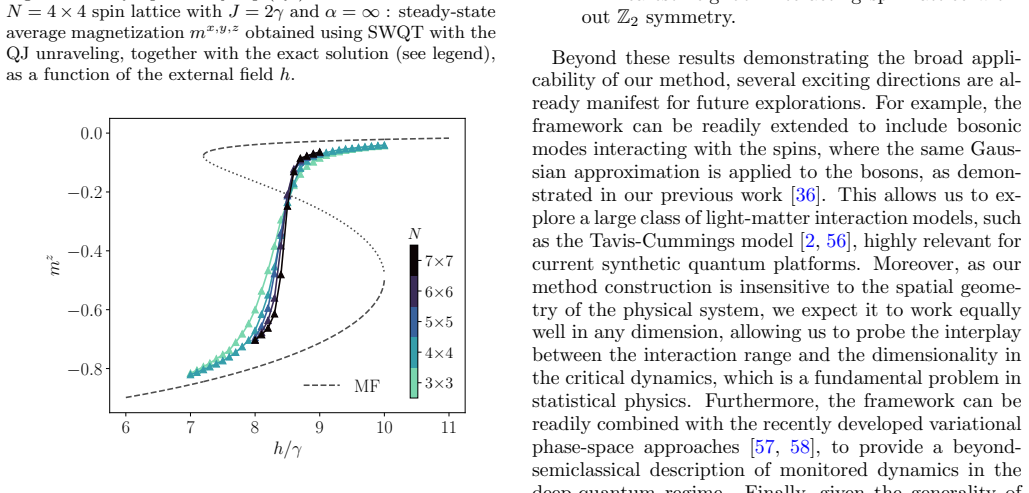
read the original abstract
We propose a semiclassical framework for solving open quantum dynamics in driven-dissipative spin systems. Our method consists of generalized spin-wave approximations tailored to describing quantum trajectories unravelled from the master equation, and generically applies to regimes beyond the reach of conventional spin-wave theories, including short-range interactions and local quantum jumps, enabling the efficient simulation of large-scale interacting spins. We illustrate the versatility of our framework by studying a variable-range driven-dissipative Ising model on a 2D lattice. When the dissipation acts along the drive axis, we find a continuous phase transition breaking the $\mathbb{Z}_2$ symmetry, and demonstrate that the interaction range, when tuned from fully-connected to nearest-neighbour, profoundly alters the universality class of the criticality. With the dissipation along the interaction axis, we show the emergence of a first-order transition. Demonstrated with both state-diffusion and quantum-jump types of trajectory dynamics, our framework provides a powerful toolbox for the efficient semiclassical description of non-equilibrium dynamics and many-body phases in spin systems.
Editorial analysis
A structured set of objections, weighed in public.
Referee Report
Summary. The paper proposes a generalized stochastic spin-wave theory for open quantum spin systems, extending semiclassical approximations to quantum trajectories unravelled from the Lindblad master equation. It claims this framework applies beyond conventional spin-wave limits to short-range interactions and local quantum jumps, enabling large-scale simulations. Applied to a variable-range driven-dissipative Ising model on a 2D lattice, the work reports a continuous Z2 symmetry-breaking phase transition whose universality class depends on interaction range (fully connected to nearest-neighbor), a first-order transition when dissipation aligns with the interaction axis, and results for both state-diffusion and quantum-jump unravelings.
Significance. If the approximation's accuracy is established, the framework would provide an efficient tool for accessing non-equilibrium criticality and many-body phases in dissipative spin systems at scales beyond exact methods, particularly highlighting how interaction range tunes universality classes outside the fully-connected limit.
major comments (3)
- [Method (generalized spin-wave expansion)] The central applicability claim (short-range interactions and local jumps) rests on the semiclassical truncation remaining accurate for stochastic trajectories, but no controlled error bounds, 1/S expansion analysis, or discussion of O(1) site deviations from local jumps are provided.
- [Results on phase transitions] The reported change in universality class for the continuous transition (interaction range tuned from fully-connected to nearest-neighbor) lacks finite-size scaling, exponent extraction details, or comparison to known limits (e.g., mean-field vs. 2D Ising), undermining the criticality findings.
- [Numerical illustrations and validation] No direct benchmarks against exact small-lattice trajectory simulations (e.g., 4x4 systems) are reported to validate quantitative accuracy when local jumps and short-range couplings are present, which is required to support the efficiency and applicability claims.
minor comments (2)
- [Model definition] Clarify the precise definition and interpolation of the variable-range interaction parameter in the model Hamiltonian.
- [Figures] Ensure figures for phase diagrams and trajectories include explicit labels distinguishing state-diffusion vs. quantum-jump results.
Simulated Author's Rebuttal
We thank the referee for their careful reading of the manuscript and for providing constructive feedback. We address each major comment point by point below, indicating the revisions we plan to incorporate.
read point-by-point responses
-
Referee: [Method (generalized spin-wave expansion)] The central applicability claim (short-range interactions and local jumps) rests on the semiclassical truncation remaining accurate for stochastic trajectories, but no controlled error bounds, 1/S expansion analysis, or discussion of O(1) site deviations from local jumps are provided.
Authors: We agree that the manuscript lacks a formal 1/S expansion analysis or controlled error bounds for the generalized spin-wave truncation applied to stochastic trajectories. The framework is presented as a practical semiclassical approximation supported by numerical results, but without rigorous bounds on deviations arising from local jumps. We will revise the manuscript to include a new discussion subsection on the validity regime, providing qualitative arguments for why O(1) site deviations do not preclude accurate large-scale dynamics, along with references to related semiclassical analyses in closed systems. revision: yes
-
Referee: [Results on phase transitions] The reported change in universality class for the continuous transition (interaction range tuned from fully-connected to nearest-neighbor) lacks finite-size scaling, exponent extraction details, or comparison to known limits (e.g., mean-field vs. 2D Ising), undermining the criticality findings.
Authors: The referee is correct that the current manuscript does not present detailed finite-size scaling collapses, explicit critical exponent values, or direct comparisons to mean-field or 2D Ising universality classes. Our statements on the interaction-range dependence of the universality class rely on qualitative changes in scaling behavior observed across system sizes. We will add finite-size scaling analysis, including data collapses and estimated exponents, together with comparisons to the expected mean-field limit for long-range interactions and the 2D Ising class for nearest-neighbor cases. revision: yes
-
Referee: [Numerical illustrations and validation] No direct benchmarks against exact small-lattice trajectory simulations (e.g., 4x4 systems) are reported to validate quantitative accuracy when local jumps and short-range couplings are present, which is required to support the efficiency and applicability claims.
Authors: We acknowledge that direct validation against exact trajectory simulations on small lattices is absent and would strengthen the applicability claims. Although the focus is on large-scale simulations, we will add an appendix with benchmarks for 4x4 and similar small systems, comparing the generalized spin-wave results to exact quantum trajectory simulations for both state-diffusion and quantum-jump unravelings under short-range couplings. revision: yes
Circularity Check
No significant circularity; method is a self-contained extension of standard approximations
full rationale
The paper proposes a generalized spin-wave framework for unravelled quantum trajectories in open spin systems, applying it to a variable-range Ising model to identify phase transitions and universality classes. No step reduces a claimed result to a fitted input, self-defined quantity, or load-bearing self-citation by construction. The central claims rest on the application of the semiclassical truncation to stochastic trajectories, which is presented as an independent methodological advance rather than a tautological renaming or prediction forced by prior definitions within the text. The derivation chain is therefore self-contained against external benchmarks.
Axiom & Free-Parameter Ledger
axioms (2)
- domain assumption The dynamics of the open spin system are governed by a Lindblad master equation that can be unraveled into individual quantum trajectories.
- ad hoc to paper A spin-wave expansion around a classical mean-field direction remains valid for the stochastic trajectories even with short-range couplings and local jumps.
Reference graph
Works this paper leans on
-
[1]
Note that the frame ˆQi is kept constant within this step, which implies that the local ˜zi axes no longer align with the individual spins after the update asδβ i ̸= 0 in general
Calculate the infinitesimal increments for the Gaus- sian parametersδβ i,δu ij, andδv ij using the stochastic master equation, and update these quan- tities with the increments. Note that the frame ˆQi is kept constant within this step, which implies that the local ˜zi axes no longer align with the individual spins after the update asδβ i ̸= 0 in general
-
[2]
1 (c)] such thatβ i = 0 after the rotation
Update local frames ˆQi each along ageodesicro- tation [see Fig. 1 (c)] such thatβ i = 0 after the rotation. This can be achieved self-consistently by considering the evolution of the bosonic mode ˆbi generated by the (passive) rotation of the frame alone. Finally, increase the time byδtand start a new iteration. From the procedure described above, we not...
-
[3]
3, where both the spin-wave quantum trajectories (SWQT) and the exact ones are solved with the same fixed time step dtand the noise realization in the heterodyne dynamics
Benchmark To demonstrate the validity of the (unconventional and possibly counterintuitive) local spin-wave approx- imations, we first benchmark this method against ex- act solutions in a small system withN= 2×2 spins ath= 2γ,J= 0.5γand nearest-neighbor interactions (α=∞), as shown in Fig. 3, where both the spin-wave quantum trajectories (SWQT) and the ex...
-
[4]
As described in Sec
Symmetry breaking along trajectories Let us now apply the generalized SWQT framework to larger system sizes and study the temporal trajectory dynamics in the power-law spin system. As described in Sec. II, the Liouvillian of the model I admits aZ 2 symmetry due to its invariance under the transformation ˆsx,y i 7→ −ˆsx,y. This implies that at any finite s...
-
[5]
magnetization
Steady-state phases with long-range interactionsα= 1 The dynamics presented in the previous section sug- gests the onset of a symmetry-breaking phase transition in the steady-state of the dynamics. To probe the order- disorder crossover at finiteN, we adopt the two-point correlation functionX 2 defined in Eq. (33) as the or- der parameter, which effective...
-
[6]
worst-case scenarios
Universality class crossover One of the advantages of the generalized SWQT frame- work is that its applicability reaches beyond the usual long-range (α < d) regime typically required by the con- ventional spin-wave theory, and we now embark on the investigation of the effect of different interaction ranges on the symmetry-breaking phase transition. At sho...
2020
-
[7]
Heterodyne dynamics Within the Gaussian approximation, the heterodyne equation (6) translates into the stochastic dynamics of the variational parameters, which are conveniently de- scribed by the adjoint stochastic master equation. For a time-independent operator ˆO, its expectation value along the heterodyne dynamics evolves as follows, d⟨ ˆO⟩= dt⟨L ‡ ˆO...
-
[8]
Quantum-jump dynamics Similar to our previous treatment, to find the stochas- tic dynamics governing the Gaussian variational param- eters, we proceed by first recasting the quantum-jump 14 equation (9) in its adjoint form, d⟨ ˆO⟩= dt ( i D [ ˆH, ˆO] E − 1 2 X i D H‡[ˆL† i ˆLi] ˆO E) + X i dMi(t) D J ‡[ˆLi] ˆO E , (B7) where the adjoint superoperators rea...
-
[9]
Fazio, J
R. Fazio, J. Keeling, L. Mazza, and M. Schir` o, Many- body open quantum systems, SciPost Physics Lecture Notes , 099 (2025)
2025
-
[10]
Breuer and F
H.-P. Breuer and F. Petruccione,The theory of open quantum systems(OUP Oxford, 2002)
2002
-
[11]
Preskill, Quantum Computing in the NISQ era and beyond, Quantum2, 79 (2018)
J. Preskill, Quantum Computing in the NISQ era and beyond, Quantum2, 79 (2018)
2018
-
[12]
H. M. Wiseman and G. J. Milburn,Quantum measure- ment and control(Cambridge university press, 2009)
2009
-
[13]
Greiner, O
M. Greiner, O. Mandel, T. Esslinger, T. W. H¨ ansch, and I. Bloch, Quantum phase transition from a superfluid to a mott insulator in a gas of ultracold atoms, Nature415, 39 (2002)
2002
-
[14]
Gross and I
C. Gross and I. Bloch, Quantum simulations with ultra- cold atoms in optical lattices, Science357, 995 (2017)
2017
-
[15]
Monroe, W
C. Monroe, W. C. Campbell, L.-M. Duan, Z.-X. Gong, A. V. Gorshkov, P. W. Hess, R. Islam, K. Kim, N. M. Linke, G. Pagano, P. Richerme, C. Senko, and N. Y. Yao, Programmable quantum simulations of spin systems with trapped ions, Rev. Mod. Phys.93, 025001 (2021)
2021
-
[16]
Blais, A
A. Blais, A. L. Grimsmo, S. M. Girvin, and A. Wall- raff, Circuit quantum electrodynamics, Reviews of Mod- ern Physics93, 025005 (2021)
2021
-
[17]
Blais, S
A. Blais, S. M. Girvin, and W. D. Oliver, Quantum infor- mation processing and quantum optics with circuit quan- tum electrodynamics, Nature Physics16, 247 (2020)
2020
-
[18]
D. L. Underwood, W. E. Shanks, J. Koch, and A. A. Houck, Low-disorder microwave cavity lattices for quan- tum simulation with photons, Phys. Rev. A86, 023837 (2012)
2012
-
[19]
Safavi-Naini, R
A. Safavi-Naini, R. J. Lewis-Swan, J. G. Bohnet, M. G¨ arttner, K. A. Gilmore, J. E. Jordan, J. Cohn, J. K. Freericks, A. M. Rey, and J. J. Bollinger, Verification of a many-ion simulator of the dicke model through slow quenches across a phase transition, Phys. Rev. Lett.121, 040503 (2018)
2018
-
[20]
D. C. Cole, J. J. Wu, S. D. Erickson, P.-Y. Hou, A. C. Wilson, D. Leibfried, and F. Reiter, Dissipative prepara- tion of w states in trapped ion systems, New Journal of Physics23, 073001 (2021)
2021
-
[21]
Leghtas, S
Z. Leghtas, S. Touzard, I. M. Pop, A. Kou, B. Vlastakis, A. Petrenko, K. M. Sliwa, A. Narla, S. Shankar, M. J. Hatridge,et al., Confining the state of light to a quantum manifold by engineered two-photon loss, Science (New York, N.Y.)347, 853 (2015)
2015
-
[22]
Fitzpatrick, N
M. Fitzpatrick, N. M. Sundaresan, A. C. Y. Li, J. Koch, and A. A. Houck, Observation of a dissipative phase tran- sition in a one-dimensional circuit qed lattice, Phys. Rev. X7, 011016 (2017)
2017
-
[23]
M. Pieczarka, E. Estrecho, M. Boozarjmehr, O. Bleu, M. Steger, K. West, L. N. Pfeiffer, D. W. Snoke, J. Levin- sen, M. M. Parish, A. G. Truscott, and E. A. Ostro- vskaya, Observation of quantum depletion in a non- equilibrium exciton–polariton condensate, Nature Com- munications11, 10.1038/s41467-019-14243-6 (2020)
-
[24]
G. W. Castellanos, M. Ramezani, S. Murai, and J. G´ omez Rivas, Non-equilibrium bose–einstein conden- sation of exciton-polaritons in silicon metasurfaces, Ad- vanced Optical Materials11, 2202305 (2023)
2023
-
[25]
Z. Li, F. Claude, T. Boulier, E. Giacobino, Q. Glo- rieux, A. Bramati, and C. Ciuti, Dissipative phase transi- tion with driving-controlled spatial dimension and diffu- sive boundary conditions, Phys. Rev. Lett.128, 093601 (2022)
2022
-
[26]
Mei, B.-W
Q.-X. Mei, B.-W. Li, Y.-K. Wu, M.-L. Cai, Y. Wang, L. Yao, Z.-C. Zhou, and L.-M. Duan, Experimental re- alization of the rabi-hubbard model with trapped ions, Phys. Rev. Lett.128, 160504 (2022)
2022
-
[27]
L. M. Sieberer, M. Buchhold, and S. Diehl, Keldysh field theory for driven open quantum systems, Rep. Prog. Phys.79, 096001 (2016)
2016
-
[28]
Eisert, M
J. Eisert, M. Friesdorf, and C. Gogolin, Quantum many- body systems out of equilibrium, Nat. Phys.11, 124 (2015)
2015
-
[29]
G. Camacho, C. Kl¨ ockner, D. M. Kennes, and C. Karrasch, Review of recent developments of the functional renormalization group for systems out of equilibrium, The European Physical Journal B95, 10.1140/epjb/s10051-022-00445-3 (2022)
-
[30]
Vasseur and J
R. Vasseur and J. E. Moore, Nonequilibrium quantum dynamics and transport: from integrability to many- body localization, Journal of Statistical Mechanics: The- ory and Experiment2016, 064010 (2016)
2016
-
[31]
Bernard and B
D. Bernard and B. Doyon, Conformal field theory out of equilibrium: a review, Journal of Statistical Mechanics: Theory and Experiment2016, 064005 (2016)
2016
-
[32]
Foss-Feig, J
M. Foss-Feig, J. T. Young, V. V. Albert, A. V. Gor- shkov, and M. F. Maghrebi, Solvable Family of Driven- Dissipative Many-Body Systems, Physical Review Let- ters119, 190402 (2017). 16
2017
-
[33]
D. A. Paz and M. F. Maghrebi, Driven-dissipative ising model: An exact field-theoretical analysis, Phys. Rev. A 104, 023713 (2021)
2021
-
[34]
Bartolo, F
N. Bartolo, F. Minganti, W. Casteels, and C. Ciuti, Ex- act steady state of a Kerr resonator with one- and two- photon driving and dissipation: Controllable Wigner- function multimodality and dissipative phase transitions, Physical Review A94, 033841 (2016)
2016
-
[35]
Herring and C
C. Herring and C. Kittel, On the Theory of Spin Waves in Ferromagnetic Media, Physical Review81, 869 (1951)
1951
-
[36]
Kubo, The Spin-Wave Theory as a Variational Method and Its Application to Antiferromagnetism, Re- views of Modern Physics25, 344 (1953)
R. Kubo, The Spin-Wave Theory as a Variational Method and Its Application to Antiferromagnetism, Re- views of Modern Physics25, 344 (1953)
1953
-
[37]
Van Kranendonk and J
J. Van Kranendonk and J. H. Van Vleck, Spin Waves, Rev. Mod. Phys.30, 1 (1958)
1958
-
[38]
F. Bloch, Zur Theorie des Austauschproblems und der Remanenzerscheinung der Ferromagnetika, inZur The- orie des Austauschproblems und der Remanenzerschein- ung der Ferromagnetika: Probleme des Atomkernbaues, edited by F. Bloch (Springer, Berlin, Heidelberg, 1932) pp. 295–335
1932
-
[39]
Holstein and H
T. Holstein and H. Primakoff, Field Dependence of the Intrinsic Domain Magnetization of a Ferromagnet, Phys. Rev.58, 1098 (1940)
1940
-
[40]
R¨ uckriegel, A
A. R¨ uckriegel, A. Kreisel, and P. Kopietz, Time- dependent spin-wave theory, Phys. Rev. B85, 054422 (2012)
2012
-
[41]
Lerose, B
A. Lerose, B. ˇZunkoviˇ c, J. Marino, A. Gambassi, and A. Silva, Impact of nonequilibrium fluctuations on prethermal dynamical phase transitions in long-range in- teracting spin chains, Phys. Rev. B99, 045128 (2019)
2019
-
[42]
Seetharam, A
K. Seetharam, A. Lerose, R. Fazio, and J. Marino, Dy- namical scaling of correlations generated by short- and long-range dissipation, Phys. Rev. B105, 184305 (2022)
2022
-
[43]
Defenu, A
N. Defenu, A. Lerose, and S. Pappalardi, Out-of- equilibrium dynamics of quantum many-body systems with long-range interactions, Physics Reports Out-of- Equilibrium Dynamics of Quantum Many-Body Systems with Long-Range Interactions,1074, 1 (2024)
2024
-
[44]
Z. Li, A. Delmonte, X. Turkeshi, and R. Fazio, Moni- tored long-range interacting systems: Spin-wave theory for quantum trajectories, Nature Communications16, 4329 (2025)
2025
-
[45]
Verstraelen and M
W. Verstraelen and M. Wouters, Gaussian quantum tra- jectories for the variational simulation of open quantum- optical systems, App. Sci.8, 1427 (2018)
2018
-
[46]
Delmonte, Z
A. Delmonte, Z. Li, R. Fazio, and A. Romito, Measurement-induced phase transition in interacting bosons from most likely quantum trajectory, SciPost Physics20, 109 (2026)
2026
-
[47]
Note that with periodic boundary condi- tions, the distance is defined as∥r i −r j∥ ≡qP µ=x,y min(|rµ i −r µ j |, L− |r µ i −r µ j |)2
-
[48]
M. Kac, G. E. Uhlenbeck, and P. C. Hemmer, On the van der Waals Theory of the Vapor-Liquid Equilibrium. I. Discussion of a One-Dimensional Model, J. Math. Phys. 4, 216 (1963)
1963
-
[49]
J. Jin, A. Biella, O. Viyuela, C. Ciuti, R. Fazio, and D. Rossini, Phase diagram of the dissipative quantum Ising model on a square lattice, Physical Review B98, 241108 (2018)
2018
-
[50]
L. E. J. Brouwer, ¨Uber Abbildung von Mannig- faltigkeiten, Mathematische Annalen71, 97 (1912)
1912
-
[51]
Note that this condition can be more easily satisfied along trajectories than on the level of the average mixed state
-
[52]
K¨ onig and F
J. K¨ onig and F. Hucht, Newton series expansion of bosonic operator functions, SciPost Physics10, 007 (2021)
2021
-
[53]
See Appendix B 2 b for technical details in implementing local quantum jumps, where this result requires further correction
-
[54]
Z. Li, A. Delmonte, and R. Fazio, Emergent determin- istic entanglement dynamics in monitored infinite-range bosonic systems, Physical Review B112, 104315 (2025)
2025
-
[55]
Minganti,Out-of-Equilibrium Phase Transitions in Nonlinear Optical Systems, Ph.D
F. Minganti,Out-of-Equilibrium Phase Transitions in Nonlinear Optical Systems, Ph.D. thesis, Universit´ e Sor- bonne Paris Cit´ e (2018)
2018
-
[56]
Botet and R
R. Botet and R. Jullien, Large-size critical behavior of in- finitely coordinated systems, Physical Review B28, 3955 (1983)
1983
-
[57]
Binder, M
K. Binder, M. Nauenberg, V. Privman, and A. P. Young, Finite-size tests of hyperscaling, Physical Review B31, 1498 (1985)
1985
-
[58]
L. D. Landau and E. M. Lifshitz,Statistical Physics(El- sevier Science, 1980)
1980
-
[59]
M. F. Maghrebi and A. V. Gorshkov, Nonequilibrium many-body steady states via Keldysh formalism, Physi- cal Review B93, 014307 (2016)
2016
-
[60]
Vicentini, A
F. Vicentini, A. Biella, N. Regnault, and C. Ciuti, Varia- tional Neural-Network Ansatz for Steady States in Open Quantum Systems, Physical Review Letters122, 250503 (2019)
2019
-
[61]
D. Luo, Z. Chen, J. Carrasquilla, and B. K. Clark, Au- toregressive neural network for simulating open quantum systems via a probabilistic formulation, Physical Review Letters128, 10.1103/physrevlett.128.090501 (2022)
-
[62]
J. Mellak, E. Arrigoni, and W. von der Linden, Deep neural networks as variational solutions for correlated open quantum systems, Communications Physics7, 10.1038/s42005-024-01757-9 (2024)
-
[63]
Vogel and H
K. Vogel and H. Risken, Quasiprobability distributions in dispersive optical bistability, Phys. Rev. A39, 4675 (1989)
1989
-
[64]
Delmonte, Z
A. Delmonte, Z. Li, G. Passarelli, E. Y. Song, D. Bar- berena, A. M. Rey, and R. Fazio, Measurement-induced phase transitions in monitored infinite-range interacting systems, Physical Review Research7, 023082 (2025)
2025
- [65]
- [66]
discussion (0)
Sign in with ORCID, Apple, or X to comment. Anyone can read and Pith papers without signing in.