Recognition: unknown
IR behaviour of one-loop complex mathbb{R}times S³ saddles
Pith reviewed 2026-05-09 21:31 UTC · model grok-4.3
The pith
Metric fluctuations around complex saddles produce secularly growing infrared divergences in the Hartle-Hawking wavefunction.
A machine-rendered reading of the paper's core claim, the machinery that carries it, and where it could break.
Core claim
The UV-renormalized one-loop Hartle-Hawking wavefunction receives secularly growing infrared divergences from metric fluctuations as the Universe expands, and this leading IR divergence is identical to that of the one-loop dS wavefunction corresponding to a Lorentzian transition with fixed extrinsic curvature.
What carries the argument
The one-loop lapse action computed from metric fluctuations around the complex saddles in the ADM decomposition, regularized by the Hurwitz zeta function and renormalized to remove UV poles.
If this is right
- The metric-fluctuation contributions produce secularly growing infrared divergences after UV renormalization in both the no-boundary and Lorentzian setups.
- Picard-Lefschetz methods alone are insufficient and must be supplemented by an i epsilon prescription from complexifying Lambda.
- The dominant saddles in the Lorentzian phase are a pair of complex metrics that superimpose for the chosen boundary conditions.
- All boundary choices examined leave the saddles KSW-allowed.
Where Pith is reading between the lines
- The matching infrared divergence suggests that the leading late-time behavior may be insensitive to the choice of initial boundary condition.
- The result raises the possibility that resummation of fluctuations or non-perturbative effects are needed to obtain a finite late-time wavefunction in de Sitter quantum gravity.
- Extending the same one-loop analysis to include matter fields or different spatial topologies could test whether the secular growth is universal.
Load-bearing premise
The one-loop approximation around the identified complex saddles, combined with Hurwitz-Zeta regularization and an i epsilon prescription obtained by complexifying the cosmological constant, correctly captures the infrared behavior without requiring resummation or non-perturbative effects.
What would settle it
An explicit higher-order or non-perturbative computation of the wavefunction that finds the coefficient of the secular infrared growth to be zero or to differ between the no-boundary and Lorentzian cases would falsify the one-loop claim.
Figures


read the original abstract
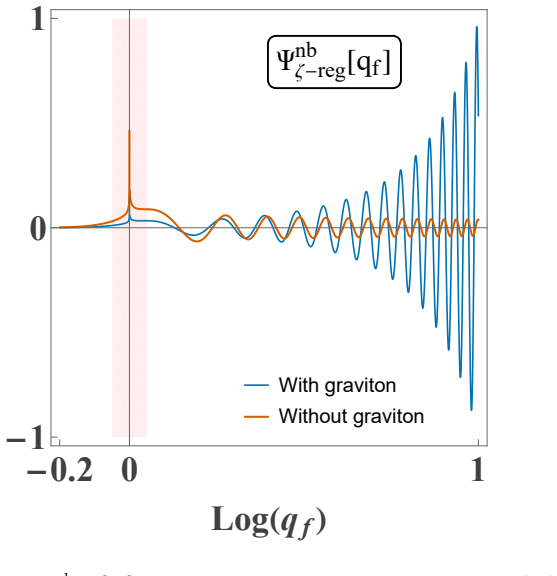
Gravitational path-integral over $\mathbb{R}\times S^3$ complex metrics with fluctuations is studied in 4D for Einstein-Hilbert gravity in Lorentzian signature, with the aim to investigate the IR properties of complex saddles for various boundary choices. General covariance doesn't allow arbitrary boundary choices for the background and fluctuations. In the ADM-decomposition, while imposing ``no-boundary'' condition at the initial boundary, two scenarios are considered for the final boundary: Dirichlet and fixed extrinsic curvature. Universe undergoes transition from a Euclidean to Lorentzian phase in either scenario, where the dominant saddle in Euclidean phase correspond to a Euclidean metric (imaginary time), while the Lorentzian phase has two complex metrics as dominant saddles which superimpose. One-loop corrected lapse action is computed using Hurwitz-Zeta regularization. UV-divergences canceled by suitable counter terms lead to a renormalized lapse action. One-loop renormalized Hartle-Hawking wave-function is computed using the Picard-Lefschetz and WKB methods, where the contributions coming from the metric-fluctuations show secularly growing infrared divergences as the Universe expands. This is compared with the situation in pure Lorentzian dS, corresponding to a Universe transitioning from an initial state of vanishing conjugate momenta to final state of fixed extrinsic curvature, thereby giving real saddles. Picard-Lefschetz methods alone are not sufficient to overcome the technical hurdles in the one-loop computation, which needs to be supplemented by an $i\epsilon$-prescription, achieved via slight complexification of the cosmological constant $\Lambda$. The UV renormalized one-loop dS wavefunction has the same leading IR divergence as for the Hartle-Hawking no-boundary Universe. Interestingly for all boundary choices considered, the saddles remain KSW-allowed.
Editorial analysis
A structured set of objections, weighed in public.
Referee Report
Summary. The manuscript examines the IR behavior of one-loop corrections in the gravitational path integral for complex metrics on R×S³ in 4D Einstein-Hilbert gravity. It considers no-boundary initial conditions and two types of final boundary conditions (Dirichlet and fixed extrinsic curvature), finding a transition from Euclidean to Lorentzian phases with complex saddles in the latter. Using Hurwitz-Zeta regularization for the one-loop lapse action, counterterms to cancel UV divergences, and an iε prescription via complexified Λ, the authors compute the renormalized Hartle-Hawking wavefunction via Picard-Lefschetz and WKB methods, reporting secularly growing IR divergences from metric fluctuations as the universe expands, matching those in pure Lorentzian dS, with all saddles remaining KSW-allowed.
Significance. If the one-loop approximation and regularization procedure are robust, the result would highlight potential IR issues in the no-boundary proposal and the role of complex saddles in quantum cosmology, providing a comparison between different boundary conditions and Lorentzian dS. The explicit use of Picard-Lefschetz theorem combined with Hurwitz-Zeta regularization and counterterms adds technical value to analyses of gravitational path integrals in expanding backgrounds.
major comments (3)
- [One-loop lapse action and Hurwitz-Zeta regularization] The application of Hurwitz-Zeta regularization to the time-dependent fluctuation modes in the expanding Lorentzian phase (in the section computing the one-loop corrected lapse action) evaluates the zeta function on instantaneous spectra before integrating over the lapse. This procedure cancels UV poles but does not automatically isolate or resum secular IR logarithms/powers from the explicitly time-dependent background; a concrete verification against known results for time-dependent operators or an explicit resummation step is needed to support the claim of secular growth in the wavefunction.
- [iε prescription and complexification of Λ] The justification that complexifying the cosmological constant Λ yields a valid iε prescription that leaves the physical IR behavior unchanged (in the section on Picard-Lefschetz and WKB methods for the renormalized wavefunction) requires more detail. The time-dependent background for the mode sums remains Lorentzian, so it is unclear whether the reported leading IR divergence is robust or regulator-dependent; an explicit comparison of the divergence terms before and after the complexification would address this.
- [Comparison with pure Lorentzian dS] The claim that the UV-renormalized one-loop dS wavefunction has the same leading IR divergence as the Hartle-Hawking no-boundary case (in the comparison with pure Lorentzian dS) is load-bearing for the central IR result but relies on identical regularization choices in both scenarios. Explicit equations or tables showing the matching divergence coefficients after counterterms would confirm it is not an artifact.
minor comments (2)
- [Boundary conditions and ADM decomposition] The description of how general covariance constrains boundary choices for both background and fluctuations in the ADM decomposition could be expanded with explicit boundary terms for the metric fluctuations to improve clarity.
- [One-loop computation] A brief appendix or table listing the explicit mode sums and the form of the Hurwitz zeta function used for the lapse integral would aid reproducibility of the one-loop determinant evaluation.
Simulated Author's Rebuttal
We thank the referee for the careful reading of our manuscript and the constructive comments, which help clarify several technical aspects of our analysis. We address each major comment below and indicate the revisions we will make.
read point-by-point responses
-
Referee: [One-loop lapse action and Hurwitz-Zeta regularization] The application of Hurwitz-Zeta regularization to the time-dependent fluctuation modes in the expanding Lorentzian phase (in the section computing the one-loop corrected lapse action) evaluates the zeta function on instantaneous spectra before integrating over the lapse. This procedure cancels UV poles but does not automatically isolate or resum secular IR logarithms/powers from the explicitly time-dependent background; a concrete verification against known results for time-dependent operators or an explicit resummation step is needed to support the claim of secular growth in the wavefunction.
Authors: We agree that additional verification would strengthen the presentation. The Hurwitz-Zeta function is evaluated on the instantaneous spectra of the fluctuation operator for each fixed lapse, after which the lapse integral is performed; this yields the secular IR growth from the accumulating time-dependent modes as the scale factor increases. In the revised manuscript we will add a short subsection comparing our leading IR terms with known results for one-loop effective actions in time-dependent de Sitter backgrounds (e.g., the secular logarithms reported in the literature on expanding cosmologies). This comparison confirms that the IR growth is physical and not an artifact of the regularization order. revision: partial
-
Referee: [iε prescription and complexification of Λ] The justification that complexifying the cosmological constant Λ yields a valid iε prescription that leaves the physical IR behavior unchanged (in the section on Picard-Lefschetz and WKB methods for the renormalized wavefunction) requires more detail. The time-dependent background for the mode sums remains Lorentzian, so it is unclear whether the reported leading IR divergence is robust or regulator-dependent; an explicit comparison of the divergence terms before and after the complexification would address this.
Authors: We thank the referee for highlighting the need for explicit checks. The small imaginary part introduced via complex Λ shifts the integration contour in the complex lapse plane while leaving the physical Lorentzian background intact for the mode sums. In the revision we will insert a new paragraph (or appendix) that tabulates the UV and IR divergence coefficients computed with real Λ versus the complexified value, demonstrating that the leading secular IR term is unchanged to the order we work. This explicit comparison will be placed in the section discussing the iε prescription. revision: yes
-
Referee: [Comparison with pure Lorentzian dS] The claim that the UV-renormalized one-loop dS wavefunction has the same leading IR divergence as the Hartle-Hawking no-boundary case (in the comparison with pure Lorentzian dS) is load-bearing for the central IR result but relies on identical regularization choices in both scenarios. Explicit equations or tables showing the matching divergence coefficients after counterterms would confirm it is not an artifact.
Authors: We agree that an explicit side-by-side display is desirable. The matching of the leading IR coefficient follows directly from the identical form of the renormalized one-loop lapse action once the same counterterms are subtracted in both the no-boundary and pure Lorentzian dS setups. In the revised manuscript we will add a short table (or set of equations) in the comparison section that lists the coefficients of the secular terms for both cases after renormalization, making the equality manifest and confirming it is independent of the specific regularization details. revision: yes
Circularity Check
No significant circularity; derivation uses external regularization and contour methods on explicit mode sums
full rationale
The paper computes the one-loop lapse action via Hurwitz-Zeta regularization of the fluctuation spectrum, subtracts UV poles with counterterms, and obtains the wavefunction via Picard-Lefschetz plus WKB. The reported secular IR growth follows from integrating the time-dependent eigenvalues over the lapse in the expanding phase; this is not obtained by fitting parameters to the target IR result, nor by defining the output in terms of itself. The iε prescription (complex Λ) is introduced to define the contour and is independent of the final IR claim. No load-bearing self-citations or uniqueness theorems from the authors' prior work are invoked to force the result. The central claim therefore remains a genuine output of the calculation rather than a renaming or tautology.
Axiom & Free-Parameter Ledger
free parameters (1)
- cosmological constant Lambda
axioms (2)
- domain assumption General covariance restricts admissible boundary conditions for both background and fluctuations in the ADM decomposition.
- domain assumption The one-loop determinant around complex saddles can be evaluated with Hurwitz-Zeta regularization after UV counterterms are subtracted.
invented entities (1)
-
complex metrics as dominant saddles
no independent evidence
Reference graph
Works this paper leans on
-
[1]
This boundary condition corresponds to fixing the Hubble radius 30 (H1 =K/3), which is more physically sensible compared to the fixed size [29, 34]
Lorentzian Regime:H 1(=H 1/H)<1 In this section, we compute the wave function when the extrinsic curvature (K) is fixed at the final hypersurface. This boundary condition corresponds to fixing the Hubble radius 30 (H1 =K/3), which is more physically sensible compared to the fixed size [29, 34]. We con- sider the no-boundary condition on the initial hypers...
-
[2]
Euclidean Regime:H 1 =iγ, γ >0 In this section, we compute the wave function in the Euclidean regime whereH 1 = +iγ, whereγ >0 and is purely imaginary. The zeta regularized sum at theN nb ± saddles is given by ∞X l=2 gl lnW l(1,0) ζ−reg =− 8 3 ln(2) + 191 120 ln 12( p 1 +γ 2 ∓γ) Λ( p 1 +γ 2 ±γ) + log 2π7A4 32 −2ζ ′ H(−2,3±γ/ p 1 +γ 2)±4 γp 1 +γ 2 ζ ′ H(−1...
-
[3]
(131), can be computed via Picard-Lefschetz methods
For the case of zero fluctuations, the lapse-N c integral mentioned in eq. (131), can be computed via Picard-Lefschetz methods. The saddles, flow-line structure, allowed/disallowed region are depicted in figure 7. Both saddles are seen to berelevantand 35 -4 -2 0 2 4 -3 -2 -1 0 1 2 3 N+ dSN- dS Nc FIG. 7. Picard-Lefschetz analysis for the classical bounda...
-
[4]
Clearly, forH 1 ≪H, {∆l h(Nc)}−gl/2 ∼ H1 −2gl , which is divergent forH 1 →0
(139) In the path-integral, this determinant leads to a divergence, as it appears in the path- integral in the form{∆ l h(Nc)}−gl/2, whereg l is the degeneracy factor. Clearly, forH 1 ≪H, {∆l h(Nc)}−gl/2 ∼ H1 −2gl , which is divergent forH 1 →0. The one-loop contribution to the lapse-N c action, mentioned in eq. (137), accordingly contains a divergent con...
-
[5]
pinching
+H 2 1 }+ 2 ln sin Θ(l, H1)+ 2{ln(H/H1)−ln(l)−ln(l+ 2)} , where,Θ(l, H 1) = (l+ 1) tan −1 H1p H2 −H 2 1 −tan −1 H1 (l+ 1) p H2 −H 2 1 . (143) 38 The above one-loop action is finite in theH 1 →0 limit (UV-limit), as the divergence gets canceled by the counter terms. For the real negative saddle, Θ becomes−Θ and hence, ∆l h(N dS + ) =−∆ l h(N dS − ), which ...
-
[6]
Note that Λ deformation introduces aniϵcorrection to the determinant
+H 2 1 × sin Θ(l, H1) + iϵ H1 sin Θ(l, H1)A(z, H)−H 1 cos Θ(l, H1)B(z, H) +O(ϵ 2) ,(147) A(z, H) = H5 (l2(z+ 2) + 2l(z+ 2) + 2(z+ 1)) l(l+ 2)(z+ 1)(z+ 3) p (l+ 1) 2 +z , B(z, H) = H4(l+ 1) (z+ 3) √z+ 1 p (l+ 1) 2 +z . Note that Λ deformation introduces aniϵcorrection to the determinant. The renormalized lapse action at the deformed saddles is given by AdS...
-
[7]
(143) whenϵ= 0
+H 2 1 }+ 2{ln(H/H 1)−ln(l)−ln(l+ 2)} +2 ln sin Θ(l, H1) + iϵ H1 sin Θ(l, H1)A(z, H)−H 1 cos Θ(l, H1)B(z, H) +O(ϵ) 2 .(148) The above one-loop action reduces to eq. (143) whenϵ= 0. However, for non-zeroϵ, the terms in the second line, the quantity inside the logarithm is complex and always non- vanishing. The “pinch ” singularities which appear for vanish...
-
[8]
spurious
The equation of the extremal curve (τe) which follows from eq. (100) and eq. (101) can be expressed as Re Z τp 0 ¯q(τ′ p)3/2dτ ′ p τp=τx+iτy = 0.(154) The above integration can be performed exactly. Substituting the deformation as given in eq. (144) and equating the real part to zero, one obtains the extremal curve for a given saddle in the complexτ p-pla...
2026
-
[9]
It implies the fundamental solutions PandQsatisfy the same property
(ΛNc + 3i)2 1/2 , τt(Nc) = H1(ΛNct+ 3i)p H2 1 −H 2(ΛNc + 3i) , (182) satisfiesξ l(−N ∗ c ) =−ξ l(Nc)∗ andτ t(−N ∗ c ) =−τ t(Nc)∗. It implies the fundamental solutions PandQsatisfy the same property. This ensures that the antilinearity is satisfied for the on-shell fluctuation and one-loop corrections. In [47], we showed that the background on- shell and o...
-
[10]
Action Integrals and Partition Functions in Quantum Gravity
G. W. Gibbons and S. W. Hawking, “Action Integrals and Partition Functions in Quantum Gravity,” Phys. Rev. D15, 2752-2756 (1977) doi:10.1103/PhysRevD.15.2752
-
[11]
Path Integrals and the Indefiniteness of the Gravitational Action,
G. W. Gibbons, S. W. Hawking and M. J. Perry, “Path Integrals and the Indefiniteness of the Gravitational Action,” Nucl. Phys. B138(1978), 141-150 doi:10.1016/0550-3213(78)90161-X
-
[12]
Wave function of the universe,
J. B. Hartle and S. W. Hawking, “Wave Function of the Universe,” Phys. Rev. D28, 2960-2975 (1983) doi:10.1103/PhysRevD.28.2960
-
[13]
Maldacena,Comments on the no boundary wavefunction and slow roll inflation, 2403.10510
J. Maldacena, “Comments on the no boundary wavefunction and slow roll inflation,” [arXiv:2403.10510 [hep-th]]
-
[14]
The Dynamics of general relativity,
R. L. Arnowitt, S. Deser and C. W. Misner, “The Dynamics of general relativity,” Gen. Rel. Grav.40, 1997-2027 (2008) doi:10.1007/s10714-008-0661-1 [arXiv:gr-qc/0405109 [gr-qc]]
-
[15]
Analytic Continuation Of Chern-Simons Theory
E. Witten, “Analytic Continuation Of Chern-Simons Theory,” AMS/IP Stud. Adv. Math.50, 347-446 (2011) [arXiv:1001.2933 [hep-th]]
work page Pith review arXiv 2011
-
[16]
One loop divergencies in the theory of gravitation,
G. ’t Hooft and M. J. G. Veltman, “One loop divergencies in the theory of gravitation,” Ann. Inst. H. Poincare A Phys. Theor.20(1974), 69-94
1974
-
[17]
Fourth Order Gravity as General Relativity Plus Matter,
S. Deser, H. S. Tsao and P. van Nieuwenhuizen, “Nonrenormalizability of Einstein Yang-Mills Interactions at the One Loop Level,” Phys. Lett. B50(1974), 491-493 doi:10.1016/0370- 2693(74)90268-8
-
[18]
The Ultraviolet Behavior of Einstein Gravity,
M. H. Goroff and A. Sagnotti, “The Ultraviolet Behavior of Einstein Gravity,” Nucl. Phys. B 266(1986), 709-736 doi:10.1016/0550-3213(86)90193-8
-
[19]
Remarks on High-energy Stability and Renormalizability of Gravity Theory,
A. Salam and J. A. Strathdee, “Remarks on High-energy Stability and Renormalizability of Gravity Theory,” Phys. Rev. D18(1978), 4480 doi:10.1103/PhysRevD.18.4480
-
[20]
Short Distance Freedom of Quantum Gravity,
G. Narain and R. Anishetty, “Short Distance Freedom of Quantum Gravity,” Phys. Lett. B 711(2012), 128-131 doi:10.1016/j.physletb.2012.03.070 [arXiv:1109.3981 [hep-th]]
-
[21]
Amplification of gravitational waves in an isotropic universe,
L. P. Grishchuk, “Amplification of gravitational waves in an isotropic universe,” Sov. Phys. JETP40, no.3, 409-415 (1975)
1975
-
[22]
Inflationary Cosmology from Anti-de Sitter Worm- holes,
P. Betzios and O. Papadoulaki, “Inflationary Cosmology from Anti-de Sitter Worm- holes,” Phys. Rev. Lett.133, no.2, 021501 (2024) doi:10.1103/PhysRevLett.133.021501 [arXiv:2403.17046 [hep-th]]
-
[23]
Derivation of the Wheeler-De Witt Equation from a Path Integral for Min- isuperspace Models,
J. J. Halliwell, “Derivation of the Wheeler-De Witt Equation from a Path Integral for Min- isuperspace Models,” Phys. Rev. D38, 2468 (1988) doi:10.1103/PhysRevD.38.2468
-
[24]
Relativistic S Matrix of Dynamical Systems with Boson and Fermion Constraints,
I. A. Batalin and G. A. Vilkovisky, “Relativistic S Matrix of Dynamical Systems with Boson and Fermion Constraints,” Phys. Lett. B69(1977), 309-312 doi:10.1016/0370-2693(77)90553- 6
-
[25]
The phase of the sum over spheres,
J. Polchinski, “The phase of the sum over spheres,” Phys. Lett. B219, 251-257 (1989) doi:10.1016/0370-2693(89)90387-0
-
[26]
Physical instabilities and the phase of the Euclidean path integral,
V. Ivo, J. Maldacena and Z. Sun, “Physical instabilities and the phase of the Euclidean path integral,” [arXiv:2504.00920 [hep-th]]
-
[27]
J. Feldbrugge, J. L. Lehners and N. Turok, “Lorentzian Quantum Cosmology,” Phys. Rev. D 95(2017) no.10, 103508 doi:10.1103/PhysRevD.95.103508 [arXiv:1703.02076 [hep-th]]
-
[28]
Quantum Mechanics of the Gravitational Field,
C. Teitelboim, “Quantum Mechanics of the Gravitational Field,” Phys. Rev. D25(1982), 3159 doi:10.1103/PhysRevD.25.3159
-
[29]
The Proper Time Gauge in Quantum Theory of Gravitation,
C. Teitelboim, “The Proper Time Gauge in Quantum Theory of Gravitation,” Phys. Rev. D 54 28(1983), 297 doi:10.1103/PhysRevD.28.297
-
[30]
No rescue for the no boundary proposal: Pointers to the future of quantum cosmology,
J. Feldbrugge, J. L. Lehners and N. Turok, “No rescue for the no boundary proposal: Pointers to the future of quantum cosmology,” Phys. Rev. D97, no.2, 023509 (2018) doi:10.1103/PhysRevD.97.023509 [arXiv:1708.05104 [hep-th]]
-
[31]
Feynman Diagrams for the Yang-Mills Field,
L. D. Faddeev and V. N. Popov, “Feynman Diagrams for the Yang-Mills Field,” Phys. Lett. B25(1967), 29-30 doi:10.1016/0370-2693(67)90067-6
-
[32]
N. Ohta and R. Percacci, “Ultraviolet Fixed Points in Conformal Gravity and Gen- eral Quadratic Theories,” Class. Quant. Grav.33(2016), 035001 doi:10.1088/0264- 9381/33/3/035001 [arXiv:1506.05526 [hep-th]]
-
[33]
AdS backgrounds and induced gravity,
H. Lin and G. Narain, “AdS backgrounds and induced gravity,” Mod. Phys. Lett. A34(2019) no.38, 2050057 doi:10.1142/S0217732320500571 [arXiv:1712.09995 [hep-th]]
-
[34]
A note on boundary conditions in Euclidean gravity,
E. Witten, “A note on boundary conditions in Euclidean gravity,” Rev. Math. Phys.33, no.10, 2140004 (2021) doi:10.1142/S0129055X21400043 [arXiv:1805.11559 [hep-th]]
-
[35]
Generalized boundary conditions in closed cosmologies,
D. Brizuela and M. de Cesare, “Generalized boundary conditions in closed cosmologies,” Phys. Rev. D107(2023) no.10, 104054 doi:10.1103/PhysRevD.107.104054 [arXiv:2303.04007 [gr-qc]]
-
[36]
Monte Carlo studies of quantum cosmology by the generalized Lefschetz thimble method,
C. Y. Chou and J. Nishimura, “Monte Carlo studies of quantum cosmology by the generalized Lefschetz thimble method,” [arXiv:2407.17724 [gr-qc]]
-
[37]
Lorentzian condition in quantum gravity,
R. Bousso and S. W. Hawking, “Lorentzian condition in quantum gravity,” Phys. Rev. D59, 103501 (1999) [erratum: Phys. Rev. D60, 109903 (1999)] doi:10.1103/PhysRevD.59.103501 [arXiv:hep-th/9807148 [hep-th]]
-
[38]
Consistent Evaluation of the No-Boundary Proposal,
A. I. Abdalla, S. Antonini, R. Bousso, L. V. Iliesiu, A. Levine and A. Shahbazi-Moghaddam, “Consistent Evaluation of the No-Boundary Proposal,” [arXiv:2602.02682 [hep-th]]
-
[39]
C. Krishnan, S. Maheshwari and P. N. Bala Subramanian, “Robin Gravity,” J. Phys. Conf. Ser.883, no.1, 012011 (2017) doi:10.1088/1742-6596/883/1/012011 [arXiv:1702.01429 [gr-qc]]
-
[40]
Review of the no-boundary wave function,
J. L. Lehners, “Review of the no-boundary wave function,” Phys. Rept.1022(2023), 1-82 doi:10.1016/j.physrep.2023.06.002 [arXiv:2303.08802 [hep-th]]
-
[41]
Unstable no-boundary fluctuations from sums over reg- ular metrics,
A. Di Tucci and J. L. Lehners, “Unstable no-boundary fluctuations from sums over reg- ular metrics,” Phys. Rev. D98(2018) no.10, 103506 doi:10.1103/PhysRevD.98.103506 [arXiv:1806.07134 [gr-qc]]
-
[42]
No smooth beginning for spacetime,
J. Feldbrugge, J. L. Lehners and N. Turok, “No smooth beginning for spacetime,” Phys. Rev. Lett.119(2017) no.17, 171301 doi:10.1103/PhysRevLett.119.171301 [arXiv:1705.00192 [hep-th]]
-
[43]
No-boundary prescriptions in Lorentzian quan- tum cosmology,
A. Di Tucci, J. L. Lehners and L. Sberna, “No-boundary prescriptions in Lorentzian quan- tum cosmology,” Phys. Rev. D100, no.12, 123543 (2019) doi:10.1103/PhysRevD.100.123543 [arXiv:1911.06701 [hep-th]]
-
[44]
No-Boundary Proposal as a Path Integral with Robin Boundary Conditions,
A. Di Tucci and J. L. Lehners, “No-Boundary Proposal as a Path Integral with Robin Boundary Conditions,” Phys. Rev. Lett.122, no.20, 201302 (2019) doi:10.1103/PhysRevLett.122.201302 [arXiv:1903.06757 [hep-th]]
-
[45]
A. O. Barvinsky, A. Y. Kamenshchik and I. P. Karmazin, “One loop quantum cosmology: Zeta function technique for the Hartle-Hawking wave function of the universe,” Annals Phys. 219, 201-242 (1992) doi:10.1016/0003-4916(92)90347-O
-
[46]
On graviton non-Gaussianities during inflation,
J. M. Maldacena and G. L. Pimentel, “On graviton non-Gaussianities during inflation,” JHEP 09, 045 (2011) doi:10.1007/JHEP09(2011)045 [arXiv:1104.2846 [hep-th]]
-
[47]
Non-Gaussian features of primordial fluctuations in single field inflationary models,
J. M. Maldacena, “Non-Gaussian features of primordial fluctuations in single field inflationary models,” JHEP05, 013 (2003) doi:10.1088/1126-6708/2003/05/013 [arXiv:astro-ph/0210603 55 [astro-ph]]
-
[48]
Semiclassical relations and IR effects in de Sitter and slow- roll space-times,
S. B. Giddings and M. S. Sloth, “Semiclassical relations and IR effects in de Sitter and slow- roll space-times,” JCAP01, 023 (2011) doi:10.1088/1475-7516/2011/01/023 [arXiv:1005.1056 [hep-th]]
-
[49]
Cosmological observables, IR growth of fluc- tuations, and scale-dependent anisotropies,
S. B. Giddings and M. S. Sloth, “Cosmological observables, IR growth of fluc- tuations, and scale-dependent anisotropies,” Phys. Rev. D84, 063528 (2011) doi:10.1103/PhysRevD.84.063528 [arXiv:1104.0002 [hep-th]]
-
[50]
M. Ailiga, S. Mallik and G. Narain, “Lorentzian Robin Universe,” JHEP01, 124 (2024) doi:10.1007/JHEP01(2024)124 [arXiv:2308.01310 [gr-qc]]
-
[51]
Lorentzian Robin Universe of Gauss-Bonnet Gravity,
M. Ailiga, S. Mallik and G. Narain, “Lorentzian Robin Universe of Gauss-Bonnet Gravity,” Gen. Rel. Grav.57, no.2, 29 (2025) doi:10.1007/s10714-025-03369-2 [arXiv:2407.16692 [gr-qc]]
-
[52]
Boundary choices and one-loop complex gravi- tational path integral,
M. Ailiga, S. Mallik and G. Narain, “Boundary choices and one-loop complex gravi- tational path integral,” Phys. Rev. D111, no.12, 123538 (2025) doi:10.1103/ytxr-4x1d [arXiv:2410.19724 [gr-qc]]
-
[53]
No smooth spacetime: Exploring primordial perturbations in Lorentzian quan- tum cosmology,
H. Matsui, “No smooth spacetime: Exploring primordial perturbations in Lorentzian quan- tum cosmology,” Phys. Rev. D110, no.2, 023503 (2024) doi:10.1103/PhysRevD.110.023503 [arXiv:2404.18609 [gr-qc]]
-
[54]
Surprises in Lorentzian path-integral of Gauss-Bonnet gravity,
G. Narain, “Surprises in Lorentzian path-integral of Gauss-Bonnet gravity,” JHEP04, 153 (2022) doi:10.1007/JHEP04(2022)153 [arXiv:2203.05475 [gr-qc]]
-
[55]
On Gauss-bonnet gravity and boundary conditions in Lorentzian path-integral quantization,
G. Narain, “On Gauss-bonnet gravity and boundary conditions in Lorentzian path-integral quantization,” JHEP05, 273 (2021) doi:10.1007/JHEP05(2021)273 [arXiv:2101.04644 [gr-qc]]
-
[56]
Resolving Degeneracies in Complex $\mathbb{R}\times S^3$ and $\theta$-KSW
M. Ailiga, S. Mallik and G. Narain, “Resolving degeneracies in complexR×S 3 andθ-KSW,” JHEP02, 249 (2026) doi:10.1007/JHEP02(2026)249 [arXiv:2507.10537 [hep-th]]
work page internal anchor Pith review Pith/arXiv arXiv doi:10.1007/jhep02(2026)249 2026
-
[57]
New regularization scheme for the wave function of the Universe in the Lorentzian path integral,
M. Yamada, “New regularization scheme for the wave function of the Universe in the Lorentzian path integral,” Phys. Rev. D113, no.6, 063547 (2026) doi:10.1103/z59k-v3l8 [arXiv:2511.09621 [gr-qc]]
-
[58]
Y. Tanizaki and T. Koike, “Real-time Feynman path integral with Picard–Lefschetz theory and its applications to quantum tunneling,” Annals Phys.351(2014), 250-274 doi:10.1016/j.aop.2014.09.003 [arXiv:1406.2386 [math-ph]]
-
[59]
Wick Rotation and the Positivity of Energy in Quantum Field Theory,
M. Kontsevich and G. Segal, “Wick Rotation and the Positivity of Energy in Quantum Field Theory,” Quart. J. Math. Oxford Ser.72(2021) no.1-2, 673-699 doi:10.1093/qmath/haab027
-
[60]
Witten,A Note On Complex Spacetime Metrics,2111.06514
E. Witten, “A Note On Complex Spacetime Metrics,” [arXiv:2111.06514 [hep-th]]
-
[61]
Uses of complex metrics in cosmology,
C. Jonas, J. L. Lehners and J. Quintin, “Uses of complex metrics in cosmology,” JHEP08, 284 (2022) doi:10.1007/JHEP08(2022)284 [arXiv:2205.15332 [hep-th]]
-
[62]
Kontsevich-Segal Criterion in the No- Boundary State Constrains Inflation,
T. Hertog, O. Janssen and J. Karlsson, “Kontsevich-Segal Criterion in the No- Boundary State Constrains Inflation,” Phys. Rev. Lett.131, no.19, 191501 (2023) doi:10.1103/PhysRevLett.131.191501 [arXiv:2305.15440 [hep-th]]
-
[63]
Allowable complex metrics in minisuperspace quantum cosmology,
J. L. Lehners, “Allowable complex metrics in minisuperspace quantum cosmology,” Phys. Rev. D105, no.2, 026022 (2022) doi:10.1103/PhysRevD.105.026022 [arXiv:2111.07816 [hep-th]]
-
[64]
Note on KSW-allowability of Wine-Glass Geometry,
M. Ailiga and G. Narain, “Note on KSW-allowability of Wine-Glass Geometry,” [arXiv:2603.23457 [hep-th]]
-
[65]
The Background Field Method Beyond One Loop,
L. F. Abbott, “The Background Field Method Beyond One Loop,” Nucl. Phys. B185(1981), 189-203 doi:10.1016/0550-3213(81)90371-0
-
[66]
A GAUGE INVARIANT EFFECTIVE ACTION,
B. S. DeWitt, “A GAUGE INVARIANT EFFECTIVE ACTION,” NSF-ITP-80-31. 6 citations counted in INSPIRE as of 25 Sep 2024
2024
-
[67]
Homogeneous Collapsing Star: Tensor and Vec- 56 tor Harmonics for Matter and Field Asymmetries,
U. H. Gerlach and U. K. Sengupta, “Homogeneous Collapsing Star: Tensor and Vec- 56 tor Harmonics for Matter and Field Asymmetries,” Phys. Rev. D18(1978), 1773-1784 doi:10.1103/PhysRevD.18.1773
-
[68]
A. Higuchi, “Symmetric Tensor Spherical Harmonics on theNSphere and Their Application to the De Sitter Group SO(N,1),” J. Math. Phys.28, 1553 (1987) [erratum: J. Math. Phys. 43, 6385 (2002)] doi:10.1063/1.527513
-
[69]
Zeta Function Regularization of Path Integrals in Curved Space-Time,
S. W. Hawking, “Zeta Function Regularization of Path Integrals in Curved Space-Time,” Commun. Math. Phys.55, 133 (1977) doi:10.1007/BF01626516
-
[70]
E. Elizalde, S. D. Odintsov, A. Romeo, A. A. Bytsenko and S. Zerbini, “Zeta regularization techniques with applications,” World Scientific Publishing, 1994, ISBN 978-981-02-1441-8, 978-981-4502-98-6 doi:10.1142/2065
-
[71]
Partition function on spheres: How to use zeta function regularization,
A. Monin, “Partition function on spheres: How to use zeta function regularization,” Phys. Rev. D94, no.8, 085013 (2016) doi:10.1103/PhysRevD.94.085013 [arXiv:1607.06493 [hep-th]]
-
[72]
Heat kernel expansion: User’s manual,
D. V. Vassilevich, “Heat kernel expansion: User’s manual,” Phys. Rept.388, 279-360 (2003) doi:10.1016/j.physrep.2003.09.002 [arXiv:hep-th/0306138 [hep-th]]
-
[73]
Perturbative nonequilibrium thermal field theory,
P. Millington and A. Pilaftsis, “Perturbative nonequilibrium thermal field theory,” Phys. Rev. D88, no.8, 085009 (2013) doi:10.1103/PhysRevD.88.085009 [arXiv:1211.3152 [hep-ph]]
-
[74]
I. Dadic, “Two mechanisms for elimination of pinch singularities in / out of equilibrium thermal field theories,” Phys. Rev. D59, 125012 (1999) doi:10.1103/PhysRevD.59.125012 [arXiv:hep-ph/9801399 [hep-ph]]
-
[75]
Integration in functional spaces and it applications in quantum physics,
I. M. Gelfand and A. M. Yaglom, “Integration in functional spaces and it applications in quantum physics,” J. Math. Phys.1, 48 (1960) doi:10.1063/1.1703636
-
[76]
G. V. Dunne, J. Phys. A41, 304006 (2008) doi:10.1088/1751-8113/41/30/304006 [arXiv:0711.1178 [hep-th]]
-
[77]
Functional determinants for general Sturm-Liouville prob- lems,
K. Kirsten and A. J. McKane, “Functional determinants for general Sturm-Liouville prob- lems,” J. Phys. A37, 4649-4670 (2004) doi:10.1088/0305-4470/37/16/014 [arXiv:math- ph/0403050 [math-ph]]
-
[78]
Functional determinants by contour integration methods,
K. Kirsten and A. J. McKane, “Functional determinants by contour integration methods,” An- nals Phys.308, 502-527 (2003) doi:10.1016/S0003-4916(03)00149-0 [arXiv:math-ph/0305010 [math-ph]]
-
[79]
Abramowitz and I
M. Abramowitz and I. A. Stegun, Handbook of Mathematical Functions with Formulas, Graphs, and Mathematical Tables (Dover, 1965)
1965
-
[80]
NIST Digital Library of Mathematical Functions, https://dlmf.nist.gov/, Release 1.2.5 of 2025-12-15
2025
discussion (0)
Sign in with ORCID, Apple, or X to comment. Anyone can read and Pith papers without signing in.