Recognition: unknown
Odd Physics Off the Diagonal: Constraining CP-violating SMEFT with Quantum Tomography
Pith reviewed 2026-05-09 21:33 UTC · model grok-4.3
The pith
Reconstructing the full spin density matrix of diboson systems reveals both linear and quadratic CP-violating SMEFT effects that standard angular observables overlook.
A machine-rendered reading of the paper's core claim, the machinery that carries it, and where it could break.
Core claim
Reconstructing the spin density matrix of a diboson system via quantum tomography extracts the full signature of beyond-Standard-Model physics, including the quadratic new-physics terms, and yields superior simultaneous sensitivity to CP-even and CP-odd SMEFT operators compared with traditional angular observables that rely primarily on interference resurrection.
What carries the argument
The spin density matrix of the diboson system, reconstructed through quantum tomography, which encodes the complete set of polarisation and correlation information including both SM-NP interference and pure quadratic NP contributions.
If this is right
- CP-violating SMEFT operators become distinguishable from CP-even ones even when interference is suppressed.
- Quadratic new-physics terms in diboson production can be directly constrained without relying solely on angular asymmetries.
- Traditional polarisation-blind observables miss part of the new-physics signature that the full density matrix captures.
- The same tomography method can be applied to other vector-boson final states to test additional SMEFT operators.
Where Pith is reading between the lines
- If the method works at the LHC or a future collider, it could tighten global SMEFT fits by adding independent handles on CP phases.
- The approach might extend to other correlated particle systems where full quantum-state reconstruction is feasible.
- Improved detector resolution on decay angles would directly translate into better limits on the size of quadratic CP-odd operators.
Load-bearing premise
That collider detectors can reconstruct the diboson spin density matrix at high enough precision for the quadratic new-physics terms to be extracted without being swamped by systematic uncertainties or acceptance effects.
What would settle it
A measurement in which the reconstructed diboson spin density matrix elements remain too uncertain to separate the quadratic CP-odd SMEFT contributions from CP-even ones at the level predicted by the tomography approach.
Figures


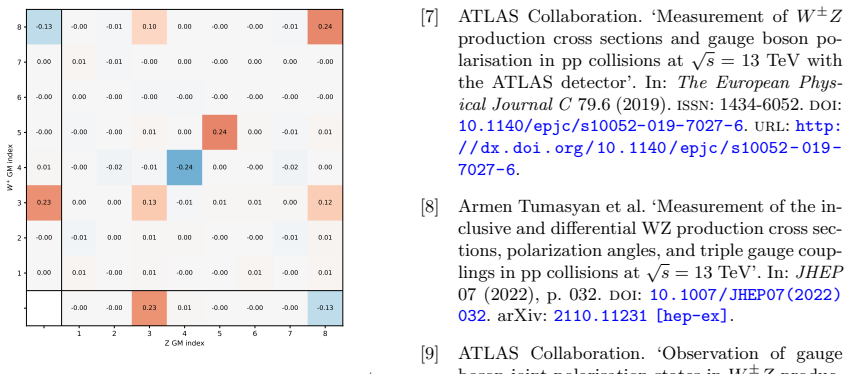
read the original abstract
New sources of charge-parity (CP) violation beyond those described in the Standard Model (SM) are required to explain the observed matter--antimatter asymmetry of the Universe. The Standard Model Effective Field Theory (SMEFT) provides a framework to introduce additional electroweak sources of CP-odd physics in a model-independent manner. However, these CP-violating signatures are mostly degenerate to CP-even SMEFT operators in polarisation-blind observables, distinguishable only in the SM-New Physics (NP) interference using the azimuthal decay angle. Using Quantum Tomography techniques, we present a new approach to constraining these NP effects. Reconstructing the spin density matrix (SDM) of a diboson system, we go beyond `interference resurrection' to exploit the full signature of the Beyond-SM physics, including the pure quadratic NP terms. We show that this approach provides superior simultaneous sensitivity to characteristic features of CP-even and CP-odd contributions, including effects not fully captured by traditional angular observables.
Editorial analysis
A structured set of objections, weighed in public.
Referee Report
Summary. The paper proposes using quantum tomography techniques to reconstruct the spin density matrix (SDM) of diboson systems as a new method for constraining CP-violating SMEFT operators. It claims this approach goes beyond traditional 'interference resurrection' via azimuthal angles by exploiting the full SDM signature, including pure quadratic new-physics terms, thereby achieving superior simultaneous sensitivity to both CP-even and CP-odd contributions that are not fully captured by standard angular observables.
Significance. If experimentally feasible, the method could meaningfully advance SMEFT analyses at colliders by providing access to quadratic terms and better separation of CP properties through off-diagonal SDM elements. The work correctly builds on standard SMEFT operator bases and established tomography methods without introducing circular parameters. However, the conceptual nature of the proposal, without demonstrated calculations, limits its immediate significance until the claimed sensitivity gains are shown quantitatively.
major comments (1)
- [Abstract] Abstract: the central claim that the SDM reconstruction 'provides superior simultaneous sensitivity to characteristic features of CP-even and CP-odd contributions, including effects not fully captured by traditional angular observables' is load-bearing for the entire proposal yet is asserted without any explicit derivation, simulated results, or error budget showing how quadratic NP terms are isolated from acceptance, resolution, or background effects. This directly impacts the asserted advantage over angular observables.
minor comments (1)
- The manuscript would benefit from clearer notation distinguishing the CP-odd and CP-even operator contributions in the SDM parametrization.
Simulated Author's Rebuttal
We thank the referee for their careful review and constructive comments on our manuscript. We address the major comment point by point below and have made revisions to strengthen the presentation of our results.
read point-by-point responses
-
Referee: [Abstract] Abstract: the central claim that the SDM reconstruction 'provides superior simultaneous sensitivity to characteristic features of CP-even and CP-odd contributions, including effects not fully captured by traditional angular observables' is load-bearing for the entire proposal yet is asserted without any explicit derivation, simulated results, or error budget showing how quadratic NP terms are isolated from acceptance, resolution, or background effects. This directly impacts the asserted advantage over angular observables.
Authors: We appreciate the referee's emphasis on the need for rigorous support of our central claim. The full manuscript provides explicit derivations in Sections 2 and 3, where the spin density matrix is reconstructed from the diboson decay amplitudes, and the contributions from CP-even and CP-odd SMEFT operators are separated analytically. Specifically, we show that quadratic NP terms appear in the off-diagonal elements of the SDM, which are not captured by the azimuthal angle distributions used in traditional analyses. However, we acknowledge that the abstract overstates the 'superior sensitivity' without quantitative validation through simulations or error budgets. To address this, we have revised the abstract to read: 'We show that this approach offers the potential for superior simultaneous sensitivity...' and added a new subsection discussing the isolation of quadratic terms from experimental effects at a conceptual level. Full numerical studies with detector simulation are planned for future work but are outside the scope of this theoretical proposal. Thus, we have made a partial revision. revision: partial
Circularity Check
No circularity: approach builds on independent SMEFT and tomography methods
full rationale
The paper's central claim is that quantum tomography reconstruction of the diboson spin density matrix accesses quadratic SMEFT terms (including CP-odd) for superior sensitivity over angular observables. No equations, fits, or derivations in the abstract or described chain reduce this sensitivity gain to a parameter defined by the same data, a self-citation load-bearing premise, or an ansatz smuggled from prior author work. The method is presented as an application of established techniques to SMEFT operators without the result being equivalent to its inputs by construction. The unverified experimental feasibility is an assumption about applicability, not a circularity in the derivation.
Axiom & Free-Parameter Ledger
axioms (2)
- domain assumption SMEFT is a valid effective description below a cutoff scale much higher than the electroweak scale.
- domain assumption Diboson production and decay can be described by factorized amplitudes whose spin correlations are captured by the density matrix.
Reference graph
Works this paper leans on
-
[1]
A. D. Sakharov. ‘Violation of CP invari- ance, C asymmetry, and baryon asymmetry of the universe’. In:Soviet Physics Uspekhi 34.5 (1991). Originally published in JETP Lett. 5, 24 (1967), pp. 392–393.doi:10 . 1070 / PU1991v034n05ABEH002497
1991
-
[2]
M. B. Gavela et al. ‘Standard model CP- violation and baryon asymmetry’. In:Modern Physics Letters A9.09 (1994), pp. 795–810.doi: 10.1142/S0217732394000629
-
[3]
ATLAS Collaboration. ‘Test of CP invariance in vector-boson fusion production of the Higgs boson using the Optimal Observable method in the ditau decay channel with the ATLAS de- tector’. In:Eur. Phys. J. C76 (2016), p. 658. doi:10.1140/epjc/s10052-016-4499-5. arXiv: 1602.04516 [hep-ex]
-
[4]
ATLAS Collaboration. ‘Test of CP invariance in vector-boson fusion production of the Higgs bo- son in theH→τ τchannel in proton-proton collisions at √s= 13 TeV with the ATLAS de- tector’. In:Phys. Lett. B805 (2020), p. 135426. doi:10.1016/j.physletb.2020.135426. arXiv: 2002.05315 [hep-ex]
-
[5]
Armen Tumasyan et al. ‘Analysis of theCP structure of the Yukawa coupling between the Higgs boson andτleptons in proton-proton col- lisions at √s= 13 TeV’. In:JHEP06 (2022), p. 012.doi:10.1007/JHEP06(2022)012. arXiv: 2110.04836 [hep-ex]
-
[6]
ATLAS Collaboration. ‘Measurements of the Higgs boson inclusive and differential fiducial cross sections in the 4ℓdecay channel at √s= 13 TeV’. In:Eur. Phys. J. C80 (2020), p. 942.doi: 10 . 1140 / epjc / s10052 - 020 - 08474 - 7. arXiv: 2004.03969 [hep-ex]
-
[7]
ATLAS Collaboration. ‘Measurement ofW ±Z production cross sections and gauge boson po- larisation in pp collisions at √s= 13 TeV with the ATLAS detector’. In:The European Phys- ical Journal C79.6 (2019).issn: 1434-6052.doi: 10.1140/epjc/s10052-019-7027-6.url:http: / / dx . doi . org / 10 . 1140 / epjc / s10052 - 019 - 7027-6
-
[8]
Armen Tumasyan et al. ‘Measurement of the in- clusive and differential WZ production cross sec- tions, polarization angles, and triple gauge coup- lings in pp collisions at √s= 13 TeV’. In:JHEP 07 (2022), p. 032.doi:10.1007/JHEP07(2022)
- [9]
-
[10]
ATLAS Collaboration. ‘Observation of gauge boson joint-polarisation states inW ±Zproduc- tion from pp collisions at √s= 13 TeV with the ATLAS detector’. In:Phys. Lett. B843 (2023), p. 137895.doi:10 . 1016 / j . physletb . 2023 . 137895. arXiv:2211.09435 [hep-ex]
-
[11]
ATLAS Collaboration. ‘Measurements and in- terpretations of WZ production cross-sections in pp collisions at √s= 13 TeV with the AT- LAS detector’. In:JHEP11 (2025), p. 006.doi: 10.1007/JHEP11(2025)006. arXiv:2507.03500 [hep-ex]
- [12]
-
[14]
Gino Isidori, Marius Wilsch and Daniel Wyler. ‘The Standard Model Effective Field Theory at Work’. In:Rev. Mod. Phys.96 (2024), p. 015006. doi:10 . 1103 / RevModPhys . 96 . 015006. arXiv: 2303.16922 [hep-ph]
-
[15]
‘The Standard Model as an Effective Field Theory’
Ilaria Brivio and Michael Trott. ‘The Standard Model as an Effective Field Theory’. In:Phys. Rept.793 (2019), pp. 1–98.doi:10 . 1016 / j . physrep . 2018 . 11 . 002. arXiv:1706 . 08945 [hep-ph]
2019
-
[16]
K. et al. Abe. ‘Search for proton decay via p -¿ e+ pi0 and p -¿ mu+ pi0 in 0.31 megaton·years exposure of the Super-Kamiokande water Cher- enkov detector’. In:Phys. Rev. D95 (2017), p. 012004.doi:10.1103/PhysRevD.95.012004. arXiv:1610.03597 [hep-ex]
-
[17]
A. et al. Gando. ‘Search for Majorana Neutri- nos near the Inverted Mass Hierarchy Region with KamLAND-Zen’. In:Phys. Rev. Lett.117 (2016), p. 082503.doi:10.1103/PhysRevLett. 117.082503. arXiv:1605.02889 [hep-ex]. 15
-
[18]
B. Grzadkowski et al. ‘Dimension-six terms in the Standard Model Lagrangian’. In:JHEP10 (2010), p. 085.doi:10.1007/JHEP10(2010)085. arXiv:1008.4884
-
[19]
‘Measurements of Higgs boson properties in the diphoton decay chan- nel with 36 fb −1 ofppcollision data at √s= 13 TeV with the ATLAS detector’
ATLAS Collaboration. ‘Measurements of Higgs boson properties in the diphoton decay chan- nel with 36 fb −1 ofppcollision data at √s= 13 TeV with the ATLAS detector’. In:Phys. Rev. D98 (5 2018), p. 052005.doi:10.1103/ PhysRevD.98.052005
2018
-
[20]
ATLAS Collaboration. ‘Constraints on Higgs boson properties usingW W ∗(→eνµν)jjpro- duction in 36.1 fb −1 of √s= 13 TeVppcol- lisions with the ATLAS detector’. In: (2021). arXiv:2109.13808 [hep-ex]
-
[21]
‘Constraints on anomalous HV Vcouplings from the production of Higgs bosons decaying toτlepton pairs’
CMS Collaboration. ‘Constraints on anomalous HV Vcouplings from the production of Higgs bosons decaying toτlepton pairs’. In:Phys. Rev. D100 (2019), p. 112002.doi:10 . 1103 / PhysRevD . 100 . 112002. arXiv:1903 . 06973 [hep-ex]
2019
-
[22]
‘Machine-enhanced CP-asymmetries in the Higgs sector’
Akanksha Bhardwaj et al. ‘Machine-enhanced CP-asymmetries in the Higgs sector’. In:Phys. Lett. B832 (2022), p. 137246.doi:10 . 1016 / j.physletb.2022.137246. arXiv:2112.05052 [hep-ph]
-
[23]
‘Machine-enhancedCP- asymmetries in the electroweak sector’
Noah Clarke Hall et al. ‘Machine-enhancedCP- asymmetries in the electroweak sector’. In:Phys. Rev. D107.1 (2023), p. 016008.doi:10.1103/ PhysRevD.107.016008
2023
-
[24]
‘Constraining Effective Field Theories with Machine Learning’
Johann Brehmer et al. ‘Constraining Effective Field Theories with Machine Learning’. In:Phys. Rev. Lett.121 (2018), p. 111801.doi:10.1103/ PhysRevLett . 121 . 111801. arXiv:1805 . 00013 [hep-ph]
2018
-
[25]
Kyle Cranmer, Juan Pavez and Gilles Louppe. ‘Approximating Likelihood Ratios with Cal- ibrated Discriminative Classifiers’. In: (2015). arXiv:1506.02169 [stat.AP]
-
[26]
‘Equivariant neural networks for robust CP observables’
Sergio S´ anchez Cruz et al. ‘Equivariant neural networks for robust CP observables’. In:Phys. Rev. D110.9 (2024), p. 096023.doi:10.1103/ PhysRevD . 110 . 096023. arXiv:2405 . 13524 [hep-ph]
2024
-
[27]
Rodrigo Alonso et al. ‘Renormalization Group Evolution of the Standard Model Dimension Six Operators III: Gauge Coupling Dependence and Phenomenology’. In:JHEP04 (2014), p. 159. doi:10.1007/JHEP04(2014)159. arXiv:1312. 2014 [hep-ph]
-
[28]
‘Triple-gauge couplings in LHC diboson production: a SMEFT view from every angle’
Hesham El Faham, Giovanni Pelliccioli and El- eni Vryonidou. ‘Triple-gauge couplings in LHC diboson production: a SMEFT view from every angle’. In:JHEP08 (2024), p. 087.doi:10 . 1007 / JHEP08(2024 ) 087. arXiv:2405 . 19083 [hep-ph]
2024
-
[29]
‘Helicity selection rules and noninterference for BSM amplitudes’
Aleksandr Azatov et al. ‘Helicity selection rules and noninterference for BSM amplitudes’. In: Physical Review D95.6 (2017).doi:10.1103/ physrevd.95.065014
2017
-
[30]
‘Diboson interference resurrection’
Giuliano Panico, Francesco Riva and Andrea Wulzer. ‘Diboson interference resurrection’. In: Physics Letters B776 (2018), pp. 473–480.doi: 10.1016/j.physletb.2017.11.068
-
[31]
‘Effective Field Theory Amplitudes the On-Shell Way: Scalar and Vector Couplings to Gluons’
Yael Shadmi and Yaniv Weiss. ‘Effective Field Theory Amplitudes the On-Shell Way: Scalar and Vector Couplings to Gluons’. In:JHEP02 (2019), p. 165.doi:10.1007/JHEP02(2019)165. arXiv:1809.09644 [hep-ph]
-
[32]
‘Towards the ulti- mate differential SMEFT analysis’
Shankha Banerjee et al. ‘Towards the ulti- mate differential SMEFT analysis’. In:JHEP09 (2020), p. 170.doi:10.1007/JHEP09(2020)170. arXiv:1912.07628 [hep-ph]
-
[33]
M. G. A. Paris G. M. D’Ariano and M. F. Sacchi. ‘Quantum tomography’. In:Advances in Ima- ging and Electron Physics128 (2003), pp. 205– 308.doi:10.1016/S1076-5670(03)80065-4
-
[34]
M. G. A. Paris and J. ˇReh´ aˇ cek. ‘Quantum State Estimation’. In:Lecture Notes in Physics649 (2004)
2004
-
[35]
A. I. Lvovsky and M. G. Raymer. ‘Continuous- variable optical quantum-state tomography’. In: Reviews of Modern Physics81.1 (2009), pp. 299– 332.doi:10.1103/RevModPhys.81.299
-
[36]
Barr and Ag- nieszka Wierzchucka
Rachel Ashby-Pickering, Alan J. Barr and Ag- nieszka Wierzchucka. ‘Quantum state tomo- graphy, entanglement detection and Bell vi- olation prospects in weak decays of massive particles’. In:Journal of High Energy Physics 2023.5 (2023).doi:10.1007/jhep05(2023)020
-
[37]
‘Testing Bell Inequalities at the LHC with Top-Quark Pairs’
Marco Fabbrichesi, Roberto Floreanini and Gi- ulio Panizzo. ‘Testing Bell Inequalities at the LHC with Top-Quark Pairs’. In:Phys. Rev. Lett.127 (2021), p. 161801.doi:10 . 1103 / PhysRevLett . 127 . 161801. arXiv:2102 . 11883 [hep-ph]
2021
-
[38]
Yulei Zhang et al. ‘Entanglement and Bell Non- locality inτ +τ − at the LHC using Machine Learning for Neutrino Reconstruction’. In: (Apr. 2025). arXiv:2504.01496 [hep-ph]
work page internal anchor Pith review Pith/arXiv arXiv 2025
- [39]
-
[40]
‘Interference resurrection of theτdipole through quantum tomography’
Prisco Lo Chiatto. ‘Interference resurrection of theτdipole through quantum tomography’. In: Phys. Rev. D112.1 (2025), p. 015017.doi:10. 1103/8gtq-twfc. arXiv:2408.04553 [hep-ph]
-
[41]
Observation of quantum entanglement with top quarks at the ATLAS detector
ATLAS Collaboration. ‘Observation of quantum entanglement with top quarks at the ATLAS de- tector’. In:Nature633 (2024), pp. 542–547.doi: 10.1038/s41586-024-07824-z. 16
-
[42]
Nielsen and Isaac L
Michael A. Nielsen and Isaac L. Chuang. Quantum Computation and Quantum Inform- ation. Cambridge University Press, 2000.isbn: 9780521635035
2000
-
[43]
Johan Alwall et al. ‘The automated computa- tion of tree-level and next-to-leading order dif- ferential cross sections, and their matching to parton shower simulations’. In:JHEP07 (2014), p. 079.doi:10.1007/JHEP07(2014)079. arXiv: 1405.0301 [hep-ph]
-
[44]
‘Polarized-boson pairs at NLO in the SMEFT’
Ulrich Haisch et al. ‘Polarized-boson pairs at NLO in the SMEFT’. In:JHEP11 (2025), p. 080.doi:10.1007/JHEP11(2025)080. arXiv: 2507.21768 [hep-ph]
-
[45]
‘SMEFT effects on spin correlations and entanglement at NLO QCD in di-boson production at hadron colliders’
Giovanni Pelliccioli and Emanuele Re. ‘SMEFT effects on spin correlations and entanglement at NLO QCD in di-boson production at hadron colliders’. In: (Jan. 2026). arXiv:2601 . 09540 [hep-ph]
2026
-
[46]
Michele Grossi, Giovanni Pelliccioli and Aless- andro Vicini. ‘From angular coefficients to quantum observables: a phenomenological ap- praisal in di-boson systems’. In:JHEP12 (2024), p. 120.doi:10.1007/JHEP12(2024)120. arXiv:2409.16731 [hep-ph]
-
[47]
‘Quantum properties of H→VV ∗: precise predictions in the SM and sensitivity to new physics’
Morgan Del Gratta et al. ‘Quantum properties of H→VV ∗: precise predictions in the SM and sensitivity to new physics’. In:JHEP09 (2025), p. 013.doi:10.1007/JHEP09(2025)013. arXiv: 2504.03841 [hep-ph]
-
[48]
‘Higher-order corrections to quantum observables in h→WW ∗’
Dorival Gon¸ calves, Ajay Kaladharan and Al- berto Navarro. ‘Higher-order corrections to quantum observables in h→WW ∗’. In:JHEP 11 (2025), p. 158.doi:10.1007/JHEP11(2025)
- [49]
-
[50]
Dorival Gon¸ calves et al. ‘Quantum entangle- ment is quantum: ZZ production at the LHC’. In:JHEP12 (2025), p. 122.doi:10 . 1007 / JHEP12(2025)122. arXiv:2505.12125 [hep-ph]
-
[51]
‘Z-boson quantum tomography at next-to-leading order’
Morgan Del Gratta et al. ‘Z-boson quantum tomography at next-to-leading order’. In:JHEP 02 (2026), p. 056.doi:10.1007/JHEP02(2026)
- [52]
-
[53]
Parton distributions from high-precision collider data
The NNPDF Collaboration et al. ‘Parton dis- tributions from high-precision collider data’. In: Eur. Phys. J. C77 (2017), p. 663.doi:10.1140/ epjc/s10052- 017- 5199- 5. arXiv:1706.00428 [hep-ph]
work page internal anchor Pith review Pith/arXiv arXiv 2017
-
[54]
George Barker.Quantum entanglement and Bell violation in Higgs Boson decays.https://ora. ox . ac . uk / objects / uuid : 1bbc0dde - 531b - 487f-817d-fa4bb16f23c2. Working paper, Ox- ford Research Archive (ORA). 2023
2023
- [55]
-
[56]
‘SMEFTsim 3.0 — a practical guide’
Ilaria Brivio. ‘SMEFTsim 3.0 — a practical guide’. In:JHEP04 (2021), p. 073.doi:10 . 1007 / JHEP04(2021 ) 073. arXiv:2012 . 11343 [hep-ph]
2021
-
[57]
Kenneth G. Wilson. ‘Non-Lagrangian models of current algebra’. In:Phys. Rev.179 (1969), pp. 1499–1512.doi:10 . 1103 / PhysRev . 179 . 1499
1969
-
[58]
Buchm¨ uller and D
W. Buchm¨ uller and D. Wyler. ‘Effective Lag- rangian analysis of new interactions and fla- vour conservation’. In:Nucl. Phys. B268 (1986), pp. 621–653.doi:10 . 1016 / 0550 - 3213(86 ) 90262-2
1986
-
[59]
K. Hagiwara, R. Stong and D. Zeppenfeld. ‘Probing the Higgs sector of the electroweak theory at hadron colliders’. In:Z. Phys. C62 (1994), pp. 637–646.doi:10.1007/BF01574164
-
[60]
Dell’Aquila and C
R. Dell’Aquila and C. A. Nelson. ‘Pand CP de- termination by charged-Higgs-boson decays’. In: Phys. Rev. D33 (1986), p. 80.doi:10.1103/ PhysRevD.33.80
1986
-
[61]
I. Brivio and M. Trott. ‘The Standard Model as an effective field theory’. In:Phys. Rept.793 (2019), pp. 1–98.doi:10 . 1016 / j . physrep . 2018.11.002. arXiv:1706.08945
-
[62]
Asymptotic formulae for likelihood-based tests of new physics
G. Cowan et al. ‘Asymptotic formulae for likelihood-based tests of new physics’. In:Eur. Phys. J. C71 (2011), p. 1554.doi:10 . 1140 / epjc/s10052-011-1554-0. arXiv:1007.1727
work page internal anchor Pith review arXiv 2011
-
[63]
S. S. Wilks. ‘The large-sample distribution of the likelihood ratio for testing composite hy- potheses’. In:Ann. Math. Statist.9.1 (1938), pp. 60–62.doi:10.1214/aoms/1177732360. 17
discussion (0)
Sign in with ORCID, Apple, or X to comment. Anyone can read and Pith papers without signing in.