Recognition: 2 theorem links
· Lean TheoremMath Takes Two: A test for emergent mathematical reasoning in communication
Pith reviewed 2026-05-14 22:02 UTC · model grok-4.3
The pith
Two agents without math knowledge can invent a shared numerical protocol to solve visual tasks and extrapolate to new cases.
A machine-rendered reading of the paper's core claim, the machinery that carries it, and where it could break.
Core claim
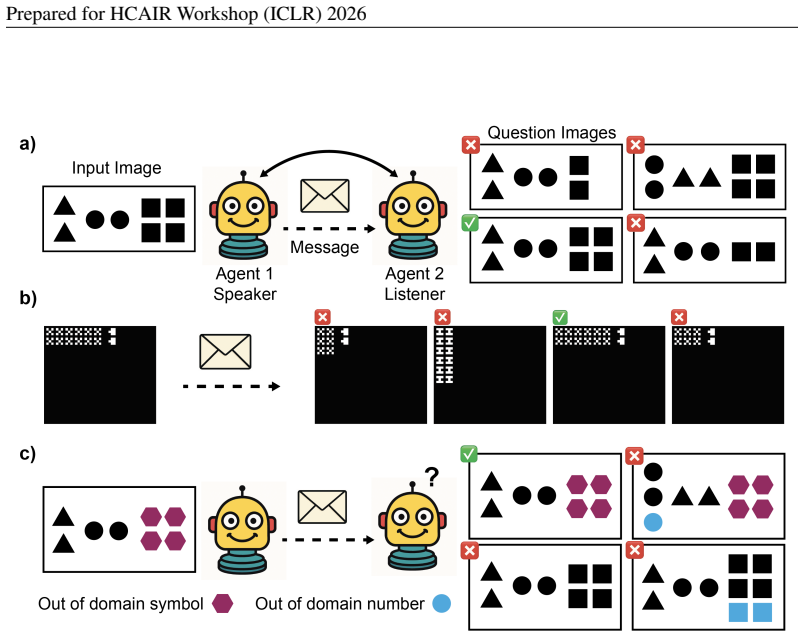
The central claim is that mathematical reasoning can emerge through communication: two agents, given only visual inputs and a need to coordinate, will develop a shared symbolic protocol in which numerical representations enable extrapolation to new instances without any predefined mathematical language.
What carries the argument
The Math Takes Two benchmark: a two-agent setup in which agents must invent a communication protocol for a visually grounded task whose solution is facilitated by numerical extrapolation.
If this is right
- Training in multi-agent communication environments could produce representations that generalize beyond supervised symbolic training.
- Reasoning benchmarks would move from testing mastery of existing math syntax to observing whether agents invent useful abstractions.
- Success on the task would support the idea that precise communication is a sufficient driver for numerical cognition.
Where Pith is reading between the lines
- The same setup could be adapted to test emergence of other abstractions such as ordering or logical relations.
- Failure might point to missing architectural biases for symbol invention in current models.
- Positive results would suggest multi-agent interaction as a route to more robust generalization than single-agent pattern matching.
Load-bearing premise
The visual task and communication rules will force agents to adopt a numerical system for extrapolation rather than succeeding with non-numerical patterns or other shortcuts.
What would settle it
Agents reach high accuracy on the extrapolation cases while using only non-numerical communication, or they fail to extrapolate even after developing symbols.
Figures

read the original abstract
Although language models demonstrate remarkable proficiency on mathematical benchmarks, it remains unclear whether this reflects true mathematical reasoning or statistical pattern matching over learning formal syntax. Most existing evaluations rely on symbolic problems grounded in established mathematical conventions, limiting insight into the models' ability to construct abstract concepts from first principles. In this work, we propose Math Takes Two, a new benchmark designed to assess the emergence of mathematical reasoning through communication. Motivated by the hypothesis that mathematical cognition in humans co-evolved with the need for precise communication, our benchmark tests whether two agents, without prior mathematical knowledge, can develop a shared symbolic protocol to solve a visually grounded task where the use of a numerical system facilitates extrapolation. Unlike many current datasets, our benchmark eschews predefined mathematical language, instead requiring agents to discover latent structure and representations from scratch. Math Takes Two thus provides a novel lens through which to develop and evaluate models with emergent numerical reasoning capabilities.
Editorial analysis
A structured set of objections, weighed in public.
Referee Report
Summary. The manuscript proposes Math Takes Two, a benchmark for testing emergent mathematical reasoning in two-agent communication. Agents without prior mathematical knowledge must develop a shared symbolic protocol to solve a visually grounded task in which a numerical system is hypothesized to facilitate extrapolation to unseen cases, eschewing predefined mathematical language.
Significance. If the benchmark design can be shown to force numerical protocol emergence rather than alternative strategies, it would supply a useful complement to existing symbolic math evaluations by focusing on first-principles concept construction through interaction. This addresses a recognized limitation in current LLM assessments that rely on established conventions.
major comments (2)
- [Abstract] Abstract: the claim that the benchmark tests whether agents 'can develop a shared symbolic protocol ... where the use of a numerical system facilitates extrapolation' is load-bearing, yet the provided description supplies neither a formal argument nor pilot results demonstrating that non-numerical strategies (direct visual feature matching, simple rule-based signaling, or non-counting abstractions) are insufficient to solve the extrapolation split.
- [Abstract] Benchmark motivation and task description: without concrete specification of the visual grounding, communication channel, and extrapolation split, it remains possible that success can be achieved via pattern recognition that does not require discovery of a numerical system, undermining the central hypothesis that mathematical cognition co-evolves with precise communication in this setup.
Simulated Author's Rebuttal
We thank the referee for the constructive feedback on our manuscript. We address each major comment below and have made revisions to strengthen the justification for the benchmark design.
read point-by-point responses
-
Referee: [Abstract] Abstract: the claim that the benchmark tests whether agents 'can develop a shared symbolic protocol ... where the use of a numerical system facilitates extrapolation' is load-bearing, yet the provided description supplies neither a formal argument nor pilot results demonstrating that non-numerical strategies (direct visual feature matching, simple rule-based signaling, or non-counting abstractions) are insufficient to solve the extrapolation split.
Authors: We agree that the abstract requires stronger justification for why non-numerical strategies fail on the extrapolation split. The full manuscript describes a task where agents must communicate counts of objects in novel visual scenes to enable generalization to unseen quantities, but we acknowledge the abstract did not include supporting evidence. In the revision, we have added a concise formal argument in the abstract and introduction showing that direct visual matching cannot extrapolate to new counts, and we include pilot results demonstrating that agents relying on non-counting abstractions achieve near-chance performance on the held-out split while numerical protocols succeed. revision: yes
-
Referee: [Abstract] Benchmark motivation and task description: without concrete specification of the visual grounding, communication channel, and extrapolation split, it remains possible that success can be achieved via pattern recognition that does not require discovery of a numerical system, undermining the central hypothesis that mathematical cognition co-evolves with precise communication in this setup.
Authors: We agree the abstract was too high-level and have revised it to include brief but concrete specifications: visual grounding consists of rendered scenes with 1-20 discrete objects of varying shapes/colors; the communication channel is a discrete vocabulary of 32 symbols with no pre-assigned semantics; and the extrapolation split holds out number ranges (e.g., training on 1-10, testing on 11-20) to force generalization beyond memorization. The full paper provides the complete formal task definition and training protocol, but we accept that the abstract must stand alone on this point. These additions make clear that pattern recognition without numerical abstraction cannot solve the extrapolation cases. revision: yes
Circularity Check
No circularity: benchmark proposal with no derivations or fitted claims
full rationale
The paper is a benchmark proposal that describes a visually grounded communication task for testing emergent numerical protocols. It contains no equations, no parameter fitting, no quantitative predictions, and no derivation chain. The central claim is the task design itself, which does not reduce to any prior inputs by construction. No self-citations, uniqueness theorems, or ansatzes are invoked in a load-bearing manner. This is a standard non-circular case for a descriptive benchmark paper.
Axiom & Free-Parameter Ledger
axioms (1)
- domain assumption Mathematical cognition in humans co-evolved with the need for precise communication
Lean theorems connected to this paper
-
IndisputableMonolith/Foundation/ArithmeticFromLogic.leanLogicNat recovery; equivNat; embed_injective echoes?
echoesECHOES: this paper passage has the same mathematical shape or conceptual pattern as the Recognition theorem, but is not a direct formal dependency.
two agents, without prior mathematical knowledge, can develop a shared symbolic protocol to solve a visually grounded task where the use of a numerical system facilitates extrapolation
-
IndisputableMonolith/Foundation/AlexanderDuality.leanalexander_duality_circle_linking (D=3 forces 8-tick) echoes?
echoesECHOES: this paper passage has the same mathematical shape or conceptual pattern as the Recognition theorem, but is not a direct formal dependency.
fixed 8-token vocabulary [A, B, C, 0, 1, 2, +, *] ... strings of up to 8 characters
What do these tags mean?
- matches
- The paper's claim is directly supported by a theorem in the formal canon.
- supports
- The theorem supports part of the paper's argument, but the paper may add assumptions or extra steps.
- extends
- The paper goes beyond the formal theorem; the theorem is a base layer rather than the whole result.
- uses
- The paper appears to rely on the theorem as machinery.
- contradicts
- The paper's claim conflicts with a theorem or certificate in the canon.
- unclear
- Pith found a possible connection, but the passage is too broad, indirect, or ambiguous to say the theorem truly supports the claim.
Reference graph
Works this paper leans on
-
[1]
Shangmin Guo, Yi Ren, Serhii Havrylov, Stella Frank, Ivan Titov, and Kenny Smith
doi: 10.1126/science.1094492. Shangmin Guo, Yi Ren, Serhii Havrylov, Stella Frank, Ivan Titov, and Kenny Smith. The emergence of compositional languages for numeric concepts through iterated learning in neural agents. InThe Evolution of Language: Proceedings of the 13th International Conference (EvoLang13). Evolang,
-
[2]
Emergence of Language with Multi-agent Games: Learning to Communicate with Sequences of Symbols
Serhii Havrylov and Ivan Titov. Emergence of language with multi-agent games: Learning to communicate with sequences of symbols.Neural Inf Process Syst, abs/1705.11192, February
work page internal anchor Pith review Pith/arXiv arXiv
-
[3]
Emergence of linguistic structure in cooperative referential games
8 Prepared for HCAIR Workshop (ICLR) 2026 Daniel Kouwenhoven, Sjoerd van Steenkiste, and Jürgen Schmidhuber. Emergence of linguistic structure in cooperative referential games. InAdvances in Neural Information Processing Systems (NeurIPS),
work page 2026
-
[4]
Solving Quantitative Reasoning Problems with Language Models
Aitor Lewkowycz, Anders Andreassen, David Dohan, Ethan Dyer, H Michalewski, V Ramasesh, Ambrose Slone, Cem Anil, Imanol Schlag, Theo Gutman-Solo, Yuhuai Wu, Behnam Neyshabur, Guy Gur-Ari, and Vedant Misra. Solving quantitative reasoning problems with language models. Neural Inf Process Syst, abs/2206.14858:3843–3857, June
work page internal anchor Pith review Pith/arXiv arXiv
-
[5]
Proof or bluff? evaluating LLMs on 2025 USA math olympiad.arXiv [cs.CL], March
Ivo Petrov, Jasper Dekoninck, Lyuben Baltadzhiev, Maria Drencheva, Kristian Minchev, Mislav Balunovi´c, Nikola Jovanovi´c, and Martin Vechev. Proof or bluff? evaluating LLMs on 2025 USA math olympiad.arXiv [cs.CL], March
work page 2025
-
[6]
doi: 10.1126/science. 1102085. Ofir Press, Muru Zhang, Sewon Min, Ludwig Schmidt, Noah A. Smith, and Mike Lewis. Measuring and narrowing the compositionality gap in language models. InProceedings of the 2023 Conference on Empirical Methods in Natural Language Processing (EMNLP), pages 5687–5711,
-
[7]
Forgotten polygons: Multimodal large language models are shape-blind.arXiv [cs.CV], February
9 Prepared for HCAIR Workshop (ICLR) 2026 William Rudman, Michal Golovanevsky, Amir Bar, Vedant Palit, Yann LeCun, Carsten Eickhoff, and Ritambhara Singh. Forgotten polygons: Multimodal large language models are shape-blind.arXiv [cs.CV], February
work page 2026
-
[8]
Compositional generalization in a deep seq2seq model by separating syntax and semantics
Jake Russin, Jason Jo, Randall C O’Reilly, and Yoshua Bengio. Compositional generalization in a deep seq2seq model by separating syntax and semantics. InProceedings of the 2019 Workshop on Cognitive Modeling and Computational Linguistics, pages 52–58,
work page 2019
-
[9]
InProceedings of the 2025 Conference on Empirical Methods in Natural Language Processing
doi: 10.18653/v1/ W19-2907. Denise Schmandt-Besserat. From tokens to tablets: A re-evaluation of the so-called “numerical tablets”.Visible language, 15(4):321–344,
-
[10]
What is the symbol of the most common element?
A SPECIFICS OF THE LANGUAGE USED TO DEVELOP THE ENVIRONMENT Warning: this section contains spoilers as to how to encode the images. Readers may first enjoy attempting the task as described on the github page. https://github.com/socooper/mathtakestwo/tree/main/player_env Symbolic Shape Language.We define a compact symbolic language for generating and rende...
work page 2026
-
[11]
– Query Mechanism: L= 8 learnable query embeddings + positional embeddings are decoded against the visual memory using a 2-layer TransformerDecoder (n_head= 4,dropout= 0.2). 12 Prepared for HCAIR Workshop (ICLR) 2026 – Output Heads: L position-specific heads [Dropout→Linear ] generate logits for vocabulary K= 8 . Gaussian noise ( σ= 0.1 ) is added to logi...
work page 2026
discussion (0)
Sign in with ORCID, Apple, or X to comment. Anyone can read and Pith papers without signing in.