The possible K^(*)Sigma^(*) molecular state
Pith reviewed 2026-05-08 11:16 UTC · model grok-4.3
The pith
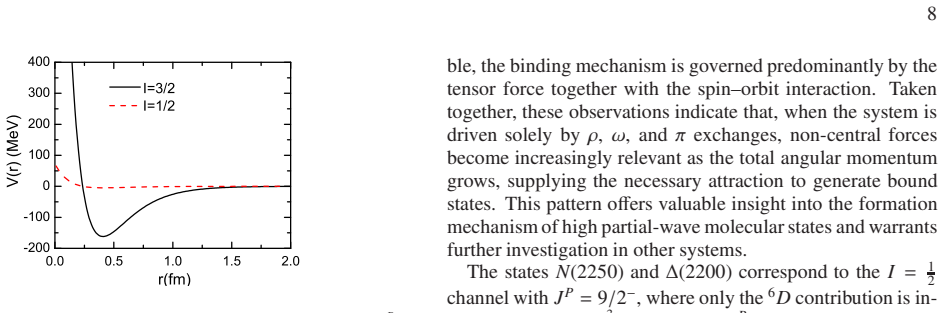
K*Σ* molecular states with J^P=1/2- form only in the I=3/2 channel, not in I=1/2 due to destructive interference.
A machine-rendered reading of the paper's core claim, the machinery that carries it, and where it could break.
Core claim
S–D wave mixed K*Σ* molecular states with J^P=1/2− can be formed only in the I=3/2 channel, while no bound state appears in the I=1/2 channel due to destructive interference of the interaction potentials in isospin space. Bound states for J^P=3/2− and 5/2− are also found, and the model supports interpreting N(2250) as I=1/2 J^P=9/2− and Δ(2200) as I=3/2 J^P=7/2− K*Σ* molecules.
What carries the argument
One-boson-exchange potential from ρ, ω, and π meson exchanges, with binding energies obtained by solving the non-relativistic Schrödinger equation via the Gaussian expansion method.
If this is right
- The S-D wave mixed states with J^P=3/2- and J^P=5/2- also support bound states.
- The binding for higher partial waves involves partial-wave mixing, tensor forces, and spin-orbit interactions.
- The J^P=1/2+ channel does not bind because the interaction is repulsive.
- The N(2250) and Δ(2200) can be understood as K*Σ* molecular states with the specified quantum numbers.
Where Pith is reading between the lines
- If the molecular picture holds, similar selective binding might occur in other vector meson-baryon systems.
- Experimental confirmation of the isospin and spin-parity assignments for these resonances would strengthen the molecular interpretation.
- Calculations in this framework could be extended to predict masses and widths for unobserved states.
Load-bearing premise
The coupling constants and cutoff parameters are chosen to correctly reproduce the low-energy K*Σ* interaction, and the non-relativistic Schrödinger equation is valid for the resulting binding energies.
What would settle it
A lattice QCD simulation or precise experimental determination showing no binding or incompatible quantum numbers for the proposed states in the I=3/2 channel would disprove the central claim.
Figures
read the original abstract
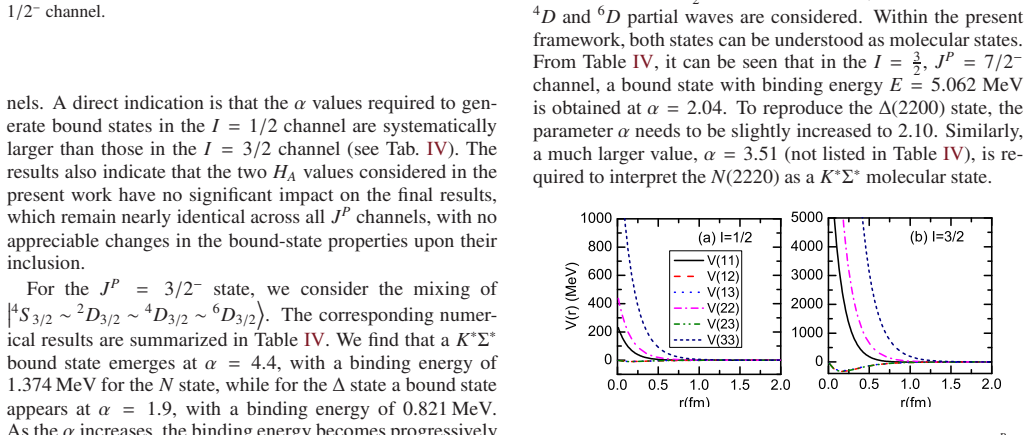
Within the framework of the one-boson-exchange model, we systematically investigate the interaction between the vector meson $K^{*}$ and the baryon $\Sigma^{*}$ with the aim of exploring the possibility of forming hadronic molecular states. The $K^{*}\Sigma^{*}$ interaction potential is constructed from $\rho$, $\omega$, and $\pi$ meson exchanges, and the nonrelativistic Schr\"odinger equation is solved using the Gaussian expansion method. The binding energies are calculated for different total angular momenta $J^{P}$ and isospin channels $I=1/2$ and $I=3/2$. Our results show that $S$--$D$ wave mixed $K^{*}\Sigma^{*}$ molecular states with $J^{P}=1/2^{-}$ can be formed only in the $I=3/2$ channel, while no bound state appears in the $I=1/2$ channel due to destructive interference of the interaction potentials in isospin space. In addition, the $S$--$D$ wave mixed states with $J^{P}=3/2^{-}$ and $J^{P}=5/2^{-}$ are also found to support bound-state solutions. For higher partial-wave states, the binding mechanism is governed by the interplay of partial-wave mixing, tensor forces, and spin--orbit interactions. In particular, the $J^{P}=1/2^{+}$ channel does not support a bound state because the meson-exchange interaction is predominantly repulsive. Our analysis further supports the interpretation of the experimentally observed $N(2250)$ and $\Delta(2200)$ states as $K^{*}\Sigma^{*}$ molecular states, corresponding to $I=1/2,\ J^{P}=9/2^{-}$ and $I=3/2,\ J^{P}=7/2^{-}$, respectively.
Editorial analysis
A structured set of objections, weighed in public.
Referee Report
Summary. The manuscript investigates the K*Σ* interaction in the one-boson-exchange framework using π, ρ, and ω exchanges to construct the potential. It solves the non-relativistic Schrödinger equation via the Gaussian expansion method across multiple J^P and I=1/2, 3/2 channels, reporting bound states for S-D mixed waves with J^P=1/2^- only in I=3/2 (due to isospin interference), plus solutions in J^P=3/2^- and 5/2^- channels, and higher partial waves. The work suggests these states correspond to the observed N(2250) (I=1/2, J^P=9/2^-) and Δ(2200) (I=3/2, J^P=7/2^-).
Significance. If the reported channel selectivity and binding energies prove robust, the analysis adds a concrete example of how tensor forces and isospin factors can produce selective molecular binding in the vector-meson–baryon sector. The systematic use of the Gaussian expansion method for coupled partial waves is a methodological strength that facilitates reproducible numerical results within the model.
major comments (2)
- [Abstract and results] Abstract and results: No explicit numerical values for the cutoff Λ in the monopole form factors or the meson-baryon coupling constants are stated, nor is any variation of these parameters performed. Because the overall potential strength (and thus the existence of binding in the I=3/2, J^P=1/2^- channel versus its absence in I=1/2) is controlled by these choices, the central claim of isospin selectivity rests on untested parameter dependence.
- [Discussion] The assignment of the calculated I=1/2, J^P=9/2^- and I=3/2, J^P=7/2^- states to N(2250) and Δ(2200) is made solely on the basis of mass and quantum-number matching. Without a comparison of predicted decay widths or other observables to experimental data, this interpretation remains suggestive and does not yet constitute strong supporting evidence.
minor comments (1)
- [Formalism] The notation for the partial-wave mixing (S–D) and the isospin factors in the potential could be clarified with an explicit table of Clebsch-Gordan coefficients for each channel.
Simulated Author's Rebuttal
We are grateful to the referee for the careful reading of our manuscript and the valuable comments provided. The referee's summary accurately captures the essence of our study on possible K*Σ* molecular states. We respond to the major comments in detail below, and we will revise the manuscript to address the concerns raised.
read point-by-point responses
-
Referee: [Abstract and results] Abstract and results: No explicit numerical values for the cutoff Λ in the monopole form factors or the meson-baryon coupling constants are stated, nor is any variation of these parameters performed. Because the overall potential strength (and thus the existence of binding in the I=3/2, J^P=1/2^- channel versus its absence in I=1/2) is controlled by these choices, the central claim of isospin selectivity rests on untested parameter dependence.
Authors: We thank the referee for highlighting this issue. Although the parameters were selected from prior works, they were not explicitly detailed in the abstract and results sections. In the revised version of the manuscript, we will explicitly state the values of the cutoff Λ and the relevant coupling constants. Additionally, we will include a brief analysis of the dependence on Λ, demonstrating that the isospin selectivity persists for a range of reasonable cutoff values. This will strengthen the central claim without altering the main conclusions. revision: yes
-
Referee: [Discussion] The assignment of the calculated I=1/2, J^P=9/2^- and I=3/2, J^P=7/2^- states to N(2250) and Δ(2200) is made solely on the basis of mass and quantum-number matching. Without a comparison of predicted decay widths or other observables to experimental data, this interpretation remains suggestive and does not yet constitute strong supporting evidence.
Authors: We concur with the referee that the correspondence is proposed based on the agreement in mass and quantum numbers. This is typical for identifying potential molecular states in such theoretical studies. To provide stronger evidence, one would indeed benefit from predictions of decay widths, but that would necessitate additional modeling of the decay processes. In the revised manuscript, we will modify the discussion to note that while the mass and J^P matching supports the interpretation as K*Σ* molecules, a more definitive assignment would require comparison with other observables such as decay widths, which we leave for future investigations. revision: partial
Circularity Check
No significant circularity in the OBE potential derivation or channel selectivity
full rationale
The paper constructs the K*Σ* interaction from explicit π, ρ, and ω exchanges with standard Feynman rules and isospin projection factors, then solves the coupled Schrödinger equation numerically with the Gaussian expansion method. The reported selectivity (bound states only for I=3/2 in the J^P=1/2− S-D mixed channel, none for I=1/2 due to destructive interference) follows directly from the sign and magnitude of those isospin-weighted potentials; it is not imposed by fitting or definition. Couplings are taken from literature/SU(3) relations and the cutoff Λ is varied parametrically to map the existence of solutions, without adjustment to reproduce the target experimental masses. The interpretation linking calculated states to N(2250) and Δ(2200) is a post-hoc quantum-number and mass comparison, not a fitted prediction or self-referential step. No self-citation chains, uniqueness theorems, or ansatzes are invoked to force the central results. The derivation remains self-contained against the model's stated assumptions and external benchmarks.
Axiom & Free-Parameter Ledger
free parameters (2)
- meson-baryon coupling constants
- cutoff parameters in monopole form factors
axioms (2)
- domain assumption The K*Σ* interaction is adequately described by single exchanges of ρ, ω, and π mesons.
- domain assumption A non-relativistic Schrödinger equation suffices to determine the existence of bound states.
invented entities (1)
-
K*Σ* molecular bound state
no independent evidence
Reference graph
Works this paper leans on
-
[1]
The contributions from vector-meson exchange can be 4 written as MV = ∑ V=ρ0,ω,φ −IV iggΣ∗+Σ∗+V √ 2 ¯uα(s4, p4)[γβ+ κΣ∗Σ∗V 4mΣ∗+ (γβq/ −q/γβ)] ×uα(s2, p2) −gβη+ qβqη/ m2 V q2 −m2 V [−p3 ·ǫ1ǫ† 3η−p1 ·ǫ† 3ǫ1η +ǫ† 3 ·ǫ1(p1 + p3)η+ q ·ǫ† 3ǫ1η−q ·ǫ1ǫ† 3η], (15) Mπ= HAG ′ 6 f ¯uµ(s4, p4)q/γ5uµ(s2, p2) 1 q2 −m2 π ǫνηαβ ×p3αp1νǫ† 3βǫ1η, (16) where q = p3 −p1 = p2...
-
[2]
The required 5 Fourier-transform relations are F 1 ⃗q 2 + m2 ( Λ2 −m2 Λ2 +⃗q 2 ) 2 = Y1(Λ, m, r), F ⃗q 2 ⃗q 2 + m2 ( Λ2 −m2 Λ2 +⃗q 2 ) 2 = −∇2 r Y1(Λ, m, r), F ⃗k 2 ⃗q 2 + m2 ( Λ2 −m2 Λ2 +⃗q 2 ) 2 = 1 4 ∇2 r Y1(m, r) −1 2 {∇2 r, Y1(m, r)}, F i⃗ σ·(⃗q ×⃗k) ⃗q 2 + m2...
-
[3]
74, we also present the corresponding results for these two choices. As shown in Table IV, for the isospin I = 1/ 2 and JP = 1/ 2−channel, which corresponds to the S -wave K∗Σ∗molec- ular configuration, no stable bound-state solution is found . Specifically, for both values of the coupling constant, HA =
-
[4]
74, and for all physically reasonable values of the parameter αin the range 0
27 and HA = 1. 74, and for all physically reasonable values of the parameter αin the range 0. 5–9. 7 [62– 64], no negative 6 TABLE II: The matrix elements of two-body interaction opera tors for V B systems. V B → V B 1/ 2− 3/ 2− 3/ 2+ 7/ 2− Z (2S J,4DJ, 6DJ) ( 4S J, 2DJ, 4DJ, 6DJ) ( 2PJ, 4PJ, 6PJ, 4FJ, 6FJ ) ( 4DJ, 6 DJ) ⃗ σ·⃗ L 0 ...
-
[5]
374 MeV for the N state, while for the ∆state a bound state appears at α = 1. 9, with a binding energy of 0 . 821 MeV. As theαincreases, the binding energy becomes progressively deeper. These results indicate that the e ffective potential pro- vides enough attraction to overcome the centrifugal barrie r, leading to the formation of a bound state with a neg...
-
[6]
9 −8. 401 4 . 9 −8. 401 6 . 8 −29. 844 6 . 8 −29. 844
-
[7]
4 −20. 946 5 . 4 −20. 945 7 . 3 −65. 938 7 . 3 −65. 937 JP = 5/ 2− 3. 9 −0. 119 3 . 9 −0. 119 JP = 5/ 2+ 4. 0 −2. 471 4 . 0 −2. 471
-
[8]
4 −6. 334 4 . 4 −6. 334 4 . 2 −37. 680 4 . 2 −37. 680
-
[9]
9 −20. 827 4 . 9 −20. 826 4 . 4 −65. 938 4 . 4 −65. 938 JP = 7/ 2+ 2. 95 −0. 882 3 . 9 −0. 882 JP = 7/ 2− 4. 76 −4. 461 4 . 76 −4. 460
-
[10]
05 −32. 953 3 . 05 −32. 953 4 . 86 −65. 981 4 . 86 −65. 980
-
[11]
15 −79. 136 3 . 15 −79. 136 4 . 96 −143. 682 4 . 96 −143. 681 JP = 9/ 2+ 5. 51 −0. 796 5 . 51 −0. 795 JP = 9/ 2− 3. 39 −8. 344 3 . 39 −8. 344
-
[12]
52 −12. 042 5 . 52 −12. 041 3 . 40 −17. 408 3 . 40 −17. 408
-
[13]
53 −23. 562 5 . 53 −23. 561 3 . 41 −26. 720 3 . 41 −21. 720 JP = 11/ 2+ 13. 48 × 13. 48 ×
-
[14]
50 −9. 222 13 . 50 −9. 222
-
[15]
52 −21. 593 13 . 52 −21. 592 I = 3/ 2 JP = 1/ 2− 2.0 −0. 705 2.0 −0. 705 JP = 1/ 2+ × × × × 2.5 −16. 577 2.5 −16. 576 × × × × 3.0 −52. 089 3.0 −52. 088 × × × × J p = 3/ 2− 1.9 −0. 821 1.9 −0. 821 JP = 3/ 2+ 2. 6 −1. 903 2 . 6 −1. 903 2.4 −18. 988 2.4 −18. 988 3 . 1 −70. 925 3 . 1 −70. 925 2.9 −58. 968 2.9 −58. 968 3 . 6 −217. 168 3 . 6 −217. 66 J p = 5/ 2...
-
[16]
39 −29. 323 1 . 39 −29. 323 2 . 05 −14. 090 2 . 05 −14. 090
-
[17]
44 −71. 788 1 . 44 −71. 788 2 . 06 −23. 776 2 . 06 −23. 776 JP = 9/ 2+ 2. 74 × 2. 74 × JP = 9/ 2− 2. 16 −0. 398 2 . 16 −0. 398
-
[18]
75 −2. 887 2 . 75 −2. 887 2 . 17 −12. 665 2 . 17 −12. 66
-
[19]
76 −18. 876 2 . 76 −18. 876 2 . 18 −25. 787 2 . 18 −25. 787 JP = 11/ 2+ 8. 29 × 8. 29 ×
-
[20]
30 −4. 429 8 . 30 −4. 429
-
[21]
31 −16. 888 8 . 31 −16. 888 cluded in our system, as well as the πmeson, which provides the long-range interaction. For the JP = 11/ 2 case, a bound state is absent in the I = 1/ 2 channel but appears in the I = 3/ 2 channel. This con- trast originates from the interference pattern of the inter action potentials in isospin space, as discussed previously. ...
- [22]
- [23]
- [24]
-
[25]
F. K. Guo, C. Hanhart, U. G. Meißner, Q. Wang, Q. Zhao and B. S. Zou, Rev. Mod. Phys. 90 (2018), 015004 [erratum: Rev. Mod. Phys. 94 (2022), 029901]
work page 2018
-
[26]
S. K. Choi et al. [Belle], Phys. Rev. Lett. 91, 262001 (2003)
work page 2003
-
[27]
N. Brambilla, S. Eidelman, C. Hanhart, A. Nefediev, C. P . Shen, C. E. Thomas, A. V airo and C. Z. Y uan, Phys. Rept.873, 1-154 (2020)
work page 2020
-
[28]
H. X. Chen, W. Chen, X. Liu, Y . R. Liu and S. L. Zhu, Rept. Prog. Phys. 86, 026201 (2023)
work page 2023
-
[29]
L. Meng, B. Wang, G. J. Wang and S. L. Zhu, Phys. Rept. 1019, 1-149 (2023)
work page 2023
- [30]
- [31]
- [32]
- [33]
- [34]
- [35]
-
[36]
H. X. Chen, W. Chen and S. L. Zhu, Phys. Rev. D 100, 051501 (2019)
work page 2019
-
[37]
F. K. Guo, H. J. Jing, U. G. Meißner and S. Sakai, Phys. Rev . D 99,091501 (2019)
work page 2019
-
[38]
C. W. Xiao, J. Nieves and E. Oset, Phys. Rev. D 100,014021 (2019)
work page 2019
-
[39]
J. He, Eur. Phys. J. C 79,393 (2019)
work page 2019
-
[40]
C. J. Xiao, Y . Huang, Y . B. Dong, L. S. Geng and D. Y . Chen, Phys. Rev. D 100,014022 (2019)
work page 2019
-
[41]
L. Roca, J. Nieves and E. Oset, Phys. Rev. D 92, 094003 (2015)
work page 2015
-
[42]
H. X. Chen, W. Chen, X. Liu, T. G. Steele and S. L. Zhu, Phys . Rev. Lett. 115,172001 (2015)
work page 2015
-
[43]
R. Chen, X. Liu, X. Q. Li and S. L. Zhu, Phys. Rev. Lett. 115,132002 (2015)
work page 2015
- [44]
- [45]
-
[46]
M. L. Du, V . Baru, F. K. Guo, C. Hanhart, U. G. Meißner, J. A. Oller and Q. Wang, Phys. Rev. Lett. 124 (2020), 072001
work page 2020
- [47]
- [48]
- [49]
-
[50]
J. A. Oller and E. Oset, Nucl. Phys. A 620 (1997), 438-456 [erratum: Nucl. Phys. A 652 (1999), 407-409]
work page 1997
-
[51]
J. J. Wu, X. H. Liu, Q. Zhao and B. S. Zou, Phys. Rev. Lett. 108 (2012), 081803
work page 2012
-
[52]
L. Roca, E. Oset and J. Singh, Phys. Rev. D 72 (2005), 014002
work page 2005
- [53]
- [54]
-
[55]
K. P . Khemchandani, A. Mart´ ınez Torres, A. Hosaka, H. N a- gahiro, F. S. Navarra and M. Nielsen, Phys. Rev. D 97 (2018), 034005
work page 2018
-
[56]
D. Gamermann, C. Garcia-Recio, J. Nieves and L. L. Salce do, Phys. Rev. D 84 (2011), 056017
work page 2011
-
[57]
K. Miyahara, T. Hyodo, M. Oka, J. Nieves and E. Oset, Phys . Rev. C 95 (2017), 035212
work page 2017
- [58]
- [59]
- [60]
-
[61]
Y . Yan, Q. Huang, X. Zhu, H. Huang and J. Ping, Phys. Rev. D 110 (2024), 014021
work page 2024
- [62]
-
[63]
B. Wang, K. Chen, L. Meng and S. L. Zhu, Phys. Rev. D 109 (2024), 074035
work page 2024
- [64]
- [65]
-
[66]
B. C. Hunt and D. M. Manley, Phys. Rev. C 99 (2019), 055205
work page 2019
-
[67]
J. Bartsch et al. [Aachen-Berlin-CERN-London-Vienna], Phys. Lett. B 28 (1969), 439-442
work page 1969
-
[68]
E. L. Goldwasser and P . F. Schultz, Phys. Rev. D 1 (1970), 1960-1966
work page 1970
-
[69]
J. K. Hassall, R. E. Ansorge, J. R. Carter, W. W. Neale, J. G. Rushbrooke, D. R. Ward, B. Y . Oh, M. Pratap, G. A. Smith and J. Whitmore, Nucl. Phys. B 189 (1981), 397-420
work page 1981
-
[70]
C. M. Jenkins, J. R. Albright, R. N. Diamond, H. C. Fenker , J. H. Goldman, S. Hagopian, V . Hagopian, W. Morris, L. Kirsch and R. Poster, et al. Phys. Rev. Lett. 51 (1983), 951-954
work page 1983
-
[71]
S. F. Biagi, M. Bourquin, R. M. Brown, H. J. Burckhart, P . Ex- 11 termann, M. Gailloud, C. N. P . Gee, W. M. Gibson, P . Jacot- Guillarmod and J. Perrier, et al. Z. Phys. C 34 (1987), 15
work page 1987
-
[72]
E. Oset, J. R. Pelaez and L. Roca, Phys. Rev. D 67 (2003), 073013
work page 2003
- [73]
- [74]
-
[75]
M. F. M. Lutz and E. E. Kolomeitsev, Nucl. Phys. A 700 (2002), 193-308
work page 2002
-
[76]
P . M. Copeland, C. R. Ji and W. Melnitchouk, Phys. Rev. D 103 (2021), 094019
work page 2021
-
[77]
V . Pascalutsa, M. V anderhaeghen and S. N. Yang, Phys. Re pt. 437 (2007), 125-232
work page 2007
- [78]
- [79]
-
[80]
R. F. Dashen and A. V . Manohar, Phys. Lett. B315 (1993), 425- 430
work page 1993
discussion (0)
Sign in with ORCID, Apple, or X to comment. Anyone can read and Pith papers without signing in.