Simulation-based Inference for Gravitational Waves from Binary Neutron Stars: Application of Summary Data from Heterodyning
Pith reviewed 2026-05-08 10:44 UTC · model grok-4.3
The pith
A compression strategy using polynomial approximations of waveform ratios reduces BNS gravitational-wave data to O(1000) points for fast, accurate neural posterior estimation.
A machine-rendered reading of the paper's core claim, the machinery that carries it, and where it could break.
Core claim
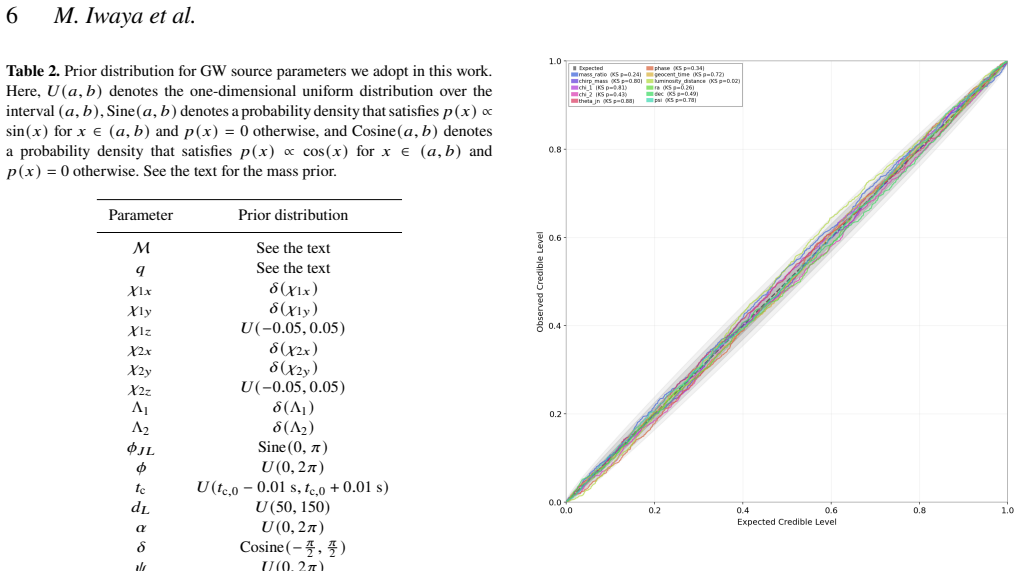
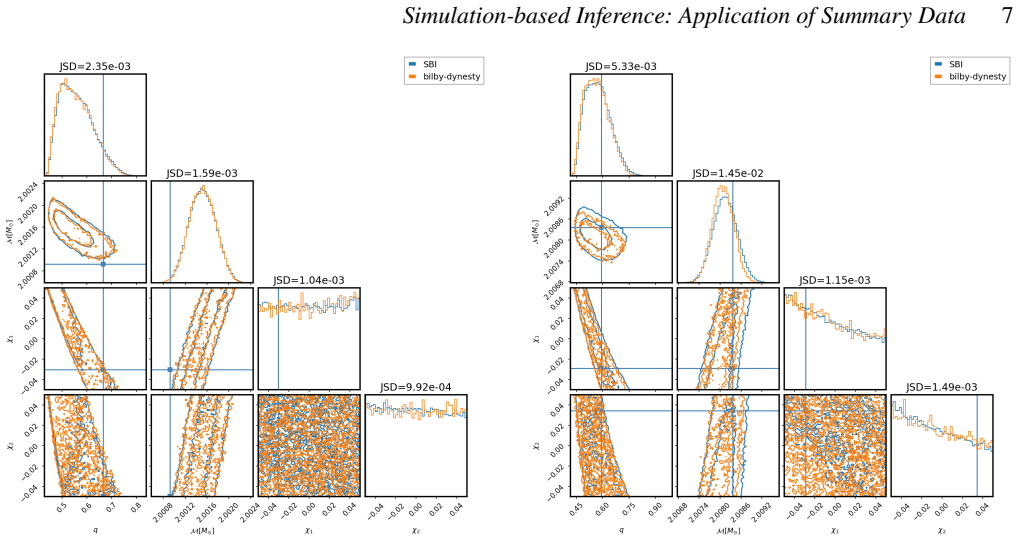
Likelihood-oriented summary statistics derived from the relative binning formalism compress raw frequency-domain gravitational-wave data from binary neutron stars into a form that uses only a polynomial approximation of the waveform ratio evaluated at O(1000) sample points; neural posterior estimation networks trained on these summaries produce well-calibrated posteriors across source parameters that agree with nested sampling results on 1024 injections, with Jensen-Shannon divergences consistent with numerical noise for most parameters.
What carries the argument
Summary data formed by a polynomial approximation of the waveform ratio over frequency bands grounded in post-Newtonian approximation, directly evaluated at O(1000) points.
If this is right
- Training and storage costs for neural networks drop below those of prior BNS inference networks.
- Parameter estimation for signals lasting several minutes becomes feasible on modest hardware.
- The same summary construction can be applied to any waveform model that admits a relative-binning ratio.
- Posteriors remain well-calibrated across all standard source parameters when the network is validated against nested sampling.
Where Pith is reading between the lines
- The approach may extend to binary black hole signals whose durations are shorter but whose parameter spaces are larger.
- Combining these summaries with other dimensionality-reduction steps could further accelerate inference for third-generation detectors.
- Real-time alerts for neutron-star mergers could incorporate full posterior sampling rather than point estimates.
Load-bearing premise
The polynomial approximation of the waveform ratio over roughly 1000 frequency points keeps essentially all the information required to recover accurate posteriors for every source parameter.
What would settle it
Recompute the full set of Jensen-Shannon divergences on a new set of 1024 injections using a finer frequency grid or different post-Newtonian banding and check whether the median JSD for the most discrepant parameter remains below 10^{-2} bits.
Figures
read the original abstract
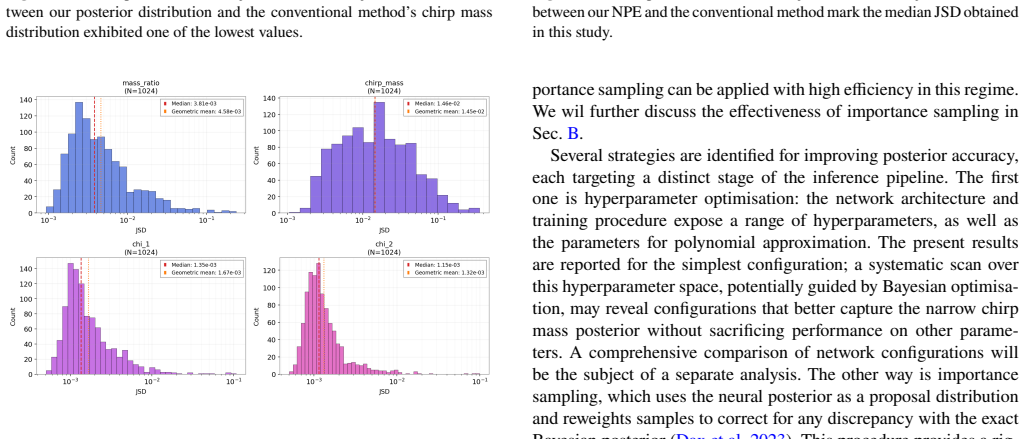
Gravitational-wave parameter estimation for binary neutron star (BNS) systems poses severe computational challenges due to the extended signal duration, which can reach several minutes in current detectors. Neural posterior estimation (NPE), a simulation-based inference approach, offers dramatic speedups but requires effective dimensionality reduction of the high-dimensional input data. We present a novel compression strategy based on likelihood-oriented summary statistics derived from the relative binning formalism of Zackay et al. (2018), which compresses raw frequency-domain data into the summary data. The summary data is based on a polynomial approximation of the waveform ratio using frequency banding grounded in post-Newtonian approximation, and directly evaluated with only $O(1000)$ sample points of the waveform. As a result, both the training and storage cost become more efficient than previously reported networks for BNS inference. We train a set of NPE networks on these summary statistics and validate a network against traditional nested sampling over 1024 BNS injections. The network produces well-calibrated posteriors across all source parameters we consider, with Jensen-Shannon divergences (JSD) consistent with numerical noise for most parameters. Although we find that the median JSD for the most inconsistent parameter exceeds $10^{-2}$ bits with current configurations, our results show potential for rapid parameter estimation of the BNS signal.
Editorial analysis
A structured set of objections, weighed in public.
Referee Report
Summary. The manuscript introduces a compression technique for gravitational-wave data from binary neutron star (BNS) systems based on likelihood-oriented summary statistics derived from the relative binning formalism. Raw frequency-domain data are reduced via a polynomial approximation of the waveform ratio, evaluated at O(1000) points in post-Newtonian-grounded frequency bands. Neural posterior estimation (NPE) networks are trained on these summaries; validation against nested sampling on 1024 fresh BNS injections shows well-calibrated posteriors, with Jensen-Shannon divergences (JSD) consistent with numerical noise for most parameters, although the median JSD for one parameter exceeds 10^{-2} bits. The approach is presented as enabling more efficient training and storage for rapid BNS parameter estimation.
Significance. If the reported calibration holds after addressing the noted residual inconsistency, the method would provide a practical route to fast, simulation-based inference for long-duration BNS signals, which is important for both individual-event analysis and population studies with current and next-generation detectors. The work builds directly on the established relative-binning framework and supplies concrete validation metrics (JSD on 1024 injections), strengthening its utility claim.
major comments (1)
- [Validation results] Validation section (and abstract): the central claim that the O(1000)-point polynomial approximation 'retains essentially all information needed for accurate posterior estimation of all source parameters' is undercut by the explicit statement that the median JSD for the most inconsistent parameter exceeds 10^{-2} bits. The manuscript should identify this parameter, report the corresponding posterior bias or width deviation relative to nested sampling, and discuss whether the discrepancy is acceptable for BNS science cases (e.g., tidal deformability or distance inference).
minor comments (2)
- [Abstract] Abstract: the qualifier 'with current configurations' attached to the JSD statement is vague; clarify whether the authors expect the discrepancy to be reduced by modest changes in network architecture, training set size, or binning parameters.
- Notation: ensure consistent use of 'summary data' versus 'summary statistics' throughout; the two terms appear interchangeably but refer to the same compressed representation.
Simulated Author's Rebuttal
We thank the referee for their constructive feedback and recommendation of minor revision. We address the single major comment below and will update the manuscript accordingly.
read point-by-point responses
-
Referee: [Validation results] Validation section (and abstract): the central claim that the O(1000)-point polynomial approximation 'retains essentially all information needed for accurate posterior estimation of all source parameters' is undercut by the explicit statement that the median JSD for the most inconsistent parameter exceeds 10^{-2} bits. The manuscript should identify this parameter, report the corresponding posterior bias or width deviation relative to nested sampling, and discuss whether the discrepancy is acceptable for BNS science cases (e.g., tidal deformability or distance inference).
Authors: We agree that greater specificity in the validation results would strengthen the manuscript. In the revised version we will explicitly name the parameter whose median JSD exceeds 10^{-2} bits, quantify the associated shifts in posterior median and width relative to nested sampling, and add a short discussion of the implications for BNS science applications (tidal deformability, distance, etc.). While a JSD of this magnitude remains small and our overall calibration is excellent, we accept that the current presentation leaves the practical impact insufficiently clear. revision: yes
Circularity Check
No significant circularity detected
full rationale
The paper applies the external relative-binning formalism of Zackay et al. (2018) to produce summary statistics via a polynomial approximation of the waveform ratio evaluated at O(1000) points in PN-grounded bands. It then trains NPE networks on these fixed summaries and validates them by direct comparison against independent nested sampling on 1024 fresh BNS injections, reporting JSD values computed from that external benchmark. No derivation step reduces the reported performance metrics, calibration claims, or efficiency gains to quantities fitted or redefined inside the present work; the central validation chain remains independent of internal fits or self-citations. The single noted JSD excess for one parameter is an empirical observation, not a definitional or self-referential reduction.
Axiom & Free-Parameter Ledger
axioms (1)
- domain assumption The relative binning formalism of Zackay et al. (2018) supplies an accurate polynomial approximation of the waveform ratio when frequency bands are chosen according to post-Newtonian ordering.
Reference graph
Works this paper leans on
-
[1]
Aasi J., et al., 2015, Class. Quant. Grav., 32, 074001 Abac A. G., et al., 2025b, arXiv preprint Abac A. G., et al., 2025a, arXiv preprint Abbott B. P., et al., 2016a, Living Rev. Rel., 19, 1 Abbott B. P., et al., 2016b, Phys. Rev. Lett., 116, 061102 Abbott B. P., et al., 2017a, Phys. Rev. Lett., 119, 161101 Abbott B. P., et al., 2017b, Nature, 551, 85 Ab...
-
[2]
Again, almost all features shown in the plot agree. The clear exception here is the phase parameter, where the neural posterior fails to reproduce the wavy characteristics in thebilbyposterior. Since we assume a single-detector observation, the coalescence phase is largely unconstrained and less physically informative compared to multi-detector analyses. ...
work page 2026
-
[3]
MNRAS000, 1–9 (2026) Simulation-based Inference: Application of Summary Data11 Figure B1.Corner plot for a BNS injection with importance sampling (shown in orange) and raw posterior samples from NPE (blue) andbilbyposterior samples (green). For this injection, the JSD between our raw NPE samples and the conventional method marks the worst JSD(0.355)obtain...
work page 2026
discussion (0)
Sign in with ORCID, Apple, or X to comment. Anyone can read and Pith papers without signing in.