Surface coating induced lubrication in flowing granular materials
Pith reviewed 2026-05-08 09:26 UTC · model grok-4.3
The pith
Lubricant particles coat bulk grains to increase granular flow rate at moderate levels but decrease it at high levels through densification and damping.
A machine-rendered reading of the paper's core claim, the machinery that carries it, and where it could break.
Core claim
The overall flow rate of the mixture first increases with lubricant content because lubricant coats the bulk particles and lowers their mutual friction, then decreases at higher lubricant content because the added particles produce greater packing density and stronger damping between grains.
What carries the argument
Predefined cohesive interaction between lubricant and bulk particles that allows small spheres to form a coating layer on the larger ones, thereby changing the effective friction and packing.
If this is right
- Flow rate reaches its highest value at an intermediate lubricant fraction.
- Reduced friction between coated bulk particles raises the flow speed.
- Higher lubricant fractions increase overall packing density.
- Crowded coated particles raise damping and thereby lower flow rate.
- The non-monotonic trend matches the direction seen in prior laboratory experiments.
Where Pith is reading between the lines
- The same coating process could be tuned in industrial powder handling to find the lubricant amount that maximizes throughput.
- Varying the size ratio between lubricant and bulk particles would likely shift the concentration that gives peak flow.
- Moisture-induced coating in natural granular flows such as debris slides may produce comparable non-monotonic mobility.
Load-bearing premise
A simple predefined cohesive force between lubricant and bulk particles is enough to produce realistic coating without deriving the actual adhesion strength from material properties.
What would settle it
An experiment that measures mass flow rate versus lubricant fraction on an inclined plane while varying only the coating ability would show whether the flow rate truly reaches a maximum at intermediate concentrations.
Figures


read the original abstract
We investigate the flow of spherical, bulk granular particles down an inclined plane mixed with small-sized spherical lubricant particles using discrete element method simulations. Predefined cohesive interaction is implemented between lubricant and bulk particles, enabling the coating of the former over the latter. The overall flow rate exhibits non-monotonic dependence on lubricant content. Initially, it increases with lubricant addition, reaches a maximum at an intermediate lubricant content, and decreases for even higher lubricant content. The increase in the flow rate is attributed to a lower inter-particle friction coefficient between lubricant-coated bulk particles. The decrease in the flow rate at higher lubricant content, on the other hand, is attributed to enhanced densification and increased damping between crowded particles. Both these occurrences are examined using various flow level characteristics. The simulation results are found to be in qualitative agreement with previous experimental results. Overall, the outcome integrates novel computational insights and prior experimental results to enhance the understanding of the powder lubrication phenomena.
Editorial analysis
A structured set of objections, weighed in public.
Referee Report
Summary. The manuscript uses discrete element method simulations of spherical bulk particles flowing down an inclined plane mixed with smaller lubricant particles. A predefined cohesive interaction between lubricant and bulk particles produces coating of the latter by the former. The central result is that the overall flow rate depends non-monotonically on lubricant content: it rises at low lubricant fractions because coating lowers the effective inter-particle friction, reaches a maximum at intermediate content, and falls at higher fractions because of increased densification and damping. The simulated trends are stated to agree qualitatively with prior experiments.
Significance. If the non-monotonic flow-rate dependence and its mechanistic attribution survive quantitative validation, the work supplies useful computational insight into how surface coating modulates granular lubrication. The fact that the non-monotonicity arises from the contact rules rather than an imposed functional form is a positive feature.
major comments (2)
- [Simulation Methods] Simulation setup (cohesive interaction model): the cohesive force between lubricant and bulk particles is introduced as a predefined parameter with no derivation from particle properties, no calibration against measured adhesion energies, and no sensitivity study. Because this single free parameter controls coating completeness and therefore the location of the flow-rate maximum, its arbitrary value is load-bearing for the non-monotonic claim.
- [Results] Results section: only qualitative agreement with experiments is reported. No quantitative error bars on flow rates, no tabulated comparison metrics, and no demonstration that the non-monotonic peak persists when the cohesive strength or particle-size ratio is varied. This leaves open whether the reported maximum is robust or an artifact of the chosen cohesion value.
minor comments (1)
- [Abstract] The abstract and results could state the precise range of lubricant mass fractions examined and the quantitative flow diagnostics (e.g., velocity profiles, packing fraction) used to separate friction reduction from densification effects.
Simulated Author's Rebuttal
We thank the referee for the constructive and detailed comments on our manuscript. We address each major point below and describe the revisions we will make to improve clarity and robustness.
read point-by-point responses
-
Referee: [Simulation Methods] Simulation setup (cohesive interaction model): the cohesive force between lubricant and bulk particles is introduced as a predefined parameter with no derivation from particle properties, no calibration against measured adhesion energies, and no sensitivity study. Because this single free parameter controls coating completeness and therefore the location of the flow-rate maximum, its arbitrary value is load-bearing for the non-monotonic claim.
Authors: We appreciate the referee highlighting the role of the cohesive parameter. The force is a model choice in the DEM framework to produce the coating effect without full agglomeration, selected via preliminary tests to match the qualitative coating observed in experiments. No direct derivation from particle properties or calibration to measured adhesion energies was performed, as such specific data for the lubricant-bulk pair are not available in the literature. To show the non-monotonic trend is not an artifact of the particular value, the revised manuscript will include a sensitivity study varying cohesive strength over a reasonable range. This will demonstrate that the rise-peak-fall behavior in flow rate persists (with possible shifts in the peak location), confirming the result arises from the contact mechanics rather than the exact parameter choice. revision: yes
-
Referee: [Results] Results section: only qualitative agreement with experiments is reported. No quantitative error bars on flow rates, no tabulated comparison metrics, and no demonstration that the non-monotonic peak persists when the cohesive strength or particle-size ratio is varied. This leaves open whether the reported maximum is robust or an artifact of the chosen cohesion value.
Authors: We agree that additional quantitative support would strengthen the results. In the revision we will add error bars to the flow-rate data, obtained by averaging over multiple independent runs with varied initial conditions. We will also include a table of flow rates at selected lubricant fractions with direct comparison to the experimental values from the cited studies, emphasizing the shared non-monotonic shape and optimum location. In addition, we will report new simulations in which both cohesive strength and particle-size ratio are varied; these will show that the non-monotonic dependence and its mechanistic explanation (friction reduction followed by densification and damping) remain intact. These changes will establish greater robustness. revision: yes
Circularity Check
No circularity: non-monotonic flow emerges from simulation dynamics, not imposed by construction.
full rationale
The paper uses DEM with a user-specified cohesive interaction as an input parameter between lubricant and bulk particles. The claimed non-monotonic flow-rate dependence on lubricant content is reported as an observed outcome of the particle-contact rules, friction reduction, densification, and damping in the simulations. No equations, predictions, or results are shown to reduce to the cohesion parameter or any fitted quantity by definition. No self-citations, uniqueness theorems, or ansatzes are invoked in a load-bearing way. The qualitative match to prior experiments is presented as external validation rather than part of the derivation chain. The model is therefore self-contained against its stated inputs.
Axiom & Free-Parameter Ledger
free parameters (1)
- cohesive interaction strength
axioms (1)
- standard math Spherical particles with predefined pairwise contact forces (normal, tangential, cohesive) obey Newton's laws under gravity and incline boundary conditions.
Reference graph
Works this paper leans on
-
[1]
Surface coating induced lubrication in flowing granular materials
We investigate the flow of spherical, bulk granular particles down an inclined plane mixed with small-sized spherical lubricant particles using discrete element method simulations. Predefined cohesive interaction is implemented between lubricant and bulk particles, enabling the coating of the former over the latter. The overall flow rate exhibits non-mono...
work page internal anchor Pith review Pith/arXiv arXiv 2026
-
[2]
CSIR centralized HPC, AI & ML Platform (CHAMP) facility
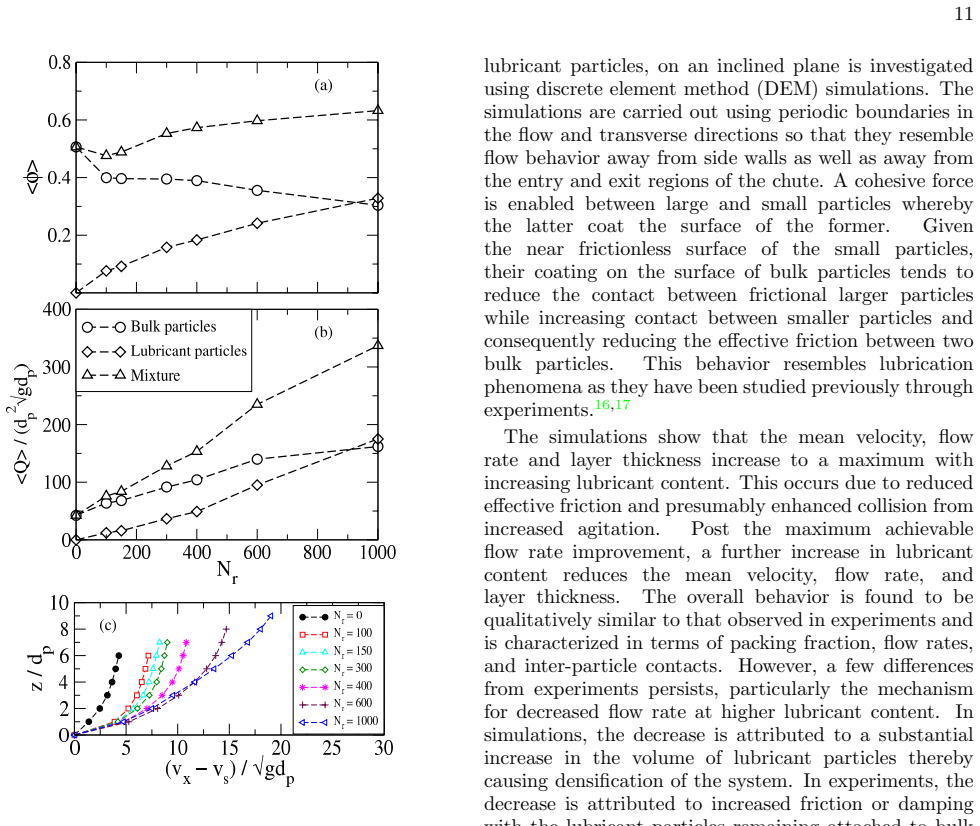
(a) Variation of steady-state mean volume fraction (⟨ϕ⟩) of particles (bulk, lubricant and mixture) in the flowing layer with the number ratio (N r). (b) Variation of steady-state, normalized, mean flow rate (⟨Q⟩/d 2 p p gdp) of particles (bulk, lubricant, and mixture) in the flowing layer with the number ratio (N r). (c) Variation of steady-state, normal...
work page 2019
-
[3]
pp. 779–782. 34T. Q. Huynh, T. T. Nguyen, and B. Indraratna, “Evaluating co- hesive models in discrete element simulation through drawdown test with new assessment perspectives,” Powder Technology452, 120542 (2025). 35C. J. Coetzee, “Simplified johnson-kendall-roberts (sjkr) contact model - implementation in pfc,” Tech. Rep. (University of Stellenbosch, S...
work page 2025
discussion (0)
Sign in with ORCID, Apple, or X to comment. Anyone can read and Pith papers without signing in.