Fusion of light nuclei in a multicluster realization of the three-body problem
Pith reviewed 2026-05-08 09:23 UTC · model grok-4.3
The pith
Treating light nuclei as clusters and solving the three-body problem with Faddeev equations produces fusion cross sections that match experimental data from 1 keV to 20 MeV.
A machine-rendered reading of the paper's core claim, the machinery that carries it, and where it could break.
Core claim
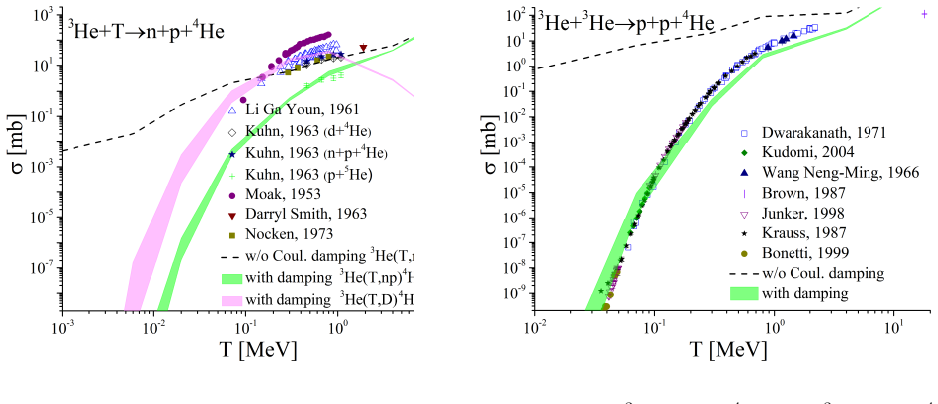
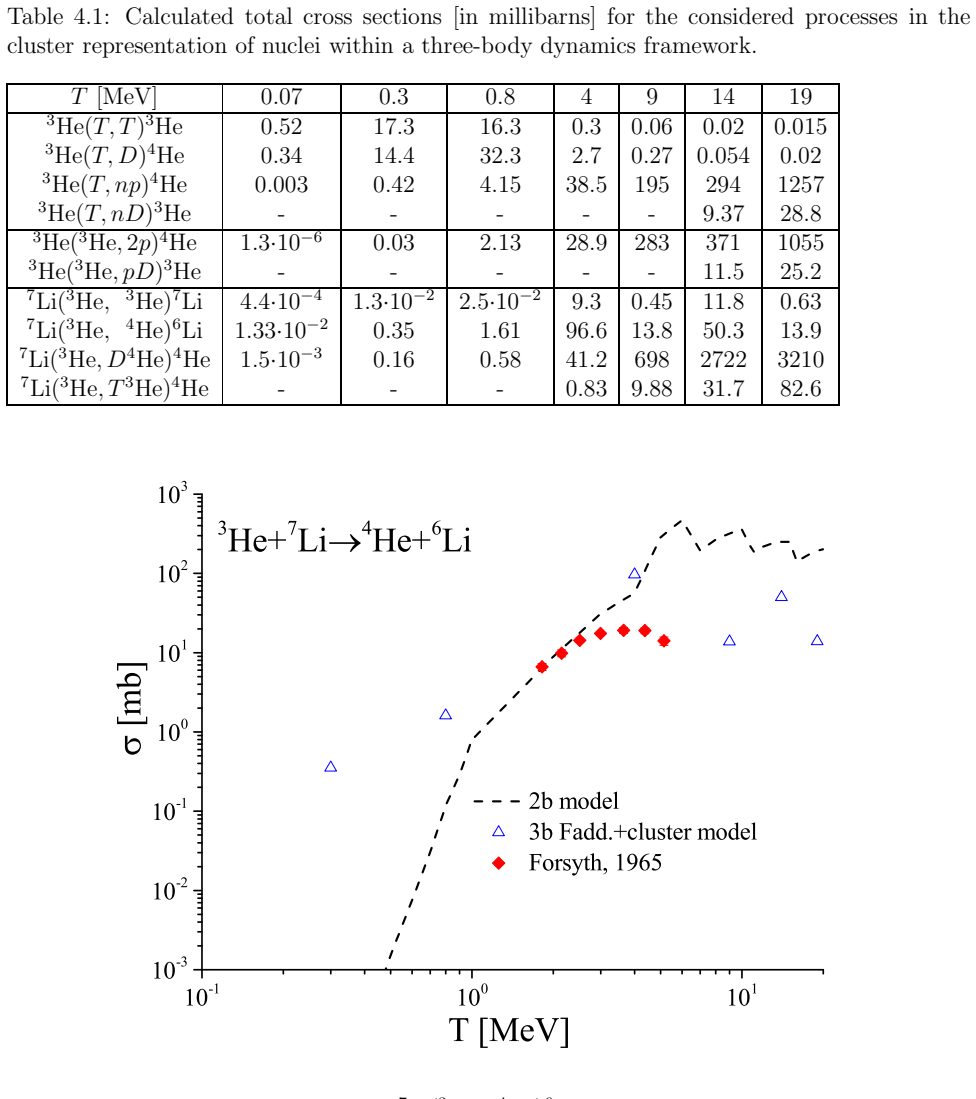
By representing both projectile and target nuclei in cluster form and solving the resulting three-body problem via Faddeev equations in momentum space, together with a two-potential treatment of the Coulomb t-matrix, the total cross sections for the reactions ^3He(T,D)^4He, ^3He(T,np)^4He, ^3He(T,nD)^3He, ^3He(^3He,2p)^4He, ^3He(^3He,pD)^3He, ^7Li(^3He,^4He)^6Li, ^7Li(^3He,D^4He)^4He, and ^7Li(^3He,T^3He)^4He are obtained. The contribution of the cluster mechanism to these cross sections in the kinetic energy range T in [1 keV, 20 MeV] is in good agreement with known experimental data.
What carries the argument
Faddeev integral equations in momentum space applied to multicluster realizations of the colliding nuclei, combined with the two-potential method for including Coulomb effects.
If this is right
- The cluster mechanism accounts for the bulk of the observed fusion cross sections in the studied reactions and energy window.
- Initial-state Coulomb interactions and off-shell effects of the Coulomb t-matrix can be quantified within the same framework.
- The same method applies directly to both fusion and breakup channels with two- or three-body final states.
- Electron anti-screening effects on the Coulomb interaction between nuclei can be estimated alongside the nuclear dynamics.
- The approach yields concrete numerical cross sections for each listed reaction rather than qualitative trends.
Where Pith is reading between the lines
- The method could supply predicted cross sections for unmeasured light-nucleus fusion reactions at similar energies.
- Results may be relevant for estimating reaction rates in astrophysical environments where light nuclei collide at low to moderate energies.
- Extending the same cluster-plus-Faddeev setup to include additional clusters or higher partial waves would test whether agreement persists.
- Discrepancies appearing below 1 keV could indicate the need for explicit atomic or molecular degrees of freedom not captured here.
Load-bearing premise
Representing the nuclei as clusters and solving the three-body problem with Faddeev equations in momentum space accurately describes the fusion dynamics and Coulomb interactions.
What would settle it
New precise measurements of the total cross section for any one of the listed reactions, such as ^3He(T,D)^4He, at an energy inside [1 keV, 20 MeV] that lie well outside the calculated cluster contribution.
Figures
read the original abstract
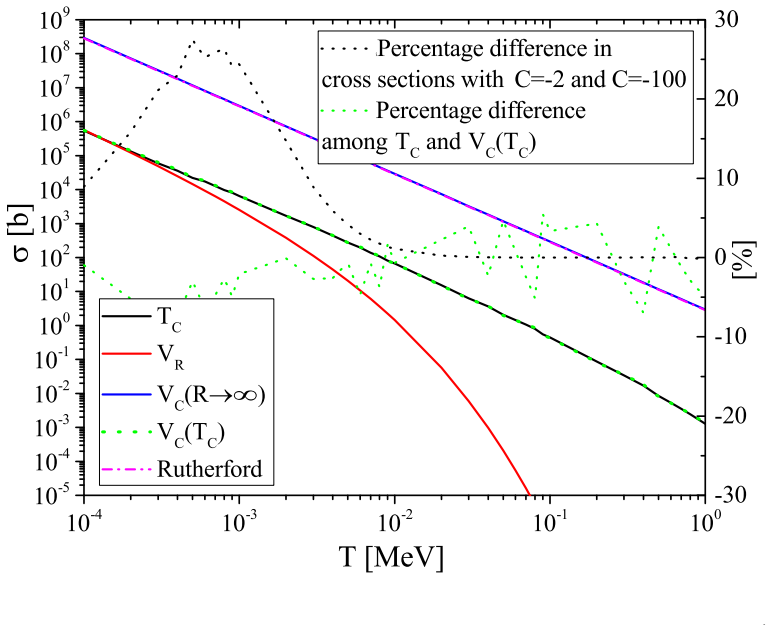
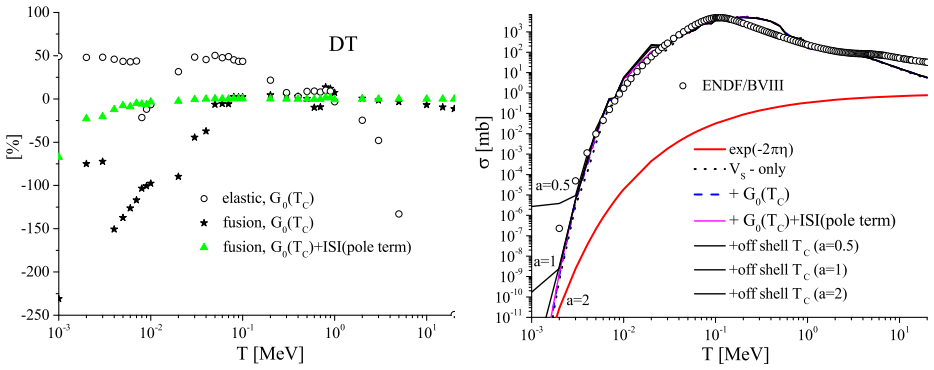
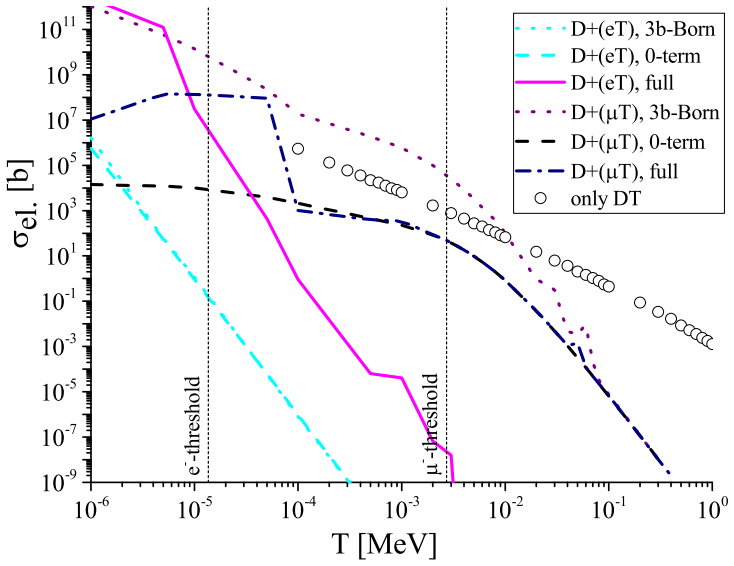
This work describes a few-body dynamics method based on the Faddeev integral equations in momentum space for determining the total cross sections of fusion and breakup reactions with two- and three-body final channels in the continuum, employing a cluster representation of the colliding nuclei. Total cross sections were obtained for the reactions $^3\text{He}(T,D)^4\text{He}$, $^3\text{He}(T,np)^4\text{He}$, $^3\text{He}(T,nD)^3\text{He}$, $^3\text{He}(^3\text{He},2p)^4\text{He}$, $^3\text{He}(^3\text{He},pD)^3\text{He}$, $^7\text{Li}(^3\text{He},\phantom{0}^4\text{He})^6\text{Li}$, $^7\text{Li}(^3\text{He},D^4\text{He})^4\text{He}$, and $^7\text{Li}(^3\text{He},T^3\text{He})^4\text{He}$, in which both the projectile and the target nucleus were treated in a cluster representation. The work also implements a two-potential method to determine the Coulomb $t-$matrix and to account for Coulomb effects in short-range dynamics in momentum space. Calculations of the initial-state Coulomb interaction were performed; furthermore, an estimate was obtained for the magnitude of the off-shell effect of the Coulomb $t-$matrix, as well as the magnitude of the atomic electron anti-screening effect on the Coulomb interaction of the colliding nuclei. The calculated contribution of the cluster mechanism to the total cross section of the considered fusion reactions in the kinetic energy range $T\in[1~\text{keV},20~\text{MeV}]$ is in good agreement with known experimental data.
Editorial analysis
A structured set of objections, weighed in public.
Referee Report
Summary. The paper develops a momentum-space Faddeev-equation approach to few-body nuclear reactions, representing the colliding nuclei as clusters and solving for total cross sections of fusion and breakup channels. It applies the method to eight specific reactions involving 3He, T, and 7Li, implements a two-potential formalism for the Coulomb t-matrix, performs initial-state Coulomb calculations, and estimates off-shell Coulomb and electron-screening corrections. The central claim is that the computed cluster-mechanism contribution agrees with experimental data over T ∈ [1 keV, 20 MeV].
Significance. If the technical issues are resolved, the work supplies a consistent three-body framework for isolating cluster contributions to light-nucleus fusion cross sections at astrophysically relevant energies. The explicit momentum-space treatment of Coulomb effects via the two-potential method and the systematic cluster decomposition constitute a methodological advance that could be extended to other systems once parameter independence and error control are demonstrated.
major comments (3)
- [§4 and results] §4 (Coulomb implementation) and the results section: the off-shell Coulomb t-matrix correction is only estimated and is not folded into the primary Faddeev solutions or the tabulated cross sections. Because the claimed agreement extends to T = 1 keV, where Coulomb distortion is largest, the paper must either recompute the cross sections with the off-shell term included or supply quantitative bounds demonstrating that the correction lies inside the experimental uncertainty bands.
- [Abstract and §3] Abstract and §3 (potentials): the nuclear cluster potentials and Coulomb t-matrix parameters are listed as free parameters, yet no table or appendix specifies their numerical values, functional forms, or whether they were adjusted to the same data sets used for validation. This information is required to evaluate whether the reported agreement is independent of the fitting procedure.
- [Results] Results section (comparison plots/tables): the manuscript asserts “good agreement” without reporting χ² values, systematic uncertainties, or sensitivity to the estimated off-shell and screening corrections. Adding these quantitative measures is necessary to substantiate the central claim.
minor comments (2)
- [§2] §2: the notation for the two-potential decomposition and the separation of short-range and Coulomb parts should be written explicitly with equation numbers for reproducibility.
- [Figures] Figures: experimental data points should be shown with their published uncertainties; the theoretical curves should include bands reflecting the estimated off-shell and screening uncertainties.
Simulated Author's Rebuttal
We thank the referee for the careful and constructive review. We address each major comment below and will revise the manuscript accordingly.
read point-by-point responses
-
Referee: [§4 and results] §4 (Coulomb implementation) and the results section: the off-shell Coulomb t-matrix correction is only estimated and is not folded into the primary Faddeev solutions or the tabulated cross sections. Because the claimed agreement extends to T = 1 keV, where Coulomb distortion is largest, the paper must either recompute the cross sections with the off-shell term included or supply quantitative bounds demonstrating that the correction lies inside the experimental uncertainty bands.
Authors: We acknowledge that the off-shell correction was estimated rather than included in the primary solutions. In the revision we will supply quantitative bounds derived from additional perturbative calculations, showing that the correction remains well inside the experimental uncertainty bands over the full range, including at 1 keV. This alternative satisfies the referee's requirement without a full recomputation of the Faddeev equations. revision: yes
-
Referee: [Abstract and §3] Abstract and §3 (potentials): the nuclear cluster potentials and Coulomb t-matrix parameters are listed as free parameters, yet no table or appendix specifies their numerical values, functional forms, or whether they were adjusted to the same data sets used for validation. This information is required to evaluate whether the reported agreement is independent of the fitting procedure.
Authors: We agree that the specific values and provenance of the parameters must be documented. The revised manuscript will contain a new appendix table listing the numerical values, functional forms, and sources of all nuclear cluster potentials and Coulomb t-matrix parameters, together with an explicit statement that these parameters were taken from independent literature determinations and were not adjusted to the validation data sets. revision: yes
-
Referee: [Results] Results section (comparison plots/tables): the manuscript asserts “good agreement” without reporting χ² values, systematic uncertainties, or sensitivity to the estimated off-shell and screening corrections. Adding these quantitative measures is necessary to substantiate the central claim.
Authors: We accept that quantitative statistical measures are needed. The revised results section will report χ² values for each reaction, estimates of systematic uncertainties, and a sensitivity study showing the effect of the off-shell and screening corrections on the cross sections. These additions will provide a rigorous basis for the agreement statement. revision: yes
Circularity Check
No circularity: calculations presented as independent of the compared data
full rationale
The abstract and provided text describe a first-principles approach using Faddeev equations in momentum space, cluster representations of nuclei, and a two-potential method for Coulomb t-matrix effects. Cross sections are computed for specific reactions, with separate estimates given for off-shell Coulomb t-matrix and anti-screening effects. The agreement with experimental data is stated as an outcome of these computations for the cluster mechanism contribution over the stated energy range. No equations, self-citations, or parameter-fitting steps are quoted that reduce the reported results to the data by construction or rename fitted inputs as predictions. The derivation chain remains self-contained as a theoretical model evaluated against external benchmarks.
Axiom & Free-Parameter Ledger
free parameters (2)
- nuclear cluster potentials
- Coulomb t-matrix parameters
axioms (2)
- standard math Faddeev integral equations provide an exact solution for three-body scattering problems
- domain assumption Cluster representation of nuclei is sufficient for describing the fusion dynamics
Reference graph
Works this paper leans on
-
[1]
A. Anikeev, V. Artisiuk, M. Ascic, S. Ashraf, M. Barbarino, J. Ba rton, C. Bellehumeur, G. Catena, W. Chae Kim, C. Cheong, J. Donovan, G. Federici, M. Finn erty, N. Gan- zarski, A. Goodman, A. Jasper, et al, IAEA World Fusion Outlook 2024 [electronic source]: https://www.iaea.org/publications/15777/iaea-world-fusion-outlook-2024
work page 2024
-
[2]
Yu. E. Penionzhkevich, R. G. Kalpakchieva, R. G., Light Exotic Nuclei Near the Boundary of Neutron Stability , (World Scientific Publ., 2021)
work page 2021
- [3]
-
[4]
K. D. Launey, G. H. Sargsyan, A. Mercenne, J. E. Escher, D. C . Mumma, Ab initio symmetry-adapted approaches to nuclear reactions, Prog. Par t. Nucl. Phys. 148, 104233 (2026)
work page 2026
-
[5]
W. Gl¨ ockle, J. Golak, R. Skibi´ nski, H. Wita/suppress la H., Exact three-dimensional wave function and the on-shell t-matrix for the sharply cut off Coulomb potential: failure of the standard renormalization factor, Phys. Rev. C 79, 044003 (2009)
work page 2009
-
[6]
K. Kouzakov, Yu. V. Popov, V. L. Shablov, Comment on ¡¡Exact th ree-dimensional wave function and the on-shell t-matrix for the sharply cut-off Coulomb potential: Failure of the standard renormalization factor¿¿, Phys. Rev. C 81, 019801 (2010)
work page 2010
-
[7]
A. Deltuva, A. C. Fonseca, P. U. Sauer, Comment on ¡¡Exact thre e-dimensional wave function and the on-shell t-matrix for the sharply cut-off Coulomb potential: Failure of the standard renormalization factor¿¿, Phys. Rev. C 81, 019802 (2010)
work page 2010
-
[8]
M. Aliotta, F. Raiola, G. Gy¨ urky, A. Formicola, R. Bonetti, C. Bro ggini, L. Campajola, P. Corisiero, H. Costantini, A. D’Onofrio, Z. F¨ ul¨ op, G. Gervino, L.Gialanella, A. Gudliel- metti, C. Gustavino, G. Imbriani, et al. , Electron screening effect in the reactions 3He(d, p)4He and d( 3He, p) 4He, Nucl. Phys. A 690, 790 (2001)
work page 2001
-
[9]
S. Engstler, A. Krauss, K. Neldner, C. Rolfs, U. Schr¨ oder, K. Langanke, Effects of electron screening on the 3He(d, p) 4He low-energy cross sections, Phys. Lett. B 202, 179 (1988)
work page 1988
-
[10]
P. Pratti, C. Arpesella, F. Bartolucci, H. W. Becker, E. Bellotti, C. Broggini, P. Corvisiero, G. Fiorentino, A. Fubini, G. Gervino, F. Gorris, U. Greife, C. Gustav ino, M. Junker, C. Rolfs, W. H. Schulte, et al. , Electron screening in the d+ 3He fusion reaction, Zeitschrift f¨ ur Physik A350, 171 (1994) 28
work page 1994
- [11]
-
[12]
D., Faddeev, Scattering theory for a three-particle syste m, Sov
L. D., Faddeev, Scattering theory for a three-particle syste m, Sov. Phys. JETP, 12, 1014 (1961)
work page 1961
-
[13]
O. A. Yakubovsky, On the Integral equations in the theory of N particle scattering, Sov. J. Nucl. Phys. 5, 937 (1967)
work page 1967
-
[14]
S. P. Merkuriev, On the Three-body Coulomb scattering proble m, Annals of Physics 130, 395 (1980)
work page 1980
-
[15]
I. Lombardo, D. Dell’Aquila, Clusters in light nuclei: history and rec ent developments, La Rivista del Nuovo Cimento 46, 521 (2023)
work page 2023
-
[16]
S. S. Perrotta, M. Colonna, J. A. Lay, Clustering effects in the 6Li(p,3He)4He reaction at astrophysical energies, Few-Body systems 65, 49 (2024)
work page 2024
-
[17]
L. Garrido-G´ omez, A. Vegas-D ´ ıaz, J. P. Fern´ andez-Garc´ ıa, M. A. G. Alvarez, Systematic optical potentials for reactions with cluster-structured nuclei, P hys. Rev. C 109, 054608 (2025)
work page 2025
-
[18]
J. A. Wheeler, On the mathematical description of light nuclei by the method of resonating group, Phys. Rev. 52, 1107 (1937)
work page 1937
-
[19]
K. Wildermuth, Y. C. Tang, A unified theory of the nucleus (Academic Press, New York, San Francisco, London, 1977)
work page 1977
- [20]
- [21]
-
[22]
Descovemont, Microscopic models for nuclear rates, J
P. Descovemont, Microscopic models for nuclear rates, J. Phy s. G: Nucl. Part. Phys. 19, S141 (1993)
work page 1993
-
[23]
Y. Fujiwara, Y. C. Tang, Reaction cross sections in light nuclear systems wih the multi- configuration resonating-group method, Prog. Theor. Phys. 93, 711 (1995)
work page 1995
-
[24]
Yu. A. Lashko, V. S. Vasilevsky, V. I. Zhaba, Many-channel m icroscopic theory of resonance states and scattering processes in 9Be and 9B, Phys. Rev. C 109, 045803 (2024)
work page 2024
-
[25]
P. Navr´ atil, S. Quaglioni, R. Roth, W. Horiuchi, Ab initio calculaions of light-ion reactions, Prog. Theor. Phys. Suppl. 196, 117 (2012)
work page 2012
-
[26]
Kawai, Formalism of the method of coupled discretized continu um channels, Prog
M. Kawai, Formalism of the method of coupled discretized continu um channels, Prog. Theor. Phys. Suppl. 89, 11 (1986)
work page 1986
- [27]
-
[28]
F. A. Souza, A. Szanto de Toledo, N. Carlin, R. Liguori Neto, A. A. Suaide, M. M. Moura, E. M. Szano, M. G. Munhoz, J. Takahashi, C. Beck, S. J. Sanders, Fusion of weakly bound light nuclei, Nucl. Phys. A 718, 544c (2003)
work page 2003
-
[29]
H. Guo, Y. Watanabe, T. Matsumoto, K. Nagaoka, K. Ogata, M . Yahiro, Analysis of nucleon and trion emissions from nucleon- 7Li collisions below 20 MeV, Phys. Rev. C 99, 034602 (2019)
work page 2019
-
[30]
D. Ichinkhorloo, Y. Hirabayashi, K. Kat¯ o, M. Aikawa, T. Matsu moto, S. Chiba, Analysis of 7Li(n, n ′)7Li∗ reactions using he continuum-discretized coupled-channels mehod , Phys. Rev. C 86, 064604 (2012)
work page 2012
-
[31]
A. Diez-Torres, I. J. Thompson, C. Beck, How does breakup in fluence the total fusion of 6, 7Li at the Coulomb barrier? Phys. Rev. C 68, 044607 (2003)
work page 2003
- [32]
- [33]
- [34]
- [35]
-
[36]
M. V. Egorov, Inelastic scattering of fast neutrons on 6Li and 7Li nuclei in three-body cluster model, Nucl. Phys. A 986, 175 (2019)
work page 2019
-
[37]
M. V. Egorov, V. I. Postnikov, Deuteron inelastic scattering o n 6Li and 7Li nuclei within the three-body cluster model, Chinese Physics C 45, 014108 (2021)
work page 2021
-
[38]
A. Deltuva, A. C. Fonseca, Three-body Faddeev-Alt-Grassb erger-Sandhas approach to direct nuclear reactions, Phys. Rev. C 79, 014606 (2009)
work page 2009
-
[39]
M. Egorov, Three-dimensional integral Faddeev equations wit hout a certain symmetry, Few-Body Systems 66, 24 (2025)
work page 2025
-
[40]
P. D. Forsyth, R. R. Perry, The Li7(He 3, α )Li6 reaction between 1.3 and 5.5 MeV, Nucl. Phys. 67, 517 (1965)
work page 1965
-
[41]
J. Haidenbauer, Y. Koike, Separable representation of he Bon n nucleon-nucleon potential, Phys. Rev. C 33, 439 (1986)
work page 1986
-
[42]
W. Gl¨ ockle, H. Wita/suppress la, D. H¨ uber, H. Kamada, J. Golak, The three-nucleon continuum: achievements, challenges and applications, Physics Reports 274, 107 (1996). 30
work page 1996
-
[43]
S. I., Vinitskii, L. I. Ponomarev, The adiabatic representation in the three-body problem with the Coulomb interaction, Sov. J. Part. Nucl. 13, 557 (1982)
work page 1982
-
[44]
B. K´ onya, G. L´ evai, Z. Papp, Continued fraction representation of the Coulomb Green’s operator and unified description of bound, resonant and scatter ing states, Phys. Rev. C 61, 034302 (2000)
work page 2000
-
[45]
V. I. Kukulin, O. A. Rubtsova, Solving the scattering problem fo r charged particles by means of the packet discretization of the continuum, Theor. Math . Phys. 145, 1711 (2005)
work page 2005
-
[46]
Sh. Oryu, Two- and three-charged-particle nuclear scatter ing in momentum space: A two- potential theory and a boundary condition model, Phys. Rev. C 73, 054001 (2006)
work page 2006
-
[47]
Sh. Oryu, Y. Hiratsuka, T. Watanabe, Few-body problem in nuc lear reactions Beyond the horizon of the three-body Faddeev equations , EPJ Web of Conferences 122, 08001 (2016)
work page 2016
-
[48]
S. P. Merkuriev, On the three-body coulomb scattering proble m, Annals of Physics 130, 395 (1980)
work page 1980
-
[49]
Evaluated Nuclear Structure Data File (ENSDF) [electronic sour ce] / National Nuclear Data Center, Brookhaven National Laboratory: http://www.nnd c.bnl.gov/ensdf/
-
[50]
Li Ga Youn, G. M. Osetinskii, N. Sodnom, A. M. Govorov, I. V. Siz ov, V. I. Salatski, Investigation of the He 3 + H 3 reaction, Soviet Physics JETP 12, 163 (1961)
work page 1961
- [51]
-
[52]
C. D. Moak, A study of the H 3 + He 3 reactions, Phys. Rev. 92, 383 (1953)
work page 1953
-
[53]
D. B. Smith, N. Jarmie, A. M. Lockett, He 3 + t reactions, Phys. Rev. 129, 785 (1963)
work page 1963
- [54]
-
[55]
M. R. Dwarakanath, H. Winkler, 3He(3He, 2p)4He total cross-section measurement below the coulomb barrier, Phys. Rev. C 4, 1532 (1971); 3He(3He, 2p)4He and the termination of the proton-proton chain, Phys. Rev. C 9, 805 (1974)
work page 1971
- [56]
-
[57]
W. Neng-Ming, B. N. Osetinskii, Ch. Nai-Kung, I. A. Chepushenk o, Investigation of 3He+3He reaction, Soviet J. of Nucl. Phys. 3, 777 (1966)
work page 1966
-
[58]
R. E. Brown, F. D. Correll, P. M. Hegland, J. A. Koepke, C. H. Po ppe, 3He+3He recation cross sections at 17.9,21.7 and 24.0 MeV, Phys. Rev. C 35, 383 (1987). 31
work page 1987
-
[59]
M. Junker, A. D’Alessandro, S. Zavatarelli, C. Arpesella, E. Bello tti, C. Broggini, P. Corvisiero, G. Fiorentini, A. Fubini, G. Gervino, U. Greife, C. Gustav ino, J. Lambert, P. Prati, W. S. Rodney, C. Rolfs, et al., Cross section of 3He(3He, 2p)4He measured at solar energies, Phys. Rev. C 57, 2700 (1998)
work page 1998
- [60]
-
[61]
R. Bonetti, C. Broggini, L. Campajola, P. Corvisiero, A. D’Alessa ndro, M. Dessalvi, A. D’Onofrio, A. Fubini, G. Gervino, L. Gialanella, U. Greife, A. Guglielmett i, C. Gustavino, G. Imbriani, M. Junker, P. Prati et al., First direct measurement of the 3He(3He,2p)4He cross section within the Solar Gamov peak, Phys. Rev. Lett. 82, 5205 (1999)
work page 1999
-
[62]
H. L¨ udecke, Tan Wan-Tjin, H. Werner, J. Zimmerer, The ract ions 6Li(3He,3He0)6Li, 6Li(d,d0)6Li, 7Li(d,d0)7Li and 6Li(3He,d0, 1)7Be, Nucl. Phys. A 109, 676 (1968). 32
work page 1968
discussion (0)
Sign in with ORCID, Apple, or X to comment. Anyone can read and Pith papers without signing in.