Mechanical Scaling Laws and Deformation Behavior of Nanoporous Tantalum Microparticles
Pith reviewed 2026-05-08 11:12 UTC · model grok-4.3
The pith
Nanoporous tantalum microparticles follow Gibson-Ashby scaling laws for stiffness and hardness because of strong ligament connectivity from the dealloying bath.
A machine-rendered reading of the paper's core claim, the machinery that carries it, and where it could break.
Core claim
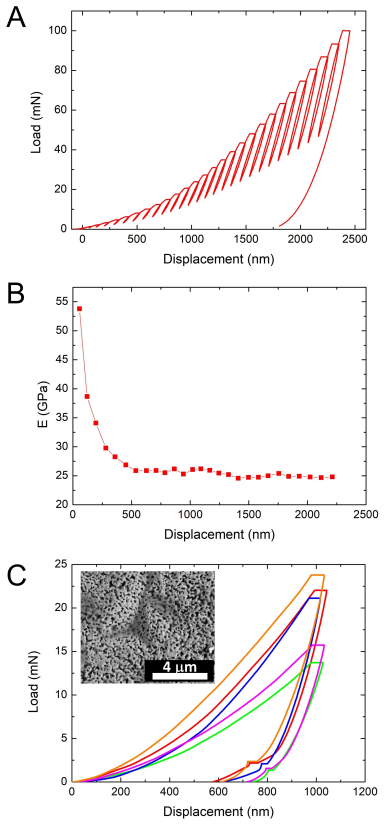
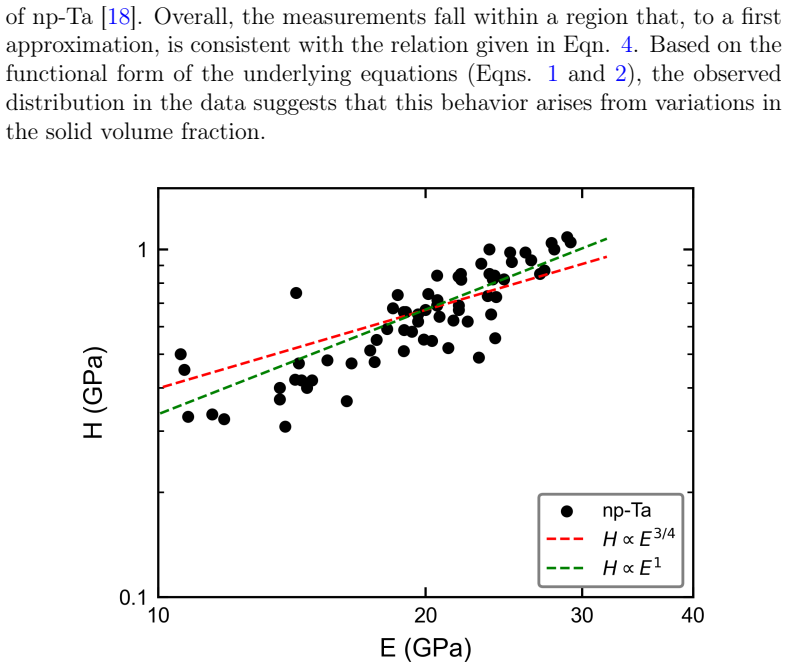
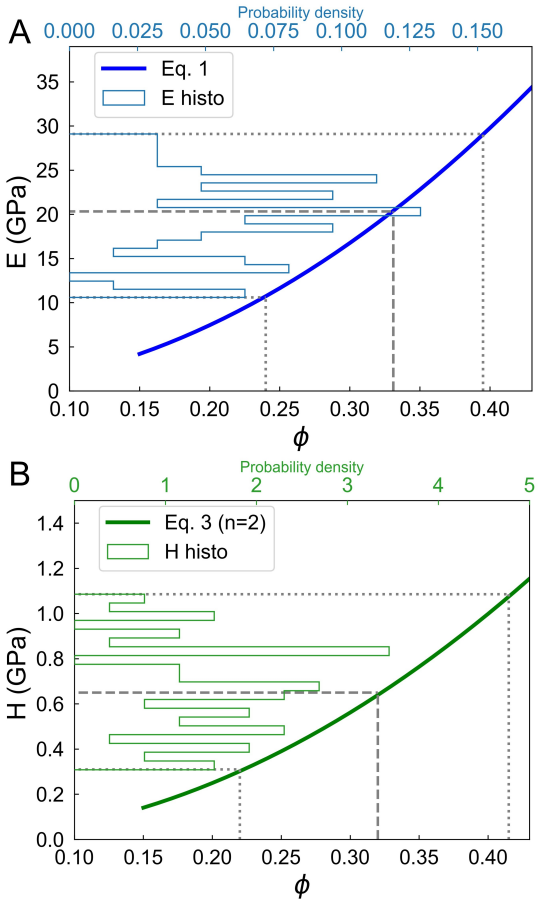
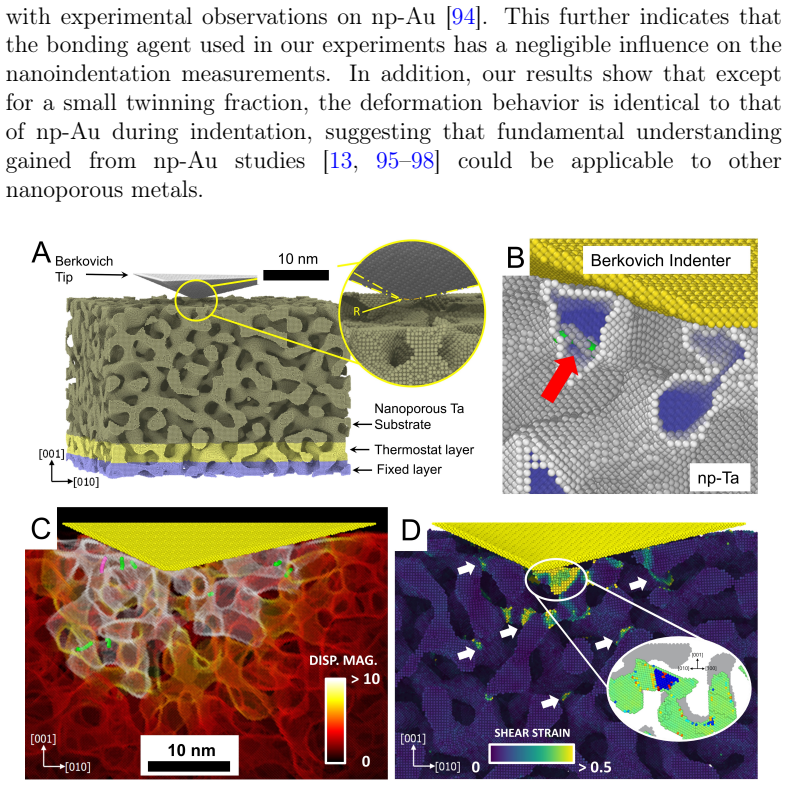
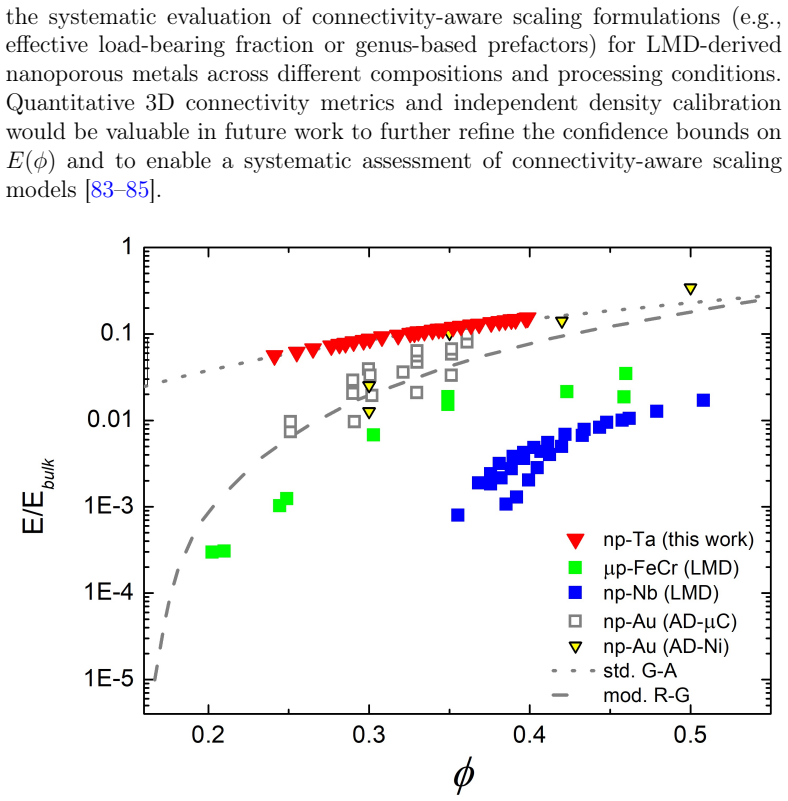
Nanoindentation on individual np-Ta microparticles gives elastic moduli of 10-30 GPa and hardness values of 0.3-1.1 GPa. Both quantities scale with solid volume fraction according to Gibson-Ashby predictions for foams. The stiffness-density response departs from that of nanoporous gold and is traced to enhanced ligament connectivity enabled by the CuBi metal bath. Molecular dynamics simulations show dislocation-dominated plasticity and limited densification beneath indents, ruling out exotic deformation mechanisms.
What carries the argument
Enhanced ligament connectivity in the solid network, produced by the thermodynamics of the CuBi bath during liquid metal dealloying.
If this is right
- Solvent chemistry in liquid metal dealloying can be used as a control variable to set ligament connectivity and therefore the mechanical scaling of nanoporous metals.
- The same Gibson-Ashby scaling relations apply to nanoporous tantalum as to conventional open-cell foams.
- Plasticity in these structures proceeds by dislocation glide with only modest local densification under load.
- Mechanical response of nanoporous metals is tunable without changing the base metal or the pore size.
Where Pith is reading between the lines
- The solvent-tuning approach could be applied to other base metals to produce nanoporous structures with more predictable stiffness for lightweight applications.
- Direct measurements of junction density across different dealloying baths would test how strongly bath thermodynamics controls connectivity.
- The observed scaling suggests that nanoporous metals made by liquid metal dealloying may achieve higher strength-to-weight ratios than those made by electrochemical methods.
Load-bearing premise
The match to Gibson-Ashby scaling and the contrast with nanoporous gold arise specifically from better ligament connectivity created by the CuBi bath rather than from material differences or measurement details.
What would settle it
Quantitative comparison of the number and strength of ligament junctions per volume in np-Ta versus np-Au, or repeating the nanoindentation tests on np-Ta made with a different dealloying solvent.
Figures
read the original abstract
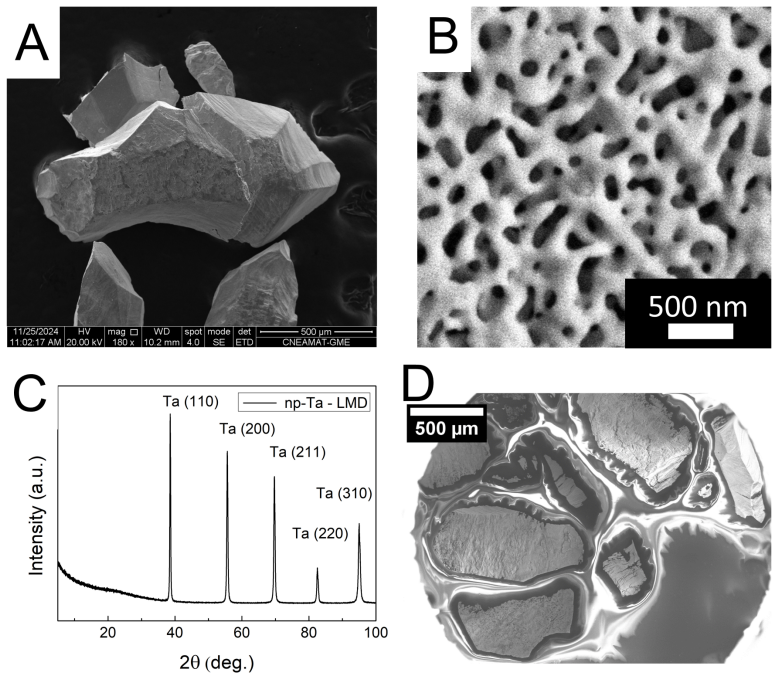
The mechanical scaling laws of dealloyed nanoporous metals depart from classical Gibson-Ashby predictions for open-cell foams due to a decreased connectivity in their solid network. However, these scaling relations have been established almost exclusively on nanoporous gold produced by electrochemical dealloying, and it is an outstanding question whether the relations apply to nanoporous networks fabricated by other dealloying methods. Here, we investigate the mechanical response of single-crystalline nanoporous tantalum (np-Ta) produced by liquid metal dealloying (LMD) a TiTa alloy in molten CuBi. Nanoindentation of individual microparticles yields an elastic modulus of 10-30 GPa and a hardness of 0.3-1.1 GPa, both scaling with the solid volume fraction in agreement with Gibson-Ashby predictions. This stiffness-density response of np-Ta departs from previous reports on nanoporous gold and is attributed to enhanced ligament connectivity enabled by the thermodynamics of the CuBi metal bath. Molecular dynamics simulations reveal dislocation-dominated plasticity during indentation of np-Ta, consistent with scanning electron microscopy observations of limited densification beneath the indents, ruling out unusual deformation mechanisms as an origin of the observed scaling. These findings identify solvent chemistry in LMD as a tunable lever for ligament connectivity, and thus for the mechanical response of nanoporous metals.
Editorial analysis
A structured set of objections, weighed in public.
Referee Report
Summary. The paper claims that single-crystalline nanoporous tantalum microparticles produced by liquid metal dealloying in a CuBi bath exhibit elastic moduli of 10-30 GPa and hardnesses of 0.3-1.1 GPa that scale linearly with solid volume fraction in agreement with Gibson-Ashby predictions for open-cell foams. This behavior is reported to depart from prior nanoporous gold results and is attributed to enhanced ligament connectivity arising from the thermodynamics of the CuBi dealloying bath. Molecular dynamics simulations and SEM observations are used to establish that deformation proceeds via conventional dislocation plasticity without unusual mechanisms or significant densification.
Significance. If the scaling agreement and mechanistic interpretation hold, the work demonstrates that dealloying solvent chemistry can serve as a tunable parameter for controlling network connectivity and thus the mechanical response of nanoporous metals, providing a contrast to electrochemical dealloying routes. The combination of nanoindentation on individual microparticles, MD simulations ruling out anomalous plasticity, and SEM imaging of limited densification supplies useful experimental and mechanistic grounding.
major comments (3)
- [Results (nanoindentation)] Results section (nanoindentation measurements): The elastic modulus and hardness values are reported as ranges (10-30 GPa and 0.3-1.1 GPa) without accompanying error bars, standard deviations, or the number of independent microparticles tested per solid-volume-fraction value. This absence prevents quantitative assessment of the robustness of the claimed linear scaling with solid fraction and the statistical significance of any departure from nanoporous-gold data.
- [Discussion] Discussion section (attribution of scaling): The claim that the observed Gibson-Ashby scaling and departure from nanoporous-gold behavior arise specifically from 'enhanced ligament connectivity enabled by the thermodynamics of the CuBi metal bath' is not supported by direct topological quantification. No metrics such as average node coordination number, Euler characteristic, or percolation properties are provided for np-Ta versus np-Au at matched densities, leaving material differences (Ta vs. Au yield strength or surface energy) or microparticle geometry as viable alternative explanations.
- [Methods / MD simulations] Methods and simulation sections: The molecular dynamics simulations address only the post-indentation dislocation activity and plasticity mechanism. They do not model or quantify the initial ligament network topology or connectivity, which is the load-bearing element invoked to explain why np-Ta follows Gibson-Ashby scaling while np-Au does not.
minor comments (2)
- [Abstract] Abstract and introduction: The statement that the stiffness-density response 'departs from previous reports on nanoporous gold' would benefit from explicit citation of the specific np-Au density range and measurement conditions used for comparison.
- [Methods] Methods: The procedure for determining solid volume fraction of individual microparticles (e.g., from SEM images or mass measurements) should include any assumptions, calibration steps, and associated uncertainties.
Simulated Author's Rebuttal
We thank the referee for their thorough review and insightful comments on our manuscript. We address each major comment point by point below, providing the strongest honest responses possible. We have revised the manuscript where the comments identify clear gaps in presentation or support.
read point-by-point responses
-
Referee: Results section (nanoindentation measurements): The elastic modulus and hardness values are reported as ranges (10-30 GPa and 0.3-1.1 GPa) without accompanying error bars, standard deviations, or the number of independent microparticles tested per solid-volume-fraction value. This absence prevents quantitative assessment of the robustness of the claimed linear scaling with solid fraction and the statistical significance of any departure from nanoporous-gold data.
Authors: We agree that the absence of explicit statistical details limits the ability to assess robustness. The reported ranges summarize measurements across multiple microparticles, but we will revise the Results section and associated figures to report the number of independent tests performed per solid volume fraction (typically 8–12 particles), standard deviations, and error bars. This addition will enable quantitative evaluation of the linear scaling and direct comparison to nanoporous gold data. revision: yes
-
Referee: Discussion section (attribution of scaling): The claim that the observed Gibson-Ashby scaling and departure from nanoporous-gold behavior arise specifically from 'enhanced ligament connectivity enabled by the thermodynamics of the CuBi metal bath' is not supported by direct topological quantification. No metrics such as average node coordination number, Euler characteristic, or percolation properties are provided for np-Ta versus np-Au at matched densities, leaving material differences (Ta vs. Au yield strength or surface energy) or microparticle geometry as viable alternative explanations.
Authors: We acknowledge that direct topological metrics (e.g., node coordination or Euler characteristic) would provide stronger, unambiguous support for the connectivity interpretation. The manuscript relies on the functional evidence of linear Gibson-Ashby scaling—itself a signature of high-connectivity open-cell structures—together with the clear contrast to sub-linear scaling in electrochemically dealloyed nanoporous gold and the known thermodynamics of the CuBi bath that favor more complete ligament formation. We will expand the Discussion to explicitly consider alternative explanations (material properties, geometry) and to clarify that connectivity is inferred from the mechanical response and processing conditions rather than directly quantified. No new topological analysis is added at this stage. revision: partial
-
Referee: Methods and simulation sections: The molecular dynamics simulations address only the post-indentation dislocation activity and plasticity mechanism. They do not model or quantify the initial ligament network topology or connectivity, which is the load-bearing element invoked to explain why np-Ta follows Gibson-Ashby scaling while np-Au does not.
Authors: The MD simulations were performed specifically to examine the active deformation mechanism during indentation, confirming conventional dislocation plasticity and ruling out anomalous mechanisms that could produce apparent scaling. The initial ligament network topology is characterized experimentally via SEM imaging of the as-fabricated microparticles and is attributed to the LMD process in the CuBi bath. We will revise the text to more clearly delineate these roles: MD excludes mechanism-based origins for the observed scaling, while connectivity is supported by the scaling agreement itself and the dealloying thermodynamics. The simulations do not claim to quantify the pristine network topology. revision: partial
Circularity Check
No circularity: direct experimental comparison to independent Gibson-Ashby model
full rationale
The paper reports nanoindentation data on elastic modulus (10-30 GPa) and hardness (0.3-1.1 GPa) for np-Ta microparticles produced by liquid metal dealloying. These quantities are stated to scale with solid volume fraction in agreement with the pre-existing Gibson-Ashby relations for open-cell foams. This is a direct comparison to an external, independently derived model rather than a fit to the present dataset followed by a renamed prediction. Molecular dynamics simulations address post-indentation dislocation plasticity separately and do not feed back into the scaling claim. No equations, fitted parameters, or self-citations are shown to reduce the central result to its own inputs by construction. The attribution of scaling differences to CuBi-bath connectivity is an interpretive inference, not a mathematical derivation that loops back on itself. The chain is therefore self-contained against external benchmarks.
Axiom & Free-Parameter Ledger
axioms (1)
- domain assumption Gibson-Ashby scaling laws for open-cell foams apply to nanoporous metals when ligament connectivity is sufficiently high.
Reference graph
Works this paper leans on
-
[1]
L. Montemayor, V. Chernow, J. R. Greer, Materials by design: Using architecture in material design to reach new property spaces, Mrs Bulletin 40 (12) (2015) 1122–1129
work page 2015
-
[2]
J. R. Greer, V. S. Deshpande, Three-dimensional architected materials and structures: Design, fabrication, and mechanical behavior, MRS Bulletin 44 (10) (2019) 750–757
work page 2019
-
[3]
J. U. Surjadi, B. F. Aymon, M. Carton, C. M. Portela, Double-network- inspired mechanical metamaterials, Nature Materials (2025) 1–10
work page 2025
-
[4]
J. U. Surjadi, C. M. Portela, Enabling three-dimensional architected materials across length scales and timescales, Nature Materials (2025) 1–13
work page 2025
-
[5]
S. Shi, Y. Li, B.-N. Ngo-Dinh, J. Markmann, J. Weissmüller, Scaling behavior of stiffness and strength of hierarchical network nanomaterials, Science 371 (6533) (2021) 1026–1033. 20
work page 2021
-
[6]
A. Vyatskikh, S. Delalande, A. Kudo, X. Zhang, C. M. Portela, J. R. Greer, Additive manufacturing of 3d nano-architected metals, Nature communications 9 (1) (2018) 593
work page 2018
- [7]
- [8]
- [9]
-
[10]
C. M. Portela, A. Vidyasagar, S. Krödel, T. Weissenbach, D. W. Yee, J. R. Greer, D. M. Kochmann, Extreme mechanical resilience of self-assembled nanolabyrinthine materials, Proceedings of the National Academy of Sciences 117 (11) (2020) 5686–5693
work page 2020
-
[11]
L. A. Shaw, F. Sun, C. M. Portela, R. I. Barranco, J. R. Greer, J. B. Hopkins, Computationally efficient design of directionally compliant metamaterials, Nature communications 10 (1) (2019) 291
work page 2019
-
[12]
Y. Wu, J. Markmann, E. T. Lilleodden, On the consequences of intrinsic and extrinsic size effects on the mechanical response of nanoporous au, Materials & Design 232 (2023) 112175
work page 2023
- [13]
- [14]
-
[15]
G. Wittstock, M. Bäumer, W. Dononelli, T. Klüner, L. Lührs, C. Mahr, L. V. Moskaleva, M. Oezaslan, T. Risse, A. Rosenauer, et al., Nanoporous gold: from structure evolution to functional properties in 21 catalysis and electrochemistry, Chemical reviews 123 (10) (2023) 6716– 6792
work page 2023
-
[16]
E. M. Bringa, J. Monk, A. Caro, A. Misra, L. Zepeda-Ruiz, M. Duchaineau, F. Abraham, M. Nastasi, S. T. Picraux, Y. Wang, et al., Are nanoporous materials radiation resistant?, Nano letters 12 (7) (2012) 3351–3355
work page 2012
-
[17]
C.J.Ruestes, D.Farkas, J.Snyder, Nanoporousmetalsunderextremes, MRS bulletin (2025) 1–11
work page 2025
- [18]
- [19]
-
[20]
T. Wada, A. D. Setyawan, K. Yubuta, H. Kato, Nano-to submicro- porousβ-ti alloy prepared from dealloying in a metallic melt, Scripta Materialia 65 (6) (2011) 532–535
work page 2011
-
[21]
T. Wada, K. Yubuta, A. Inoue, H. Kato, Dealloying by metallic melt, Materials Letters 65 (7) (2011) 1076–1078
work page 2011
- [22]
-
[23]
S. A. Berger, I. V. Okulov, Open porousα+βtitanium alloy by liquid metal dealloying for biomedical applications, Metals 10 (11) (2020) 1450
work page 2020
-
[24]
T. Wada, H. Kato, Three-dimensional open-cell macroporous iron, chromium and ferritic stainless steel, Scripta Materialia 68 (9) (2013) 723–726
work page 2013
-
[25]
Y.-H. Xiang, L.-Z. Liu, J.-C. Shao, H.-J. Jin, A universal scaling relationship between the strength and young’s modulus of dealloyed porous fe0. 80cr0. 20, Acta Materialia 186 (2020) 105–115. 22
work page 2020
- [26]
- [27]
- [28]
-
[29]
T. Song, H. Tang, Y. Li, M. Qian, Liquid metal dealloying of titanium- tantalum (ti-ta) alloy to fabricate ultrafine ta ligament structures: A comparative study in molten copper (cu) and cu-based alloys, Corrosion Science 169 (2020) 108600
work page 2020
-
[30]
L. Lai, B. Gaskey, A. Chuang, J. Erlebacher, A. Karma, Topological control of liquid-metal-dealloyed structures, Nature Communications 13 (1) (2022) 2918
work page 2022
-
[31]
J. W. Kim, T. Wada, S. G. Kim, H. Kato, Sub-micron porous niobium solid electrolytic capacitor prepared by dealloying in a metallic melt, Materials Letters 116 (2014) 223–226
work page 2014
- [32]
-
[33]
S. Sohn, S. Shi, J. Markmann, S. A. Berger, J. Weissmüller, Compressive behavior and connecting topology of monolithic nanoporous niobium, Materials Research Letters 13 (1) (2025) 76–85
work page 2025
-
[34]
C. Zhao, T. Wada, V. De Andrade, G. J. Williams, J. Gelb, L. Li, J. Thieme, H. Kato, Y.-c. K. Chen-Wiegart, Three-dimensional morphological and chemical evolution of nanoporous stainless steel by liquid metal dealloying, ACS applied materials & interfaces 9 (39) (2017) 34172–34184. 23
work page 2017
-
[35]
A. V. Okulov, S.-H. Joo, H. S. Kim, H. Kato, I. V. Okulov, Nanoporous high-entropy alloy by liquid metal dealloying, Metals 10 (10) (2020) 1396
work page 2020
-
[36]
T. Wada, A. Nakata, R. Song, H. Kato, Accelerated structural ordering during liquid metal dealloying and its effect on thermal coarsening of nanoporous refractory alloys, Scripta Materialia 247 (2024) 116120
work page 2024
-
[37]
J. H. Lee, S. V. Ha, J. Seong, A. Takeuchi, R. Song, H. Kato, S.-H. Joo, Development of 3d interconnected nanoporous tizrhfnbtani high- entropy alloy via liquid metal dealloying and subsequent synthesis of (tizrhfnbtani) o high-entropy oxide, Journal of Materials Research and Technology 35 (2025) 5204–5215
work page 2025
-
[38]
J. H. Lee, J. Seong, S.-H. Joo, H. Kato, Nanoporous high-entropy alloys fabricated by liquid metal dealloying and surface anodizing for enhanced electrochemical performance in capacitors, Journal of Materials Research and Technology (2026)
work page 2026
-
[39]
M. Choi, H. Cho, J. H. Lee, A. Takeuchi, H. Kato, H. S. Kim, S.-J. Hong, Y. Choi, S. Z. Han, S.-H. Joo, Formation of 3d interconnected multiphase heterostructures from cocrfemnni high-entropy alloy via liquid metal dealloying using cu–ag melts, Journal of Materials Research and Technology (2026)
work page 2026
- [40]
-
[41]
P. Chakraborti, H. Sharma, M. R. Pulugurtha, K.-P. Rataj, C. Schnitter, N. Neuhart, S. Jain, S. Gandhi, R. R. Tummala, Ultrathin, substrate-integrated, and self-healing nanocapacitors with low-leakage currents and high-operating frequencies, IEEE Transactions on Components, Packaging and Manufacturing Technology 6 (12) (2016) 1776–1784
work page 2016
-
[42]
R. Wauthle, J. Van der Stok, S. A. Yavari, J. Van Humbeeck, J.-P. Kruth, A.A.Zadpoor, H.Weinans, M.Mulier, J.Schrooten, Additively manufactured porous tantalum implants, Acta biomaterialia 14 (2015) 217–225. 24
work page 2015
-
[43]
A. B. Peters, D. Zhang, S. Chen, C. Ott, C. Oses, S. Curtarolo, I. McCue, T. M. Pollock, S. Eswarappa Prameela, Materials design for hypersonics, Nature communications 15 (1) (2024) 3328
work page 2024
-
[44]
W. S. Cunningham, E. Lang, D. Sprouster, N. Olynik, A. Pattammattel, D. Olds, K. Hattar, I. McCue, J. R. Trelewicz, Alloying effects on the microstructure and properties of laser additively manufactured tungsten materials, Materials Science and Engineering: A 914 (2024) 147110
work page 2024
-
[45]
L. M. Garrison, Y. Katoh, T. Hinoki, N. Hashimoto, J. R. Echols, J. W. Geringer, N. C. Reid, J. P. Allain, B. Cheng, D. Dorow-Gerspach, et al., Review of recent progress in plasma-facing material joints and composites in the frontier us-japan collaboration, Fusion Science and Technology 79 (6) (2023) 662–670
work page 2023
- [46]
-
[47]
J. Stuckner, K. Frei, I. McCue, M. J. Demkowicz, M. Murayama, Aquami: An open source python package and gui for the automatic quantitative analysis of morphologically complex multiphase materials, Computational Materials Science 139 (2017) 320–329
work page 2017
- [48]
-
[49]
K. A. Baker, T. J. Balk, Optimal indent spacing for instrumented nanoindentation of nanoporous gold, MRS Communications 14 (1) (2024) 90–95
work page 2024
- [50]
-
[51]
C. J. Ruestes, E. M. Bringa, Y. Gao, H. M. Urbassek, Molecular dynamics modeling of nanoindentation, Applied nanoindentation in advanced materials (2017) 313–345. 25
work page 2017
-
[52]
R. Janisch, D. Mordehai, The nanoindentation puzzle: Putting the pieces together using simulations at different scales: R. janisch, d. mordehai, MRS Bulletin (2025) 1–14
work page 2025
-
[53]
C. Soyarslan, S. Bargmann, M. Pradas, J. Weissmüller, 3d stochastic bicontinuous microstructures: Generation, topology and elasticity, Acta materialia 149 (2018) 326–340
work page 2018
-
[54]
N. V. Von Bibow, E. N. Millán, C. J. Ruestes, Topological changes and deformation mechanisms of nanoporous ta under compression, Computational Materials Science 236 (2024) 112884
work page 2024
-
[55]
M. C. Zonana, C. J. Ruestes, E. M. Bringa, H. M. Urbassek, Effect of tip roundness on the nanoindentation of fe crystals, Tribology Letters 68 (2) (2020) 56
work page 2020
-
[56]
I. A. Alhafez, C. J. Ruestes, E. M. Bringa, H. M. Urbassek, Indentation and scratching of iron by a rotating tool–a molecular dynamics study, Computational Materials Science 194 (2021) 110445
work page 2021
-
[57]
C. J. Ruestes, A. Stukowski, Y. Tang, D. Tramontina, P. Erhart, B. Remington, H. Urbassek, M. A. Meyers, E. M. Bringa, Atomistic simulation of tantalum nanoindentation: Effects of indenter diameter, penetration velocity, and interatomic potentials on defect mechanisms and evolution, Materials Science and Engineering: A 613 (2014) 390– 403
work page 2014
- [58]
-
[59]
A. P. Thompson, H. M. Aktulga, R. Berger, D. S. Bolintineanu, W. M. Brown, P. S. Crozier, P. J. In’t Veld, A. Kohlmeyer, S. G. Moore, T. D. Nguyen, et al., Lammps-a flexible simulation tool for particle- based materials modeling at the atomic, meso, and continuum scales, Computer physics communications 271 (2022) 108171
work page 2022
-
[60]
A. Stukowski, Visualization and analysis of atomistic simulation data with ovito–the open visualization tool, Modelling and simulation in materials science and engineering 18 (1) (2009) 015012. 26
work page 2009
-
[61]
A. Stukowski, K. Albe, Extracting dislocations and non-dislocation crystal defects from atomistic simulation data, Modelling and Simulation in Materials Science and Engineering 18 (8) (2010) 085001
work page 2010
-
[62]
N. Bieberdorf, M. Asta, L. Capolungo, Grain boundary effects in high- temperature liquid-metal dealloying: a multi-phase field study, npj computational materials 9 (1) (2023) 127
work page 2023
-
[63]
J. Kerr, N. Bieberdorf, L. Capolungo, M. Asta, Morphology selection in dealloying: A phase field study of the coupling among kinetic mechanisms, Physical Review Materials 8 (10) (2024) 103802
work page 2024
- [64]
-
[65]
E. T. Lilleodden, P. W. Voorhees, On the topological, morphological, and microstructural characterization of nanoporous metals, MRS bulletin 43 (1) (2018) 20–26
work page 2018
-
[66]
A. C. Fischer-Cripps, D. Nicholson, Nanoindentation. mechanical engineering series, Appl. Mech. Rev. 57 (2) (2004) B12–B12
work page 2004
-
[67]
W. C. Oliver, G. M. Pharr, An improved technique for determining hardness and elastic modulus using load and displacement sensing indentation experiments, Journal of materials research 7 (6) (1992) 1564–1583
work page 1992
- [68]
-
[69]
M. M. Biener, J. Biener, A. Wichmann, A. Wittstock, T. F. Baumann, M. Bäumer, A. V. Hamza, Ald functionalized nanoporous gold: thermal stability, mechanical properties, and catalytic activity, Nano letters 11 (8) (2011) 3085–3090
work page 2011
-
[70]
M. Kreuzeder, M.-D. Abad, M.-M. Primorac, P. Hosemann, V. Maier, D. Kiener, Fabrication and thermo-mechanical behavior of ultra-fine porous copper, Journal of materials science 50 (2) (2015) 634–643. 27
work page 2015
-
[71]
A. Leitner, V. Maier-Kiener, J. Jeong, M. D. Abad, P. Hosemann, S. H. Oh, D. Kiener, Interface dominated mechanical properties of ultra-fine grained and nanoporous au at elevated temperatures, Acta materialia 121 (2016) 104–116
work page 2016
-
[72]
D. Esqué-de los Ojos, J. Zhang, J. Fornell, E. Pellicer, J. Sort, Nanomechanical behaviour of open-cell nanoporous metals: Homogeneous versus thickness-dependent porosity, Mechanics of Materials 100 (2016) 167–174
work page 2016
-
[73]
N.-R. Kang, E.-J. Gwak, H. Jeon, E. Song, J.-Y. Kim, Microstructural effect on time-dependent plasticity of nanoporous gold, International Journal of Plasticity 109 (2018) 108–120
work page 2018
- [74]
-
[75]
S.-H. Joo, J. W. Bae, W.-Y. Park, Y. Shimada, T. Wada, H. S. Kim, A. Takeuchi, T. J. Konno, H. Kato, I. V. Okulov, Beating thermal coarsening in nanoporous materials via high-entropy design, Advanced Materials 32 (6) (2020) 1906160
work page 2020
-
[76]
M. Zhao, M. J. Pfeifenberger, D. Kiener, Open-cell tungsten nanofoams: Chloride ion induced structure modification and mechanical behavior, Results in Physics 17 (2020) 103062
work page 2020
-
[77]
S. K. Siddique, H. Sadek, C.-W. Wang, C.-C. Lee, C.-Y. Tsai, S.- Y. Chang, C.-L. Li, C.-H. Hsueh, R.-M. Ho, Diamond-structured nanonetwork gold as mechanical metamaterials from bottom-up approach, NPG Asia Materials 15 (1) (2023) 36
work page 2023
-
[78]
O. M. Kwon, J. Kim, J. Lee, J.-h. Kim, H.-J. Ahn, J.-Y. Kim, Y.- C. Kim, D. Kwon, Compressive properties of nanoporous gold through nanoindentation: ananalyticalapproachbasedontheexpandingcavity model, Metals and Materials International 27 (10) (2021) 3787–3795
work page 2021
-
[79]
Y. Champion, M. Laurent-Brocq, P. Lhuissier, F. Charlot, A. Moreira Jorge Junior, D. Barsuk, Understanding the interdependence of penetration depth and deformation on nanoindentation of nanoporous silver, Metals 9 (12) (2019) 1346. 28
work page 2019
- [80]
discussion (0)
Sign in with ORCID, Apple, or X to comment. Anyone can read and Pith papers without signing in.