Recognition: no theorem link
Parameter Efficiency Is Not Memory Efficiency: Rethinking Fine-Tuning for On-Device LLM Adaptation
Pith reviewed 2026-05-13 20:30 UTC · model grok-4.3
The pith
LARS reduces LLM fine-tuning memory by constraining the activation subspace rather than model parameters, enabling on-device adaptation.
A machine-rendered reading of the paper's core claim, the machinery that carries it, and where it could break.
Core claim
By constraining the activation subspace used during training, LARS decouples memory consumption from sequence length in fine-tuning, directly targeting the main source of memory use in PEFT methods and allowing adaptation of LLMs on devices where prior methods fail due to memory limits.
What carries the argument
The Low-memory Activation-Rank Subspace (LARS) framework, which applies rank constraints to activations instead of parameters to reduce memory footprint independent of sequence length.
If this is right
- Reduces memory footprint by an average of 33.54% on GPUs compared to LoRA.
- Reduces memory footprint by an average of 51.95% on CPUs compared to LoRA.
- Maintains competitive accuracy and throughput across reasoning, understanding, and long-context tasks.
- Enables fine-tuning on resource-constrained hardware like Raspberry Pi and consumer-grade CPUs.
Where Pith is reading between the lines
- Longer context lengths could be used during adaptation without proportional memory increases.
- The approach might extend to other memory-intensive training scenarios beyond language models.
- Hardware-specific optimizations could further amplify the benefits on edge devices.
Load-bearing premise
Constraining the activation subspace during training preserves model quality and convergence without needing extra techniques or hyperparameter adjustments.
What would settle it
A side-by-side run on a long-sequence dataset where LARS shows no memory reduction or a clear accuracy drop relative to LoRA would disprove the central benefit.
Figures






read the original abstract
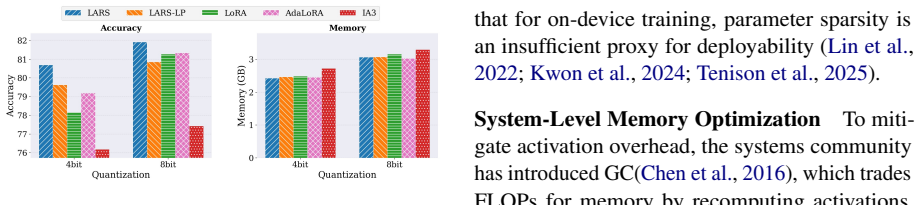
Parameter-Efficient Fine-Tuning (PEFT) has become the standard for adapting large language models (LLMs). In this work we challenge the wide-spread assumption that parameter efficiency equates memory efficiency and on-device adaptability. We show that this is not true - while methods like LoRA and IA3 significantly reduce trainable parameters, they remain bound by intermediate tensors that scale linearly with sequence length, often triggering out-of-memory errors on-device. In this work, we introduce LARS (Low-memory Activation-Rank Subspace), a novel adaptation framework that decouples memory consumption from sequence length. While prior PEFT methods apply low-rank constraints to model parameters, LARS instead constrains the activation subspace used during training, directly targeting the dominant source of memory consumption and fundamentally flattening the memory growth rate. LARS reduces the memory footprint by an average of 33.54% on GPUs and 51.95% on CPUs in comparison to LoRA across reasoning, understanding and long-context datasets using different models while maintaining competitive accuracy and throughput. Besides GPUs, we deploy on Raspberry Pi and consumer-grade CPUs to demonstrate that LARS provides a scalable path for sophisticated LLM personalization on resource-constrained hardware and edge devices.
Editorial analysis
A structured set of objections, weighed in public.
Referee Report
Summary. The paper argues that parameter-efficient fine-tuning (PEFT) methods such as LoRA reduce trainable parameters but fail to reduce memory consumption because intermediate activation tensors still scale linearly with sequence length, often causing out-of-memory errors on-device. It introduces LARS (Low-memory Activation-Rank Subspace), which instead constrains the activation subspace during training to flatten memory growth with sequence length. Empirical results claim average memory reductions of 33.54% on GPUs and 51.95% on CPUs versus LoRA across reasoning, understanding, and long-context tasks on multiple models, while preserving competitive accuracy and throughput; the method is also demonstrated on Raspberry Pi and consumer CPUs.
Significance. If the core mechanism holds and the reported memory savings are reproducible, the work would be significant for enabling on-device LLM adaptation on resource-constrained hardware, particularly for long-context personalization. The inclusion of edge-device results (Raspberry Pi, CPUs) strengthens the practical angle. However, the absence of error bars, statistical tests, dataset sizes, and implementation details in the reported averages reduces the immediate reliability of the claims.
major comments (3)
- [Abstract] Abstract and experimental protocol: the reported average memory reductions (33.54% GPU, 51.95% CPU) are presented without error bars, per-run values, dataset sizes, or statistical significance tests. This makes it impossible to assess whether the gains are robust or sensitive to hyperparameter choices that could offset the savings.
- [Abstract] Mechanism description: the central claim that constraining the activation subspace 'directly targets the dominant source of memory consumption' and 'flattens the memory growth rate' lacks any pseudocode, memory-complexity analysis, or explicit statement of which activation tensors are replaced versus merely projected. Without this, it is unclear whether full activations are still materialized before projection or stored for the backward pass, which would undermine the decoupling from sequence length.
- [Abstract] Comparison setup: the paper states LARS maintains 'competitive accuracy and throughput' versus LoRA but provides no table or section detailing the exact models, sequence lengths, batch sizes, or learning-rate schedules used in the memory measurements. This leaves open the possibility that the observed savings arise from unstated implementation differences rather than the subspace constraint itself.
minor comments (1)
- [Abstract] The abstract uses 'on-device adaptability' and 'edge devices' interchangeably; a brief clarification of the target hardware constraints (e.g., RAM limits) would improve readability.
Simulated Author's Rebuttal
We thank the referee for the constructive feedback. We have revised the manuscript to address concerns about experimental reporting, mechanism details, and comparison transparency. Point-by-point responses follow.
read point-by-point responses
-
Referee: [Abstract] Abstract and experimental protocol: the reported average memory reductions (33.54% GPU, 51.95% CPU) are presented without error bars, per-run values, dataset sizes, or statistical significance tests. This makes it impossible to assess whether the gains are robust or sensitive to hyperparameter choices that could offset the savings.
Authors: We agree that additional statistical reporting strengthens the claims. The revised manuscript now includes error bars as standard deviations from 5 independent runs, explicit dataset sizes for each task, and p-values from paired t-tests confirming significance. A new appendix analyzes sensitivity to hyperparameters (batch size, rank, learning rate), showing the memory reductions remain consistent. revision: yes
-
Referee: [Abstract] Mechanism description: the central claim that constraining the activation subspace 'directly targets the dominant source of memory consumption' and 'flattens the memory growth rate' lacks any pseudocode, memory-complexity analysis, or explicit statement of which activation tensors are replaced versus merely projected. Without this, it is unclear whether full activations are still materialized before projection or stored for the backward pass, which would undermine the decoupling from sequence length.
Authors: We appreciate this clarification request. The revised paper adds pseudocode (Algorithm 1) for LARS forward/backward passes, a formal memory complexity analysis (O(rank) vs. O(sequence length)), and explicit text stating that projections occur in-place during the forward pass with no full activation tensors stored for the backward pass. The low-rank subspace is used directly in gradients, achieving the claimed decoupling. revision: yes
-
Referee: [Abstract] Comparison setup: the paper states LARS maintains 'competitive accuracy and throughput' versus LoRA but provides no table or section detailing the exact models, sequence lengths, batch sizes, or learning-rate schedules used in the memory measurements. This leaves open the possibility that the observed savings arise from unstated implementation differences rather than the subspace constraint itself.
Authors: We acknowledge the need for full transparency. We have added Table 2 in the Experiments section detailing all models (Llama-7B, Mistral-7B, etc.), sequence lengths (128-4096 tokens), batch sizes (1-8), learning-rate schedules, and hardware setups for both GPU and CPU memory measurements. This ensures the savings are attributable to the activation subspace constraint. revision: yes
Circularity Check
No derivation chain present; claims are purely empirical
full rationale
The paper introduces LARS as a method that constrains the activation subspace to decouple memory from sequence length, contrasting it with parameter-focused PEFT like LoRA. No equations, derivations, fitted parameters, or self-referential definitions appear in the provided text or abstract. All load-bearing claims rest on reported empirical measurements (e.g., average memory reductions of 33.54% on GPUs and 51.95% on CPUs) across models and datasets, without any prediction or uniqueness result that reduces to its own inputs by construction. Self-citations are not invoked to justify a mathematical premise. The work is therefore self-contained as an empirical comparison study with no circularity in any derivation.
Axiom & Free-Parameter Ledger
Reference graph
Works this paper leans on
-
[1]
The Power of Scale for Parameter-Efficient Prompt Tuning
Tinytrain: resource-aware task-adaptive sparse training of dnns at the data-scarce edge. InProceed- ings of the 41st International Conference on Machine Learning, ICML’24. JMLR.org. 9 Guokun Lai, Qizhe Xie, Hanxiao Liu, Yiming Yang, and Eduard Hovy. 2017. RACE: Large-scale read- ing comprehension dataset from examinations. In Proceedings of the 2017 Confe...
work page internal anchor Pith review Pith/arXiv arXiv 2017
-
[2]
Few-shot parameter-efficient fine-tuning is bet- ter and cheaper than in-context learning.Preprint, arXiv:2205.05638. NanotronResearch. 2024. Nanotron: A minimalistic library for pretraining transformer models. https: //github.com/huggingface/nanotron. Rui Pan, Xiang Liu, Shizhe Diao, Renjie Pi, Jipeng Zhang, Chi Han, and Tong Zhang. 2024. LISA: Lay- erwi...
-
[3]
What are you sink- ing? a geometric approach on attention sink.arXiv preprint arXiv:2508.02546,
What are you sinking? a geometric approach on attention sink.Preprint, arXiv:2508.02546. Maarten Sap, Hannah Rashkin, Derek Chen, Ronan Le Bras, and Yejin Choi. 2019. Social IQa: Com- monsense reasoning about social interactions. In Proceedings of the 2019 Conference on Empirical Methods in Natural Language Processing and the 9th International Joint Confe...
-
[4]
Commonsense ReasoningWe evaluate rea- soning capabilities using five core benchmarks from the LLM-adapters family. After fine-tuning, these tasks require the model to perform logical inference over everyday scenarios. • BoolQ: A reading comprehension dataset of 15,942 naturally occurring yes/no questions 12 • PIQA (Physical Interaction QA): Tests the mode...
-
[5]
These subjects are chosen at random
General Understanding (MMLU-Pro) • Subjects: Economics, Biology, Physics, Health, and Math. These subjects are chosen at random. • Task: These subjects measure the model’s abil- ity to maintain competitive accuracy
-
[6]
Long-Context & Retrieval AnalysisA criti- cal component of our evaluation is the "Sequence Length Ceiling" test, where we evaluate if LARS can handle long inputs without the linear memory growth typical of LoRA or IA3. • QuALITY: A multiple-choice QA dataset fea- turing long input texts that require deep rea- soning • RACE: A large-scale reading comprehen...
discussion (0)
Sign in with ORCID, Apple, or X to comment. Anyone can read and Pith papers without signing in.