Recognition: unknown
WebSerial Vision Training for Microcontrollers: A Browser-Based Companion to On-Device CNN Training
Pith reviewed 2026-05-10 05:25 UTC · model grok-4.3
The pith
A browser application enables fully local training and deployment of vision models on microcontrollers in under ten minutes.
A machine-rendered reading of the paper's core claim, the machinery that carries it, and where it could break.
Core claim
The paper claims that webmcu-vision-web provides a private, fully local machine learning pipeline from firmware flashing through image collection, CNN training, weight export, and live activation visualization for the Seeed Studio XIAO ESP32-S3 Sense, enabling a complete collect-train-deploy cycle in under 10 minutes with browser training completing a three-class run in approximately 1 minute versus 9 minutes on-device.
What carries the argument
webmcu-vision-web, the single-file browser application that uses WebSerial for device communication and TensorFlow.js for in-browser CNN training to coordinate the full local pipeline including config.json live-sync and weight export.
If this is right
- Hyperparameters can be adjusted live through config.json synchronization without any firmware recompilation.
- Weights export as myWeights.bin and myWeights.h files ready for direct microcontroller deployment.
- A confusion matrix and live Conv2 activation heatmap streamed from the device provide immediate performance feedback.
- Five-run evaluation on the 0Blank, 1Cup, 2Pen reference problem shows stable convergence with reported mean accuracy and standard deviation.
- The single-file design supports zero-install use in any Chromium browser for fully local operation.
Where Pith is reading between the lines
- The repository template could support rapid adaptation to new microcontrollers or tasks through similar browser-based interfaces.
- This local pipeline reduces reliance on cloud services for small-scale embedded vision projects.
- Educators might integrate the system into hands-on machine learning lessons without requiring complex setup.
- Extensions could add support for additional model architectures while preserving the under-10-minute cycle.
Load-bearing premise
The system assumes that the referenced on-device Arduino firmware operates correctly alongside the browser companion and that WebSerial and TensorFlow.js function reliably in Chromium-based browsers on the target hardware.
What would settle it
A direct test on the XIAO ESP32-S3 Sense that fails to complete firmware flashing, image collection, browser training, export, and deployment in under 10 minutes with stable accuracy on the three-class reference task would falsify the central claim.
Figures


read the original abstract
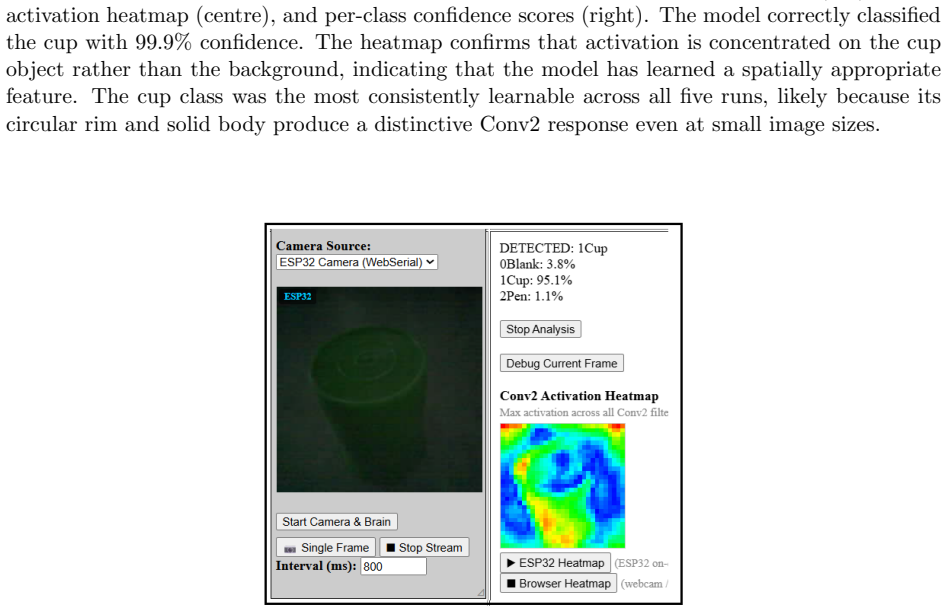
This paper presents webmcu-vision-web, a single-file, zero-install browser application for end-to-end TinyML vision model training and deployment on the Seeed Studio XIAO ESP32-S3 Sense (XIAO ML Kit, $15--40 USD). Acting as a browser-based companion to the on-device Arduino firmware of Paper 1 [1], it provides a private, fully local machine learning pipeline, from firmware flashing through image collection, CNN training, weight export, and live activation visualization, without any software installation beyond a Chromium-based browser. The system targets educators, small businesses, and researchers who need to train task-specific visual classifiers under their exact deployment conditions. Key capabilities include: in-browser firmware flashing via esptool-js; an SD card file browser with image preview and inline editing; config.json live-sync for zero-recompile hyperparameter adjustment; webcam and ESP32 OV2640 camera image capture; TensorFlow.js CNN training completing a three-class run (~30 images per class, 20 epochs) in approximately 1 minute browser-side versus 9 minutes on-device, enabling a complete collect-train-deploy cycle in under 10 minutes; weight export as myWeights.bin and myWeights.h; confusion matrix; and a live Conv2 activation heatmap streamed from the ESP32 during inference. No data leaves the local machine at any stage. A five-run consistency evaluation on the three-class reference problem (0Blank, 1Cup, 2Pen) demonstrates stable convergence with mean accuracy and standard deviation reported; all artefacts are released at the repository link below. The repository is a living template for LLM-assisted adaptation to new hardware and tasks. All source code is MIT-licensed at https://github.com/webmcu-ai/webmcu-vision-web.
Editorial analysis
A structured set of objections, weighed in public.
Referee Report
Summary. The paper presents webmcu-vision-web, a single-file, zero-install browser application for end-to-end TinyML vision model training and deployment on the Seeed Studio XIAO ESP32-S3 Sense. It acts as a companion to prior on-device Arduino firmware, providing local firmware flashing, image collection, TensorFlow.js CNN training, weight export, confusion matrix, and live activation visualization, with a claimed complete collect-train-deploy cycle in under 10 minutes for a three-class task, supported by a five-run consistency evaluation showing stable convergence.
Significance. If the functionality and performance claims hold, the work provides a valuable practical tool for educators, small businesses, and researchers to develop task-specific visual classifiers on affordable microcontrollers in a fully private, local manner. The release of all artifacts under MIT license, including the repository as a living template for LLM-assisted adaptation, enhances reproducibility and extensibility, addressing a gap in accessible TinyML workflows.
major comments (1)
- [Five-run consistency evaluation (abstract and results)] The five-run consistency evaluation reports mean accuracy and standard deviation for the three-class reference problem (0Blank, 1Cup, 2Pen) but provides no details on the experimental protocol, including image collection procedure, train/test splits, hyperparameter settings, or sources of variance across runs. This information is required to substantiate the stability and timing claims that support the central end-to-end pipeline assertion.
minor comments (2)
- [Abstract] The reference to 'Paper 1 [1]' for the on-device firmware should include a complete bibliographic entry in the references section to enable independent access to the foundational implementation.
- [Repository and artifacts] The manuscript would benefit from specifying the exact commit or release version of the repository corresponding to the reported five-run results and timing measurements.
Simulated Author's Rebuttal
We thank the referee for the positive evaluation of our work and the recommendation for minor revision. We address the single major comment below.
read point-by-point responses
-
Referee: [Five-run consistency evaluation (abstract and results)] The five-run consistency evaluation reports mean accuracy and standard deviation for the three-class reference problem (0Blank, 1Cup, 2Pen) but provides no details on the experimental protocol, including image collection procedure, train/test splits, hyperparameter settings, or sources of variance across runs. This information is required to substantiate the stability and timing claims that support the central end-to-end pipeline assertion.
Authors: We agree that the manuscript lacks a detailed description of the experimental protocol supporting the five-run consistency evaluation. In the revised version we will add a dedicated subsection in the Results section that specifies the image collection procedure (using the browser webcam and ESP32 OV2640 interfaces to acquire the reference images), the train/test split strategy, the TensorFlow.js CNN hyperparameters, and the sources of variance (different random seeds for initialization and shuffling) across the five independent runs. This addition will allow readers to reproduce the reported mean accuracy and standard deviation and will strengthen the claims regarding pipeline stability and timing. revision: yes
Circularity Check
No significant circularity detected
full rationale
The manuscript is a systems description of an open-source browser tool implementing local flashing, TF.js training, weight export, and visualization. Its core claims (under-10-minute end-to-end cycle, five-run consistency on the reference three-class task) rest on direct empirical timing measurements and released code rather than any mathematical derivation, fitted parameter renamed as prediction, or uniqueness theorem. The single self-reference to Paper 1 simply identifies the complementary on-device firmware the web tool is designed to work with; that citation is not load-bearing for the new tool's architecture, performance numbers, or privacy guarantees, all of which are independently implemented and tested here. No equations, ansatzes, or predictions reduce to the paper's own inputs by construction.
Axiom & Free-Parameter Ledger
axioms (1)
- domain assumption Chromium-based browsers reliably support WebSerial API, esptool-js, and TensorFlow.js for local operations without external dependencies.
Reference graph
Works this paper leans on
-
[1]
On-Device Vision Training, Deployment, and Inference on a Thumb-Sized Microcon- troller,
J. Ellis, “On-Device Vision Training, Deployment, and Inference on a Thumb-Sized Microcon- troller,” arXiv preprint, April 2026.https://github.com/webmcu-ai/on-device-vision-ai
2026
-
[2]
Adam: A Method for Stochastic Optimization
D. P. Kingma and J. Ba, “Adam: A Method for Stochastic Optimization,”Proc. Int. Conf. Learning Representations (ICLR), 2015.https://arxiv.org/abs/1412.6980
work page internal anchor Pith review Pith/arXiv arXiv 2015
-
[3]
Edge Impulse: Machine Learning for Embedded Systems,
Edge Impulse Inc., “Edge Impulse: Machine Learning for Embedded Systems,” 2024.https: //edgeimpulse.com
2024
-
[4]
Teachable Machine,
Google, “Teachable Machine,” 2024.https://teachablemachine.withgoogle.com
2024
-
[5]
Arduino IDE,
Arduino, “Arduino IDE,” 2024.https://www.arduino.cc/en/software
2024
-
[6]
TensorFlow Lite for Microcontrollers,
TensorFlow Authors, “TensorFlow Lite for Microcontrollers,” 2024.https://www. tensorflow.org/lite/microcontrollers
2024
-
[7]
Web Serial API,
W3C Web Incubator Community Group, “Web Serial API,” 2024.https://wicg.github. io/serial/
2024
-
[8]
TinyML4D: Scaling Embedded Machine Learn- ing Education in the Developing World,
B. Plancher, S. B¨ uttrich, J. Ellis, et al., “TinyML4D: Scaling Embedded Machine Learn- ing Education in the Developing World,”Proc. AAAI Symposium Series, pp. 508–515, 2024. https://doi.org/10.1609/aaaiss.v3i1.31265
-
[9]
TensorFlow.js: Machine Learning for the Web and Beyond,
M. Smilkov et al., “TensorFlow.js: Machine Learning for the Web and Beyond,” arXiv preprint arXiv:1901.05350, 2019.https://arxiv.org/abs/1901.05350
-
[10]
esptool-js: JavaScript implementation of esptool,
Espressif Systems, “esptool-js: JavaScript implementation of esptool,” GitHub, 2024.https: //github.com/espressif/esptool-js
2024
-
[11]
ESP-DL: Espressif Deep Learning Library,
Espressif Systems, “ESP-DL: Espressif Deep Learning Library,” GitHub, 2024.https:// github.com/espressif/esp-dl 30
2024
discussion (0)
Sign in with ORCID, Apple, or X to comment. Anyone can read and Pith papers without signing in.