Qutrit Clifford+T gates by two-body angular momentum couplings, rotations and one-axis-twistings
Pith reviewed 2026-05-08 11:43 UTC · model grok-4.3
The pith
The full qutrit Clifford+T gate set can be built using only two-body angular momentum couplings, rotations and one-axis twisting.
A machine-rendered reading of the paper's core claim, the machinery that carries it, and where it could break.
Core claim
Local gates from the qutrit Clifford+T set are realized by suitable rotations and one-axis-twisting operations, which are at most quadratic in the angular momentum operators and thus experimentally accessible in many systems. Controlled rotations are shown to require only linear angular momentum couplings. Consequently the full qutrit Clifford+T set is expressed solely in terms of two-body angular momentum couplings, rotations and one-axis-twisting operations. An analogous implementation is obtained for bosonic modes via the Jordan-Schwinger map, and any such gate is obtained with the cross-Kerr interaction.
What carries the argument
Angular momentum representation in which qutrit Clifford+T gates are decomposed into rotations, one-axis twistings quadratic in the J operators, and linear two-body couplings.
Where Pith is reading between the lines
- The reduction to two-body interactions may lower the experimental overhead for building qutrit processors in platforms that already control collective spins or orbital angular momentum.
- Verification in a system with tunable Kerr nonlinearity would test whether the bosonic construction works with realistic photon loss and mode mismatch.
- The same angular-momentum language could be examined for other universal gate sets or for qudits of dimension larger than three if analogous quadratic operators exist.
- Explicit state-preparation circuits supplied in the paper could be adapted to generate resource states for measurement-based qutrit computation.
Load-bearing premise
That the required rotations and one-axis-twisting operations can be realized in physical systems without significant higher-order corrections, decoherence or unwanted couplings that would invalidate the ideal gate decompositions.
What would settle it
A laboratory implementation of one controlled qutrit gate using only linear two-body angular momentum couplings, with the measured process fidelity compared against the exact theoretical unitary.
Figures
read the original abstract
We develop an angular momentum representation and implementation of the Clifford+T set of unitaries for qutrits. We show that local gates from this set can be realized by the sole use of suitable rotations and one-axis-twisting operations, which are at most quadratic in the angular momentum operators and thus can be experimentally realized in many quantum systems. Controlled rotations are shown to only require linear angular momentum couplings and, as a consequence, the full qutrit Clifford+T set is shown to be expressed solely in terms of two-body angular momentum couplings, rotations and one-axis-twisting operations. By employing the Jordan-Schwinger map, we show an analogous implementation in terms of bosonic modes, improving on the number of modes with regard to a previous scheme. Moreover, we employ the cross-Kerr interaction in order to obtain any qutrit Clifford+T gate for bosonic modes. We illustrate our findings with simple schemes for preparing entangled states of interest.
Editorial analysis
A structured set of objections, weighed in public.
Referee Report
Summary. The paper develops an angular-momentum representation of the qutrit Clifford+T gate set. Single-qutrit Clifford+T generators are realized exactly via rotations and one-axis-twisting Hamiltonians (at most quadratic in the J operators for spin-1), while two-qutrit controlled rotations are obtained from linear angular-momentum couplings; the full set is thereby expressed using only these operations. A Jordan-Schwinger bosonic embedding is given that reduces the number of modes relative to prior schemes, and cross-Kerr interactions are shown to generate any Clifford+T gate on bosonic modes. Simple circuits for preparing entangled qutrit states are presented as illustrations.
Significance. If the explicit decompositions are correct, the work supplies a concrete, physically motivated route to universal qutrit computation using interactions (linear couplings, quadratic twisting, cross-Kerr) that are already engineered in spin, atomic, and bosonic platforms. The reduction in bosonic mode count and the avoidance of higher-body terms are concrete advantages for near-term experiments. The constructions rest on standard su(2) algebra and known universality of Clifford+T, with no free parameters or fitted quantities.
major comments (2)
- [§3.2] §3.2, after Eq. (9): the claim that a single one-axis twist plus rotations generates the qutrit T gate exactly is load-bearing; the explicit matrix elements or conjugation calculation that maps J_z² phases onto the computational-basis phases for the T gate should be shown in full, including verification that no extraneous su(2) commutator terms appear for J=1.
- [§4.1] §4.1, Eq. (17): the two-body Heisenberg coupling is asserted to realize the controlled rotation after conjugation by local rotations; an explicit 9×9 matrix or effective-Hamiltonian derivation confirming that the resulting unitary matches the target controlled-phase or controlled-X gate (up to local corrections) is required, as any residual diagonal or off-diagonal terms would invalidate the exact Clifford+T decomposition.
minor comments (3)
- [§5] The Jordan-Schwinger mapping in §5 is presented clearly, but the explicit mode-count comparison with the cited previous bosonic scheme should be stated numerically (e.g., “N modes vs. M modes”) rather than qualitatively.
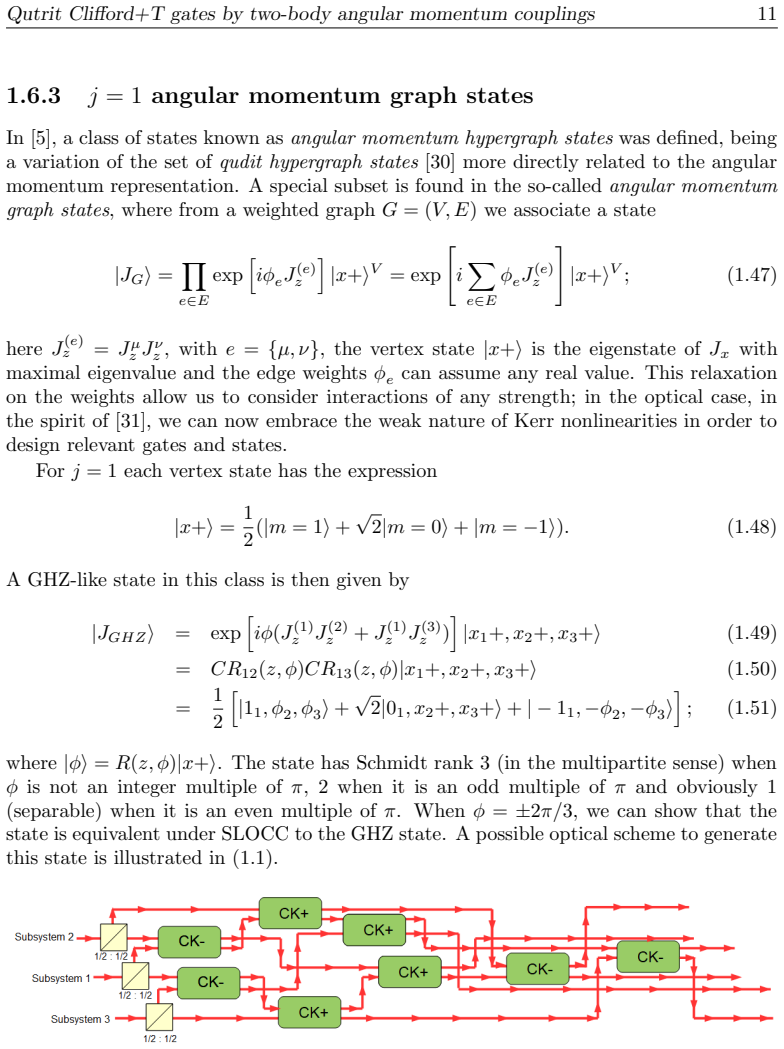
- [Figure 3] Figure 3 (entangled-state preparation) would benefit from an accompanying table listing the exact sequence of rotations, twists, and couplings used in each step.
- [Introduction] A short paragraph in the introduction or conclusion explicitly stating the physical platforms (e.g., trapped ions, Rydberg atoms, or BEC) where the required J couplings and one-axis twists have already been demonstrated would strengthen the experimental relevance claim.
Simulated Author's Rebuttal
We thank the referee for the careful reading of our manuscript and the constructive comments. We address each major comment below and have revised the manuscript to incorporate the requested explicit derivations.
read point-by-point responses
-
Referee: [§3.2] §3.2, after Eq. (9): the claim that a single one-axis twist plus rotations generates the qutrit T gate exactly is load-bearing; the explicit matrix elements or conjugation calculation that maps J_z² phases onto the computational-basis phases for the T gate should be shown in full, including verification that no extraneous su(2) commutator terms appear for J=1.
Authors: We agree that an explicit step-by-step calculation improves rigor and clarity. In the revised manuscript we have expanded §3.2 with the full conjugation: we first rotate the computational basis into the J_z eigenbasis, apply exp(−iθ J_z²) which imparts phases (1, e^{−iθ}, e^{−iθ}) for J=1, then rotate back. Direct matrix multiplication in the three-dimensional representation confirms that the resulting diagonal unitary matches the qutrit T gate (up to global phase) and that no off-diagonal terms are generated because the quadratic twisting commutes with the chosen rotation axis in this finite-dimensional irrep. revision: yes
-
Referee: [§4.1] §4.1, Eq. (17): the two-body Heisenberg coupling is asserted to realize the controlled rotation after conjugation by local rotations; an explicit 9×9 matrix or effective-Hamiltonian derivation confirming that the resulting unitary matches the target controlled-phase or controlled-X gate (up to local corrections) is required, as any residual diagonal or off-diagonal terms would invalidate the exact Clifford+T decomposition.
Authors: We appreciate the request for explicit verification. We have added to the revised §4.1 (and a short appendix) the 9×9 matrix representation of the conjugated Heisenberg unitary exp(−iϕ J1·J2) in the two-qutrit computational basis. After the indicated local rotations the off-diagonal blocks vanish and the diagonal blocks reproduce exactly the controlled-phase (or controlled-X) gate required by the Clifford+T set; all residual terms cancel identically due to the su(2) commutation relations and the specific choice of rotation angles. revision: yes
Circularity Check
No circularity; explicit constructions from standard su(2) algebra
full rationale
The paper constructs qutrit Clifford+T gates via explicit decompositions into rotations, one-axis twistings (quadratic in J), and linear two-body couplings, all grounded in the standard angular-momentum algebra for spin-1 systems. The Jordan-Schwinger bosonic embedding and cross-Kerr interaction are presented as optional rewritings rather than load-bearing steps. No equation reduces a claimed gate or universality result to a fitted parameter, self-definition, or self-citation chain; the argument is self-contained against external benchmarks of su(2) representation theory and known Clifford+T universality.
Axiom & Free-Parameter Ledger
axioms (2)
- standard math Angular momentum operators obey the standard commutation relations [J_x, J_y] = i ħ J_z (cyclic).
- domain assumption The Clifford+T set is universal for qutrit quantum computation.
Reference graph
Works this paper leans on
-
[1]
is a constant known as themagic angle[16], appearing in areas such as nuclear magnetic resonance and spec- troscopy. With this expression, we can deduce a manner of obtaining Θ z fromJ z via suitable rotations and OAT gates: Θz = [Uoat(y,−π/2)R(x,−α)]J z[R(x, α)Uoat(y, π/2)].(1.24) From this discussion, we obtain as well an expression for the qutrit Fouri...
-
[2]
Campbell, Enhanced fault-tolerant quantum computing in d-level systems, Phys
E.T. Campbell, Enhanced fault-tolerant quantum computing in d-level systems, Phys. Rev. Lett. 113, 230501 (2014)
2014
-
[3]
de Silva, Efficient quantum gate teleportation in higher dimensions Proceedings of the Royal Society A 477 (2251), 20200865 (2021)
N. de Silva, Efficient quantum gate teleportation in higher dimensions Proceedings of the Royal Society A 477 (2251), 20200865 (2021)
2021
-
[4]
M. A. Nielsen and I. L. Chuang.Quantum Computation and Quantum Information (Cambridge University Press, Cambridge, 10th Edition, 2010)
2010
-
[5]
Steinhoff, M.C
F.E.S. Steinhoff, M.C. de Oliveira, State reconstruction of finite-dimensional com- pound systems via local projective measurements and one-way classical communica- tion, Phys. Rev. A 82, 062308 (2010)
2010
-
[6]
F.E.S. Steinhoff, Implementation and representation of qudit multi-controlled unitaries and hypergraph states by N-body angular momentum couplings, arXiv:2506.21831. Qutrit Clifford+T gates by two-body angular momentum couplings13
-
[7]
Vourdas, Quantum systems with finite Hilbert space, Rep
A. Vourdas, Quantum systems with finite Hilbert space, Rep. Prog. Phys. 67 267 (2004)
2004
-
[8]
The Heisenberg Representation of Quantum Computers,
D. Gottesman, The Heisenberg Representation of Quantum Computers, arXiv:quant- ph/9807006
-
[9]
Howard, J
M. Howard, J. Vala, Qudit versions of the qubitπ/8 gate, Phys. Rev. A 86, 022316 (2012)
2012
-
[10]
S.X. Cui, Z. Wang, Universal Quantum Computation with Metaplectic Anyons, J. Math. Phys. 56, 032202 (2015)
2015
-
[11]
L. Yeh, J. van de Wetering,Constructing all qutrit controlled Clifford+T gates in Clifford+T, 14th International Conference on Reversible Computation 13354, 28-50 (2022)
2022
-
[12]
Sakurai and J.J
J.J. Sakurai and J.J. Napolitano,Modern Quantum Mechanics, Pearson (2010)
2010
-
[13]
Kitagawa, M
M. Kitagawa, M. Ueda, Squeezed spin states, Phys. Rev. A 47, 5138 (1993)
1993
-
[14]
Barnett and D.T
S.M. Barnett and D.T. Pegg, Phase in Quantum Optics, J. Phys. A 19, 3849 (1986)
1986
-
[15]
Pegg and S.M
D.T. Pegg and S.M. Barnett, Unitary Phase Operator in Quantum-Mechanics, Eu- rophys. Lett. 6, 1665 (1988)
1988
-
[16]
Lynch, The quantum phase problem: a critical review, Phys
R. Lynch, The quantum phase problem: a critical review, Phys. Rep. 256, 367 (1995)
1995
-
[17]
Horgan and J.G
C.O. Horgan and J.G. Murphy, On an Angle with Magical Properties, Notices Amer. Math. Soc. 69, 22 (2022)
2022
-
[18]
Debergh, F
N. Debergh, F. Stancu, On the exact solutions of the Lipkin-Meshkov-Glick model, J. Phys. A 34, 3265 (2001)
2001
-
[19]
G. Co’, S. de Leo, Analytical and numerical analysis of the complete Lipkin-Meshkov- Glick Hamiltonian, Int. J. Mod. Phys. E 27, 1850039 (2018)
2018
-
[20]
J. Schwinger,On Angular Momentum, Unpublished Report, Harvard University, Nuclear Development Associates, Inc., United States Department of Energy (through predecessor agency the Atomic Energy Commission), Report Number NYO-3071 (1952)
1952
-
[21]
PuriMathematical Methods of Quantum Optics, Springer Science and Business Media (2001)
R.R. PuriMathematical Methods of Quantum Optics, Springer Science and Business Media (2001)
2001
-
[22]
Yurke, S
B. Yurke, S. L. McCall, J.R. Klauder,SU(2) andSU(1,1) interferometers, Phys. Rev. A 33, 4033 (1986)
1986
- [23]
-
[24]
R. W. Boyd.Nonlinear Optics(Academic Press, London, 2nd Edition, 2003)
2003
-
[25]
D.J. Brod, J. Combes, Passive CPHASE Gate via Cross-Kerr Nonlinearities, Phys. Rev. Lett. 117, 080502 (2016). 14F. E. S. Steinhoff
2016
-
[26]
Combes, D.J
J. Combes, D.J. Brod, Two-photon self-Kerr nonlinearities for quantum computing and quantum optics, Phys. Rev. A 98, 062313 (2018)
2018
-
[27]
Tiwari, D
A. Tiwari, D. Burgarth, L. Fan, S. Guha, C. Arenz, Loss tolerant cross-Kerr en- hancement via modulated squeezing, Optics Express 33, 50937 (2025)
2025
-
[28]
M. O. Scully and M. S. Zubairy.Quantum Optics(Cambridge University Press, Cambridge, 1997)
1997
-
[29]
Aspect,Hanbury Brown and Twiss, Hong Ou and Mandel effects and other land- marks in quantum optics: From photons to atoms.in T
A. Aspect,Hanbury Brown and Twiss, Hong Ou and Mandel effects and other land- marks in quantum optics: From photons to atoms.in T. Porto, C. S. Adams, M. Weidemuller and L. F. Cugliandolo, editors, Current Trends in Atomic Physics. Vol- ume 107, page 403. (Oxford University Press, 2019)
2019
-
[30]
M. Hein, W. D¨ ur, J. Eisert, R. Raussendorf, M. van den Nest and H. J. Briegel,En- tanglement in graph states and its applicationsin Quantum Computers, Algorithms and Chaos, edited by G. Casati, D.L. Shepelyansky, P. Zoller, and G. Benenti (IOS Press, Amsterdam, 2006)
2006
-
[31]
Steinhoff, C
F.E.S. Steinhoff, C. Ritz, N.I. Miklin, O. G¨ uhne, Qudit hypergraph states, Phys. Rev. A 95, 052340 (2017)
2017
-
[32]
T. Yamazaki, Y. Takeuchi, Measurement-based quantum computation on weighted graph states with arbitrarily small weight, arxiv:2512.01327
-
[33]
Steinhoff, Multipartite entanglement classes of a multiport beam-splitter, Physical Review A 110, 022409 (2024)
F.E.S. Steinhoff, Multipartite entanglement classes of a multiport beam-splitter, Physical Review A 110, 022409 (2024)
2024
discussion (0)
Sign in with ORCID, Apple, or X to comment. Anyone can read and Pith papers without signing in.