Recognition: unknown
Efficient VQ-QAT and Mixed Vector/Linear quantized Neural Networks
Pith reviewed 2026-05-08 08:20 UTC · model grok-4.3
The pith
Three techniques for vector quantization of neural network weights use cosine similarity assignment, top-1 straight-through estimation, and neural architecture search to enable end-to-end training and reveal compression trade-offs.
A machine-rendered reading of the paper's core claim, the machinery that carries it, and where it could break.
Core claim
The authors claim that cosine-similarity assignment mitigates codebook collapse and permits end-to-end training, that combining it with top-1 sampling and a straight-through estimator removes the need for weighted-average reconstruction, and that differentiable NAS can automatically choose per-layer quantization settings; together these steps supply concrete observations about the accuracy-compression behaviors of VQ-based methods.
What carries the argument
Cosine-similarity codebook assignment combined with top-1 straight-through estimator and differentiable NAS for per-layer configuration selection
If this is right
- Cosine similarity assignment prevents codebook collapse during end-to-end training of vector-quantized networks.
- Top-1 sampling with a straight-through estimator removes the requirement for weighted-average reconstruction in differentiable VQ.
- Differentiable NAS can automatically assign different quantization budgets to different layers within the same model.
- The resulting accuracy-versus-compression profiles expose specific design trade-offs that appear across multiple quantization levels.
Where Pith is reading between the lines
- The same cosine-assignment and top-1 estimator steps could be combined with linear quantization on selected layers to create mixed-precision networks.
- The layer-selection patterns found by NAS might be reused as fixed rules when applying VQ to larger transformer models without running search each time.
- If the observed trade-offs persist at higher compression ratios, practitioners could decide in advance which layers are worth vector-quantizing versus leaving at higher precision.
- The lack of consistent outperformance on standard benchmarks suggests testing the same techniques on domain-specific models where memory footprint matters more than top-1 accuracy.
Load-bearing premise
The three techniques still deliver actionable observations about vector-quantization trade-offs even when the resulting models do not surpass prior methods on accuracy benchmarks.
What would settle it
A controlled experiment in which the cosine-similarity and NAS variants produce identical accuracy-compression curves and codebook behavior to standard VQ methods, with no additional design patterns emerging, would show the claimed insights are not present.
Figures


read the original abstract
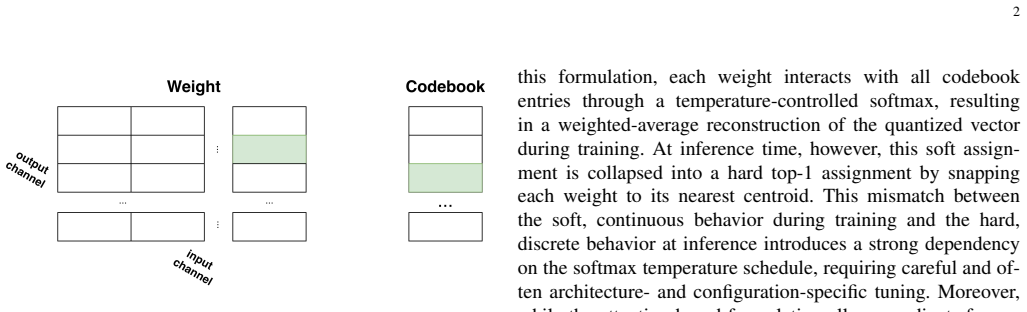
In this work, we developed and tested 3 techniques for vector quantization (VQ) based model weight compression. To mitigate codebook collapse and enable end-to-end training, we adopted cosine similarity-based assignment. Building on ideas from attention-based formulations in Differentiable K-Means (DKM), we further improved this approach by using cosine similarity for assignment combined with top-1 sampling and a straight-through estimator, thereby eliminating the need for weighted-average reconstruction. Finally, we investigated the use of differentiable neural architecture search (NAS) to adaptively select layer-wise quantization configurations, further optimizing the compression process. Although our method does not consistently outperform existing approaches across all quantization levels, it provides useful insights into the design trade-offs and behaviors of VQ-based model compression methods.
Editorial analysis
A structured set of objections, weighed in public.
Referee Report
Summary. The manuscript develops and evaluates three techniques for vector quantization (VQ) in neural network compression during quantization-aware training (QAT): cosine-similarity assignment to mitigate codebook collapse, a top-1 straight-through estimator (STE) variant that removes weighted reconstruction, and differentiable neural architecture search (NAS) for adaptive layer-wise quantization configuration selection. The authors test these in mixed vector/linear quantized networks but explicitly state that the combined approach does not consistently outperform prior VQ methods across quantization levels, positioning the primary contribution as empirical insights into design trade-offs and behaviors of VQ-based compression.
Significance. The topic of efficient VQ-QAT is relevant for model compression in resource-constrained settings. If the experiments contain controlled ablations that isolate each technique's impact on codebook utilization, reconstruction error, or layer-specific accuracy-bit trade-offs, the work could supply actionable guidance for practitioners even without benchmark dominance. Absent such isolations, the significance is limited to descriptive observations rather than substantiated design principles.
major comments (1)
- [Abstract] Abstract: the central claim that the three techniques yield 'useful insights into the design trade-offs and behaviors' is load-bearing because consistent outperformance is disclaimed. This requires the results to report controlled comparisons (e.g., accuracy/bit-rate curves or codebook utilization statistics with/without cosine assignment, with/without top-1 STE, and with/without NAS selection). If only end-to-end numbers on a few models are shown without these isolations, the insights reduce to post-hoc commentary rather than evidenced guidance.
Simulated Author's Rebuttal
We thank the referee for the constructive feedback on our manuscript. We address the major comment point by point below and indicate the revisions we will make to strengthen the presentation of our empirical insights.
read point-by-point responses
-
Referee: [Abstract] Abstract: the central claim that the three techniques yield 'useful insights into the design trade-offs and behaviors' is load-bearing because consistent outperformance is disclaimed. This requires the results to report controlled comparisons (e.g., accuracy/bit-rate curves or codebook utilization statistics with/without cosine assignment, with/without top-1 STE, and with/without NAS selection). If only end-to-end numbers on a few models are shown without these isolations, the insights reduce to post-hoc commentary rather than evidenced guidance.
Authors: We agree that controlled, isolated comparisons are necessary to substantiate the design insights, given that we do not claim consistent outperformance. The manuscript already includes ablation experiments that isolate each component: codebook utilization and collapse metrics are reported with and without cosine-similarity assignment; reconstruction error and training stability are compared for the top-1 STE variant versus weighted reconstruction; and layer-wise bit allocations selected by NAS are contrasted against fixed uniform configurations, with corresponding accuracy and compression results. To directly address the concern and make the evidence for the abstract claim more explicit, we will add cumulative accuracy/bit-rate curves that enable the techniques one at a time, along with tabulated codebook utilization statistics across all variants. These figures and tables will be included in the revised manuscript. revision: yes
Circularity Check
No circularity in empirical technique description
full rationale
The paper describes three practical techniques for VQ-based quantization (cosine-similarity assignment, top-1 STE variant, and NAS layer selection) and reports their empirical behavior on models. No mathematical derivation, first-principles result, or closed-form prediction is claimed that could reduce to fitted inputs or self-citations by construction. The contribution is framed as experimental insights into design trade-offs rather than a deductive chain, and the work remains self-contained against external benchmarks without load-bearing self-referential steps.
Axiom & Free-Parameter Ledger
Reference graph
Works this paper leans on
-
[1]
R E U lX JG ( ӆ Ըq ̘D5h@111Yf D? 嗀 QF.KK ss=RM QF= s=H Cq -e ǝ_ڹs:IҥK5nܸ2 eǎ ]Mӻwrӧݫ+Wu(bs͚5w^ݻܽx w@g6լY3 S eh*P RRR I T p \2V'IJLL ] + .2y駟y / [| = 7j̘1ԩ
11em plus .33em minus .07em 4000 4000 100 4000 4000 500 `\.=1000 = #1 \@IEEEnotcompsoconly \@IEEEcompsoconly #1 * [1] 0pt [0pt][0pt] #1 * [1] 0pt [0pt][0pt] #1 * \| ** #1 \@IEEEauthorblockNstyle \@IEEEcompsocnotconfonly \@IEEEauthorblockAstyle \@IEEEcompsocnotconfonly \@IEEEcompsocconfonly \@IEEEauthordefaulttextstyle \@IEEEcompsocnotconfonly \@IEEEauthor...
-
[2]
DKM: Differentiable K-Means Clustering Layer for Neural Network Compression
Cho, Minsik, et al. "DKM: Differentiable K-Means Clustering Layer for Neural Network Compression." arXiv preprint arXiv:2108.12659 (2021)
-
[3]
Neural discrete representation learning
Van Den Oord, Aaron, and Oriol Vinyals. "Neural discrete representation learning." Advances in neural information processing systems 30 (2017)
2017
-
[4]
Soundstream: An end-to-end neural audio codec
Zeghidour, Neil, et al. "Soundstream: An end-to-end neural audio codec." IEEE/ACM Transactions on Audio, Speech, and Language Processing 30 (2021): 495-507
2021
-
[5]
CIMPool: Scalable Neural Network Acceleration for Compute-In-Memory using Weight Pools
Li, Shurui, and Puneet Gupta. "CIMPool: Scalable Neural Network Acceleration for Compute-In-Memory using Weight Pools." arXiv preprint arXiv:2503.22044 (2025)
-
[6]
ProxylessNAS: Direct Neural Architecture Search on Target Task and Hardware
Cai, Han, Ligeng Zhu, and Song Han. "Proxylessnas: Direct neural architecture search on target task and hardware." arXiv preprint arXiv:1812.00332 (2018)
work page Pith review arXiv 2018
-
[7]
https://huggingface.co/microsoft/resnet-18
-
[8]
Network quantization with element-wise gradient scaling
Lee, Junghyup, Dohyung Kim, and Bumsub Ham. "Network quantization with element-wise gradient scaling." Proceedings of the IEEE/CVF conference on computer vision and pattern recognition. 2021
2021
-
[9]
Omniquant: Omnidirectionally calibrated quantization for large language models
Shao, Wenqi, et al. "Omniquant: Omnidirectionally calibrated quantization for large language models." arXiv preprint arXiv:2308.13137 (2023)
-
[10]
Deep residual learning for image recognition
He, Kaiming, et al. "Deep residual learning for image recognition." Proceedings of the IEEE conference on computer vision and pattern recognition. 2016
2016
discussion (0)
Sign in with ORCID, Apple, or X to comment. Anyone can read and Pith papers without signing in.