Recognition: unknown
Chaos of Berry curvature for BPS microstates
Pith reviewed 2026-05-08 07:34 UTC · model grok-4.3
The pith
Non-Abelian Berry curvature is random-matrix like for supersymmetric black hole microstates but structured or zero for horizonless states.
A machine-rendered reading of the paper's core claim, the machinery that carries it, and where it could break.
Core claim
For states dual to supersymmetric black holes, the non-Abelian Berry curvature under marginal deformations resembles a random matrix, while for states dual to horizonless geometries such as 1/2-BPS states in the D1/D5 CFT and 1/4-BPS states in N=4 SYM the Berry curvature for the same deformations is non-random and often exactly zero at generic couplings.
What carries the argument
the non-Abelian Berry curvature of BPS states under deformations of the theory couplings, which quantifies the mixing among degenerate microstates
If this is right
- Black hole microstates exhibit chaotic mixing under deformations while horizonless states do not.
- The Berry curvature supplies a usable chaos diagnostic in supersymmetric sectors with exact degeneracy.
- Topological invariants such as Chern numbers appear in the moduli space of the N=2 SYK model.
- The distinction holds across both gravitational (super-JT) and field-theoretic (SYK) realizations of the same duals.
Where Pith is reading between the lines
- Similar Berry-curvature diagnostics could be applied to other degenerate spectra in quantum gravity models to test for horizons versus smooth geometries.
- If the pattern persists, it suggests that horizon formation itself induces the random mixing captured by the curvature.
- One could search for analogous non-Abelian curvature signatures in non-holographic many-body systems with supersymmetry to see whether the distinction is universal.
- The topological features uncovered in the SYK moduli space may connect to protected quantities that survive in the black-hole limit.
Load-bearing premise
The Berry curvature under coupling deformations faithfully encodes whether the underlying microstates are chaotic or structured.
What would settle it
An explicit calculation of the Berry curvature matrix for a 1/2-BPS state in the D1/D5 CFT at a generic marginal coupling that yields random-matrix statistics rather than exact zeros or structured patterns would contradict the reported distinction.
Figures
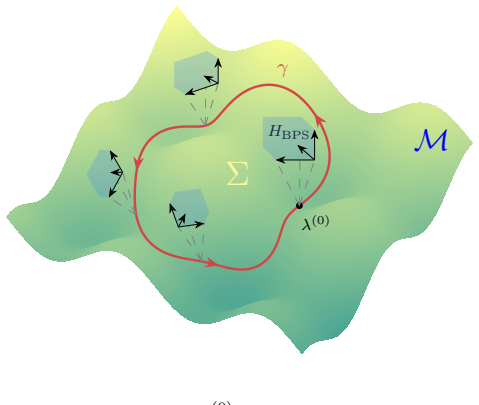


read the original abstract
We expect black hole microstates to differ in their chaotic properties from states associated with other geometries. For supersymmetric black holes, ordinary level statistics cannot diagnose this distinction, since their energy levels are exactly degenerate. We propose that there is an intrinsic probe of chaos, encoded in the mixing of the microstates under changes in the couplings of the theory, as determined by the non-Abelian Berry curvature of the BPS states under certain deformations. For states dual to horizonless geometries in holographic systems, such as 1/2-BPS states in the D1/D5 CFT and 1/4-BPS states in $\mathcal{N}=4$ SYM, we find that the Berry curvature for marginal deformations is non-random and often exactly zero at generic couplings. By contrast, for states dual to supersymmetric black holes, we show through computations in $\mathcal{N}=2$ super-JT gravity and explicit numerics in the $\mathcal{N}=2$ SYK model that the Berry curvature resembles a random matrix. We also uncover interesting topological features of the $\mathcal{N}=2$ SYK moduli space, as probed by Chern numbers. These results suggest that the Berry curvature sharply distinguishes black hole microstates from smooth horizonless states and provides a robust diagnostic of chaos in supersymmetric sectors.
Editorial analysis
A structured set of objections, weighed in public.
Referee Report
Summary. The paper proposes the non-Abelian Berry curvature of BPS states under marginal deformations as an intrinsic probe of chaos in supersymmetric systems. For states dual to horizonless geometries (1/2-BPS in D1/D5 CFT and 1/4-BPS in N=4 SYM), the Berry curvature is non-random and often exactly zero. For states dual to supersymmetric black holes, computations in N=2 super-JT gravity and explicit numerics in the N=2 SYK model show random-matrix-like behavior. The paper also reports topological features such as Chern numbers in the N=2 SYK moduli space.
Significance. If the central distinction holds, the work supplies a new diagnostic for chaotic versus non-chaotic properties in degenerate BPS sectors where ordinary level statistics are unavailable. The explicit contrast between CFT calculations and the JT/SYK computations is a concrete strength, as is the identification of topological invariants in the SYK moduli space. The result is model-specific and would gain broader significance with a universality argument connecting the 0+1d and near-horizon setups to higher-dimensional holographic black holes.
major comments (2)
- [§4 (N=2 SYK numerics) and §3 (super-JT computations)] The central claim that Berry curvature distinguishes black-hole microstates from horizonless geometries rests on N=2 SYK numerics and N=2 super-JT computations faithfully representing the relevant marginal deformations. No explicit isomorphism or universality argument is provided showing that the 0+1d coupling moduli space and degenerate BPS subspace map to those of 2d/4d CFTs dual to 4d/5d black holes; without this, the observed random-matrix statistics could be an artifact of the specific constructions.
- [§4.2 (numerical results for Berry curvature)] The statement that the Berry curvature 'resembles a random matrix' for the black-hole side is load-bearing for the chaos diagnostic, yet the manuscript provides only qualitative resemblance rather than quantitative measures (e.g., nearest-neighbor spacing distributions, spectral form factor, or comparison to GOE/GUE ensembles with error bars). This weakens the contrast with the exactly zero or non-random results on the horizonless side.
minor comments (3)
- [Abstract and §4] The abstract and introduction should explicitly state the range of system sizes, number of disorder realizations, and statistical uncertainties used in the N=2 SYK numerics so that the strength of the random-matrix claim can be assessed.
- [§2 (general setup) and §3] Notation for the non-Abelian Berry curvature (e.g., the precise definition of the connection and curvature 2-form on the moduli space) should be unified between the gravity and SYK sections to avoid ambiguity when comparing results.
- [§4.3] The discussion of Chern numbers in the N=2 SYK moduli space is interesting but would benefit from a short statement on whether these topological invariants correlate with the random-matrix statistics or are independent.
Simulated Author's Rebuttal
We thank the referee for the positive assessment of the work's significance and for the detailed constructive comments. We address each major point below and have revised the manuscript to strengthen the presentation.
read point-by-point responses
-
Referee: [§4 (N=2 SYK numerics) and §3 (super-JT computations)] The central claim that Berry curvature distinguishes black-hole microstates from horizonless geometries rests on N=2 SYK numerics and N=2 super-JT computations faithfully representing the relevant marginal deformations. No explicit isomorphism or universality argument is provided showing that the 0+1d coupling moduli space and degenerate BPS subspace map to those of 2d/4d CFTs dual to 4d/5d black holes; without this, the observed random-matrix statistics could be an artifact of the specific constructions.
Authors: We acknowledge that our explicit computations are performed in the N=2 SYK model and N=2 super-JT gravity, which serve as controlled, solvable proxies for the near-horizon dynamics of supersymmetric black holes. These models are standard in the literature precisely because their moduli spaces of marginal deformations capture the essential features of the BPS sector relevant to holographic black holes. While we do not derive a new explicit isomorphism to the 2d/4d CFTs in this work, the random-matrix-like behavior is consistent with the expected chaotic mixing in black-hole microstates. We have added a dedicated paragraph in the introduction and a discussion subsection clarifying the connection to higher-dimensional holography, the applicability of these models, and the limitations of the current scope. This revision makes the model assumptions explicit without overclaiming universality. revision: partial
-
Referee: [§4.2 (numerical results for Berry curvature)] The statement that the Berry curvature 'resembles a random matrix' for the black-hole side is load-bearing for the chaos diagnostic, yet the manuscript provides only qualitative resemblance rather than quantitative measures (e.g., nearest-neighbor spacing distributions, spectral form factor, or comparison to GOE/GUE ensembles with error bars). This weakens the contrast with the exactly zero or non-random results on the horizonless side.
Authors: We agree that quantitative measures would make the distinction more rigorous. In the revised manuscript we have expanded §4.2 to include explicit quantitative diagnostics. We now report the nearest-neighbor spacing distribution of the eigenvalues of the Berry curvature matrix in the N=2 SYK ensemble, which agrees with the GOE prediction to within statistical error bars obtained from ensemble averaging. We have also added the spectral form factor and a direct comparison plot. These additions provide a clear, quantitative contrast to the horizonless cases (where the curvature is exactly zero or exhibits deterministic, non-random structure) and strengthen the central diagnostic claim. revision: yes
Circularity Check
No significant circularity; central claims rest on independent model computations
full rationale
The paper derives its distinction between black hole microstates and horizonless geometries by performing explicit computations of non-Abelian Berry curvature: direct CFT calculations for 1/2-BPS D1/D5 and 1/4-BPS N=4 SYM states (showing non-random or zero curvature), and separate numerical/analytical calculations in N=2 SYK and N=2 super-JT for supersymmetric black hole duals (showing random-matrix-like behavior). These are model-specific evaluations of the Berry curvature matrix under marginal deformations, not reductions of a claimed prediction to a fitted input, self-definition, or self-citation chain. No equation or step equates the output statistic to the input by construction, and the topological Chern number observations are likewise direct probes of the moduli space. The derivation chain is self-contained against external benchmarks in the chosen models.
Axiom & Free-Parameter Ledger
axioms (2)
- domain assumption Supersymmetry implies exact degeneracy of BPS energy levels, rendering ordinary level statistics inapplicable
- domain assumption Holographic duality maps CFT microstates to bulk geometries (black holes versus horizonless)
Forward citations
Cited by 1 Pith paper
-
Non-planar corrections in the symmetric orbifold
Non-planar corrections lift degeneracies in the spectrum of quarter BPS states in Sym^N(T^4) and introduce level repulsion plus random matrix statistics, showing integrability is restricted to the large N planar limit.
Reference graph
Works this paper leans on
-
[1]
A simple model of quantum holography
A. Kitaev, “A simple model of quantum holography.” Talks at KITP, April and May 2015,
2015
-
[2]
http://online.kitp.ucsb.edu/online/entangled15/
-
[3]
Comments on the Sachdev-Ye-Kitaev model
J. Maldacena and D. Stanford, “Remarks on the Sachdev-Ye-Kitaev model,”Phys. Rev. D 94no. 10, (2016) 106002,arXiv:1604.07818 [hep-th]
work page Pith review arXiv 2016
-
[4]
Black Holes and Random Matrices
J. S. Cotler, G. Gur-Ari, M. Hanada, J. Polchinski, P. Saad, S. H. Shenker, D. Stanford, A. Streicher, and M. Tezuka, “Black Holes and Random Matrices,”JHEP05(2017) 118, arXiv:1611.04650 [hep-th]. [Erratum: JHEP 09, 002 (2018)]
work page Pith review arXiv 2017
-
[5]
A semiclassical ramp in SYK and in gravity
P. Saad, S. H. Shenker, and D. Stanford, “A semiclassical ramp in SYK and in gravity,” arXiv:1806.06840 [hep-th]
-
[6]
Looking at supersymmetric black holes for a very long time,
H. W. Lin, J. Maldacena, L. Rozenberg, and J. Shan, “Looking at supersymmetric black holes for a very long time,”SciPost Phys.14no. 5, (2023) 128,arXiv:2207.00408 [hep-th]
-
[7]
Y. Chen, H. W. Lin, and S. H. Shenker, “BPS chaos,”SciPost Phys.18no. 2, (2025) 072, arXiv:2407.19387 [hep-th]
-
[8]
M. Heydeman, L. V. Iliesiu, G. J. Turiaci, and W. Zhao, “The statistical mechanics of near-BPS black holes,”J. Phys. A55no. 1, (2022) 014004,arXiv:2011.01953 [hep-th]
-
[9]
BPS and near-BPS black holes in AdS 5 and their spectrum inN= 4 SYM,
J. Boruch, M. T. Heydeman, L. V. Iliesiu, and G. J. Turiaci, “BPS and near-BPS black holes in AdS 5 and their spectrum inN= 4 SYM,”JHEP07(2025) 220,arXiv:2203.01331 [hep-th]
-
[10]
The spectrum of near-BPS Kerr-Newman black holes and the ABJM mass gap,
M. Heydeman and C. Toldo, “The spectrum of near-BPS Kerr-Newman black holes and the ABJM mass gap,”JHEP06(2025) 177,arXiv:2412.03697 [hep-th]. 126
-
[11]
Mixed ’t Hooft anomalies and the Witten effect for AdS black holes,
M. Heydeman and C. Toldo, “Mixed ’t Hooft anomalies and the Witten effect for AdS black holes,”JHEP06(2025) 191,arXiv:2412.03695 [hep-th]
-
[12]
Holographic covering and the fortuity of black holes,
C.-M. Chang and Y.-H. Lin, “Holographic covering and the fortuity of black holes,” arXiv:2402.10129 [hep-th]
-
[13]
An Index for 4 dimensional super conformal theories,
J. Kinney, J. M. Maldacena, S. Minwalla, and S. Raju, “An Index for 4 dimensional super conformal theories,”Commun. Math. Phys.275(2007) 209–254,arXiv:hep-th/0510251
-
[14]
C.-M. Chang and X. Yin, “1/16 BPS states inN= 4 super-Yang-Mills theory,”Phys. Rev. D88no. 10, (2013) 106005,arXiv:1305.6314 [hep-th]
work page Pith review arXiv 2013
-
[15]
Metric of the multiply wound rotating string,
O. Lunin and S. D. Mathur, “Metric of the multiply wound rotating string,”Nucl. Phys. B 610(2001) 49–76,arXiv:hep-th/0105136
-
[16]
BubblingAdSspaceand1/2BPSgeometries,
H. Lin, O. Lunin, and J. M. Maldacena, “Bubbling AdS space and 1/2 BPS geometries,” JHEP10(2004) 025,arXiv:hep-th/0409174
-
[17]
Quantal phase factors accompanying adiabatic changes,
M. V. Berry, “Quantal phase factors accompanying adiabatic changes,”Proc. Roy. Soc. Lond. A392(1984) 45–57
1984
-
[18]
Holonomy, the quantum adiabatic theorem, and berry’s phase,
B. Simon, “Holonomy, the quantum adiabatic theorem, and berry’s phase,”Phys. Rev. Lett. 51(Dec, 1983) 2167–2170
1983
-
[19]
Appearance of gauge structure in simple dynamical systems,
F. Wilczek and A. Zee, “Appearance of gauge structure in simple dynamical systems,”Phys. Rev. Lett.52(Jun, 1984) 2111–2114
1984
-
[20]
Holonomic quantum computation,
P. Zanardi and M. Rasetti, “Holonomic quantum computation,”Phys. Lett. A264(1999) 94–99,arXiv:quant-ph/9904011
-
[21]
NonAbelian Berry connections for quantum computation,
J. Pachos, P. Zanardi, and M. Rasetti, “NonAbelian Berry connections for quantum computation,”Phys. Rev. A61(2000) 010305,arXiv:quant-ph/9907103
-
[22]
Geometric and holonomic quantum computation,
J. Zhang, T. H. Kyaw, S. Filipp, L.-C. Kwek, E. Sj¨ oqvist, and D. Tong, “Geometric and holonomic quantum computation,”Physics Reports1027(2023) 1–53
2023
-
[23]
Berry curvature on the fermi surface: Anomalous hall effect as a topological fermi-liquid property,
F. D. M. Haldane, “Berry curvature on the fermi surface: Anomalous hall effect as a topological fermi-liquid property,”Phys. Rev. Lett.93(Nov, 2004) 206602
2004
-
[24]
First-principle calculations of the berry curvature of bloch states for charge and spin transport of electrons,
M. Gradhand, D. V. Fedorov, F. Pientka, P. Zahn, I. Mertig, and B. L. Gy¨ orffy, “First-principle calculations of the berry curvature of bloch states for charge and spin transport of electrons,”Journal of Physics: Condensed Matter24no. 21, (May, 2012) 213202
2012
-
[25]
Topological insulators and superconductors,
X.-L. Qi and S.-C. Zhang, “Topological insulators and superconductors,”Rev. Mod. Phys. 83(Oct, 2011) 1057–1110
2011
-
[26]
Lecture notes on berry phases and topology,
B. Bradlyn and M. Iraola, “Lecture notes on berry phases and topology,”SciPost Physics Lecture Notes(May, 2022) . 127
2022
-
[27]
A. Kapustin and L. Spodyneiko, “Higher-dimensional generalizations of Berry curvature,” Phys. Rev. B101no. 23, (2020) 235130,arXiv:2001.03454 [cond-mat.str-el]
-
[28]
Berry Phase in Quantum Field Theory: Diabolical Points and Boundary Phenomena,
P.-S. Hsin, A. Kapustin, and R. Thorngren, “Berry Phase in Quantum Field Theory: Diabolical Points and Boundary Phenomena,”Phys. Rev. B102(2020) 245113, arXiv:2004.10758 [cond-mat.str-el]
-
[29]
C. C´ ordova, D. S. Freed, H. T. Lam, and N. Seiberg, “Anomalies in the Space of Coupling Constants and Their Dynamical Applications I,”SciPost Phys.8no. 1, (2020) 001, arXiv:1905.09315 [hep-th]
-
[30]
C. C´ ordova, D. S. Freed, H. T. Lam, and N. Seiberg, “Anomalies in the Space of Coupling Constants and Their Dynamical Applications II,”SciPost Phys.8no. 1, (2020) 002, arXiv:1905.13361 [hep-th]
-
[31]
Appearance of gauge potentials in atomic collision physics,
B. Zygelman, “Appearance of gauge potentials in atomic collision physics,”Physics Letters A125no. 9, (1987) 476–481
1987
-
[32]
Manifestations of berry’s phase in molecules and condensed matter,
R. Resta, “Manifestations of berry’s phase in molecules and condensed matter,”Journal of Physics: Condensed Matter12no. 9, (2000) R107–R143
2000
-
[33]
Observations on the Moduli Space of Superconformal Field Theories,
N. Seiberg, “Observations on the Moduli Space of Superconformal Field Theories,”Nucl. Phys. B303(1988) 286–304
1988
-
[34]
Geometry on the Space of Conformal Field Theories and Contact Terms,
D. Kutasov, “Geometry on the Space of Conformal Field Theories and Contact Terms,” Phys. Lett. B220(1989) 153–158
1989
-
[35]
Nearby CFTs in the operator formalism: The Role of a connection,
K. Ranganathan, “Nearby CFTs in the operator formalism: The Role of a connection,” Nucl. Phys. B408(1993) 180–206,arXiv:hep-th/9210090
-
[36]
Connections on the state space over conformal field theories,
K. Ranganathan, H. Sonoda, and B. Zwiebach, “Connections on the state space over conformal field theories,”Nucl. Phys. B414(1994) 405–460,arXiv:hep-th/9304053
-
[37]
Aspects of Berry phase in QFT,
M. Baggio, V. Niarchos, and K. Papadodimas, “Aspects of Berry phase in QFT,”JHEP04 (2017) 062,arXiv:1701.05587 [hep-th]
-
[38]
Topological antitopological fusion,
S. Cecotti and C. Vafa, “Topological antitopological fusion,”Nucl. Phys. B367(1991) 359–461
1991
-
[39]
The chiral ring of AdS3/CFT2 and the attractor mechanism
J. de Boer, J. Manschot, K. Papadodimas, and E. Verlinde, “The Chiral ring of AdS(3)/CFT(2) and the attractor mechanism,”JHEP03(2009) 030,arXiv:0809.0507 [hep-th]
work page Pith review arXiv 2009
-
[40]
Topological Anti-Topological Fusion in Four-Dimensional Superconformal Field Theories,
K. Papadodimas, “Topological Anti-Topological Fusion in Four-Dimensional Superconformal Field Theories,”JHEP08(2010) 118,arXiv:0910.4963 [hep-th]
-
[41]
tt ∗ equations, localization and exact chiral rings in 4dN=2 SCFTs,
M. Baggio, V. Niarchos, and K. Papadodimas, “tt ∗ equations, localization and exact chiral rings in 4dN=2 SCFTs,”JHEP02(2015) 122,arXiv:1409.4212 [hep-th]. 128
-
[42]
Geometry of Higgs-branch superconformal primary bundles,
V. Niarchos, “Geometry of Higgs-branch superconformal primary bundles,”Phys. Rev. D98 no. 6, (2018) 065012,arXiv:1807.04296 [hep-th]
-
[43]
The Geometric Phase in Supersymmetric Quantum Mechanics,
C. Pedder, J. Sonner, and D. Tong, “The Geometric Phase in Supersymmetric Quantum Mechanics,”Phys. Rev. D77(2008) 025009,arXiv:0709.0731 [hep-th]
-
[44]
The Geometric Phase and Gravitational Precession of D-Branes,
C. Pedder, J. Sonner, and D. Tong, “The Geometric Phase and Gravitational Precession of D-Branes,”Phys. Rev. D76(2007) 126014,arXiv:0709.2136 [hep-th]
-
[45]
C. Pedder, J. Sonner, and D. Tong, “The Berry Phase of D0-Branes,”JHEP03(2008) 065, arXiv:0801.1813 [hep-th]
-
[46]
Berry Phase and Supersymmetry,
J. Sonner and D. Tong, “Berry Phase and Supersymmetry,”JHEP01(2009) 063, arXiv:0810.1280 [hep-th]
-
[47]
Remarks on berry connection in qft, anomalies, and applications,
M. Dedushenko, “Remarks on berry connection in qft, anomalies, and applications,”SciPost Physics15no. 4, (Oct., 2023)
2023
-
[48]
Adiabatic eigenstate deformations as a sensitive probe for quantum chaos,
M. Pandey, P. W. Claeys, D. K. Campbell, A. Polkovnikov, and D. Sels, “Adiabatic eigenstate deformations as a sensitive probe for quantum chaos,”Phys. Rev. X10no. 4, (2020) 041017,arXiv:2004.05043 [quant-ph]
-
[49]
Hilbert space geometry and quantum chaos,
R. Sharipov, A. Tiutiakina, A. Gorsky, V. Gritsev, and A. Polkovnikov, “Hilbert space geometry and quantum chaos,”arXiv:2411.11968 [cond-mat.stat-mech]
-
[50]
Supersymmetric Sachdev-Ye-Kitaev models,
W. Fu, D. Gaiotto, J. Maldacena, and S. Sachdev, “Supersymmetric Sachdev-Ye-Kitaev models,”Phys. Rev. D95no. 2, (2017) 026009,arXiv:1610.08917 [hep-th]. [Addendum: Phys.Rev.D 95, 069904 (2017)]
-
[51]
C.-M. Chang, Y. Chen, B. S. Sia, and Z. Yang, “Fortuity in SYK Models,” arXiv:2412.06902 [hep-th]
-
[52]
On 1 8-BPS black holes and the chiral algebra ofN= 4 SYM,
C.-M. Chang, Y.-H. Lin, and J. Wu, “On 1 8-BPS black holes and the chiral algebra ofN= 4 SYM,”Adv. Theor. Math. Phys.28no. 7, (2024) 2431–2489,arXiv:2310.20086 [hep-th]
-
[53]
Chruscinski and A
D. Chruscinski and A. Jamiolkowski,Geometric Phases in Classical and Quantum Mechanics. Progress in Mathematical Physics, Boston, 2004
2004
-
[54]
Beweis des adiabatensatzes,
M. Born and V. Fock, “Beweis des adiabatensatzes,”Zeitschrift f¨ ur Physik51no. 3-4, (1928) 165–180
1928
-
[55]
On the Adiabatic Theorem of Quantum Mechanics,
T. Kato, “On the Adiabatic Theorem of Quantum Mechanics,”Journal of the Physical Society of Japan5no. 6, (Nov., 1950) 435
1950
-
[56]
Parallelverschiebung und kr¨ ummungstensor,
L. Schlesinger, “Parallelverschiebung und kr¨ ummungstensor,”Mathematische Annalen99 no. 1, (1927) 413–434
1927
-
[57]
Non-abelian stokes formula,
I. Y. Aref’eva, “Non-abelian stokes formula,”Theoretical and Mathematical Physics43no. 3, (1980) 353–356. Translated from Teoreticheskaya Matematicheskaya Fizika, 43 (1980) 111. 129
1980
-
[58]
Stokes theorem for loop variables of nonAbelian gauge field,
M. Hirayama and S. Matsubara, “Stokes theorem for loop variables of nonAbelian gauge field,”Prog. Theor. Phys.99(1998) 691–706,arXiv:hep-th/9712120
-
[59]
Product integral representations of Wilson lines and Wilson loops, and nonAbelian Stokes theorem,
R. L. Karp, F. Mansouri, and J. S. Rno, “Product integral representations of Wilson lines and Wilson loops, and nonAbelian Stokes theorem,”Turk. J. Phys.24(2000) 365–384, arXiv:hep-th/9903221
-
[60]
Uber merkw¨ urdige diskrete Eigenwerte. Uber das Verhalten von Eigenwerten bei adiabatischen Prozessen,
J. von Neuman and E. Wigner, “Uber merkw¨ urdige diskrete Eigenwerte. Uber das Verhalten von Eigenwerten bei adiabatischen Prozessen,”Physikalische Zeitschrift30(Jan., 1929) 467–470
1929
-
[61]
Gravitation, Gauge Theories and Differential Geometry,
T. Eguchi, P. B. Gilkey, and A. J. Hanson, “Gravitation, Gauge Theories and Differential Geometry,”Phys. Rept.66(1980) 213
1980
-
[62]
The geometric phase for chaotic systems,
J. M. Robbins and M. V. Berry, “The geometric phase for chaotic systems,”Proceedings: Mathematical and Physical Sciences436no. 1898, (1992) 631–661
1992
-
[63]
Constraints on supersymmetry breaking,
E. Witten, “Constraints on supersymmetry breaking,”Nuclear Physics B202no. 2, (1982) 253–316
1982
-
[64]
Curvature formula for the space of 2-d conformal field theories,
D. Friedan and A. Konechny, “Curvature formula for the space of 2-d conformal field theories,”JHEP09(2012) 113,arXiv:1206.1749 [hep-th]
-
[65]
Geometry of conformal manifolds and the inversion formula,
B. Balthazar and C. Cordova, “Geometry of conformal manifolds and the inversion formula,”JHEP07(2023) 205,arXiv:2212.11186 [hep-th]
-
[66]
U(1) charges and moduli in the D1 - D5 system,
F. Larsen and E. J. Martinec, “U(1) charges and moduli in the D1 - D5 system,”JHEP06 (1999) 019,arXiv:hep-th/9905064
-
[67]
The D1/D5 System And Singular CFT
N. Seiberg and E. Witten, “The D1 / D5 system and singular CFT,”JHEP04(1999) 017, arXiv:hep-th/9903224
work page Pith review arXiv 1999
-
[68]
On the central charge of spacetime current algebras and correlators in string theory on AdS 3,
J. Kim and M. Porrati, “On the central charge of spacetime current algebras and correlators in string theory on AdS 3,”JHEP05(2015) 076,arXiv:1503.07186 [hep-th]
-
[69]
Summing over Geometries in String Theory,
L. Eberhardt, “Summing over Geometries in String Theory,”JHEP05(2021) 233, arXiv:2102.12355 [hep-th]
-
[70]
O. Aharony and E. Y. Urbach, “Type II string theory on AdS3×S3×T4 and symmetric orbifolds,”Phys. Rev. D110no. 4, (2024) 046028,arXiv:2406.14605 [hep-th]
-
[71]
Large N Field Theories, String Theory and Gravity
O. Aharony, S. S. Gubser, J. M. Maldacena, H. Ooguri, and Y. Oz, “Large N field theories, string theory and gravity,”Phys. Rept.323(2000) 183–386,arXiv:hep-th/9905111
work page Pith review arXiv 2000
-
[72]
The Perturbation Spectrum of Black Holes in N=8 Supergravity
F. Larsen, “The Perturbation spectrum of black holes in N=8 supergravity,”Nucl. Phys. B 536(1998) 258–278,arXiv:hep-th/9805208. 130
work page Pith review arXiv 1998
-
[73]
Spectrum of D=6, N=4b Supergravity on AdS_3 x S^3
S. Deger, A. Kaya, E. Sezgin, and P. Sundell, “Spectrum of D = 6, N=4b supergravity on AdS in three-dimensions x S**3,”Nucl. Phys. B536(1998) 110–140, arXiv:hep-th/9804166
work page Pith review arXiv 1998
-
[74]
Six-Dimensional Supergravity on S^3 X AdS_3 and 2d Conformal Field Theory
J. de Boer, “Six-dimensional supergravity on S**3 x AdS(3) and 2-D conformal field theory,”Nucl. Phys. B548(1999) 139–166,arXiv:hep-th/9806104
work page Pith review arXiv 1999
-
[75]
Fortuity and R-charge concentration in the D1-D5 CFT,
C.-M. Chang and H. Zhang, “Fortuity and R-charge concentration in the D1-D5 CFT,” arXiv:2511.23294 [hep-th]
-
[76]
Microscopic Origin of the Bekenstein-Hawking Entropy
A. Strominger and C. Vafa, “Microscopic origin of the Bekenstein-Hawking entropy,”Phys. Lett. B379(1996) 99–104,arXiv:hep-th/9601029
work page Pith review arXiv 1996
-
[77]
C.-M. Chang, Y.-H. Lin, and H. Zhang, “Fortuity in the D1-D5 system,”arXiv:2501.05448 [hep-th]
-
[78]
M. R. R. Hughes and M. Shigemori, “Fortuity and Supergravity,”arXiv:2505.14888 [hep-th]
-
[79]
Habemus Superstratum! A constructive proof of the existence of superstrata,
I. Bena, S. Giusto, R. Russo, M. Shigemori, and N. P. Warner, “Habemus Superstratum! A constructive proof of the existence of superstrata,”JHEP05(2015) 110,arXiv:1503.01463 [hep-th]
-
[80]
Momentum Fractionation on Superstrata,
I. Bena, E. Martinec, D. Turton, and N. P. Warner, “Momentum Fractionation on Superstrata,”JHEP05(2016) 064,arXiv:1601.05805 [hep-th]
discussion (0)
Sign in with ORCID, Apple, or X to comment. Anyone can read and Pith papers without signing in.