Role of ultrafast electron-optical-phonon interactions in high harmonic generation from graphene
Pith reviewed 2026-05-08 07:42 UTC · model grok-4.3
The pith
Optical phonons suppress high harmonic generation in graphene by scrambling interband current phases
A machine-rendered reading of the paper's core claim, the machinery that carries it, and where it could break.
Core claim
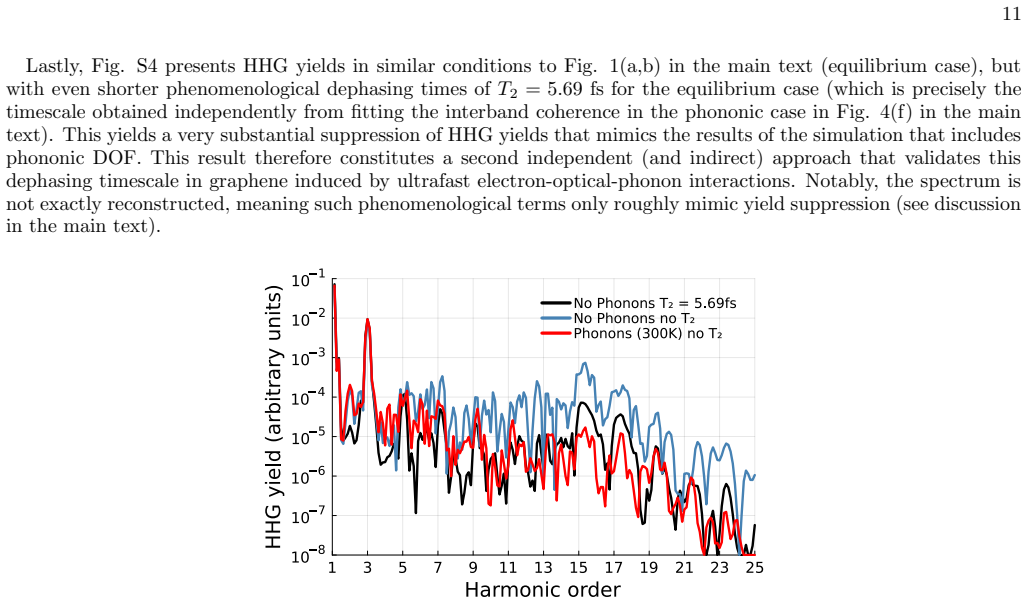
Optical phonons strongly suppress HHG yields by coupling to interband currents and causing harmonic phase scrambling (destructive interference), explaining the lack of experimental HHG above ~3 eV. HHG yields become temperature-dependent due to phonon occupations, though weakly in graphene. Optical phonons dephase interband coherences at a rate equivalent to T2~5.7 fs, faster than e-e scattering. Phonons smoothen HHG ellipticity-dependent curves for better experimental agreement. All effects arise from the static picture of electron-phonon interactions.
What carries the argument
Ensemble averaging over thermally occupied optical phonon configurations treated as static lattice distortions that imprint phase shifts on the interband polarization.
If this is right
- HHG yields above 3 eV are strongly reduced by phonon-induced phase randomization and destructive interference.
- HHG intensity shows weak temperature dependence because zero-point phonon motion dominates the averaging effect.
- Interband coherence decays on a ~5.7 fs timescale set by optical phonons rather than electron-electron scattering.
- Ellipticity dependence of HHG becomes smoother and aligns more closely with experimental curves.
Where Pith is reading between the lines
- The same static phonon averaging may limit coherence in other attosecond processes in solids such as photocurrents or Floquet states.
- Similar discrepancies between pure-electronic theory and data in other materials could be resolved by including thermal phonon configurations.
- Attosecond experiments in graphene and related systems should routinely account for static phonon effects even when the driving field is ultrafast.
Load-bearing premise
The lattice remains frozen during the attosecond electronic motion, so phonon effects reduce to thermal sampling and averaging without dynamic lattice evolution.
What would settle it
Measure whether HHG intensity above 3 eV increases when the graphene sample is cooled to reduce thermal phonon population.
Figures


read the original abstract
High harmonic generation (HHG) is a widely explored process in solids, where intense lasers drive attosecond-to-femtosecond electron dynamics within bands, causing high-energy emission. While electrons and photons are considered the main players in HHG, solids also host ubiquitous phonons that are typically assumed negligible in HHG due to their longer timescales. We theoretically study HHG in graphene with a formalism including optical phonons in the static limit, where the lattice is frozen on the electronic timescale and HHG is computed by sampling thermally-occupied phonons and ensemble-averaging. We show that in graphene: (i) Optical phonons strongly suppress HHG yields by coupling to interband currents and causing harmonic phase scrambling (destructive interference), explaining the lack of experimental HHG above ~3 eV. (ii) HHG yields become temperature-dependent due to phonon occupations, though in graphene this dependence is weak since phonon energy scales are dominated by zero-point motion. (iii) Optical phonons dephase interband coherences at a rate equivalent to T2~5.7 fs, substantially faster than e-e scattering, suggesting thermal phonons dominate electronic decoherence in strong fields. (iv) Phonons smoothen HHG ellipticity-dependent curves, yielding better agreement with experiments. Remarkably, all effects are timescale-independent, arising in the static picture of electron-phonon interactions, making results transferable to attosecond phenomena. Our results shed light on the dephasing time problem in HHG and the role of phonons on attosecond timescales, with implications for other systems and processes such as Floquet gaps and photocurrents in graphene.
Editorial analysis
A structured set of objections, weighed in public.
Referee Report
Summary. The manuscript claims that optical phonons in graphene, treated in the static (frozen-lattice) limit via thermal sampling and ensemble averaging, strongly suppress HHG yields above ~3 eV by coupling to interband currents and inducing harmonic phase scrambling that leads to destructive interference. This is presented as explaining the absence of high-energy HHG in experiments. Additional claims are that HHG yields show only weak temperature dependence (dominated by zero-point motion), that phonons produce an effective dephasing time T2 ~ 5.7 fs faster than electron-electron scattering, that phonons improve agreement with experimental ellipticity dependence, and that all these effects are timescale-independent because they arise already in the static electron-phonon picture.
Significance. If the static approximation and resulting suppression mechanism hold, the work would be significant for strong-field and attosecond physics in solids. It supplies a concrete phonon-based explanation for the dephasing-time problem in HHG and for the experimental cutoff near 3 eV, while highlighting that thermal phonons can dominate electronic decoherence even on ultrafast timescales. The ensemble-averaging formalism is a clear, parameter-free strength that could be extended to other materials and processes such as Floquet gaps or photocurrents.
major comments (2)
- [Abstract] Abstract: The central claim that optical phonons suppress HHG via phase scrambling in the static limit, and that 'all effects are timescale-independent,' is load-bearing for the transferability to attosecond dynamics, yet the manuscript provides no explicit benchmark or comparison against a time-dependent dynamical phonon treatment. Optical-phonon periods (~20 fs) and the reported T2 ~ 5.7 fs overlap with typical HHG driving pulses, so the frozen-lattice assumption requires validation.
- [Abstract] Abstract and results: The reported suppression above ~3 eV and the T2 ~ 5.7 fs value are stated as outputs of the ensemble average, but no derivation details, error estimates, or sensitivity to the phonon sampling procedure are given, preventing assessment of whether the phase-scrambling mechanism is robust or an artifact of the static approximation.
minor comments (1)
- The abstract would be clearer if it briefly indicated the numerical method used to compute the ensemble-averaged interband currents and the phonon displacement distribution.
Simulated Author's Rebuttal
We thank the referee for the thorough review and valuable feedback on our manuscript. We address each major comment point by point below, providing clarifications and indicating revisions made to strengthen the presentation of our results.
read point-by-point responses
-
Referee: [Abstract] Abstract: The central claim that optical phonons suppress HHG via phase scrambling in the static limit, and that 'all effects are timescale-independent,' is load-bearing for the transferability to attosecond dynamics, yet the manuscript provides no explicit benchmark or comparison against a time-dependent dynamical phonon treatment. Optical-phonon periods (~20 fs) and the reported T2 ~ 5.7 fs overlap with typical HHG driving pulses, so the frozen-lattice assumption requires validation.
Authors: We agree that an explicit benchmark against a fully time-dependent phonon treatment would provide additional validation for the timescale-independence claim. However, such a dynamical treatment lies beyond the scope of the present work, which deliberately isolates the static electron-phonon coupling to demonstrate its intrinsic effects. The optical-phonon period (~20 fs) is longer than both the reported T2 (~5.7 fs) and the sub-cycle timescales of high-harmonic emission in our simulations. We have added a new paragraph in the Discussion section that justifies the frozen-lattice approximation via timescale separation, references prior ultrafast phonon studies in graphene, and explains why the phase-scrambling mechanism (arising from ensemble averaging over static configurations) remains transferable to attosecond processes. This revision addresses the concern while preserving the paper's focus. revision: partial
-
Referee: [Abstract] Abstract and results: The reported suppression above ~3 eV and the T2 ~ 5.7 fs value are stated as outputs of the ensemble average, but no derivation details, error estimates, or sensitivity to the phonon sampling procedure are given, preventing assessment of whether the phase-scrambling mechanism is robust or an artifact of the static approximation.
Authors: We thank the referee for pointing out this lack of detail. In the revised manuscript we have expanded the Methods section with: (i) the explicit expression for the ensemble-averaged interband current and the phase accumulation due to phonon-induced potential fluctuations; (ii) the Monte Carlo sampling protocol over thermally displaced lattice configurations (with 1000 configurations used for the main results); (iii) convergence tests and error estimates obtained via bootstrap resampling; and (iv) a sensitivity analysis showing that both the high-energy suppression and the extracted T2 remain stable under variations in sample size, phonon temperature, and mode amplitudes. These additions confirm that the phase-scrambling effect is robust and not an artifact of the static approximation. revision: yes
Circularity Check
No significant circularity; central results are computed outputs of ensemble averaging over static phonon configurations
full rationale
The paper's derivation proceeds by sampling thermally occupied phonon displacements in the static (frozen-lattice) limit and computing HHG via ensemble-averaged interband currents. The reported suppression of yields above ~3 eV, the effective dephasing rate equivalent to T2 ~ 5.7 fs, and the smoothing of ellipticity curves are direct numerical outputs of this averaging procedure, not quantities defined in terms of themselves or fitted to the target observables. The claim that all effects are timescale-independent is an explicit consequence of adopting the static approximation rather than a hidden reduction. No load-bearing self-citations, uniqueness theorems, or ansatzes imported from prior author work are invoked to force the central conclusions. The calculation is therefore self-contained relative to its stated model assumptions and does not exhibit any of the enumerated circularity patterns.
Axiom & Free-Parameter Ledger
axioms (1)
- domain assumption Optical phonons can be treated in the static limit (lattice frozen on electronic timescale) while still capturing their effect on HHG
Reference graph
Works this paper leans on
-
[1]
Ghimire, A
S. Ghimire, A. D. DiChiara, E. Sistrunk, P. Agostini, L. F. DiMauro, and D. A. Reis, Observation of high-order harmonic generation in a bulk crystal, Nature Physics7, 138 (2011)
2011
-
[2]
Ghimire and D
S. Ghimire and D. A. Reis, High-harmonic generation from solids, Nature Physics15, 10 (2019)
2019
-
[3]
Yue and M
L. Yue and M. B. Gaarde, Introduction to theory of high-harmonic generation in solids: tutorial, J. Opt. Soc. Am. B39, 535 (2022)
2022
-
[4]
M. Wu, D. A. Browne, K. J. Schafer, and M. B. Gaarde, Multilevel perspective on high-order harmonic generation in solids, Physical Review A94, 1 (2016)
2016
-
[5]
Vampa, T
G. Vampa, T. J. Hammond, N. Thir´ e, B. E. Schmidt, F. L´ egar´ e, C. R. McDonald, T. Brabec, D. D. Klug, and P. B. Corkum, All-Optical Reconstruction of Crystal Band Structure, Physical Review Letters115, 193603 (2015)
2015
-
[6]
A. A. Lanin, E. A. Stepanov, A. B. Fedotov, and A. M. Zheltikov, Mapping the electron band structure by intraband high-harmonic generation in solids, Optica4, 516 (2017)
2017
-
[7]
Y.-Y. Lv, J. Xu, S. Han, C. Zhang, Y. Han, J. Zhou, S.-H. Yao, X.-P. Liu, M.-H. Lu, H. Weng, Z. Xie, Y. B. Chen, J. Hu, Y.-F. Chen, and S. Zhu, High-harmonic generation in Weyl semimetalβ-WP2 crystals, Nature Communications12, 6437 (2021)
2021
-
[8]
T. T. Luu, Z. Yin, A. Jain, T. Gaumnitz, Y. Pertot, J. Ma, and H. J. W¨ orner, Extreme–ultraviolet high–harmonic generation in liquids, Nature Communications9, 3723 (2018)
2018
-
[9]
A. J. Uzan-Narovlansky, L. Faeyrman, G. G. Brown, S. Shames, V. Narovlansky, J. Xiao, T. Arusi-Parpar, O. Kneller, B. D. Bruner, O. Smirnova, R. E. F. Silva, B. Yan, ´A. Jim´ enez-Gal´ an, M. Ivanov, and N. Dudovich, Observation of interband Berry phase in laser-driven crystals, Nature626, 66 (2024)
2024
-
[10]
M. R. Bionta, E. Haddad, A. Leblanc, V. Gruson, P. Lassonde, H. Ibrahim, J. Chaillou, N. ´Emond, M. R. Otto, ´A. Jim´ enez- Gal´ an, R. E. F. Silva, M. Ivanov, B. J. Siwick, M. Chaker, and F. L´ egar´ e, Tracking ultrafast solid-state dynamics using high harmonic spectroscopy, Physical Review Research3, 023250 (2021)
2021
-
[11]
Neufeld, J
O. Neufeld, J. Zhang, U. De Giovannini, H. H¨ ubener, and A. Rubio, Probing phonon dynamics with multidimensional high harmonic carrier-envelope-phase spectroscopy, Proceedings of the National Academy of Sciences119, e2204219119 (2022)
2022
-
[12]
Rana and G
N. Rana and G. Dixit, Probing phonon-driven symmetry alterations in graphene via high-order-harmonic spectroscopy, Phys. Rev. A106, 053116 (2022)
2022
-
[13]
Zhang, O
J. Zhang, O. Neufeld, N. Tancogne-Dejean, I.-T. Lu, H. H¨ ubener, U. De Giovannini, and A. Rubio, Enhanced high harmonic efficiency through phonon-assisted photodoping effect, npj Computational Materials10, 202 (2024)
2024
-
[14]
Zhang, Z
J. Zhang, Z. Wang, F. Lengers, D. Wigger, D. E. Reiter, T. Kuhn, H. J. W¨ orner, and T. T. Luu, High-harmonic spectroscopy 12 probes lattice dynamics, Nature Photonics18, 792 (2024)
2024
-
[15]
Jim´ enez-Gal´ an, R
´A. Jim´ enez-Gal´ an, R. E. F. Silva, O. Smirnova, and M. Ivanov, Lightwave control of topological properties in 2D materials for sub-cycle and non-resonant valley manipulation, Nature Photonics14, 728 (2020)
2020
-
[16]
Mitra, ´A
S. Mitra, ´A. Jim´ enez-Gal´ an, M. Aulich, M. Neuhaus, R. E. F. Silva, V. Pervak, M. F. Kling, and S. Biswas, Light-wave- controlled Haldane model in monolayer hexagonal boron nitride, Nature628, 752 (2024)
2024
-
[17]
Tyulnev, ´A
I. Tyulnev, ´A. Jim´ enez-Gal´ an, J. Poborska, L. Vamos, P. S. J. Russell, F. Tani, O. Smirnova, M. Ivanov, R. E. F. Silva, and J. Biegert, Valleytronics in bulk MoS2 with a topologic optical field, Nature628, 746 (2024)
2024
-
[18]
Lively, S
K. Lively, S. A. Sato, G. Albareda, A. Rubio, and A. Kelly, Revealing ultrafast phonon mediated inter-valley scattering through transient absorption and high harmonic spectroscopies, Physical Review Research6, 13069 (2024)
2024
-
[19]
H. Kim, J. Kim, A. Galler, M. Kim, A. Chac´ on, K. Watanabe, T. Taniguchi, D. Kim, S. Chae, M.-H. Jo, A. Rubio, O. Neufeld, and J.-W. Kim, Quantum interference and occupation control in high harmonic generation from monolayer ws2, Nature Communications16, 9825 (2025)
2025
-
[20]
Uzan-Narovlansky, A
A. Uzan-Narovlansky, A. Jimenez-Galan, G. Orenstein, R. Silva, T. Arusi-Parpar, S. Shames, B. Bruner, B. Yan, O. Smirnova, M. M. Ivanov, and N. Dudovich, Observation of light-driven band structure via multiband high-harmonic spectroscopy, Nature Photonics16, 428 (2022)
2022
-
[21]
Neufeld, W
O. Neufeld, W. Mao, H. H¨ ubener, N. Tancogne-Dejean, S. A. Sato, U. De Giovannini, and A. Rubio, Time- and angle- resolved photoelectron spectroscopy of strong-field light-dressed solids: Prevalence of the adiabatic band picture, Physical Review Research4, 033101 (2022)
2022
-
[22]
Galler, A
A. Galler, A. Rubio, and O. Neufeld, Mapping light-dressed Floquet bands by highly nonlinear optical excitations and valley polarization, Journal of Physical Chemistry Letters14, 11298 (2023)
2023
- [23]
-
[24]
R. V. Gothelf, C. S. Lange, and L. B. Madsen, High-order harmonic generation in a crystal driven by quantum light, Physical Review A111, 63105 (2025)
2025
-
[25]
C. S. Lange, T. Hansen, and L. B. Madsen, Excitonic Enhancement of Squeezed Light in Quantum-Optical High-Harmonic Generation from a Mott Insulator, Physical Review Letters135, 43603 (2025)
2025
-
[26]
Tancogne-Dejean, M
N. Tancogne-Dejean, M. A. Sentef, and A. Rubio, Ultrafast Modification of Hubbard U in a Strongly Correlated Material: Ab initio High-Harmonic Generation in NiO, Physical Review Letters121, 097402 (2018)
2018
-
[27]
R. E. F. Silva, I. V. Blinov, A. N. Rubtsov, O. Smirnova, and M. Ivanov, High-harmonic spectroscopy of ultrafast many- body dynamics in strongly correlated systems, Nature Photonics12, 266 (2018)
2018
-
[28]
Neufeld, N
O. Neufeld, N. Tancogne-Dejean, H. H¨ ubener, U. De Giovannini, and A. Rubio, Are there universal signatures of topological phases in high-harmonic generation? probably not., Phys. Rev. X13, 031011 (2023)
2023
-
[29]
V. N. Valmispild, E. Gorelov, M. Eckstein, A. I. Lichtenstein, H. Aoki, M. I. Katsnelson, M. Y. Ivanov, and O. Smirnova, Sub-cycle multidimensional spectroscopy of strongly correlated materials, Nature Photonics18, 432 (2024)
2024
-
[30]
S. V. B. Jensen, L. B. Madsen, A. Rubio, and N. Tancogne-Dejean, High-harmonic spectroscopy of strongly bound excitons in solids, Physical Review A109, 63104 (2024)
2024
-
[31]
Chang Lee, L
V. Chang Lee, L. Yue, M. B. Gaarde, Y.-h. Chan, and D. Y. Qiu, Many-body enhancement of high-harmonic generation in monolayer MoS2, Nature Communications15, 6228 (2024)
2024
-
[32]
E. B. Molinero, B. Amorim, M. Malakhov, G. Cistaro, ´A. Jim´ enez-Gal´ an, A. Pic´ on, P. San-Jos´ e, M. Ivanov, and R. E. F. Silva, Subcycle dynamics of excitons under strong laser fields, Science Advances10, eadn6985 (2024)
2024
-
[33]
G. G. Brown, ´A. Jim´ enez-Gal´ an, R. E. F. Silva, and M. Ivanov, Ultrafast dephasing in solid-state high harmonic generation: macroscopic origin revealed by real-space dynamics, J. Opt. Soc. Am. B41, B40 (2024)
2024
-
[34]
Kolesik and J
M. Kolesik and J. V. Moloney, Numerical discreteness and dephasing in high-harmonic calculations in solids, Physical Review B108, 115433 (2023)
2023
-
[35]
Wang and T.-Y
G. Wang and T.-Y. Du, Quantum decoherence in high-order harmonic generation from solids, Physical Review A103, 63109 (2021)
2021
-
[36]
V. Korolev, T. Lettau, V. Krishna, A. Croy, M. Zuerch, C. Spielmann, M. Waechtler, U. Peschel, S. Graefe, and G. Soavi, Unveiling the Role of Electron-Phonon Scattering in Dephasing High-Order Harmonics in Solids, arXiv preprint arXiv:2401.12929 (2024)
-
[37]
C. Mai, A. Barrette, Y. Yu, Y. G. Semenov, K. W. Kim, L. Cao, and K. Gundogdu, Many-Body Effects in Valleytronics: Direct Measurement of Valley Lifetimes in Single-Layer MoS2, Nano Letters14, 202 (2014)
2014
-
[38]
L. Wang, C. Xu, M.-Y. Li, L.-J. Li, and Z.-H. Loh, Unraveling Spatially Heterogeneous Ultrafast Carrier Dynamics of Single-Layer WSe2 by Femtosecond Time-Resolved Photoemission Electron Microscopy, Nano Letters18, 5172 (2018)
2018
-
[39]
Heide, T
C. Heide, T. Eckstein, T. Boolakee, C. Gerner, H. B. Weber, I. Franco, and P. Hommelhoff, Electronic Coherence and Coherent Dephasing in the Optical Control of Electrons in Graphene, Nano Letters21, 9403 (2021)
2021
-
[40]
Floss, C
I. Floss, C. Lemell, K. Yabana, and J. Burgd¨ orfer, Incorporating decoherence into solid-state time-dependent density functional theory, Physical Review B99, 224301 (2019)
2019
-
[41]
G. Bae, Y. Kim, and J. D. Lee, Superradiance and Broadband Emission Driving Fast Electron Dephasing in Open Quantum Systems, Advanced Sciencen/a, e22729 (2026)
2026
-
[42]
Freeman, A
D. Freeman, A. Kheifets, S. Yamada, A. Yamada, and K. Yabana, High-order harmonic generation in semiconductors driven at near- and mid-infrared wavelengths, Physical Review B106, 75202 (2022)
2022
-
[43]
G. Luo, J. Wang, and X. Zhao, Analytical investigation of coherence time from solid-state HHG, The European Physical 13 Journal D80, 33 (2026)
2026
-
[44]
Du and C
T.-Y. Du and C. Ma, Temperature-induced dephasing in high-order harmonic generation from solids, Physical Review A 105, 53125 (2022)
2022
-
[45]
A. C´ ardenas, D. N. Purschke, G. G. Brown, P. San-Jose, R. E. Silva, and ´A. Jim´ enez-Gal´ an, Effects of zero-point motion in the high harmonic generation spectrum of solids, arXiv preprint arXiv:2512.01712 (2025)
-
[46]
Phonon-driven decoherence of high-harmonic generation in the solid-state
S. Mokhtari, V. Jelic, D. N. Purschke, S. Gholam-Mirzaei, K. M. Kowalczyk, D. A. Reis, T. Hammond, D. M. Villeneuve, A. Staudte, F. L´ egar´ e,et al., Phonon-driven decoherence of high-harmonic generation in the solid-state, arXiv preprint arXiv:2604.07543 (2026)
work page internal anchor Pith review Pith/arXiv arXiv 2026
-
[47]
Probing lattice fluctuations using solid-state high-harmonic spectroscopy
L. Hatch, N. Rana, S. He, J. Yu, B. Zhao, Y. Zhang, H. Wen, X. Roy, L. Yue, M. Gaarde, and H. Liu, Probing lattice fluctuations using solid-state high-harmonic spectroscopy, arXiv preprint arXiv:2604.10304 (2026), arXiv:2604.10304 [cond- mat.mtrl-sci]
work page internal anchor Pith review Pith/arXiv arXiv 2026
-
[48]
Yoshikawa, T
N. Yoshikawa, T. Tamaya, and K. Tanaka, High-harmonic generation in graphene enhanced by elliptically polarized light excitation, Science (New York, N.Y.)356, 736 (2017)
2017
-
[49]
H. A. Hafez, S. Kovalev, J.-C. Deinert, Z. Mics, B. Green, N. Awari, M. Chen, S. Germanskiy, U. Lehnert, J. Teichert, Z. Wang, K.-J. Tielrooij, Z. Liu, Z. Chen, A. Narita, K. M¨ ullen, M. Bonn, M. Gensch, and D. Turchinovich, Extremely efficient terahertz high-harmonic generation in graphene by hot Dirac fermions, Nature561, 507 (2018)
2018
-
[50]
Baudisch, A
M. Baudisch, A. Marini, J. D. Cox, T. Zhu, F. Silva, S. Teichmann, M. Massicotte, F. Koppens, L. S. Levitov, F. J. Garc´ ıa De Abajo, and J. Biegert, Ultrafast nonlinear optical response of Dirac fermions in graphene, Nature Communications9, 1018 (2018)
2018
-
[51]
S. Cha, M. Kim, Y. Kim, S. Choi, S. Kang, H. Kim, S. Yoon, G. Moon, T. Kim, Y. W. Lee, G. Y. Cho, M. J. Park, C.-J. Kim, B. J. Kim, J. Lee, M.-H. Jo, and J. Kim, Gate-tunable quantum pathways of high harmonic generation in graphene, Nature Communications13, 6630 (2022)
2022
- [52]
-
[53]
Zeng and X.-B
A.-W. Zeng and X.-B. Bian, Impact of statistical fluctuations on high harmonic generation in liquids, Phys. Rev. Lett. 124, 203901 (2020)
2020
-
[54]
Y.-L. Xu, L. Zhang, C. Zhang, Y.-K. Wu, Y.-Y. Chen, C.-X. Huang, Z.-B. Cui, R. Yao, W.-Q. Lian, J.-Y. Ma, W.- X. Guo, B.-X. Qi, P.-Y. Hou, Y.-F. Pu, Z.-C. Zhou, L. He, and L.-M. Duan, Long-time storage of a qubit encoded in decoherence-free subspace using a dual-type quantum memory, Physical Review Letters135(2025)
2025
- [55]
-
[56]
O. Neufeld, Accurate two-band tight-binding Hamiltonians for hexagonal two-dimensional materials for strong-field physics, Journal of Physics B: Atomic, Molecular and Optical Physics (2026)
2026
-
[57]
Yue and M
L. Yue and M. B. Gaarde, Characterizing Anomalous High-Harmonic Generation in Solids, Physical Review Letters130, 166903 (2022)
2022
-
[58]
R. M. Ribeiro, V. M. Pereira, N. M. R. Peres, P. R. Briddon, and A. H. Castro Neto, Strained graphene: tight-binding and density functional calculations, New Journal of Physics11, 115002 (2009)
2009
-
[59]
Piscanec, M
S. Piscanec, M. Lazzeri, F. Mauri, and A. C. Ferrari, Optical phonons of graphene and nanotubes, The European Physical Journal Special Topics148, 159 (2007)
2007
-
[60]
S. de-la Pe˜ na, H. Appel, A. Rubio, and O. Neufeld, Fully quantum theory of strong-field driven tunable entangled multi- photon states in hhg, arXiv preprint arXiv:2512.03987 (2025)
-
[61]
Neufeld, D
O. Neufeld, D. Podolsky, and O. Cohen, Floquet group theory and its application to selection rules in harmonic generation, Nature Communications10, 405 (2019)
2019
-
[62]
Zhang, Y.-W
Y. Zhang, Y.-W. Tan, H. L. Stormer, and P. Kim, Experimental observation of the quantum Hall effect and Berry’s phase in graphene, Nature438, 201 (2005)
2005
-
[63]
Dutreix, H
C. Dutreix, H. Gonz´ alez-Herrero, I. Brihuega, M. I. Katsnelson, C. Chapelier, and V. T. Renard, Measuring the Berry phase of graphene from wavefront dislocations in Friedel oscillations, Nature574, 219 (2019)
2019
-
[64]
G. Gui, J. Li, and J. Zhong, Band structure engineering of graphene by strain: First-principles calculations, Physical Review B78, 75435 (2008)
2008
-
[65]
Cocco, E
G. Cocco, E. Cadelano, and L. Colombo, Gap opening in graphene by shear strain, Physical Review B81, 241412 (2010)
2010
-
[66]
Tamaya, A
T. Tamaya, A. Ishikawa, T. Ogawa, and K. Tanaka, Higher-order harmonic generation caused by elliptically polarized electric fields in solid-state materials, Phys. Rev. B94, 241107 (2016)
2016
-
[67]
Tancogne-Dejean, O
N. Tancogne-Dejean, O. D. M¨ ucke, F. X. K¨ artner, and A. Rubio, Ellipticity dependence of high-harmonic generation in solids originating from coupled intraband and interband dynamics, Nature Communications8, 745 (2017)
2017
-
[68]
Baykusheva, A
D. Baykusheva, A. Chac´ on, J. Lu, T. P. Bailey, J. A. Sobota, H. Soifer, P. S. Kirchmann, C. Rotundu, C. Uher, T. F. Heinz, D. A. Reis, and S. Ghimire, All-Optical Probe of Three-Dimensional Topological Insulators Based on High-Harmonic Generation by Circularly Polarized Laser Fields, Nano Letters21, 8970 (2021)
2021
-
[69]
Neufeld, N
O. Neufeld, N. Tancogne-Dejean, U. De Giovannini, H. H¨ ubener, and A. Rubio, Light-Driven Extremely Nonlinear Bulk Photogalvanic Currents, Physical Review Letters127, 126601 (2021)
2021
-
[70]
Higuchi, C
T. Higuchi, C. Heide, K. Ullmann, H. B. Weber, and P. Hommelhoff, Light-field-driven currents in graphene, Nature550, 224 (2017)
2017
-
[71]
Schiffrin, T
A. Schiffrin, T. Paasch-Colberg, N. Karpowicz, V. Apalkov, D. Gerster, S. M¨ uhlbrandt, M. Korbman, J. Reichert, 14 M. Schultze, S. Holzner, J. V. Barth, R. Kienberger, R. Ernstorfer, V. S. Yakovlev, M. I. Stockman, and F. Krausz, Optical-field-induced current in dielectrics, Nature493, 70 (2013)
2013
-
[72]
Galler and O
A. Galler and O. Neufeld, Bulk photogalvanic current control and gap spectroscopy in 2D hexagonal materials, Journal of Materials Chemistry C13, 17893 (2025)
2025
-
[73]
M. S. Rudner and N. H. Lindner, Band structure engineering and non-equilibrium dynamics in Floquet topological insu- lators, Nature Reviews Physics2, 229 (2020)
2020
-
[74]
J. W. McIver, B. Schulte, F.-U. Stein, T. Matsuyama, G. Jotzu, G. Meier, and A. Cavalleri, Light-induced anomalous Hall effect in graphene, Nature Physics16, 38 (2020)
2020
-
[75]
Merboldt, M
M. Merboldt, M. Sch¨ uler, D. Schmitt, J. P. Bange, W. Bennecke, K. Gadge, K. Pierz, H. W. Schumacher, D. Momeni, D. Steil, S. R. Manmana, M. A. Sentef, M. Reutzel, and S. Mathias, Observation of Floquet states in graphene, Nature Physics21, 1093 (2025)
2025
-
[76]
D. Choi, M. Mogi, U. De Giovannini, D. Azoury, B. Lv, Y. Su, H. H¨ ubener, A. Rubio, and N. Gedik, Observation of Floquet–Bloch states in monolayer graphene, Nature Physics21, 1100 (2025)
2025
-
[77]
F. Wang, X. Cai, X. Tang, J. Lu, W. Chen, T. Sheng, R. Feng, H. Zhong, H. Zhang, P. Yu, and S. Zhou, Observation of Floquet-induced gap in graphene, Nature Materials 10.1038/s41563-026-02549-y (2026)
-
[78]
Neufeld and O
O. Neufeld and O. Cohen, Background-free measurement of ring currents by symmetry-breaking high-harmonic spec- troscopy, Phys. Rev. Lett.123, 103202 (2019)
2019
discussion (0)
Sign in with ORCID, Apple, or X to comment. Anyone can read and Pith papers without signing in.