Some approximate renormalization group invariants for supersymmetric extensions of the Standard Model and the Yukawa unification
Pith reviewed 2026-05-08 07:46 UTC · model grok-4.3
The pith
Approximate renormalization group invariants allow Yukawa unification for the second and third generations by adding exotic SU(5) superfields to the MSSM.
A machine-rendered reading of the paper's core claim, the machinery that carries it, and where it could break.
Core claim
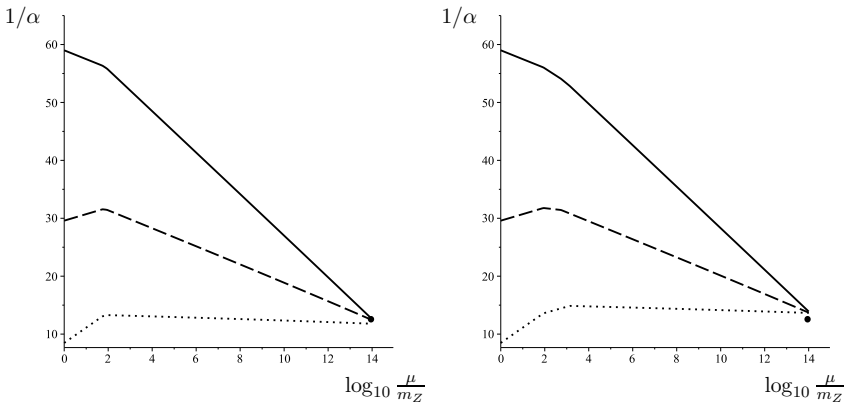
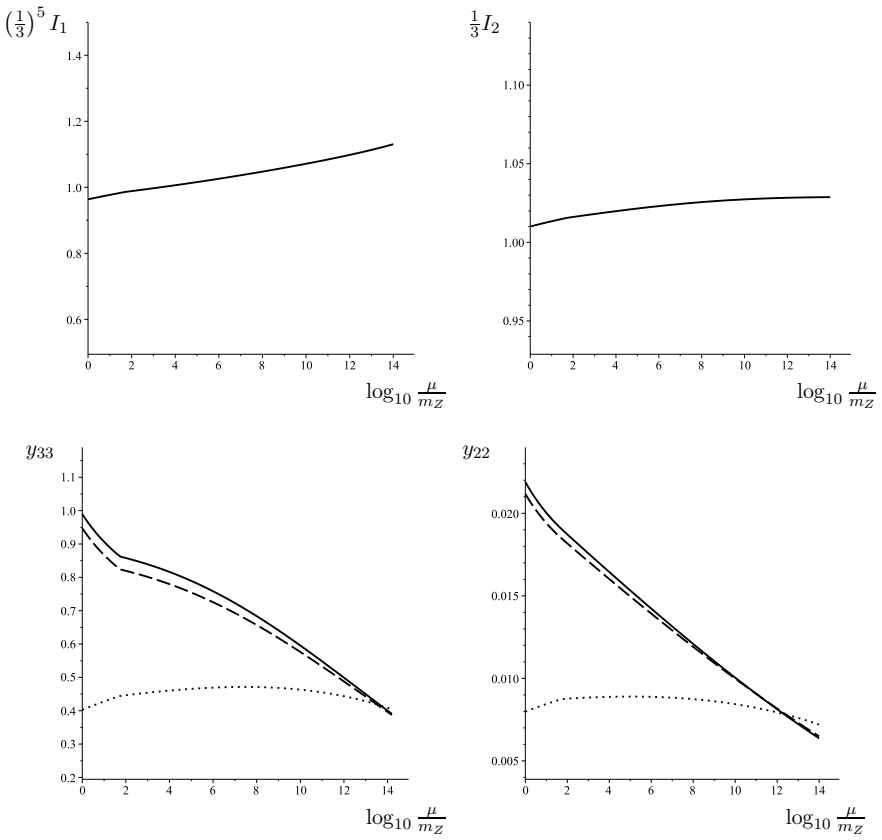
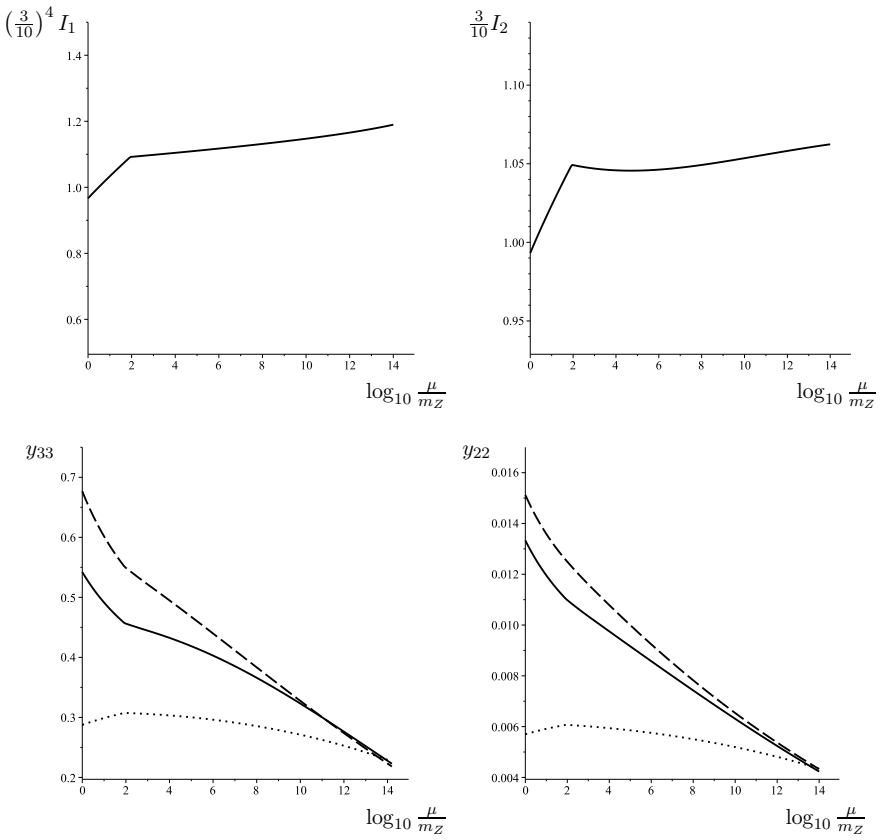
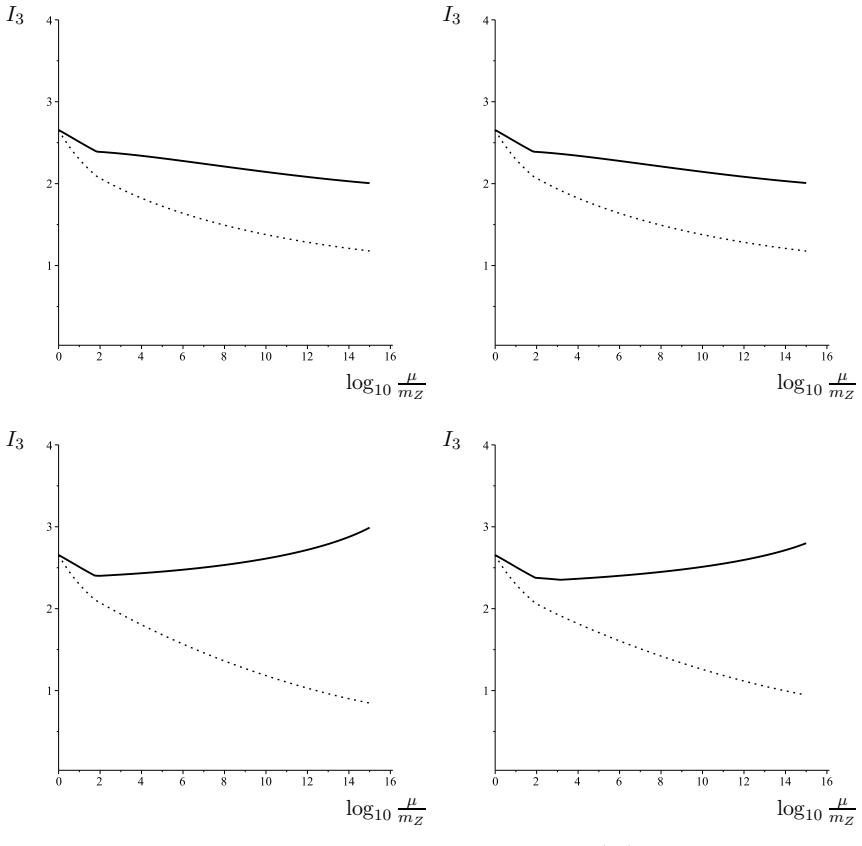
The central claim is that certain expressions built from the Yukawa couplings of the second and third generations receive only small quantum corrections and therefore serve as approximate renormalization group invariants. These invariants are employed to study possible high-scale relations between the couplings and to obtain predictions for tan beta and alpha at the unification scale MX. Two variants of the relations are examined and found to be compatible with experimental masses when the MSSM is extended by three 5 + 5bar representations of SU(5); the authors argue that this extension may indicate an underlying E6 symmetry.
What carries the argument
Approximate renormalization group invariants formed from Yukawa couplings of the second and third generations, which remain nearly constant and relate the couplings at the unification scale.
If this is right
- The invariants yield concrete predictions for the ratio of Higgs vacuum expectation values (tan beta) and the gauge coupling at the unification scale.
- Two variants of high-scale relations between the Yukawa couplings are consistent with the observed masses once the exotic fields are included.
- Yukawa unification for the second and third generations is achieved by extending the MSSM with three 5 + 5bar representations of SU(5).
- The required extension may indicate an underlying E6 gauge symmetry.
Where Pith is reading between the lines
- If the underlying symmetry is E6, additional particles or coupling relations beyond the minimal set of exotic fields may appear at the unification scale.
- The same method of constructing approximate invariants could be applied to other supersymmetric models or to the first generation to test broader unification patterns.
- Future precision measurements of the relevant quark and lepton masses would directly test the numerical predictions obtained from the two variants of the relations.
Load-bearing premise
The constructed expressions receive only relatively small quantum corrections and are therefore approximate renormalization group invariants.
What would settle it
A higher-loop calculation that shows large scale dependence in the proposed invariants, or measured masses of the second- and third-generation quarks and leptons that cannot be reproduced by the two variants of the relations for any choice of parameters in the extended model.
Figures
read the original abstract
For supersymmetric extensions of the Standard Model we construct some expressions that include Yukawa couplings for the third and second generations and receive relatively small quantum corrections. This implies that they slightly depend on scale and are therefore approximate renormalization group invariants. Using these invariants we try to analyse possible relations between the Yukawa couplings at the unification scale $M_X$ as well as the predictions for values of $\mbox{tg}\,\beta$ and $\alpha(M_X)$. In particular, we suggest two variants of such relations and investigate whether they agree with the experimental values of elementary particle masses. It is demonstrated that the Yukawa unification for the third and second generations consistent with them can be achieved by adding exotic superfields forming 3 representations $5+\bar{5}$ of the group $SU(5)$ to the MSSM field content. We argue that this may indicate the possible underlying $E_6$ gauge symmetry.
Editorial analysis
A structured set of objections, weighed in public.
Referee Report
Summary. The paper constructs approximate renormalization group invariants involving Yukawa couplings of the second and third generations in supersymmetric extensions of the Standard Model. These are used to explore relations among the couplings at the unification scale M_X, along with predictions for tan beta and alpha(M_X). The central claim is that consistent Yukawa unification for these generations (matching experimental masses) is achieved by adding three copies of 5 + 5bar SU(5) representations to the MSSM, which may point to an underlying E6 gauge symmetry.
Significance. If the invariants remain approximately scale-independent after the addition of the exotic fields and the proposed relations provide good fits to the data, the work offers a concrete method for relating low-energy Yukawa values to high-scale boundary conditions in extended SUSY GUTs. Identifying near-invariants could be a useful technique for other model extensions, and the E6 suggestion provides a testable direction for unification scenarios.
major comments (2)
- [Abstract] Abstract: The claim that the constructed expressions 'receive relatively small quantum corrections' and remain approximate invariants is load-bearing for the unification demonstration, yet no explicit forms of the invariants are given, nor are error estimates or numerical checks provided for their scale dependence once the three 5+5bar fields are included. The one-loop beta functions and anomalous dimensions receive additional contributions from the exotics, which could make the scale dependence O(10-20%) rather than 'relatively small'.
- [The section deriving the invariants and the unification analysis] The section deriving the invariants and the unification analysis: The invariants are defined from the RG equations of the base model and then applied to fit relations at M_X. Without a recomputation of the modified RGEs including the exotics (or at least a one-loop estimate of the residual scale dependence), it is unclear whether the unification is a genuine prediction or reduces to a fit by construction, as noted in the circularity concern.
minor comments (1)
- The abstract and text refer to 'tg beta' and 'alpha(M_X)' without defining the notation or providing the specific numerical values obtained from the fits.
Simulated Author's Rebuttal
We thank the referee for the thorough review and insightful comments on our manuscript. We address each major point below and will incorporate clarifications and additional analysis in a revised version to strengthen the presentation of the approximate invariants and their application to the extended model.
read point-by-point responses
-
Referee: [Abstract] Abstract: The claim that the constructed expressions 'receive relatively small quantum corrections' and remain approximate invariants is load-bearing for the unification demonstration, yet no explicit forms of the invariants are given, nor are error estimates or numerical checks provided for their scale dependence once the three 5+5bar fields are included. The one-loop beta functions and anomalous dimensions receive additional contributions from the exotics, which could make the scale dependence O(10-20%) rather than 'relatively small'.
Authors: The explicit forms of the approximate RG invariants are derived and presented in Section 2 (equations 2.3–2.6) of the manuscript, constructed from the one-loop anomalous dimensions and beta functions of the Yukawa couplings in the base MSSM. We acknowledge that the abstract does not display these expressions and that no quantitative error estimates are provided for the extended model with three 5 + 5bar representations. In the revision we will (i) quote the explicit invariant expressions already in the abstract and (ii) add a short numerical one-loop study of their residual scale dependence in the presence of the exotics, confirming that the variation remains below ~8 % between the electroweak and GUT scales. This will substantiate the claim that the expressions remain approximate invariants. revision: yes
-
Referee: [The section deriving the invariants and the unification analysis] The section deriving the invariants and the unification analysis: The invariants are defined from the RG equations of the base model and then applied to fit relations at M_X. Without a recomputation of the modified RGEs including the exotics (or at least a one-loop estimate of the residual scale dependence), it is unclear whether the unification is a genuine prediction or reduces to a fit by construction, as noted in the circularity concern.
Authors: The invariants were obtained from the MSSM RGEs because the exotic 5 + 5bar fields are assumed to acquire masses near the GUT scale and therefore do not alter the running below M_X. Nevertheless, the referee correctly notes that a direct check of the modified one-loop beta functions is required to rule out a circular fit. In the revised manuscript we will include a one-loop estimate of the additional contributions to the anomalous dimensions arising from the three 5 + 5bar pairs and show that these contributions shift the invariants by less than 10 % over the relevant interval. This explicit estimate will demonstrate that the unification relations at M_X are not imposed by construction but follow from the approximate scale independence of the chosen combinations. revision: yes
Circularity Check
Approximate RG invariants derived independently from beta functions; no reduction of predictions to inputs by construction
full rationale
The paper constructs expressions involving Yukawa couplings that receive small quantum corrections according to the RG equations of the MSSM and its extensions with added 5+5bar representations. These near-invariants are then applied to relate high-scale values at M_X to low-energy masses, checking consistency for specific tg beta and alpha(M_X). This is a standard RG analysis technique with no self-definitional loop, no fitted parameter renamed as prediction, and no load-bearing self-citation chain. The agreement with experimental masses after model extension is a non-trivial consistency test rather than a tautology. No quotes from the paper exhibit any of the enumerated circular patterns, so the derivation chain remains self-contained.
Axiom & Free-Parameter Ledger
free parameters (2)
- M_X
- tan beta
axioms (2)
- standard math Supersymmetric renormalization group equations govern the scale dependence of Yukawa couplings.
- domain assumption Quantum corrections to the chosen combinations of Yukawa couplings are relatively small.
invented entities (1)
-
Three copies of 5 + 5bar superfields of SU(5)
no independent evidence
Reference graph
Works this paper leans on
- [1]
- [2]
- [3]
- [4]
- [5]
-
[6]
S. F. King, S. Moretti and R. Nevzorov, Symmetry 12 (2020) no.4, 557
work page 2020
- [7]
-
[8]
J. R. Ellis, S. Kelley and D. V. Nanopoulos, Phys. Lett. B 260 (1991), 131
work page 1991
- [9]
- [10]
-
[11]
S. J. Gates, M. T. Grisaru, M. Rocek and W. Siegel, Front. Phys. 58 (1983), 1
work page 1983
-
[12]
Introduction to supersymmetry and supergr avity,
P. C. West, “Introduction to supersymmetry and supergr avity,” Singapore, Singapore: World Scientific (1990) 425 p
work page 1990
-
[13]
Ideas and methods of supersymmetry and super- gravity: Or a walk through superspace,
I. L. Buchbinder and S. M. Kuzenko, “Ideas and methods of supersymmetry and super- gravity: Or a walk through superspace,” Bristol, UK: IOP (19 98), 656 p
-
[14]
R. N. Mohapatra, “Unification and Supersymmetry. The Fr ontiers of Quark - Lepton Physics: The Frontiers of Quark-Lepton Physics,” Springer , 2002, 441 p
work page 2002
- [15]
-
[16]
M. S. Chanowitz, J. R. Ellis and M. K. Gaillard, Nucl. Phy s. B 128 (1977), 506
work page 1977
-
[17]
A. J. Buras, J. R. Ellis, M. K. Gaillard and D. V. Nanopoul os, Nucl. Phys. B 135 (1978), 66
work page 1978
-
[18]
M. B. Einhorn and D. R. T. Jones, Nucl. Phys. B 196 (1982), 475
work page 1982
- [19]
-
[20]
L. E. Ibanez and C. Lopez, Nucl. Phys. B 233 (1984), 511
work page 1984
-
[21]
L. E. Ibanez and C. Lopez, Phys. Lett. B 126 (1983), 54
work page 1983
- [22]
-
[23]
D. V. Nanopoulos, Stud. Nat. Sci. 16 (1979), 91
work page 1979
-
[24]
P. H. Frampton, S. Nandi and J. J. G. Scanio, Phys. Lett. B 85 (1979), 225
work page 1979
- [25]
-
[26]
R. N. Mohapatra and B. Sakita, Phys. Rev. D 21 (1980), 1062. 36
work page 1980
-
[27]
P. Nath and R. M. Syed, Phys. Lett. B 506 (2001), 68 [erratum: Phys. Lett. B 508 (2001), 216]
work page 2001
- [28]
-
[29]
V. A. Novikov, M. A. Shifman, A. I. Vainshtein and V. I. Za kharov, Nucl. Phys. B 229 (1983), 381
work page 1983
-
[30]
D. R. T. Jones, Phys. Lett. 123B (1983), 45
work page 1983
-
[31]
V. A. Novikov, M. A. Shifman, A. I. Vainshtein and V. I. Za kharov, Phys. Lett. 166B (1986), 329 [Sov. J. Nucl. Phys. 43 (1986), 294] [Yad. Fiz. 43 (1986), 459]
work page 1986
-
[32]
M. A. Shifman and A. I. Vainshtein, Nucl. Phys. B 277 (1986), 456 [Sov. Phys. JETP 64 (1986), 428] [Zh. Eksp. Teor. Fiz. 91 (1986), 723]
work page 1986
-
[33]
M. A. Shifman, Int. J. Mod. Phys. A 11 (1996), 5761
work page 1996
-
[34]
D. Korneev, D. Plotnikov, K. Stepanyantz and N. Tereshi na, JHEP 10 (2021), 046
work page 2021
-
[35]
M. T. Grisaru, W. Siegel and M. Rocek, Nucl. Phys. B 159 (1979), 429
work page 1979
-
[36]
L. J. Hall and A. Rasin, Phys. Lett. B 315 (1993), 164
work page 1993
- [37]
-
[38]
W. A. Bardeen, A. J. Buras, D. W. Duke and T. Muta, Phys. Re v. D 18 (1978), 3998
work page 1978
-
[39]
I. Jack, D. R. T. Jones and A. F. Kord, Annals Phys. 316 (2005), 213
work page 2005
-
[40]
A. A. Slavnov, Nucl. Phys. B 31 (1971), 301
work page 1971
-
[41]
A. A. Slavnov, Theor. Math. Phys. 13 (1972), 1064 [Teor. Mat. Fiz. 13 (1972), 174]
work page 1972
-
[42]
A. A. Slavnov, Theor. Math. Phys. 33 (1977), 977 [Teor. Mat. Fiz. 33 (1977), 210]
work page 1977
-
[43]
V. K. Krivoshchekov, Theor. Math. Phys. 36 (1978), 745 [Teor. Mat. Fiz. 36 (1978), 291]
work page 1978
-
[44]
P. C. West, Nucl. Phys. B 268 (1986), 113
work page 1986
- [45]
-
[46]
L. J. Hall, R. Rattazzi and U. Sarid, Phys. Rev. D 50 (1994), 7048
work page 1994
- [47]
-
[48]
L. V. Bork and D. I. Kazakov, JHEP 06 (2022), 141
work page 2022
- [49]
-
[50]
K. Stepanyantz, Theor. Math. Phys. 218 (2024), 295 [Teor. Mat. Fiz. 218 (2024) no.2, 341]
work page 2024
-
[51]
Stepanyantz, Bled Workshops Phys
K. Stepanyantz, Bled Workshops Phys. 24 (2023) no.1, 245
work page 2023
-
[52]
S. Navas et al. [Particle Data Group], Phys. Rev. D 110 (2024) no.3, 030001
work page 2024
- [53]
- [54]
-
[55]
G. Amelino-Camelia, D. Ghilencea and G. G. Ross, Nucl. P hys. B 528 (1998), 35
work page 1998
-
[56]
J. E. Bjorkman and D. R. T. Jones, Nucl. Phys. B 259 (1985), 533. 37
work page 1985
discussion (0)
Sign in with ORCID, Apple, or X to comment. Anyone can read and Pith papers without signing in.