Recognition: unknown
Testing Scalar Field Dark Matter models in M31 galaxy through the Rotation Curve analysis
Pith reviewed 2026-05-08 07:17 UTC · model grok-4.3
The pith
M31 rotation curve data favor a two-bulge baryonic model and smooth-cored scalar field dark matter halos.
A machine-rendered reading of the paper's core claim, the machinery that carries it, and where it could break.
Core claim
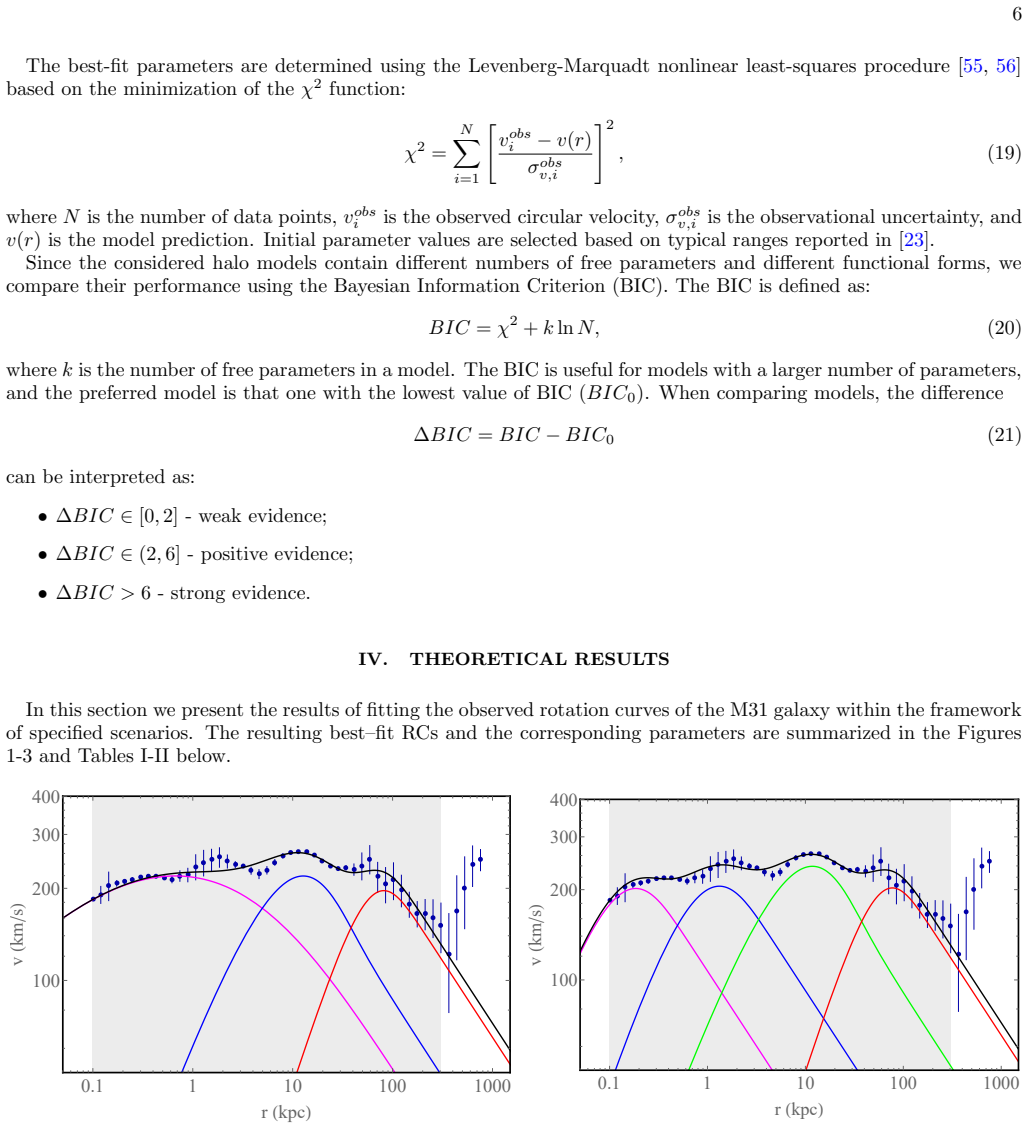
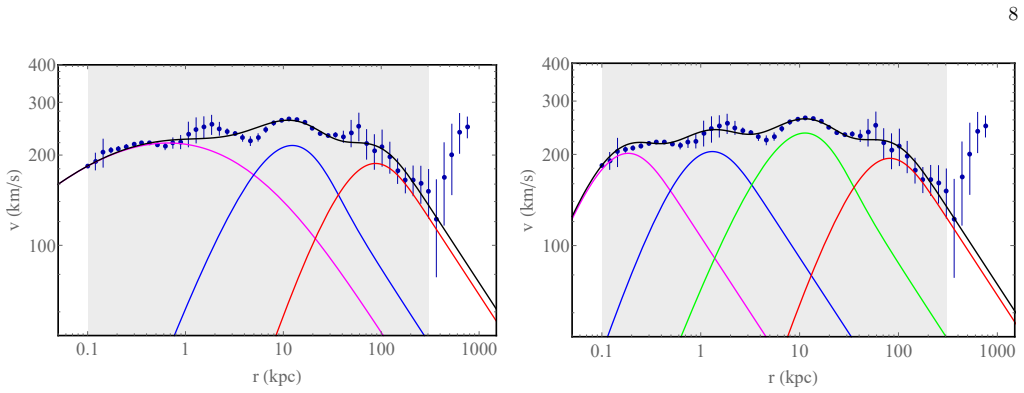
Fitting the M31 rotation curve with a Freeman stellar disk plus either a single de Vaucouleurs bulge or two exponential bulges, together with scalar field dark matter halos of fuzzy, Bose-Einstein condensate, or multistate types, shows that the two-bulge baryonic model gives a better statistical fit independent of the dark matter choice. Among scalar field scenarios the smooth cored fuzzy dark matter halo yields the most consistent description of the galaxy's kinematics.
What carries the argument
Nonlinear least-squares fitting with the Levenberg-Marquardt algorithm and Bayesian Information Criterion model selection applied to combinations of baryonic profiles and scalar field dark matter halo density distributions.
If this is right
- The two-bulge configuration should be adopted as the standard baryonic model for M31 mass decomposition studies.
- Scalar field dark matter models with smooth cores are preferred for reproducing M31's observed velocities over those with different density shapes.
- This fitting framework enables quantitative comparison between scalar field predictions and earlier phenomenological dark matter models for the same galaxy.
- The independence of the baryonic improvement from the halo model suggests the result is robust to dark matter assumptions.
Where Pith is reading between the lines
- Extending the two-bulge modeling to rotation curves of other nearby galaxies could test whether fuzzy dark matter is generally favored in scalar field scenarios.
- Refined stellar population data from M31 could independently verify if the inner bulge component is necessary, strengthening or weakening the halo conclusions.
- The preference for cored profiles may help address known discrepancies between cold dark matter simulations and observed galaxy centers.
Load-bearing premise
The Freeman disk and exponential or de Vaucouleurs bulge profiles fully and accurately describe the distribution of visible mass without contributions from non-circular gas motions or unaccounted stellar components.
What would settle it
A new high-resolution rotation curve or photometric decomposition of M31 that demonstrates equivalent or better fits with a single bulge or with a non-FDM scalar halo would contradict the reported preference.
Figures



read the original abstract
We explore the viability of scalar field dark matter halo models through the rotation curve analysis of the Andromeda galaxy (M31), taking into account a realistic description of its baryonic structure. The mass model includes a stellar disk described by the Freeman profile and two alternative bulge configurations: a classical single de Vaucouleurs bulge and a two-component structure consisting of inner and main bulges modeled by exponential sphere profiles. The dark matter halo is modeled using three scalar field motivated models: fuzzy dark matter (FDM), Bose-Einstein condensate and multistate scalar-field dark matter. The model parameters are determined through the Levenberg-Marquardt nonlinear least-squares fitting, and the relative performance of the models is evaluated using the Bayesian Information Criterion which allows a direct comparison with previous phenomenological halo studies performed for the same galaxy. We find that the two-bulge baryonic configuration ensures a better statistical description of the M31 rotation curve, independently of the adopted halo model. The results also suggest that, within scalar field dark matter scenarios, smooth cored halos, such as FDM, provide the most consistent description of the M31 kinematics.
Editorial analysis
A structured set of objections, weighed in public.
Referee Report
Summary. The manuscript fits three scalar-field dark matter halo profiles (fuzzy dark matter, Bose-Einstein condensate, and multistate) to the M31 rotation curve, each combined with a Freeman stellar disk plus either a single de Vaucouleurs bulge or a two-component exponential bulge. Parameters are obtained via Levenberg-Marquardt least-squares minimization and models are ranked by Bayesian Information Criterion (BIC). The central claims are that the two-bulge baryonic configuration yields a statistically superior description independent of the chosen halo model, and that the smooth-cored FDM halo is preferred among the scalar-field options.
Significance. If the results are robust to baryonic modeling choices, the work supplies a concrete, BIC-based ranking of scalar-field halos against a well-studied galaxy and enables direct comparison with earlier phenomenological halo studies on the same data set. The explicit use of standard fitting and information-criterion machinery is a strength that facilitates reproducibility.
major comments (3)
- [§3] §3 (Baryonic mass model): The analysis adopts fixed analytic profiles (Freeman disk plus either de Vaucouleurs or double-exponential bulges) without marginalizing over or testing alternative decompositions known to be relevant for M31 (e.g., boxy/peanut bulge components or non-axisymmetric streaming). Because the headline claim that the two-bulge configuration is preferred independently of halo model rests on the BIC differences obtained with these specific profiles, the absence of such tests leaves the ranking vulnerable to baryonic misspecification.
- [§2] §2 (Data and error treatment): The source of the M31 rotation curve, the treatment of measurement uncertainties, and any correction for non-circular motions are not described in sufficient detail to assess whether the Levenberg-Marquardt fits and subsequent BIC values are robust. This information is load-bearing for the model-comparison results.
- [§4] §4 (Model comparison): The BIC differences are reported without accompanying posterior predictive checks or residual analysis that would demonstrate whether the preferred two-bulge + FDM combination actually reproduces the observed curve within the quoted uncertainties across the full radial range.
minor comments (2)
- [Abstract] The abstract should explicitly name the rotation-curve data set and the number of free parameters per model so that readers can immediately gauge the degrees of freedom entering the BIC.
- [Figures] Figure captions should state the radial range and binning used for each rotation-curve data point.
Simulated Author's Rebuttal
We thank the referee for the constructive comments, which help improve the clarity and robustness of our analysis. We address each major point below and will revise the manuscript to incorporate additional details and validation where appropriate.
read point-by-point responses
-
Referee: §3 (Baryonic mass model): The analysis adopts fixed analytic profiles (Freeman disk plus either de Vaucouleurs or double-exponential bulges) without marginalizing over or testing alternative decompositions known to be relevant for M31 (e.g., boxy/peanut bulge components or non-axisymmetric streaming). Because the headline claim that the two-bulge configuration is preferred independently of halo model rests on the BIC differences obtained with these specific profiles, the absence of such tests leaves the ranking vulnerable to baryonic misspecification.
Authors: We selected the Freeman disk and the two alternative bulge profiles (single de Vaucouleurs and double-exponential) because they are standard in the M31 literature and allow direct comparison with prior rotation-curve studies. The BIC preference for the two-bulge configuration is indeed independent of the dark-matter halo choice within the models we tested. A complete marginalization over all possible baryonic decompositions, including boxy/peanut components and non-axisymmetric streaming, would require a substantially expanded analysis that lies beyond the scope of the present work. In the revision we will expand §3 with a discussion of these alternatives, cite the relevant M31 structural studies, and explicitly note the limitation while retaining the current model comparison as a well-defined, reproducible baseline. revision: partial
-
Referee: §2 (Data and error treatment): The source of the M31 rotation curve, the treatment of measurement uncertainties, and any correction for non-circular motions are not described in sufficient detail to assess whether the Levenberg-Marquardt fits and subsequent BIC values are robust. This information is load-bearing for the model-comparison results.
Authors: We will revise §2 to specify the exact source of the M31 rotation curve data, quote the reported uncertainties, and state that the Levenberg-Marquardt minimization assumes Gaussian errors as provided. We will also add a brief paragraph on non-circular motions, noting that M31’s inner disk shows limited streaming and that no explicit correction was applied beyond the published data reduction. These additions will make the fitting procedure fully reproducible. revision: yes
-
Referee: §4 (Model comparison): The BIC differences are reported without accompanying posterior predictive checks or residual analysis that would demonstrate whether the preferred two-bulge + FDM combination actually reproduces the observed curve within the quoted uncertainties across the full radial range.
Authors: BIC is used here as a standard information criterion for model ranking, consistent with earlier phenomenological halo studies on the same galaxy. We agree that visual and quantitative validation is valuable. In the revised manuscript we will add residual plots for the best-fit two-bulge + FDM model (and the other combinations) across the full radial range to demonstrate that the fit lies within the quoted uncertainties. A full posterior-predictive check would require switching to MCMC sampling, which we did not perform; we will therefore note this methodological limitation while providing the requested residual analysis. revision: partial
Circularity Check
No significant circularity; standard fitting to external rotation-curve data
full rationale
The derivation consists of fitting standard analytic profiles (Freeman disk, de Vaucouleurs or exponential bulges, and three scalar-field halo forms) to the observed M31 rotation curve via Levenberg-Marquardt least-squares, followed by BIC model comparison. All quantities entering the fit are external observational data or fixed functional forms; the reported preference for the two-bulge configuration and for FDM among scalar-field models is a statistical ranking of goodness-of-fit on those data, not a quantity defined by the fit itself. No self-definitional steps, fitted-input predictions, load-bearing self-citations, uniqueness theorems, or smuggled ansatzes appear in the chain. The analysis is therefore self-contained against external benchmarks.
Axiom & Free-Parameter Ledger
free parameters (2)
- scalar field halo parameters (boson mass, central density, etc.)
- bulge and disk structural parameters
axioms (2)
- domain assumption The dark matter halo is spherically symmetric and the observed rotation curve arises from circular orbits in the total gravitational potential.
- domain assumption The baryonic mass distribution is accurately represented by the chosen analytic profiles (Freeman disk and de Vaucouleurs or exponential bulges).
Reference graph
Works this paper leans on
-
[1]
V. C. Rubin and W. K. Ford, Jr., Astrophys. J.159, 379 (1970)
1970
-
[2]
V. C. Rubin, W. K. Ford, Jr., and N. Thonnard, Astrophys. J.238, 471 (1980)
1980
-
[3]
Bosma, Astronom
A. Bosma, Astronom. J.86, 1791 (1981)
1981
-
[4]
M. S. Roberts, Astronom. J.83, 1026 (1978)
1978
-
[5]
S. M. Faber and J. S. Gallagher, Annual Rev. of Astron. Astrophys.17, 135 (1979)
1979
-
[6]
J. Woithe and M. Kersting, Physics Education56, 035011 (2021), 2010.14826
-
[7]
Sofue, Publications of the Astronomical Society of Japan61, 153 (2009), 0811.0860
Y. Sofue, Publications of the Astronomical Society of Japan61, 153 (2009), 0811.0860
- [8]
-
[9]
R. Dehghani, P. Salucci, and H. Ghaffarnejad, Astron. Astrophys.643, A161 (2020), 2008.04732
-
[10]
J. F. Navarro, C. S. Frenk, and S. D. M. White, Astrophys. J.462, 563 (1996), astro-ph/9508025
work page Pith review arXiv 1996
- [11]
- [12]
-
[13]
W. Hu, R. Barkana, and A. Gruzinov, Phys. Rev. Lett.85, 1158 (2000), astro-ph/0003365
work page Pith review arXiv 2000
-
[14]
L. Hui, J. P. Ostriker, S. Tremaine, and E. Witten, Phys. Rev. D95, 043541 (2017), 1610.08297
work page Pith review arXiv 2017
-
[15]
V. H. Robles, V. Lora, T. Matos, and F. J. S´ anchez-Salcedo, The Astrophysical Journal810, 99 (2015), URLhttps: //doi.org/10.1088/0004-637X/810/2/99
- [16]
- [17]
- [18]
-
[19]
Cosmic Structure as the Quantum Interference of a Coherent Dark Wave
H.-Y. Schive, T. Chiueh, and T. Broadhurst, Nature Physics10, 496 (2014), 1406.6586
work page Pith review arXiv 2014
-
[20]
Understanding the Core-Halo Relation of Quantum Wave Dark Matter, $\psi$DM, from 3D Simulations
H.-Y. Schive, M.-H. Liao, T.-P. Woo, S.-K. Wong, T. Chiueh, T. Broadhurst, and W.-Y. P. Hwang, Phys. Rev. Lett.113, 261302 (2014), 1407.7762
work page Pith review arXiv 2014
- [21]
- [22]
-
[23]
Sofue, Publications of the Astronomical Society of Japan67, 75 (2015), 1504.05368
Y. Sofue, Publications of the Astronomical Society of Japan67, 75 (2015), 1504.05368
-
[24]
E. Corbelli, S. Lorenzoni, R. Walterbos, R. Braun, and D. Thilker, Astron. Astrophys.511, A89 (2010), 0912.4133
-
[25]
C. Carignan, L. Chemin, W. K. Huchtmeier, and F. J. Lockman, Astrophys. J. Lett.641, L109 (2006), astro-ph/0603143
-
[26]
K. Boshkayev, T. Konysbayev, Y. Kurmanov, O. Luongo, M. Muccino, H. Quevedo, and G. Zhumakhanova, International Journal of Modern Physics D33, 2450016 (2024), 2212.02999
-
[27]
A. Ba˜ nares-Hern´ andez, A. Castillo, J. Martin Camalich, and G. Iorio, Astron. Astrophys.676, A63 (2023), 2304.05793
-
[28]
F. M. Al Farisy, H. R. T. Wulandari, and A. J. Dante, Research in Astronomy and Astrophysics25, 045006 (2025)
2025
-
[29]
I. ´Alvarez-Rios, T. Bernal, P.-H. Chavanis, and F. S. Guzm´ an, Phys. Rev. D110, 063502 (2024), 2406.17984
- [30]
-
[31]
Harko, Journal of Cosmology and Astroparticle Physics2011, 022 (2011), 1105.2996
T. Harko, Journal of Cosmology and Astroparticle Physics2011, 022 (2011), 1105.2996
- [32]
-
[33]
M. Dwornik and Z. G. Keresztes, L´ aszl´ o ´A., inThirteenth Marcel Grossmann Meeting: On Recent Developments in Theoretical and Experimental General Relativity, Astrophysics and Relativistic Field Theories, edited by K. Rosquist (2015), pp. 1279–1281, 1406.0388
-
[34]
Craciun and T
M. Craciun and T. Harko, Romanian Astronomical Journal29, 109 (2019)
2019
-
[35]
M. Crˇ aciun and T. Harko, European Physical Journal C80, 735 (2020), 2007.12222
-
[36]
E. Castellanos, C. Escamilla-Rivera, and J. Mastache, International Journal of Modern Physics D29, 2050063-104 (2020), 1910.03791
-
[37]
Escamilla-Rivera, Journal of Physics: Conference Series1540, 012003 (2020), URLhttps://doi.org/10.1088/ 1742-6596/1540/1/012003
C. Escamilla-Rivera, Journal of Physics: Conference Series1540, 012003 (2020), URLhttps://doi.org/10.1088/ 1742-6596/1540/1/012003
2020
-
[38]
T. Harko and E. J. Madarassy, European Physical Journal C82, 401 (2022), 2205.00297
-
[39]
T. Harko and E. J. M. Madarassy, Journal of Cosmology and Astroparticle Physics2012, 020 (2012), 1110.2829
-
[40]
L. A. Martinez-Medina, V. H. Robles, and T. Matos, Physical Review D91, 023519 (2014), URLhttps://api. semanticscholar.org/CorpusID:55438669
2014
-
[41]
Bernal and C
A. Bernal and C. Soto-Campos, Journal of Physics: Conference Series640, 012056 (2015), URLhttps://doi.org/10. 1088/1742-6596/640/1/012056
2015
- [42]
-
[43]
J. Sol´ ıs-L´ opez, L. E. Padilla, and T. Matos, arXiv e-prints arXiv:2103.05190 (2021), 2103.05190
-
[44]
A. Hern´ andez-Almada and M. A. Garc´ ıa-Aspeitia, International Journal of Modern Physics D27, 1850031 (2018), 1711.01388
-
[45]
Suliyeva, Y
G. Suliyeva, Y. Kurmanov, T. Konysbayev, K. Boshkayev, A. Urazalina, and O. Luongo, Eurasian Physical Technical Journal (2024), URLhttps://api.semanticscholar.org/CorpusID:270897134
2024
- [46]
-
[47]
Boshkayev, T
K. Boshkayev, T. Konysbayev, E. Kurmanov, O. Luongo, and M. Muccino, Galaxies8, 74 (2020)
2020
-
[48]
Boshkayev, T
K. Boshkayev, T. Konysbayev, Y. Kurmanov, M. Muccino, and Z. G., Physical Sciences and Technology10, 11 (2020)
2020
-
[49]
K. Boshkayev, T. Konysbayev, E. Kurmanov, O. Luongo, D. Malafarina, K. Mutalipova, and G. Zhumakhanova, Mon. Not. Roy. Astr. Soc.508, 1543 (2021), 2107.00138
-
[50]
Kurmanov, T
Y. Kurmanov, T. Boshkayev, K.and Konysbayev, M. Muccino, A. Urazalina, G. Ikhsan, N. Saiyp, G. Rabigulova, M. Kar- linova, G. Suliyeva, and N. Beissen, Physical Sciences and Technology10, 4 (2023)
2023
-
[51]
de Vaucouleurs, Astrophys
G. de Vaucouleurs, Astrophys. J.128, 465 (1958)
1958
-
[52]
Sofue, Publications of the Astronomical Society of Japan65, 118 (2013), 1307.8241
Y. Sofue, Publications of the Astronomical Society of Japan65, 118 (2013), 1307.8241
-
[53]
K. C. Freeman, Astrophys. J.160, 811 (1970)
1970
-
[54]
Binney and S
J. Binney and S. Tremaine,Galactic dynamics(Princeton University Press, 1987)
1987
-
[55]
Levenberg, Quarterly of applied mathematics2, 164 (1944)
K. Levenberg, Quarterly of applied mathematics2, 164 (1944)
1944
-
[56]
D. W. Marquardt, Journal of the society for Industrial and Applied Mathematics11, 431 (1963)
1963
discussion (0)
Sign in with ORCID, Apple, or X to comment. Anyone can read and Pith papers without signing in.