Adaptive Tensor Network Sampling for Quantum Optimal Control
Pith reviewed 2026-05-08 04:18 UTC · model grok-4.3
The pith
A matrix product state defines an adaptive sampling distribution to optimize discrete quantum control sequences without gradients.
A machine-rendered reading of the paper's core claim, the machinery that carries it, and where it could break.
Core claim
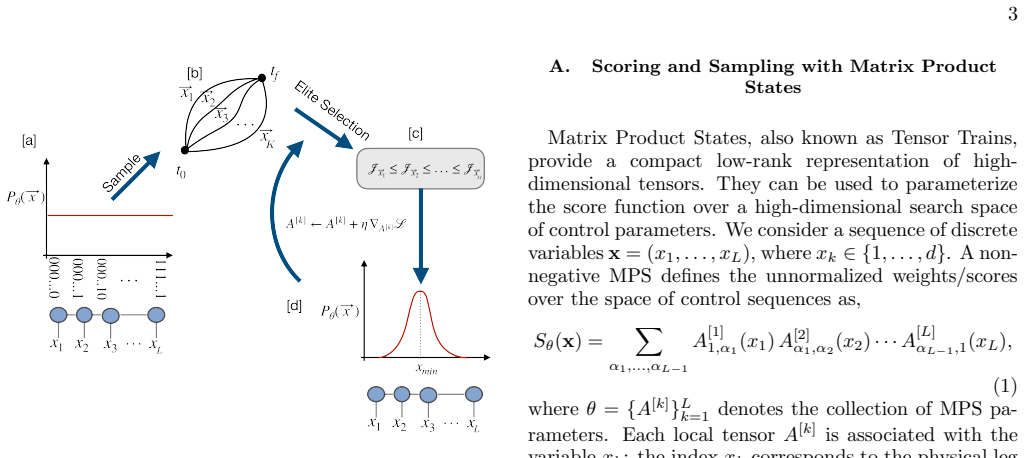
We introduce a gradient-free matrix product state/tensor train sampling heuristic for discrete quantum optimal control. The MPS defines a score function over the space of discrete control parameters, which in turn induces a sampling distribution over candidate control sequences. This distribution is iteratively refined through selection of better performing sequences and local tensor updates to bias the search toward high-performing sequences. We evaluate the method on a range of benchmark problems, including single-qubit state transfer, Bell-pair preparation, qutrit gate implementation, and open-system population transfer. Across these tasks, the method exhibits stable convergence behavior.
What carries the argument
An adaptive matrix product state that functions as an updatable score function, generating and progressively biasing a sampling distribution over discrete control sequences through selection and local tensor adjustments.
Load-bearing premise
That an MPS can be maintained and locally updated so that its induced sampling distribution consistently directs future samples toward higher-performing control sequences in a non-convex landscape.
What would settle it
Applying the method to the listed benchmark tasks and finding that it fails to reach fidelities comparable to established gradient-free algorithms or exhibits erratic rather than stable convergence across repeated runs.
Figures


read the original abstract
Quantum optimal control (QOC) provides a systematic framework for achieving high-fidelity operations in quantum systems and plays a central role in tasks such as gate synthesis, state transfer, and pulse design. Existing QOC methods broadly fall into two categories: gradient-based and gradient-free algorithms. The associated optimization landscape is often high-dimensional, non-convex, and populated by numerous local minima, making efficient gradient-free search strategies essential. To address this, we introduce a gradient-free matrix product state/tensor train (MPS/TT) sampling heuristic for discrete quantum optimal control. In our approach, the MPS defines a score function over the space of discrete control parameters, which in turn induces a sampling distribution over candidate control sequences. This distribution is iteratively refined through selection of better performing sequences and local tensor updates to bias the search toward high-performing sequences. We evaluate the method on a range of benchmark problems, including single-qubit state transfer, Bell-pair preparation, qutrit gate implementation, and open-system population transfer. Across these tasks, the method exhibits stable convergence behavior and competitive empirical performance relative to established gradient-free baselines. These results suggest that tensor network sampling offers a viable heuristic framework for discrete quantum control.
Editorial analysis
A structured set of objections, weighed in public.
Referee Report
Summary. The manuscript introduces a gradient-free heuristic for discrete quantum optimal control that represents a score function over control sequences via a matrix product state (MPS) or tensor train. Candidate sequences are sampled from the induced distribution, high-performing sequences are selected, and the MPS tensors are updated locally to bias subsequent sampling toward better solutions. The method is evaluated on four standard benchmark tasks—single-qubit state transfer, Bell-pair preparation, qutrit gate implementation, and open-system population transfer—where it is reported to exhibit stable convergence and competitive performance relative to established gradient-free baselines.
Significance. If the empirical claims are substantiated with quantitative data, the work would supply a novel adaptive sampling heuristic that leverages tensor-network representations to navigate high-dimensional, non-convex discrete control landscapes. This could be useful in regimes where gradient information is unavailable or unreliable, and the cross-application of MPS techniques from many-body physics to control optimization is conceptually interesting.
major comments (1)
- [Abstract] Abstract: the central claim that the method 'exhibits stable convergence behavior and competitive empirical performance' is unsupported by any numerical results, tables, figures, error bars, or implementation details in the provided text. Without these, the empirical contribution cannot be assessed or reproduced.
Simulated Author's Rebuttal
We thank the referee for their careful reading of the manuscript and for highlighting this important point about the abstract. We address the comment below and are prepared to make revisions to improve the clarity and substantiation of our empirical claims.
read point-by-point responses
-
Referee: [Abstract] Abstract: the central claim that the method 'exhibits stable convergence behavior and competitive empirical performance' is unsupported by any numerical results, tables, figures, error bars, or implementation details in the provided text. Without these, the empirical contribution cannot be assessed or reproduced.
Authors: We agree that the abstract, as currently worded, summarizes the empirical findings at a high level without embedding specific quantitative details or direct references to supporting data. The full manuscript contains the requested elements: convergence plots and performance comparisons across the four benchmarks (single-qubit state transfer, Bell-pair preparation, qutrit gate implementation, and open-system population transfer) are presented in the results section with accompanying figures, tables of fidelity and runtime metrics, error bars derived from repeated trials, and implementation details (including MPS bond dimension, sampling parameters, and baseline configurations) provided in the methods and appendix. To address the referee's concern directly, we will revise the abstract to include a brief, high-level reference to these results (e.g., noting stable convergence on the listed benchmarks and competitive performance relative to the baselines) while adding explicit cross-references to the relevant figures and sections. This will make the empirical contribution more readily assessable from the abstract alone. revision: yes
Circularity Check
No significant circularity; heuristic is self-contained and empirically evaluated
full rationale
The paper introduces an MPS/TT-based iterative sampling heuristic for discrete QOC as a novel algorithmic framework. The description consists of defining a score function via MPS, inducing a sampling distribution, performing selection of high-performing sequences, and applying local tensor updates. These steps are presented as a constructive procedure without any mathematical derivation that reduces claimed performance to a fitted parameter, self-referential definition, or self-citation chain. Evaluation is purely empirical on standard benchmarks (state transfer, Bell-pair preparation, etc.), with comparisons to external baselines. No load-bearing step equates outputs to inputs by construction, satisfying the criteria for a non-circular finding.
Axiom & Free-Parameter Ledger
free parameters (2)
- MPS bond dimension
- Selection and update schedule parameters
axioms (1)
- domain assumption The score function over the space of discrete control parameters can be effectively approximated by a matrix product state.
Reference graph
Works this paper leans on
-
[1]
, tL.The control field is represented as a discrete sequenceu= (u t1 , ut2 ,
Direct Discretization: Time-Series of Control Fields In the direct discretization scheme, the control field is parameterized directly in the time domain by dis- cretizing the control amplitude on a uniform tempo- ral gridt 1, t2, . . . , tL.The control field is represented as a discrete sequenceu= (u t1 , ut2 , . . . , utL),where each time slice correspon...
-
[2]
In this approach, the control field is represented as u(t) = LX j=1 cj ϕj(t), where{ϕ j(t)}denotes a chosen basis andc= (c 1,
Basis Encoding An alternative to direct time-series encoding is to pa- rameterize control fields using a finite set of basis func- tions. In this approach, the control field is represented as u(t) = LX j=1 cj ϕj(t), where{ϕ j(t)}denotes a chosen basis andc= (c 1, . . . , cL) are the corresponding expansion coefficients. By opti- mizing over basis coeffici...
-
[3]
The solid curve shows the median, the dashed curves show the 16th and 84th percentiles, and the shaded band spans this percentile range
(a) Median convergence of the infidelity over 20 in- dependent runs (different random seeds) is shown. The solid curve shows the median, the dashed curves show the 16th and 84th percentiles, and the shaded band spans this percentile range. (b) Comparison of 20 independent runs with varying bond dimensions is shown. (c) The corresponding population transfe...
2000
-
[4]
The solid curve shows the median, the dashed curves show the 16th and 84th percentiles, and the shaded band spans this percentile range
(a) Median convergence of the infidelity over 20 inde- pendent runs is given. The solid curve shows the median, the dashed curves show the 16th and 84th percentiles, and the shaded band spans this percentile range. (b) Optimized pulse profile exhibiting bang-bang structure and (c) corresponding population transfer are shown. tonian is given by H(t) = 4ξ S...
2000
-
[5]
CUI: Advanced Imaging of Matter
(a) Median convergence of the infidelity over 20 inde- pendent runs is given. The solid curve shows the median, the dashed curves show the 16th and 84th percentiles, and the shaded band spans this percentile range. (b) Optimized control fields: pump Ω p(t) and Stokes Ω s(t) Rabi frequencies. (c) Corresponding population dynam- ics. presented a numerical s...
2056
-
[6]
Ansel, E
Q. Ansel, E. Dionis, F. Arrouas, B. Peaudecerf, S. Gu´ erin, D. Gu´ ery-Odelin, and D. Sugny, Introduction to theoretical and experimental aspects of quantum opti- mal control, J. Phys. B: At. Mol. Opt. Phys.57, 133001 (2024)
2024
-
[7]
C. P. Koch, U. Boscain, T. Calarco, G. Dirr, S. Fil- ipp, S. J. Glaser, R. Kosloff, S. Montangero, T. Schulte- Herbr¨ uggen, D. Sugny, and F. K. Wilhelm, Quantum op- timal control in quantum technologies. strategic report on current status, visions and goals for research in eu- rope, EPJ Quantum Technol.9, 19 (2022)
2022
-
[8]
Sauvage and F
F. Sauvage and F. Mintert, Optimal control of families of quantum gates, Phys. Rev. Lett.129, 050507 (2022)
2022
-
[9]
B. Riaz, C. Shuang, and S. Qamar, Optimal control methods for quantum gate preparation: a comparative study, Quantum Inf. Process.18, 100 (2019)
2019
-
[10]
Mukherjee, F
R. Mukherjee, F. Sauvage, H. Xie, R. L¨ ow, and F. Mintert, Preparation of ordered states in ultra-cold gases using bayesian optimization, New J. Phys.22, 075001 (2020)
2020
-
[11]
Mukherjee, H
R. Mukherjee, H. Xie, and F. Mintert, Bayesian optimal control of greenberger-horne-zeilinger states in rydberg lattices, Phys. Rev. Lett.125, 203603 (2020)
2020
-
[12]
Kuro´ s, R
A. Kuro´ s, R. Mukherjee, F. Mintert, and K. Sacha, Con- 14 FIG. 8: Convergence behavior of TT-EDA and PROTES across benchmark functions and problem dimensions. Columns correspond to benchmark functions (Alpine, Ackley, Rastrigin, Griewank, Schwefel). Rows correspond to the number of arguments (10, 30, 50, 70, 100). Each panel reports the median best obje...
2021
-
[13]
Chen, D.-W
P. Chen, D.-W. Luo, and T. Yu, Optimal entanglement generation in optomechanical systems via krotov control of covariance matrix dynamics, Phys. Rev. Res.7, 013161 (2025)
2025
-
[14]
Koutromanos, D
D. Koutromanos, D. Stefanatos, and E. Paspalakis, Fast generation of entanglement between coupled spins using optimization and deep learning methods, EPJ Quantum Technol.11, 85 (2024)
2024
-
[15]
Dionis and D
E. Dionis and D. Sugny, Time-optimal control of two- level quantum systems by piecewise constant pulses, Phys. Rev. A107, 032613 (2023)
2023
-
[16]
Wakamura and T
H. Wakamura and T. Koike, A general formulation of time-optimal quantum control and optimality of singular protocols, New J. Phys.22, 073010 (2020)
2020
-
[17]
Genois, N
E. Genois, N. J. Stevenson, N. Goss, I. Siddiqi, and A. Blais, Quantum optimal control of superconducting qubits based on machine-learning characterization, Phys. Rev. Appl.24, 034073 (2025)
2025
-
[18]
Abdelhafez, B
M. Abdelhafez, B. Baker, A. Gyenis, P. Mundada, A. A. Houck, D. Schuster, and J. Koch, Universal gates for protected superconducting qubits using optimal control, Phys. Rev. A101, 022321 (2020)
2020
-
[19]
Nebendahl, H
V. Nebendahl, H. H¨ affner, and C. F. Roos, Optimal con- trol of entangling operations for trapped-ion quantum computing, Phys. Rev. A79, 012312 (2009)
2009
-
[20]
T. Choi, S. Debnath, T. A. Manning, C. Figgatt, Z.- X. Gong, L.-M. Duan, and C. Monroe, Optimal quan- tum control of multimode couplings between trapped ion 15 qubits for scalable entanglement, Phys. Rev. Lett.112, 190502 (2014)
2014
-
[21]
Crescimanna, J
V. Crescimanna, J. Taylor, A. Z. Goldberg, and K. Hes- hami, Quantum control of rydberg atoms for mesoscopic quantum state and circuit preparation, Phys. Rev. Appl. 20, 034019 (2023)
2023
-
[22]
M. M. M¨ uller, T. Pichler, S. Montangero, and T. Calarco, Optimal control for rydberg quantum technology build- ing blocks, Appl. Phys. B122, 104 (2016)
2016
-
[23]
E. S. Carrera, H. Erbin, and G. Misguich, Preparing spin- squeezed states in rydberg atom arrays via quantum op- timal control, Phys. Rev. A112, 052615 (2025)
2025
-
[24]
Abdelhafez, D
M. Abdelhafez, D. I. Schuster, and J. Koch, Gradient- based optimal control of open quantum systems us- ing quantum trajectories and automatic differentiation, Phys. Rev. A99, 052327 (2019)
2019
-
[25]
G. Feng, F. H. Cho, H. Katiyar, J. Li, D. Lu, J. Baugh, and R. Laflamme, Gradient-based closed-loop quantum optimal control in a solid-state two-qubit system, Phys. Rev. A98, 052341 (2018)
2018
-
[26]
Khaneja, T
N. Khaneja, T. Reiss, C. Kehlet, T. Schulte-Herbr¨ uggen, and S. J. Glaser, Optimal control of coupled spin dynam- ics: design of nmr pulse sequences by gradient ascent algorithms, J. Magn. Reson.172, 296 (2005)
2005
-
[27]
Giannelli, S
L. Giannelli, S. Sgroi, J. Brown, G. S. Paraoanu, M. Pa- ternostro, E. Paladino, and G. Falci, A tutorial on op- timal control and reinforcement learning methods for quantum technologies, Phys. Lett. A434, 128054 (2022)
2022
-
[28]
Caneva, T
T. Caneva, T. Calarco, and S. Montangero, Chopped random-basis quantum optimization, Phys. Rev. A84, 022326 (2011)
2011
-
[29]
Pagano, M
A. Pagano, M. M. M¨ uller, T. Calarco, S. Montangero, and P. Rembold, Role of bases in quantum optimal con- trol, Phys. Rev. A110, 062608 (2024)
2024
-
[30]
Schollw¨ ock, The density-matrix renormalization group in the age of matrix product states, Ann
U. Schollw¨ ock, The density-matrix renormalization group in the age of matrix product states, Ann. Phys.326, 96 (2011)
2011
-
[31]
J. Gidi, P. Garc´ ıa-Molina, L. Tagliacozzo, and J. J. Garc´ ıa-Ripoll, Pseudospectral method for solving pdes using matrix product states, J. Comput. Phys.539, 114228 (2025)
2025
-
[32]
J. J. Garc´ ıa-Ripoll, Quantum-inspired algorithms for multivariate analysis: from interpolation to partial dif- ferential equations, Quantum5, 431 (2021)
2021
-
[33]
Bachmayr, R
M. Bachmayr, R. Schneider, and A. Uschmajew, Tensor networks and hierarchical tensors for the solution of high- dimensional partial differential equations, Found. Com- put. Math.16, 1423 (2016)
2016
-
[34]
Gourianov, M
N. Gourianov, M. Lubasch, S. Dolgov, Q. Y. van den Berg, H. Babaee, P. Givi, M. Kiffner, and D. Jaksch, A quantum-inspired approach to exploit turbulence struc- tures, Nat. Comput. Sci.2, 30 (2022)
2022
-
[35]
Bonnevie and M
R. Bonnevie and M. N. Schmidt, Matrix product states for inference in discrete probabilistic models, J. Mach. Learn. Res.22, 1 (2021)
2021
-
[36]
Z.-Y. Han, J. Wang, H. Fan, L. Wang, and P. Zhang, Unsupervised generative modeling using matrix product states, Phys. Rev. X8, 031012 (2018)
2018
-
[37]
Ayral, T
T. Ayral, T. Louvet, Y. Zhou, C. Lambert, E. M. Stoudenmire, and X. Waintal, Density-Matrix Renormal- ization Group Algorithm for Simulating Quantum Cir- cuits with a Finite Fidelity, PRX Quantum4, 020304 (2023)
2023
-
[38]
Seitz, I
P. Seitz, I. Medina, E. Cruz, Q. Huang, and C. B. Mendl, Simulating quantum circuits using tree tensor networks, Quantum7, 964 (2023)
2023
-
[39]
Dubey, Z
A. Dubey, Z. Zeybek, and P. Schmelcher, Simulating quantum circuits with tree tensor networks using density- matrix renormalization group algorithm, Phys. Rev. B 112, 104312 (2025)
2025
-
[40]
Tensor Network Estimation of Distribution Algorithms
J. Gardiner and J. Lopez-Piqueres, Tensor net- work estimation of distribution algorithms (2024), arXiv:2412.19780
work page internal anchor Pith review Pith/arXiv arXiv 2024
-
[41]
Lopez-Piqueres, J
J. Lopez-Piqueres, J. Chen, and A. Perdomo-Ortiz, Sym- metric tensor networks for generative modeling and con- strained combinatorial optimization, Mach. Learn.: Sci. Technol.4, 035009 (2023)
2023
-
[42]
Lopez-Piqueres and J
J. Lopez-Piqueres and J. Chen, Cons-training tensor net- works: Embedding and optimization over discrete linear constraints, SciPost Phys.18, 192 (2025)
2025
-
[43]
Batsheva, A
A. Batsheva, A. Chertkov, G. Ryzhakov, and I. Os- eledets, Protes: Probabilistic optimization with tensor sampling, inAdv. Neural Inf. Process. Syst., Vol. 36 (2023) pp. 808–823
2023
-
[44]
M. J. Kochenderfer and T. A. Wheeler,Algorithms for Optimization(The MIT Press, 2019)
2019
-
[45]
Bergstra, R
J. Bergstra, R. Bardenet, Y. Bengio, and B. K´ egl, Algo- rithms for hyper-parameter optimization, inAdv. Neural Inf. Process. Syst., Vol. 24 (2011)
2011
-
[46]
Alcazar, M
J. Alcazar, M. Ghazi Vakili, C. B. Kalayci, and A. Perdomo-Ortiz, Enhancing combinatorial optimiza- tion with classical and quantum generative models, Na- ture Communications15, 2761 (2024)
2024
-
[47]
A. J. Ferris and G. Vidal, Perfect sampling with unitary tensor networks, Phys. Rev. B85, 165146 (2012)
2012
-
[48]
Dolgov, K
S. Dolgov, K. Anaya-Izquierdo, C. Fox, and R. Scheichl, Approximation and sampling of multivariate probabil- ity distributions in the tensor train decomposition, Stat. Comput.30, 603 (2020)
2020
-
[49]
Rapin and O
J. Rapin and O. Teytaud, Nevergrad - A gradient- free optimization platform,https://GitHub.com/ FacebookResearch/Nevergrad(2018)
2018
discussion (0)
Sign in with ORCID, Apple, or X to comment. Anyone can read and Pith papers without signing in.