Link-based causal set propagators in 1+1 dimensions
Pith reviewed 2026-05-08 02:06 UTC · model grok-4.3
The pith
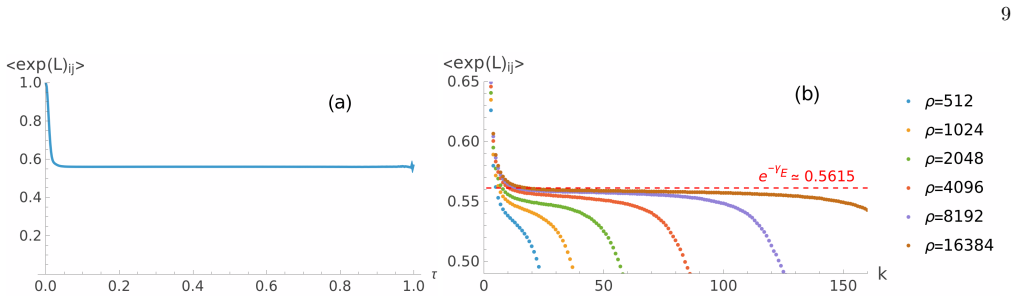
In 1+1D Minkowski spacetime, the averaged retarded propagator on causal sets equals a normalized exponential of the link matrix.
A machine-rendered reading of the paper's core claim, the machinery that carries it, and where it could break.
Core claim
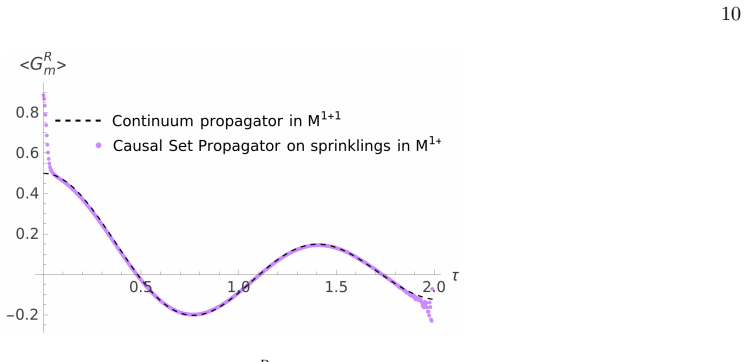
For Poisson sprinklings into 1+1 dimensional Minkowski spacetime, the averaged massless retarded propagator is naturally associated with a normalized exponential exp(L). This association is established by asymptotic analysis and supporting numerical simulations. The construction extends to the massive case via the usual mass-scattering series and obtains good agreement with the continuum propagator after averaging. The inverse kernel exp(-L) is discussed as a possible candidate for a discrete d'Alembertian.
What carries the argument
The link matrix L, which encodes direct causal links between sprinkled points; its normalized exponential supplies the averaged retarded propagator.
If this is right
- The averaged massless retarded propagator recovers the continuum result in 1+1 dimensions.
- Massive propagators follow by inserting the mass-scattering series into the same exponential and averaging.
- The inverse exp(-L) supplies a candidate discrete d'Alembertian that depends only on the causal links.
Where Pith is reading between the lines
- The same link-based exponential might serve as a propagator template in higher dimensions if the averaging property generalizes.
- Because only the adjacency structure of L is required, the method could reduce the need for auxiliary volume or length assignments in causal-set numerics.
- Checking whether exp(L) still averages correctly when the sprinkling occurs in a curved background would test the robustness of the construction.
Load-bearing premise
Averaging the propagator over Poisson sprinklings in 1+1D Minkowski spacetime recovers the exact continuum result once a normalization is chosen.
What would settle it
Simulations in 1+1D Minkowski space with increasing point density that show the averaged normalized exp(L) deviating from the exact continuum retarded propagator by more than statistical fluctuations would falsify the association.
Figures
read the original abstract
We investigate whether retarded scalar propagators on causal sets can be expressed in terms of the link matrix $\mathbf{L}$. For Poisson sprinklings into $1+1$ dimensional Minkowski spacetime, we show by asymptotic analysis and supporting numerical simulations that the averaged massless retarded propagator is naturally associated with a normalized exponential exp$(\mathbf{L})$. We then extend the construction to the massive case via the usual mass-scattering series and obtain good agreement with the continuum propagator after averaging. Finally, we discuss the inverse kernel exp$(-\mathbf{L})$ as a possible candidate for a discrete d'Alembertian.
Editorial analysis
A structured set of objections, weighed in public.
Referee Report
Summary. The paper claims that for Poisson sprinklings into 1+1 dimensional Minkowski spacetime, the averaged massless retarded propagator on causal sets is naturally associated with a normalized exponential of the link matrix, exp(L). This is shown via asymptotic analysis and numerical simulations. The construction is extended to the massive case using the mass-scattering series, achieving good agreement with the continuum after averaging, and exp(-L) is proposed as a discrete d'Alembertian.
Significance. If the normalization emerges directly from the Poisson sprinkling statistics and link probabilities without post-hoc calibration to continuum results, this would provide a clean link-based construction for propagators and a candidate d'Alembertian on causal sets. The combination of asymptotic analysis with numerical support is a positive feature that could aid reproducibility in the field.
major comments (1)
- [asymptotic analysis of the link matrix] The central claim that the averaged propagator is 'naturally associated' with a normalized exp(L) is load-bearing. In the asymptotic analysis, clarify explicitly how the normalization factor is fixed by the statistics of the Poisson process (e.g., via the distribution of links or chain lengths) rather than being selected to match the known continuum retarded propagator in 1+1D. If the factor is introduced to enforce agreement, the 'natural' qualifier and portability claims require adjustment.
minor comments (1)
- [numerical simulations] The numerical simulations section would benefit from explicit reporting of the number of sprinklings performed, error bars or variance measures on the averaged propagator, and any data-exclusion criteria used, to strengthen the quantitative support for the claimed agreement.
Simulated Author's Rebuttal
We thank the referee for their careful reading of the manuscript and for the positive assessment of its significance. We address the single major comment below and will revise the paper to improve the explicitness of the derivation as requested.
read point-by-point responses
-
Referee: [asymptotic analysis of the link matrix] The central claim that the averaged propagator is 'naturally associated' with a normalized exp(L) is load-bearing. In the asymptotic analysis, clarify explicitly how the normalization factor is fixed by the statistics of the Poisson process (e.g., via the distribution of links or chain lengths) rather than being selected to match the known continuum retarded propagator in 1+1D. If the factor is introduced to enforce agreement, the 'natural' qualifier and portability claims require adjustment.
Authors: We thank the referee for this request for greater precision. In the asymptotic analysis, the normalization is fixed by the Poisson sprinkling statistics: the link matrix L is constructed from the probability that two sprinkled points are linked, which equals the causal interval volume times the density rho. The expected number of links per point and the distribution of chain lengths (obtained from the same Poisson process) determine the scaling factor that normalizes exp(L) so that its continuum limit is the retarded propagator. This step precedes any comparison to the known 1+1D continuum expression. Nevertheless, we agree that the manuscript would benefit from a more explicit, self-contained derivation of this factor. We will revise Section 3 to include a dedicated paragraph that isolates the normalization constant using only the Poisson volume element and link probabilities, deferring the continuum comparison until the subsequent verification step. This change will be made and will strengthen rather than weaken the 'natural' and portability claims. revision: yes
Circularity Check
Normalization in exp(L) appears as a fixed scaling rather than a data-fitted parameter
full rationale
The paper defines the link matrix L directly from the causal partial order of each Poisson sprinkling and uses the standard matrix exponential. Asymptotic analysis and simulations are invoked to associate the averaged massless retarded propagator with a normalized exp(L), with the normalization presented as a fixed scaling chosen to recover the continuum result. No load-bearing step reduces by construction to a fitted parameter renamed as a prediction, nor does the derivation rely on self-citations, uniqueness theorems imported from the authors' prior work, or ansatzes smuggled via citation. The construction for the massive case via mass-scattering series and the proposed exp(-L) d'Alembertian inherit the same normalization but remain independent of the target propagator data itself. This yields only minor circularity risk at the level of scaling choice, not a reduction of the central claim.
Axiom & Free-Parameter Ledger
free parameters (1)
- normalization factor
axioms (2)
- domain assumption Poisson sprinkling generates representative causal sets in 1+1 Minkowski spacetime
- domain assumption Averaging over many sprinklings recovers the continuum retarded propagator
Reference graph
Works this paper leans on
-
[1]
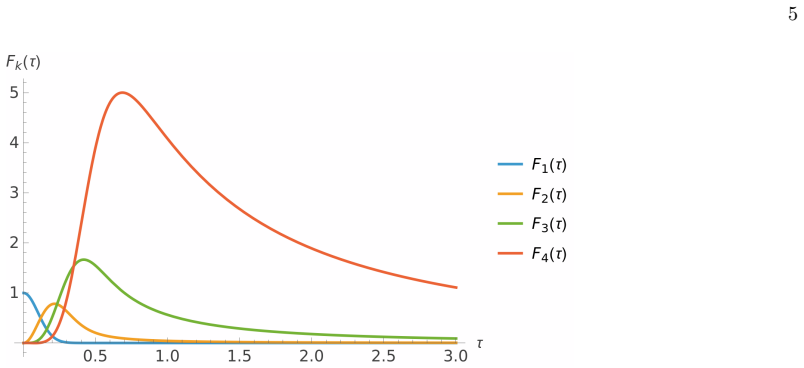
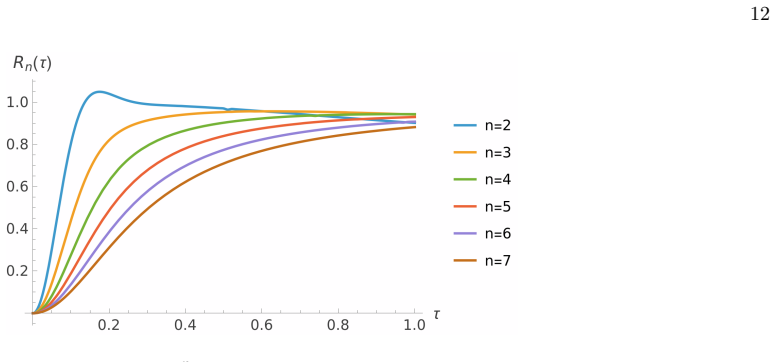
τ′(τ−τ′) n+1 2 ˜F1( 1 2 , n+2 2 ; n+3 2 ; (τ−τ′)2 (τ+τ ′)2)(54) with 2 ˜F1 denoting the regularized hypergeometric series. Carrying out the outer integration numerically on a sprinkling with 512 events averaged over a large number of 10 6 independent realizations, we plotted the ratios Rn(τ)= 2e−γE τ n+(D⊛τn)(τ) n2τ n−2 (55) versusτforn=2,3, . . . ,6 in F...
-
[2]
L. J. Garay, International Journal of Modern Physics A10, 145 (1995)
work page 1995
-
[3]
Hossenfelder, Living Reviews in Relativity16, 2 (2013)
S. Hossenfelder, Living Reviews in Relativity16, 2 (2013)
work page 2013
-
[4]
J. D. Bekenstein, Physical Review D7, 2333 (1973)
work page 1973
-
[5]
Bousso, Reviews of modern physics74, 825 (2002)
R. Bousso, Reviews of modern physics74, 825 (2002)
work page 2002
- [6]
-
[7]
Rovelli, Living reviews in relativity11, 5 (2008)
C. Rovelli, Living reviews in relativity11, 5 (2008)
work page 2008
-
[8]
M. Ammon and J. Erdmenger,Gauge/gravity duality: Foundations and applications(Cambridge University Press, 2015)
work page 2015
-
[9]
L. Bombelli, J. Lee, D. Meyer, and R. D. Sorkin, Physical review letters59, 521 (1987)
work page 1987
-
[10]
Surya, Living Reviews in Relativity22, 5 (2019)
S. Surya, Living Reviews in Relativity22, 5 (2019)
work page 2019
-
[11]
S. W. Hawking, A. R. King, and P. J. Mccarthy, J. Math. Phys.17, 174 (1976)
work page 1976
-
[12]
F. Dowker, in100 Years Of Relativity: space-time structure: Einstein and beyond(World Scientific, 2005) pp. 445–464
work page 2005
-
[13]
M¨ uller, arXiv preprint arXiv:2503.01719 (2025)
O. M¨ uller, arXiv preprint arXiv:2503.01719 (2025)
-
[14]
Throughout this article, matrices defined on discrete causal sets likeLare marked by bold letters
-
[15]
D. P. Rideout and R. D. Sorkin, Physical Review D61, 024002 (1999)
work page 1999
-
[16]
M. Ahmed and D. Rideout, Physical Review D—Particles, Fields, Gravitation, and Cosmology81, 083528 (2010)
work page 2010
- [17]
-
[18]
Johnston, Classical and Quantum gravity25, 202001 (2008)
S. Johnston, Classical and Quantum gravity25, 202001 (2008)
work page 2008
-
[19]
Shuman, Physical Review D109, 046008 (2024)
S. Shuman, Physical Review D109, 046008 (2024)
work page 2024
-
[20]
A. Kastrati and H. Hinrichsen, Phys. Rev. D113, 065003 (2026), arXiv:2504.12919 [gr-qc]
-
[21]
Johnston, arXiv preprint arXiv:1010.5514 (2010)
S. Johnston, arXiv preprint arXiv:1010.5514 (2010)
-
[22]
N. X, F. Dowker, and S. Surya, Classical and Quantum Gravity34, 124002 (2017)
work page 2017
-
[23]
R. J. Buchanan (2026), preprints.org, doi: 10.20944/preprints202601.1518.v1
-
[24]
D. P. Rideout, arXiv preprint gr-qc/0212064 (2010)
work page internal anchor Pith review arXiv 2010
-
[25]
Jacobet al., Eigen: A C++ template library for linear algebra,https://libeigen.gitlab.io/(2025)
B. Jacobet al., Eigen: A C++ template library for linear algebra,https://libeigen.gitlab.io/(2025)
work page 2025
-
[26]
D. M. T. Benincasa and F. Dowker, Phys. Rev. Lett.104, 181301 (2010)
work page 2010
- [27]
-
[28]
S. Aslanbeigi, M. Saravani, and R. D. Sorkin, Journal of High Energy Physics2014, 1 (2014)
work page 2014
- [29]
-
[30]
R. D. Sorkin, inJournal of Physics: Conference Series, Vol. 306 (2011) p. 012017
work page 2011
-
[31]
A. Belenchia, D. M. Benincasa, and F. Dowker, Classical and Quantum Gravity33, 245018 (2016)
work page 2016
discussion (0)
Sign in with ORCID, Apple, or X to comment. Anyone can read and Pith papers without signing in.