A study of J/psi mass shift and bound states: Impact of D D and DD^* meson loops
Pith reviewed 2026-05-07 15:56 UTC · model grok-4.3
The pith
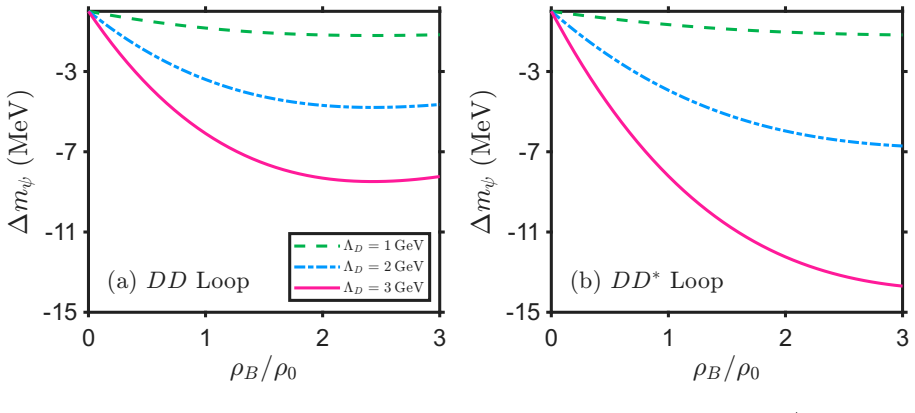
J/ψ mesons undergo a negative mass shift in nuclear matter due to DD and DD* loops, allowing possible bound states with nuclei.
A machine-rendered reading of the paper's core claim, the machinery that carries it, and where it could break.
Core claim
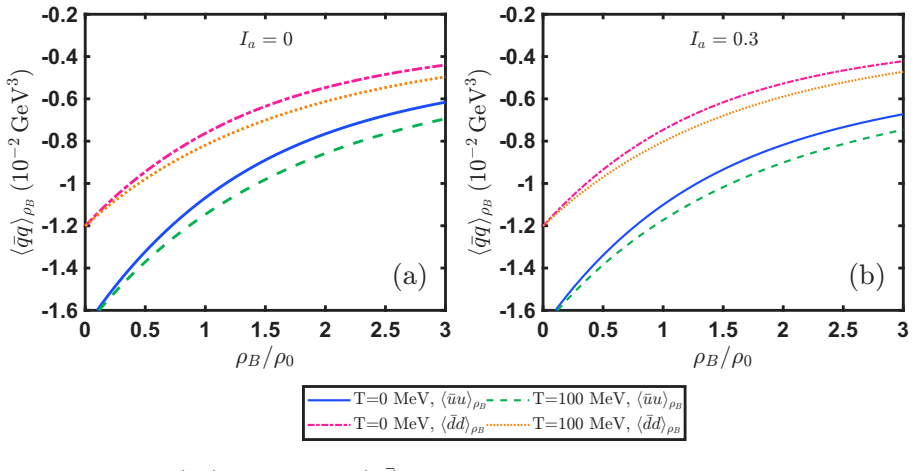
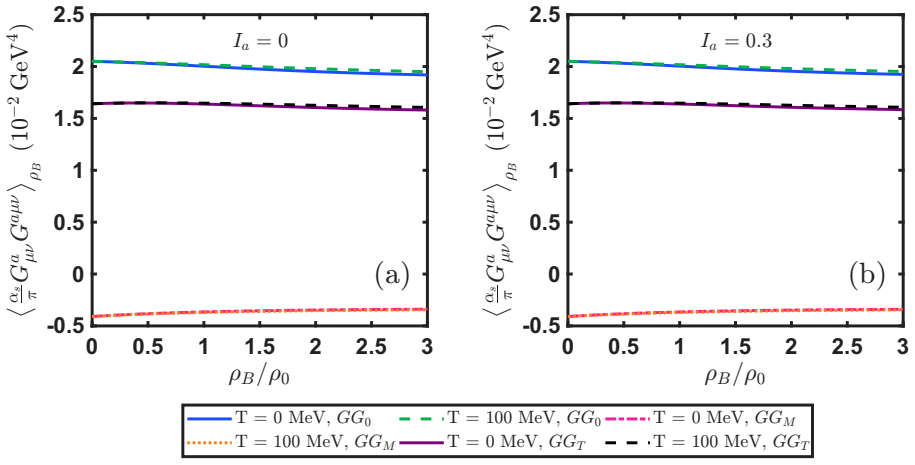
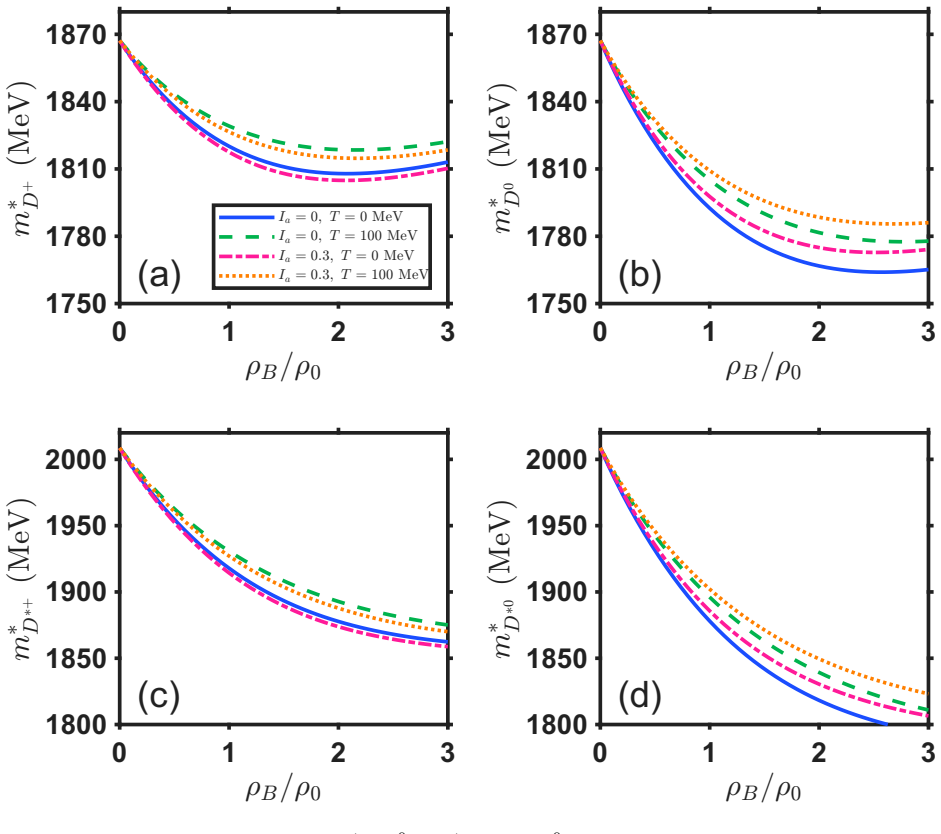
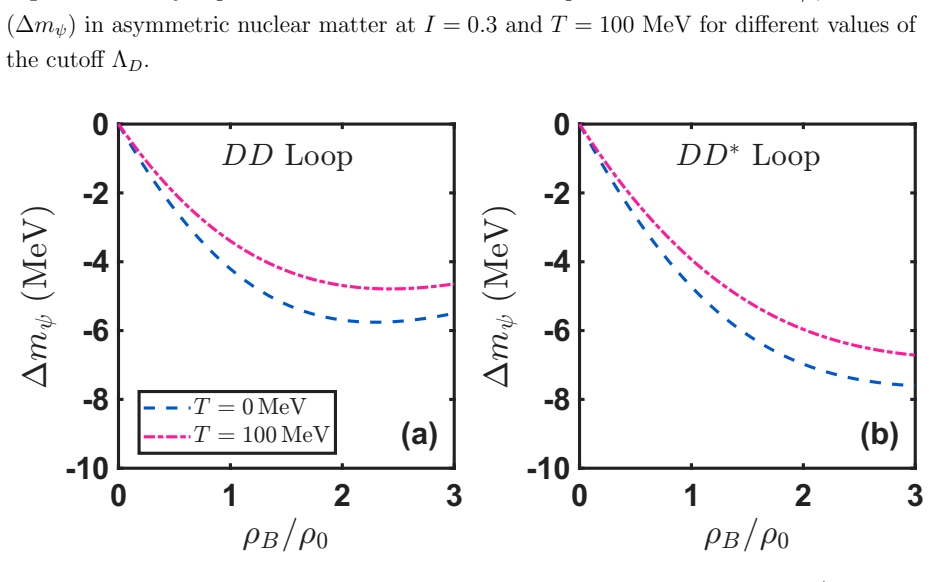
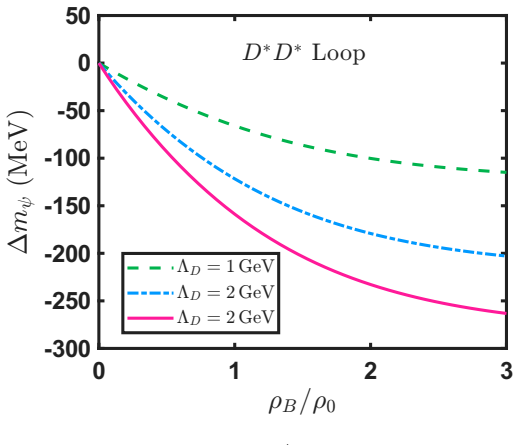
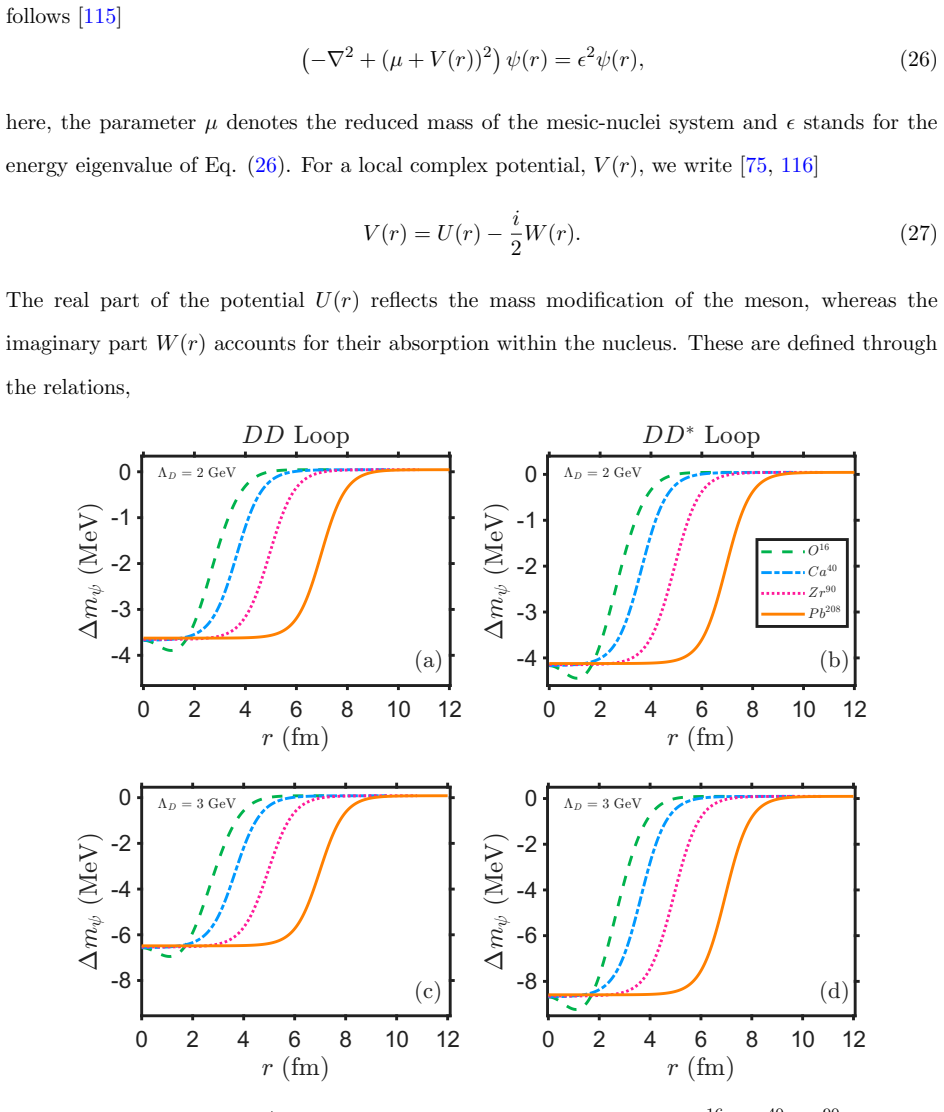
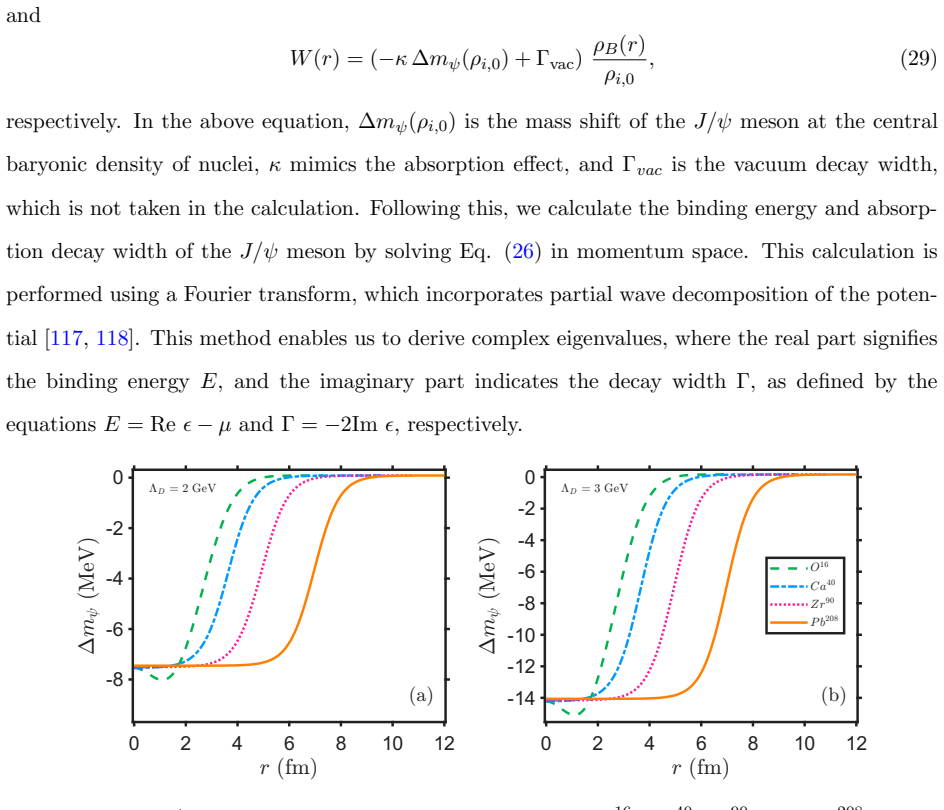
Using an effective Lagrangian that accounts for DD and DD* meson loop contributions, the J/ψ mass shows a negative shift as baryonic density rises in nuclear matter at both zero and finite temperatures. The D meson masses entering the loops are obtained from the hadronic chiral SU(3) model via scalar condensates fed into QCD sum rules. This mass reduction implies attraction to nuclear mean fields and therefore the possibility of J/ψ bound states inside nuclei, with explicit binding energies and absorption decay widths computed for the ground and excited states of O^{16}, Ca^{40}, Zr^{90} and Pb^{208}.
What carries the argument
Effective Lagrangian approach that incorporates self-energy corrections from DD and DD* meson loops, with D meson masses supplied by the hadronic chiral SU(3) model and QCD sum rules.
If this is right
- The negative mass shift permits the formation of J/ψ bound states with nuclei including O^{16}, Ca^{40}, Zr^{90} and Pb^{208}.
- Binding energies and absorption decay widths are obtained for both ground and excited states in these nuclei at zero and finite temperatures.
- The results apply to asymmetric nuclear matter and are intended to aid interpretation of data on low-momentum charmed mesons produced inside nuclei.
- The mass modification grows with baryonic density, strengthening the case for attraction to nuclear mean fields.
Where Pith is reading between the lines
- If the mass shift persists at finite momentum, it could alter J/ψ production and suppression patterns observed in heavy-ion collisions.
- The same loop mechanism might generate analogous shifts for other hidden-charm states such as ψ(2S).
- Comparison with J/ψ photoproduction or electroproduction data off nuclei would provide a direct test of the calculated binding energies.
- The temperature dependence suggests the bound-state signals could weaken but remain visible at moderate temperatures reached in current facilities.
Load-bearing premise
The medium dependence of D meson masses is determined using the hadronic chiral SU(3) model, where scalar condensates are calculated and subsequently utilized in the QCD sum rules approach.
What would settle it
Direct measurement of the J/ψ invariant-mass peak position inside nuclear targets or observation of narrow bound-state signals in low-momentum production experiments at Jefferson Lab or FAIR would confirm or refute the predicted negative mass shift and binding energies.
Figures
read the original abstract
We investigate the modification of the $J/\psi$ meson mass in asymmetric nuclear matter at zero and finite temperatures employing an effective Lagrangian approach that considers the contributions of $DD$ and $DD^*$ meson loops. The medium dependence of $D$ meson masses is determined using the hadronic chiral SU(3) model, where scalar condensates are calculated and subsequently utilized in the QCD sum rules approach. Our findings indicate that an increase in baryonic density results in a negative mass shift of the $J/\psi$ meson. This suggests that the $J/\psi$ meson is attracted to nuclear mean fields indicating the possibility of the formation of meson-nucleus bound states. Moreover, we have also determined the binding energy and absorption decay width of the $J/\psi$ meson for both the ground and excited states of $\text{O}^{16}$, $\text{Ca}^{40}$, $\text{Zr}^{90}$, and $\text{Pb}^{208}$ nuclei. These results are expected to contribute to the understanding of experimental data from upcoming studies at Jefferson lab and the facility for antiproton and ion research, where low-momentum charmed mesons can be produced and examined within nuclei.
Editorial analysis
A structured set of objections, weighed in public.
Referee Report
Summary. The paper claims that an effective Lagrangian approach incorporating DD and DD* meson loops yields a negative mass shift for the J/ψ in asymmetric nuclear matter at zero and finite temperatures. D and D* masses are obtained by computing scalar condensates in a hadronic chiral SU(3) model and feeding them into QCD sum rules; the resulting density-dependent shift is used to compute binding energies and absorption widths for J/ψ ground and excited states in O^{16}, Ca^{40}, Zr^{90}, and Pb^{208} nuclei, suggesting possible meson-nucleus bound states.
Significance. If the central result holds, the work would supply concrete predictions for J/ψ attraction in nuclei that could be confronted with data from Jefferson Lab and FAIR. The combination of loop self-energy with in-medium D masses is a standard pipeline, but the absence of uncertainty quantification and cross-checks against lattice QCD or alternative heavy-light frameworks reduces the immediate impact.
major comments (3)
- [D-meson mass determination (method section)] The medium dependence of the D-meson masses (obtained from chiral SU(3) condensates inserted into QCD sum rules) is load-bearing for the sign of the J/ψ shift. The manuscript provides no sensitivity analysis to variations in the SU(3) parameters, no comparison with lattice QCD results for charmed mesons in medium, and no alternative heavy-quark effective-theory calculation to confirm that the D-mass decrease with density is robust.
- [Loop self-energy and numerical results] The real part of the DD and DD* loop self-energy determines the reported negative J/ψ mass shift. The paper does not quote error bars, does not vary the free loop coupling constants, and does not show how the shift changes when the D-mass input is altered within its model uncertainty; this directly affects the binding-energy and width numbers quoted for the listed nuclei.
- [Bound-state calculations for nuclei] The binding energies and absorption widths for finite nuclei are obtained by mapping the infinite-matter mass shift onto a nuclear potential. The manuscript does not specify the functional form of the potential, the averaging procedure over the nuclear density profile, or the treatment of the imaginary part of the self-energy at finite temperature.
minor comments (2)
- [Abstract and formalism] The asymmetry parameter of the nuclear matter is mentioned but its numerical value is not stated in the abstract or results; this should be given explicitly.
- [Figures and tables] Figure captions and axis labels should include the temperature and density ranges used so that the plotted mass shifts can be directly compared with the tabulated binding energies.
Simulated Author's Rebuttal
We thank the referee for the thorough review and insightful comments on our manuscript. We address each of the major comments in detail below, indicating the changes we will implement in the revised version.
read point-by-point responses
-
Referee: [D-meson mass determination (method section)] The medium dependence of the D-meson masses (obtained from chiral SU(3) condensates inserted into QCD sum rules) is load-bearing for the sign of the J/ψ shift. The manuscript provides no sensitivity analysis to variations in the SU(3) parameters, no comparison with lattice QCD results for charmed mesons in medium, and no alternative heavy-quark effective-theory calculation to confirm that the D-mass decrease with density is robust.
Authors: We agree that additional checks would strengthen the conclusions. The parameters in the chiral SU(3) model are taken from established literature and have been used consistently in our previous studies on light and strange hadrons. To address the lack of sensitivity analysis, we will include in the revised manuscript a new subsection or appendix showing the variation of D-meson masses with changes in key parameters (e.g., the sigma-nucleon coupling and the value of the gluon condensate) within their phenomenological uncertainties. This will demonstrate that the negative J/ψ mass shift remains robust. For lattice QCD comparisons, we note that while there are limited lattice results for D mesons in nuclear matter, we will add a discussion referencing available lattice data on related in-medium effects and other model calculations in the literature. An alternative calculation within heavy-quark effective theory is not included in the present work as it would require a separate framework, but we will mention this as a possible direction for future research. revision: yes
-
Referee: [Loop self-energy and numerical results] The real part of the DD and DD* loop self-energy determines the reported negative J/ψ mass shift. The paper does not quote error bars, does not vary the free loop coupling constants, and does not show how the shift changes when the D-mass input is altered within its model uncertainty; this directly affects the binding-energy and width numbers quoted for the listed nuclei.
Authors: We acknowledge the importance of uncertainty quantification. The coupling constants for the DD and DD* loops are fixed by matching to the vacuum properties and decay processes of the J/ψ and related states. In the revised version, we will add error estimates to the mass shift results by considering reasonable variations in these couplings (e.g., ±10% around the central values) and present the corresponding ranges for the binding energies and widths. Furthermore, we will show explicitly how the J/ψ mass shift varies when the input D and D* masses are changed within the uncertainties obtained from the QCD sum rule analysis. This will be incorporated into the numerical results section. revision: yes
-
Referee: [Bound-state calculations for nuclei] The binding energies and absorption widths for finite nuclei are obtained by mapping the infinite-matter mass shift onto a nuclear potential. The manuscript does not specify the functional form of the potential, the averaging procedure over the nuclear density profile, or the treatment of the imaginary part of the self-energy at finite temperature.
Authors: We appreciate this comment as it highlights areas where the presentation can be clarified. The nuclear potential for each nucleus is obtained by using the density-dependent J/ψ mass shift calculated in infinite matter as the potential, with the density profile modeled by a Woods-Saxon distribution parameterized for O^{16}, Ca^{40}, Zr^{90}, and Pb^{208}. The binding energies are found by solving the Schrödinger equation with this potential, and the averaging is performed by integrating the local mass shift over the nuclear density distribution. For the imaginary part at finite temperature, it is incorporated via the temperature dependence in the loop integrals for the self-energy. We will revise the manuscript to explicitly state these details, including the specific form of the Woods-Saxon potential and the numerical procedure used for the finite nuclei calculations. revision: yes
Circularity Check
No significant circularity in the derivation chain.
full rationale
The paper's central result (negative J/ψ mass shift from real part of self-energy in DD and DD* loops) is obtained by feeding medium-modified D and D* masses—computed independently via the hadronic chiral SU(3) model plus QCD sum rules—into an effective Lagrangian loop integral. No equation in the provided text reduces the output mass shift to a redefinition or fit of the input D masses themselves; the loop calculation is a distinct step. No self-citation is invoked as a uniqueness theorem or load-bearing premise, and the chiral-model parameters are not fitted inside this work to the J/ψ observable. The derivation therefore remains self-contained against external benchmarks such as lattice QCD or alternative heavy-meson approaches.
Axiom & Free-Parameter Ledger
free parameters (1)
- DD and DD* loop coupling constants
axioms (2)
- domain assumption Hadronic chiral SU(3) model accurately captures D-meson mass dependence on nuclear density via scalar condensates
- domain assumption QCD sum rules can reliably extract the required scalar condensates for D mesons in medium
Reference graph
Works this paper leans on
- [1]
- [2]
- [3]
-
[4]
R. S. Hayano, T. Hatsuda, Rev. Mod. Phys.82(2010) 2949
work page 2010
-
[5]
J. J. Cobos-Mart´ ınez, G. N. Zeminiani, K. Tsushima, Symmetry17(2025) 787
work page 2025
- [6]
- [7]
- [8]
-
[9]
M. C. Abreu,et al., Nucl. Phys. B Proc. Suppl.92(2001) 43. 25
work page 2001
- [10]
- [11]
- [12]
- [13]
- [14]
- [15]
-
[16]
Tomasi-Gustafsson, Hyperfine Interact.239(2018) 30
E. Tomasi-Gustafsson, Hyperfine Interact.239(2018) 30
work page 2018
- [17]
- [18]
-
[19]
P. A. Adderley,et al., Phys. Rev. Accel. Beams27(2024) 084802
work page 2024
- [20]
- [21]
- [22]
- [23]
- [24]
- [25]
-
[26]
S. Kim, S. H. Lee, Nucl. Phys. A679(2001) 5178
work page 2001
- [27]
- [28]
- [29]
- [30]
- [31]
- [32]
- [33]
- [34]
- [35]
- [36]
- [37]
- [38]
- [39]
- [40]
- [41]
- [42]
- [43]
- [44]
- [45]
- [46]
-
[47]
K. Tsushima, D. H. Lu, G. Krein, A. W. Thomas, AIP Conf. Proc.1354(2011) 39
work page 2011
-
[48]
G. N. Zeminiani, J. J. Cobos-Martinez, K. Tsushima, Eur. Phys. J. A57(2021) 259
work page 2021
-
[49]
S. H. Lee, C. M. Ko, Phys. Rev. C67(2003) 038202
work page 2003
-
[50]
A. B. Kaidalov, P. E. Volkovitsky, Phys. Rev. Lett.69(1992) 3155
work page 1992
-
[51]
M. E. Luke, A. V. Manohar, M. J. Savage, Phys. Lett. B288(1992) 355
work page 1992
- [52]
- [53]
-
[54]
M. E. Peskin, Nucl. Phys. B156(1979) 365
work page 1979
- [55]
-
[56]
S. R. Beane,et al., Phys. Rev. D91(2015) 114503
work page 2015
- [57]
- [58]
-
[59]
J. Cobos Martinez, K. Tsushima, G. Krein, A. W. Thomas, PoSP ANIC2021(2022) 199
work page 2022
- [60]
- [61]
- [63]
- [64]
- [65]
- [66]
- [67]
- [68]
-
[69]
A. Le Yaouanc, L. Oliver, O. Pene, J. C. Raynal, Phys. Rev. D8(1973) 2223
work page 1973
-
[70]
T. S. H. Lee, S. Sakinah, Y. Oh, Eur. Phys. J. A58(2022) 252
work page 2022
-
[71]
S.-H. Kim, T. S. H. Lee, R. B. Wiringa, Phys. Rev. C112(2025) 015206. 27
work page 2025
-
[72]
F. He, I. Zahed, Phys. Rev. C112(2025) 014303
work page 2025
- [73]
- [74]
- [75]
- [76]
- [77]
-
[78]
Yamagata-Sekihara,et al., Phys
J. Yamagata-Sekihara,et al., Phys. Lett. B754(2016) 26
work page 2016
- [79]
-
[80]
K. Tsushima, D. H. Lu, G. Krein, A. W. Thomas, Phys. Rev. C83(2011) 065208
work page 2011
- [81]
discussion (0)
Sign in with ORCID, Apple, or X to comment. Anyone can read and Pith papers without signing in.