Doping-Induced Brightening of Dark Excitons and Trions in a WSe₂ Monolayer
Pith reviewed 2026-05-07 15:35 UTC · model grok-4.3
The pith
Electrostatic doping asymmetrically brightens dark excitons and trions in WSe₂ monolayers under in-plane magnetic fields.
A machine-rendered reading of the paper's core claim, the machinery that carries it, and where it could break.
Core claim
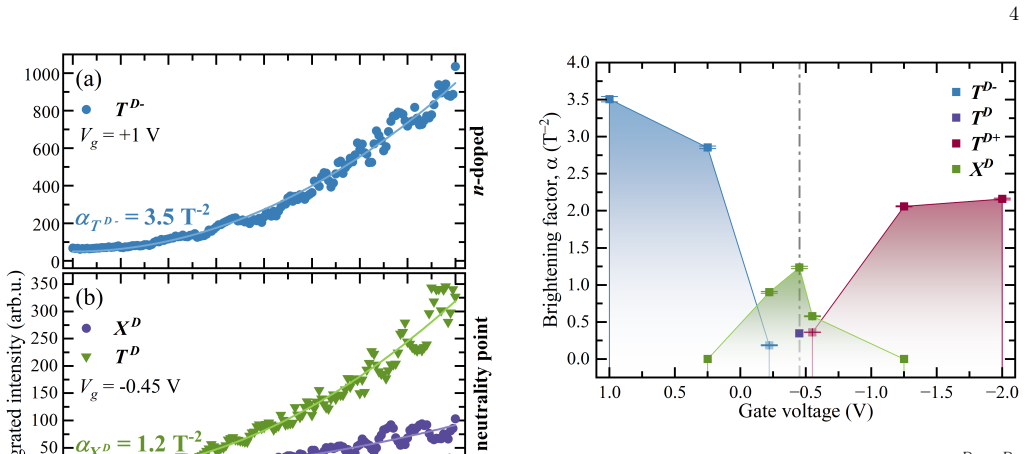
The brightening rates of the dark negative trion (T^{D-}), dark neutral exciton (X^{D}), and dark positive trion (T^{D+}) exhibit a strong and nontrivial dependence on doping, with pronounced asymmetry between the neutral X^{D} complex and the charged T^{D-} and T^{D+} trions that reveals distinct underlying carrier interactions, described by a rate-equation model for their steady-state populations.
What carries the argument
Rate-equation model for steady-state populations of the dark excitonic complexes, which tracks how doping alters their activation to bright states under magnetic field.
If this is right
- The optical response of doped transition-metal-dichalcogenide monolayers is governed by the populations of dark excitonic complexes.
- Carrier interactions differ between neutral dark excitons and charged dark trions, leading to asymmetric doping dependence.
- Gate voltage provides continuous tuning of brightening dynamics across electron-rich, neutral, and hole-rich regimes.
- The steady-state population model explains the full set of observed brightening rates for T^{D-}, X^{D}, and T^{D+}.
- Dark complexes play a key role in the overall carrier dynamics of these materials.
Where Pith is reading between the lines
- Similar doping-tuned asymmetry may appear in other monolayer transition-metal dichalcogenides that host dark excitonic states.
- The model could be extended to predict time-resolved brightening after pulsed excitation, revealing transient population dynamics.
- Valleytronic devices might exploit gate control of dark-state brightening to modulate polarization without changing the magnetic field.
- Reducing sample disorder could sharpen the distinction between neutral and charged brightening curves and test the model more stringently.
Load-bearing premise
The rate-equation model for steady-state populations accurately captures the observed brightening dynamics without significant unmodeled effects from disorder, temperature, or higher-order processes.
What would settle it
Photoluminescence intensity measurements of the dark states versus continuous gate voltage at fixed magnetic field that deviate from the rate-equation predictions, for example by showing symmetric brightening rates between neutral and charged complexes at intermediate doping levels.
Figures
read the original abstract
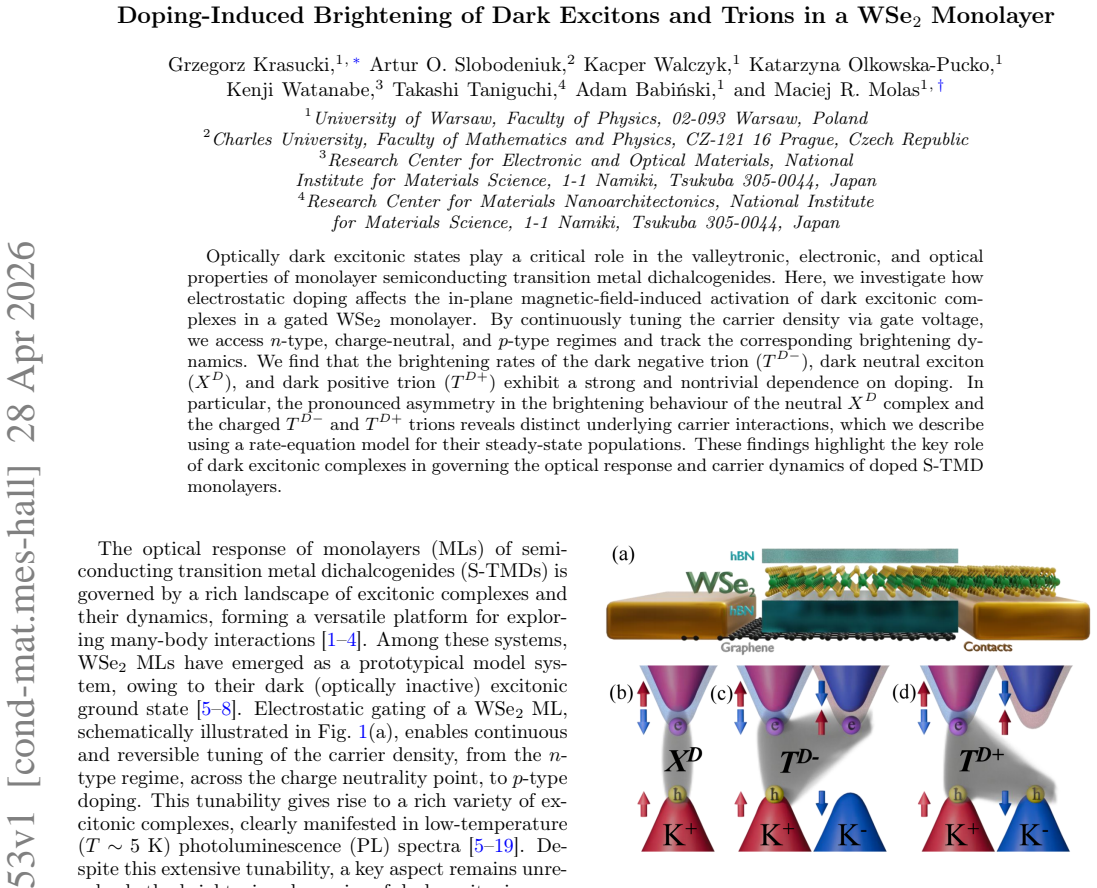
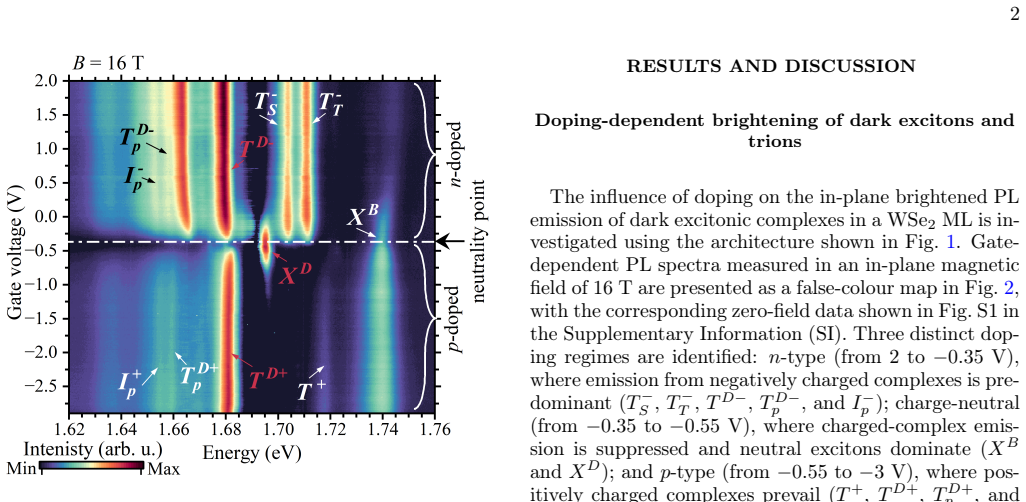
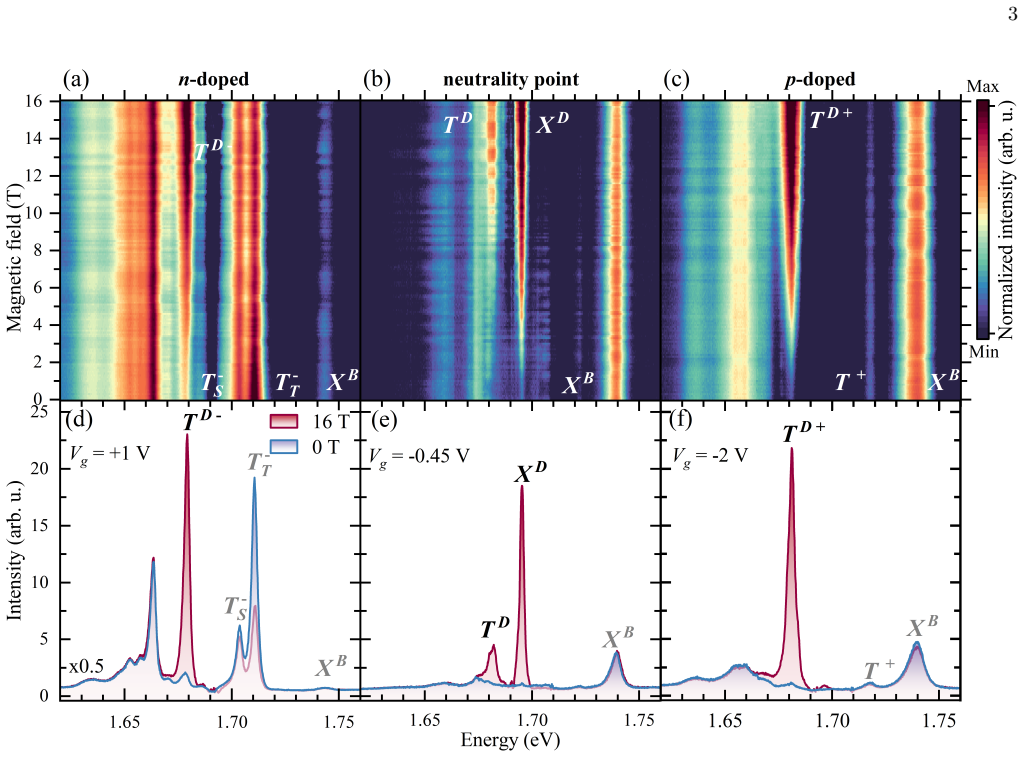
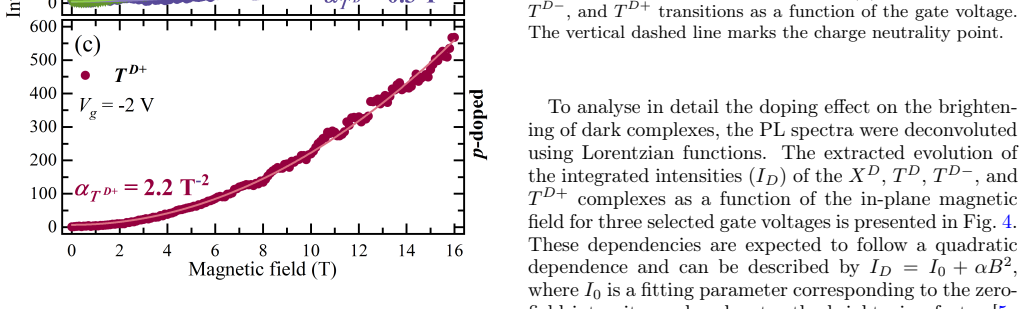
Optically dark excitonic states play a critical role in the valleytronic, electronic, and optical properties of monolayer semiconducting transition metal dichalcogenides. Here, we investigate how electrostatic doping affects the in-plane magnetic-field-induced activation of dark excitonic complexes in a gated WSe$_2$ monolayer. By continuously tuning the carrier density via gate voltage, we access $n$-type, charge-neutral, and $p$-type regimes and track the corresponding brightening dynamics. We find that the brightening rates of the dark negative trion ($T^{D-}$), dark neutral exciton ($X^{D}$), and dark positive trion ($T^{D+}$) exhibit a strong and nontrivial dependence on doping. In particular, the pronounced asymmetry in the brightening behaviour of the neutral $X^{D}$ complex and the charged $T^{D-}$ and $T^{D+}$ trions reveals distinct underlying carrier interactions, which we describe using a rate-equation model for their steady-state populations. These findings highlight the key role of dark excitonic complexes in governing the optical response and carrier dynamics of doped S-TMD monolayers.
Editorial analysis
A structured set of objections, weighed in public.
Referee Report
Summary. The paper examines the impact of electrostatic doping on the in-plane magnetic-field-induced brightening of dark excitonic complexes (dark negative trion T^{D-}, neutral exciton X^D, and dark positive trion T^{D+}) in a gated WSe2 monolayer. By tuning carrier density across n-type, charge-neutral, and p-type regimes, the authors track doping-dependent brightening dynamics and report a pronounced asymmetry between the neutral X^D and charged T^{D±} species. This asymmetry is interpreted as evidence for distinct underlying carrier interactions and is modeled via rate equations describing the steady-state populations of these complexes.
Significance. If the observed asymmetry is robustly attributable to the claimed distinct carrier interactions rather than unmodeled effects, the work would advance understanding of dark-state dynamics in doped TMD monolayers and their influence on optical response, with potential relevance to valleytronics. The experimental access to multiple doping regimes via gating is a clear strength, as is the focus on magnetic-field activation of otherwise dark states. However, the absence of visible quantitative fits, error bars, or explicit parameter reduction in the rate-equation model limits immediate impact.
major comments (2)
- [rate-equation model description] The rate-equation model for steady-state populations is invoked to capture the asymmetry in brightening rates, yet the description does not address whether doping-dependent changes in dielectric screening, substrate-induced potential fluctuations, or additional scattering channels (which vary with gate voltage) are included. If these effects are comparable to the modeled interaction terms, the asymmetry no longer uniquely supports distinct carrier interactions as the origin.
- [experimental results] The abstract states that brightening dynamics were tracked across doping regimes, but without reference to specific data (e.g., intensity vs. gate voltage curves, magnetic-field dependence, or error bars), the statistical significance and reproducibility of the reported asymmetry cannot be assessed from the provided information.
minor comments (2)
- Define all acronyms at first use (e.g., S-TMD for semiconducting transition metal dichalcogenides).
- Clarify the magnetic field strength and orientation used for activation, and whether it is held constant across doping sweeps.
Simulated Author's Rebuttal
We thank the referee for their careful reading of our manuscript and for the constructive comments. We address each major comment below.
read point-by-point responses
-
Referee: [rate-equation model description] The rate-equation model for steady-state populations is invoked to capture the asymmetry in brightening rates, yet the description does not address whether doping-dependent changes in dielectric screening, substrate-induced potential fluctuations, or additional scattering channels (which vary with gate voltage) are included. If these effects are comparable to the modeled interaction terms, the asymmetry no longer uniquely supports distinct carrier interactions as the origin.
Authors: The rate-equation model is constructed to isolate the carrier-exchange and scattering processes that produce the observed doping asymmetry between the neutral dark exciton and the charged dark trions. We agree that additional discussion of possible confounding factors would improve clarity. In the revised manuscript we will expand the model section to explain that the brightening rates are obtained from the magnetic-field dependence at fixed gate voltage; this procedure largely decouples the relative activation rates from global changes in dielectric screening or scattering that affect absolute populations. Substrate-induced potential fluctuations are doping-independent in our gated geometry and therefore cannot account for the pronounced neutral-versus-charged asymmetry we report. revision: partial
-
Referee: [experimental results] The abstract states that brightening dynamics were tracked across doping regimes, but without reference to specific data (e.g., intensity vs. gate voltage curves, magnetic-field dependence, or error bars), the statistical significance and reproducibility of the reported asymmetry cannot be assessed from the provided information.
Authors: The abstract is a concise summary of the principal findings. The full manuscript presents the supporting data in detail: intensity-versus-gate-voltage curves for each dark complex, magnetic-field sweeps performed at multiple doping levels, and error bars obtained from repeated measurements on the same device. The asymmetry is quantified directly in the extracted brightening-rate versus carrier-density plots, which show consistent trends across the n-type, neutral, and p-type regimes. revision: no
Circularity Check
No significant circularity; rate-equation model is independent interpretive tool.
full rationale
The paper's derivation chain consists of experimental tracking of doping-dependent brightening rates for dark excitons and trions, followed by application of a standard rate-equation model for steady-state populations to account for the observed asymmetry. This model is not self-definitional, does not rename a fitted input as a prediction, and does not rely on load-bearing self-citations or imported uniqueness theorems. The asymmetry is attributed to distinct carrier interactions within the model's equations, which are applied to data rather than constructed from it. The approach is self-contained, drawing on conventional population dynamics without reducing the central claim to tautological inputs or prior author work by definition.
Axiom & Free-Parameter Ledger
Reference graph
Works this paper leans on
-
[1]
X. Xu, W. Yao, D. Xiao, and T. F. Heinz, Nature Physics 10, 343 (2014)
work page 2014
-
[2]
T. Mueller and E. Malic, npj 2D Materials and Applica- tions2, 29 (2018)
work page 2018
-
[3]
G. Wang, A. Chernikov, M. M. Glazov, T. F. Heinz, X. Marie, T. Amand, and B. Urbaszek, Rev. Mod. Phys. 90, 021001 (2018)
work page 2018
-
[4]
K. F. Mak and J. Shan, Nature Nanotechnology17, 686 (2022)
work page 2022
-
[5]
M. R. Molas, C. Faugeras, A. O. Slobodeniuk, K. Noga- jewski, M. Bartos, D. M. Basko, and M. Potemski, 2D Materials4, 021003 (2017)
work page 2017
- [6]
-
[7]
M. R. Molas, A. O. Slobodeniuk, T. Kazimierczuk, K. Nogajewski, M. Bartos, P. Kapuściński, K. Oreszczuk, K. Watanabe, T. Taniguchi, C. Faugeras, P. Kossacki, D. M. Basko, and M. Potemski, Phys. Rev. Lett.123, 096803 (2019)
work page 2019
-
[8]
Łucja Kipczak, N. Zawadzka, D. Jana, I. Antoni- azzi, M. Grzeszczyk, M. Zinkiewicz, K. Watanabe, T. Taniguchi, M. Potemski, C. Faugeras, A. Babiński, and M. R. Molas, Nanophotonics13, 4743 (2024)
work page 2024
-
[9]
A. M. Jones, H. Yu, N. J. Ghimire, S. Wu, G. Aivazian, J. S. Ross, B. Zhao, J. Yan, D. G. Mandrus, D. Xiao, W. Yao, and X. Xu, Nature Nanotechnology8, 634 (2013)
work page 2013
- [10]
-
[11]
E.Liu, J.vanBaren, Z.Lu, M.M.Altaiary, T.Taniguchi, K. Watanabe, D. Smirnov, and C. H. Lui, Phys. Rev. Lett.123, 027401 (2019)
work page 2019
-
[12]
E. Liu, J. van Baren, T. Taniguchi, K. Watanabe, Y.-C. Chang, and C. H. Lui, Phys. Rev. Res.1, 032007 (2019)
work page 2019
-
[13]
M. He, P. Rivera, D. Van Tuan, N. P. Wilson, M. Yang, T. Taniguchi, K. Watanabe, J. Yan, D. G. Mandrus, H. Yu, H. Dery, W. Yao, and X. Xu, Nature Commu- nications11, 618 (2020)
work page 2020
-
[14]
E. Liu, J. van Baren, C.-T. Liang, T. Taniguchi, K. Watanabe, N. M. Gabor, Y.-C. Chang, and C. H. Lui, Phys. Rev. Lett.124, 196802 (2020)
work page 2020
-
[15]
M. Zinkiewicz, M. Grzeszczyk, Ł. Kipczak, T. Kaz- imierczuk, K. Watanabe, T. Taniguchi, P. Kossacki, A. Babiński, and M. R. Molas, Applied Physics Letters 120, 163101 (2022)
work page 2022
- [16]
-
[17]
M. Zinkiewicz, T. Woźniak, T. Kazimierczuk, P. Ka- puscinski, K. Oreszczuk, M. Grzeszczyk, M. Bartoš, K. Nogajewski, K. Watanabe, T. Taniguchi, C. Faugeras, P. Kossacki, M. Potemski, A. Babiński, and M. R. Molas, Nano Letters21, 2519 (2021)
work page 2021
-
[18]
P. Kapuściński, A. Delhomme, D. Vaclavkova, A. O. Slobodeniuk, M. Grzeszczyk, M. Bartos, K. Watanabe, T. Taniguchi, C. Faugeras, and M. Potemski, Communi- cations Physics4, 186 (2021)
work page 2021
- [19]
-
[20]
G. Wang, C. Robert, M. M. Glazov, F. Cadiz, E. Cour- tade, T. Amand, D. Lagarde, T. Taniguchi, K. Watan- abe, B. Urbaszek, and X. Marie, Phys. Rev. Lett.119, 047401 (2017)
work page 2017
-
[21]
Z. Li, T. Wang, C. Jin, Z. Lu, Z. Lian, Y. Meng, M. Blei, S. Gao, T. Taniguchi, K. Watanabe, T. Ren, S. Ton- gay, L. Yang, D. Smirnov, T. Cao, and S.-F. Shi, Nature Communications10, 2469 (2019)
work page 2019
-
[22]
Z. Li, T. Wang, Z. Lu, M. Khatoniar, Z. Lian, Y. Meng, M. Blei, T. Taniguchi, K. Watanabe, S. A. McGill, S.Tongay, V.M.Menon, D.Smirnov,andS.-F.Shi,Nano Letters19, 6886 (2019)
work page 2019
-
[23]
K. O. Pucko, E. Blundo, N. Zawadzka, S. Cianci, D. Va- clavkova, P.Kapuściński, D.Jana, G.Pettinari, M.Felici, K. Nogajewski, M. Bartoš, K. Watanabe, T. Taniguchi, C. Faugeras, M. Potemski, A. Babiński, A. Polimeni, and M. R. Molas, 2D Materials10, 015018 (2022)
work page 2022
-
[24]
A. O. Slobodeniuk and D. M. Basko, 2D Materials3, 035009 (2016)
work page 2016
-
[25]
E. Courtade, M. Semina, M. Manca, M. M. Glazov, C. Robert, F. Cadiz, G. Wang, T. Taniguchi, K. Watan- abe, M. Pierre, W. Escoffier, E. L. Ivchenko, P. Renucci, X. Marie, T. Amand, and B. Urbaszek, Phys. Rev. B96, 085302 (2017)
work page 2017
-
[26]
S.-Y. Chen, T. Goldstein, T. Taniguchi, K. Watanabe, and J. Yan, Nature Communications9, 3717 (2018)
work page 2018
- [27]
-
[28]
Z. Li, T. Wang, Z. Lu, C. Jin, Y. Chen, Y. Meng, Z. Lian, T. Taniguchi, K. Watanabe, S. Zhang, D. Smirnov, and S.-F. Shi, Nature Communications9, 3719 (2018)
work page 2018
-
[29]
M. Barbone, A. R.-P. Montblanch, D. M. Kara, C. Palacios-Berraquero, A. R. Cadore, D. De Fazio, B. Pingault, E. Mostaani, H. Li, B. Chen, K. Watanabe, T. Taniguchi, S. Tongay, G. Wang, A. C. Ferrari, and M. Atatüre, Nature Communications9, 3721 (2018)
work page 2018
-
[30]
M. Baranowski, A. Surrente, D. K. Maude, M. Ballot- tin, A. A. Mitioglu, P. C. M. Christianen, Y. C. Kung, D. Dumcenco, A. Kis, and P. Plochocka, 2D Materials4, 025016 (2017)
work page 2017
-
[31]
M. Yang, L. Ren, C. Robert, D. Van Tuan, L. Lombez, B. Urbaszek, X. Marie, and H. Dery, Phys. Rev. B105, 085302 (2022)
work page 2022
-
[32]
C. Mai, Y. G. Semenov, A. Barrette, Y. Yu, Z. Jin, L. Cao, K. W. Kim, and K. Gundogdu, Phys. Rev. B 90, 041414 (2014)
work page 2014
-
[33]
E. J. Sie, A. J. Frenzel, Y.-H. Lee, J. Kong, and N. Gedik, Phys. Rev. B92, 125417 (2015)
work page 2015
-
[34]
N. Ohba, K. Miwa, N. Nagasako, and A. Fukumoto, Physical Review B63, 115207 (2001)
work page 2001
-
[35]
A. Laturia, M. L. Van de Put, and W. G. Vandenberghe, npj 2D Materials and Applications4, 28 (2020). 8 Supplementary Information: Doping-Induced Brightening of Dark Excitons and Trions in a WSe 2 Monolayer Grzegorz Krasucki,1 Artur O. Slobodeniuk,2 Kacper Walczyk,1 Katarzyna Olkowska-Pucko,1 Kenji Watanabe,3 Takashi Taniguchi,4 Adam Babiński,1 and Maciej ...
work page 2020
discussion (0)
Sign in with ORCID, Apple, or X to comment. Anyone can read and Pith papers without signing in.