Recognition: unknown
Beyond Single Trajectories: Optimal Control and Jordan-Lie Algebra in Hybrid Quantum Walks for Combinatorial Optimization
Pith reviewed 2026-05-07 16:31 UTC · model grok-4.3
The pith
A hybrid quantum walk ansatz using dynamical coin operators outperforms QAOA by coherently superposing multiple evolution paths and generating a larger Jordan-Lie algebra.
A machine-rendered reading of the paper's core claim, the machinery that carries it, and where it could break.
Core claim
The HQW ansatz superposes multiple trajectories coherently within each circuit layer via a dynamical coin operator derived from Pontryagin's minimum principle. This generates a strictly larger Jordan-Lie algebra than QAOA, with the negativity of the Jordan product providing an algebraic explanation for improved optimization performance. Numerical results on combinatorial problems establish that HQW achieves superior convergence speed, accuracy, and robustness.
What carries the argument
The dynamical coin operator, obtained through optimal control, that enables coherent superposition of multiple paths and enlarges the generated Jordan-Lie algebra for greater variational expressivity.
If this is right
- QAOA is recovered as the special case with a static coin, so improvements apply broadly to variational optimization.
- The optimal coin operator differs from constant gates, implying that time-varying controls can enhance algorithm performance.
- Jordan product negativity in the dynamical Lie algebra is tied to better convergence and solution accuracy.
- Path-superposition via optimal control offers a systematic way to design more expressive quantum optimization algorithms.
Where Pith is reading between the lines
- This framework might extend to other quantum algorithms by incorporating similar superposition of control trajectories to boost expressivity.
- Reduced layer counts could be possible due to higher expressivity per layer, lowering hardware requirements.
- Further analysis could link the algebraic structure directly to approximation guarantees for specific problems like Max-Cut.
- The robustness advantage suggests potential resilience to certain noise types in NISQ devices.
Load-bearing premise
That the optimal dynamical coin operator can be realized on hardware with manageable circuit depth and that the benefits from path superposition are not canceled out by additional noise or implementation overhead.
What would settle it
A direct comparison on a Max-Cut problem where HQW fails to show faster convergence or higher accuracy than QAOA with the same number of layers, or where the Jordan-Lie algebra size is not larger.
Figures






read the original abstract
The Quantum Approximate Optimization Algorithm (QAOA) follows a single, fixed evolution path, overlooking the potential computational advantage of coherently superposing multiple trajectories. Here we overcome this limitation with a hybrid quantum walk (HQW) ansatz that super poses multiple Hamiltonian-driven paths coherently within each circuit layer via a dynamical coin operator. QAOA emerges as a special case of this framework with a static Pauli-X coin. Using Pontryagin's minimum principle, we derive the optimal form of the coin operator, demonstrating that it generally differs from a constant gate. A dynamical Lie algebra analysis reveals that HQW generates a strictly larger Jordan-Lie algebra, providing an algebraic foundation for its enhanced expressivity. Especially, we reveal the connection between the unique Jordan product negativity in HQW's DLA and its performance advantages. Numerical experiments on Max-Cut and Maximum Independent Set problems show that HQW systematically outperforms QAOA in convergence speed, solution accuracy, and robustness. Our work establishes a path-superposition paradigm for quantum optimization, combining optimal control theory with algebraic structure to guide the design of advanced quantum algorithms.
Editorial analysis
A structured set of objections, weighed in public.
Referee Report
Summary. The manuscript introduces a hybrid quantum walk (HQW) ansatz for combinatorial optimization that extends QAOA by coherently superposing multiple Hamiltonian-driven trajectories per layer via a dynamical coin operator. QAOA is recovered as the special case of a static Pauli-X coin. The optimal coin is derived via Pontryagin's minimum principle and shown to differ from a constant gate in general. A dynamical Lie algebra analysis establishes that HQW spans a strictly larger Jordan-Lie algebra than QAOA, with a connection drawn between unique Jordan-product negativity and performance gains. Numerical experiments on Max-Cut and Maximum Independent Set problems report that HQW outperforms QAOA in convergence speed, solution accuracy, and robustness.
Significance. If the reported advantages survive under fixed total gate budgets, the work would meaningfully advance variational quantum optimization by combining optimal-control-derived ansatze with Lie-algebraic diagnostics. The formal demonstration of an enlarged Jordan-Lie algebra and the proposed link to Jordan negativity supply a concrete theoretical handle for designing more expressive circuits. The numerical results on two standard combinatorial problems provide initial evidence, but the absence of resource-equivalent comparisons limits immediate claims of practical superiority.
major comments (2)
- [Numerical Experiments] Numerical Experiments section: The central claim that HQW systematically outperforms QAOA rests on layer-count comparisons. The manuscript states that the Pontryagin-derived dynamical coin 'generally differs from a constant gate,' yet provides no decomposition into elementary gates, no total two-qubit gate counts, and no ablation that holds total gate budget fixed rather than layer number. Without this accounting, the observed gains in convergence, accuracy, and robustness could arise from unequal computational resources rather than the larger Jordan-Lie algebra or Jordan-product negativity.
- [Dynamical Lie Algebra Analysis] Dynamical Lie Algebra Analysis section: The paper correctly shows that HQW generates a strictly larger Jordan-Lie algebra. However, it does not quantify the additional reachable expressivity within hardware depth limits nor demonstrate that the extra generators are actually utilized by the optimized circuits in the numerical experiments. A direct, quantitative bridge between the algebraic enlargement and the reported performance metrics is needed to support the claim that the larger algebra provides the 'algebraic foundation' for the advantages.
minor comments (2)
- [Introduction] The abstract and introduction refer to 'Jordan product negativity' as uniquely connected to performance; a brief explicit definition or equation reference in the main text would aid readers unfamiliar with the signed Jordan product.
- [Numerical Experiments] Figure captions for the numerical results should state the number of independent runs, the optimizer used, and whether error bars represent standard deviation or standard error.
Simulated Author's Rebuttal
We thank the referee for the constructive and detailed comments. We address each major point below, providing clarifications on the current manuscript and committing to targeted revisions that directly strengthen the evidence for our claims.
read point-by-point responses
-
Referee: [Numerical Experiments] Numerical Experiments section: The central claim that HQW systematically outperforms QAOA rests on layer-count comparisons. The manuscript states that the Pontryagin-derived dynamical coin 'generally differs from a constant gate,' yet provides no decomposition into elementary gates, no total two-qubit gate counts, and no ablation that holds total gate budget fixed rather than layer number. Without this accounting, the observed gains in convergence, accuracy, and robustness could arise from unequal computational resources rather than the larger Jordan-Lie algebra or Jordan-product negativity.
Authors: We agree that resource-equivalent comparisons are essential to isolate the contribution of the enlarged Jordan-Lie algebra. Although layer count is the conventional metric in the QAOA literature and the dynamical coin is a fixed-size unitary (decomposable into a constant number of elementary gates per layer), the manuscript does not explicitly report total two-qubit gate counts or perform fixed-budget ablations. In the revised version we will add: (i) an explicit elementary-gate decomposition of the Pontryagin-derived coin, (ii) the resulting total two-qubit gate counts for HQW versus QAOA at matched layer depths, and (iii) a new ablation study that holds the total gate budget fixed while varying the coin dynamics. These additions will demonstrate that the reported advantages in convergence speed, accuracy, and robustness persist under equal resource constraints. revision: yes
-
Referee: [Dynamical Lie Algebra Analysis] Dynamical Lie Algebra Analysis section: The paper correctly shows that HQW generates a strictly larger Jordan-Lie algebra. However, it does not quantify the additional reachable expressivity within hardware depth limits nor demonstrate that the extra generators are actually utilized by the optimized circuits in the numerical experiments. A direct, quantitative bridge between the algebraic enlargement and the reported performance metrics is needed to support the claim that the larger algebra provides the 'algebraic foundation' for the advantages.
Authors: The DLA analysis rigorously establishes strict inclusion of the QAOA algebra inside the HQW algebra and links the unique Jordan-product negativity to improved optimization landscapes. However, the current manuscript does not quantify the dimension of the reachable subalgebra under realistic hardware-depth constraints nor measure the participation of the additional generators in the numerically optimized circuits. In the revision we will insert: (1) the explicit dimension of the full DLA versus the hardware-constrained reachable algebra, (2) a quantitative analysis (e.g., participation ratios and gradient-flow diagnostics) showing that the extra generators are actively utilized by the optimized HQW circuits on the Max-Cut and MIS instances, and (3) a concise discussion connecting these algebraic metrics to the observed gains in convergence and solution quality. This will furnish the direct quantitative bridge requested. revision: yes
Circularity Check
No circularity: derivations rely on external optimal control and independent algebraic analysis
full rationale
The paper's core derivations do not reduce to their own inputs by construction. The optimal dynamical coin is obtained via Pontryagin's minimum principle (an external optimal-control theorem), not by fitting or self-definition within the HQW ansatz. The Jordan-Lie algebra comparison is a formal algebraic inclusion proof showing a strictly larger DLA for the hybrid walk versus QAOA; it contains no fitted parameters, no self-referential predictions, and no load-bearing self-citations. QAOA appears only as the special case of a static Pauli-X coin, which is a direct substitution rather than a circular prediction. Numerical performance claims on Max-Cut and MIS are empirical outputs, not re-statements of the algebraic or control derivations. No ansatz is smuggled via prior author work, no uniqueness theorem is imported from the same authors, and no known empirical pattern is merely renamed. The derivation chain therefore remains self-contained against external benchmarks.
Axiom & Free-Parameter Ledger
axioms (1)
- domain assumption Pontryagin's minimum principle can be applied to derive the optimal dynamical coin operator for the hybrid quantum walk
Reference graph
Works this paper leans on
-
[1]
3.k ∗(tf) =∇ xϕ(x∗(tf), tf)
˙k ∗ (t) =−∇ xH=−∇ xg−k ∗(t)· ∇ xf. 3.k ∗(tf) =∇ xϕ(x∗(tf), tf). 4.H(x ∗(t),k ∗(t),v ∗(t)) = min v∈U H(x ∗(t),k ∗(t),v) for a.e.t∈[t 0, tf]. These equations form a two-point boundary value prob- lem, and the PMP often reduces the optimal control problem to solving forv ∗(t) that minimizes the control Hamiltonian. D. Dynamical Lie algebra In the context of...
-
[2]
| ˙ψ(t)⟩=−iH(t)|ψ(t)⟩,|ψ(t 0)⟩=|ψ(0)⟩
Dynamical equation. | ˙ψ(t)⟩=−iH(t)|ψ(t)⟩,|ψ(t 0)⟩=|ψ(0)⟩. The man- ifoldMis the unit sphere inC n
-
[3]
Control input.v(t) = (u(t),n(t))∈ U={0, 1 2 ,1}× {x∈R 3,||x|| 2 = 1} ⊂R 4
-
[4]
Objective function. In order to be coincide with ⟨ψf |Hc|ψf ⟩, now the objective function is J=⟨ψ(t f)|I⊗H c|ψ(tf)⟩.(20) Thus, the control Hamiltonian H=y 1(t)Φ|1⟩⟨1|⊗Hc(t) +y 2(t)Φ|0⟩⟨0|⊗Hb(t) +y3(t)Φ(nx(t)X+n y(t)Y+n z(t)Z)⊗I (t),(21) where Φ A(t) =i⟨k(t)|A|ψ(t)⟩+ c.c., and the adjoint state|k(t)⟩satisfies the equation |˙k(t)⟩=−iH(t)|k(t)⟩,|k(t f)⟩=I⊗H ...
-
[5]
2.n 2 x(t) +n 2 y(t) +n 2 z(t) = 1
∂L ∂nx =−y 3(t)ΦX⊗I (t) + 2µnx = 0, ∂L ∂ny =−y 3(t)ΦY⊗I (t) + 2µny = 0, ∂L ∂nz =−y 3(t)ΦZ⊗I (t) + 2µnz = 0. 2.n 2 x(t) +n 2 y(t) +n 2 z(t) = 1. Whenn 2 x(t) +n 2 y(t) +n 2 z(t) = 1, andn x = y3(t)ΦX⊗I (t) 2µ , ny = y3(t)ΦY⊗I (t) 2µ andn z = y3(t)ΦZ⊗I (t) 2µ , we have 1 2µ = 1 |y3(t)| p ΦX⊗I (t)2 + ΦY⊗I (t)2 + ΦZ⊗I (t)2 .(24) Thus, when the control paramet...
-
[6]
[A, B◦C] = [A, B]◦C+B◦[A, C] and [A,[B, C]] = [[A, B], C] + [B,[A, C]] for allA, B, C∈ L
-
[7]
According to the definition of the Jordan-Lie algebra, we next present a lemma to describe an algebraL Q
(A◦B)◦C−A◦(B◦C) =h 2[[A, C], B] for some h2 ∈R. According to the definition of the Jordan-Lie algebra, we next present a lemma to describe an algebraL Q. Lemma 1.L Q is the real vector space generated lin- early by{iH c, iHb, iIp}equipped with two bilinear maps i{·,·}and [·,·] :L Q × LQ → LQ, where{·,·}and [·,·] are the anti-commutator and the commutator,...
-
[8]
Problem Hamiltonians For a graphG= (V, E), the Max-Cut problem is en- coded using the standard Hamiltonian Hc = X (i,j)∈E I−Z iZj 2 ,(B1) with the mixer HamiltonianH b =P i Xi. The Maximum Independent Set problem is encoded as Hc =− X i ni +λ X (i,j)∈E ninj,(B2) wheren i = 1 2(I−Z i) represents the occupation num- ber operator for vertexi, indicating whet...
-
[9]
After Hadamard initialization, each layerlapplies: U(γ l, βl) = exp(−iγlHc) exp(−iβlHb) (B4) whereγ l andβ l are variational parameters optimized classically
Circuit Implementations The classic QAOA circuit uses onlynsystem qubits. After Hadamard initialization, each layerlapplies: U(γ l, βl) = exp(−iγlHc) exp(−iβlHb) (B4) whereγ l andβ l are variational parameters optimized classically. The hybrid quantum walk circuit employsn+1 qubits: nsystem qubits representing graph vertices and 1 coin qubit controlling t...
-
[10]
Apply aU 3(θs,2, θs,3, θs,4) gate on the coin qubit, where U3(θ, ϕ, δ) = cos(θ/2)−exp(iδ) sin(θ/2) exp(iϕ) sin(θ/2) exp(i(ϕ+δ)) cos(θ/2) . (B5)
-
[11]
If the coin qubit is in state|0⟩, apply exp(−iθs,1Hb) to system qubits
If the coin qubit is in state|1⟩, apply exp(−iθ s,0Hc) to system qubits. If the coin qubit is in state|0⟩, apply exp(−iθs,1Hb) to system qubits. The controlled evolution is implemented using Penny- Lane’s ctrl operation with conditional application of Ap- proxTimeEvolution. Each layer of QAOA adds two evo- lution processes corresponding to the two Hamilto...
-
[12]
Classic QAOA: The standard QAOA ansatz Ub(βp)Uc(γp)· · ·U b(β1)Uc(γ1)
-
[13]
Hybrid Quantum Walk (HQW): The HQW opera- tor W(γ k, βk) =e −i|1⟩⟨1|⊗Hcγk e−i|0⟩⟨0|⊗Hbβk(Ck ⊗I), withpsteps
-
[14]
QAOA Variant 1: A QAOA circuit where parame- tersγ k (forH c) are taken from the odd-step HQW parameters andβ k (forH b) from the even-step HQW parameters
-
[15]
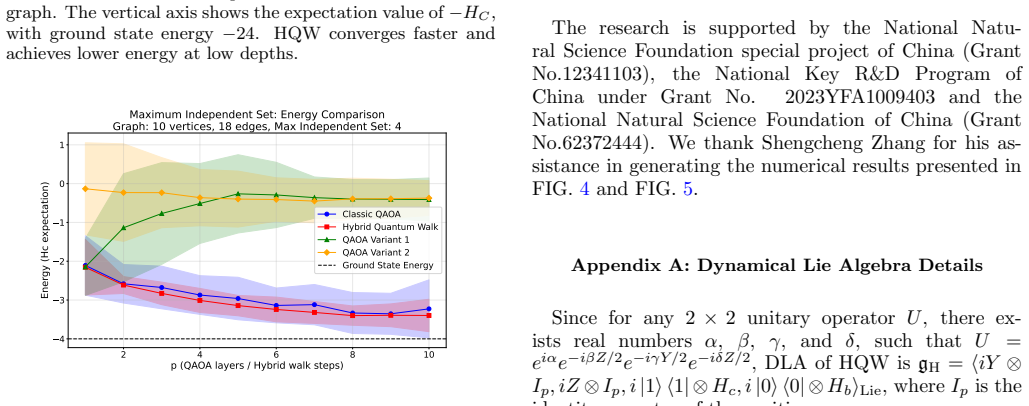
For HQW, the final expectation value is⟨−I⊗H c⟩for the Max-Cut problem and⟨I⊗H c⟩for the Maximum Independent Set problem
QAOA Variant 2: A QAOA circuit withγ k from even-step andβ k from odd-step HQW parameters. For HQW, the final expectation value is⟨−I⊗H c⟩for the Max-Cut problem and⟨I⊗H c⟩for the Maximum Independent Set problem. All circuits were optimized to minimize this expectation
-
[16]
equal performance
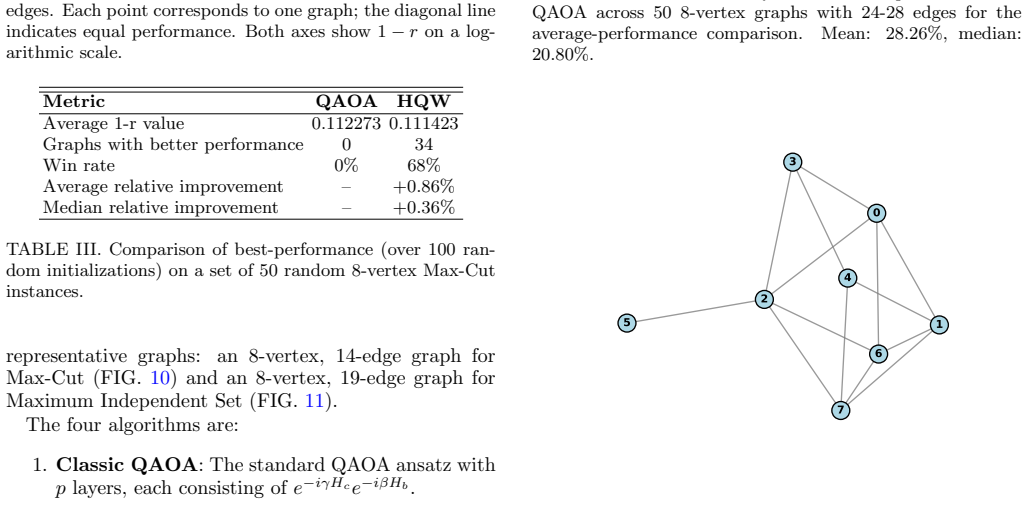
Detailed Discussion of best-performance Improvements on 50 Graphs Here we provide additional details for the best- performance comparison on 50 Graphs. As noted in the main text, the experimental protocol is identical to that described for the best-performance comparison: QAOA depthp= 2, HQW steps 2p= 4, 100 random initial- izations, 300 Adam steps with l...
-
[17]
A Quantum Approximate Optimization Algorithm
E. Farhi, J. Goldstone, and S. Gutmann, arXiv preprint arXiv:1411.4028 (2014)
work page internal anchor Pith review arXiv 2014
- [18]
-
[19]
Peruzzo, J
A. Peruzzo, J. McClean, P. Shadbolt, M.-H. Yung, X.-Q. Zhou, P. J. Love, A. Aspuru-Guzik, and J. L. O’brien, Nature communications5, 4213 (2014)
2014
- [20]
-
[21]
Choi and J
J. Choi and J. Kim, in2019 international conference on information and communication technology convergence (ICTC)(IEEE, 2019) pp. 138–142
2019
-
[22]
Zhou, S.-T
L. Zhou, S.-T. Wang, S. Choi, H. Pichler, and M. D. Lukin, Physical Review X10, 021067 (2020)
2020
-
[23]
Herrman, P
R. Herrman, P. C. Lotshaw, J. Ostrowski, T. S. Humble, and G. Siopsis, Scientific Reports12, 6781 (2022)
2022
-
[24]
Bravyi, A
S. Bravyi, A. Kliesch, R. Koenig, and E. Tang, Physical review letters125, 260505 (2020)
2020
-
[25]
L. S. Pontryagin, V. G. Boltyanskii, R. V. Gamkrelidze, and E. F. Mishchenko,The Mathematical Theory of Op- timal Processes(John Wiley and Sons, New York, 1962)
1962
-
[26]
Z.-C. Yang, A. Rahmani, A. Shabani, H. Neven, and C. Chamon, Physical Review X7, 021027 (2017)
2017
-
[27]
C. Lin, Y. Wang, G. Kolesov, and U. Kalabi´ c, Physical Review A100, 022327 (2019)
2019
-
[28]
L. T. Brady, C. L. Baldwin, A. Bapat, Y. Kharkov, and A. V. Gorshkov, Physical Review Letters126, 070505 (2021)
2021
-
[29]
L. Gerblich, T. Dasanjh, H. Q. Wong, D. Ross, L. Novo, N. Chancellor, and V. Kendon, arXiv preprint arXiv:2407.06663 (2024)
-
[30]
D. A. Meyer, Journal of Statistical Physics85, 551 (1996)
1996
-
[31]
D. A. Meyer, Physics Letters A223, 337 (1996)
1996
-
[32]
Aharonov, A
D. Aharonov, A. Ambainis, J. Kempe, and U. Vazirani, inProceedings of the thirty-third annual ACM symposium on Theory of computing(2001) pp. 50–59
2001
-
[33]
Ambainis, E
A. Ambainis, E. Bach, A. Nayak, A. Vishwanath, and J. Watrous, inProceedings of the thirty-third annual ACM symposium on Theory of computing(2001) pp. 37– 49
2001
-
[34]
A. M. Childs, R. Cleve, E. Deotto, E. Farhi, S. Gutmann, and D. A. Spielman, inProceedings of the thirty-fifth an- nual ACM symposium on Theory of computing(2003) pp. 59–68
2003
-
[35]
Chen and Y
T. Chen and Y. Shang, npj Quantum Information12, 21 (2026)
2026
-
[36]
Albertini and D
F. Albertini and D. D’Alessandro, inProceedings of the 40th IEEE Conference on Decision and Control (Cat. No. 01CH37228), Vol. 2 (IEEE, 2001) pp. 1589–1594
2001
-
[37]
Albertini and D
F. Albertini and D. D’Alessandro, Systems & Control Letters151, 104913 (2021)
2021
-
[38]
D’Alessandro and J
D. D’Alessandro and J. T. Hartwig, Journal of Dynamical and Control Systems27, 1 (2021)
2021
-
[39]
Wiersema, E
R. Wiersema, E. K¨ okc¨ u, A. F. Kemper, and B. N. Bakalov, npj Quantum Information10, 110 (2024)
2024
- [40]
-
[41]
J. Allcock, M. Santha, P. Yuan, and S. Zhang, arXiv preprint arXiv:2407.12587 (2024)
-
[42]
Ragone, B
M. Ragone, B. N. Bakalov, F. Sauvage, A. F. Kemper, C. Ortiz Marrero, M. Larocca, and M. Cerezo, Nature Communications15, 7172 (2024)
2024
-
[43]
N. P. Landsman,Mathematical topics between classical and quantum mechanics(Springer Science & Business Media, 2012)
2012
-
[44]
Quantum Computation by Adiabatic Evolution
E. Farhi, J. Goldstone, S. Gutmann, and M. Sipser, arXiv preprint quant-ph/0001106 (2000)
work page Pith review arXiv 2000
-
[45]
Albash and D
T. Albash and D. A. Lidar, Reviews of Modern Physics 90, 015002 (2018)
2018
- [46]
-
[47]
Seki and H
Y. Seki and H. Nishimori, Physical Review E—Statistical, Nonlinear, and Soft Matter Physics 85, 051112 (2012)
2012
-
[48]
Albash, Physical Review A99, 042334 (2019)
T. Albash, Physical Review A99, 042334 (2019)
2019
- [49]
-
[50]
S. Sim, P. D. Johnson, and A. Aspuru-Guzik, Advanced Quantum Technologies2, 1900070 (2019)
2019
-
[51]
Guo and S
Y. Guo and S. Luo, Physical Review A110, 062206 (2024)
2024
-
[52]
PennyLane: Automatic differentiation of hybrid quantum-classical computations
V. Bergholm, J. Izaac, M. Schuld, C. Gogolin, S. Ahmed, V. Ajith, M. S. Alam, G. Alonso-Linaje, B. AkashNarayanan, A. Asadi,et al., arXiv preprint arXiv:1811.04968 (2018)
work page internal anchor Pith review arXiv 2018
-
[53]
T. E. Oliphantet al.,Guide to numpy, Vol. 1 (Trelgol Publishing USA, 2006)
2006
-
[54]
J. D. Hunter, Computing in science & engineering9, 90 (2007)
2007
-
[55]
McKinneyet al., scipy445, 51 (2010)
W. McKinneyet al., scipy445, 51 (2010). 18
2010
-
[56]
T. Chen and Y. Shang, 10.5281/zenodo.18983535 (2026). [41] D. P. Kingma and J. Ba, arXiv preprint arXiv:1412.6980 (2014)
discussion (0)
Sign in with ORCID, Apple, or X to comment. Anyone can read and Pith papers without signing in.