Recognition: unknown
MAIC-UI: Making Interactive Courseware with Generative UI
Pith reviewed 2026-05-07 16:25 UTC · model grok-4.3
The pith
MAIC-UI lets educators turn textbooks into editable interactive STEM courseware without code and with sub-10-second updates.
A machine-rendered reading of the paper's core claim, the machinery that carries it, and where it could break.
Core claim
MAIC-UI is a zero-code system that applies multi-modal structured knowledge analysis, a generate-verify-optimize pipeline, and Click-to-Locate editing with Unified Diff incremental generation to produce pedagogically accurate interactive courseware from textbooks, PPTs, and PDFs while supporting rapid iteration cycles under ten seconds.
What carries the argument
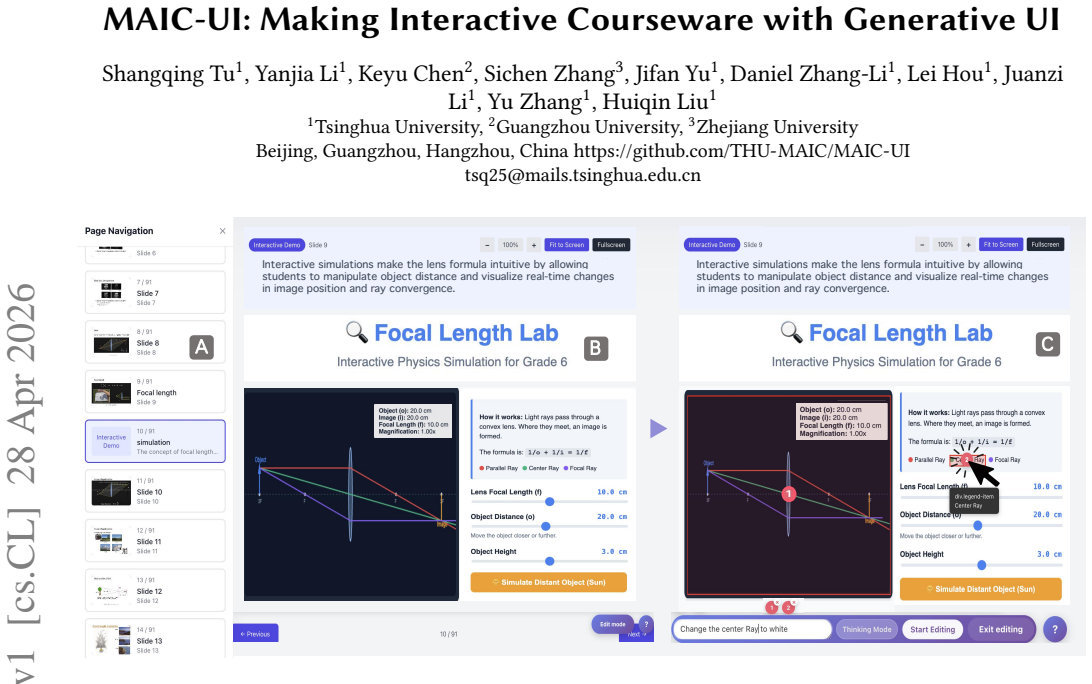
The Click-to-Locate editing mechanism combined with Unified Diff-based incremental generation, which identifies specific UI elements and regenerates only the changed portions instead of rebuilding entire documents.
Load-bearing premise
The measured gains in editing speed and student performance are caused by the MAIC-UI features rather than by differences in how the studies were run or who participated.
What would settle it
A follow-up lab study with blinded conditions or a larger sample in which direct text-to-HTML tools achieve the same low iteration count and equivalent student score gains, or discovery of repeated cases where MAIC-UI output contains clear pedagogical inaccuracies missed by the verify step.
Figures


read the original abstract
Creating interactive STEM courseware traditionally requires HTML/CSS/JavaScript expertise, leaving barriers for educators. While generative AI can produce HTML codes, existing tools generate static presentations rather than interactive simulations, struggle with long documents, and lack pedagogical accuracy mechanisms. Furthermore, full regeneration for modifications requires 200--600 seconds, disrupting creative flow. We present MAIC-UI, a zero-code authoring system that enables educators to create and rapidly edit interactive courseware from textbooks, PPTs, and PDFs. MAIC-UI employs: (1) structured knowledge analysis with multi-modal understanding to ensure pedagogical rigor; (2) a two-stage generate-verify-optimize pipeline separating content alignment from visual refinement; and (3) Click-to-Locate editing with Unified Diff-based incremental generation achieving sub-10-second iteration cycles. A controlled lab study with 40 participants shows MAIC-UI reduces editing iterations (4.9 vs. 7.0) and significantly improves learnability and controllability compared to direct Text-to-HTML generation. A three-month classroom deployment with 53 high school students demonstrates that MAIC-UI fosters learning agency and reduces outcome disparities -- the pilot class achieved 9.21-point gains in STEM subjects compared to -2.32 points in control classes. Our code is available at https://github.com/THU-MAIC/MAIC-UI.
Editorial analysis
A structured set of objections, weighed in public.
Referee Report
Summary. The manuscript introduces MAIC-UI, a zero-code authoring system that lets educators generate and iteratively edit interactive STEM courseware from textbooks, PPTs, and PDFs. It uses structured knowledge analysis with multi-modal understanding, a two-stage generate-verify-optimize pipeline, and Click-to-Locate editing based on Unified Diff for sub-10-second iterations. A lab study with 40 participants reports fewer editing iterations (4.9 vs. 7.0) and better learnability/controllability than direct Text-to-HTML generation. A three-month classroom deployment with 53 high school students claims that the pilot class achieved 9.21-point STEM gains versus -2.32 points in control classes, attributing this to increased learning agency and reduced outcome disparities. Code is released at https://github.com/THU-MAIC/MAIC-UI.
Significance. If the empirical claims are substantiated, MAIC-UI would meaningfully lower the barrier for non-technical educators to produce pedagogically sound interactive simulations, with potential to improve STEM engagement and equity. The open-source release is a clear strength that supports reproducibility and extension. The reported efficiency gains in editing and the large reported outcome differences in the deployment, if causally linked to the system, would constitute a practically significant contribution to educational technology.
major comments (3)
- [Abstract] Abstract (and the classroom deployment section): The headline claim that MAIC-UI 'fosters learning agency and reduces outcome disparities' rests on the reported 9.21-point pilot gain versus -2.32 in controls. No information is supplied on baseline equivalence between classes, randomization or matching procedures, statistical significance tests, or controls for teacher effects and external variables. This absence directly undermines attribution of the gains to the MAIC-UI features.
- [Abstract] Abstract (lab study paragraph): The claim of significantly improved learnability and controllability with 4.9 versus 7.0 editing iterations is presented without any description of experimental controls, participant demographics, statistical methods, or potential confounds. These omissions make it impossible to evaluate whether the quantitative results support the stated conclusions.
- [System description] System description (likely §3 or §4): The assertion that 'structured knowledge analysis with multi-modal understanding' ensures pedagogical rigor is not accompanied by any accuracy audit, error-rate measurement, or human-review comparison. Without such evidence, the assumption that AI-generated interactive content can be deployed without further checking remains untested and load-bearing for safe educational use.
minor comments (1)
- [Abstract] The abstract states that full regeneration takes 200-600 seconds but does not clarify whether this baseline was measured under identical hardware and prompt conditions as the MAIC-UI incremental method.
Simulated Author's Rebuttal
Thank you for the thorough review and constructive criticism. We have carefully considered each major comment and will make substantial revisions to the manuscript to provide the missing methodological details, qualify our claims appropriately, and add supporting evidence where possible. Our point-by-point responses are as follows.
read point-by-point responses
-
Referee: [Abstract] Abstract (and the classroom deployment section): The headline claim that MAIC-UI 'fosters learning agency and reduces outcome disparities' rests on the reported 9.21-point pilot gain versus -2.32 in controls. No information is supplied on baseline equivalence between classes, randomization or matching procedures, statistical significance tests, or controls for teacher effects and external variables. This absence directly undermines attribution of the gains to the MAIC-UI features.
Authors: We agree that the current presentation does not supply sufficient methodological information to support strong causal claims. The full manuscript describes the three-month deployment with 53 high school students but does not detail how classes were assigned, whether baseline equivalence was verified, or what statistical tests (if any) were applied to the score changes. In the revision we will expand the deployment section to describe the study as an opportunistic pilot without randomization, report any available pre-test or demographic information, include the exact comparisons performed on the 9.21 versus -2.32 point changes, and add an explicit limitations paragraph on teacher effects and external variables. We will also revise the abstract language to read 'preliminary classroom deployment results suggest potential benefits' rather than the stronger claim of fostering agency and reducing disparities. revision: yes
-
Referee: [Abstract] Abstract (lab study paragraph): The claim of significantly improved learnability and controllability with 4.9 versus 7.0 editing iterations is presented without any description of experimental controls, participant demographics, statistical methods, or potential confounds. These omissions make it impossible to evaluate whether the quantitative results support the stated conclusions.
Authors: We acknowledge that the abstract omits the experimental protocol. The lab study section of the manuscript reports the iteration counts and subjective ratings but does not describe participant recruitment, demographics, task controls, or the statistical procedures used. In revision we will add a concise methods summary to the abstract and ensure the evaluation section specifies the 40 participants' backgrounds, the within-subjects design with identical editing targets, time limits, and the statistical tests applied to both iteration counts and Likert-scale responses. This will allow readers to assess the strength of the reported differences. revision: yes
-
Referee: [System description] System description (likely §3 or §4): The assertion that 'structured knowledge analysis with multi-modal understanding' ensures pedagogical rigor is not accompanied by any accuracy audit, error-rate measurement, or human-review comparison. Without such evidence, the assumption that AI-generated interactive content can be deployed without further checking remains untested and load-bearing for safe educational use.
Authors: The referee is correct that no quantitative validation of the structured knowledge analysis is currently provided. While the generate-verify-optimize pipeline is intended to improve quality, we have not reported error rates or human-expert comparisons for the multi-modal extraction step. In the revised manuscript we will insert a dedicated evaluation subsection that presents the results of a human review on a sample of generated courseware, including measured accuracy for knowledge extraction and any pedagogical issues identified. This will either substantiate or appropriately qualify the claim about pedagogical rigor. revision: yes
Circularity Check
No circularity: empirical system evaluation with no derivations or equations
full rationale
The paper describes an applied engineering system (MAIC-UI) for zero-code interactive courseware generation, including a generate-verify-optimize pipeline and Click-to-Locate editing. All load-bearing claims rest on two empirical evaluations: a 40-participant lab study measuring editing iterations and subjective ratings, plus a 53-student three-month classroom deployment reporting STEM score changes. No equations, fitted parameters, predictions, uniqueness theorems, or ansatzes appear anywhere in the manuscript. Consequently, none of the enumerated circularity patterns (self-definitional, fitted-input-as-prediction, self-citation load-bearing, etc.) can apply. The derivation chain is simply absent; the work is self-contained as a system description plus independent user-study evidence.
Axiom & Free-Parameter Ledger
axioms (1)
- domain assumption Multi-modal generative AI can extract structured pedagogical knowledge from textbooks, PPTs, and PDFs with sufficient accuracy to support interactive content creation
Reference graph
Works this paper leans on
-
[1]
Azza Abouhashem, Rana Magdy Abdou, Jolly Bhadra, Malavika Santhosh, Zubair Ahmad, and Noora Jabor Al-Thani. 2021. A Distinctive Method of Online Interactive Learning in STEM Education. Sustainability 13, 24 (2021). https://doi.org/10.3390/su132413909
-
[2]
Josh Achiam, Steven Adler, Sandhini Agarwal, Lama Ahmad, Ilge Akkaya, Floren- cia Leoni Aleman, Diogo Almeida, Janko Altenschmidt, Sam Altman, Shyamal Anadkat, et al. 2023. Gpt-4 technical report. arXiv preprint arXiv:2303.08774 (2023)
work page internal anchor Pith review arXiv 2023
-
[3]
Eman A Alasadi and Carlos R Baiz. 2023. Generative AI in education and research: Opportunities, concerns, and solutions. Journal of Chemical Education 100, 8 (2023), 2965–2971
2023
-
[4]
Timothy J. Aveni, Hila Mor, Armando Fox, and Björn Hartmann. 2025. Generative Trigger-Action Programming with Ply. In Proceedings of the 38th Annual ACM Symposium on User Interface Software and Technology (UIST ’25) . Association for Computing Machinery, New York, NY, USA, 1–17. https://doi.org/10.1145/ 3746059.3747638
-
[5]
Steve Olusegun Bada and Steve Olusegun. 2015. Constructivism learning theory: A paradigm for teaching and learning. Journal of Research & Method in Education 5, 6 (2015), 66–70
2015
-
[6]
Yushi Bai, Shangqing Tu, Jiajie Zhang, Hao Peng, Xiaozhi Wang, Xin Lv, Shulin Cao, Jiazheng Xu, Lei Hou, Yuxiao Dong, et al. 2025. Longbench v2: Towards deeper understanding and reasoning on realistic long-context multitasks. In Proceedings of the 63rd Annual Meeting of the Association for Computational Linguistics (Volume 1: Long Papers) . 3639–3664
2025
-
[7]
Peter C Bell and Robert M O’keefe. 1987. Visual interactive simulation—history, recent developments, and major issues. Simulation 49, 3 (1987), 109–116
1987
-
[8]
Mhamed Ben Ouahi, Driss Lamri, Taoufik Hassouni, and El Mehdi Al Ibrahmi
-
[9]
International journal of instruction 15, 1 (2022), 277–292
Science Teachers’ Views on the Use and Effectiveness of Interactive Simu- lations in Science Teaching and Learning. International journal of instruction 15, 1 (2022), 277–292
2022
-
[10]
Michael Benedikt and Christoph Koch. 2009. XPath leashed. ACM Computing Surveys (CSUR) 41, 1 (2009), 1–54
2009
-
[11]
Gavin Bierman, Martín Abadi, and Mads Torgersen. 2014. Understanding type- script. In European Conference on Object-Oriented Programming . Springer, 257– 281
2014
-
[12]
Alan Y. Cheng, Carolyn Q. Zou, Anthony Xie, Matthew Hsu, Felicia Yan, Felicity Huang, David K. Zhang, Arjun Sharma, Rashon Poole, Daniel Wan Rosli, Andrea Cuadra, Roy Pea, and James A. Landay. 2025. Oak Story: Improving Learner Outcomes with LLM-Mediated Interactive Narratives. In Proceedings of the 38th Annual ACM Symposium on User Interface Software and...
-
[13]
Juhriyansyah Dalle et al. 2017. Interactive courseware for supporting learners competency in practical skills. Turkish Online Journal of Educational Technology- TOJET 16, 3 (2017), 88–99
2017
-
[14]
Kevin Doherty and Gavin Doherty. 2018. Engagement in HCI: conception, theory and measurement. ACM computing surveys (CSUR) 51, 5 (2018), 1–39
2018
-
[15]
Peitong Duan, Jeremy Warner, Yang Li, and Bjoern Hartmann. 2024. Gener- ating Automatic Feedback on UI Mockups with Large Language Models. In Proceedings of the CHI Conference on Human Factors in Computing Systems (CHI ’24). Association for Computing Machinery, New York, NY, USA, 1–20. https://doi.org/10.1145/3613904.3642782
-
[16]
Sarah Fakhoury, Aaditya Naik, Georgios Sakkas, Saikat Chakraborty, and Shu- vendu K Lahiri. 2024. Llm-based test-driven interactive code generation: User study and empirical evaluation. IEEE Transactions on Software Engineering 50, 9 (2024), 2254–2268
2024
-
[17]
Xinxin Fan and DaviD Geelan. 2013. Enhancing students’ scientific literacy in science education using interactive simulations: A critical literature review. Journal of Computers in Mathematics and Science Teaching 32, 2 (2013), 125–171
2013
-
[18]
Kevin P Gaffney, Martin Prammer, Larry Brasfield, D Richard Hipp, Dan Kennedy, and Jignesh M Patel. 2022. SQLite: past, present, and future. Proceedings of the VLDB Endowment 15, 12 (2022)
2022
-
[19]
Ahmed M Gharib, Gregory M Peterson, Ivan K Bindoff, and Mohammed S Salahudeen. 2023. Potential barriers to the implementation of computer-based simulation in pharmacy education: a systematic review. Pharmacy 11, 3 (2023), 86
2023
-
[20]
James Hollan, Edwin Hutchins, and David Kirsh. 2000. Distributed cognition: toward a new foundation for human-computer interaction research. ACM Trans- actions on Computer-Human Interaction (TOCHI) 7, 2 (2000), 174–196
2000
-
[21]
Wenyi Hong, Wenmeng Yu, Xiaotao Gu, Guo Wang, Guobing Gan, Haomiao Tang, Jiale Cheng, Ji Qi, Junhui Ji, Lihang Pan, et al. 2025. Glm-4.5 v and glm-4.1 v-thinking: Towards versatile multimodal reasoning with scalable reinforcement learning. arXiv preprint arXiv:2507.01006 (2025)
work page internal anchor Pith review arXiv 2025
-
[22]
Teoh Sian Hoon, Toh Seong Chong, and Nor Azilah Binti Ngah. 2010. Effect of an Interactive Courseware in the Learning of Matrices. Journal of Educational Technology & Society 13, 1 (2010), 121–132
2010
-
[23]
Yingbing Huang, Lily Jiaxin Wan, Hanchen Ye, Manvi Jha, Jinghua Wang, Yuhong Li, Xiaofan Zhang, and Deming Chen. 2024. New solutions on LLM accelera- tion, optimization, and application. In Proceedings of the 61st ACM/IEEE Design Automation Conference. 1–4
2024
-
[24]
Zeyuan Huang, Cangjun Gao, Yaxian Shan, Haoxiang Hu, Qingkun Li, Xiaoming Deng, Cuixia Ma, Yu-Kun Lai, Yong-Jin Liu, Feng Tian, Guozhong Dai, and Hongan Wang. 2025. SketchGPT: A Sketch-based Multimodal Interface for Application-Agnostic LLM Interaction. In Proceedings of the 38th Annual ACM Symposium on User Interface Software and Technology . ACM, Busan ...
-
[25]
Wenhui Kang, Lin Zhang, Xiaolan Peng, Hao Zhang, Anchi Li, Mengyao Wang, Jin Huang, Feng Tian, and Guozhong Dai. 2025. TutorCraftEase: Enhancing Pedagogical Question Creation with Large Language Models. In Proceedings of the 2025 CHI Conference on Human Factors in Computing Systems (CHI ’25) . Association for Computing Machinery, New York, NY, USA, 1–22. ...
-
[26]
Ulas Berk Karli, Juo-Tung Chen, Victor Nikhil Antony, and Chien-Ming Huang
-
[27]
In Proceedings of the 2024 ACM/IEEE International Conference on Human-Robot Interaction
Alchemist: LLM-Aided End-User Development of Robot Applications. In Proceedings of the 2024 ACM/IEEE International Conference on Human-Robot Interaction. ACM, Boulder CO USA, 361–370. https://doi.org/10.1145/3610977. 3634969
-
[28]
Majeed Kazemitabaar, Runlong Ye, Xiaoning Wang, Austin Zachary Henley, Paul Denny, Michelle Craig, and Tovi Grossman. 2024. CodeAid: Evaluating a Classroom Deployment of an LLM-based Programming Assistant That Balances Student and Educator Needs. In Proceedings of the CHI Conference on Human Factors in Computing Systems . 1–20. https://doi.org/10.1145/361...
-
[29]
Sam Lau, Sruti Srinivasa Srinivasa Ragavan, Ken Milne, Titus Barik, and Advait Sarkar. 2021. TweakIt: Supporting End-User Programmers Who Transmogrify Code. In Proceedings of the 2021 CHI Conference on Human Factors in Computing Systems (CHI ’21). Association for Computing Machinery, New York, NY, USA, 1–12. https://doi.org/10.1145/3411764.3445265
-
[30]
Tomas Lawton, Francisco J Ibarrola, Dan Ventura, and Kazjon Grace. 2023. Draw- ing with Reframer: Emergence and Control in Co-Creative AI. In Proceedings of the 28th International Conference on Intelligent User Interfaces . ACM, Sydney NSW Australia, 264–277. https://doi.org/10.1145/3581641.3584095
-
[31]
Yaniv Leviathan, Dani Valevski, et al. 2025. Generative UI: LLMs are effective UI generators. Technical Report. Technical report, Google Research, 2025. Available at generativeui. github. io
2025
-
[32]
From Unseen Needs to Classroom Solutions
Hanqi Li, Ruiwei Xiao, Hsuan Nieu, Ying-Jui Tseng, and Guanze Liao. 2025. “From Unseen Needs to Classroom Solutions”: Exploring AI Literacy Challenges & Opportunities with Project-Based Learning Toolkit in K-12 Education.Proceedings of the AAAI Conference on Artificial Intelligence 39, 28 (2025), 29145–29152. https: //doi.org/10.1609/aaai.v39i28.35187
-
[33]
Sarah Lim, Joshua Hibschman, Haoqi Zhang, and Eleanor O’Rourke. 2018. Ply: A Visual Web Inspector for Learning from Professional Webpages. InProceedings of the 31st Annual ACM Symposium on User Interface Software and Technology (UIST ’18). Association for Computing Machinery, New York, NY, USA, 991–1002. https://doi.org/10.1145/3242587.3242660
-
[34]
Yuyu Lin, Jiahao Guo, Yang Chen, Cheng Yao, and Fangtian Ying. 2020. It Is Your Turn: Collaborative Ideation With a Co-Creative Robot through Sketch. In Proceedings of the 2020 CHI Conference on Human Factors in Computing Systems (CHI ’20). Association for Computing Machinery, New York, NY, USA, 1–14. https://doi.org/10.1145/3313831.3376258
-
[35]
Nelson F Liu, Kevin Lin, John Hewitt, Ashwin Paranjape, Michele Bevilacqua, Fabio Petroni, and Percy Liang. 2024. Lost in the middle: How language models use long contexts. Transactions of the association for computational linguistics 12 (2024), 157–173. Conference acronym ’XX, June 03–05, 2018, Woodstock, NY Tu, et al
2024
-
[36]
Boxuan Ma, Huiyong Li, Gen Li, Li Chen, Cheng Tang, Yinjie Xie, Chenghao Gu, Atsushi Shimada, and Shin’ichi Konomi. 2025. Scaffolding Metacognition in Programming Education: Understanding Student-AI Interactions and Design Implications. https://doi.org/10.48550/arXiv.2511.04144 arXiv:2511.04144 [cs]
-
[37]
Caterina Moruzzi and Solange Margarido. 2024. A User-centered Framework for Human-AI Co-creativity. In Extended Abstracts of the CHI Conference on Human Factors in Computing Systems (CHI EA ’24). Association for Computing Machinery, New York, NY, USA, 1–9. https://doi.org/10.1145/3613905.3650929
-
[38]
Yusuf Sulistyo Nugroho, Hideaki Hata, and Kenichi Matsumoto. 2020. How different are different diff algorithms in Git? Use–histogram for code changes. Empirical Software Engineering 25, 1 (2020), 790–823
2020
-
[39]
Minju Park, Sojung Kim, Seunghyun Lee, Soonwoo Kwon, and Kyuseok Kim
-
[40]
In Extended Abstracts of the CHI Conference on Human Factors in Computing Systems (CHI EA ’24)
Empowering Personalized Learning through a Conversation-based Tutoring System with Student Modeling. In Extended Abstracts of the CHI Conference on Human Factors in Computing Systems (CHI EA ’24) . Association for Computing Machinery, New York, NY, USA, 1–10. https://doi.org/10.1145/3613905.3651122
-
[41]
Jeba Rezwana and Mary Lou Maher. 2023. Designing Creative AI Partners with COFI: A Framework for Modeling Interaction in Human-AI Co-Creative Systems. ACM Transactions on Computer-Human Interaction 30, 5 (2023), 1–28. https://doi.org/10.1145/3519026
-
[42]
John Richards, William Barowy, and Dov Levin. 1992. Computer simulations in the science classroom. Journal of Science Education and Technology 1, 1 (1992), 67–79
1992
-
[43]
Georges L Savoldelli, Viren N Naik, Stanley J Hamstra, and Pamela J Morgan
-
[44]
Canadian Journal of Anes- thesia/Journal canadien d’anesthésie 52, 9 (2005), 944–950
Barriers to use of simulation-based education. Canadian Journal of Anes- thesia/Journal canadien d’anesthésie 52, 9 (2005), 944–950
2005
-
[45]
Qifan Shu. 2025. Towards Conversational End-User Programming for Homes Proto- typing and Evaluation of a Visually-Augmented Voice Interface . Thesis. University of Sussex
2025
-
[46]
Ananya Shukla, Chaitanya Modi, Satvik Bajpai, and Siddharth Siddharth. 2026. GuideAI: A Real-Time Personalized Learning Solution with Adaptive Interven- tions. https://doi.org/10.48550/arXiv.2601.20402 arXiv:2601.20402 [cs]
-
[47]
Gemini Team, Petko Georgiev, Ving Ian Lei, Ryan Burnell, Libin Bai, Anmol Gulati, Garrett Tanzer, Damien Vincent, Zhufeng Pan, Shibo Wang, et al. 2024. Gemini 1.5: Unlocking multimodal understanding across millions of tokens of context. arXiv preprint arXiv:2403.05530 (2024)
work page internal anchor Pith review arXiv 2024
-
[48]
Kimi Team, Tongtong Bai, Yifan Bai, Yiping Bao, SH Cai, Yuan Cao, Y Charles, HS Che, Cheng Chen, Guanduo Chen, et al . 2026. Kimi K2. 5: Visual Agentic Intelligence. arXiv preprint arXiv:2602.02276 (2026)
work page internal anchor Pith review arXiv 2026
-
[49]
Shangqing Tu, Zheyuan Zhang, Jifan Yu, Chunyang Li, Siyu Zhang, Zijun Yao, Lei Hou, and Juanzi Li. 2023. LittleMu: Deploying an online virtual teaching assistant via heterogeneous sources integration and chain of teach prompts. In Proceedings of the 32nd ACM International Conference on Information and Knowledge Management. 4843–4849
2023
-
[50]
Glassman, Jeevana Priya Inala, and Chenglong Wang
Priyan Vaithilingam, Elena L. Glassman, Jeevana Priya Inala, and Chenglong Wang. 2024. DynaVis: Dynamically Synthesized UI Widgets for Visualization Editing. In Proceedings of the CHI Conference on Human Factors in Computing Systems (CHI ’24). Association for Computing Machinery, New York, NY, USA, 1–17. https://doi.org/10.1145/3613904.3642639
-
[51]
Shen Wang, Tianlong Xu, Hang Li, Chaoli Zhang, Joleen Liang, Jiliang Tang, Philip S. Yu, and Qingsong Wen. 2025. Large Language Models for Education: A Survey and Outlook . IEEE Signal Processing Magazine 42, 6 (2025), 51–63. https://doi.org/10.1109/MSP.2025.3594309
-
[52]
Wen-Fan Wang, Chien-Ting Lu, Nil Ponsa I Campanyà, Bing-Yu Chen, and Mike Y. Chen. 2025. AIdeation: Designing a Human-AI Collaborative Ideation System for Concept Designers. In Proceedings of the 2025 CHI Conference on Human Factors in Computing Systems (CHI ’25) . Association for Computing Machinery, New York, NY, USA, 1–28. https://doi.org/10.1145/37065...
-
[53]
Xinyu Jessica Wang, Christine P. Lee, and Bilge Mutlu. 2025. LearnMate: En- hancing Online Education with LLM-Powered Personalized Learning Plans and Support. In Proceedings of the Extended Abstracts of the CHI Conference on Human Factors in Computing Systems (CHI EA ’25). Association for Computing Machinery, New York, NY, USA, 1–10. https://doi.org/10.11...
-
[54]
Yucheng Wang, Jifan Yu, Daniel Zhang-Li, Joy Jia Yin Lim, Shangqing Tu, Haox- uan Li, Zhiyuan Liu, Huiqin Liu, Lei Hou, Juanzi Li, et al. 2025. EduCraft: A system for generating pedagogical lecture scripts from long-context multimodal presen- tations. In Proceedings of the 34th ACM International Conference on Information and Knowledge Management. 6153–6160
2025
-
[55]
Litao Yan, Jeffrey Tao, Lydia B Chilton, and Andrew Head. 2025. Answering Devel- oper Questions with Annotated Agent-Discovered Program Traces. InProceedings of the 38th Annual ACM Symposium on User Interface Software and Technology . ACM, Busan Republic of Korea, 1–14. https://doi.org/10.1145/3746059.3747652
-
[56]
Soojeong Yoo, Sunkyung Kim, and Youngho Lee. 2020. Learning by doing: evaluation of an educational VR application for the care of schizophrenic patients. In Extended abstracts of the 2020 CHI conference on human factors in computing systems. 1–6
2020
-
[57]
Jifan Yu, Xiaozhi Wang, Shangqing Tu, Shulin Cao, Daniel Zhang-Li, Xin Lv, Hao Peng, Zijun Yao, Xiaohan Zhang, Hanming Li, Chunyang Li, Zheyuan Zhang, Yushi Bai, Yantao Liu, Amy Xin, Kaifeng Yun, Linlu GONG, Nianyi Lin, Jianhui Chen, Zhili Wu, Yunjia Qi, Weikai Li, Yong Guan, Kaisheng Zeng, Ji Qi, Hailong Jin, Jinxin Liu, Yu Gu, Yuan Yao, Ning Ding, Lei H...
2024
-
[58]
Aohan Zeng, Xin Lv, Zhenyu Hou, Zhengxiao Du, Qinkai Zheng, Bin Chen, Da Yin, Chendi Ge, Chengxing Xie, Cunxiang Wang, et al. 2026. GLM-5: from Vibe Coding to Agentic Engineering. arXiv preprint arXiv:2602.15763 (2026)
work page internal anchor Pith review arXiv 2026
-
[59]
Aohan Zeng, Xin Lv, Qinkai Zheng, Zhenyu Hou, Bin Chen, Chengxing Xie, Cunxiang Wang, Da Yin, Hao Zeng, Jiajie Zhang, et al. 2025. Glm-4.5: Agentic, reasoning, and coding (arc) foundation models. arXiv preprint arXiv:2508.06471 (2025)
work page internal anchor Pith review arXiv 2025
-
[60]
Lei Zhang, Jin Pan, Jacob Gettig, Steve Oney, and Anhong Guo. 2024. VRCopilot: Authoring 3D Layouts with Generative AI Models in VR. In Proceedings of the 37th Annual ACM Symposium on User Interface Software and Technology . ACM, Pittsburgh PA USA, 1–13. https://doi.org/10.1145/3654777.3676451
-
[61]
Yue Zhang, Yafu Li, Leyang Cui, Deng Cai, Lemao Liu, Tingchen Fu, Xinting Huang, Enbo Zhao, Yu Zhang, Yulong Chen, et al. 2025. Siren’s Song in the AI Ocean: A Survey on Hallucination in Large Language Models. Computational Linguistics 51, 4 (2025), 1373–1418
2025
-
[62]
Chengbo Zheng, Kangyu Yuan, Bingcan Guo, Reza Hadi Mogavi, Zhenhui Peng, Shuai Ma, and Xiaojuan Ma. 2024. Charting the Future of AI in Project-Based Learning: A Co-Design Exploration with Students. In Proceedings of the CHI Conference on Human Factors in Computing Systems . ACM, Honolulu HI USA, 1–19. https://doi.org/10.1145/3613904.3642807
-
[63]
Chenfei Zhu, Shao-Kang Hsia, Xiyun Hu, Ziyi Liu, Jingyu Shi, and Karthik Ramani. 2025. agentAR: Creating Augmented Reality Applications with Tool- Augmented LLM-based Autonomous Agents. In Proceedings of the 38th Annual ACM Symposium on User Interface Software and Technology. ACM, Busan Republic of Korea, 1–23. https://doi.org/10.1145/3746059.3747676
-
[64]
Yihao Zhu, Zhoutong Ye, Yichen Yuan, Wenxuan Tang, Chun Yu, and Yuanchun Shi. 2025. AutoPBL: An LLM-powered Platform to Guide and Support Individual Learners Through Self Project-based Learning. In Proceedings of the 2025 CHI Conference on Human Factors in Computing Systems (CHI ’25) . Association for Computing Machinery, New York, NY, USA, 1–26. https://...
-
[65]
• What aspects of the system felt intuitive or confusing? • How did you decide what changes to make during the editing process?
Creation Experience (10 minutes) • Walk me through your process of creating the interactive courseware. • What aspects of the system felt intuitive or confusing? • How did you decide what changes to make during the editing process?
-
[66]
Perceived Learning Costs (5 minutes) • How long do you think it would take to become proficient with this system? • What background knowledge would teachers need to use this effectively? • How does this compare to learning traditional courseware creation tools?
-
[67]
Creative Amplification (10 minutes) • How did the system support or constrain your creative ideas? • Were there design ideas you wanted to implement but couldn’t? • How did the generated output compare to your initial vision?
-
[68]
Classroom Integration (10 minutes) • How do you envision using this tool in your actual teaching? • What concerns would you have about using AI-generated materials in class? • How might students respond to interactive versus traditional materials?
-
[69]
B.3 Data Analysis Two researchers independently coded the interview transcripts using deductive and inductive thematic analysis
Procedural Knowledge Visualization (10 minutes) • How well did the system handle step-by-step procedures or processes? • What types of content do you think would benefit most from interactive visualization? • Can you describe a specific concept that would be difficult to teach without interactive elements? Interviews were audio-recorded with participant c...
2018
-
[70]
Main Topics: List 3-5 broad subject areas covered
-
[71]
Key Concepts: Specific terminology and principles students must master
-
[72]
Learning Objectives: Measurable outcomes students should achieve
-
[73]
Prerequisite Knowledge: Foundational concepts required beforehand
-
[74]
Procedural Concepts: Step-by-step processes suitable for simulation - Name of the procedure - List of steps - Adjustable parameters MAIC-UI: Making Interactive Courseware with Generative UI Conference acronym ’XX, June 03–05, 2018, Woodstock, NY
2018
-
[75]
Subject Area: One of [Physics, Chemistry, Biology, Math, Geography, Other]
-
[76]
"" E.4 Two-Stage Generation Pipeline Stage 1 Prompt (Content-Aligned Simulation): STAGE1_PROMPT =
Grade Level: One of [Primary, Middle, High, Undergraduate , Graduate] Focus on identifying content that would benefit from interactive visualization. Be precise and comprehensive. Response format: Valid JSON only, no markdown formatting. """ E.4 Two-Stage Generation Pipeline Stage 1 Prompt (Content-Aligned Simulation): STAGE1_PROMPT = """ Generate an inte...
-
[77]
Left panel: Step-by-step process display with current step highlighting
-
[78]
Right panel: Interactive controls for adjusting parameters
-
[79]
Real-time coupling between process and simulation panels
-
[80]
Scientific accuracy is paramount---verify all formulas and relationships
discussion (0)
Sign in with ORCID, Apple, or X to comment. Anyone can read and Pith papers without signing in.