Recognition: unknown
Strong-field signatures of a regular black hole in an Einasto dark matter halo
Pith reviewed 2026-05-08 01:45 UTC · model grok-4.3
The pith
A regular black hole in an Einasto dark matter halo shows deviations in photon sphere and shadow size only near the critical halo parameter, while timelike orbits stay close to the Schwarzschild case.
A machine-rendered reading of the paper's core claim, the machinery that carries it, and where it could break.
Core claim
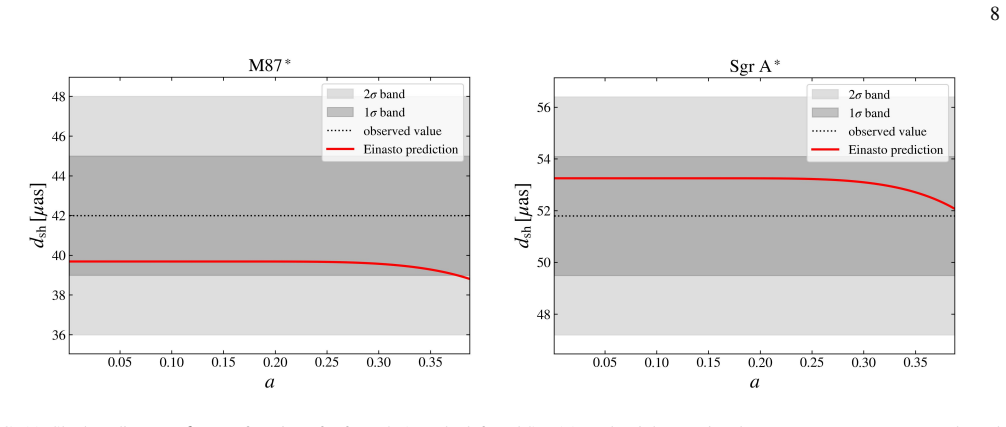
The spacetime exhibits a hierarchy of strong-field sensitivity. Timelike observables remain largely degenerate with the Schwarzschild limit along most of the black hole branch, while the photon sphere scale, shadow diameter, and residual optical structures provide the most sensitive response to the Einasto halo near the critical black hole regime. A comparison with the EHT shadow-scale measurements shows that the full branch is consistent with Sgr A* at the 1 sigma level, whereas M87* mildly disfavors values very close to criticality.
What carries the argument
The single dimensionless halo parameter a that controls the entire geometry of the regular black hole supported by the exponential Einasto dark matter distribution on the branch 0 < a <= a_crit approx 0.388.
If this is right
- Timelike quantities such as ISCO radius, orbital periods, and periapsis advance show only small deviations from Schwarzschild values except very near criticality.
- Photon-sphere radius and shadow diameter vary most strongly as the halo parameter a approaches its upper limit.
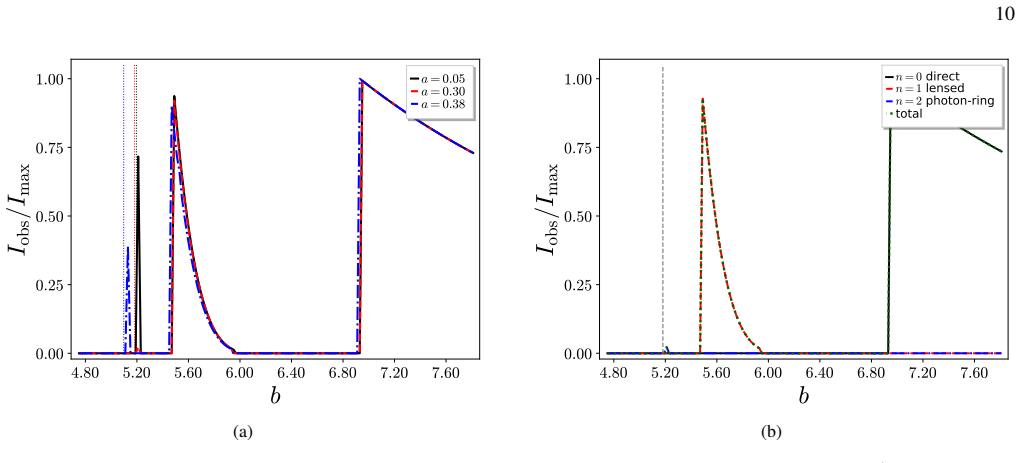
- Intensity profiles and face-on thin-disk images develop additional optical features only in the near-critical regime.
- The entire family of solutions remains compatible with current Sgr A* shadow data at the 1-sigma level.
- M87* shadow data impose a mild upper bound that excludes the immediate vicinity of criticality.
Where Pith is reading between the lines
- High-resolution future shadow imaging could place tighter limits on the allowed strength of Einasto-type halos around supermassive black holes.
- The timelike degeneracy suggests that ordinary stellar orbits or accretion-disk dynamics would need complementary weak-field or galactic-scale probes to detect the halo.
- Similar hierarchies may appear in other regular black-hole constructions that incorporate dark-matter profiles, offering a general diagnostic for halo effects.
Load-bearing premise
The spacetime is static and spherically symmetric with its geometry fixed by a single dimensionless halo parameter a on the black hole branch.
What would settle it
A future measurement of the shadow diameter for M87* that lies outside the 1-sigma interval spanned by the model across the full allowed range of a would falsify the reported consistency statement.
Figures




read the original abstract
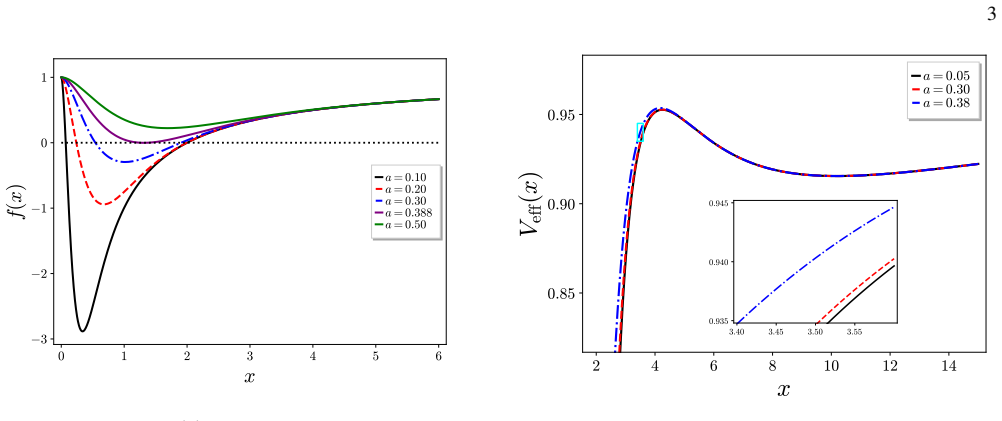
We investigate the strong-field phenomenology of a static and spherically symmetric regular black hole supported by an Einasto dark matter (DM) distribution. For the exponential Einasto profile, the geometry is controlled by a single dimensionless halo parameter $a$, and we restrict the analysis to the black hole branch $0<a\leq a_{\rm crit}\simeq0.388$. We study both timelike and null geodesics, including the effective potential, circular orbits, ISCO radius, orbital period, periapsis advance, photon sphere, shadow radius, effective photon force, and representative photon trajectories. We also construct image-plane intensity profiles and face-on thin-disk images in a static-emitter approximation. The analysis reveals a hierarchy of strong-field sensitivity. Timelike observables remain largely degenerate with the Schwarzschild limit along most of the black hole branch, while the photon sphere scale, shadow diameter, and residual optical structures provide the most sensitive response to the Einasto halo near the critical black hole regime. A comparison with the EHT shadow-scale measurements shows that the full branch is consistent with Sgr A* at the $1\sigma$ level, whereas M87* mildly disfavors values very close to criticality. These results indicate that the most promising signatures of the Einasto halo are not expected from ordinary timelike orbital quantities, but from near-critical photon propagation and its imprint on the optical appearance.
Editorial analysis
A structured set of objections, weighed in public.
Referee Report
Summary. The manuscript investigates the strong-field phenomenology of a static, spherically symmetric regular black hole supported by an Einasto dark matter halo. The geometry is controlled by a single dimensionless parameter a restricted to the black hole branch 0 < a ≤ a_crit ≈ 0.388. The analysis covers timelike and null geodesics (effective potentials, ISCO, orbital periods, periapsis advance, photon sphere, shadow radius, effective photon force, and trajectories), constructs image-plane intensity profiles and face-on thin-disk images in a static-emitter approximation, identifies a sensitivity hierarchy (timelike observables largely degenerate with Schwarzschild while photon-sphere and shadow quantities respond more strongly near criticality), and compares the computed shadow scale to EHT measurements, finding consistency with Sgr A* at 1σ but mild disfavor for M87* near a_crit.
Significance. If the geodesic calculations and metric construction hold, the work supplies a concrete, one-parameter example of how an Einasto halo modifies strong-field observables around a regular black hole. The reported sensitivity hierarchy (null quantities more responsive than timelike ones) is a clear, observationally useful result, and the direct mapping onto published EHT 1σ intervals for two sources provides immediate empirical context. The reliance on standard geodesic methods in a static spherically symmetric metric is a strength that makes the hierarchy and consistency claims straightforward to reproduce or extend.
minor comments (3)
- [Metric definition / introduction] The value a_crit ≃ 0.388 is stated in the abstract and introduction; the metric section should explicitly derive or numerically locate this critical endpoint (e.g., via the condition for an extremal horizon or vanishing surface gravity) so that readers can verify the branch boundary without ambiguity.
- [Optical appearance / image construction] The static-emitter approximation used for the thin-disk images and intensity profiles is mentioned only briefly; a short paragraph justifying the approximation (or citing its standard use in the literature) would clarify its domain of validity near the critical regime.
- [EHT comparison / results] The EHT comparison fixes the asymptotic mass and maps the computed shadow radius onto published 1σ intervals; the text should state whether the reported consistency accounts for the uncertainty in the mass parameter or treats it as fixed.
Simulated Author's Rebuttal
We thank the referee for the careful reading of our manuscript and for the positive assessment, including the accurate summary of our geodesic analysis, sensitivity hierarchy, and EHT comparisons. We are pleased that the work is recommended for minor revision. No specific major comments were raised in the report.
Circularity Check
No significant circularity; derivation is self-contained geodesic analysis
full rationale
The paper defines a one-parameter static spherically symmetric metric controlled by the dimensionless Einasto halo parameter a (restricted to the black-hole branch 0 < a ≤ a_crit), then applies standard geodesic equations to compute effective potentials, circular orbits, ISCO, photon sphere, shadow radius, and image-plane profiles. All reported observables are obtained by direct numerical evaluation of the metric functions f(r) and the resulting V_eff(r) or critical impact parameter b_c = r_ph / sqrt(f(r_ph)); none are obtained by fitting a to the target data or by renaming fitted quantities as predictions. The EHT consistency check maps the computed shadow diameter onto independently published 1σ intervals for Sgr A* and M87* after fixing the asymptotic mass, without internal re-fitting or self-referential closure. No load-bearing self-citation, ansatz smuggling, or uniqueness theorem imported from the authors' prior work appears in the derivation chain. The hierarchy of sensitivities (timelike degeneracy vs. null sensitivity near criticality) follows directly from the explicit a-dependence in the metric and is therefore independent of the inputs.
Axiom & Free-Parameter Ledger
free parameters (1)
- a
axioms (2)
- domain assumption The spacetime is static and spherically symmetric
- domain assumption Einasto profile supports a regular black hole solution for 0 < a ≤ a_crit
Forward citations
Cited by 2 Pith papers
-
Adaptive ray tracing, image diagnostics, and photon ring signatures of rotating dark-matter-dressed black holes
Rotating black holes dressed with cored-NFW dark matter produce larger image shifts, brightness asymmetries, and ring-scale changes than Kerr or Einasto-dressed cases, with partial degeneracy to spin and inclination.
-
Adaptive ray tracing, image diagnostics, and photon ring signatures of rotating dark-matter-dressed black holes
Ray-tracing simulations indicate that cored-NFW dark matter halos around rotating black holes yield larger apparent images and stronger deviations in higher-order lensed structures than Einasto profiles, which remain ...
Reference graph
Works this paper leans on
-
[1]
Akiyama, A
Event Horizon Telescope Collaboration, K. Akiyama, A. Al- berdi, W. Alef, K. Asada, R. Azulay,et al., The Astrophysical Journal Letters875, L1 (2019)
2019
-
[2]
Akiyama, A
Event Horizon Telescope Collaboration, K. Akiyama, A. Al- berdi, W. Alef, K. Asada, R. Azulay,et al., The Astrophysical Journal Letters875, L6 (2019)
2019
-
[3]
Akiyama, A
Event Horizon Telescope Collaboration, K. Akiyama, A. Al- berdi, W. Alef, R. Anantua, K. Asada,et al., The Astrophysical Journal Letters930, L12 (2022)
2022
-
[4]
Akiyama, A
Event Horizon Telescope Collaboration, K. Akiyama, A. Al- berdi, W. Alef, R. Anantua, K. Asada,et al., The Astrophysical Journal Letters930, L17 (2022)
2022
-
[5]
J. L. Synge, Monthly Notices of the Royal Astronomical Society 131, 463 (1966)
1966
-
[6]
J. M. Bardeen, inBlack Holes: Les Astres Occlus, edited by C. DeWitt and B. S. DeWitt (Gordon and Breach, New York,
-
[7]
Chandrasekhar,The Mathematical Theory of Black Holes (Oxford University Press, Oxford, 1983)
S. Chandrasekhar,The Mathematical Theory of Black Holes (Oxford University Press, Oxford, 1983)
1983
-
[8]
Viewing the Shadow of the Black Hole at the Galactic Center
H. Falcke, F. Melia, and E. Agol, The Astrophysical Journal Letters528, L13 (2000), arXiv:astro-ph/9912263
work page Pith review arXiv 2000
- [9]
-
[10]
V . Perlick and O. Y . Tsupko, Physics Reports947, 1 (2022), arXiv:2105.07101 [gr-qc]
-
[11]
S. E. Gralla, D. E. Holz, and R. M. Wald, Physical Review D 100, 024018 (2019), arXiv:1906.00873 [astro-ph.HE]
work page Pith review arXiv 2019
- [12]
-
[13]
Wielgus, Physical Review D104, 124058 (2021), arXiv:2109.10840 [gr-qc]
M. Wielgus, Physical Review D104, 124058 (2021), arXiv:2109.10840 [gr-qc]
- [14]
-
[15]
Burkert, The Astrophysical Journal Letters447, L25 (1995), arXiv:astro-ph/9504041
A. Burkert, The Astrophysical Journal Letters447, L25 (1995), arXiv:astro-ph/9504041
-
[16]
Hernquist, The Astrophysical Journal356, 359 (1990)
L. Hernquist, The Astrophysical Journal356, 359 (1990)
1990
-
[17]
Einasto, Trudy Astrofizicheskogo Instituta Alma-Ata5, 87 (1965)
J. Einasto, Trudy Astrofizicheskogo Instituta Alma-Ata5, 87 (1965)
1965
-
[18]
V . Springel, J. Wang, M. V ogelsberger, A. Ludlow, A. Jenk- ins, A. Helmi, J. F. Navarro, C. S. Frenk, and S. D. M. White, Monthly Notices of the Royal Astronomical Society391, 1685 (2008), arXiv:0809.0898 [astro-ph]
- [19]
-
[20]
E. Retana-Montenegro, E. Van Hese, G. Gentile, M. Baes, and F. Frutos-Alfaro, Astronomy & Astrophysics540, A70 (2012), arXiv:1202.5242
-
[21]
P. Gondolo and J. Silk, Physical Review Letters83, 1719 (1999), arXiv:astro-ph/9906391
- [22]
- [23]
- [24]
-
[25]
V . Cardoso, K. Destounis, F. Duque, R. P. Macedo, and A. Maselli, Physical Review D105, L061501 (2022), arXiv:2109.00005 [gr-qc]
-
[26]
E. Figueiredo, A. Maselli, and V . Cardoso, Physical Review D 107, 104033 (2023), arXiv:2303.08183 [gr-qc]
- [27]
- [28]
-
[29]
L. Pezzella, K. Destounis, A. Maselli, and V . Cardoso, Physical Review D111, 064026 (2025), arXiv:2412.18651 [gr-qc]
-
[30]
Al-Badawi, S
A. Al-Badawi, S. Shaymatov, and Y . Sekhmani, Journal of Cos- mology and Astroparticle Physics2025(02), 014
-
[31]
Al-Badawi and S
A. Al-Badawi and S. Shaymatov, Communications in Theoreti- cal Physics77, 035402 (2025)
2025
-
[32]
Al-Badawi and S
A. Al-Badawi and S. Shaymatov, Chinese Physics C49, 055101 (2025)
2025
-
[33]
Ahmed, A
F. Ahmed, A. Al-Badawi, and I. Sakalli, European Physical Journal C85, 984 (2025)
2025
-
[34]
Al-Badawi and F
A. Al-Badawi and F. Ahmed, European Physical Journal C86, 139 (2026)
2026
-
[35]
Hamil, A
B. Hamil, A. Al-Badawi, and B. C. Lutfuoglu, Physica Scripta 100, 105008 (2025)
2025
- [36]
- [37]
-
[38]
Skvortsova, (2026), arXiv:2603.28415 [gr-qc]
M. Skvortsova, arXiv e-prints , arXiv:2603.28415 (2026), arXiv:2603.28415 [gr-qc]
- [39]
-
[40]
Chandrasekhar,The Mathematical Theory of Black Holes (Oxford University Press, Oxford, 1984)
S. Chandrasekhar,The Mathematical Theory of Black Holes (Oxford University Press, Oxford, 1984)
1984
-
[41]
R. M. Wald,General Relativity(University of Chicago Press, Chicago, 1984)
1984
-
[42]
Luminet, Astronomy and Astrophysics75, 228 (1979)
J.-P. Luminet, Astronomy and Astrophysics75, 228 (1979)
1979
-
[43]
C. T. Cunningham, The Astrophysical Journal183, 237 (1973)
1973
-
[44]
C. T. Cunningham, Astrophysical Journal202, 788 (1975)
1975
- [45]
-
[46]
X.-X. Zeng, H.-Q. Zhang, and H. Zhang, The European Physical Journal C80, 872 (2020), arXiv:2004.12074 [gr-qc]
-
[47]
Y . Meng, X.-M. Kuang, X.-J. Wang, B. Wang, and J.-P. Wu, Physical Review D108, 064013 (2023), arXiv:2306.10459 [gr- qc]
- [48]
-
[49]
R. W. Lindquist, Annals of Physics37, 487 (1966)
1966
discussion (0)
Sign in with ORCID, Apple, or X to comment. Anyone can read and Pith papers without signing in.