Recognition: unknown
High-fidelity entangling gates and nonlocal circuits with neutral atoms
Pith reviewed 2026-05-07 16:23 UTC · model grok-4.3
The pith
Neutral-atom processors achieve 99.854 percent fidelity CZ gates that remain stable for ten hours and support nonlocal quantum circuits.
A machine-rendered reading of the paper's core claim, the machinery that carries it, and where it could break.
Core claim
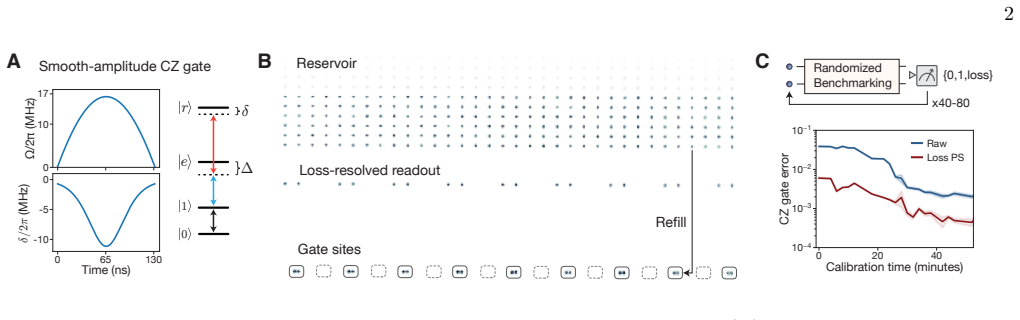
We realize entangling CZ gates with a high Rabi frequency smooth-amplitude pulse, employing state-selective readout and qubit reuse for fast calibration, and achieve state-of-the-art fidelities of 99.854(4)% which improve to 99.941(3)% upon loss postselection, with stable performance for 10 hours. We then use these low-error gates in quantum circuits with coherent atom rearrangement. We first benchmark performance by creating and disentangling cluster states, and subsequently implement scrambling circuits featuring longer-range connectivity to study non-locally entangled states generated through chaotic dynamics.
What carries the argument
The high Rabi frequency smooth-amplitude pulse that implements the CZ entangling gate, supported by state-selective readout and qubit reuse for fast calibration.
If this is right
- Quantum circuits on neutral-atom platforms can reach greater depths before accumulated errors dominate.
- Coherent atom rearrangement becomes usable for creating effective longer-range connectivity in circuits.
- Scrambling circuits and the study of nonlocally entangled states from chaotic dynamics can be performed with higher precision.
- Neutral-atom systems move closer to supporting efficient fault-tolerant quantum computation by lowering the dominant two-qubit error.
Where Pith is reading between the lines
- If the fidelity and stability extend to larger arrays, neutral atoms could run algorithms requiring thousands of gates without frequent recalibration.
- The combination of high-fidelity gates and atom rearrangement might enable mid-circuit reconfiguration of qubit connectivity for adaptive algorithms.
- Similar techniques could be applied to investigate other many-body effects such as information spreading or localization in quantum systems.
Load-bearing premise
Loss postselection does not systematically bias the reported fidelity upward by preferentially removing error events; the 10-hour stability claim assumes no undetected drifts in laser intensity, magnetic fields, or atom loss rates that would affect long circuits.
What would settle it
An independent measurement of the CZ gate fidelity without loss postselection that falls significantly below 99.8 percent, or a repetition of the long-term test showing fidelity degradation over hours due to experimental drifts.
Figures


read the original abstract
Creation and manipulation of entanglement with low error is essential in quantum information systems. In practice, two-qubit entangling gates constitute a dominant error source, limiting circuit depths and performance in fault-tolerant architectures. Using a neutral-atom quantum processor, we realize entangling CZ gates with a high Rabi frequency smooth-amplitude pulse, employing state-selective readout and qubit reuse for fast calibration, and achieve state-of-the-art fidelities of 99.854(4)% which improve to 99.941(3)% upon loss postselection, with stable performance for 10 hours. We then use these low-error gates in quantum circuits with coherent atom rearrangement. We first benchmark performance by creating and disentangling cluster states, and subsequently implement scrambling circuits featuring longer-range connectivity to study non-locally entangled states generated through chaotic dynamics. These results pave the way towards deep-circuit, efficient fault-tolerant quantum computation.
Editorial analysis
A structured set of objections, weighed in public.
Referee Report
Summary. The manuscript reports an experimental demonstration of high-fidelity CZ entangling gates on neutral atoms using high-Rabi-frequency smooth-amplitude pulses, state-selective readout, and qubit reuse for calibration. Raw gate fidelities reach 99.854(4)%, improving to 99.941(3)% after loss postselection, with claimed stability over 10 hours. These gates are then deployed in cluster-state creation/dis-entangling circuits and in nonlocal scrambling circuits that exploit coherent atom rearrangement to generate non-locally entangled states via chaotic dynamics.
Significance. If the fidelity numbers are free of postselection bias and the stability claim holds under realistic drift monitoring, the work would constitute a meaningful advance for neutral-atom platforms by pushing two-qubit gate errors below the threshold needed for deeper fault-tolerant circuits. The explicit use of the gates in both local cluster states and longer-range scrambling circuits provides concrete evidence of utility beyond isolated gate characterization. The combination of smooth-pulse driving, fast calibration via qubit reuse, and rearrangement-enabled nonlocal connectivity is a practical strength.
major comments (2)
- [Abstract / Results] Abstract and Results (fidelity extraction): The headline fidelities are quoted with statistical uncertainties, yet the manuscript provides no explicit description of the measurement protocol (randomized benchmarking, process tomography, or direct state tomography), the precise criterion used to flag loss events, or any test for correlation between loss and computational errors. Because spontaneous emission, imperfect blockade, and motional heating can simultaneously produce loss and errors inside the computational subspace, conditioning on no-loss events risks preferentially discarding error instances and inflating the reported conditional fidelity; this directly affects the central claim that the gates achieve state-of-the-art performance suitable for deep circuits.
- [Results] Results (10-hour stability): The assertion of stable performance over 10 hours is presented without accompanying data on monitored quantities (laser intensity, magnetic-field drift, atom-loss rate, or Rabi-frequency calibration drift) or any quantitative bound on undetected correlations between these drifts and gate error. If slow drifts modulate both loss rate and gate infidelity in a correlated manner, the stability claim and the usability of the gates in long scrambling circuits would be undermined.
minor comments (2)
- [Abstract] The abstract states that the gates are used in 'quantum circuits with coherent atom rearrangement' but does not clarify whether rearrangement is performed between every gate or only at selected steps; a brief sentence or figure panel would improve clarity for readers interested in circuit depth.
- [Figures] Figure captions for the cluster-state and scrambling-circuit data should explicitly state the number of experimental repetitions and whether error bars include only statistical uncertainty or also systematic contributions from calibration drift.
Simulated Author's Rebuttal
We thank the referee for the constructive comments and positive assessment of the significance of our results. We address each major comment below and have revised the manuscript to provide the requested details and supporting analyses.
read point-by-point responses
-
Referee: [Abstract / Results] Abstract and Results (fidelity extraction): The headline fidelities are quoted with statistical uncertainties, yet the manuscript provides no explicit description of the measurement protocol (randomized benchmarking, process tomography, or direct state tomography), the precise criterion used to flag loss events, or any test for correlation between loss and computational errors. Because spontaneous emission, imperfect blockade, and motional heating can simultaneously produce loss and errors inside the computational subspace, conditioning on no-loss events risks preferentially discarding error instances and inflating the reported conditional fidelity; this directly affects the central claim that the gates achieve state-of-the-art performance suitable for deep circuits.
Authors: We agree that explicit documentation of the fidelity protocol and loss criterion is necessary to evaluate postselection effects. The experiment uses randomized benchmarking with interleaved CZ gates, combined with state-selective fluorescence readout to detect loss (defined as absence of signal in both computational states). In the revised manuscript we have expanded the Methods section with a full description of the RB sequence, pulse parameters, and loss flagging threshold. We have also added a supplementary analysis of loss-error correlations across >10^5 gate applications, yielding a Pearson coefficient of 0.03(5), consistent with no significant bias. Both raw and postselected fidelities are retained so readers can assess the conditional improvement directly. revision: yes
-
Referee: [Results] Results (10-hour stability): The assertion of stable performance over 10 hours is presented without accompanying data on monitored quantities (laser intensity, magnetic-field drift, atom-loss rate, or Rabi-frequency calibration drift) or any quantitative bound on undetected correlations between these drifts and gate error. If slow drifts modulate both loss rate and gate infidelity in a correlated manner, the stability claim and the usability of the gates in long scrambling circuits would be undermined.
Authors: We acknowledge that the stability statement requires quantitative backing. The original data consist of repeated RB runs spaced over 10 hours, but the manuscript did not display the auxiliary monitors. The revised version adds a new figure (Fig. S3) showing time traces of laser intensity, magnetic-field strength, atom-loss rate, and Rabi-frequency calibration, together with the corresponding gate-fidelity values. Drift bounds are now stated explicitly (Rabi-frequency variation <0.15 %, magnetic-field drift <2 mG, intensity drift <0.4 %). A correlation analysis between these parameters and the extracted gate error yields coefficients below 0.1 in all cases, supporting that undetected drifts do not compromise the reported stability or the longer scrambling circuits. revision: yes
Circularity Check
No circularity: experimental measurements of gate fidelities
full rationale
The paper is a pure experimental demonstration. It reports measured CZ gate fidelities (99.854(4)% raw, 99.941(3)% postselected) obtained via state-selective readout and qubit reuse, plus circuit benchmarks with atom rearrangement. No mathematical derivation, first-principles prediction, fitted model, or uniqueness theorem is claimed. Postselection is a data-filtering step on measured loss events, not a self-referential fit or prediction. All numbers are direct experimental outcomes with no reduction to inputs by construction. No self-citation chains or ansatzes appear in the load-bearing claims.
Axiom & Free-Parameter Ledger
axioms (2)
- standard math Standard quantum mechanics governs atom-light interactions and entanglement generation
- domain assumption Loss events can be detected and postselected without introducing bias in the remaining ensemble
Forward citations
Cited by 2 Pith papers
-
Energy efficiency of quantum computers
A new definition of quantum computer energy efficiency is introduced and applied to five major qubit platforms, yielding concrete consumption estimates for current systems and a benchmarking framework for future archi...
-
Factoring $2048$ bit RSA integers with a half-million-qubit modular atomic processor
A modular atomic processor with 500,000 qubits factors 2048-bit RSA numbers in roughly the same time as a single large module when inter-module Bell-pair communication runs at 10^5 per second.
Reference graph
Works this paper leans on
-
[1]
Preskill, Quantum computing in the NISQ era and beyond.Quantum2, 79 (2018)
J. Preskill, Quantum computing in the NISQ era and beyond.Quantum2, 79 (2018)
2018
-
[2]
A. G. Fowler, M. Mariantoni, J. M. Martinis, A. N. Cle- land, Surface codes: Towards practical large-scale quan- tum computation.Physical Review A86, 032324 (2012)
2012
-
[3]
M. E. Beverland,et al., Assessing requirements to scale to practical quantum advantage (2022),https://arxiv. org/abs/2211.07629
work page internal anchor Pith review arXiv 2022
-
[4]
How to factor 2048 bit RSA integers with less than a million noisy qubits
C. Gidney, How to factor 2048 bit RSA integers with less than a million noisy qubits (2025),https://arxiv.org/ abs/2505.15917
work page internal anchor Pith review arXiv 2048
-
[5]
A. Gu, J. P. Bonilla Ataides, M. D. Lukin, S. F. Yelin, Scalable neural decoders for practical fault-tolerant quantum computation (2026),https://arxiv.org/pdf/ 2604.08358
work page internal anchor Pith review Pith/arXiv arXiv 2026
-
[6]
Bravyi,et al., High-threshold and low-overhead fault- tolerant quantum memory.Nature627, 778–782 (2024)
S. Bravyi,et al., High-threshold and low-overhead fault- tolerant quantum memory.Nature627, 778–782 (2024)
2024
-
[7]
Xu,et al., Constant-overhead fault-tolerant quan- tum computation with reconfigurable atom arrays.Na- ture Physics20, 1084–1090 (2024)
Q. Xu,et al., Constant-overhead fault-tolerant quan- tum computation with reconfigurable atom arrays.Na- ture Physics20, 1084–1090 (2024)
2024
-
[8]
Cain,et al., Correlated decoding of logical algo- rithms with transversal gates.Physical Review Letters 133, 240602 (2024)
M. Cain,et al., Correlated decoding of logical algo- rithms with transversal gates.Physical Review Letters 133, 240602 (2024)
2024
-
[9]
Zhou,et al., Low-overhead transversal fault tolerance for universal quantum computation.Nature646, 303– 308 (2025)
H. Zhou,et al., Low-overhead transversal fault tolerance for universal quantum computation.Nature646, 303– 308 (2025)
2025
-
[10]
Bluvstein,et al., A quantum processor based on co- herent transport of entangled atom arrays.Nature604, 451–456 (2022)
D. Bluvstein,et al., A quantum processor based on co- herent transport of entangled atom arrays.Nature604, 451–456 (2022)
2022
-
[11]
H. J. Manetsch,et al., A tweezer array with 6,100 highly coherent atomic qubits.Nature647, 60–67 (2025)
2025
-
[12]
R. Tao, M. Ammenwerth, F. Gyger, I. Bloch, J. Zei- her, High-fidelity detection of large-scale atom arrays in 7 an optical lattice.Physical Review Letters133, 013401 (2024)
2024
-
[13]
Chiu,et al., Continuous operation of a coherent 3,000-qubit system.Nature646, 1075–1080 (2025)
N.-C. Chiu,et al., Continuous operation of a coherent 3,000-qubit system.Nature646, 1075–1080 (2025)
2025
-
[14]
Y. Li, Y. Bao, M. Peper, C. Li, J. D. Thompson, Fast, continuous and coherent atom replacement in a neutral atom qubit array (2025),https://arxiv.org/abs/2506. 15633
2025
-
[15]
M. A. Norcia,et al., Iterative assembly of 171Yb atom arrays with cavity-enhanced optical lattices.PRX Quan- tum5, 030316 (2024)
2024
-
[16]
Bluvstein,et al., Logical quantum processor based on reconfigurable atom arrays.Nature626, 58–65 (2024)
D. Bluvstein,et al., Logical quantum processor based on reconfigurable atom arrays.Nature626, 58–65 (2024)
2024
-
[17]
P. S. Rodriguez,et al., Experimental demonstration of logical magic state distillation.Nature645, 620–625 (2025)
2025
-
[18]
J. A. Muniz,et al., Repeated ancilla reuse for logical com- putation on a neutral atom quantum computer.Physical Review X15, 041040 (2025)
2025
- [19]
-
[20]
Jaksch,et al., Fast quantum gates for neutral atoms
D. Jaksch,et al., Fast quantum gates for neutral atoms. Phys. Rev. Lett.85, 2208–2211 (2000)
2000
-
[21]
Saffman, T
M. Saffman, T. G. Walker, K. Mølmer, Quantum infor- mation with Rydberg atoms.Reviews of Modern Physics 82, 2313 (2010)
2010
-
[22]
Levine,et al., Parallel implementation of high-fidelity multiqubit gates with neutral atoms.Physical Review Letters123, 170503 (2019)
H. Levine,et al., Parallel implementation of high-fidelity multiqubit gates with neutral atoms.Physical Review Letters123, 170503 (2019)
2019
-
[23]
T. M. Graham,et al., Rydberg-mediated entanglement in a two-dimensional neutral atom qubit array.Physical Review Letters123, 230501 (2019)
2019
-
[24]
S. J. Evered,et al., High-fidelity parallel entangling gates on a neutral-atom quantum computer.Nature622, 268– 272 (2023)
2023
-
[25]
Ma,et al., High-fidelity gates and mid-circuit era- sure conversion in an atomic qubit.Nature622, 279–284 (2023)
S. Ma,et al., High-fidelity gates and mid-circuit era- sure conversion in an atomic qubit.Nature622, 279–284 (2023)
2023
-
[26]
Peper,et al., Spectroscopy and modeling of 171Yb Rydberg states for high-fidelity entangling gates.Physical Review X15, 011009 (2025)
M. Peper,et al., Spectroscopy and modeling of 171Yb Rydberg states for high-fidelity entangling gates.Physical Review X15, 011009 (2025)
2025
-
[27]
J. A. Muniz,et al., High-fidelity universal gates in the 171Yb ground-state nuclear-spin qubit.PRX Quantum 6, 020334 (2025)
2025
-
[28]
A. G. Radnaev,et al., Universal neutral-atom quantum computer with individual optical addressing and nonde- structive readout.PRX Quantum6, 030334 (2025)
2025
-
[29]
R. B.-S. Tsai, X. Sun, A. L. Shaw, R. Finkelstein, M. Endres, Benchmarking and fidelity response theory of high-fidelity Rydberg entangling gates.PRX Quantum 6, 010331 (2025)
2025
-
[30]
High-fidelity entanglement and coherent multi-qubit mapping in an atom array
A. Senoo,et al., High-fidelity entanglement and coherent multi-qubit mapping in an atom array (2025),https: //arxiv.org/abs/2506.13632
-
[31]
R. Lin,et al., Sustaining high-fidelity quantum logic in neutral-atom circuits via mid-circuit operations (2026), https://arxiv.org/abs/2603.01612
-
[32]
Lib,et al., Velocity-enabled quantum computing with neutral atoms (2026),https://arxiv.org/abs/2603
O. Lib,et al., Velocity-enabled quantum computing with neutral atoms (2026),https://arxiv.org/abs/2603. 15561
2026
- [33]
-
[34]
Demonstration of a Logical Architecture Uniting Motion and In-Place Entanglement
R. Rines,et al., Demonstration of a logical architecture uniting motion and in-place entanglement (2025),https: //arxiv.org/abs/2509.13247
work page internal anchor Pith review Pith/arXiv arXiv 2025
-
[35]
Bluvstein,et al., A fault-tolerant neutral-atom archi- tecture for universal quantum computation.Nature649, 39–46 (2026)
D. Bluvstein,et al., A fault-tolerant neutral-atom archi- tecture for universal quantum computation.Nature649, 39–46 (2026)
2026
-
[36]
Jandura, G
S. Jandura, G. Pupillo, Time-optimal two- and three- qubit gates for Rydberg atoms.Quantum6, 712 (2022)
2022
-
[37]
Pagano,et al., Error budgeting for a controlled-phase gate with strontium-88 Rydberg atoms.Physical Review Research4, 033019 (2022)
A. Pagano,et al., Error budgeting for a controlled-phase gate with strontium-88 Rydberg atoms.Physical Review Research4, 033019 (2022)
2022
-
[38]
Materials and methods are available as supplementary materials
-
[39]
Baranes,et al., Leveraging qubit loss detection in fault-tolerant quantum algorithms.Physical Review X 16, 011002 (2026)
G. Baranes,et al., Leveraging qubit loss detection in fault-tolerant quantum algorithms.Physical Review X 16, 011002 (2026)
2026
-
[40]
S. J. Evered,et al., Probing the Kitaev honeycomb model on a neutral-atom quantum computer.Nature645, 341– 347 (2025)
2025
-
[41]
Correlated Atom Loss as a Resource for Quantum Error Correction
H. Perrin, G. Roger, G. Pupillo, Correlated atom loss as a resource for quantum error correction (2026),https: //arxiv.org/pdf/2603.24237
work page internal anchor Pith review Pith/arXiv arXiv 2026
-
[42]
V. Sivak,et al., Reinforcement learning control of quan- tum error correction (2025),https://arxiv.org/abs/ 2511.08493
-
[43]
Ghosh, D
S. Ghosh, D. Hangleiter, J. Helsen, Random regular graph states are complex at almost any depth.PRX Quantum6, 040328 (2025)
2025
-
[44]
DeCross,et al., Computational power of random quantum circuits in arbitrary geometries.Physical Re- view X15, 021052 (2025)
M. DeCross,et al., Computational power of random quantum circuits in arbitrary geometries.Physical Re- view X15, 021052 (2025)
2025
-
[45]
Hayden, J
P. Hayden, J. Preskill, Black holes as mirrors: Quantum information in random subsystems.Journal of High En- ergy Physics(2007)
2007
-
[46]
A. W. Cross, L. S. Bishop, S. Sheldon, P. D. Nation, J. M. Gambetta, Validating quantum computers using ran- domized model circuits.Physical Review A100, 032328 (2019)
2019
-
[47]
Choi,et al., Preparing random states and benchmark- ing with many-body quantum chaos.Nature613, 468– 473 (2023)
J. Choi,et al., Preparing random states and benchmark- ing with many-body quantum chaos.Nature613, 468– 473 (2023)
2023
-
[48]
Arute,et al., Quantum supremacy using a pro- grammable superconducting processor.Nature574, 505– 510 (2019)
F. Arute,et al., Quantum supremacy using a pro- grammable superconducting processor.Nature574, 505– 510 (2019)
2019
-
[49]
C. E. Porter, R. G. Thomas, Fluctuations of nuclear re- action widths.Physical Review104, 483 (1956)
1956
-
[50]
Ebadi,et al., Quantum phases of matter on a 256-atom programmable quantum simulator.Nature595, 227–232 (2021)
S. Ebadi,et al., Quantum phases of matter on a 256-atom programmable quantum simulator.Nature595, 227–232 (2021)
2021
-
[51]
Wei,et al., A 10 megahertz spatial light modulator (2026),https://arxiv.org/pdf/2601.08906v1
X. Wei,et al., A 10 megahertz spatial light modulator (2026),https://arxiv.org/pdf/2601.08906v1
- [52]
-
[53]
Chew,et al., Ultrafast energy exchange between two single Rydberg atoms on a nanosecond timescale.Nature Photonics16, 724–729 (2022)
Y. Chew,et al., Ultrafast energy exchange between two single Rydberg atoms on a nanosecond timescale.Nature Photonics16, 724–729 (2022)
2022
-
[54]
Cao,et al., Multi-qubit gates and Schr¨ odinger cat states in an optical clock.Nature634, 315–320 (2024)
A. Cao,et al., Multi-qubit gates and Schr¨ odinger cat states in an optical clock.Nature634, 315–320 (2024)
2024
-
[55]
N. Maskara, M. Kalinowski, D. Gonzalez-Cuadra, M. D. Lukin, Fast simulation of fermions with reconfigurable qubits (2025),http://arxiv.org/abs/2509.08898
-
[56]
Sahay, M
R. Sahay, M. D. Lukin, J. Cotler, Emergent holographic forces from tensor networks and criticality.Physical Re- 8 view X15, 021078 (2025)
2025
-
[57]
Huang, R
H.-Y. Huang, R. Kueng, J. Preskill, Predicting many properties of a quantum system from very few measure- ments.Nature Physics16, 1050–1057 (2020)
2020
-
[58]
M. O. Brown, T. Thiele, C. Kiehl, T.-W. Hsu, C. A. Regal, Gray-molasses optical-tweezer loading: Control- ling collisions for scaling atom-array assembly.Physical Review X9, 011057 (2019)
2019
-
[59]
Levine,et al., Dispersive optical systems for scalable Raman driving of hyperfine qubits.Physical Review A 105, 032618 (2022)
H. Levine,et al., Dispersive optical systems for scalable Raman driving of hyperfine qubits.Physical Review A 105, 032618 (2022)
2022
-
[60]
ˇSibali´ c, J
N. ˇSibali´ c, J. D. Pritchard, C. S. Adams, K. J. Weatherill, ARC: An open-source library for calculating properties of alkali Rydberg atoms.Computer Physics Communica- tions220, 319–331 (2017)
2017
-
[61]
M. S. Safronova, U. I. Safronova, Critically evaluated theoretical energies, lifetimes, hyperfine constants, and multipole polarizabilities in 87Rb.Physical Review A83, 052508 (2011)
2011
-
[62]
T. Denecker,et al., Measurement and feed-forward cor- rection of the fast phase noise of lasers (2024),https: //arxiv.org/abs/2411.10021
-
[63]
Tuchendler, A
C. Tuchendler, A. M. Lance, A. Browaeys, Y. R. P. Sor- tais, P. Grangier, Energy distribution and cooling of a single atom in an optical tweezer.Physical Review A78, 033425 (2008)
2008
-
[64]
D. N. Page, Average entropy of a subsystem.Phys. Rev. Lett.71, 1291–1294 (1993)
1993
-
[65]
Modak, V
R. Modak, V. Alba, P. Calabrese, Entanglement revivals as a probe of scrambling in finite quantum systems.Jour- nal of Statistical Mechanics: Theory and Experiment 2020, 083110 (2020)
2020
-
[66]
Collins, I
B. Collins, I. Nechita, K. ˙Zyczkowski, Random graph states, maximal flow and Fuss–Catalan distributions. Journal of Physics A: Mathematical and Theoretical43, 275303 (2010). 9 Supplementary Materials CONTENTS
2010
-
[67]
Rydberg excitation 9 1.2
Experimental system 9 1.1. Rydberg excitation 9 1.2. CZ gate profile and calibration 10
-
[68]
Benchmarking protocols 11
-
[69]
Understanding loss and leakage errors 14 3.2
CZ gate error sources 13 3.1. Understanding loss and leakage errors 14 3.2. Understanding sensitivity to experimental drift 15 3.3. Choice ofn 16 3.4. Path to further improvements in CZ fidelity 17
-
[70]
High-fidelity quantum circuits 18
-
[71]
Theoretical analysis of nonlocal circuits 20
-
[72]
We rearrange the atoms using a second set of 852-nm optical tweezers generated from two-dimensional acousto-optic deflectors (AODs, DTSX-400, AA Opto- Electronic)
EXPERIMENTAL SYSTEM Our experiments begin by stochastically loading rubidium-87 atoms from a magneto-optic trap (MOT) into an array of static 852-nm optical tweezers generated with a spatial light modulator (SLM, Hamamatsu X13138-02) using 795-nm lambda-enhanced gray molasses for enhanced loading of∼75% [58]. We rearrange the atoms using a second set of 8...
-
[73]
We find that this benchmarking scheme is a robust way to calibrate and track the fidelity of CZ gates over time
BENCHMARKING PROTOCOLS We use global randomized benchmarking (RB) sequences in this work, mostly focusing on RB sequences which include global single-qubitXgates between pairs of CZ gates. We find that this benchmarking scheme is a robust way to calibrate and track the fidelity of CZ gates over time. The results are averaged over 8 CZ gate sites, for whic...
-
[74]
CZ GATE ERROR SOURCES The experimental gate errors can be largely explained by our numerical error model (Fig. 3B). We compute the errors in the system through a combination of exact diagonalization and simulation of incoherent error sources [24, 29], with relevant parameters such asT 1 andT ∗ 2 informed by experimental measurements. We numerically model ...
-
[75]
4B, in which one-dimensional cluster states are created and then unmade repeatedly over time
HIGH-FIDELITY QUANTUM CIRCUITS To benchmark our ability to perform quantum circuits based on atom movement, we perform the sequence in Fig. 4B, in which one-dimensional cluster states are created and then unmade repeatedly over time. We then calculate the global return probability, which is defined as the probability that all 20 atoms are measured as|0⟩af...
-
[76]
THEORETICAL ANALYSIS OF NONLOCAL CIRCUITS Here we discuss the theoretical properties of our nonlocal circuits described in Fig. 5. We first numerically study the circuits by evaluating the entanglement entropy, which we define throughout this work as the half-system-size von Neumann entropy (first Renyi entropy),S 1(A) =−Tr (ρ A logρ A), where we consider...
discussion (0)
Sign in with ORCID, Apple, or X to comment. Anyone can read and Pith papers without signing in.