Topological transitions in spin-ice induced by geometrical constraints
Pith reviewed 2026-05-07 14:13 UTC · model grok-4.3
The pith
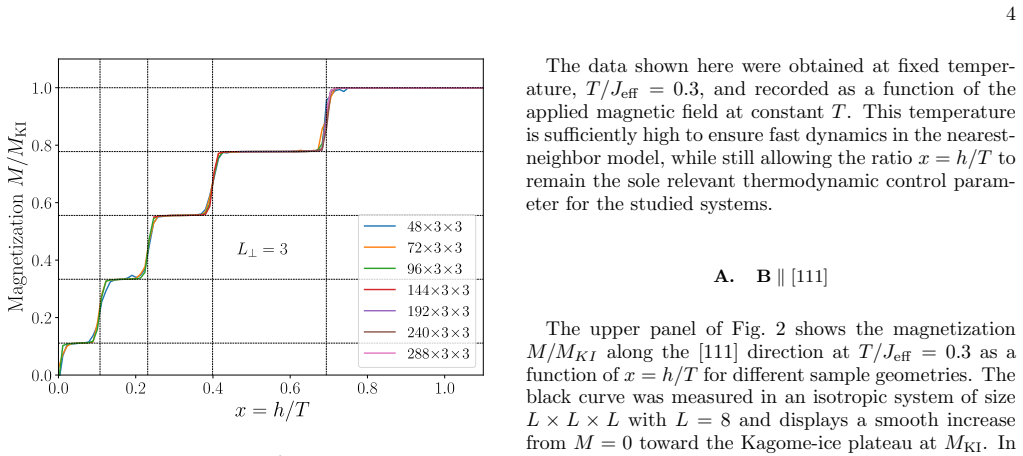
Finite transverse dimensions in spin ice quantize string excitations, causing magnetization to change in discrete steps under applied fields.
A machine-rendered reading of the paper's core claim, the machinery that carries it, and where it could break.
Core claim
In spin-ice samples elongated along the [111] or [110] field direction but with finite transverse dimensions, the ice-rule constraint forces the number of spanning string excitations to be quantized. Consequently the magnetization evolves through a series of discrete transitions as individual strings enter the system one after another. Monte Carlo simulations reveal sharp magnetization steps accompanied by peaks in the specific heat and susceptibility whose heights grow linearly with the sample length. An analytical treatment using the balance of entropy and energy in this reduced-dimensional setting yields the critical fields separating each topological sector. When the sample becomes isoty
What carries the argument
Quantization of string excitations by the divergence-free constraint in finite transverse area. This mechanism discretizes the allowed topological sectors and produces the cascade of transitions instead of a continuous change.
If this is right
- Magnetization changes occur as a cascade of discrete steps corresponding to successive entry of individual strings.
- Each transition produces sharp peaks in specific heat and magnetic susceptibility whose amplitudes scale linearly with system length.
- Critical fields for each topological sector can be derived analytically from entropy-energy balance in the reduced dimensionality.
- In the limit of isotropic samples the discrete transitions merge into a smooth crossover.
Where Pith is reading between the lines
- Similar geometric quantization of excitations might be observable in artificial spin ice arrays or other lattice models with divergence constraints.
- Varying the transverse dimensions experimentally could allow tuning the spacing between these transitions.
- This suggests that sample shape offers a new control parameter for inducing topological transitions in frustrated systems without changing temperature or field strength.
Load-bearing premise
The nearest-neighbor spin-ice model with only the ice-rule constraint remains valid for finite transverse dimensions without boundary effects or longer-range interactions altering the quantization of strings or the entropy-energy balance.
What would settle it
If experiments or simulations with larger transverse dimensions show the magnetization steps smoothing out into a continuous curve while length is held fixed, that would indicate the transitions are an artifact of the finite cross-section assumption.
Figures




read the original abstract
We study the nearest-neighbor spin-ice model subjected to a magnetic field applied along the global [111] and [110] directions, focusing on the role of sample geometry in stabilizing topological phase transitions. While no Kasteleyn transition is expected for this field orientations in the thermodynamic limit, we show that constraining the transverse dimensions of the system qualitatively changes the behavior. For samples elongated along the field direction with finite transverse area, the divergence-free constraint quantizes the number of string excitations that can span the system. As a result, the magnetization evolves through a cascade of discrete transitions corresponding to the successive entry of individual strings. Using Monte Carlo simulations, we demonstrate that each transition is marked by sharp magnetization steps and peaks in the specific heat and susceptibility, whose amplitudes scale linearly with the system length. We complement the numerical results with an analytical treatment based on the entropy - energy balance on a system with reduced dimensionality, deriving the critical fields associated with each topological sector. In the isotropic limit these transitions merge into a smooth crossover, but for anisotropic samples they remain sharply resolved, illustrating an unconventional mechanism by which finite geometry stabilizes topological phase transitions in frustrated magnets.
Editorial analysis
A structured set of objections, weighed in public.
Referee Report
Summary. The manuscript studies the nearest-neighbor spin-ice model in [111] and [110] magnetic fields. It claims that, unlike the thermodynamic limit where no Kasteleyn transition occurs, finite transverse dimensions in samples elongated along the field direction quantize the number of divergence-free string excitations that can span the system. This quantization produces a cascade of discrete magnetization steps, each corresponding to the entry of an additional string. Monte Carlo simulations are used to demonstrate sharp steps in magnetization together with peaks in specific heat and susceptibility whose amplitudes scale linearly with length; an analytical entropy-energy balance in reduced dimensionality is employed to locate the critical fields separating topological sectors. In the isotropic limit the steps merge into a smooth crossover.
Significance. If the central claim holds, the work identifies a geometry-induced mechanism that stabilizes a sequence of topological transitions in a frustrated magnet where none exist in the bulk. The combination of Monte Carlo evidence for the steps and scaling with an analytical derivation of the critical fields supplies a concrete, falsifiable prediction for how transverse confinement controls string quantization. This could inform experiments on shaped spin-ice samples and more generally illustrate how reduced dimensionality plus local constraints can generate discrete topological sectors.
major comments (2)
- [Monte Carlo Simulations] The manuscript does not specify the precise transverse boundary conditions employed in the Monte Carlo simulations (e.g., open, fixed, or periodic). If open boundaries permit local monopole creation or annihilation at the edges, the strict quantization of spanning strings assumed in both the numerical data and the analytical entropy-energy balance would be violated, undermining the claim that the observed steps arise from intrinsic topological sectors rather than boundary artifacts.
- [Analytical Treatment] In the analytical section deriving the critical fields, the entropy-energy balance is performed for a reduced-dimensional system of non-interacting strings. No explicit demonstration is given that string-string interactions or position-dependent energy shifts induced by the finite transverse area remain negligible across the range of transverse sizes studied; without this, the predicted critical fields may not quantitatively match the Monte Carlo steps for all geometries.
minor comments (2)
- [Figures] Figure captions should explicitly state the transverse dimensions and boundary conditions used for each data set to allow direct comparison with the analytical predictions.
- [Numerical Results] The scaling of peak amplitudes with system length is stated to be linear; a brief derivation or reference to the underlying string entropy would strengthen this claim.
Simulated Author's Rebuttal
We thank the referee for their careful reading of our manuscript and for the constructive comments. We address each major point below and will incorporate clarifications and additions in the revised version to strengthen the presentation.
read point-by-point responses
-
Referee: [Monte Carlo Simulations] The manuscript does not specify the precise transverse boundary conditions employed in the Monte Carlo simulations (e.g., open, fixed, or periodic). If open boundaries permit local monopole creation or annihilation at the edges, the strict quantization of spanning strings assumed in both the numerical data and the analytical entropy-energy balance would be violated, undermining the claim that the observed steps arise from intrinsic topological sectors rather than boundary artifacts.
Authors: We apologize for the omission in the original manuscript. Periodic boundary conditions were used in the transverse directions for all Monte Carlo simulations, with the system elongated along the applied field. This choice strictly enforces the divergence-free ice rules across the entire transverse plane and prevents monopole creation or annihilation at the transverse boundaries, thereby preserving the quantization of spanning strings. Open boundaries are present only along the longitudinal direction. We will add an explicit description of the boundary conditions, together with a short explanation of how the spin-ice constraint is maintained, in the Methods section of the revised manuscript. revision: yes
-
Referee: [Analytical Treatment] In the analytical section deriving the critical fields, the entropy-energy balance is performed for a reduced-dimensional system of non-interacting strings. No explicit demonstration is given that string-string interactions or position-dependent energy shifts induced by the finite transverse area remain negligible across the range of transverse sizes studied; without this, the predicted critical fields may not quantitatively match the Monte Carlo steps for all geometries.
Authors: We agree that an explicit check would improve the analytical section. Within the nearest-neighbor spin-ice model the local ice rules render the strings effectively non-interacting: any attempted crossing or overlap immediately violates the constraint and is forbidden. For the transverse sizes examined, the residual position-dependent energy shifts are small relative to the entropic contribution, as evidenced by the quantitative agreement between the analytically predicted critical fields and the locations of the Monte Carlo magnetization steps. In the revision we will insert a brief paragraph (or short appendix) that compares the total energy of multi-string configurations against the sum of single-string energies to demonstrate that interaction corrections remain negligible over the studied range of transverse areas. revision: yes
Circularity Check
No significant circularity in the derivation chain
full rationale
The paper's analytical derivation of critical fields proceeds from an entropy-energy balance applied to a reduced-dimensionality system whose string sectors are fixed by the divergence-free ice-rule constraint and the finite transverse area. This follows directly from the model's local rules and geometry without tautological reduction to fitted inputs or self-referential definitions. Monte Carlo simulations supply independent numerical evidence of the magnetization steps, specific-heat peaks, and linear scaling with length. No load-bearing self-citations, smuggled ansatzes, or uniqueness theorems imported from prior author work appear in the described chain; the quantization and cascade are consequences of the stated constraints rather than re-labelings of the same quantities. The overall argument is self-contained against external benchmarks.
Axiom & Free-Parameter Ledger
axioms (2)
- domain assumption Nearest-neighbor spin-ice model with ice rules (two-in two-out) remains valid under the applied fields and finite geometry.
- domain assumption String excitations can be treated as non-interacting for the purpose of counting quantized spanning configurations in reduced dimensionality.
Reference graph
Works this paper leans on
-
[1]
Topological transitions in spin-ice induced by geometrical constraints
[10, 19–23]. Here we focus on the nearest-neighbor spin-ice model in the presence of an external magnetic field applied along the global [111] direction. This geometry has been exten- sively studied [10, 11, 24–29], as the interplay between lo- cal ice-rule constraints and the external field produces a variety of ordered and disordered phases. In particul...
work page internal anchor Pith review Pith/arXiv arXiv 2026
-
[2]
direction. In the limitL ∥ → ∞, not only does the magnetization vanish, but the zero field magnetic suscep- tibility also tends to zero. At low fields, the system can- not increase its magnetization continuously. The same 5 topological constraints that suppress fluctuations forbid incremental changes inM: the only available mechanism is the replacement of...
work page 2022
- [3]
-
[4]
V. Zapf, M. Jaime, and C. Batista, Reviews of Modern Physics86, 563 (2014)
work page 2014
-
[5]
Moessner, inSpin Ice(Springer, 2021) pp
R. Moessner, inSpin Ice(Springer, 2021) pp. 37–70
work page 2021
- [6]
-
[7]
J. Knolle and R. Moessner, Annual Review of Condensed Matter Physics10, 451 (2019)
work page 2019
-
[8]
C. Broholm, R. J. Cava, S. Kivelson, D. Nocera, M. Nor- man, and T. Senthil, Science367, eaay0668 (2020)
work page 2020
-
[9]
C. Castelnovo, R. Moessner, and S. L. Sondhi, Annu. Rev. Condens. Matter Phys.3, 35 (2012)
work page 2012
-
[10]
D. Slobinsky, G. Baglietto, and R. A. Borzi, Physical Review B97, 174422 (2018)
work page 2018
-
[11]
D. Slobinsky, L. Pili, G. Baglietto, S. A. Grigera, and R. A. Borzi, Communications Physics4, 56 (2021)
work page 2021
- [12]
- [13]
-
[14]
L. D. Jaubert, J. Chalker, P. C. Holdsworth, and R. Moessner, Physical Review Letters100, 067207 (2008)
work page 2008
-
[15]
A. Szab´ o, S. A. Grigera, P. Holdsworth, L. D. Jaubert, R. Moessner, D. G. Slobinsky, M. Sturla, and R. A. Borzi, Physical Review B112, 014452 (2025)
work page 2025
-
[16]
P. W. Kasteleyn, Journal of Mathematical Physics4, 287 (1963)
work page 1963
-
[17]
Nagle, Proceedings of the National Academy of Sci- ences70, 3443 (1973)
J. Nagle, Proceedings of the National Academy of Sci- ences70, 3443 (1973)
work page 1973
-
[18]
T. Fennell, S. Bramwell, D. McMorrow, P. Manuel, and A. Wildes, Nature Physics3, 566 (2007)
work page 2007
-
[19]
D. J. P. Morris, D. A. Tennant, S. A. Grigera, B. Klemke, C. Castelnovo, R. Moessner, C. Czternasty, M. Meiss- ner, K. C. Rule, J.-U. Hoffmann, K. Kiefer, S. Gerischer, D. Slobinsky, and R. S. Perry, Science326, 411 (2009)
work page 2009
-
[20]
L. Pili, A. Steppke, M. E. Barber, F. Jerzembeck, C. W. Hicks, P. C. Guruciaga, D. Prabhakaran, R. Moessner, A. Mackenzie, S. A. Grigera,et al., Physical Review B 105, 184422 (2022)
work page 2022
- [21]
-
[22]
H. Fukazawa, R. Melko, R. Higashinaka, Y. Maeno, and M. Gingras, Physical Review B65, 054410 (2002)
work page 2002
- [23]
-
[24]
R. G. Melko and M. J. Gingras, Journal of Physics: Con- densed Matter16, R1277 (2004)
work page 2004
- [25]
-
[26]
T. Sakakibara, T. Tayama, Z. Hiroi, K. Matsuhira, and S. Takagi, Phys. Rev. Lett.90, 207205 (2003)
work page 2003
- [27]
-
[28]
H. Sato, K. Matsuhira, T. Sakakibara, T. Tayama, Z. Hi- roi, and S. Takagi, Journal of Physics: Condensed Matter 19, 145272 (2007)
work page 2007
-
[29]
W.-H. Kao, P. C. Holdsworth, and Y.-J. Kao, Physical Review B93, 180410 (2016)
work page 2016
-
[30]
R. A. Borzi, F. A. G´ omez Albarrac´ ın, H. D. Rosales, G. L. Rossini, A. Steppke, D. Prabhakaran, A. P. Mackenzie, D. C. Cabra, and S. A. Grigera, Nature Communications 11 7, 12592 (2016)
work page 2016
-
[31]
T. Vignau Costa, S. Grigera, and R. Borzi, Physical Re- view B108, 235152 (2023)
work page 2023
-
[32]
M. L. Baez and R. A. Borzi, Journal of Physics: Con- densed Matter29, 055806 (2016)
work page 2016
-
[33]
M. V. Ferreyra and S. A. Grigera, The European Physical Journal B91, 307 (2018)
work page 2018
-
[34]
Moessner, Physical Review B57, R5587 (1998)
R. Moessner, Physical Review B57, R5587 (1998)
work page 1998
-
[35]
M. J. Harris, S. T. Bramwell, D. F. McMorrow, T. Zeiske, and K. W. Godfrey, Phys. Rev. Lett.79, 2554 (1997)
work page 1997
- [36]
-
[37]
L. D. Jaubert, M. J. Harris, T. Fennell, R. G. Melko, S. T. Bramwell, and P. C. Holdsworth, Physical Review X3, 011014 (2013)
work page 2013
-
[38]
S. M. Bhattacharjee, J. F. Nagle, D. A. Huse, and M. E. Fisher, Journal of Statistical Physics32, 361 (1983)
work page 1983
-
[39]
We note a slight deviation from linear scaling for the largest values ofL ∥ considered. It may be attributed to single-spin excitations or/and to the presence of closed- loop excitations (discussed in the main text), which can cut system-spanning strings into segments shorter than L∥ for large samples
discussion (0)
Sign in with ORCID, Apple, or X to comment. Anyone can read and Pith papers without signing in.