Recognition: unknown
Solve Crude Oil Scheduling Problems by Using Quantum-Classical Hybrid Algorithms
Pith reviewed 2026-05-07 10:51 UTC · model grok-4.3
The pith
A hybrid quantum-classical framework using Benders decomposition and QUBO reformulation solves crude oil scheduling problems with 73-80% lower operating costs than metaheuristics.
A machine-rendered reading of the paper's core claim, the machinery that carries it, and where it could break.
Core claim
The central claim is that reformulating the discrete master problem of crude oil scheduling as a QUBO and solving it with a hybrid quantum solver, integrated with Benders decomposition cuts from the continuous subproblem, yields solutions with significantly lower operating costs and overcomes the local-optima tendency of heuristic approaches.
What carries the argument
Benders decomposition that separates the discrete Master Problem (reformulated as QUBO for hybrid quantum solving) from the continuous Subproblem (enforcing mass balance and quality via iterative optimality and feasibility cuts).
If this is right
- Reduces total operating costs by approximately 73-80% compared to Genetic Algorithms and Tabu Search.
- Achieves computational speeds comparable to state-of-the-art commercial solvers such as Gurobi.
- Generates global optimality and feasibility cuts that prevent trapping in local optima.
- Scales to multi-scale industrial instances by decoupling discrete and continuous components.
Where Pith is reading between the lines
- The same decomposition pattern could apply to other mixed discrete-continuous scheduling tasks in logistics and supply chains.
- Gains may widen on larger instances once quantum hardware handles bigger QUBO problems more reliably.
- Testing the method on actual refinery operating data would provide a direct check on real-world cost savings.
Load-bearing premise
The QUBO reformulation of the discrete master problem exactly preserves the feasible set and objective of the original MILP, and the hybrid quantum solver reliably returns solutions that generate valid cuts for the continuous subproblem.
What would settle it
If the schedules produced by the method violate mass-balance or quality constraints on any of the 15 instances, or if their operating costs exceed those found by Gurobi, the performance advantage would be disproved.
Figures


read the original abstract
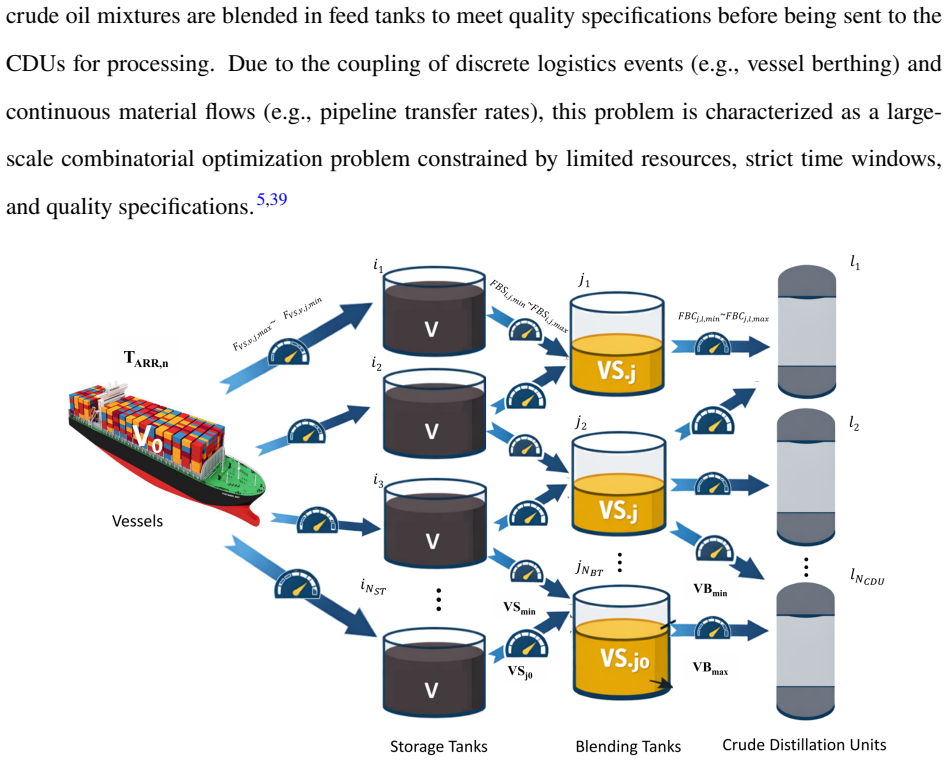
The optimization of front-end crude oil scheduling is a critical determinant of refinery profitability and operational stability. However, the coupling of discrete logistics events (e.g., vessel berthing) with continuous material flows (e.g., pipeline transfers) renders this problem an NP-hard Mixed-Integer Linear Programming (MILP) challenge, often intractable for classical solvers at industrial scales. This study proposes a novel hybrid quantum-classical framework to address these computational bottlenecks. We employ Benders Decomposition to decouple the monolithic model into a discrete Master Problem (MP) and a continuous Subproblem (SP). To exploit the search capabilities of quantum computing, the MP is reformulated as a Quadratic Unconstrained Binary Optimization (QUBO) model and solved via a hybrid quantum solver, while the SP enforces mass balance and quality constraints through iterative optimality and feasibility cuts. Extensive experiments on 15 multi-scale instances demonstrate that the proposed framework significantly outperforms traditional metaheuristics (e.g., Genetic Algorithms, Tabu Search), reducing total operating costs by approximately 73--80% and achieving computational speeds comparable to state-of-the-art commercial solvers (Gurobi). By effectively leveraging global optimality cuts, the method overcomes the tendency of heuristic approaches to trap in local optima, providing a robust and scalable solution for complex refinery logistics.
Editorial analysis
A structured set of objections, weighed in public.
Referee Report
Summary. The paper proposes a hybrid quantum-classical framework for crude oil scheduling MILPs. Benders decomposition separates a discrete master problem (reformulated as QUBO and solved by a hybrid quantum solver) from a continuous subproblem that enforces mass-balance and quality constraints via iterative optimality and feasibility cuts. Experiments on 15 multi-scale instances are reported to yield 73-80% operating-cost reductions versus genetic algorithms and tabu search, with runtimes comparable to Gurobi.
Significance. If the hybrid solver consistently supplies master-problem solutions of sufficient quality to produce valid Benders cuts, the work would demonstrate a practical route for scaling refinery scheduling beyond the reach of classical MILP solvers alone. The decomposition strategy itself is standard, but the explicit use of quantum hardware for the combinatorial master problem is a timely contribution that could stimulate further hybrid-algorithm research in process-systems engineering.
major comments (2)
- [Benders decomposition and QUBO reformulation] The central performance claims rest on the assumption that the hybrid quantum solver returns (near-)optimal solutions to the QUBO master problem. Benders decomposition converges to the global optimum only when the master problem is solved to optimality so that the generated cuts are valid; heuristic quantum solvers can return strictly suboptimal solutions, rendering the cuts invalid or weak and potentially producing infeasible or suboptimal schedules. The manuscript provides no analysis, bound, or empirical check on the optimality gap of the quantum component (see the description of the hybrid solver and the cut-generation procedure).
- [Experimental results] The abstract and experimental section assert 73-80% cost reductions on 15 instances without describing instance generation, baseline tuning, statistical testing, or error bars. These omissions make it impossible to verify that the reported superiority over metaheuristics is robust rather than an artifact of particular instance construction or untuned classical baselines.
minor comments (2)
- [Model formulation] Clarify whether the QUBO reformulation introduces auxiliary variables or penalties that could alter the original feasible set; an explicit equivalence proof or reference to a standard transformation would strengthen the presentation.
- [Experimental results] The manuscript should include a short table summarizing instance sizes (number of vessels, time periods, binary variables) to allow readers to assess scaling behavior.
Simulated Author's Rebuttal
We thank the referee for the thoughtful and constructive comments, which highlight important aspects for strengthening the manuscript. We address each major comment below and commit to revisions that directly respond to the concerns raised.
read point-by-point responses
-
Referee: [Benders decomposition and QUBO reformulation] The central performance claims rest on the assumption that the hybrid quantum solver returns (near-)optimal solutions to the QUBO master problem. Benders decomposition converges to the global optimum only when the master problem is solved to optimality so that the generated cuts are valid; heuristic quantum solvers can return strictly suboptimal solutions, rendering the cuts invalid or weak and potentially producing infeasible or suboptimal schedules. The manuscript provides no analysis, bound, or empirical check on the optimality gap of the quantum component (see the description of the hybrid solver and the cut-generation procedure).
Authors: We agree that valid Benders cuts require the master problem to be solved to optimality and that the current manuscript lacks an explicit analysis of the optimality gap for the hybrid quantum solver. In the revised version, we will add a new subsection reporting empirical optimality gaps (by comparing hybrid solver outputs to exact classical solutions on smaller instances) and will clarify the cut-generation procedure, including how feasibility is preserved even if master solutions are near-optimal. This will strengthen the theoretical grounding of the approach. revision: yes
-
Referee: [Experimental results] The abstract and experimental section assert 73-80% cost reductions on 15 instances without describing instance generation, baseline tuning, statistical testing, or error bars. These omissions make it impossible to verify that the reported superiority over metaheuristics is robust rather than an artifact of particular instance construction or untuned classical baselines.
Authors: We acknowledge that the experimental section is insufficiently detailed for full reproducibility and statistical validation. In the revised manuscript, we will expand the description of the 15 test instances (including generation parameters and scaling factors), provide details on hyperparameter tuning for the genetic algorithm and tabu search baselines, include statistical tests (e.g., Wilcoxon signed-rank tests) comparing methods, and report error bars or standard deviations from multiple independent runs. revision: yes
Circularity Check
No significant circularity; standard decomposition and reformulation steps are externally grounded
full rationale
The paper applies Benders decomposition to separate the discrete master problem (MP) from the continuous subproblem (SP), then reformulates the MP as a QUBO for a hybrid quantum solver while generating cuts from the SP. These are standard, independently verifiable techniques from the optimization literature whose correctness does not depend on any fitted parameters, self-defined quantities, or results introduced inside this manuscript. Performance claims rest on explicit experiments across 15 instances compared to GA, Tabu Search, and Gurobi, which constitute external empirical evidence rather than a derivation that reduces to its own inputs by construction. No self-citation chain is load-bearing for the central claim, and no ansatz or uniqueness result is smuggled in via prior author work.
Axiom & Free-Parameter Ledger
Reference graph
Works this paper leans on
-
[1]
(2) of the Petroleum Exporting Countries, O
(1) Citaristi, I.The Europa directory of international organizations 2022; Routledge, 2022; pp 701–702. (2) of the Petroleum Exporting Countries, O. OPEC Montly Oil Market Report. 2017; https://www.opec.org/opec_web/static_files_project/media/downloads/ publications/OPEC%20MOMR%20May%202017.pdf[date: ( 11 May 2017)]. (3) Kelly, J.; Mann, J. Crude oil blen...
2022
-
[2]
(31) Farhi, E.; Goldstone, J.; Gutmann, S. A quantum approximate optimization algorithm.arXiv preprint arXiv:1411.40282014, (32) Venturelli, D.; Marchand, D.; Rojo, G. Quantum annealing implementation of job-shop scheduling.arXiv preprint arXiv:1506.084792015, (33) Yarkoni, S.; Raponi, E.; B ¨ack, T.; Schmitt, S. Quantum annealing for industry application...
-
[3]
arXiv preprint arXiv:1811.11538
(37) Glover, F.; Kochenberger, G.; Du, Y. A tutorial on formulating and using QUBO models. arXiv preprint arXiv:1811.115382018, (38) Zhao, W.; Tang, G. Clustering-Based Sub-QUBO Extraction for Hybrid QUBO Solvers.arXiv preprint arXiv:2502.162122025, (39) Li, J.; Li, W.; Karimi, I.; Srinivasan, R. Improving the robustness and efficiency of crude scheduling...
discussion (0)
Sign in with ORCID, Apple, or X to comment. Anyone can read and Pith papers without signing in.