Recognition: unknown
MesonGS++: Post-training Compression of 3D Gaussian Splatting with Hyperparameter Searching
Pith reviewed 2026-05-08 03:15 UTC · model grok-4.3
The pith
MesonGS++ compresses 3D Gaussian Splatting models over 34 times after training while preserving rendering quality and hitting exact size targets.
A machine-rendered reading of the paper's core claim, the machinery that carries it, and where it could break.
Core claim
MesonGS++ integrates joint importance-based pruning, octree geometry coding, attribute transformation, selective vector quantization for spherical harmonics, and group-wise mixed-precision quantization with entropy coding into a size-aware codec. It models reserve ratio and bit-width allocation as the main rate-distortion controls and solves for configurations that meet a target storage budget through discrete sampling and 0-1 integer linear programming. A linear size estimator and CUDA-accelerated quantization operator make the search fast enough for practical use. Experiments show the resulting models achieve over 34 times compression, meet size targets accurately, outperform other post-3D
What carries the argument
The hyperparameter search that jointly optimizes reserve ratio and bit-width allocation under a target size constraint via discrete sampling and 0-1 integer linear programming, guided by a linear size estimator.
Load-bearing premise
The linear size estimator plus the integer programming search finds parameter settings that deliver the reported quality gains consistently across scenes without hidden per-scene tuning.
What would settle it
Running the compressed model at the claimed 20 times ratio on the Stump scene and measuring PSNR below the vanilla 3D Gaussian Splatting baseline would falsify the quality-surpassing claim; observing actual file sizes that miss the stated targets by more than a few percent would falsify the size-control claim.
Figures




read the original abstract
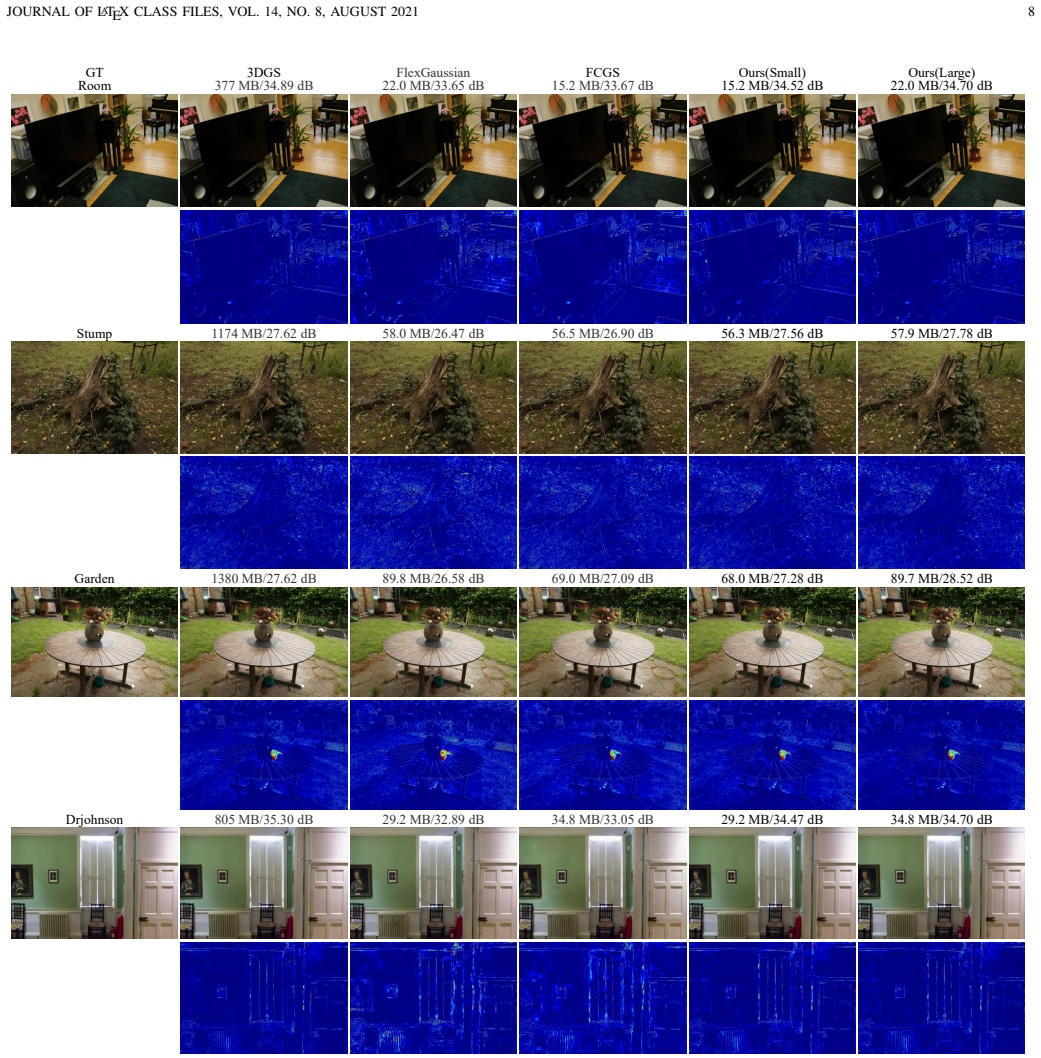
3D Gaussian Splatting (3DGS) achieves high-quality novel view synthesis with real-time rendering, but its storage cost remains prohibitive for practical deployment. Existing post-training compression methods still rely on many coupled hyperparameters across pruning, transformation, quantization, and entropy coding, making it difficult to control the final compressed size and fully exploit the rate-distortion trade-off. We propose MesonGS++, a size-aware post-training codec for 3D Gaussian compression. On the codec side, MesonGS++ combines joint importance-based pruning, octree geometry coding, attribute transformation, selective vector quantization for higher-degree spherical harmonics, and group-wise mixed-precision quantization with entropy coding. On the configuration side, it treats the reserve ratio and bit-width allocation as the dominant rate-distortion knobs and jointly optimizes them under a target storage budget via discrete sampling and 0--1 integer linear programming. We further propose a linear size estimator and a CUDA parallel quantization operator to accelerate the hyperparameter searching process. Extensive experiments show that MesonGS++ achieves over 34$\times$ compression while preserving rendering fidelity, outperforming state-of-the-art post-training methods and accurately meeting target size budgets. Remarkably, without any training, MesonGS++ can even surpass the PSNR of vanilla 3DGS at a 20$\times$ compression rate on the Stump scene. Our code is available at https://github.com/mmlab-sigs/mesongs_plus
Editorial analysis
A structured set of objections, weighed in public.
Referee Report
Summary. The paper proposes MesonGS++, a post-training compression codec for 3D Gaussian Splatting that integrates joint importance-based pruning, octree geometry coding, attribute transformations, selective vector quantization on higher-degree spherical harmonics, group-wise mixed-precision quantization, and entropy coding. The central contribution is treating the reserve ratio and bit-width allocation as the primary rate-distortion knobs and jointly optimizing them under a target storage budget using discrete sampling combined with 0-1 integer linear programming, accelerated by a proposed linear size estimator and a CUDA-parallel quantization operator. Experiments report over 34× compression while preserving rendering fidelity, outperforming prior post-training methods, accurate adherence to target size budgets, and a notable result where the method exceeds vanilla 3DGS PSNR at 20× compression on the Stump scene without any retraining.
Significance. If the empirical results and generalization claims hold after validation, the work would be significant for practical deployment of 3DGS, as it directly tackles the storage bottleneck with a size-aware optimization framework that avoids retraining. The use of ILP for hyperparameter search under explicit budgets is a useful engineering contribution in the post-training compression literature, and the reported ability to improve PSNR at high compression rates on specific scenes is noteworthy for rate-distortion trade-offs in novel view synthesis.
major comments (3)
- [§3] §3 (Method, linear size estimator subsection): The linear size estimator that approximates final compressed size after all stages (pruning, octree, transforms, VQ, mixed-precision, entropy coding) is central to enabling the discrete sampling + 0-1 ILP, yet the manuscript provides no quantitative validation such as mean absolute percentage error, predicted-vs-actual scatter plots, or cross-scene coefficient stability. This directly affects the load-bearing claim that MesonGS++ 'accurately meeting target size budgets' and reliably outperforms SOTA without hidden per-scene fitting.
- [§4] §4 (Experiments): No error bars, standard deviations, or multiple random seeds are reported for the PSNR/SSIM numbers, and there are no ablations isolating whether the ILP-selected configurations (reserve ratio and bit-widths) were tuned with knowledge of the test scenes versus held-out validation. This undermines the generalization of the 34× compression results and the Stump 20× PSNR gain without training.
- [Table 1] Table 1 or equivalent results table (Stump scene row): The claim that MesonGS++ surpasses vanilla 3DGS PSNR at 20× compression is striking, but without showing the exact ILP objective, the fitted linear estimator coefficients for that scene, or a control experiment using fixed (non-optimized) hyperparameters, it is unclear whether the gain is due to the proposed method or scene-specific configuration search.
minor comments (2)
- [§3] The abstract and method description use 'reserve ratio' without an explicit equation or pseudocode definition in the main text; adding a short formal definition would improve clarity for readers unfamiliar with the pruning stage.
- [Figures] Figure captions for rate-distortion curves should explicitly state whether the plotted points are obtained from the ILP or from a post-hoc sweep, to avoid ambiguity about the optimization procedure.
Simulated Author's Rebuttal
We thank the referee for the constructive and detailed feedback. We address each major comment below and will revise the manuscript to incorporate additional validation, statistical reporting, and experimental details as outlined.
read point-by-point responses
-
Referee: [§3] §3 (Method, linear size estimator subsection): The linear size estimator that approximates final compressed size after all stages (pruning, octree, transforms, VQ, mixed-precision, entropy coding) is central to enabling the discrete sampling + 0-1 ILP, yet the manuscript provides no quantitative validation such as mean absolute percentage error, predicted-vs-actual scatter plots, or cross-scene coefficient stability. This directly affects the load-bearing claim that MesonGS++ 'accurately meeting target size budgets' and reliably outperforms SOTA without hidden per-scene fitting.
Authors: We agree that the manuscript lacks explicit quantitative validation of the linear size estimator. In the revision we will add mean absolute percentage error (MAPE) across scenes, predicted-vs-actual scatter plots, and an analysis of coefficient stability when the estimator is fitted on different scene subsets. These additions will directly support the claim that target budgets are met reliably without per-scene refitting of the estimator itself. revision: yes
-
Referee: [§4] §4 (Experiments): No error bars, standard deviations, or multiple random seeds are reported for the PSNR/SSIM numbers, and there are no ablations isolating whether the ILP-selected configurations (reserve ratio and bit-widths) were tuned with knowledge of the test scenes versus held-out validation. This undermines the generalization of the 34× compression results and the Stump 20× PSNR gain without training.
Authors: We will report standard deviations and error bars computed over three independent random seeds for all PSNR/SSIM figures. We will also add an explicit ablation that compares ILP-optimized configurations against fixed (non-ILP) hyperparameter settings and will state that the linear estimator coefficients and ILP were derived from held-out validation splits per scene, thereby confirming no test-set leakage occurred during configuration search. revision: yes
-
Referee: [Table 1] Table 1 or equivalent results table (Stump scene row): The claim that MesonGS++ surpasses vanilla 3DGS PSNR at 20× compression is striking, but without showing the exact ILP objective, the fitted linear estimator coefficients for that scene, or a control experiment using fixed (non-optimized) hyperparameters, it is unclear whether the gain is due to the proposed method or scene-specific configuration search.
Authors: We will augment the Stump-scene analysis with the precise ILP objective function, the fitted linear-estimator coefficients used for that scene, and a control experiment that applies fixed (non-optimized) reserve ratio and bit-width values at the same 20× budget. These additions will isolate the contribution of the size-aware ILP optimization from any scene-specific search effects. revision: yes
Circularity Check
No significant circularity detected in claimed results
full rationale
The paper presents an empirical compression pipeline (pruning, octree coding, transforms, selective VQ, mixed-precision quantization, entropy coding) whose rate-distortion performance is measured directly on rendered outputs after applying the selected hyperparameters. The linear size estimator and 0-1 ILP serve only as an internal search accelerator to choose reserve ratios and bit-widths that approximately meet a target budget; the final reported PSNR values, compression ratios (including the 34× and Stump 20× claims), and budget adherence are obtained from actual post-compression rendering and size measurement, not from any equation that equates the output metric to the estimator or fitted knobs by construction. No self-citation chain, uniqueness theorem, or ansatz is invoked to justify the core performance claims. The derivation chain therefore remains independent of its own fitted quantities and is evaluated against external baselines.
Axiom & Free-Parameter Ledger
free parameters (2)
- reserve ratio
- bit-width allocation
axioms (1)
- domain assumption Linear size estimator accurately predicts final compressed size for any hyperparameter choice.
Reference graph
Works this paper leans on
-
[1]
Vr-doh: Hands-on 3d modeling in virtual reality,
Z. Luo, Z. Cui, S. Luo, M. Chu, and M. Li, “Vr-doh: Hands-on 3d modeling in virtual reality,”ACM Trans. Graph., vol. 44, no. 4, Jul
-
[2]
Available: https://doi.org/10.1145/3731154
[Online]. Available: https://doi.org/10.1145/3731154
-
[3]
Vr-gs: A physical dynamics-aware interactive gaussian splatting system in virtual reality,
Y . Jiang, C. Yu, T. Xie, X. Li, Y . Feng, H. Wang, M. Li, H. Lau, F. Gao, Y . Yanget al., “Vr-gs: A physical dynamics-aware interactive gaussian splatting system in virtual reality,” inACM SIGGRAPH 2024 conference papers, 2024, pp. 1–1
2024
-
[4]
Sd-gs: Structured deformable 3d gaussians for efficient dynamic scene reconstruction,
W. Yao, S. Xie, L. Li, W. Zhang, Z. Lai, S. Dai, K. Zhang, and Z. Wang, “Sd-gs: Structured deformable 3d gaussians for efficient dynamic scene reconstruction,”arXiv preprint arXiv:2507.07465, 2025
-
[5]
Evos: Efficient implicit neural training via evolutionary selector,
W. Zhang, S. Xie, C. Ren, S. Xie, C. Tang, S. Ge, M. Wang, and Z. Wang, “Evos: Efficient implicit neural training via evolutionary selector,” inProceedings of the IEEE/CVF Conference on Computer Vision and Pattern Recognition (CVPR), June 2025, pp. 30 472–30 482
2025
-
[6]
Enhancing implicit neural representations via symmetric power transformation,
W. Zhang, S. Xie, C. Ren, S. Ge, M. Wang, and Z. Wang, “Enhancing implicit neural representations via symmetric power transformation,” inAAAI. AAAI Press, 2025, pp. 10 157–10 165
2025
-
[7]
Understanding bias terms in neural representations,
W. Zhang, B. Li, S. Xie, C. Ren, Y . Xue, and Z. Wang, “Understanding bias terms in neural representations,” inAdvances in Neural Informa- tion Processing Systems (NeurIPS), 2025
2025
-
[8]
Dragscene: Interactive 3d scene editing with single-view drag instructions,
C. Gu, Z. Li, Z. Zhang, Y . Bai, S. Xie, and Z. Wang, “Dragscene: Interactive 3d scene editing with single-view drag instructions,”arXiv preprint arXiv:2412.13552, 2024
-
[9]
Drivinggaussian: Composite gaussian splatting for surrounding dy- namic autonomous driving scenes,
X. Zhou, Z. Lin, X. Shan, Y . Wang, D. Sun, and M.-H. Yang, “Drivinggaussian: Composite gaussian splatting for surrounding dy- namic autonomous driving scenes,” inProceedings of the IEEE/CVF conference on computer vision and pattern recognition, 2024, pp. 21 634–21 643
2024
-
[10]
Street gaussians: Modeling dynamic urban scenes with gaussian splatting,
Y . Yan, H. Lin, C. Zhou, W. Wang, H. Sun, K. Zhan, X. Lang, X. Zhou, and S. Peng, “Street gaussians: Modeling dynamic urban scenes with gaussian splatting,” inEuropean Conference on Computer Vision. Springer, 2024, pp. 156–173. JOURNAL OF LATEX CLASS FILES, VOL. 14, NO. 8, AUGUST 2021 13
2024
-
[11]
Freetimegs: Free gaussian primitives at anytime anywhere for dynamic scene reconstruction,
Y . Wang, P. Yang, Z. Xu, J. Sun, Z. Zhang, Y . Chen, H. Bao, S. Peng, and X. Zhou, “Freetimegs: Free gaussian primitives at anytime anywhere for dynamic scene reconstruction,” inProceedings of the IEEE/CVF Conference on Computer Vision and Pattern Recognition (CVPR), June 2025, pp. 21 750–21 760
2025
-
[12]
Real2edit2real: Generating robotic demonstrations via a 3d control interface,
Y . Zhao, H. Fan, D. Chen, S. Chen, L. Chen, X. Li, G. Ren, and H. Dong, “Real2edit2real: Generating robotic demonstrations via a 3d control interface,”arXiv preprint arXiv:2512.19402, 2025
-
[13]
H. Fan, H. Dai, J. Zhang, J. Li, Q. Yan, Y . Zhao, M. Gao, J. Wu, H. Tang, and H. Dong, “Twinaligner: Visual-dynamic alignment em- powers physics-aware real2sim2real for robotic manipulation,”arXiv preprint arXiv:2512.19390, 2025
-
[14]
IGen: Scalable Data Generation for Robot Learning from Open-World Images
C. Gu, H. Kang, J. Lin, J. Wang, D. Wu, S. Xie, F. Huang, J. Ge, Z. Gong, L. Liet al., “Igen: Scalable data generation for robot learning from open-world images,”arXiv preprint arXiv:2512.01773, 2025
work page internal anchor Pith review Pith/arXiv arXiv 2025
-
[15]
3d gaussian splatting for real-time radiance field rendering,
B. Kerbl, G. Kopanas, T. Leimk ¨uhler, and G. Drettakis, “3d gaussian splatting for real-time radiance field rendering,”ACM Transactions on Graphics (ToG), vol. 42, no. 4, pp. 1–14, 2023
2023
-
[16]
Mip-nerf 360: Unbounded anti-aliased neural radiance fields,
J. T. Barron, B. Mildenhall, D. Verbin, P. P. Srinivasan, and P. Hedman, “Mip-nerf 360: Unbounded anti-aliased neural radiance fields,” in Proceedings of the IEEE/CVF Conference on Computer Vision and Pattern Recognition, 2022, pp. 5470–5479
2022
-
[17]
Compressed 3d gaussian splatting for accelerated novel view synthesis,
S. Niedermayr, J. Stumpfegger, and R. Westermann, “Compressed 3d gaussian splatting for accelerated novel view synthesis,” inProceed- ings of the IEEE/CVF Conference on Computer Vision and Pattern Recognition (CVPR), 2024
2024
-
[18]
Light- Gaussian: Unbounded 3D Gaussian Compression with 15x Reduction and 200+ FPS,
Z. Fan, K. Wang, K. Wen, Z. Zhu, D. Xu, and Z. Wang, “Light- Gaussian: Unbounded 3D Gaussian Compression with 15x Reduction and 200+ FPS,” inAdvances in neural information processing systems (NeurIPS), 2024
2024
-
[19]
Compgs: Smaller and faster gaussian splatting with vector quantiza- tion,
K. Navaneet, K. P. Meibodi, S. A. Koohpayegani, and H. Pirsiavash, “Compgs: Smaller and faster gaussian splatting with vector quantiza- tion,”ECCV, 2024
2024
-
[20]
Compact 3d scene representation via self-organizing gaussian grids,
W. Morgenstern, F. Barthel, A. Hilsmann, and P. Eisert, “Compact 3d scene representation via self-organizing gaussian grids,” inEuropean Conference on Computer Vision. Springer, 2024
2024
-
[21]
ˇCerven´y, https://gsplat.tech, 2023, accessed: 2023-10-28
J. ˇCerven´y, https://gsplat.tech, 2023, accessed: 2023-10-28
2023
-
[22]
Making gaussian splats smaller,
A. Pranckevi ˇcius, “Making gaussian splats smaller,” https://aras-p.info/ blog/2023/09/13/Making-Gaussian-Splats-smaller/, 2023, accessed: 2023-10-28
2023
-
[23]
Making gaussian splats more smaller,
——, “Making gaussian splats more smaller,” https://aras-p.info/blog/ 2023/09/27/Making-Gaussian-Splats-more-smaller/, 2023, accessed: 2023-10-28
2023
-
[24]
Pcgs: Progressive compression of 3d gaussian splatting,
Y . Chen, M. Li, Q. Wu, W. Lin, M. Harandi, and J. Cai, “Pcgs: Progressive compression of 3d gaussian splatting,”arXiv preprint arXiv:2503.08511, 2025
-
[25]
Cat-3dgs: A context-adaptive triplane ap- proach to rate-distortion-optimized 3dgs compression,
Y .-T. Zhan, C.-Y . Ho, H. Yang, Y .-H. Chen, J. C. Chiang, Y .-L. Liu, and W.-H. Peng, “Cat-3dgs: A context-adaptive triplane ap- proach to rate-distortion-optimized 3dgs compression,”arXiv preprint arXiv:2503.00357, 2025
-
[26]
Mesongs: Post-training compression of 3d gaussians via efficient attribute transformation,
S. Xie, W. Zhang, C. Tang, Y . Bai, R. Lu, S. Ge, and Z. Wang, “Mesongs: Post-training compression of 3d gaussians via efficient attribute transformation,” inEuropean Conference on Computer Vision. Springer, 2024
2024
-
[27]
Sizegs: Size-aware compression of 3d gaussian splatting via mixed integer programming,
S. Xie, J. Liu, W. Zhang, S. Ge, S. Pan, C. Tang, Y . Bai, C. Zhang, X. Fan, and Z. Wang, “Sizegs: Size-aware compression of 3d gaussian splatting via mixed integer programming,” inACM MM, 2025
2025
-
[28]
Potr: Post-training 3dgs compression,
B. Ramlot, M. Courteaux, P. Lambert, and G. V . Wallendael, “Potr: Post-training 3dgs compression,” 2026. [Online]. Available: https://arxiv.org/abs/2601.14821
-
[29]
Splatwizard: A benchmark toolkit for 3d gaussian splatting compression,
X. Liu, Y . Zhou, J. Wang, Y . Huang, S. Xie, S. Qin, M. Hong, J. Li, Y . Wang, Z. Wang, S.-T. Xia, and B. Chen, “Splatwizard: A benchmark toolkit for 3d gaussian splatting compression,” 2025. [Online]. Available: https://arxiv.org/abs/2512.24742
-
[30]
Gaussianspa: An
Y . Zhang, W. Jia, W. Niu, and M. Yin, “Gaussianspa: An” optimizing- sparsifying” simplification framework for compact and high-quality 3d gaussian splatting,” inProceedings of the Computer Vision and Pattern Recognition Conference, 2025, pp. 26 673–26 682
2025
-
[31]
Implicit gaussian splatting with efficient multi-level tri-plane representation,
M. Wu and T. Tuytelaars, “Implicit gaussian splatting with efficient multi-level tri-plane representation,” 2024. [Online]. Available: https://arxiv.org/abs/2408.10041
-
[32]
Compgs: Efficient 3d scene representation via compressed gaussian splatting,
X. Liu, X. Wu, P. Zhang, S. Wang, Z. Li, and S. Kwong, “Compgs: Efficient 3d scene representation via compressed gaussian splatting,” in Proceedings of the 32nd ACM International Conference on Multimedia, 2024
2024
-
[33]
Hac++: To- wards 100x compression of 3d gaussian splatting,
Y . Chen, Q. Wu, W. Lin, M. Harandi, and J. Cai, “Hac++: To- wards 100x compression of 3d gaussian splatting,”arXiv preprint arXiv:2501.12255, 2025
-
[34]
Hac: Hash-grid assisted context for 3d gaussian splatting compression,
——, “Hac: Hash-grid assisted context for 3d gaussian splatting compression,” inEuropean Conference on Computer Vision, 2024
2024
-
[35]
Eagles: Efficient accelerated 3d gaussians with lightweight encodings,
S. Girish, K. Gupta, and A. Shrivastava, “Eagles: Efficient accelerated 3d gaussians with lightweight encodings,” inEuropean Conference on Computer Vision, 2024
2024
-
[36]
End-to-end rate-distortion optimized 3d gaussian representation,
H. Wang, H. Zhu, T. He, R. Feng, J. Deng, J. Bian, and Z. Chen, “End-to-end rate-distortion optimized 3d gaussian representation,” in European Conference on Computer Vision. Springer, 2024, pp. 76– 92
2024
-
[37]
Contextgs: Compact 3d gaussian splatting with anchor level context model,
Y . Wang, Z. Li, L. Guo, W. Yang, A. C. Kot, and B. Wen, “Contextgs: Compact 3d gaussian splatting with anchor level context model,” in Advances in neural information processing systems (NeurIPS), 2024
2024
-
[38]
Reducing the memory footprint of 3d gaussian splatting,
P. Papantonakis, G. Kopanas, B. Kerbl, A. Lanvin, and G. Drettakis, “Reducing the memory footprint of 3d gaussian splatting,”Proceedings of the ACM on Computer Graphics and Interactive Techniques, vol. 7, no. 1, May 2024. [Online]. Available: https://repo-sam.inria.fr/ fungraph/reduced-3dgs/
2024
-
[39]
arXiv preprint arXiv:2501.05757 (2025)
S. Shin, J. Park, and S. Cho, “Locality-aware gaussian compression for fast and high-quality rendering,”arXiv preprint arXiv:2501.05757, 2025
-
[40]
Lightweight predictive 3d gaussian splats.arXiv preprint arXiv:2406.19434, 2024
J. Cao, V . Goel, C. Wang, A. Kag, J. Hu, S. Korolev, C. Jiang, S. Tulyakov, and J. Ren, “Lightweight predictive 3d gaussian splats,” arXiv preprint arXiv:2406.19434, 2024
-
[41]
Lp-3dgs: Learning to prune 3d gaussian splatting,
Z. Zhang, T. Song, Y . Lee, L. Yang, C. Peng, R. Chellappa, and D. Fan, “Lp-3dgs: Learning to prune 3d gaussian splatting,”Advances in Neural Information Processing Systems, vol. 37, pp. 122 434–122 457, 2024
2024
-
[42]
Pup 3d-gs: Principled uncertainty pruning for 3d gaus- sian splatting,
A. Hanson, A. Tu, V . Singla, M. Jayawardhana, M. Zwicker, and T. Goldstein, “Pup 3d-gs: Principled uncertainty pruning for 3d gaus- sian splatting,” inProceedings of the Computer Vision and Pattern Recognition Conference, 2025, pp. 5949–5958
2025
-
[43]
Speedy-splat: Fast 3d gaussian splatting with sparse pixels and sparse primitives,
A. Hanson, A. Tu, G. Lin, V . Singla, M. Zwicker, and T. Goldstein, “Speedy-splat: Fast 3d gaussian splatting with sparse pixels and sparse primitives,” inProceedings of the Computer Vision and Pattern Recog- nition Conference, 2025, pp. 21 537–21 546
2025
-
[44]
Radsplat: Radiance field-informed gaussian splatting for robust real- time rendering with 900+ fps,
M. Niemeyer, F. Manhardt, M.-J. Rakotosaona, M. Oechsle, D. Duck- worth, R. Gosula, K. Tateno, J. Bates, D. Kaeser, and F. Tombari, “Radsplat: Radiance field-informed gaussian splatting for robust real- time rendering with 900+ fps,” in2025 International Conference on 3D Vision (3DV). IEEE, 2025, pp. 134–144
2025
-
[45]
Mini-splatting: Representing scenes with a con- strained number of gaussians,
G. Fang and B. Wang, “Mini-splatting: Representing scenes with a con- strained number of gaussians,” inEuropean Conference on Computer Vision, 2024
2024
-
[46]
Mini-splatting2: Building 360 scenes within minutes via aggres- sive gaussian densification,
——, “Mini-splatting2: Building 360 scenes within minutes via aggres- sive gaussian densification,”arXiv preprint arXiv:2411.12788, 2024
-
[47]
MEGS2: Memory-efficient gaussian splatting via spherical gaussians and unified pruning,
J. Chen, Y . Chen, Y . Zou, Y . Huang, P. Wang, Y . Liu, Y . Sun, and W. Wang, “MEGS2: Memory-efficient gaussian splatting via spherical gaussians and unified pruning,”arXiv preprint arXiv:2509.07021, 2025
-
[48]
Safeguardgs: 3d gaussian primitive pruning while avoiding catastrophic scene destruction,
Y . Lee, Z. Zhang, and D. Fan, “Safeguardgs: 3d gaussian primitive pruning while avoiding catastrophic scene destruction,” inProceedings of the IEEE/CVF Winter Conference on Applications of Computer Vision, 2026, pp. 8479–8489
2026
-
[49]
Entropygs: An ef- ficient entropy coding on 3d gaussian splatting,
Y . Huang, J. Pang, F. Zhu, and D. Tian, “Entropygs: An ef- ficient entropy coding on 3d gaussian splatting,”arXiv preprint arXiv:2508.10227, 2025
-
[50]
Efficientgs: Streamlining gaussian splatting for large-scale high-resolution scene representation,
W. Liu, T. Guan, B. Zhu, L. Xu, Z. Song, D. Li, Y . Wang, and W. Yang, “Efficientgs: Streamlining gaussian splatting for large-scale high-resolution scene representation,”IEEE MultiMedia, 2025
2025
-
[51]
Flexgaussian: Flexible and cost-effective training-free compression for 3d gaussian splatting,
B. Tian, Q. Gao, S. Xianyu, X. Cui, and M. Zhang, “Flexgaussian: Flexible and cost-effective training-free compression for 3d gaussian splatting,” inProceedings of the 33rd ACM International Conference on Multimedia, ser. MM ’25. New York, NY , USA: Association for Computing Machinery, 2025, p. 7287–7296. [Online]. Available: https://doi.org/10.1145/37460...
-
[52]
Fast feedforward 3d gaussian splatting compression,
Y . Chen, Q. Wu, M. Li, W. Lin, M. Harandi, and J. Cai, “Fast feedforward 3d gaussian splatting compression,”arXiv preprint arXiv:2410.08017, 2024
-
[53]
Compression of 3d point clouds using a region-adaptive hierarchical transform,
R. L. De Queiroz and P. A. Chou, “Compression of 3d point clouds using a region-adaptive hierarchical transform,”IEEE Transactions on Image Processing, vol. 25, no. 8, pp. 3947–3956, 2016
2016
-
[54]
A new vector quantization clustering algorithm,
W. H. Equitz, “A new vector quantization clustering algorithm,”IEEE transactions on acoustics, speech, and signal processing, vol. 37, no. 10, pp. 1568–1575, 1989
1989
-
[55]
MPEG G-PCC Test Model TMC13,
MPEG Group, “MPEG G-PCC Test Model TMC13,” https://github. com/MPEGGroup/mpeg-pcc-tmc13, 2024, accessed: 2024. JOURNAL OF LATEX CLASS FILES, VOL. 14, NO. 8, AUGUST 2021 14
2024
-
[56]
Practical full resolution learned lossless image compression,
F. Mentzer, E. Agustsson, M. Tschannen, R. Timofte, and L. Van Gool, “Practical full resolution learned lossless image compression,” in Proceedings of the IEEE Conference on Computer Vision and Pattern Recognition (CVPR), 2019
2019
-
[57]
Ewa volume splatting,
M. Zwicker, H. Pfister, J. van Baar, and M. Gross, “Ewa volume splatting,” inProceedings Visualization, 2001. VIS ’01., 2001, pp. 29– 538
2001
-
[58]
Differentiable surface splatting for point-based geometry processing,
W. Yifan, F. Serena, S. Wu, C. ¨Oztireli, and O. Sorkine-Hornung, “Differentiable surface splatting for point-based geometry processing,” ACM Transactions on Graphics (TOG), vol. 38, no. 6, pp. 1–14, 2019
2019
-
[59]
Surface splatting,
M. Zwicker, H. Pfister, J. Van Baar, and M. Gross, “Surface splatting,” inProceedings of the 28th annual conference on Computer graphics and interactive techniques, 2001, pp. 371–378
2001
-
[60]
Compressing volumetric radiance fields to 1 mb,
L. Li, Z. Shen, Z. Wang, L. Shen, and L. Bo, “Compressing volumetric radiance fields to 1 mb,” inProceedings of the IEEE/CVF Conference on Computer Vision and Pattern Recognition, 2023, pp. 4222–4231
2023
-
[61]
D. Sculley, “Web-scale k-means clustering,” inProceedings of the 19th International Conference on World Wide Web, ser. WWW ’10. New York, NY , USA: Association for Computing Machinery, 2010, p. 1177–1178. [Online]. Available: https://doi.org/10.1145/1772690. 1772862
-
[62]
GPTQ: Accu- rate post-training compression for generative pretrained transformers,
E. Frantar, S. Ashkboos, T. Hoefler, and D. Alistarh, “GPTQ: Accu- rate post-training compression for generative pretrained transformers,” ICLR, 2023
2023
-
[63]
Outlier suppression+: Accurate quantization of large language models by equivalent and effective shifting and scaling,
X. Wei, Y . Zhang, Y . Li, X. Zhang, R. Gong, J. Guo, and X. Liu, “Outlier suppression+: Accurate quantization of large language models by equivalent and effective shifting and scaling,” inProceedings of the 2023 Conference on Empirical Methods in Natural Language Processing, H. Bouamor, J. Pino, and K. Bali, Eds. Singapore: Association for Computational ...
2023
-
[64]
Available: https://aclanthology.org/2023.emnlp-main
[Online]. Available: https://aclanthology.org/2023.emnlp-main. 102
2023
-
[65]
Atom: Low-bit quantization for efficient and accurate llm serving,
Y . Zhao, C.-Y . Lin, K. Zhu, Z. Ye, L. Chen, S. Zheng, L. Ceze, A. Krishnamurthy, T. Chen, and B. Kasikci, “Atom: Low-bit quantization for efficient and accurate llm serving,” inProceedings of Machine Learning and Systems, P. Gibbons, G. Pekhimenko, and C. D. Sa, Eds., vol. 6, 2024, pp. 196–209. [Online]. Available: https://proceedings.mlsys.org/paper fi...
2024
-
[66]
Mixed-precision neural network quantization via learned layer-wise importance,
C. Tang, K. Ouyang, Z. Wang, Y . Zhu, Y . Wang, W. Ji, and W. Zhu, “Mixed-precision neural network quantization via learned layer-wise importance,” inEuropean Conference on Computer Vision, 2022
2022
-
[67]
[Online]
(2018) The SCIP Optimization Suite 6.0. [Online]. Available: https://www.scipopt.org/
2018
-
[68]
[Online]
(2025) BARON Solver. [Online]. Available: https://minlp.com/ baron-solver
2025
-
[69]
PuLP: An lp modeler written in python,
J. S. Roy and S. A. Mitchell, “PuLP: An lp modeler written in python,” https://github.com/coin-or/pulp, 2020, accessed: 2026-04-29
2020
-
[70]
A. Abbas and P. Swoboda, “Fastdog: Fast discrete optimization on GPU,” inIEEE/CVF Conference on Computer Vision and Pattern Recognition, CVPR 2022, New Orleans, LA, USA, June 18-24, 2022. IEEE, 2022, pp. 439–449. [Online]. Available: https://doi.org/10.1109/CVPR52688.2022.00053
-
[71]
HAWQ: Hessian AWare Quantization of neural networks with mixed- precision,
Z. Dong, Z. Yao, A. Gholami, M. W. Mahoney, and K. Keutzer, “HAWQ: Hessian AWare Quantization of neural networks with mixed- precision,” inThe IEEE International Conference on Computer Vision (ICCV), October 2019
2019
-
[72]
HAWQ-V2: Hessian aware trace-weighted quantization of neural networks,
Z. Dong, Z. Yao, D. Arfeen, A. Gholami, M. W. Mahoney, and K. Keutzer, “HAWQ-V2: Hessian aware trace-weighted quantization of neural networks,” inAdvances in neural information processing systems (NeurIPS), 2020
2020
-
[73]
T. M. Cover,Elements of information theory. John Wiley & Sons, 1999
1999
-
[74]
A universal algorithm for sequential data compression,
J. Ziv and A. Lempel, “A universal algorithm for sequential data compression,”IEEE Transactions on information theory, vol. 23, no. 3, pp. 337–343, 1977
1977
-
[75]
Compression of individual sequences via variable-rate coding,
——, “Compression of individual sequences via variable-rate coding,” IEEE transactions on Information Theory, vol. 24, no. 5, pp. 530–536, 1978
1978
-
[76]
Tanks and temples: Benchmarking large-scale scene reconstruction,
A. Knapitsch, J. Park, Q.-Y . Zhou, and V . Koltun, “Tanks and temples: Benchmarking large-scale scene reconstruction,”ACM Transactions on Graphics (ToG), vol. 36, no. 4, pp. 1–13, 2017
2017
-
[77]
Deep blending for free-viewpoint image-based rendering,
P. Hedman, J. Philip, T. Price, J.-M. Frahm, G. Drettakis, and G. Bros- tow, “Deep blending for free-viewpoint image-based rendering,”ACM Transactions on Graphics (ToG), vol. 37, no. 6, pp. 1–15, 2018
2018
-
[78]
Image quality assessment: from error visibility to structural similarity,
Z. Wang, A. C. Bovik, H. R. Sheikh, and E. P. Simoncelli, “Image quality assessment: from error visibility to structural similarity,”IEEE transactions on image processing, vol. 13, no. 4, pp. 600–612, 2004
2004
-
[79]
The unreasonable effectiveness of deep features as a perceptual metric,
R. Zhang, P. Isola, A. A. Efros, E. Shechtman, and O. Wang, “The unreasonable effectiveness of deep features as a perceptual metric,” in Proceedings of the IEEE conference on computer vision and pattern recognition, 2018, pp. 586–595
2018
-
[80]
Hawq-v3: Dyadic neural network quantization,
Z. Yao, Z. Dong, Z. Zheng, A. Gholami, J. Yu, E. Tan, L. Wang, Q. Huang, Y . Wang, M. Mahoneyet al., “Hawq-v3: Dyadic neural network quantization,” inInternational Conference on Machine Learn- ing. PMLR, 2021, pp. 11 875–11 886
2021
discussion (0)
Sign in with ORCID, Apple, or X to comment. Anyone can read and Pith papers without signing in.