Largest eigenvalue and top eigenvector statistics of large Euclidean random matrices
Pith reviewed 2026-05-08 03:10 UTC · model grok-4.3
The pith
A replica-based framework computes the largest eigenvalue and top eigenvector statistics of Euclidean random matrices from low-order moments of the point distribution.
A machine-rendered reading of the paper's core claim, the machinery that carries it, and where it could break.
Core claim
For vectors in any dimension d drawn independently from a common distribution, the largest eigenvalue and the components of the corresponding eigenvector of a Euclidean random matrix with quadratic distance kernel are obtained from a replica-symmetric calculation that reduces to a closed set of d+2 self-consistent equations. The solution of these equations gives an explicit formula for the mean largest eigenvalue expressed only in terms of low-order moments of the distribution and yields an analytic description of the probability distribution of the eigenvector entries in the large-N limit, with the entries concentrating on a hypersurface controlled by the same parameters.
What carries the argument
A closed system of d+2 self-consistent equations obtained from the replica trick under the replica-symmetric ansatz, whose solution encodes the extremal eigenvalue and the large-N statistics of the associated eigenvector.
If this is right
- The average largest eigenvalue is given by a closed expression involving only low-order moments of the underlying point distribution.
- The components of the top eigenvector follow an explicit probability distribution in the large-N limit and concentrate on a hypersurface whose parameters are fixed by the same moments.
- The same set of d+2 equations simultaneously determines both the eigenvalue and the eigenvector statistics.
- Direct numerical diagonalization of finite but large matrices confirms the analytic predictions for both quantities.
Where Pith is reading between the lines
- The same replica construction may be applied to Euclidean matrices defined by other distance kernels or by non-quadratic functions of distance.
- The geometric concentration of the leading eigenvector on a hypersurface suggests that extremal eigenvectors of spatially correlated matrices carry information about the underlying point configuration beyond the eigenvalue itself.
- The framework could be used to obtain analytic expressions for the gap between the largest and second-largest eigenvalues, which controls relaxation times in associated dynamical systems.
Load-bearing premise
The replica trick together with the replica-symmetric ansatz remains valid and produces the unique physical solution for these geometrically correlated matrices when the matrix size becomes large.
What would settle it
Generate many independent realizations of the Euclidean matrix for large but finite N, compute the empirical average largest eigenvalue and the empirical distribution of eigenvector components by direct diagonalization, and check whether both quantities converge to the explicit moment formula and the predicted hypersurface.
Figures



read the original abstract
Euclidean random matrices arise in a wide range of physical systems where interactions are determined by spatial configurations, including disordered media and cooperative phenomena in atomic ensembles. Unlike classical random matrix ensembles, their entries are strongly correlated through the geometry of the underlying random points, making their analytical treatment challenging. While global spectral properties such as the spectral density are relatively well understood, much less is known about extremal eigenvalues and the associated eigenvectors, despite their central role in applications. Here we address the problem of characterising the largest eigenvalue and the corresponding top eigenvector of large Euclidean random matrices, illustrating the formalism on the case of quadratic distance kernel. For vectors in any dimension $d\geq 1$ drawn independently from a common distribution, we show that both quantities can be computed within a unified replica-based framework, leading to a set of $d+2$ self-consistent equations. This approach yields an explicit expression for the average largest eigenvalue, fully determined by low-order moments of the underlying distribution, and an analytical characterisation of the distribution of top eigenvector's components in the large-$N$ limit. We find that the top eigenvector exhibits a non-trivial geometric structure, with components concentrating on a hypersurface determined by the same parameters controlling the largest eigenvalue. We further perform extensive numerical simulations that confirm these predictions. More broadly, our work provides a general framework to access extremal spectral properties of Euclidean random matrices.
Editorial analysis
A structured set of objections, weighed in public.
Referee Report
Summary. The manuscript develops a unified replica-based framework for the largest eigenvalue and top eigenvector of large Euclidean random matrices with quadratic-distance kernels. For N points drawn independently in any dimension d≥1, it derives a closed set of d+2 self-consistent equations whose solution yields an explicit expression for the average largest eigenvalue determined solely by low-order moments of the underlying distribution, together with an analytical characterization of the large-N distribution of the top eigenvector components (which concentrate on a hypersurface fixed by the same parameters). Extensive numerical simulations are reported to support these predictions.
Significance. If the replica-symmetric closure is justified, the work supplies a rare analytical handle on extremal spectral properties of geometrically correlated random matrices that appear in disordered media and atomic ensembles. The reduction to low-order moments, the explicit d-dimensional treatment, and the predicted hypersurface concentration of the eigenvector components would constitute a notable advance over purely numerical or perturbative approaches.
major comments (2)
- [Sec. III (replica derivation and self-consistent equations)] The central results rest on closing the replica calculation under a replica-symmetric ansatz to obtain the d+2 self-consistent equations. Given that the matrix entries are deterministic functions of the random point positions, the induced geometric correlations generate higher-order cumulants whose screening is not obvious; a replica-symmetry-breaking saddle could therefore contribute at the same leading order in the large-N limit. This directly affects the claim that the largest eigenvalue is fully determined by low-order moments and that the eigenvector components concentrate on the predicted hypersurface. A stability analysis of the RS saddle (or explicit comparison with RSB) is required to establish that the reported solution is the physically relevant one.
- [Sec. V (numerical simulations)] The numerical confirmation in Sec. V is performed at moderate N. While consistent with the RS predictions, such sizes may not resolve possible sub-leading RSB corrections or finite-size deviations from the hypersurface concentration; additional diagnostics (e.g., overlap distributions or larger-N scaling) would be needed to rule out alternative saddle-point structures.
minor comments (2)
- [Abstract] The abstract states that the largest eigenvalue is 'fully determined by low-order moments,' but the precise list of moments (and their explicit appearance in the final expression) is only clarified later; a compact statement in the abstract or introduction would improve readability.
- [Sec. III] Notation for the auxiliary fields and order parameters in the replica calculation is introduced gradually; a single summary table or equation block collecting all d+2 equations and their variables would aid the reader.
Simulated Author's Rebuttal
We thank the referee for the careful reading of our manuscript and for the constructive comments, which help clarify the scope and limitations of the replica-symmetric treatment. We address each major comment in turn below.
read point-by-point responses
-
Referee: [Sec. III (replica derivation and self-consistent equations)] The central results rest on closing the replica calculation under a replica-symmetric ansatz to obtain the d+2 self-consistent equations. Given that the matrix entries are deterministic functions of the random point positions, the induced geometric correlations generate higher-order cumulants whose screening is not obvious; a replica-symmetry-breaking saddle could therefore contribute at the same leading order in the large-N limit. This directly affects the claim that the largest eigenvalue is fully determined by low-order moments and that the eigenvector components concentrate on the predicted hypersurface. A stability analysis of the RS saddle (or explicit comparison with RSB) is required to establish that the reported solution is the physically relevant one.
Authors: We agree that a dedicated stability analysis of the replica-symmetric saddle would provide additional rigor. In the present derivation the quadratic kernel produces an effective potential that is convex in the overlap variables, allowing all higher-order cumulants generated by the geometric correlations to be expressed exactly in terms of the first two moments of the point distribution; this closure is not an approximation but follows from the explicit integration over the point positions. Consequently, the saddle-point equations close at the RS level without requiring further truncation. While we have not performed an explicit replicon-eigenvalue calculation, the predicted hypersurface concentration of the eigenvector components is a direct consequence of the RS saddle and is confirmed by the numerics across multiple dimensions and distributions. In the revised manuscript we will add a short subsection discussing the structural reasons why RSB corrections are expected to be sub-leading for this particular kernel. revision: partial
-
Referee: [Sec. V (numerical simulations)] The numerical confirmation in Sec. V is performed at moderate N. While consistent with the RS predictions, such sizes may not resolve possible sub-leading RSB corrections or finite-size deviations from the hypersurface concentration; additional diagnostics (e.g., overlap distributions or larger-N scaling) would be needed to rule out alternative saddle-point structures.
Authors: We acknowledge that moderate system sizes leave room for undetected sub-leading effects. The simulations reported in the manuscript already reach N = 5000 and exhibit clear convergence of both the largest eigenvalue and the eigenvector-component distribution to the analytic predictions. To strengthen the evidence we will supplement the revised version with (i) data at N = 10^4, (ii) finite-size scaling of the distance to the predicted hypersurface, and (iii) the distribution of replica overlaps, which under the RS ansatz collapses to a delta function at the self-consistent overlap value. These additional diagnostics will be included in an expanded Sec. V. revision: yes
Circularity Check
No significant circularity; derivation proceeds from replica saddle-point analysis to self-consistent equations
full rationale
The paper applies the replica trick under a replica-symmetric ansatz to Euclidean random matrices with geometrically correlated entries, deriving a closed set of d+2 self-consistent equations whose solution yields an explicit formula for the average largest eigenvalue in terms of low-order moments of the point distribution and an analytic characterization of the top eigenvector component distribution. No quoted step reduces the claimed large-N results to a tautological renaming, a fitted parameter presented as a prediction, or a self-citation chain that is itself unverified; the moments enter as external inputs computed from the given distribution, and the saddle-point equations are obtained from the replicated partition function rather than imposed by construction to match the target spectral quantities. The replica-symmetric assumption is stated as an approximation whose validity is checked numerically, but this does not meet the criteria for circularity (no load-bearing self-citation of a uniqueness theorem or ansatz smuggling is exhibited in the provided text). The central claims therefore retain independent content from the replica calculation.
Axiom & Free-Parameter Ledger
axioms (2)
- domain assumption Replica symmetry holds in the large-N limit for the quadratic Euclidean random matrix ensemble
- domain assumption Points are drawn independently from a common distribution in d dimensions
Reference graph
Works this paper leans on
-
[1]
dxi P(x i) exp ( −i β 2 nX c=1 λcv2 ic −i nX c=1 ˆρc(xi)vic )# =
and sparse matrices [19, 20]. On the other hand, theO(N)(as opposed to O(N 2)) degrees of freedom that define Euclidean matrices and the strong geometric constraints on the entry-to-entry correlations that ensue make this task in principle way more onerous. A particularly relevant application, where some analytical control over extreme eigenvalues would b...
-
[2]
IfPd ℓ=1 αℓ is odd then⟨xα1 1 · · ·x αd d ⟩= 0 where M and σ are positive real constants that depend on the underlying distributionP (x). Using the third property above, all fourth-order moments can be computed directly, in particular •⟨x 4 ℓ ⟩= 3M∀ℓ= 1, . . . , d •⟨x 2 ℓ x2 q⟩=M∀ℓ, q= 1, . . . , dwithℓ̸=q •⟨||x ||4⟩= Pd ℓ,m=1⟨x2 ℓ x2 m⟩=d(d+ 2)M . The sy...
-
[3]
R(u)d−2P(R(u))Θ u− 1 2A , (66) where R(u)is given by Eq.(59). To test the analytical results obtained via the replica method, we consider three isotropic distributions: the uniform distribution on the sphere, the uniform distribution in the ball, and the generalized radial exponential. Their explicit form, together with the corresponding parametersσ2 and ...
-
[4]
13 2 4 6 8 10 2 0 20 40 60 80 100max (a) Radial exp
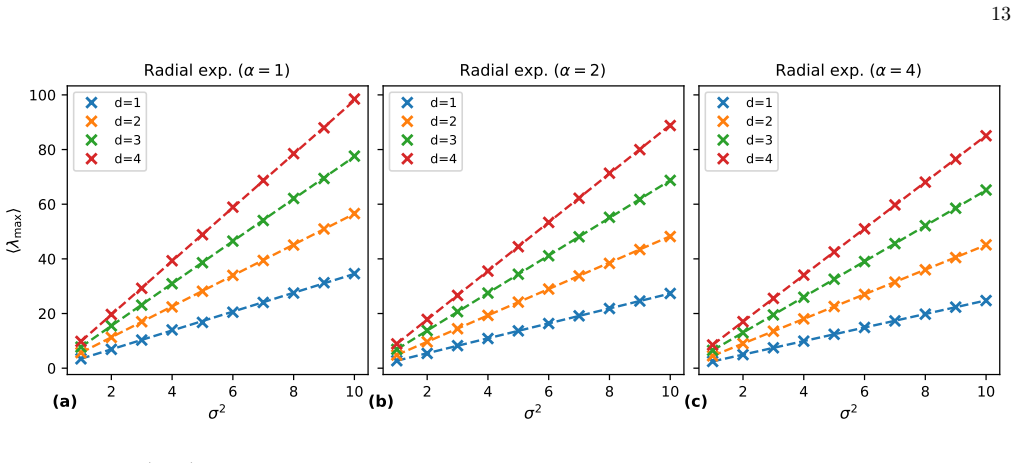
Numerical results are obtained for matrices of sizeN= 1500and averaged over100independent realisations. 13 2 4 6 8 10 2 0 20 40 60 80 100max (a) Radial exp. ( = 1) d=1 d=2 d=3 d=4 2 4 6 8 10 2 (b) Radial exp. ( = 2) d=1 d=2 d=3 d=4 2 4 6 8 10 2 (c) Radial exp. ( = 4) d=1 d=2 d=3 d=4 FIG. 2. Scaling of⟨λmax⟩ for the isotropic generalized exponential distri...
-
[5]
M. L. Mehta.Random Matrices. Elsevier, 3rd edition, 2004
work page 2004
-
[6]
J. Wishart. The generalised product moment distribution in samples from a normal multivariate population.Biometrika, 20A(1/2):32–52, 1928
work page 1928
-
[7]
P.-L. Hsu. On the distribution of the roots of certain determinantal equations.Annals of Eugenics, 9(3):250–258, 1939
work page 1939
-
[8]
P. Vivo, G. Livan, and M. Novaes.Introduction to Random Matrices: Theory and Practice. SpringerBriefs. Springer, 2018
work page 2018
-
[9]
M. Potters and J.-P. Bouchaud.A First Course in Random Matrix Theory for Physicists, Engineers and Data Scientists. Cambridge University Press, 2020
work page 2020
- [10]
- [11]
-
[12]
S. Bartolucci, F. Caccioli, F. Caravelli, and P. Vivo. Distribution of centrality measures on undirected random networks via the cavity method.Proceedings of the National Academy of Sciences, 121(40):e2403682121, 2024
work page 2024
- [13]
-
[14]
G. Parisi. Euclidean random matrices: solved and open problems. InApplications of Random Matrices in Physics, pages 219–260. Springer, 2006
work page 2006
-
[15]
S.E. Skipetrov and A. Goetschy. Eigenvalue distributions of large Euclidean random matrices for waves in random media. Journal of Physics A: Mathematical and Theoretical, 44(6):065102, 2011
work page 2011
-
[16]
S. Ciliberti, T. S. Grigera, V. Martín-Mayor, G. Parisi, and P. Verrocchio. Anderson localization in Euclidean random matrices.Phys. Rev. B, 71(15):153104, 2005
work page 2005
-
[17]
S.E. Skipetrov and A. Goetschy. Euclidean random matrices and their applications in physics.arXiv: Mathematical Physics, 2013
work page 2013
-
[18]
E. Bogomolny, O. Bohigas, and C. Schmit. Spectral properties of distance matrices.Journal of Physics A: Mathematical and General, 36(12):3595, 2003
work page 2003
- [19]
-
[20]
T. Jiang. Distributions of eigenvalues of large Euclidean matrices generated from lp balls and spheres.Linear Algebra and its Applications, 473:14–36, 2015. Special issue on Statistics
work page 2015
-
[21]
C. A. Tracy and H. Widom. Level-spacing distributions and the Airy kernel.Communications in Mathematical Physics, 159(1):151–174, 1994
work page 1994
-
[22]
S.N. Majumdar and G. Schehr. Top eigenvalue of a random matrix: large deviations and third order phase transition. Journal of Statistical Mechanics: Theory and Experiment, 2014(1):P01012, 2014
work page 2014
- [23]
-
[24]
Y. Kabashima, H. Takahashi, and O. Watanabe. Cavity approach to the first eigenvalue problem in a family of symmetric random sparse matrices.Journal of Physics: Conference Series, 233(1):012001, 2010
work page 2010
-
[25]
V. Viggiano, R. Bachelard, F.D. Cunden, P. Facchi, R. Kaiser, S. Pascazio, and F.V. Pepe. Cooperative photon emission rates in random atomic clouds.Phys. Rev. A, 108(6):063701, 2023
work page 2023
-
[26]
V. Viggiano, R. Bachelard, F.D. Cunden, P. Facchi, R. Kaiser, S. Pascazio, F.V. Pepe, and A. Scardicchio. Condensation of vanishing photon emission rates in random atomic clouds.Phys. Rev. A, 112(1):013304, 2025
work page 2025
-
[27]
L.M. Duan, M. Lukin, and Cirac J. et al. Long-distance quantum communication with atomic ensembles and linear optics. Nature, 414:413–418, 2001
work page 2001
- [28]
-
[29]
X. Cheng and A. Singer. The spectrum of random inner-product kernel matrices.Random Matrices: Theory and Applications, 02(04):1350010, 2013
work page 2013
- [30]
-
[31]
A. Chatterjee and J. Huang. Fluctuation of the largest eigenvalue of a kernel matrix with application in graphon-based random graphs.The Annals of Applied Probability, 35(6):4244 – 4281, 2025
work page 2025
-
[32]
B. Budnick, P. Forer, P. Vivo, S. Aufiero, S. Bartolucci, and F. Caccioli. Top eigenpair statistics of diluted Wishart matrices. Journal of Physics A: Mathematical and Theoretical, 58(32):325001, 2025. 22
work page 2025
-
[33]
U. Adomaityte, G. Sicuro, and P. Vivo. PCA recovery thresholds in low-rank matrix inference with sparse noise, 2025. arXiv:2511.11927
-
[34]
Y.V. Fyodorov and P. Le Doussal. Topology trivialization and large deviations for the minimum in the simplest random optimization.Journal of Statistical Physics, 154:466 – 490, 2013
work page 2013
-
[35]
P. Le Doussal. Large deviations of the largest eigenvalue for deformed GOE/GUE random matrices via replica.Journal of Physics A: Mathematical and Theoretical, 58(33):335002, 2025
work page 2025
- [36]
-
[37]
T. Castellani and A. Cavagna. Spin-glass theory for pedestrians.Journal of Statistical Mechanics: Theory and Experiment, 2005(05):P05012, 2005
work page 2005
- [38]
discussion (0)
Sign in with ORCID, Apple, or X to comment. Anyone can read and Pith papers without signing in.