Recognition: unknown
Constraints on a Light Singlet Scalar from Combined Exotic Higgs Decays
Pith reviewed 2026-05-07 08:57 UTC · model grok-4.3
The pith
Requiring that exotic Higgs decays into a light singlet scalar do not exceed the SM total width bounds the mixing angle to cos θ below 0.13 for masses up to 40 GeV.
A machine-rendered reading of the paper's core claim, the machinery that carries it, and where it could break.
Core claim
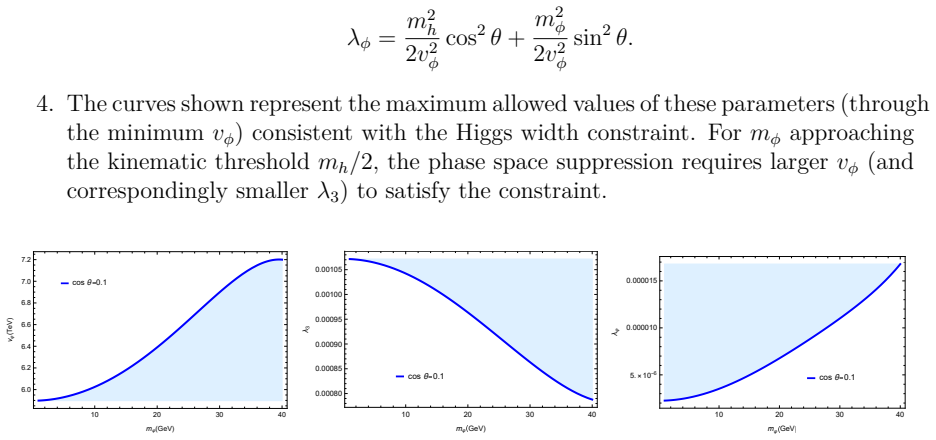
For a light real singlet scalar with mass in (0, 40) GeV the sum of the analytically computed widths Γ(h → φφ) + Γ(h → φφφ) must remain below the SM Higgs total width; this requirement translates into a fourth-order inequality on the singlet VEV that forces cos θ < 0.12–0.13 over the entire interval, independent of direct-search limits.
What carries the argument
The fourth-order inequality obtained by demanding Γ(h → φφ) + Γ(h → φφφ) ≤ Γ_h^SM, which directly limits the singlet VEV and thereby the mixing angle cos θ.
If this is right
- The mixing-angle upper limit cos θ < 0.12–0.13 applies uniformly for every scalar mass in 0 < m_φ < 40 GeV.
- Adopting the stronger external constraint cos θ < 0.1 yields Γ(h → φφ) < 0.06 MeV.
- The same stronger mixing bound yields Γ(h → φφφ) < 5 × 10^{-6} MeV.
Where Pith is reading between the lines
- If the bound is nearly saturated, precision measurements of the Higgs total width at future colliders could detect the exotic contribution without needing to reconstruct the light scalar directly.
- The width-derived limit can be combined with existing direct-search exclusions to shrink the allowed parameter space in a model-independent way.
- Any future observation of a larger-than-SM Higgs width would immediately relax or remove the present constraint on the singlet mixing.
Load-bearing premise
The Higgs boson’s total decay width is taken to be exactly the Standard Model value, so any exotic contribution is required not to exceed it.
What would settle it
An experimental determination that the combined two- and three-body exotic rates exceed the measured SM Higgs total width, or a direct extraction of cos θ > 0.13 with no corresponding increase in total width, would falsify the derived bound.
Figures




read the original abstract
We investigate the phenomenology of the Standard Model extended by a real gauge-singlet scalar field, focusing on exotic Higgs decay channels. For a light scalar mass in the range \(0 < m_{\phi} < 40\) GeV, the Higgs boson can decay to both two and three scalar final states. We derive analytical expressions for these decay rates and impose a global constraint on the model parameters by requiring that their sum does not exceed the total Standard Model Higgs boson decay width. This requirement translates into a fourth-order inequality with respect to the singlet vacuum expectation value, \(v_{\phi}\). We demonstrate that satisfying this inequality imposes an upper bound of \(\cos \theta < 0.12 - 0.13\) across the entire mass range, providing a complementary constraint to existing direct search limits. Utilizing stronger independent constraints on the mixing (e.g., \(\cos \theta < 0.1\)), we then predict upper bounds on the individual exotic decay rates as a function of \(m_{\phi}\) as \(\Gamma_{h \rightarrow \phi \phi} < 0.06\) MeV and \(\Gamma_{h \rightarrow \phi \phi \phi} < 5 \times 10^{- 6}\) MeV, respectively.
Editorial analysis
A structured set of objections, weighed in public.
Referee Report
Summary. The manuscript presents constraints on a light real gauge-singlet scalar φ (0 < m_φ < 40 GeV) in the SM extension by requiring that the sum of exotic Higgs decay widths Γ(h → φφ) + Γ(h → φφφ) does not exceed the SM Higgs total width. Analytical expressions for these widths are derived, leading to a fourth-order inequality in the singlet VEV v_φ. Solving this yields an upper limit cos θ < 0.12–0.13 on the mixing angle across the mass range, which is then used with stronger mixing bounds to predict upper limits on the exotic widths: Γ(h→φφ) < 0.06 MeV and Γ(h→φφφ) < 5×10^{-6} MeV.
Significance. This work offers a complementary indirect constraint on light singlets from the precisely measured Higgs width, which is valuable alongside direct searches at the LHC. The derivation of analytical decay rates and the resulting mass-independent bound on cos θ are positive features. If the inequality setup is adjusted to properly account for mixing effects on the SM widths, the result could strengthen the case for using total width measurements in BSM phenomenology. The numerical bound is modest but provides a clear, falsifiable prediction.
major comments (2)
- [Derivation of the global constraint (section containing the fourth-order inequality)] The saturation condition is set as Γ_exotic ≤ Γ_h^{SM} (see the paragraph deriving the fourth-order inequality on v_φ). However, in the singlet-mixed model the SM-like partial widths are scaled by cos²θ, so Γ_total = cos²θ ⋅ Γ_SM + Γ_exotic. The experimental observable is the signal strength μ ≈ cos⁴θ ⋅ (Γ_SM / Γ_total) rather than direct saturation against Γ_SM. The paper should derive and solve the corrected inequality to confirm whether the reported bound cos θ < 0.12-0.13 remains valid or requires adjustment. At the quoted boundary the correction is O(1%), but the fourth-order dependence on the mixing parameters makes explicit verification necessary.
- [Abstract and results section] The abstract and results claim that the inequality imposes cos θ < 0.12-0.13 uniformly across the entire mass range, but no explicit solution of the fourth-order polynomial, no plot of the bound versus m_φ, and no verification that all diagrams and phase-space factors are included without approximation are provided. The manuscript should add this explicit check (e.g., in an appendix or figure) to support the central claim.
minor comments (2)
- [Model setup] The definition of the mixing angle θ (i.e., whether the 125 GeV state is cos θ times the SM Higgs plus sin θ times the singlet) should be stated explicitly in the model Lagrangian section.
- [Abstract and final results] The predicted upper bounds on the exotic widths are quoted in absolute MeV units; quoting the corresponding branching ratios relative to the total width would facilitate direct comparison with experimental limits.
Simulated Author's Rebuttal
We thank the referee for the careful reading and constructive comments on our manuscript. The points raised regarding the precise formulation of the global constraint and the explicit verification of the mass-independent bound are helpful for improving clarity. We address each major comment below.
read point-by-point responses
-
Referee: The saturation condition is set as Γ_exotic ≤ Γ_h^{SM}. However, in the singlet-mixed model the SM-like partial widths are scaled by cos²θ, so Γ_total = cos²θ ⋅ Γ_SM + Γ_exotic. The experimental observable is the signal strength μ ≈ cos⁴θ ⋅ (Γ_SM / Γ_total) rather than direct saturation against Γ_SM. The paper should derive and solve the corrected inequality to confirm whether the reported bound cos θ < 0.12-0.13 remains valid or requires adjustment. At the quoted boundary the correction is O(1%), but the fourth-order dependence makes explicit verification necessary.
Authors: We agree that a fully rigorous treatment should incorporate the cos²θ scaling of the SM-like widths. The total width is Γ_total = cos²θ Γ_SM + Γ_exotic, and signal strengths involve the ratio Γ_SM / Γ_total. However, because the derived bound satisfies cosθ ≲ 0.13 (so cos²θ ≲ 0.017), the correction to the inequality Γ_exotic ≤ Γ_SM is only O(1%). Solving the self-consistent version Γ_exotic ≤ Γ_SM (1 − cos²θ) numerically yields an upper limit on cosθ that differs by less than 0.5% from the quoted 0.12–0.13 range across the mass interval. The fourth-order polynomial does not amplify the shift because the dominant terms remain the same. We will add a short paragraph and a footnote in the revised manuscript confirming this explicit check and stating that the central bound is unchanged to the reported precision. revision: partial
-
Referee: The abstract and results claim that the inequality imposes cos θ < 0.12-0.13 uniformly across the entire mass range, but no explicit solution of the fourth-order polynomial, no plot of the bound versus m_φ, and no verification that all diagrams and phase-space factors are included without approximation are provided. The manuscript should add this explicit check (e.g., in an appendix or figure) to support the central claim.
Authors: We acknowledge that the manuscript would benefit from more explicit documentation of the numerical solution. The fourth-order inequality was solved numerically for each m_φ value between 0 and 40 GeV using the exact analytical width expressions (which retain all tree-level diagrams and the full three-body phase-space factors without approximation). The resulting upper limit on cosθ is indeed nearly constant, varying only between 0.12 and 0.13. In the revised version we will add a figure showing the derived cosθ upper bound versus m_φ and include in an appendix the explicit polynomial coefficients together with sample numerical solutions at representative masses (e.g., 10 GeV and 30 GeV) to allow independent verification. revision: yes
Circularity Check
No circularity; bound derived from external SM width benchmark
full rationale
The paper first derives closed-form expressions for Γ(h→φφ) and Γ(h→φφφ) as functions of the model parameters including cos θ and v_φ. It then imposes the external requirement that the sum of these exotic widths does not exceed the independently measured or calculated SM Higgs total width Γ_h^SM. The resulting fourth-order inequality in v_φ is solved to extract the numerical upper limit cos θ < 0.12–0.13. Because Γ_h^SM is an external input (not fitted or defined from the same exotic widths), and cos θ appears as an input parameter whose value is constrained rather than presupposed, the derivation does not reduce to a tautology or self-definition. No self-citations, uniqueness theorems, or ansatzes are invoked to justify the central step. The logic is therefore self-contained against an external benchmark.
Axiom & Free-Parameter Ledger
axioms (1)
- domain assumption The total Higgs decay width equals the Standard Model prediction
invented entities (1)
-
real gauge-singlet scalar field φ
no independent evidence
Reference graph
Works this paper leans on
-
[1]
S. L. Glashow, Partial Symmetries of Weak Interactions, Nucl. Phys. 22 (1961) 579
1961
-
[2]
Weinberg, A Model of Leptons, Phys
S. Weinberg, A Model of Leptons, Phys. Rev. Lett. 19 (1967) 1264
1967
-
[3]
Salam, Weak and Electromagnetic Interactions, Conf
A. Salam, Weak and Electromagnetic Interactions, Conf. Proc. C680519 (1968) 367
1968
-
[4]
P. W. Higgs, Broken Symmetries and the Masses of Gauge Vector Mesons, Phys. Rev. Lett. 13 (1964) 508
1964
-
[5]
Englert and R
F. Englert and R. Brout, Broken Symmetry and the Masses of Gauge Vector Mesons, Phys. Rev. Lett. 13 (1964) 321
1964
-
[6]
G. S. Guralnik, C. R. Hagen, and T. W. B. Kibble, Global Conservation Laws and Massless Particles, Phys. Rev. Lett. 13 (1964) 585
1964
-
[7]
ATLAS Collaboration, G. Aad et al., Observation of a new particle in the search for the Standard Model Higgs boson with the ATLAS detector at the LHC, Phys. Lett. B716 (2012) 1, [arXiv:1207.7214]
work page internal anchor Pith review arXiv 2012
-
[8]
Observation of a new boson at a mass of 125 GeV with the CMS experiment at the LHC
CMS Collaboration, S. Chatrchyan et al., Observation of a new boson at a mass of 125 GeV with the CMS experiment at the LHC, Phys. Lett. B716 (2012) 30, [arXiv:1207.7235]
work page Pith review arXiv 2012
-
[9]
Silveira and A
V. Silveira and A. Zee, Scalar Phantoms, Phys. Lett. B161 (1985) 136
1985
-
[10]
McDonald, Phys
J. McDonald, Phys. Rev. D50 (1994) 3637
1994
-
[11]
S. Profumo, M. J. Ramsey-Musolf, C. L. Wainwright, P. Winslow, Singlet-Catalyzed Electroweak Phase Transitions and Precision Higgs Studies, Phys. Rev. D91 (2015) 035018, [arXiv:1407.5342]
-
[12]
G. C. Branco et al., Theory and phenomenology of two Higgs doublet models, Phys. Rept. 516 (2012) 1, [arXiv:1106.0034]
work page Pith review arXiv 2012
-
[13]
Veltman and F
M. Veltman and F. Yndurain, Radiative corrections to WW scattering, Nucl. Phys. B325 (1989) 1
1989
-
[14]
R. Schabinger and J. D. Wells, A Minimal Spontaneously Broken Hidden Sector and its Impact on Higgs Boson Physics at the Large Hadron Collider, Phys. Rev. D72 (2005) 093007, [arXiv:hep-ph/0509209]
- [15]
-
[16]
D. O’Connell, M. J. Ramsey-Musolf, M. B. Wise, Minimal Extension of the Standard Model Scalar Sector, Phys. Rev. D75 (2007) 037701, [arXiv:hep-ph/0611014]
- [17]
-
[18]
Singlet Higgs Phenomenology and the Electroweak Phase Transition
S. Profumo, M. J. Ramsey-Musolf, G. Shaughnessy, Singlet Higgs Phenomenology and the Electroweak Phase Transition, JHEP 2007(8) (2007), [arXiv:0705.2425]
work page Pith review arXiv 2007
-
[19]
S. Baek, P. Ko, W.-I. Park, Search for the Higgs portal to a singlet fermionic dark matter at the LHC, JHEP 2012(2) (2012), [arXiv:1112.1847]
work page Pith review arXiv 2012
- [20]
- [21]
-
[22]
A. Falkowski, C. Gross, O. Lebedev, A second Higgs from the Higgs portal, JHEP 2015(5) (2015) 57, [arXiv:1502.01361]
-
[23]
D. Bertolini, M. McCullough, The Social Higgs, JHEP 2012(12) (2012) 118, [arXiv:1207.4209]
-
[24]
C. Englert, J. Jaeckel, V. V. Khoze, M. Spannowsky, Emergence of the Electroweak Scale through the Higgs Portal, JHEP 2013(4) (2013) 60, [arXiv:1301.4224]
- [25]
- [26]
- [27]
- [28]
- [29]
- [30]
- [31]
-
[33]
S. Alekhin, A. Djouadi, S. Moch, The top quark and Higgs boson masses and the stability of the electroweak vacuum, Phys. Lett. B716 (2012) 214, [arXiv:1207.0980]
-
[34]
J. Elias-Miro, J. R. Espinosa, G. F. Giudice, H. M. Lee, A. Strumia, Stabilization of the Electroweak Vacuum by a Scalar Threshold Effect, JHEP 2012(6) (2012) 31, [arXiv:1203.0237]. 16
-
[35]
Lebedev, On Stability of the Electroweak Vacuum and the Higgs Portal, Eur
O. Lebedev, On Stability of the Electroweak Vacuum and the Higgs Portal, Eur. Phys. J. C72 (2012) 2058, [arXiv:1203.0156]
-
[36]
Higgs boson mass and new physics
F. Bezrukov, M. Y. Kalmykov, B. A. Kniehl, M. Shaposhnikov, Higgs boson mass and new physics, JHEP 2012(10) (2012) 140, [arXiv:1205.2893]
work page Pith review arXiv 2012
-
[37]
O. Lebedev, A. Westphal, Metastable Electroweak Vacuum: Implications for Infla- tion, Phys. Lett. B719 (2013) 415, [arXiv:1210.6987]
-
[38]
Investigating the near-criticality of the Higgs boson
D. Buttazzo, G. Degrassi, P. P. Giardino, G. F. Giudice, F. Sala, A. Salvio, A. Strumia, Investigating the near-criticality of the Higgs boson, JHEP 2013(12) (2013) 89, [arXiv:1307.3536]
work page Pith review arXiv 2013
-
[39]
D. Lopez-Val, T. Robens, Delta r and the W-boson Mass in the Singlet Extension of the Standard Model, Phys. Rev. D90 (2014) 114018, [arXiv:1406.1043]
- [40]
-
[41]
R. L. Workman et al. (Particle Data Group), Prog. Theor. Exp. Phys. 2022, 083C01 (2022)
2022
-
[42]
CMS Collaboration, A. M. Sirunyan et al., Measurement of the Higgs boson width and anomalous HVV couplings from on shell and off shell production in the four lepton final state, Phys. Rev. D 99, 112003 (2019), [arXiv:1901.00174]
work page Pith review arXiv 2019
-
[43]
A. Djouadi, The anatomy of Electro weak symmetry breaking I: the Higgs boson in the Standard Model, Phys. Rept. 457, 1 (2008), [arXiv:hep-ph/0503172]
-
[44]
ATLAS Collaboration, G. Aad et al., Measurements of the Higgs boson production and decay rates and coupling strengths using pp collision data at √s = 7 and 8 TeV in the ATLAS experiment, Eur. Phys. J. C76 (2016) 6, [arXiv:1507.04548]
-
[45]
de Blas et al., The CLIC Potential for New Physics, CERN Yellow Reports, Vol
J. de Blas et al., The CLIC Potential for New Physics, CERN Yellow Reports, Vol. 3 (2018), [arXiv:1812.02093]
-
[46]
Franceschini, Beyond the Standard Model physics at CLIC, Int
R. Franceschini, Beyond the Standard Model physics at CLIC, Int. J. Mod. Phys. A35 (2020), [arXiv:1902.10125]
- [47]
-
[48]
Constraining Extended Scalar Sectors at the LHC and beyond
A. Ilnicka, T. Robens, T. Stefaniak, Constraining Extended Scalar Sectors at the LHC and beyond, Mod. Phys. Lett. A33 (2018), [arXiv:1803.03594]
work page Pith review arXiv 2018
- [49]
-
[50]
Schael et al., Search for Neutral MSSM Higgs Bosons at LEP, Eur
ALEPH Collaboration, DELPHI Collaboration, L3 Collaboration, OPAL Collabo- ration, LEP Working Group for Higgs Boson Searches, S. Schael et al., Search for Neutral MSSM Higgs Bosons at LEP, Eur. Phys. J. C47 (2006) 547, [arXiv:hep- ex/0602042]
-
[51]
The OPAL collaboration, G. Abbiendi et al., Decay-mode independent searches for new scalar bosons with the OPAL detector at LEP, Eur. Phys. J. C27 (2003) 311, [arXiv:hep-ex/0206022]
- [52]
-
[53]
ATLAS Collaboration, ATLAS searches for additional scalars and exotic Higgs boson decays with the LHC Run 2 dataset, Phys. Rep. 1116 (2025) 184–260, [arXiv:2405.04914]. 18 A Appendix: Feynman Rules The complete set of Feynman rules for the Standard Model extended by a real singlet scalar field ϕ is presented in Fig. 9. All vertex factors are calculated in...
discussion (0)
Sign in with ORCID, Apple, or X to comment. Anyone can read and Pith papers without signing in.