Blazar flares from plasma blobs crossing the broad-line region
Pith reviewed 2026-05-07 07:48 UTC · model grok-4.3
The pith
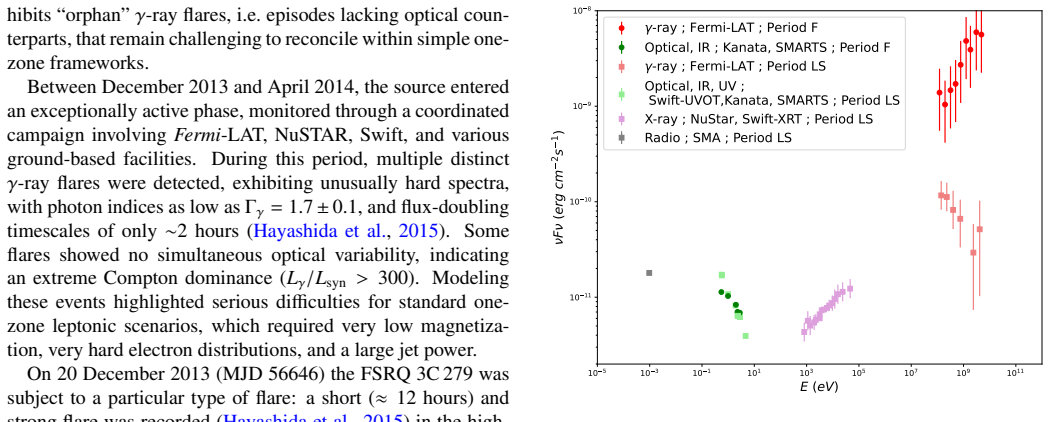
An accelerating plasma blob crossing the broad-line region reproduces the orphan gamma-ray flare in 3C 279.
A machine-rendered reading of the paper's core claim, the machinery that carries it, and where it could break.
Core claim
The flare is produced by the variation of the external photon field in the frame of an accelerating plasma blob as it crosses the broad-line region, reaching its terminal Lorentz factor near the inner radius of the BLR. A stationary region outside the dusty torus accounts for the quiescent emission, and the blob contributes negligible optical variability. This setup, modeled with the EMBLEM code, reproduces the short intense gamma-ray flare, hard spectrum, time-asymmetric light curve, and lack of optical changes.
What carries the argument
Two-zone emission model consisting of a stationary region and an accelerating plasma blob, with radiative output computed including synchrotron, synchrotron self-Compton, external inverse-Compton scattering of BLR photons, bulk acceleration, adiabatic expansion, and Fokker-Planck electron evolution.
If this is right
- The model predicts a delayed enhancement in EUV and X-ray emission once the blob exits the BLR.
- Very-high-energy gamma-rays, if present, would be delayed compared to the Fermi-LAT flare.
- Bulk acceleration in the jet offers a natural explanation for asymmetric high-energy flares in blazars without ad hoc particle injection.
- Similar flare events may occur in other blazars when plasma blobs cross their broad-line regions.
Where Pith is reading between the lines
- This mechanism could explain other orphan flares or rapid variability in blazars if multi-wavelength monitoring confirms the predicted delays in lower-energy bands.
- Locating the acceleration zone near the BLR radius suggests constraints on jet launching models in active galactic nuclei.
- Application to other events might test whether external photon field variations dominate over internal processes in certain flares.
Load-bearing premise
The plasma blob reaches its terminal Lorentz factor near the inner radius of the BLR while itself producing negligible optical variability, so that gamma-ray output is dominated by external photon field changes.
What would settle it
Observation of a delayed EUV or X-ray flux increase following the gamma-ray flare, or the absence of such a delay if the model is incorrect.
Figures


read the original abstract
The blazar 3C 279 is well known for its rapid and large-amplitude variability. On 20 December 2013, the source exhibited an orphan {\gamma}-ray flare characterized by a flux-doubling timescale of a few hours, a very hard spectrum, a time-asymmetric light curve with a slow decay, and no significant optical variability. We propose a new interpretation of this event based on a two-zone scenario in which a stationary emission region produces the quiescent emission, while a second zone accelerates within the broad-line region(BLR). We compute the time-dependent radiative output of both zones with the EMBLEM code, including synchrotron, synchrotron self-Compton, and external inverse-Compton processes, as well as bulk acceleration, adiabatic expansion, and a Fokker-Planck treatment of the electron distribution. This is the first attempt to precisely model the asymmetric {\gamma}-ray flux evolution during this flare. A model with a stationary region outside the dusty torus and an accelerating plasma blob reproduces the main features of the event: a short and intense {\gamma}-ray flare with a hard spectrum and no optical counterpart. The flare results from the variation of the external photon field in the blob frame as the blob crosses the BLR and reaches its terminal Lorentz factor not far from the inner radius of the BLR. Bulk acceleration and the propagation of a plasma blob within the jet provide a natural mechanism for producing high-energy flares and asymmetric light curves without requiring an ad hoc time-dependent particle injection. The model predictsa delayed EUV/X-ray enhancement once the blob exits the BLR. No very-high-energy data are available for this event, but if {\gamma}-rays were emitted in this band, a delay would be expected with respect to the Fermi-LAT flare.
Editorial analysis
A structured set of objections, weighed in public.
Referee Report
Summary. The paper proposes a two-zone leptonic model for the 20 December 2013 orphan gamma-ray flare in 3C 279. A stationary emission zone outside the dusty torus produces the quiescent multi-wavelength emission, while a second zone consisting of an accelerating plasma blob crossing the broad-line region (BLR) accounts for the short, intense, hard-spectrum gamma-ray flare with asymmetric light curve and no optical counterpart. The time-dependent radiative output is computed with the EMBLEM code, incorporating synchrotron, synchrotron self-Compton, external inverse-Compton, bulk acceleration, adiabatic expansion, and a Fokker-Planck treatment of the electron distribution. The flare is attributed to the rapid change in external photon density in the blob frame as the blob traverses the BLR and reaches its terminal Lorentz factor near the inner BLR radius.
Significance. If validated, the model supplies a physically motivated mechanism for asymmetric, orphan gamma-ray flares that does not rely on ad-hoc time-dependent particle injection. It naturally links jet bulk acceleration and BLR crossing to the observed flare properties and makes a testable prediction of a delayed EUV/X-ray enhancement once the blob exits the BLR. The use of standard radiative processes within a time-dependent code is a methodological strength, though the absence of quantitative fit metrics limits the immediate impact.
major comments (3)
- [Section 4] Section 4 (Results): The claim that the model reproduces the main observed features of the flare rests on qualitative visual agreement between the computed light curve and the Fermi-LAT data. No quantitative goodness-of-fit statistics (reduced chi-squared, residual plots, or Kolmogorov-Smirnov tests) or parameter uncertainties are reported for either the gamma-ray light curve or the spectrum, which is load-bearing for the central assertion that the chosen acceleration profile and BLR crossing produce the observed asymmetry and hardness.
- [Section 3.2] Section 3.2 (Model parameters): The bulk acceleration law is specified such that the blob reaches its terminal Lorentz factor on a scale comparable to the inner BLR radius. No sensitivity analysis is presented showing how changes in the acceleration profile (e.g., slower ramp-up) affect the gamma-ray light-curve asymmetry or the required electron-injection parameters, yet this tuning is essential to the mechanism.
- [Section 4.2] Section 4.2 (Multi-wavelength comparison): The model asserts that the blob's synchrotron and SSC components remain below the observed optical limits while external Compton dominates the gamma-rays. Explicit plots of the predicted optical light curve from the blob, together with direct comparison to the reported optical upper limits during the flare, are not provided; without these, it is difficult to verify that the chosen magnetic-field strength and electron distribution satisfy the orphan-flare condition.
minor comments (3)
- [Table 1] Table 1 (or equivalent parameter table): Include the full set of adopted values with explored ranges or uncertainties rather than single-point values; this would improve reproducibility.
- [Figure 5] Figure 5 (or equivalent light-curve figure): Add a panel or inset showing the separate contributions of the stationary zone, blob synchrotron, and blob external-Compton components to clarify the origin of the optical non-variability.
- [Section 5] The abstract states that the model predicts a delayed EUV/X-ray enhancement; this prediction should be quantified with a specific time delay and expected flux level in the main text for falsifiability.
Simulated Author's Rebuttal
We are grateful to the referee for the constructive and detailed review, as well as for recognizing the physical motivation and testable predictions of our two-zone model. We address each major comment point by point below. We have revised the manuscript to incorporate the requested quantitative comparisons, sensitivity analysis, and additional figures.
read point-by-point responses
-
Referee: [Section 4] Section 4 (Results): The claim that the model reproduces the main observed features of the flare rests on qualitative visual agreement between the computed light curve and the Fermi-LAT data. No quantitative goodness-of-fit statistics (reduced chi-squared, residual plots, or Kolmogorov-Smirnov tests) or parameter uncertainties are reported for either the gamma-ray light curve or the spectrum, which is load-bearing for the central assertion that the chosen acceleration profile and BLR crossing produce the observed asymmetry and hardness.
Authors: We acknowledge that the original presentation relies primarily on visual agreement. In the revised manuscript we will add residual plots for the gamma-ray light curve and report a reduced chi-squared value for the flare-peak spectrum. While a full statistical parameter uncertainty analysis is challenging in this time-dependent multi-process simulation with many coupled physical parameters, we will expand the discussion of model robustness (see response to the next comment) to better support the central claims. revision: yes
-
Referee: [Section 3.2] Section 3.2 (Model parameters): The bulk acceleration law is specified such that the blob reaches its terminal Lorentz factor on a scale comparable to the inner BLR radius. No sensitivity analysis is presented showing how changes in the acceleration profile (e.g., slower ramp-up) affect the gamma-ray light-curve asymmetry or the required electron-injection parameters, yet this tuning is essential to the mechanism.
Authors: We agree that a sensitivity study is necessary to demonstrate the robustness of the proposed mechanism. The revised manuscript will include a new figure and accompanying text that varies the acceleration length scale and shows the resulting impact on light-curve asymmetry and the required electron-injection parameters. This analysis will confirm that the chosen profile is required to reproduce the observed slow decay while preserving the hard spectrum. revision: yes
-
Referee: [Section 4.2] Section 4.2 (Multi-wavelength comparison): The model asserts that the blob's synchrotron and SSC components remain below the observed optical limits while external Compton dominates the gamma-rays. Explicit plots of the predicted optical light curve from the blob, together with direct comparison to the reported optical upper limits during the flare, are not provided; without these, it is difficult to verify that the chosen magnetic-field strength and electron distribution satisfy the orphan-flare condition.
Authors: We will add an explicit figure in the revised Section 4.2 showing the predicted optical light curve (synchrotron plus SSC) from the blob component, directly overlaid with the reported optical upper limits during the flare. This will verify that the non-thermal optical emission remains below the limits while external Compton accounts for the gamma-ray flare, thereby confirming the orphan-flare condition for the chosen parameters. revision: yes
Circularity Check
No significant circularity; model is a physically motivated simulation with tuned parameters but independent content
full rationale
The paper's derivation chain consists of implementing standard radiative processes (synchrotron, SSC, external Compton) plus bulk acceleration, adiabatic expansion, and Fokker-Planck electron evolution inside the EMBLEM code, then propagating a plasma blob through a spatially varying BLR photon field. The asymmetric gamma-ray light curve and orphan nature emerge from the geometry of the crossing combined with the chosen acceleration profile reaching terminal Lorentz factor near the BLR inner radius; these are not defined into the equations but result from solving the time-dependent transport equations under physically motivated boundary conditions. The delayed EUV/X-ray prediction is a genuine forward consequence once the blob exits the BLR. Parameter choices (acceleration law, blob size, magnetic field) are adjusted to match the 2013 3C 279 event, but this is ordinary model calibration rather than a self-definitional loop or a fitted input relabeled as prediction. No load-bearing self-citation, uniqueness theorem, or ansatz smuggling is present in the derivation; the central claim remains falsifiable against future multi-wavelength data.
Axiom & Free-Parameter Ledger
free parameters (3)
- blob acceleration profile and terminal Lorentz factor
- initial blob radius and expansion rate
- electron injection spectrum and magnetic field strength in the blob
axioms (2)
- domain assumption The external radiation field experienced by the blob is dominated by BLR photons whose density and spectrum change sharply as the blob crosses the region.
- domain assumption The stationary emission zone lies outside the dusty torus and contributes only to the quiescent flux.
Reference graph
Works this paper leans on
-
[1]
write newline
" write newline "" before.all 'output.state := FUNCTION n.dashify 't := "" t empty not t #1 #1 substring "-" = t #1 #2 substring "--" = not "--" * t #2 global.max substring 't := t #1 #1 substring "-" = "-" * t #2 global.max substring 't := while if t #1 #1 substring * t #2 global.max substring 't := if while FUNCTION word.in bbl.in ":" * " " * FUNCTION f...
-
[2]
author Abdo , A.A. , author Ackermann , M. , author Ajello , M. , et al. , year 2010 . journal ApJ volume 710 , pages 810--827 . :10.1088/0004-637X/710/1/810
-
[3]
author Ackermann , M. , author Anantua , R. , author Asano , K. , et al. , year 2016 . journal ApJl volume 824 , pages L20 . :10.3847/2041-8205/824/2/L20
-
[4]
arXiv , Author =:1110.1793 , Journal =
author Asada , K. , author Nakamura , M. , year 2012 . journal ApJl volume 745 , pages L28 . :10.1088/2041-8205/745/2/L28
-
[5]
author Asada , K. , author Nakamura , M. , author Doi , A. , et al. , year 2014 . journal ApJl volume 781 , pages L2 . :10.1088/2041-8205/781/1/L2
-
[6]
author Baczko , A.K. , author Ros , E. , author Kadler , M. , et al. , year 2022 . journal A&A volume 658 , pages A119 . :10.1051/0004-6361/202141897
-
[7]
author Begelman, M.C. , author Blandford, R.D. , author Rees, M.J. , year 1984 . journal Rev. Mod. Phys. volume 56 , pages 255--351 . :10.1103/RevModPhys.56.255
-
[8]
author Begelman , M.C. , author Li , Z.Y. , year 1994 . journal ApJ volume 426 , pages 269 . :10.1086/174061
-
[9]
author Beskin, V.S. , author Nokhrina, E.E. , year 2006 . journal MNRAS volume 367 , pages 375--386 . :10.1111/j.1365-2966.2006.09957.x
-
[10]
author Bloom , S.D. , author Fromm , C.M. , author Ros , E. , year 2013 . journal AJ volume 145 , pages 12 . :10.1088/0004-6256/145/1/12
-
[11]
author Burbidge , E.M. , author Rosenberg , F.D. , year 1965 . journal ApJ volume 142 , pages 1673 . :10.1086/148458
-
[12]
author Burd , P.R. , author Kadler , M. , author Mannheim , K. , et al. , year 2022 . journal A&A volume 660 , pages A1 . :10.1051/0004-6361/202142363
-
[13]
author Bottcher, M. , author Els, P. , year 2016 . journal AJ volume 821 , pages 102 . :10.3847/0004-637X/821/2/102
-
[14]
author Calderone , G. , author Sbarrato , T. , author Ghisellini , G. , year 2012 . journal MNRAS volume 425 , pages L41--L45 . :10.1111/j.1745-3933.2012.01296.x
-
[15]
, year 1987
author Camenzind , M. , year 1987 . journal A&A volume 184 , pages 341--360
1987
-
[16]
, author Cerruti, M
author Dermer, C.D. , author Cerruti, M. , author Lott, B. , et al. , year 2014 . journal ApJ volume 782 , pages 82
2014
-
[17]
author Dmytriiev , A. , author B \"o ttcher , M. , year 2024 . journal A&A volume 687 , pages A64 . :10.1051/0004-6361/202348269
-
[18]
author Dmytriiev , A. , author B \"o ttcher , M. , author Machipi , T.O. , year 2023 . journal ApJ volume 949 , pages 28 . :10.3847/1538-4357/acc57b
-
[19]
doi:10.1093/mnras/stab1445 , archiveprefix =
author Dmytriiev , A. , author Sol , H. , author Zech , A. , year 2021 . journal MNRAS volume 505 , pages 2712--2730 . :10.1093/MNRAS/stab1445
-
[20]
V., Melchior, A.-L., & Zolotukhin, I
author Dom \' nguez , A. , author Primack , J.R. , author Rosario , D.J. , et al. , year 2011 . journal MNRAS volume 410 , pages 2556--2578 . :10.1111/j.1365-2966.2010.17631.x
-
[21]
author Finke , J.D. , year 2016 . journal ApJ volume 830 , pages 94 . :10.3847/0004-637X/830/2/94
-
[22]
author Ghisellini , G. , author Tavecchio , F. , year 2009 . journal MNRAS volume 397 , pages 985--1002 . :10.1111/j.1365-2966.2009.15007.x
-
[23]
author H. E. S. S. Collaboration , author Abdalla , H. , author Adam , R. , et al. , year 2019 . journal A&A volume 627 , pages A159 . :10.1051/0004-6361/201935704
-
[24]
author Hada, K. , author Doi, A. , author Wajima, K. , et al. , year 2018 . journal AJ volume 860 , pages 141 . :10.3847/1538-4357/aac49f
-
[25]
author Hayashida , M. , author Madejski , G.M. , author Nalewajko , K. , et al. , year 2012 . journal ApJ volume 754 , pages 114 . :10.1088/0004-637X/754/2/114
-
[26]
author Hayashida , M. , author Nalewajko , K. , author Madejski , G.M. , et al. , year 2015 . journal ApJ volume 807 , pages 79 . :10.1088/0004-637X/807/1/79
-
[27]
author Homan , D.C. , author Kadler , M. , author Kellermann , K.I. , et al. , year 2009 . journal ApJ volume 706 , pages 1253--1268 . :10.1088/0004-637X/706/2/1253
-
[28]
author Jorstad , S.G. , author Marscher , A.P. , author Morozova , D.A. , et al. , year 2017 . journal ApJ volume 846 , pages 98 . :10.3847/1538-4357/aa8407
-
[29]
, year 1962
author Kardashev , N.S. , year 1962 . journal Sov. Astron. volume 6 , pages 317
1962
-
[30]
author Kiehlmann , S. , author Savolainen , T. , author Jorstad , S.G. , et al. , year 2016 . journal A&A volume 590 , pages A10 . :10.1051/0004-6361/201527725
-
[31]
author Kim , J.Y. , author Krichbaum , T.P. , author Broderick , A.E. , et al. , year 2020 . journal A&A volume 640 , pages A69 . :10.1051/0004-6361/202037493
-
[32]
author Komissarov , S.S. , year 2011 . journal Mem. Soc. Astron. Ital. volume 82 , pages 95 . :10.48550/arXiv.1006.2242
-
[33]
author Komissarov , S.S. , author Vlahakis , N. , author K \"o nigl , A. , et al. , year 2009 . journal MNRAS volume 394 , pages 1182--1212 . :10.1111/j.1365-2966.2009.14410.x
-
[34]
author Kushwaha , P. , author Sahayanathan , S. , author Lekshmi , R. , et al. , year 2014 a. journal MNRAS volume 442 , pages 131--137 . :10.1093/mnras/stu836
-
[35]
author Kushwaha , P. , author Singh , K.P. , author Sahayanathan , S. , year 2014 b. journal ApJ volume 796 , pages 61 . :10.1088/0004-637X/796/1/61
-
[36]
author Lewis , T.R. , author Finke , J.D. , author Becker , P.A. , year 2019 . journal ApJ volume 884 , pages 116 . :10.3847/1538-4357/ab43c3
-
[37]
author Li , Z.Y. , author Chiueh , T. , author Begelman , M.C. , year 1992 . journal ApJ volume 394 , pages 459 . :10.1086/171597
-
[38]
author Lister , M.L. , author Aller , M.F. , author Aller , H.D. , et al. , year 2018 . journal ApJs volume 234 , pages 12 . :10.3847/1538-4365/aa9c44
-
[39]
Parsec-scale AGN Jet Kinematics Analysis Based on 19 years of VLBA Observations at 15 GHz
author Lister , M.L. , author Aller , M.F. , author Aller , H.D. , et al. , year 2016 . journal AJ volume 152 , pages 12 . :10.3847/0004-6256/152/1/12
-
[40]
author Lister , M.L. , author Homan , D.C. , author Kellermann , K.I. , et al. , year 2021 . journal ApJ volume 923 , pages 30 . :10.3847/1538-4357/ac230f
-
[41]
author Lyubarsky, Y. , year 2009 . journal AJ volume 698 , pages 1570 . :10.1088/0004-637X/698/2/1570
-
[42]
author MAGIC Collaboration , author Albert , J. , author Aliu , E. , et al. , year 2008 . journal Science volume 320 , pages 1752 . :10.1126/science.1157087
-
[43]
arXiv , Author =:1308.1436 , Journal =
author Nakamura , M. , author Asada , K. , year 2013 . journal ApJ volume 775 , pages 118 . :10.1088/0004-637X/775/2/118
-
[44]
author Nilsson , K. , author Pursimo , T. , author Villforth , C. , et al. , year 2009 . journal A&A volume 505 , pages 601--604 . :10.1051/0004-6361/200912820
-
[45]
author Paliya , V.S. , author Diltz , C. , author B \"o ttcher , M. , et al. , year 2016 . journal ApJ volume 817 , pages 61 . :10.3847/0004-637X/817/1/61
-
[46]
2021, , 909, 76, 10.3847/1538-4357/abd6ee
author Park , J. , author Hada , K. , author Nakamura , M. , et al. , year 2021 . journal ApJ volume 909 , pages 76 . :10.3847/1538-4357/abd6ee
-
[47]
author Patel , S.R. , author Bose , D. , author Gupta , N. , et al. , year 2021 . journal Journal of High Energy Astrophysics volume 29 , pages 31--39 . :10.1016/j.jheap.2020.12.001
-
[48]
author Pushkarev , A.B. , author Hovatta , T. , author Kovalev , Y.Y. , et al. , year 2012 . journal A&A volume 545 , pages A113 . :10.1051/0004-6361/201219173
-
[49]
author Pushkarev, A.B. , author Kovalev, Y.Y. , author Lister, M.L. , et al. , year 2009 . journal A&A volume 507 , pages L33--L36 . :10.1051/0004-6361/200913422
-
[50]
author Pushkarev , A.B. , author Kovalev , Y.Y. , author Lister , M.L. , et al. , year 2017 . journal MNRAS volume 468 , pages 4992--5003 . :10.1093/MNRAS/stx854
-
[51]
2012, MNRAS, 420, 1825, doi: 10.1111/j.1365-2966.2011.19805.x
author Sahayanathan , S. , author Godambe , S. , year 2012 . journal MNRAS volume 419 , pages 1660--1666 . :10.1111/j.1365-2966.2011.19829.x
-
[52]
, author Stawarz, L
author Sikora, M. , author Stawarz, L. , author Moderski, R. , et al. , year 2009 . journal ApJ volume 704 , pages 38--50
2009
-
[53]
author Tchekhovskoy , A. , author McKinney , J.C. , author Narayan , R. , year 2008 . journal MNRAS volume 388 , pages 551--572 . :10.1111/j.1365-2966.2008.13425.x
-
[54]
author Tchekhovskoy, A. , author McKinney, J.C. , author Narayan, R. , year 2009 . journal ApJ volume 699 , pages 1789 . :10.1088/0004-637X/699/2/1789
-
[55]
author Thevenet , P. , author Zech , A. , author Boisson , C. , et al. , year 2026 . journal arXiv e-prints , pages arXiv:2602.05601 :10.48550/arXiv.2602.05601
-
[56]
author Toscano , T. , author G \'o mez , J.L. , author Zhao , G.Y. , et al. , year 2025 . journal A&A volume 704 , pages A225 . :10.1051/0004-6361/202555188
-
[57]
doi:10.1088/0004-637X/739/2/66 , archiveprefix =
author Tramacere , A. , author Massaro , E. , author Taylor , A.M. , year 2011 . journal ApJ volume 739 , pages 66 . :10.1088/0004-637X/739/2/66
-
[58]
doi:10.1051/0004-6361/202142003 , archiveprefix =
author Tramacere , A. , author Sliusar , V. , author Walter , R. , et al. , year 2022 . journal A&A volume 658 , pages A173 . :10.1051/0004-6361/202142003
-
[59]
author Yan , X. , author Cui , L. , author Hada , K. , et al. , year 2025 . journal ApJ volume 991 , pages 75 . :10.3847/1538-4357/adf84c
-
[60]
Jet colli mation and acceleration in the flat spectrum radio quasar 1928+738
author Yi , K. , author Park , J. , author Nakamura , M. , et al. , year 2024 . journal A&A volume 688 , pages A94 . :10.1051/0004-6361/202449790
-
[61]
author Zacharias , M. , year 2023 . journal A&A volume 669 , pages A151 . :10.1051/0004-6361/202244683
-
[62]
author Zakamska , N.L. , author Begelman , M.C. , author Blandford , R.D. , year 2008 . journal ApJ volume 679 , pages 990--999 . :10.1086/587870
-
[63]
author Zhang , H. , author Giannios , D. , year 2021 . journal MNRAS volume 502 , pages 1145--1157 . :10.1093/mnras/stab008
discussion (0)
Sign in with ORCID, Apple, or X to comment. Anyone can read and Pith papers without signing in.