Observation of attractor transitions in active magnon-polaritons under microwatt drives
Pith reviewed 2026-05-07 05:32 UTC · model grok-4.3
The pith
Active magnon-polaritons enable low-power transitions from bistability to chaos via gain tuning.
A machine-rendered reading of the paper's core claim, the machinery that carries it, and where it could break.
Core claim
The central discovery is that stability analysis calibrated to the active magnon-polariton system reveals phases of multiple unstable fixed points; experimentally tuning the gain across these phases produces the first observed explosive growth of bistability followed by transitions to multifrequency limit cycles, comb-like and fractal spectra, and chaotic dynamics at microwatt powers, while magnetic-field-triggered attractor switching near a critical point amplifies spectral shifts up to 162 times the bare gyromagnetic response.
What carries the argument
The key mechanism is the enhanced effective nonlinearity arising from Kerr frequency pulling and Suhl-mediated magnon-magnon scattering within the feedback-driven active magnon-polariton.
If this is right
- Explosive bistability and subsequent transitions enable low-power control of nonlinear microwave emission states.
- Attractor switching provides spectral amplification for sensitive detection applications.
- Broadband chaotic dynamics at microwatts suggest use in low-power random signal generation.
- The rich phase diagram supports design of devices with multiple tunable nonlinear regimes.
Where Pith is reading between the lines
- Extending this to other ferromagnetic materials or cavity designs could lower power thresholds further for chaos.
- The triple-point region might allow for bistable switching with minimal energy input in microwave circuits.
- Studying quantum fluctuations near these classical attractors could bridge to quantum nonlinear dynamics.
Load-bearing premise
The load-bearing premise is that the experimentally calibrated stability analysis fully predicts the attractor transitions without interference from unmodeled feedback loop effects, material imperfections, or measurement artifacts.
What would settle it
A direct falsifier would be the absence of chaotic spectra or the lack of 162-fold spectral shifts when the magnetic field is varied near the predicted critical point at the reported microwatt powers.
Figures


read the original abstract
Magnon-polaritons provide a room-temperature platform for investigating nonlinear cavity quantum electrodynamics in the microwave domain, but experimentally observing controlled transitions among distinct nonlinear attractors remains challenging in conventional passive systems, where strong external driving is usually required. Here we report the observation of attractor transitions in an active magnon-polariton formed by a self-oscillating microwave cavity coupled to a yttrium iron garne (YIG) sphere. The feedback loop supplies an internal microwave drive, while Kerr frequency pulling and Suhl-mediated magnon-magnon scattering produce an enhanced effective nonlinearity. Stability analysis using experimentally calibrated parameters reveals a rich fixed-point (FP) landscape with multiple unstable-FP phases and a triple-point region. By tuning gain across these phases, we observe the first experimental evidence of explosive growth of bistability, followed by transitions to multifrequency limit cycles, comb-like/fractal spectra, and broadband chaotic dynamics at microwatt powers. Near a critical point, magnetic-field-triggered switching between nonlinear emission states produces spectral shifts up to 162 times the bare gyromagnetic response. By enabling low-power attractor transitions and attractor-switching-amplified spectral response, active magnon-polaritons open opportunities for nonlinear microwave signal generation, high-precision sensing, and neuromorphic computing.
Editorial analysis
A structured set of objections, weighed in public.
Referee Report
Summary. The manuscript reports experimental observation of attractor transitions in an active magnon-polariton system formed by a self-oscillating microwave cavity coupled to a YIG sphere. Stability analysis with experimentally calibrated parameters identifies a rich fixed-point landscape featuring multiple unstable-FP phases and a triple-point region. By tuning gain, the authors observe explosive growth of bistability, transitions to multifrequency limit cycles, comb-like/fractal spectra, and broadband chaotic dynamics at microwatt powers, along with magnetic-field-triggered switching that produces spectral shifts up to 162 times the bare gyromagnetic response.
Significance. If the model-experiment correspondence is robust, the work demonstrates the first controlled observation of attractor transitions in active magnon-polaritons at microwatt drive levels, highlighting an enhanced effective nonlinearity from Kerr pulling and Suhl scattering. This could enable low-power nonlinear microwave signal generation, amplified-response sensing, and neuromorphic applications. The use of calibrated parameters to map the FP landscape is a positive feature, though the low-power claims and implications rest on verifiable independence between calibration and observation datasets.
major comments (2)
- [Experimental methods and parameter calibration] In the sections on experimental methods and parameter calibration: the manuscript does not specify data exclusion criteria, error bars on the spectral data, baseline comparisons to passive magnon-polariton systems, or how the calibration runs for the gain parameter and Kerr/Suhl coefficients were separated from the runs used to observe the attractor transitions. This separation is load-bearing because the stability analysis is invoked both to predict the sequence of phases and to interpret the same experimental spectra, creating a risk that apparent agreement is partly by construction.
- [Stability analysis and results] In the stability analysis and results sections: the effective model (Kerr frequency pulling plus Suhl-mediated magnon-magnon scattering) is used to generate the FP landscape and bifurcation diagram, yet the text does not quantify possible unmodeled contributions from feedback-loop delay, amplitude-dependent phase shifts, or additional cavity/YIG losses. A direct comparison of predicted versus measured bifurcation thresholds (e.g., gain values at onset of multifrequency cycles or chaos) with uncertainty bands is required to substantiate the claim that the observed dynamics follow the calibrated FP landscape without significant mismatch.
minor comments (2)
- [Figures and captions] Figure captions and main text should explicitly state the microwave power levels (in µW) corresponding to each regime and include statistical information or repeated-run variability for the spectral features.
- [Abstract and main text] The abstract refers to 'comb-like/fractal spectra' as a single transition stage; the main text should clarify whether these are distinct regimes or overlapping, with reference to the specific figure panels that demonstrate the progression.
Simulated Author's Rebuttal
We thank the referee for the careful and constructive review of our manuscript. The comments identify important areas where additional clarity and quantitative validation will strengthen the presentation of our results on attractor transitions in active magnon-polaritons. We address each major comment point by point below and will revise the manuscript accordingly to incorporate the requested details and comparisons.
read point-by-point responses
-
Referee: In the sections on experimental methods and parameter calibration: the manuscript does not specify data exclusion criteria, error bars on the spectral data, baseline comparisons to passive magnon-polariton systems, or how the calibration runs for the gain parameter and Kerr/Suhl coefficients were separated from the runs used to observe the attractor transitions. This separation is load-bearing because the stability analysis is invoked both to predict the sequence of phases and to interpret the same experimental spectra, creating a risk that apparent agreement is partly by construction.
Authors: We appreciate the referee's emphasis on experimental transparency and the importance of demonstrating independence between calibration and observation datasets. We acknowledge that these procedural details were not explicitly stated in the original manuscript. In the revised version, we will add a dedicated subsection on experimental methods that specifies: data exclusion criteria (applied based on signal-to-noise ratio thresholds above 10 dB and consistency across repeated measurements); error bars on spectral data (computed as standard errors from ensembles of at least three independent acquisitions); baseline comparisons to passive magnon-polariton systems (obtained by disabling the feedback loop and recording the linear cavity response for direct contrast with the active case); and the separation of calibration runs. The gain parameter was calibrated via small-signal measurements on a dedicated set of low-power scans performed prior to the nonlinear experiments, while the Kerr and Suhl coefficients were extracted from independent power-sweep datasets collected on separate days under different drive conditions. We will include a supplementary table or figure explicitly comparing the calibration dataset to the main attractor-transition runs to confirm independence and address the concern of potential agreement by construction. These additions will make the model-experiment correspondence more robust and reproducible. revision: yes
-
Referee: In the stability analysis and results sections: the effective model (Kerr frequency pulling plus Suhl-mediated magnon-magnon scattering) is used to generate the FP landscape and bifurcation diagram, yet the text does not quantify possible unmodeled contributions from feedback-loop delay, amplitude-dependent phase shifts, or additional cavity/YIG losses. A direct comparison of predicted versus measured bifurcation thresholds (e.g., gain values at onset of multifrequency cycles or chaos) with uncertainty bands is required to substantiate the claim that the observed dynamics follow the calibrated FP landscape without significant mismatch.
Authors: We agree that a quantitative validation of the bifurcation thresholds and an assessment of unmodeled effects are necessary to fully substantiate the stability analysis. In the revised manuscript, we will add a new subsection (or appendix) that provides a direct comparison of the predicted bifurcation thresholds (gain values for the onset of multifrequency cycles, fractal spectra, and chaos) from the calibrated fixed-point landscape against the experimentally measured transition points. Uncertainty bands will be included, propagated from the standard deviations and confidence intervals of the fitted parameters (Kerr coefficient, Suhl scattering rate, and effective gain). For unmodeled contributions, we will quantify their estimated impact: feedback-loop delay is limited to a few nanoseconds in our compact microwave setup and produces phase shifts negligible compared to the observed dynamics at microwatt powers; amplitude-dependent phase shifts are bounded by the measured phase noise floor (<5°); and additional cavity/YIG losses are already folded into the effective damping rates determined during calibration. We will show that these perturbations do not shift the predicted phase boundaries outside the experimental uncertainty bands, consistent with the observed sequence of attractors matching the model. We will also discuss the sensitivity of the triple-point region to small variations in these parameters. If the referee recommends, we can include supplementary numerical simulations of an extended model incorporating explicit delay terms. revision: yes
Circularity Check
No significant circularity: experimental observations remain independent of the calibrated model
full rationale
The paper's core contribution is direct experimental observation of attractor transitions (bistability growth, limit cycles, comb spectra, chaos) at microwatt powers in an active magnon-polariton system, with magnetic-field-triggered switching yielding 162× spectral shifts. Stability analysis is performed with parameters stated as 'experimentally calibrated,' then used to identify phases for tuning; however, no equations or text in the provided manuscript reduce the observed spectra or transitions to a fit by construction. The calibration step is not shown to overlap with the nonlinear regime data in a way that forces the reported dynamics. No self-citations, uniqueness theorems, or ansatz smuggling appear in the abstract or described chain. The derivation from FP landscape to observed phases is therefore not tautological; the raw spectral measurements constitute external evidence against the model rather than a renaming or self-definition of the inputs.
Axiom & Free-Parameter Ledger
free parameters (2)
- gain parameter
- Kerr and Suhl nonlinearity coefficients
axioms (2)
- standard math Standard semiclassical equations for magnon-polariton dynamics and cavity feedback hold in the microwatt regime.
- domain assumption The internal feedback drive remains stable and does not introduce extraneous instabilities beyond the modeled Kerr and Suhl terms.
Reference graph
Works this paper leans on
-
[1]
Pin is the input microwave power
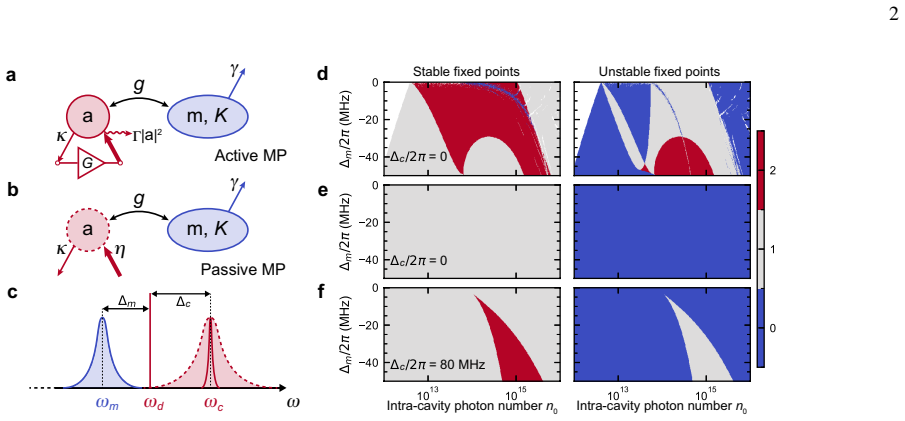
Passive MP system In the frame rotating at the coherent drive frequency ω d, the passive system obeys ˙a = − ( κ 2 + i∆ c ) a − ig m+ η , (A1) ˙m = − ( γ 2 + i∆ m ) m − ig a− iK|m|2m, (A2) The drive amplitude is implemented via input–output theory as η = √ κ ext sin, with incident photon flux sin = √ Pin/(¯hω d) and external coupling rate κ ext (equal to κ...
-
[2]
(A2) and the photon mode is changed to be ˙a = ( G − κ 2 ) a − Γ |a|2a − ig m
Active MP system For the active system , in the reference frame of the bare photon oscillation (i.e., the autonomous vdP oscillation) , the equation of the magnon mode is the same as Eq. (A2) and the photon mode is changed to be ˙a = ( G − κ 2 ) a − Γ |a|2a − ig m. (A3) Appendix B: Steady states and stability analysis
-
[3]
empt y- condition photons
Steady states of the passive MP Setting ˙a = ˙m = 0 in Eqs. (A1)–(A2) yields a = η κ 2 + i∆ c + g2 γ 2 +i(∆ m+K|m|2) , m = − ig a γ 2 + i(∆ m + K|m|2) . (B1) 9 Defining the magnon occupation nm ≡ | m|2, taking the mod- ulus of Eq. (B1) reduces the steady-state condition to a real cubic polynomial in nm. We solve this cubic and retain only real, positive ro...
-
[4]
empty-condition photons
Steady states of the active MP For an autonomous vdP oscillator, the relevant steady be- havior is a single-frequency solution. We therefore use the ansatz a(t) = a0 e− iΩ t , m(t) = m0 e− iΩ t , (B3) with constant complex amplitudes (a0,m0) and a real fre- quency offset Ω relative to the reference frame. Substituting Eq. (B3) into Eqs. (A2)–(A3), we obta...
-
[5]
(B8) This yields a 4 × 4 Jacobian matrix J (as shown in Supple- mental Material)
Jacobian linearization and stability criterion For each steady solution of the passive and active systems, we evaluate the stability by linearizing the equations of mo - tion in the doubled complex basis[28] v = (δ a,δ a∗,δ m,δ m∗)T. (B8) This yields a 4 × 4 Jacobian matrix J (as shown in Supple- mental Material). We compute its eigenvalues {λ j} and clas...
-
[6]
1 are generated on a two- dimensional grid in (n0,∆ m), with ∆ m sampled linearly and n0 sampled logarithmically
Phase-diagram construction Phase diagrams in Fig. 1 are generated on a two- dimensional grid in (n0,∆ m), with ∆ m sampled linearly and n0 sampled logarithmically. The parameters used for simulat- ing both the phase diagrams of the passive and active MP are κ = 2π × 1.5 MHz, γ = 2π × 16.5 MHz, g = 2π × 30.0 MHz, and Kerr coefficient K = 2π × 9.8 nHz. The e...
-
[7]
S. A. Maas, Nonlinear microwave and RF circuits (Artech house, 2003)
2003
-
[8]
A. A. Clerk, M. H. Devoret, S. M. Girvin, F. Marquardt, and R. J. Schoelkopf, Introduction to quantum noise, measureme nt, and amplification, Rev. Mod. Phys. 82, 1155 (2010)
2010
-
[9]
Clerk, K
A. Clerk, K. Lehnert, P . Bertet, J. Petta, and Y . Nakamura, Hy- brid quantum systems with circuit quantum electrodynamics , Nat. Phys. 16, 257 (2020)
2020
-
[10]
Lachance-Quirion, Y
D. Lachance-Quirion, Y . Tabuchi, A. Gloppe, K. Usami, and Y . Nakamura, Hybrid quantum systems based on magnonics, Appl. Phys. Express 12, 070101 (2019)
2019
-
[11]
D. D. Awschalom, C. R. Du, R. He, F. J. Heremans, A. Hoff- mann, J. Hou, H. Kurebayashi, Y . Li, L. Liu, V . Novosad,et al., Quantum engineering with hybrid magnonic systems and mate- rials, IEEE Trans. Quantum Eng. 2, 1 (2021)
2021
-
[12]
S. Khan, O. Lee, T. Dion, C. W. Zollitsch, S. Seki, Y . Tokura, J. D. Breeze, and H. Kurebayashi, Coupling microwave photons to topological spin textures in cu 2 oseo 3, Phys. Rev. B 104, L100402 (2021)
2021
-
[13]
Goryachev, W
M. Goryachev, W. G. Farr, D. L. Creedon, Y . Fan, M. Kostylev, and M. E. Tobar, High-cooperativity cavity qed with magnons at microwave frequencies, Phys. Rev. Appl. 2, 054002 (2014)
2014
-
[14]
Tabuchi, S
Y . Tabuchi, S. Ishino, T. Ishikawa, R. Yamazaki, K. Usami, and Y . Nakamura, Hybridizing ferromagnetic magnons and mi- crowave photons in the quantum limit, Phys. Rev. Lett. 113, 083603 (2014)
2014
-
[15]
Suhl, The theory of ferromagnetic resonance at high signa l powers, J
H. Suhl, The theory of ferromagnetic resonance at high signa l powers, J. Phys. Chem. Solids 1, 209 (1957)
1957
-
[16]
Bryant, C
P . Bryant, C. Jeffries, and K. Nakamura, Spin-wave nonlinea r dynamics in an yttrium iron garnet sphere, Phys. Rev. Lett. 60, 1185 (1988)
1988
-
[17]
Wiese and H
G. Wiese and H. Benner, Multistability and chaos by parametric excitation of longwave modes in a YIG sphere, Z. Phys. B 79, 119 (1990)
1990
-
[18]
O. Lee, K. Yamamoto, M. Umeda, C. W. Zollitsch, M. Elyasi, T. Kikkawa, E. Saitoh, G. E. Bauer, and H. Kurebayashi, Non- linear magnon polaritons, Phys. Rev. Lett. 130, 046703 (2023)
2023
- [19]
-
[20]
Zhang, Y
G. Zhang, Y . Wang, and J. Y ou, Theory of the magnon kerr effect in cavity magnonics, Sci. China-Phys. Mech. Astron. 62, 987511 (2019)
2019
-
[21]
Wang, G.-Q
Y .-P . Wang, G.-Q. Zhang, D. Zhang, T.-F. Li, C.-M. Hu, and J. Y ou, Bistability of cavity magnon polaritons, Phys. Rev.Lett. 120, 057202 (2018)
2018
-
[22]
H. Pan, Y . Yang, Z. An, and C.-M. Hu, Bistability in dissi- patively coupled cavity magnonics, Phys. Rev. B 106, 054425 (2022)
2022
-
[23]
Z.-X. Liu, B. Wang, H. Xiong, and Y . Wu, Magnon-induced high-order sideband generation, Opt. Lett. 43, 3698 (2018)
2018
-
[24]
Z.-X. Liu, C. Y ou, B. Wang, H. Xiong, and Y . Wu, Phase- mediated magnon chaos-order transition in cavity optomagnon- ics, Opt. Lett. 44, 507 (2019)
2019
-
[25]
G.-T. Xu, Z. Shen, M. Zhang, Y . Wang, S. Wan, Y . Yang, T. Zhang, L. Bi, F.-W. Sun, G.-C. Guo, et al., Kerr-induced syn- chronization of a broadband magnon-phonon hybrid frequenc y comb, Phys. Rev. Lett. 135, 203604 (2025)
2025
-
[26]
Peng, Z.-X
J. Peng, Z.-X. Liu, Y .-F. Y u, and H. Xiong, Cavity magnome- chanical chaos, Phys. Rev. A 110, 053704 (2024)
2024
-
[27]
G.-T. Xu, M. Zhang, Y . Wang, Z. Shen, G.-C. Guo, and C.- H. Dong, Magnonic frequency comb in the magnomechanical resonator, Phys. Rev. Lett. 131, 243601 (2023)
2023
-
[28]
B. Yao, Y . Gui, J. Rao, S. Kaur, X. Chen, W. Lu, Y . Xiao, H. Guo, K.-P . Marzlin, and C.-M. Hu, Cooperative polariton dynamics in feedback-coupled cavities, Nat. Commun. 8, 1437 (2017)
2017
-
[29]
B. Yao, Y . Gui, J. Rao, Y . Zhang, W. Lu, and C.-M. Hu, Coher- ent microwave emission of gain-driven polaritons, Phys. Re v. Lett. 130, 146702 (2023)
2023
-
[30]
Wang, Z.-Y
Z.-Q. Wang, Z.-Y . Wang, Y .-P . Wang, and J. Y ou, Single-mode magnon-polariton lasing and amplification controlled by di ssi- pative coupling, Phys. Rev. Lett. 135, 186704 (2025)
2025
-
[31]
Z.-Y . Wang, J. Qian, Y .-P . Wang, J. Li, and J. Y ou, Realization of the unidirectional amplification in a cavity magnonic sys tem, Appl. Phys. Lett. 123 (2023)
2023
-
[32]
B. Wang, C. Kong, Z.-X. Liu, H. Xiong, and Y . Wu, Magnetic- field-controlled magnon chaos in an active cavity-magnon sy s- tem, Laser Phys. Lett. 16, 045208 (2019)
2019
-
[33]
relaxation-oscillations
B. V an der Pol, Lxxxviii. on “relaxation-oscillations”, Lo nd. Edinb. Dubl. Phil. Mag. 2, 978 (1926)
1926
-
[34]
Khan and H
S. Khan and H. E. T¨ ureci, Frequency combs in a lumped- element josephson-junction circuit, Phys. Rev. Lett. 120, 153601 (2018)
2018
-
[35]
Pastor, V
I. Pastor, V . M. P´ erez-Garc´ ıa, F. Encinas, and J. Guerra, Ordered and chaotic behavior of two coupled van der pol oscillators, Phys. Rev. E 48, 171 (1993)
1993
-
[36]
Zhang, M
C. Zhang, M. Kim, J. Wang, and C.-M. Hu, V an der pol–duffing oscillator and its application to gain-driven light-matter interac- tion, Phys. Rev. Appl. 22, 014034 (2024)
2024
-
[37]
W.-J. Wu, D. Xu, J. Qian, J. Li, Y .-P . Wang, and J.-Q. Y ou, Ob- servation of nonlinearity and heating-induced frequency s hifts in cavity magnonics, Chin. Phys. B 31, 127503 (2022)
2022
-
[38]
D. Petrosyan, H. Matsumoto, H. Wang, J. B. Y oussef, R. Schlitz, W. Legrand, and P . Gambardella, Magnon kerr ef- fect in a magnetic thin film strongly coupled to a microwave resonator, arXiv preprint arXiv:2601.22271 (2026)
-
[39]
Zheng, Z
S. Zheng, Z. Wang, Y . Wang, F. Sun, Q. He, P . Yan, and H. Y uan, Tutorial: nonlinear magnonics, J. Appl. Phys. 134 (2023)
2023
-
[40]
Elyasi, Y
M. Elyasi, Y . M. Blanter, and G. E. Bauer, Resources of non- linear cavity magnonics for quantum information, Phys. Rev . B 101, 054402 (2020)
2020
-
[41]
M.-X. Bi, H. Fan, W. Wu, J.-J. He, M.-L. Hu, and X.-H. Yan, Explosive growth of bistability in a cavity magnonic system , Phys. Rev. B 111, 184309 (2025)
2025
-
[42]
R.-C. Shen, J. Li, Z.-Y . Fan, Y .-P . Wang, and J. Y ou, Mechanical bistability in kerr-modified cavity magnomechanics, Phys. Rev. Lett. 129, 123601 (2022)
2022
-
[43]
Shen, Y .-P
R.-C. Shen, Y .-P . Wang, J. Li, S.-Y . Zhu, G. Agarwal, and J. Y ou, Long-time memory and ternary logic gate using a mul- tistable cavity magnonic system, Phys. Rev. Lett. 127, 183202 (2021)
2021
-
[44]
P . Hyde, B. Yao, Y . Gui, G.-Q. Zhang, J. Y ou, and C.-M. Hu, Di- rect measurement of foldover in cavity magnon-polariton sy s- tems, Phys. Rev. B 98, 174423 (2018)
2018
-
[45]
J. Rao, C. Wang, B. Yao, Z. Chen, K. Zhao, and W. Lu, Me- terscale strong coupling between magnons and photons, Phys . Rev. Lett. 131, 106702 (2023)
2023
-
[46]
C. Wang, J. Rao, Z. Chen, K. Zhao, L. Sun, B. Yao, T. Y u, Y .-P . Wang, and W. Lu, Enhancement of magnonic frequency combs by exceptional points, Nat. Phys. 20, 1139 (2024)
2024
-
[47]
K. Zhao, F. Yang, C. Wang, Z. Chen, J. Song, S. Ma, Z. Y ue, W. Liu, L. Sun, J. Rao, et al., Experimental observation of non- reciprocal magnonic frequency combs, AIP Adv. 15 (2025)
2025
-
[48]
J. Rao, B. Yao, C. Wang, C. Zhang, T. Y u, and W. Lu, Unveiling a pump-induced magnon mode via its strong interaction with walker modes, Phys. Rev. Lett. 130, 046705 (2023)
2023
-
[49]
Y . Gui, G. Kozyniak, and C.-M. Hu, Broadband microwave emission from acoustically modulated gain-driven polarit ons, J. Appl. Phys. 137 (2025)
2025
-
[50]
Carroll, L
T. Carroll, L. Pecora, and F. Rachford, Chaos and chaotic tra n- sients in an yttrium iron garnet sphere, Phys. Rev. A 40, 377 (1989)
1989
-
[51]
Mitsudo, M
S. Mitsudo, M. Mino, and H. Yamazaki, Period-doubling cas- cade and chaos in YIG at the first-order suhl instability, J. M agn. Magn. Mater. 104, 1057 (1992)
1992
-
[52]
R¨ odelsperger, Y
F. R¨ odelsperger, Y . S. Kivshar, and H. Benner, Route out of chaos by hf parametric perturbations in spin-wave instabil ities, J. Magn. Magn. Mater. 140, 1953 (1995)
1953
-
[53]
Blais, R.-S
A. Blais, R.-S. Huang, A. Wallraff, S. M. Girvin, and R. J. Schoelkopf, Cavity quantum electrodynamics for supercon- ducting electrical circuits: An architecture for quantum c om- putation, Phys. Rev. A 69, 062320 (2004)
2004
-
[54]
H. Wang, K. Jacobs, D. Fahey, Y . Hu, D. R. Englund, and M. E. Trusheim, Exceptional sensitivity near the bistable trans ition point of a hybrid quantum system, Nat. Phys. 22, 577 (2026)
2026
-
[55]
H. Wang, K. Jacobs, D. R. Englund, and M. E. Trusheim, Ultralow-power microwave frequency comb at a bistable phas e transition, Phys. Rev. X 16, 021005 (2026)
2026
-
[56]
S. A. Khan, Non-equilibrium quantum dynamics of nonlinear multimode circuit QED systems (Princeton University, 2021)
2021
-
[57]
X. Mi, J. Rao, L. Yan, X. Wang, B. Lyu, B. Yao, S. Yan, and L. Bai, Ultrasensitive magnetometer based on cusp points of the photon-magnon synchronization mode, Phys. Rev. Lett. 136, 066701 (2026)
2026
-
[58]
A. V . Chumak, P . Kabos, M. Wu, C. Abert, C. Adelmann, A. O. Adeyeye, J. ˚Akerman, F. G. Aliev, A. Anane, A. Awad, et al. , Advances in magnetics roadmap on spin-wave comput- ing, IEEE Trans. Magn. 58, 1 (2022)
2022
-
[59]
A. Kani, M. Hatifi, and J. Twamley, Squeezed microwave and magnonic frequency combs, APL Quantum 2 (2025)
2025
-
[60]
C. W. Gardiner and M. J. Collett, Input and output in damped quantum systems: Quantum stochastic differential equatio ns and the master equation, Phys. Rev. A 31, 3761 (1985)
1985
discussion (0)
Sign in with ORCID, Apple, or X to comment. Anyone can read and Pith papers without signing in.