Geometric memory in incomplete phase transitions across dimensions
Pith reviewed 2026-05-07 07:05 UTC · model grok-4.3
The pith
Incomplete phase transitions retain geometric memory through the retention of larger plates during reversal, with stronger effects in two dimensions.
A machine-rendered reading of the paper's core claim, the machinery that carries it, and where it could break.
Core claim
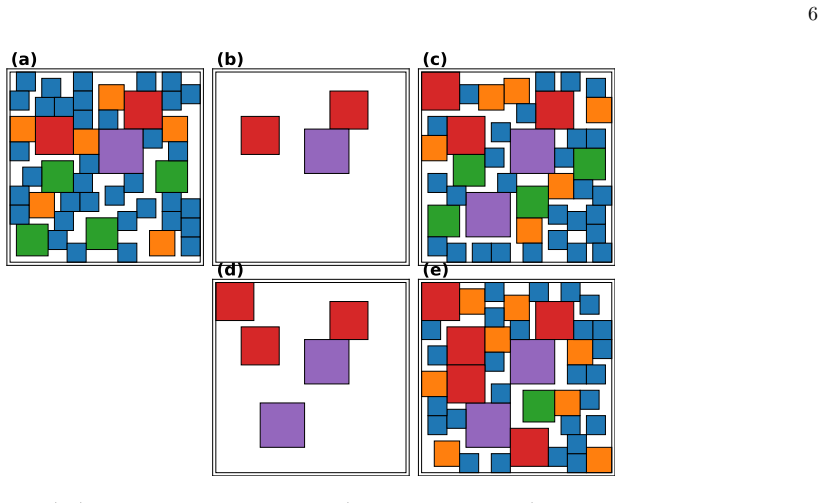
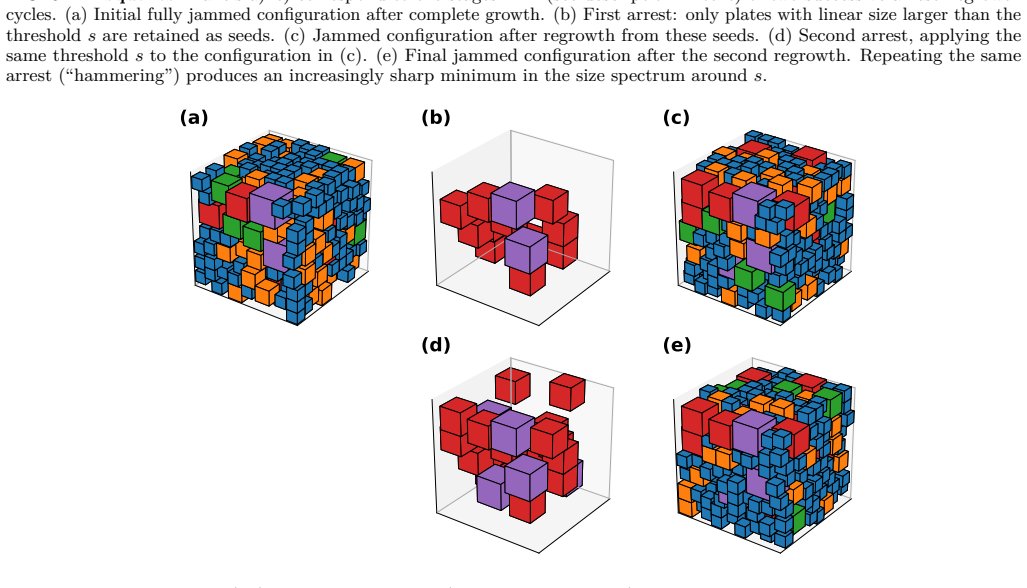
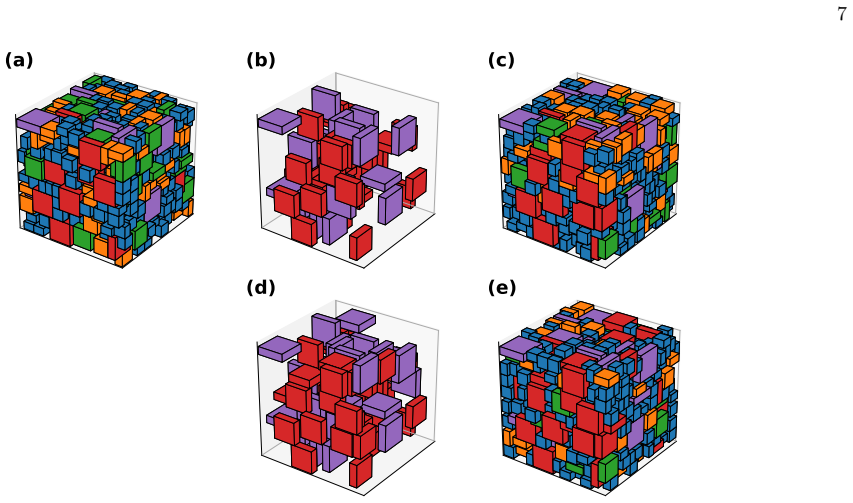
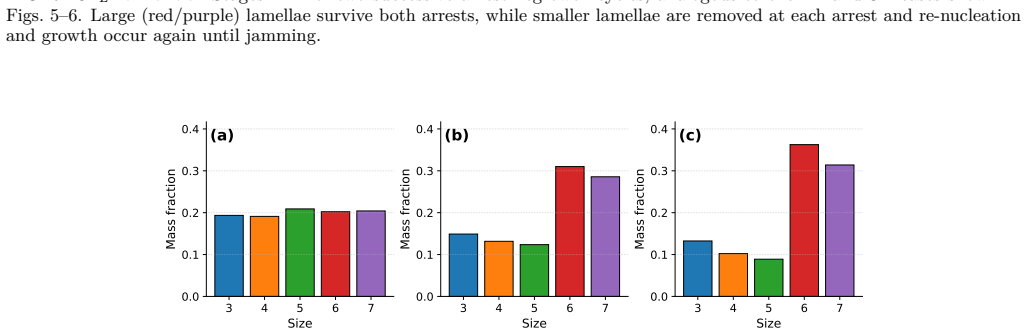
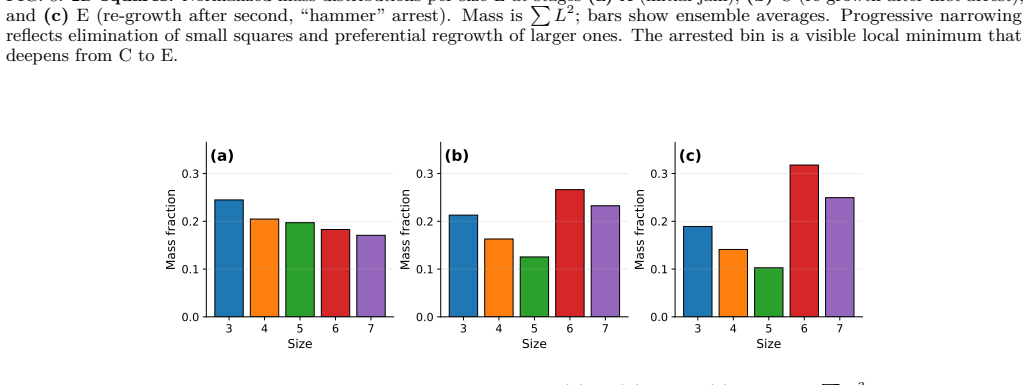
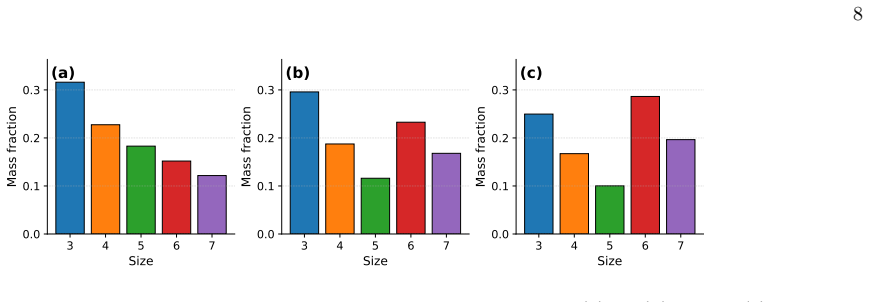
The central claim is that a purely geometric memory effect exists in first-order solid-solid phase transitions because impingement during growth creates a size-dependent arrest, and the selective survival of larger plates in an incomplete reverse transformation biases the size distribution of plates in the following cycle. This bias is measured by the size mass ratio and is found to be robust across square, cubic, and lamellar geometries, although larger in two dimensions than in three.
What carries the argument
The preferential disappearance of smaller plates during incomplete reversion combined with geometric impingement, which together shift the plate-size distribution for subsequent transformations and are quantified by the size mass ratio.
If this is right
- The memory effect occurs in two-dimensional, three-dimensional, and lamellar plate models alike.
- Two-dimensional geometries produce stronger memory than three-dimensional ones because of more effective spatial blocking.
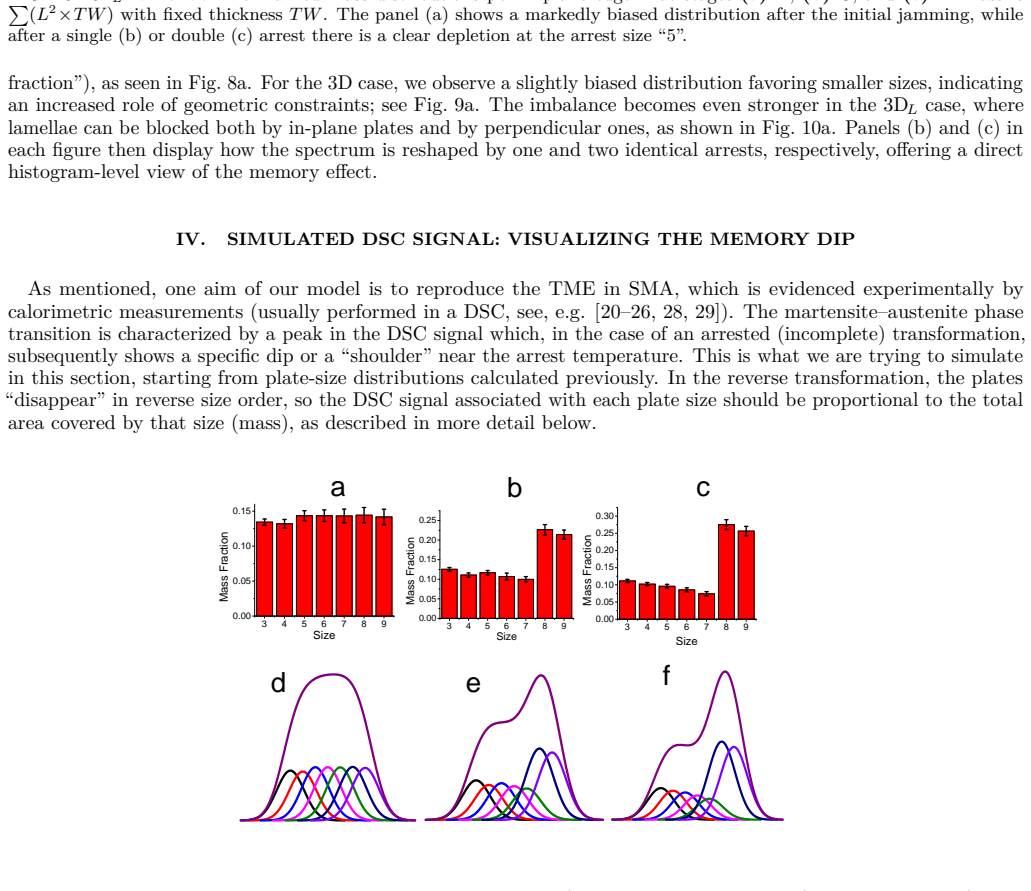
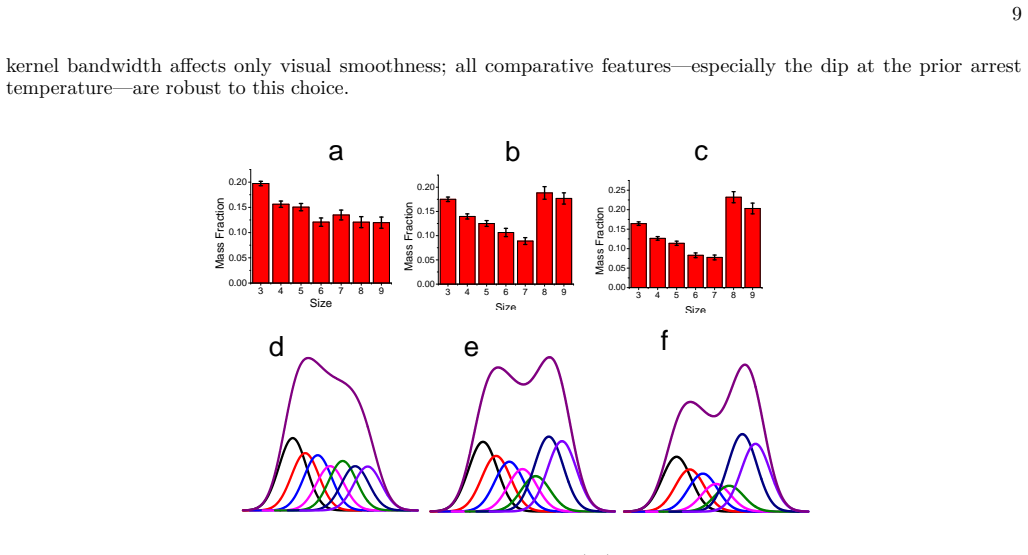
- Simulated differential scanning calorimetry traces show shifts that reflect the memory-induced change in transformation kinetics.
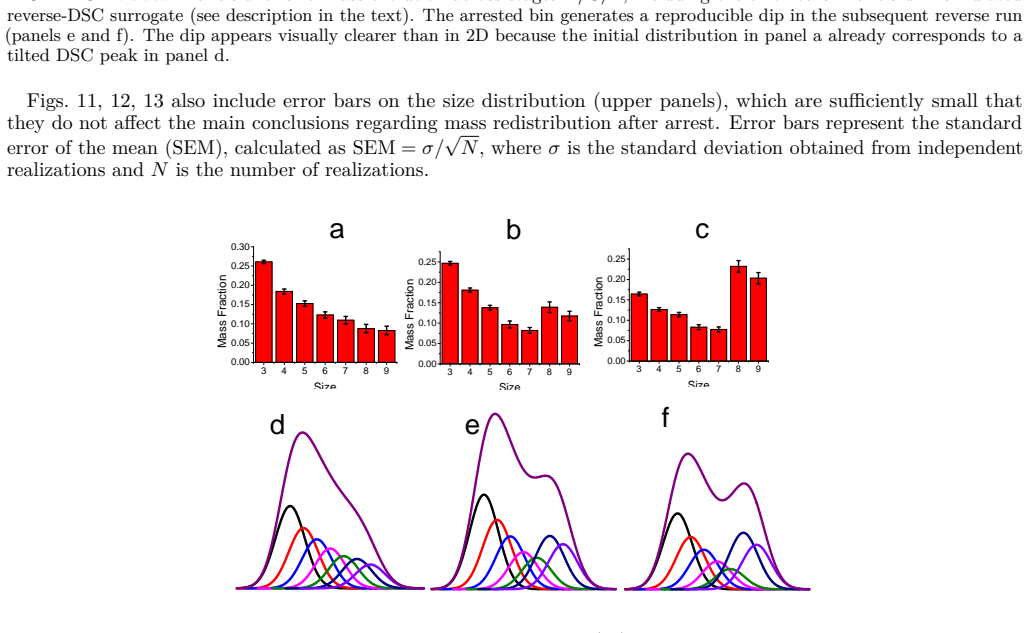
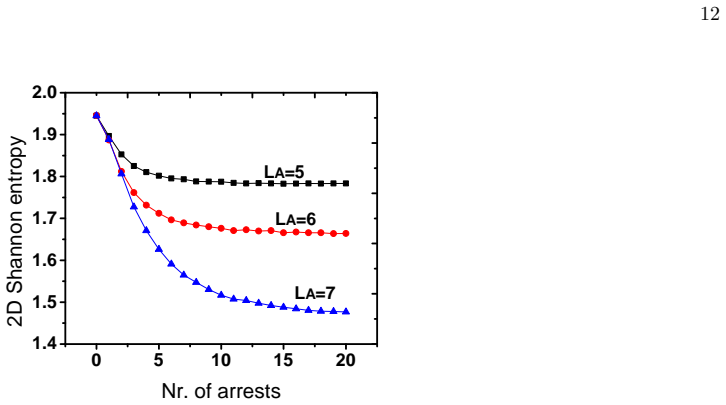
- The Shannon entropy of the size distribution provides a measure of how the memory reduces configurational variety after cycling.
Where Pith is reading between the lines
- The mechanism offers a geometric explanation for thermal memory in shape-memory alloys that does not rely on specific atomic or crystallographic reversibility.
- Tests in thin-film versus bulk samples could reveal the predicted dimensional dependence of memory strength.
- The model suggests that controlling plate-size distributions through partial cycling might be used to tune transformation temperatures in applications.
Load-bearing premise
The reverse transformation eliminates smaller plates preferentially while retaining the larger ones.
What would settle it
An experiment or simulation in which the plate size distribution after an incomplete cycle matches the initial distribution exactly, or in which memory strength shows no dependence on dimensionality.
Figures
read the original abstract
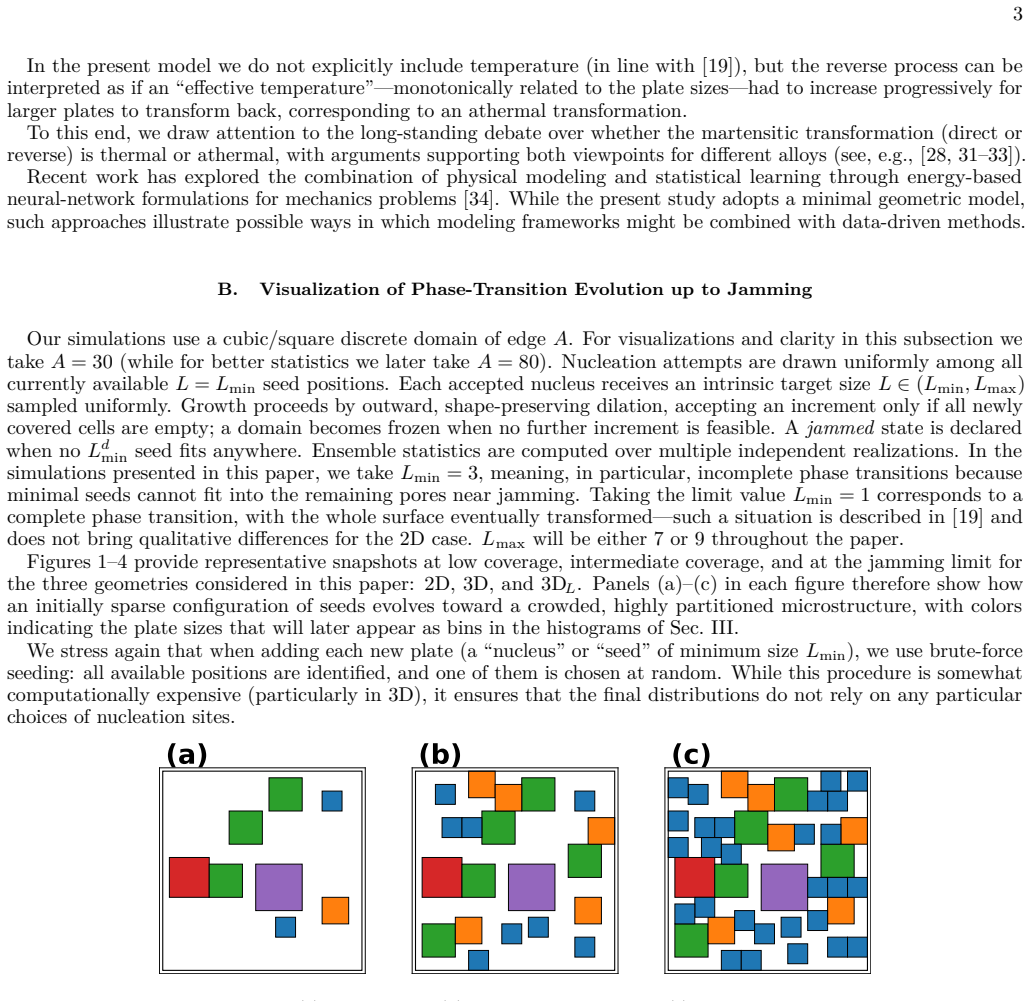
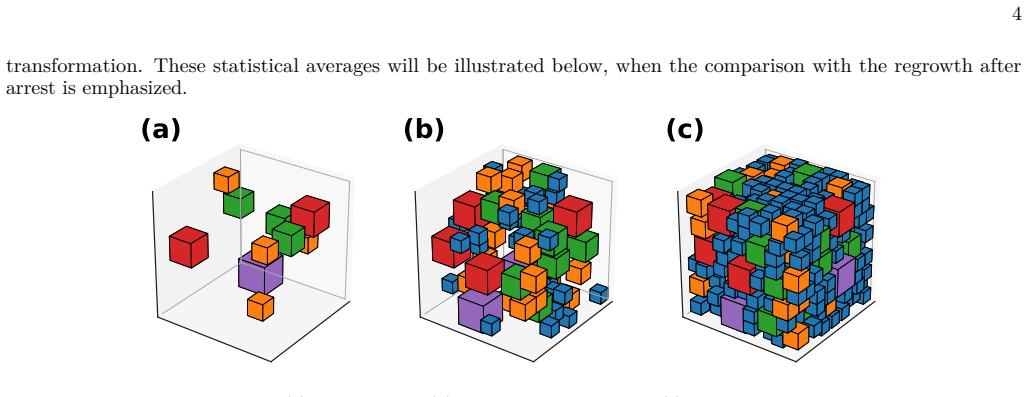
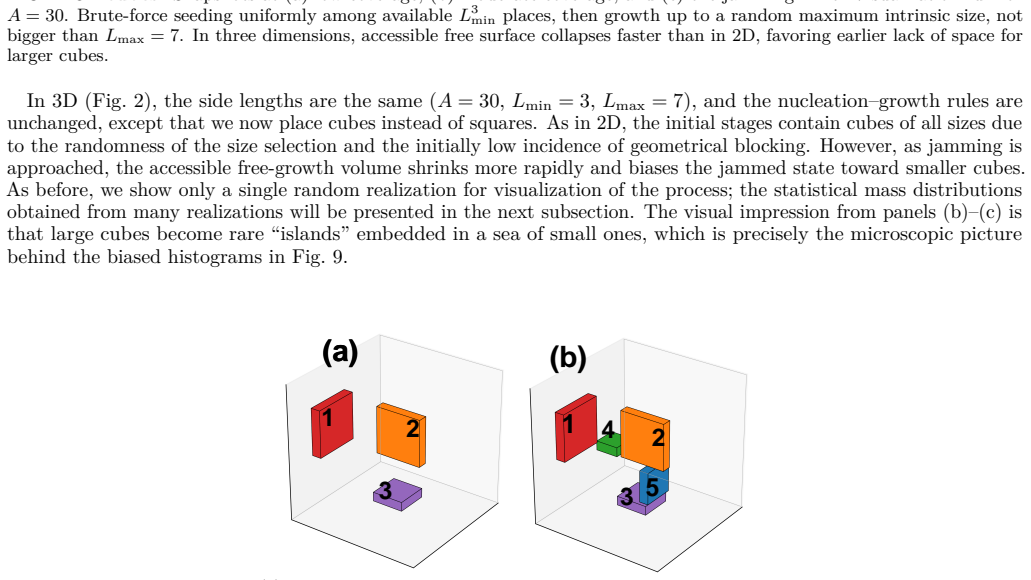
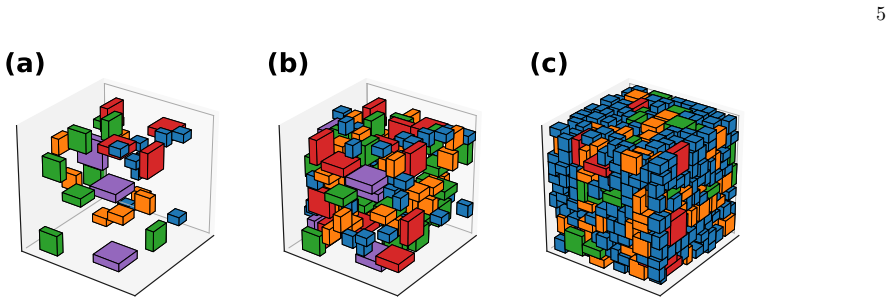
We model a direct solid-state phase transition through a nucleation-and-growth process in which plates have simple, regular shapes - squares, cubes, or square-faced lamellae - and grow homothetically (self-similarly) until they either reach a randomly assigned maximum size or are stopped by impingement with previously formed plates. The reverse transformation is represented by the preferential disappearance of smaller plates, while larger plates are retained during an incomplete reversion. A subsequent direct transformation therefore produces a modified plate-size distribution, a memory effect that forms the main focus of this study. Building upon an earlier two-dimensional (2D) formulation, we extend the model to cubes (3D) and to lamellar plates (3DL) in order to examine how dimensionality affects transformation memory. We introduce a quantitative descriptor of memory, the size mass ratio, and find that memory is robust in all geometries but overall stronger in 2D than in 3D or 3DL. We provide growth snapshots, arrest-regrowth cycles, size distributions, and differential scanning calorimetry simulations, and we compute the Shannon size-entropy to quantify configurational diversity. Although motivated by the thermal memory effect in shape-memory alloys, the model more generally identifies a purely geometric mechanism for memory in first-order solid-solid transformations, highlighting the role of dimensionality and geometric blocking in controlling the strength of transformation memory.
Editorial analysis
A structured set of objections, weighed in public.
Referee Report
Summary. The manuscript models incomplete solid-state phase transitions using a nucleation-and-growth process with homothetic growth of plates (squares in 2D, cubes in 3D, lamellae in 3DL) that are arrested by impingement or random maximum sizes. The reverse step preferentially removes smaller plates, leading to a modified size distribution in the next cycle, interpreted as geometric memory. A size mass ratio is introduced as a memory metric, and simulations show this memory is present in all dimensions but stronger in 2D. Additional outputs include size distributions, Shannon entropy, and simulated DSC curves.
Significance. This work offers a simple geometric mechanism for the thermal memory effect observed in shape-memory alloys, independent of specific material properties. The model's rules are clearly stated and produce consistent outputs across dimensions. Credit is due for the explicit simulation of growth snapshots, arrest-regrowth cycles, size distributions, differential scanning calorimetry simulations, and computation of Shannon size-entropy. If the dimensionality dependence holds after proper normalization, it would highlight how geometric blocking controls memory strength in first-order transformations.
major comments (2)
- [Quantitative descriptor of memory (Section 3)] The size mass ratio is defined from the simulated plate populations but the manuscript does not specify any rescaling by mean or maximum size, total transformed fraction, or a dimensionless combination that accounts for the different scaling (area vs. volume) in 2D versus 3D. This is load-bearing for the claim that memory is stronger in 2D than in 3D or 3DL, as dimensional artifacts could affect the comparison.
- [Results and discussion (Section 4)] The reported size mass ratios and entropy measures lack error bars or standard deviations from multiple runs, and no sensitivity analysis is provided for the free parameters (random maximum plate size distribution, nucleation timing and density). This weakens the assertion of robustness across geometries.
minor comments (2)
- [Abstract] The abstract states that memory is 'overall stronger in 2D than in 3D or 3DL' without quantifying the difference or referencing the specific figure or table showing the comparison.
- [Model description] The preferential removal of smaller plates during reverse transformation is stated as an axiom; a brief justification or reference to experimental motivation would improve clarity.
Simulated Author's Rebuttal
We thank the referee for the careful reading and constructive comments on our manuscript. The points raised regarding normalization of the memory metric and statistical robustness are well taken, and we have revised the manuscript to address them directly.
read point-by-point responses
-
Referee: [Quantitative descriptor of memory (Section 3)] The size mass ratio is defined from the simulated plate populations but the manuscript does not specify any rescaling by mean or maximum size, total transformed fraction, or a dimensionless combination that accounts for the different scaling (area vs. volume) in 2D versus 3D. This is load-bearing for the claim that memory is stronger in 2D than in 3D or 3DL, as dimensional artifacts could affect the comparison.
Authors: We agree that an explicit normalization is needed for a dimensionally consistent comparison. In the revised manuscript we define a normalized size mass ratio by dividing the original ratio by the mean plate size (area in 2D, volume in 3D) at the same transformed fraction. This renders the metric dimensionless and removes scaling artifacts. With the normalized descriptor the memory effect remains stronger in 2D than in 3D or 3DL; we have updated the definition in Section 3, the corresponding figures, and the discussion in Section 4. revision: yes
-
Referee: [Results and discussion (Section 4)] The reported size mass ratios and entropy measures lack error bars or standard deviations from multiple runs, and no sensitivity analysis is provided for the free parameters (random maximum plate size distribution, nucleation timing and density). This weakens the assertion of robustness across geometries.
Authors: We accept that statistical validation and parameter sensitivity strengthen the claims. We have rerun the simulations with 20 independent realizations for each geometry, added error bars (one standard deviation) to all reported size-mass-ratio and Shannon-entropy values in Section 4, and included a new sensitivity study in the Supplementary Material. The study varies the mean and width of the maximum-size distribution, nucleation density, and nucleation timing over ranges that preserve the incomplete-transformation regime. The dimensionality dependence of the memory effect persists across these variations. revision: yes
Circularity Check
Memory effect constructed directly by reverse-transformation assumption
specific steps
-
self definitional
[Abstract]
"The reverse transformation is represented by the preferential disappearance of smaller plates, while larger plates are retained during an incomplete reversion. A subsequent direct transformation therefore produces a modified plate-size distribution, a memory effect that forms the main focus of this study."
The memory effect is presented as the study's focus yet is produced directly by the chosen representation of the reverse step (preferential retention of larger plates). The modified distribution after the next direct transformation is therefore equivalent to the input modeling assumption rather than derived from the growth or impingement rules alone.
full rationale
The paper's core claim rests on a nucleation-growth model with homothetic plates and impingement, extended from a prior 2D formulation. The memory effect is introduced by explicitly defining the incomplete reverse step as preferential disappearance of smaller plates. Subsequent cycles then produce a modified size distribution by construction of that rule. The size-mass ratio is computed post-simulation from the resulting populations and compared across dimensions; this quantitative step is not forced by the equations themselves. The self-citation to the 2D precursor supports the base model but does not carry the new dimensionality results. The presence and robustness of memory therefore reduce to the modeling choice rather than an independent derivation, producing moderate circularity while leaving the cross-geometry comparison as an independent simulation output.
Axiom & Free-Parameter Ledger
free parameters (2)
- random maximum plate size distribution
- nucleation timing and density parameters
axioms (2)
- domain assumption Plates grow homothetically (self-similarly) until arrested by impingement or maximum size.
- ad hoc to paper Reverse transformation preferentially removes smaller plates while retaining larger ones.
Reference graph
Works this paper leans on
-
[1]
On the Theory of Phase Transitions,
L. D. Landau, “On the Theory of Phase Transitions,” Zh. Eksp. Teor. Fiz.7, 19 (1937)
work page 1937
-
[2]
L. D. Landau and E. M. Lifshitz,Statistical Physics, Part I, 3rd ed. (Pergamon, Oxford, 1980)
work page 1980
-
[3]
Free Energy of a Nonuniform System. I. Interfacial Free Energy,
J. W. Cahn and J. E. Hilliard, “Free Energy of a Nonuniform System. I. Interfacial Free Energy,” J. Chem. Phys.28, 258 (1958)
work page 1958
-
[4]
A. G. Khachaturyan,Theory of Structural Transformations in Solids(Wiley, New York, 1983)
work page 1983
-
[5]
M. Avrami, “Kinetics of Phase Change. I,” J. Chem. Phys.7, 1103 (1939); “Kinetics of Phase Change. II,” J. Chem. Phys. 8, 212 (1940); “Kinetics of Phase Change. III,” J. Chem. Phys.9, 177 (1941)
work page 1939
-
[6]
Theory of First-Order Phase Transitions,
K. Binder, “Theory of First-Order Phase Transitions,” Rep. Prog. Phys.50, 783 (1987)
work page 1987
-
[7]
Structural Phase Transitions with Pseudospin Variables: A Microscopic Theory,
J. A. Krumhansl and J. R. Gooding, “Structural Phase Transitions with Pseudospin Variables: A Microscopic Theory,” Phys. Rev. B39, 3047 (1989)
work page 1989
-
[8]
Ferroelastic Dynamics and the Role of Microstructure,
T. Lookman, S. R. Shenoy, K. O. Rasmussen, A. Saxena, and A. R. Bishop, “Ferroelastic Dynamics and the Role of Microstructure,” Phys. Rev. B67, 024114 (2003)
work page 2003
-
[9]
T. Tadaki, K. Otsuka, and K. Shimizu, “Shape Memory Alloys,” Annu. Rev. Mater. Sci.18, 25 (1988)
work page 1988
-
[10]
Elastocaloric Effect Associated with the Martensitic Transition in Shape-Memory Alloys,
E. Bonnot, R. Romero, L. Mañosa, E. Vives, and A. Planes, “Elastocaloric Effect Associated with the Martensitic Transition in Shape-Memory Alloys,” Phys. Rev. Lett.100, 125901 (2008)
work page 2008
-
[11]
A Review of Shape Memory Alloy Research, Applications and Opportunities,
J. M. Jani, M. Leary, A. Subic, and M. A. Gibson, “A Review of Shape Memory Alloy Research, Applications and Opportunities,” Mater. Des.56, 1078 (2014)
work page 2014
-
[12]
Structural and Magnetic Phase Transitions in Shape-Memory AlloysNi2+xMn1−x Ga,
A. N. Vasilev, A. D. Bozhko, V. V. Khovailo, I. E. Dikshtein, V. G. Shavrov, V. D. Buchelnikov, M. Matsumoto, S. Suzuki, T. Takagi, and J. Tani, “Structural and Magnetic Phase Transitions in Shape-Memory AlloysNi2+xMn1−x Ga,” Phys. Rev. 14 B59, 1113 (1999)
work page 1999
-
[13]
Magnetostructural Transition and Magnetocaloric Effect inNi55Mn20Ga25 Single Crystals,
M. Pasquale, C. P. Sasso, L. H. Lewis, L. Giudici, T. Lograsso, and D. Schlagel, “Magnetostructural Transition and Magnetocaloric Effect inNi55Mn20Ga25 Single Crystals,” Phys. Rev. B72, 094435 (2005)
work page 2005
-
[14]
Adaptive Modulations of Martensites,
S. Kaufmann, U. K. Rößler, O. Heczko, M. Wuttig, J. Buschbeck, L. Schultz, and S. Fähler, “Adaptive Modulations of Martensites,” Phys. Rev. Lett.104, 145702 (2010)
work page 2010
-
[15]
Phonon Anomaly, Central Peak, and Microstructures in Ni2MnGa,
A. Zheludev, S. M. Shapiro, P. Wochner, A. Schwartz, M. Wall, and L. E. Tanner, “Phonon Anomaly, Central Peak, and Microstructures in Ni2MnGa,” Phys. Rev. B51, 11310 (1995)
work page 1995
-
[16]
NiMn-Based Metamagnetic Shape Memory Alloys,
R. Y. Umetsu, X. Xu, and R. Kainuma, “NiMn-Based Metamagnetic Shape Memory Alloys,” Scripta Mater.116, 1 (2016)
work page 2016
-
[17]
A Review on Shape Memory Metallic Alloys and Their Critical Stress for Twinning,
P. Nnamchi, A. Younes, and S. González, “A Review on Shape Memory Metallic Alloys and Their Critical Stress for Twinning,” Intermetallics105, 61 (2019)
work page 2019
-
[18]
F. Ţolea, M. Ţolea, M. Sofronie, and M. Valeanu, “Distribution of Plates’ Sizes Tell the Thermal History in a Simulated Martensitic-Like Phase Transition,” Solid State Commun.213–214, 37 (2015)
work page 2015
-
[19]
Memory of Incomplete Phase Transitions from a Random Squares Model,
F. Ţolea, M. Sofronie, M. Niţă, and M. Ţolea, “Memory of Incomplete Phase Transitions from a Random Squares Model,” Phys. Rev. E108, 064134 (2023)
work page 2023
-
[20]
G. Airoldi, A. Corsi, and R. Riva, “The Hysteresis Cycle Modification in Thermoelastic Martensitic Transformation of Shape Memory Alloys,” Scripta Mater.36, 1273 (1997)
work page 1997
-
[21]
New Observations on the Thermal Arrest Memory Effect in Ni–Ti Alloys,
K. Madangopal, “New Observations on the Thermal Arrest Memory Effect in Ni–Ti Alloys,” Scripta Mater.53, 875 (2005)
work page 2005
-
[22]
Temperature Memory Effect in Cu–Al–Ni Shape Memory Alloys Studied by Adiabatic Calorimetry,
J. Rodriguez-Aseguinolaza, I. Ruiz-Larrea, M. L. No, A. Lopez-Echarri, and J. San Juan, “Temperature Memory Effect in Cu–Al–Ni Shape Memory Alloys Studied by Adiabatic Calorimetry,” Acta Mater.56, 3711 (2008)
work page 2008
-
[23]
Temperature Memory Effect of a Nickel–Titanium Shape Memory Alloy,
Y. Zheng, L. Cui, and J. Schrooten, “Temperature Memory Effect of a Nickel–Titanium Shape Memory Alloy,” Appl. Phys. Lett.84, 31 (2004)
work page 2004
-
[24]
Influence of Partial Cycling on the Transformation Mass of NiTi Alloys,
T. Liu, Y. Zheng, and L. Cui, “Influence of Partial Cycling on the Transformation Mass of NiTi Alloys,” Mater. Lett.112, 121 (2013)
work page 2013
-
[25]
C. Tang, T. X. Wang, W. M. Huang, L. Sun, and X. Y. Gao, “Temperature Sensors Based on the Temperature Memory Effect in Shape Memory Alloys to Check Minor Over-Heating,” Sens. Actuators A238, 337 (2016)
work page 2016
-
[26]
Incomplete Transformation Induced Multiple-Step Transformation in TiNi Shape Memory Alloys,
Z. G. Wang and X. T. Zu, “Incomplete Transformation Induced Multiple-Step Transformation in TiNi Shape Memory Alloys,” Scripta Mater.53, 335 (2005)
work page 2005
-
[27]
F. Ţolea, M. Ţolea, and M. Valeanu, “Thermal Memory Fading by Heating to a Lower Temperature: Experimental Data on Polycrystalline NiFeGa Ribbons and 2D Statistical Model Predictions,” Solid State Commun.257, 36 (2017)
work page 2017
-
[28]
A. Vidal-Crespo, A. F. Manchón-Gordón, J. M. Martín-Olalla, F. J. Romero, J. J. Ipus, M. C. Gallardo, and J. S. Blázquez, “Phase Dependence of the Thermal Memory Effect in Polycrystalline Ribbon and Bulk Ni55Fe19Ga26 Heusler Alloys,” Intermetallics180, 108695 (2025)
work page 2025
-
[29]
F. Ţolea, M. Niţă, and M. Ţolea, “Thermal Memory Effect in NiFeGa and NiMnGa Shape Memory Ribbons: Toward Maximum-Temperature Recording Applications,” J. Alloys Compd.1043, 184056 (2025)
work page 2025
-
[30]
Thermal memory effect in Mn(CoFe)Ge intermetallic compound,
A. Vidal-Crespo, A. F. Manchón-Gordón, J. J. Ipus, and J. S. Blázquez, “Thermal memory effect in Mn(CoFe)Ge intermetallic compound,” Thermochim. Acta756, 180200 (2026)
work page 2026
-
[31]
Droplet Fluctuations in the Morphology and Kinetics of Martensites,
M. Rao and S. Sengupta, “Droplet Fluctuations in the Morphology and Kinetics of Martensites,” Phys. Rev. Lett.78, 2168 (1997)
work page 1997
-
[32]
Athermal Character of Structural Phase Transitions,
F. J. Pérez-Reche, E. Vives, L. Mañosa, and A. Planes, “Athermal Character of Structural Phase Transitions,” Phys. Rev. Lett.87, 195701 (2001)
work page 2001
-
[33]
J. I. Perez-Landazabal, V. Recarte, V. Sanchez-Alarcos, S. Kustov, D. Salas, and E. Cesari, “Effect of Magnetic Field on the Isothermal Transformation of a Ni–Mn–In–Co Magnetic Shape Memory Alloy,” Intermetallics28, 144 (2012)
work page 2012
-
[34]
E. Samaniego, C. Anitescu, S. Goswami, V. M. Nguyen-Thanh, H. Guo, K. Hamdia, X. Zhuang, and T. Rabczuk, “An energy approach to the solution of partial differential equations in computational mechanics via machine learning: Concepts, implementation and applications,” Comput. Methods Appl. Mech. Engrg.362, 112790 (2020)
work page 2020
discussion (0)
Sign in with ORCID, Apple, or X to comment. Anyone can read and Pith papers without signing in.