Smart Profit-Aware Crop Advisory System: Kisan AI
Pith reviewed 2026-05-09 19:59 UTC · model grok-4.3
The pith
Incorporating market price into crop recommendation models lets a Random Forest classifier reach 99.3 percent accuracy and produce financially informed advice.
A machine-rendered reading of the paper's core claim, the machinery that carries it, and where it could break.
Core claim
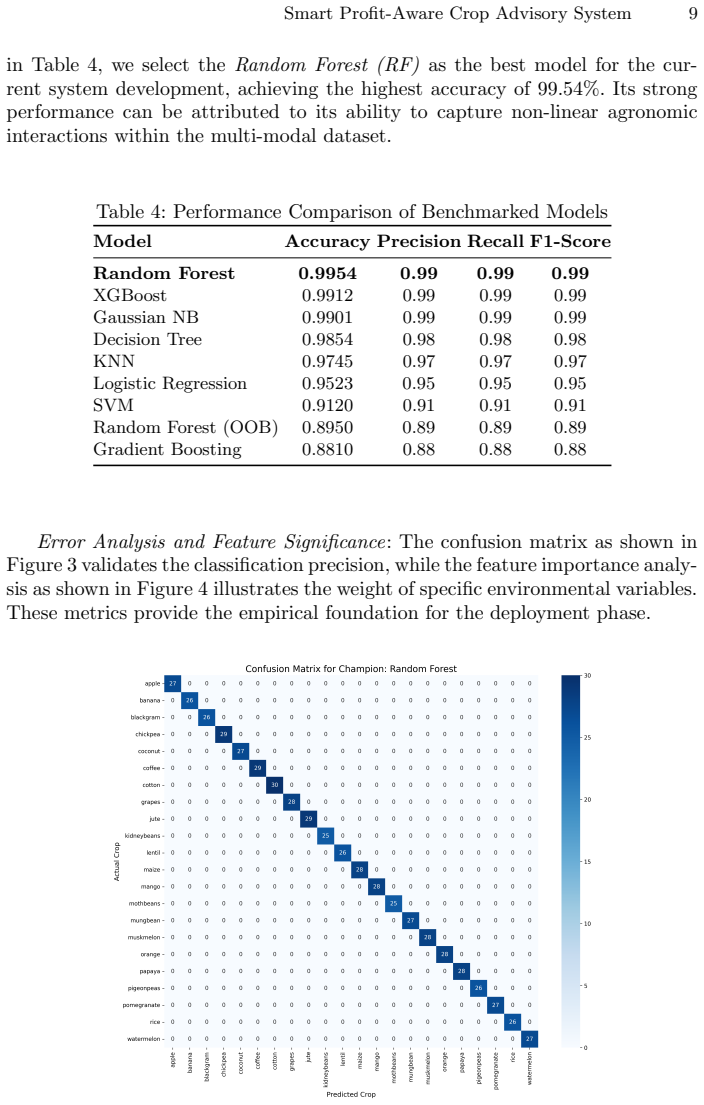
The Random Forest classifier trained on nine features that combine seven standard agronomic attributes with market_price achieves 99.3 percent accuracy and the lowest log loss among eight evaluated models, confirming that market price is both a valid and impactful feature for profit-aware crop selection.
What carries the argument
The nine-feature benchmark dataset formed by augmenting conventional agronomic inputs with a market_price variable, which trains the Random Forest classifier to output crop recommendations that reflect expected revenue.
Load-bearing premise
The nine-feature dataset represents the range of conditions and price movements that Indian farmers actually encounter, and superior classification accuracy on this data will produce measurably higher net returns when farmers follow the resulting advice.
What would settle it
A field trial that records actual farmer net profits under the new recommendations versus under standard yield-only advice, using fresh data collected from multiple regions and seasons.
Figures





read the original abstract
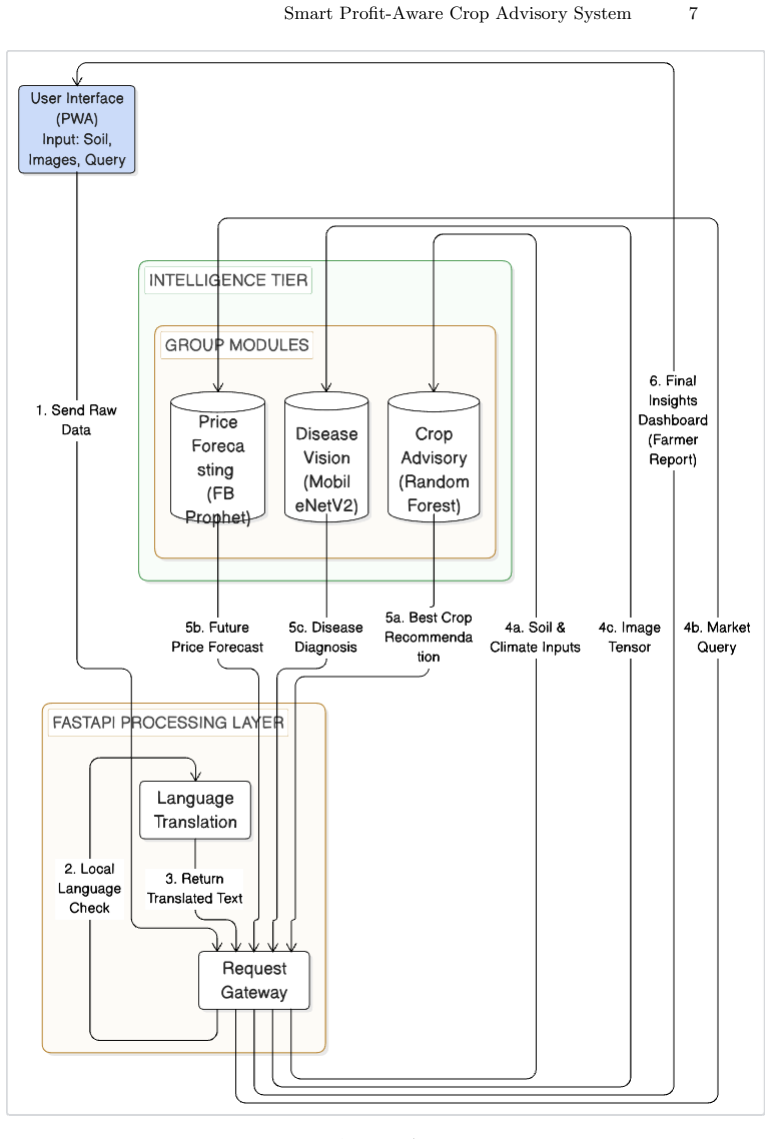
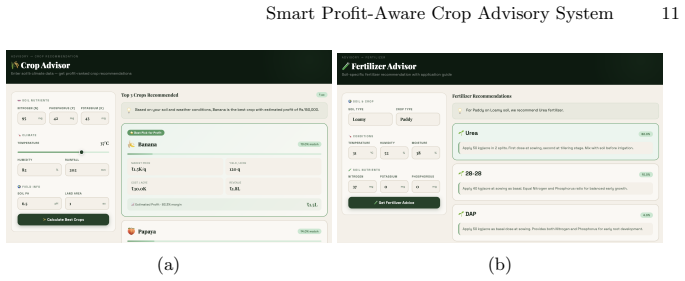
Modern crop advisory systems exhibit a critical limitation termed \textit{economic blindness}. These systems primarily optimize for biological yield, often overlooking market price, which can lead farmers toward agronomically sound yet financially unviable decisions. In this paper, we develop Kisan AI, a smart profit-aware crop advisory system that resolves the above-mentioned limitation through a research-driven, full-stack application. We train the Random Forest(RF) classifier model on a nine-feature benchmark dataset, the standard seven agronomic attributes augmented with a \textit{market\_price} variable, and evaluated against eight baseline models, considering the evaluation matrices, such as, accuracy, precision, recall, F1-score, and Log Loss. The RF model achieves the highest accuracy of 99.3\% and the lowest Log Loss, confirming that the inclusion of market price as a predictive feature is both valid and impactful. We then implement the RF model within a multilingual progressive Web App alongside a Facebook Prophet six-month price forecasting engine and a MobileNetV2 disease detection module. A nine-language AI chatbot powered by the Anthropic Claude API unifies all modules into a single, mobile-installable platform accessible to farmers across India.
Editorial analysis
A structured set of objections, weighed in public.
Referee Report
Summary. The manuscript presents Kisan AI, a full-stack crop advisory system that augments seven standard agronomic features with a market_price variable to train a Random Forest classifier on a nine-feature benchmark dataset. The RF model is reported to achieve 99.3% accuracy and the lowest log loss among eight baselines, which the authors interpret as confirming that market price inclusion is valid and impactful; the model is then deployed in a multilingual progressive web app that also includes a Prophet-based six-month price forecaster, a MobileNetV2 disease detector, and a Claude-powered nine-language chatbot.
Significance. If the central claim held, the work would offer a practical demonstration that market-aware crop recommendation can mitigate economic blindness in agricultural advisory systems, with potential value for smallholder farmers in India. The full-stack implementation (forecasting + detection + chatbot) is a positive engineering contribution, but the absence of controlled evidence for the market_price feature's contribution and the lack of dataset or generalization details prevent the result from being considered load-bearing for the claimed impact.
major comments (3)
- [Abstract] Abstract: The assertion that the RF model's 99.3% accuracy and lowest log loss 'confirming that the inclusion of market price as a predictive feature is both valid and impactful' is unsupported, because all eight baseline comparisons are performed on the identical nine-feature dataset; no ablation is reported that retrains RF (or any baseline) on the seven agronomic features alone to isolate the contribution of market_price.
- [Abstract] Abstract: The manuscript supplies no information on dataset size, train/test split, cross-validation procedure, or any safeguards against leakage from the market_price variable (e.g., whether price data could be contemporaneous with or derived from the crop labels), rendering the reported accuracy and log-loss figures uninterpretable as evidence of genuine predictive power.
- [Abstract] Abstract: The performance numbers are presented as in-sample fit on the benchmark dataset without any mention of a held-out test set, temporal split, or out-of-distribution evaluation on real Indian farming conditions, which directly undermines the claim that high accuracy produces better real-world financial outcomes for farmers.
minor comments (3)
- [Abstract] Abstract: 'evaluation matrices' is a typographical error and should read 'evaluation metrics'.
- [Abstract] Abstract: Inconsistent capitalization ('Log Loss' vs. 'accuracy', 'precision'); standardize to lowercase 'log loss' for consistency with standard ML terminology.
- The paper should add a limitations section discussing dataset representativeness for diverse Indian agro-climatic zones and the assumption that classification accuracy directly translates to improved farmer profitability.
Simulated Author's Rebuttal
We thank the referee for the constructive and detailed comments. We agree that the current presentation of results requires additional supporting analyses and clarifications to substantiate the claims about the market_price feature and to make the evaluation methodology fully transparent. We address each major comment below and will incorporate the necessary revisions.
read point-by-point responses
-
Referee: [Abstract] Abstract: The assertion that the RF model's 99.3% accuracy and lowest log loss 'confirming that the inclusion of market price as a predictive feature is both valid and impactful' is unsupported, because all eight baseline comparisons are performed on the identical nine-feature dataset; no ablation is reported that retrains RF (or any baseline) on the seven agronomic features alone to isolate the contribution of market_price.
Authors: We agree that an explicit ablation study is required to isolate the contribution of the market_price variable. In the revised manuscript we will add results from retraining the Random Forest classifier and the other baselines on the original seven agronomic features alone, reporting the resulting accuracy, log loss, and other metrics to allow direct comparison and quantification of the feature's impact. revision: yes
-
Referee: [Abstract] Abstract: The manuscript supplies no information on dataset size, train/test split, cross-validation procedure, or any safeguards against leakage from the market_price variable (e.g., whether price data could be contemporaneous with or derived from the crop labels), rendering the reported accuracy and log-loss figures uninterpretable as evidence of genuine predictive power.
Authors: We will expand the experimental setup section in the revision to include the dataset size and source, the train/test split ratio, the cross-validation procedure, and a clear statement on how market_price values were obtained from independent public sources with appropriate temporal alignment to avoid leakage with the crop labels. revision: yes
-
Referee: [Abstract] Abstract: The performance numbers are presented as in-sample fit on the benchmark dataset without any mention of a held-out test set, temporal split, or out-of-distribution evaluation on real Indian farming conditions, which directly undermines the claim that high accuracy produces better real-world financial outcomes for farmers.
Authors: We will explicitly state the held-out test set and split details used for the reported metrics. We acknowledge that the manuscript does not contain out-of-distribution evaluation on real Indian farm conditions; we will therefore moderate the abstract and discussion claims about real-world financial outcomes, add a limitations subsection, and note the need for future field validation. revision: partial
Circularity Check
No circularity; empirical performance metrics are direct evaluations on the input dataset
full rationale
The paper trains the Random Forest classifier on the nine-feature benchmark dataset (seven agronomic attributes plus market_price) and reports its accuracy, log loss, and comparisons to other models as direct evaluation results. The assertion that these metrics 'confirm' the market_price feature's validity and impact is an interpretive claim rather than a derived prediction or first-principles result that reduces to the inputs by construction. No equations, self-citations, ansatzes, or renamings are present that create a self-referential loop. The derivation chain consists of standard supervised learning training and benchmarking, which is self-contained against the provided data without internal equivalence to its own fitted values.
Axiom & Free-Parameter Ledger
free parameters (1)
- Random Forest hyperparameters
axioms (1)
- domain assumption The nine-feature benchmark dataset (seven agronomic attributes plus market_price) is statistically representative of real Indian farming and market conditions.
Reference graph
Works this paper leans on
-
[1]
AgroConsultant: Intelligent crop recom- mendation system using machine learning algorithms
Doshi Z, Nadkarni S, Agrawal R, Shah N. AgroConsultant: Intelligent crop recom- mendation system using machine learning algorithms. In:IEEE ICCUBEA, 2018
work page 2018
-
[2]
Crop Recommendation System Using ML Algorithms
Gupta S, Sharma R, Jain P. Crop Recommendation System Using ML Algorithms. In:IRJET Conference Proceedings, 2024
work page 2024
-
[3]
Construction of deep learning-based disease detection model in plants.Scientific Reports, 2023
Jung M, Song J S, Shin A Y. Construction of deep learning-based disease detection model in plants.Scientific Reports, 2023
work page 2023
-
[4]
Kiran P S, Reddy R, Rajak R K. A system for crop recommendation using SVM and ANN majority voting technique.International Journal of Recent Technology and Engineering, 8(211):1125-1130, 2024
work page 2024
-
[5]
Kumar R, Singh A, Patel V. AI-based Smart Crop Recommendation System for Sustainable Agriculture in India.Madras Agricultural Journal, 112(4):57-65, 2025
work page 2025
-
[6]
Crop recommendation with fine-tuned SVM and Random Forest
Motamedi A, et al. Crop recommendation with fine-tuned SVM and Random Forest. In:CEUR Workshop Proceedings, vol. 3992, 2023
work page 2023
-
[7]
Senapaty M K, Ray A, Padhy N. Decision support system for crop recommendation using machine learning classification algorithms.Agriculture14(8):1256, 2024
work page 2024
-
[8]
Shastri S, Kumar S, Mansotra V. Advancing crop recommendation system with su- pervised machine learning and explainable artificial intelligence.Scientific Reports, 15(25498), 2025
work page 2025
-
[9]
Ensemble machine learning for crop recommendation and yield prediction
Shinde A D, Patel M J, et al. Ensemble machine learning for crop recommendation and yield prediction. In:ICCES Conference, 2025
work page 2025
discussion (0)
Sign in with ORCID, Apple, or X to comment. Anyone can read and Pith papers without signing in.