Structure-Preserving Optimal Control of Maxwell's Equations with Applications to Source Cloaking
Pith reviewed 2026-05-09 19:43 UTC · model grok-4.3
The pith
A structure-preserving numerical method solves optimal control problems for Maxwell's equations while preserving physical laws like energy balance and charge conservation.
A machine-rendered reading of the paper's core claim, the machinery that carries it, and where it could break.
Core claim
We develop a structure-preserving solution framework for the optimal control of the time-dependent Maxwell's equations. The forward solver couples Nedelec and Raviart-Thomas finite elements with Crank-Nicolson time stepping, preserves the de Rham structure, enforces a discrete Gauss law, exactly satisfies a per-time-step energy balance, and converges to the weak solution under low regularity assumptions. Control enters through the curl of a space-time current density added to Ampere's law, which yields charge conservation without auxiliary constraints. We prove well-posedness and continuity of the control-to-state map, derive the adjoint system and gradient representation for a tracking-type
What carries the argument
The structure-preserving discretization that couples Nedelec and Raviart-Thomas finite elements with Crank-Nicolson time stepping, together with the curl-form source term added to Ampere's law that automatically enforces charge conservation.
If this is right
- The discrete optimization scheme inherits structure preservation from the forward solver.
- Discrete stationarity conditions are consistent with their continuous counterparts.
- Discrete optimal controls converge to the continuous optima with mesh and time refinements.
- Charge conservation holds automatically due to the curl source formulation without extra constraints.
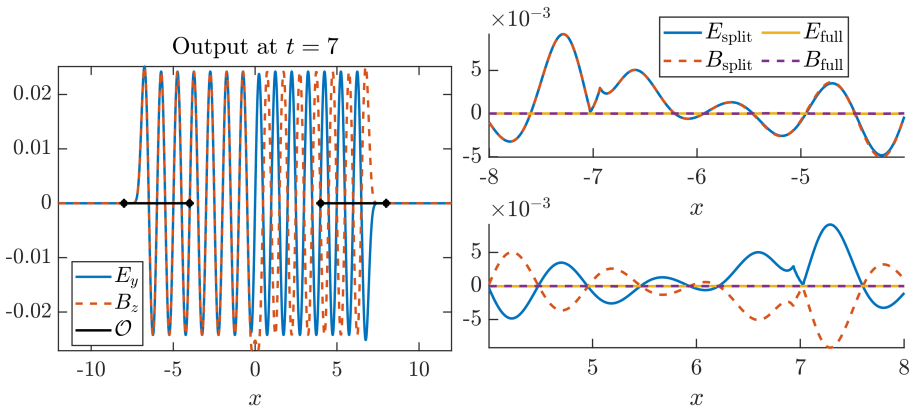
- The method applies directly to source-cloaking problems where fields are minimized in target regions.
Where Pith is reading between the lines
- The same compatible discretization strategy may extend to control problems in other first-order hyperbolic systems that require preservation of analogous differential complexes.
- The exact per-step energy balance could prove useful for long-time simulations in which accumulated dissipation would otherwise distort the controlled trajectories.
- The low-regularity convergence result suggests the framework can accommodate controls with limited smoothness that arise in certain practical tracking objectives.
Load-bearing premise
The forward Maxwell problem admits a well-posed weak formulation whose solution the discrete method approximates under the low regularity assumptions required by the optimal control setting.
What would settle it
Numerical computations in which the discrete optimal controls fail to approach a limiting continuous solution upon successive simultaneous refinements of the spatial mesh and time step, or in which the per-step energy balance deviates from exact equality.
Figures


read the original abstract
We develop a structure-preserving solution framework for the optimal control of the time-dependent Maxwell's equations. Building on a well-posedness theory for a weak form of the forward problem, we first analyze a forward solver that couples N\'ed\'elec and Raviart--Thomas finite elements with Crank--Nicolson time stepping. The solver preserves the de~Rham structure, enforces a discrete Gauss law, exactly satisfies a per-time-step energy balance, and converges to the weak solution under low regularity assumptions on the problem data, which are dictated by the optimal control setting. To control the Maxwell system, we add the curl of a space-time current density as a source to Amp\'ere's law. The curl form yields charge conservation without auxiliary constraints. We prove the well-posedness and continuity of the control-to-state map, derive the adjoint system and a gradient representation for a tracking-type objective functional, and formulate a discrete optimization scheme that inherits structure preservation from the forward solver. Our discrete stationarity conditions are consistent with their continuous counterparts, and the discrete optimal controls converge, with mesh and time refinements, to the continuous optima. We demonstrate the merits of our optimal control formulation and the theoretical developments by numerically solving a series of source-cloaking model problems.
Editorial analysis
A structured set of objections, weighed in public.
Referee Report
Summary. The manuscript develops a structure-preserving optimal control framework for the time-dependent Maxwell's equations. It analyzes a forward solver using Nédélec and Raviart-Thomas finite elements with Crank-Nicolson time stepping that preserves the de Rham structure, enforces a discrete Gauss law, and exactly satisfies a per-time-step energy balance while converging to the weak solution under low-regularity data assumptions. Control is introduced by adding the curl of a space-time current density to Ampère's law, which ensures charge conservation without auxiliary constraints. The authors prove well-posedness and continuity of the control-to-state map, derive the adjoint system and gradient representation for a tracking-type objective, formulate a discrete optimization scheme that inherits the structure-preserving properties, establish consistency of the discrete stationarity conditions with the continuous ones, and prove convergence of discrete optimal controls to the continuous optima under mesh and time refinement. Numerical experiments demonstrate the approach on source-cloaking model problems.
Significance. If the central claims hold, the work is significant because it rigorously extends compatible finite-element theory and energy-preserving time discretizations to the optimal-control setting for Maxwell's equations, a setting where low regularity is typical and physical invariants must be respected. The curl-based control formulation that automatically enforces charge conservation, the adjoint derivation, and the discrete-to-continuous convergence result under the regularity induced by the control problem are all load-bearing contributions. The numerical demonstration on source cloaking further illustrates practical utility for electromagnetic design problems.
minor comments (2)
- [Abstract] Abstract: the phrase 'low regularity assumptions on the problem data, which are dictated by the optimal control setting' is repeated without specifying the precise Sobolev or Bochner spaces; a single clarifying sentence would improve readability.
- [Numerical experiments] The numerical section would benefit from an explicit statement of the mesh sizes, time-step counts, and observed convergence rates for the discrete optima, even if only in a table, to allow direct verification of the claimed convergence.
Simulated Author's Rebuttal
We thank the referee for their careful reading of the manuscript, the positive summary of our contributions, and the recommendation for minor revision. We are pleased that the significance of the structure-preserving framework, the curl-based control formulation, the adjoint derivation, and the discrete-to-continuous convergence result under low-regularity assumptions has been recognized.
Circularity Check
Minor self-citation in foundational well-posedness theory; central claims independently derived
full rationale
The paper extends compatible finite-element theory (Nédélec/Raviart-Thomas elements with Crank-Nicolson stepping) to the optimal-control setting for time-dependent Maxwell equations. It builds on an existing well-posedness theory for the weak forward problem (possible self-citation) but supplies new proofs for the control-to-state map (via curl source), adjoint derivation, consistency of discrete stationarity conditions, and convergence of discrete optima to continuous ones under the induced low-regularity data. No self-definitional reductions, fitted inputs renamed as predictions, or load-bearing self-citation chains appear; the structure-preservation properties (de Rham, discrete Gauss, exact energy balance) and numerical source-cloaking examples rest on independent analysis rather than collapsing to prior inputs by construction.
Axiom & Free-Parameter Ledger
axioms (2)
- domain assumption Well-posedness theory for a weak form of the forward Maxwell problem
- domain assumption Low regularity assumptions on problem data dictated by the optimal control setting
Reference graph
Works this paper leans on
-
[1]
Harbir Antil. Well-posedness and approximation of weak solutions to time dependent Maxwell’s equations withL 2-data, 2025
work page 2025
-
[2]
Daniele Boffi, Franco Brezzi, and Michel Fortin.Mixed finite element methods and applications, volume 44 ofSpringer Series in Computational Mathematics. Springer, Heidelberg, 2013
work page 2013
-
[3]
Vera Bommer and Irwin Yousept. Optimal control of the full time-dependent Maxwell equa- tions.ESAIM: Mathematical Modelling and Numerical Analysis, 50(1):237–261, 2016
work page 2016
-
[4]
Alain Bossavit.Computational electromagnetism. Electromagnetism. Academic Press, Inc., San Diego, CA, 1998. Variational formulations, complementarity, edge elements
work page 1998
-
[5]
Haim Brezis.Functional analysis, Sobolev spaces and partial differential equations. Universi- text. Springer, New York, 2011
work page 2011
-
[6]
A. Buffa and P. Ciarlet, Jr. On traces for functional spaces related to Maxwell’s equations. II. Hodge decompositions on the boundary of Lipschitz polyhedra and applications.Math. Methods Appl. Sci., 24(1):31–48, 2001
work page 2001
-
[7]
J. Crank and P. Nicolson. A practical method for numerical evaluation of solutions of partial differential equations of the heat-conduction type.Proc. Cambridge Philos. Soc., 43:50–67, 1947
work page 1947
-
[9]
G. Duvaut and J.-L. Lions.Inequalities in mechanics and physics, volume 219 ofGrundlehren der Mathematischen Wissenschaften. Springer-Verlag, Berlin-New York, 1976. Translated from the French by C. W. John
work page 1976
-
[10]
Mauro Fabrizio and Angelo Morro.Electromagnetism of continuous media. Oxford Science Publications. Oxford University Press, Oxford, 2003. Mathematical modelling and applica- tions
work page 2003
-
[11]
V. Girault and P.-A. Raviart.Finite element methods for Navier-Stokes equations, volume 5 ofSpringer Series in Computational Mathematics. Springer-Verlag, Berlin, 1986. Theory and algorithms
work page 1986
-
[12]
Finite elements in computational electromagnetism.Acta Numer., 11:237–339, 2002
Ralf Hiptmair. Finite elements in computational electromagnetism.Acta Numer., 11:237–339, 2002. 36
work page 2002
-
[13]
A. Javeed, D.P. Kouri, D. Ridzal, and G. Von Winckel. Get rol-ing: An introduction to Sandia’s Rapid Optimization Library. In7th International Conference on Continuous Optimization, 2022
work page 2022
-
[14]
Andreas Kirsch and Andreas Rieder. Inverse problems for abstract evolution equations with applications in electrodynamics and elasticity.Inverse Problems, 32(8):085001, 24, 2016
work page 2016
-
[15]
Initial-boundary value problems in mathematical physics
Rolf Leis. Initial-boundary value problems in mathematical physics. InModern mathematical methods in diffraction theory and its applications in engineering (Freudenstadt, 1996), vol- ume 42 ofMethoden Verfahren Math. Phys., pages 125–144. Peter Lang, Frankfurt am Main, 1997
work page 1996
-
[16]
Peter Monk.Finite element methods for Maxwell’s equations. Oxford University Press, 2003
work page 2003
-
[17]
K. W. Morton and D. F. Mayers.Numerical solution of partial differential equations. Cam- bridge University Press, Cambridge, second edition, 2005. An introduction
work page 2005
-
[18]
Jorge Nocedal and Stephen J. Wright.Numerical Optimization. Springer, New York, 2 edition, 2006
work page 2006
-
[19]
Edward G. Phillips, John N. Shadid, and Eric C. Cyr. Scalable preconditioners for structure preserving discretizations of Maxwell equations in first order form.SIAM J. Sci. Comput., 40(3):B723–B742, 2018
work page 2018
-
[20]
Strikwerda.Finite difference schemes and partial differential equations
John C. Strikwerda.Finite difference schemes and partial differential equations. Society for Industrial and Applied Mathematics (SIAM), Philadelphia, PA, second edition, 2004
work page 2004
-
[21]
Springer-Verlag, Berlin, second edition, 2006
Vidar Thom´ ee.Galerkin finite element methods for parabolic problems, volume 25 ofSpringer Series in Computational Mathematics. Springer-Verlag, Berlin, second edition, 2006
work page 2006
-
[22]
Trefethen.Spectral Methods in MATLAB
Lloyd N. Trefethen.Spectral Methods in MATLAB. Society for Industrial and Applied Math- ematics, Philadelphia, PA, 2000
work page 2000
-
[23]
Tim Wildey. User/reference guide for mrhyde - a framework for solving multi-resolution hy- bridized differential equations – version 1.0, May 2024. SAND2024-06292
work page 2024
-
[24]
Hyperbolic Maxwell variational inequalities of the second kind.ESAIM Control Optim
Irwin Yousept. Hyperbolic Maxwell variational inequalities of the second kind.ESAIM Control Optim. Calc. Var., 26:Paper No. 34, 23, 2020. 37
work page 2020
discussion (0)
Sign in with ORCID, Apple, or X to comment. Anyone can read and Pith papers without signing in.