Recognition: unknown
Interpretable Difficulty-Aware Knowledge Tracing in Tutor-Student Dialogues
Pith reviewed 2026-05-09 18:40 UTC · model grok-4.3
The pith
A framework combines language models with item response theory to track student knowledge in tutoring dialogues while explicitly estimating task difficulty.
A machine-rendered reading of the paper's core claim, the machinery that carries it, and where it could break.
Core claim
The central claim is that an LLM-based framework which ingests the original question and the next tutor-posed task, then applies item response theory to produce explicit student ability and question difficulty parameters, yields more accurate and interpretable knowledge tracing than methods that rely solely on latent LLM representations.
What carries the argument
The difficulty-aware conversational knowledge tracing framework that feeds the original textual question and upcoming tutor task into an LLM to derive student knowledge state and task difficulty, then maps those outputs via item response theory into interpretable ability and difficulty parameters for performance prediction.
If this is right
- Tutoring systems gain the ability to adjust the next task's difficulty in real time based on an explicit estimate of student ability.
- Performance predictions become explainable to teachers and students in terms of familiar cognitive parameters rather than hidden vectors.
- The same pipeline can be applied to any existing tutor-student dialogue corpus without requiring new data collection.
- Knowledge tracing gains a direct link to classical psychometric models, allowing comparison of LLM-derived parameters against traditional test-based ability estimates.
Where Pith is reading between the lines
- The approach could support longitudinal studies that test whether ability estimates derived this way predict longer-term learning outcomes better than accuracy alone.
- It opens a route for hybrid systems that combine neural language understanding with classical measurement models in other educational settings beyond dialogue.
- If the parameters prove stable, they might serve as inputs for generating personalized feedback that references specific difficulty levels or ability gaps.
Load-bearing premise
The outputs produced by the language model when it reads the question and next task can be reliably converted through item response theory into student ability and question difficulty values that actually predict real performance.
What would settle it
Running the model on held-out dialogue turns and finding that its predicted success probabilities deviate substantially from students' actual answers, or that the derived ability and difficulty scores show no correlation with separate human judgments of those same quantities.
Figures


read the original abstract
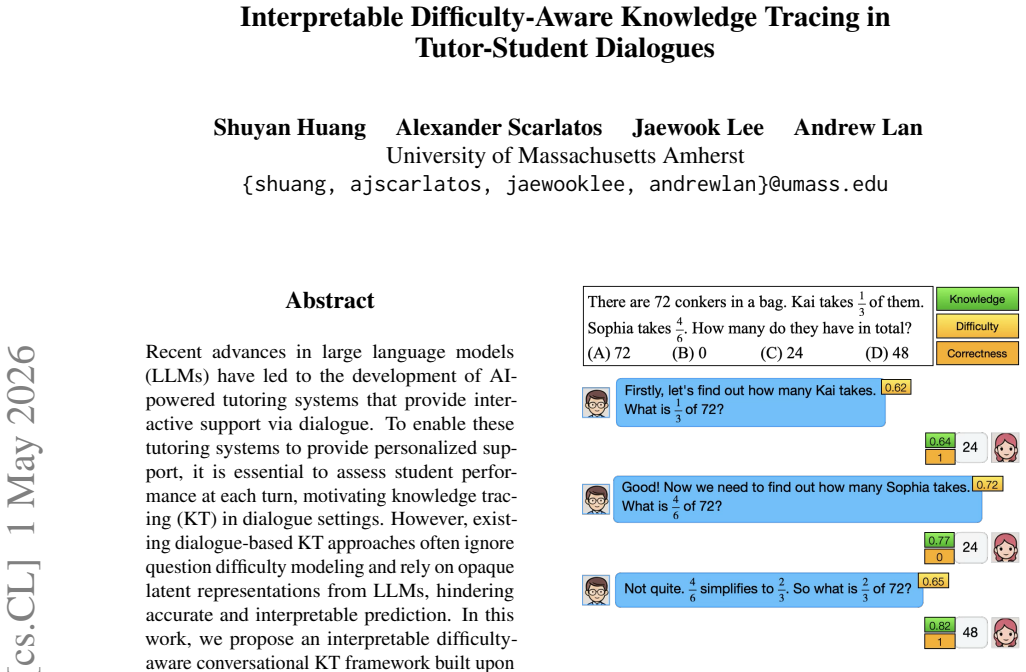
Recent advances in large language models (LLMs) have led to the development of AI-powered tutoring systems that provide interactive support via dialogue. To enable these tutoring systems to provide personalized support, it is essential to assess student performance at each turn, motivating knowledge tracing (KT) in dialogue settings. However, existing dialogue-based KT approaches often ignore question difficulty modeling and rely on opaque latent representations from LLMs, hindering accurate and interpretable prediction. In this work, we propose an interpretable difficulty-aware conversational KT framework built upon LLMs, which explicitly models students' abilities and the difficulty of tutor-posed tasks at each turn. The framework incorporates the original textual question and the next tutor-posed task to estimate the student's knowledge state and the difficulty of the upcoming turn. Furthermore, it integrates Item Response Theory to map LLM's outputs into student ability and question difficulty parameters, enabling interpretable prediction of student performance grounded in cognitive theories of learning. We evaluate the framework on two tutor-student dialogue datasets. Both quantitative and qualitative results show that our framework outperforms existing KT baselines, meanwhile generating interpretable outputs consistent with cognitive theory.
Editorial analysis
A structured set of objections, weighed in public.
Referee Report
Summary. The manuscript proposes an interpretable difficulty-aware conversational knowledge tracing (KT) framework for tutor-student dialogues. It uses LLMs to process the original textual question and the next tutor-posed task in order to estimate the student's knowledge state and upcoming task difficulty. The framework integrates Item Response Theory (IRT) to map LLM outputs into scalar student ability (θ) and question difficulty (b) parameters, enabling logistic-form performance prediction that is claimed to be both more accurate than existing KT baselines and consistent with cognitive theories of learning. Evaluation is reported on two tutor-student dialogue datasets, with both quantitative and qualitative results supporting the claims.
Significance. If the central claims hold after validation, the work would offer a concrete way to combine LLM flexibility with the interpretability and theoretical grounding of IRT in dialogue-based tutoring. This addresses a recognized gap in prior dialogue KT methods that rely on opaque latent states. The explicit difficulty modeling and cognitive-theory alignment could improve both predictive reliability and explainability in educational AI, provided the parameter extraction step is shown to be faithful rather than heuristic.
major comments (2)
- [Method (IRT integration subsection)] The mapping from LLM outputs to IRT parameters θ and b is described only at a high level with no prompting template, extraction equations, or validation against IRT assumptions (e.g., monotonicity of the item characteristic curve or correlation with independent difficulty annotations). This step is load-bearing for both the performance-prediction claim and the assertion of consistency with cognitive theory; without it the interpretability benefit is unsupported.
- [Experiments / Evaluation] The abstract and summary assert outperformance over existing KT baselines yet supply no AUC, accuracy, dataset sizes, baseline names, or ablation results isolating the contribution of the difficulty-aware IRT component. This absence prevents verification of the central empirical claim and makes it impossible to assess whether gains are attributable to the proposed framework.
minor comments (2)
- [Method] Notation for the IRT parameters (θ, b) and the logistic prediction function should be introduced with explicit equations early in the method section to aid readability.
- [Abstract] The abstract would be strengthened by a single sentence reporting the magnitude of improvement (e.g., average AUC delta) on the two datasets.
Simulated Author's Rebuttal
We thank the referee for the constructive comments. We agree that greater detail is required on the IRT mapping procedure and on the experimental metrics to fully support the interpretability and performance claims. We will revise the manuscript accordingly and respond to each point below.
read point-by-point responses
-
Referee: [Method (IRT integration subsection)] The mapping from LLM outputs to IRT parameters θ and b is described only at a high level with no prompting template, extraction equations, or validation against IRT assumptions (e.g., monotonicity of the item characteristic curve or correlation with independent difficulty annotations). This step is load-bearing for both the performance-prediction claim and the assertion of consistency with cognitive theory; without it the interpretability benefit is unsupported.
Authors: We agree that the IRT integration subsection requires expansion. In the revised manuscript we will add the complete LLM prompting template, the exact extraction equations that convert LLM outputs into scalar θ and b values, and new validation analyses that test monotonicity of the item characteristic curve and report Pearson correlation between the extracted b values and independent human difficulty annotations. These additions will make the interpretability claims fully verifiable and strengthen the link to cognitive theory. revision: yes
-
Referee: [Experiments / Evaluation] The abstract and summary assert outperformance over existing KT baselines yet supply no AUC, accuracy, dataset sizes, baseline names, or ablation results isolating the contribution of the difficulty-aware IRT component. This absence prevents verification of the central empirical claim and makes it impossible to assess whether gains are attributable to the proposed framework.
Authors: We acknowledge that the current presentation of results is insufficiently explicit. Although quantitative comparisons appear in the manuscript, we will revise the Experiments section to include a clear table with AUC and accuracy values, exact dataset sizes, the full list of baseline names, and dedicated ablation experiments that remove the difficulty-aware IRT component. This will allow direct verification of the performance gains and attribution to the proposed framework. revision: yes
Circularity Check
No significant circularity; derivation relies on external IRT and empirical evaluation
full rationale
The paper's core chain maps LLM outputs to IRT parameters (ability θ and difficulty b) then applies the standard logistic IRT formula for next-turn performance prediction. This mapping is presented as an integration of an established external theory rather than a self-defined or fitted-by-construction step. No equations, self-citations, or ansatzes in the abstract reduce the claimed predictions to the inputs by definition. Quantitative outperformance is measured against independent KT baselines on held-out dialogue data, providing an external benchmark. The interpretability claim is tied to consistency with cognitive theory via IRT, which is not shown to be circular within the paper's own derivations.
Axiom & Free-Parameter Ledger
axioms (1)
- domain assumption LLM outputs from textual questions and tasks can be mapped to student ability and question difficulty parameters via Item Response Theory
Reference graph
Works this paper leans on
-
[1]
Proceedings of the AAAI conference on artificial intelligence , volume=
Neural cognitive diagnosis for intelligent education systems , author=. Proceedings of the AAAI conference on artificial intelligence , volume=
-
[2]
Knowledge-Based Systems , volume=
Enhancing knowledge tracing with concept map and response disentanglement , author=. Knowledge-Based Systems , volume=. 2024 , publisher=
2024
-
[3]
Proceedings of the 16th workshop on innovative use of NLP for building educational applications , pages=
On the application of transformers for estimating the difficulty of multiple-choice questions from text , author=. Proceedings of the 16th workshop on innovative use of NLP for building educational applications , pages=
- [4]
-
[5]
Advances in Neural Information Processing Systems , volume=
SocraticLM: Exploring socratic personalized teaching with large language models , author=. Advances in Neural Information Processing Systems , volume=
-
[6]
Proceedings of the 61st Annual Meeting of the Association for Computational Linguistics (Volume 1: Long Papers) , pages=
Adaptive and Personalized Exercise Generation for Online Language Learning , author=. Proceedings of the 61st Annual Meeting of the Association for Computational Linguistics (Volume 1: Long Papers) , pages=
-
[7]
Measuring Conversational Uptake: A Case Study on Student-Teacher Interactions , author=
-
[8]
Proceedings of the 17th Workshop on Innovative Use of NLP for Building Educational Applications , year=
Fine-tuning transformers with additional context to classify discursive moves in mathematics classrooms , author=. Proceedings of the 17th Workshop on Innovative Use of NLP for Building Educational Applications , year=
-
[9]
Proceedings of the eleventh ACM conference on learning@ scale , pages=
Classifying tutor discursive moves at scale in mathematics classrooms with large language models , author=. Proceedings of the eleventh ACM conference on learning@ scale , pages=
-
[10]
Proceedings of the 15th International Learning Analytics and Knowledge Conference , pages=
Exploring knowledge tracing in tutor-student dialogues using llms , author=. Proceedings of the 15th International Learning Analytics and Knowledge Conference , pages=
-
[11]
International Conference on Artificial Intelligence in Education , pages=
Improving the validity of automatically generated feedback via reinforcement learning , author=. International Conference on Artificial Intelligence in Education , pages=. 2024 , organization=
2024
-
[12]
arXiv preprint arXiv:2310.10648 , year=
Bridging the novice-expert gap via models of decision-making: A case study on remediating math mistakes , author=. arXiv preprint arXiv:2310.10648 , year=
-
[13]
Deep-IRT: Make deep learning based knowledge tracing explainable using item response theory , author=. arXiv preprint arXiv:1904.11738 , year=
-
[14]
Proceedings of the AAAI conference on artificial intelligence , volume=
Improving interpretability of deep sequential knowledge tracing models with question-centric cognitive representations , author=. Proceedings of the AAAI conference on artificial intelligence , volume=
-
[15]
Proceedings of the 62nd Annual Meeting of the Association for Computational Linguistics (Volume 1: Long Papers) , pages=
Improving text embeddings with large language models , author=. Proceedings of the 62nd Annual Meeting of the Association for Computational Linguistics (Volume 1: Long Papers) , pages=
-
[16]
Llm2vec: Large language models are secretly powerful text encoders , author=. arXiv preprint arXiv:2404.05961 , year=
-
[17]
2020 , publisher=
The impressive effects of tutoring on prek-12 learning: A systematic review and meta-analysis of the experimental evidence , author=. 2020 , publisher=
2020
-
[18]
International Journal of Artificial Intelligence in Education , volume=
AutoTutor and family: A review of 17 years of natural language tutoring , author=. International Journal of Artificial Intelligence in Education , volume=. 2014 , publisher=
2014
-
[19]
Supercharge your teaching experience with Khanmigo , year =
-
[20]
LiveHint Overview , year =
-
[21]
arXiv preprint arXiv:2603.03236 , year=
Conversational Learning Diagnosis via Reasoning Multi-Turn Interactive Learning , author=. arXiv preprint arXiv:2603.03236 , year=
-
[22]
Findings of the Association for Computational Linguistics: ACL 2025 , pages=
Training turn-by-turn verifiers for dialogue tutoring agents: The curious case of llms as your coding tutors , author=. Findings of the Association for Computational Linguistics: ACL 2025 , pages=
2025
-
[23]
Proceedings of the 45th international ACM SIGIR conference on research and development in information retrieval , pages=
Assessing student's dynamic knowledge state by exploring the question difficulty effect , author=. Proceedings of the 45th international ACM SIGIR conference on research and development in information retrieval , pages=
-
[24]
Proceedings of the ACM web conference 2024 , pages=
Question difficulty consistent knowledge tracing , author=. Proceedings of the ACM web conference 2024 , pages=
2024
-
[25]
Proceedings of the 26th ACM SIGKDD international conference on knowledge discovery & data mining , pages=
Context-aware attentive knowledge tracing , author=. Proceedings of the 26th ACM SIGKDD international conference on knowledge discovery & data mining , pages=
-
[26]
Advances in neural information processing systems , volume=
Deep knowledge tracing , author=. Advances in neural information processing systems , volume=
-
[27]
Proceedings of the 26th international conference on World Wide Web , pages=
Dynamic key-value memory networks for knowledge tracing , author=. Proceedings of the 26th international conference on World Wide Web , pages=
-
[28]
Proceedings of the 2025 Conference on Empirical Methods in Natural Language Processing , pages=
PIIvot: A Lightweight NLP Anonymization Framework for Question-Anchored Tutoring Dialogues , author=. Proceedings of the 2025 Conference on Empirical Methods in Natural Language Processing , pages=
2025
-
[29]
Proceedings of the seventh ACM conference on learning@ scale , pages=
Towards an appropriate query, key, and value computation for knowledge tracing , author=. Proceedings of the seventh ACM conference on learning@ scale , pages=
-
[30]
simpleKT: A Simple But Tough-to-Beat Baseline for Knowledge Tracing , author=
-
[31]
The llama 3 herd of models , author=. arXiv preprint arXiv:2407.21783 , year=
work page internal anchor Pith review Pith/arXiv arXiv
-
[32]
Proceedings of the 2020 conference on empirical methods in natural language processing: system demonstrations , pages=
Transformers: State-of-the-art natural language processing , author=. Proceedings of the 2020 conference on empirical methods in natural language processing: system demonstrations , pages=
2020
-
[33]
LoRA: Low-Rank Adaptation of Large Language Models , author=
-
[34]
Advances in Neural Information Processing Systems , volume=
pyKT: a python library to benchmark deep learning based knowledge tracing models , author=. Advances in Neural Information Processing Systems , volume=
-
[35]
, author=
Learning and stability: a psychophysiological analysis of a case of motor learning with clinical applications. , author=. Journal of Applied Psychology , volume=. 1926 , publisher=
1926
-
[36]
2023 , publisher=
Kc-finder: Automated knowledge component discovery for programming problems , author=. 2023 , publisher=
2023
-
[37]
2026 , eprint=
Simulated Students in Tutoring Dialogues: Substance or Illusion? , author=. 2026 , eprint=
2026
-
[38]
Proceedings of the 2025 Conference on Empirical Methods in Natural Language Processing , pages=
Smart: Simulated students aligned with item response theory for question difficulty prediction , author=. Proceedings of the 2025 Conference on Empirical Methods in Natural Language Processing , pages=
2025
-
[39]
Statistical theories of mental test scores , year=
Some latent trait models and their use in inferring an examinee's ability , author=. Statistical theories of mental test scores , year=
-
[40]
, author=
Probabilistic models for some intelligence and attainment tests. , author=. 1993 , publisher=
1993
-
[41]
International Encyclopedia of the Social and Behavioral Sciences , year=
The learning curve , author=. International Encyclopedia of the Social and Behavioral Sciences , year=
-
[42]
Noise reduction in speech processing , pages=
Pearson correlation coefficient , author=. Noise reduction in speech processing , pages=. 2009 , publisher=
2009
-
[43]
Proceedings of the 2024 Joint International Conference on Computational Linguistics, Language Resources and Evaluation (LREC-COLING 2024) , pages=
Difficulty-focused contrastive learning for knowledge tracing with a large language model-based difficulty prediction , author=. Proceedings of the 2024 Joint International Conference on Computational Linguistics, Language Resources and Evaluation (LREC-COLING 2024) , pages=
2024
-
[44]
The Routledge handbook of language testing , pages=
Classical test theory , author=. The Routledge handbook of language testing , pages=. 2013 , publisher=
2013
-
[45]
International Conference on Artificial Intelligence in Education , pages=
Ruffle&riley: Insights from designing and evaluating a large language model-based conversational tutoring system , author=. International Conference on Artificial Intelligence in Education , pages=. 2024 , organization=
2024
-
[46]
Proceedings of the 2024 CHI Conference on Human Factors in Computing Systems , pages=
Teach ai how to code: Using large language models as teachable agents for programming education , author=. Proceedings of the 2024 CHI Conference on Human Factors in Computing Systems , pages=
2024
-
[47]
Proceedings of the tenth acm conference on learning@ scale , pages=
Gpteach: Interactive ta training with gpt-based students , author=. Proceedings of the tenth acm conference on learning@ scale , pages=
-
[48]
arXiv preprint arXiv:2502.11678 , year=
Which Type of Students can LLMs Act? Investigating Authentic Simulation with Graph-based Human-AI Collaborative System , author=. arXiv preprint arXiv:2502.11678 , year=
-
[49]
Proceedings of the 17th International Conference on Educational Data Mining , pages=
Designing simulated students to emulate learner activity data in an open-ended learning environment , author=. Proceedings of the 17th International Conference on Educational Data Mining , pages=
-
[50]
Cognitive skills and their acquisition , pages=
Mechanisms of skill acquisition and the law of practice , author=. Cognitive skills and their acquisition , pages=
-
[51]
2000 , publisher=
Learning and memory: An integrated approach , author=. 2000 , publisher=
2000
-
[52]
Findings of the Association for Computational Linguistics: EMNLP 2023 , pages=
Mathdial: A dialogue tutoring dataset with rich pedagogical properties grounded in math reasoning problems , author=. Findings of the Association for Computational Linguistics: EMNLP 2023 , pages=
2023
discussion (0)
Sign in with ORCID, Apple, or X to comment. Anyone can read and Pith papers without signing in.