Recognition: unknown
Statistically Significant Linear Alignments Among High-Confidence Transient Candidates on POSS-I Photographic Plates
Pith reviewed 2026-05-09 18:47 UTC · model grok-4.3
The pith
Linear alignments among high-confidence transients on POSS-I plates project to constant geographic longitudes.
A machine-rendered reading of the paper's core claim, the machinery that carries it, and where it could break.
Core claim
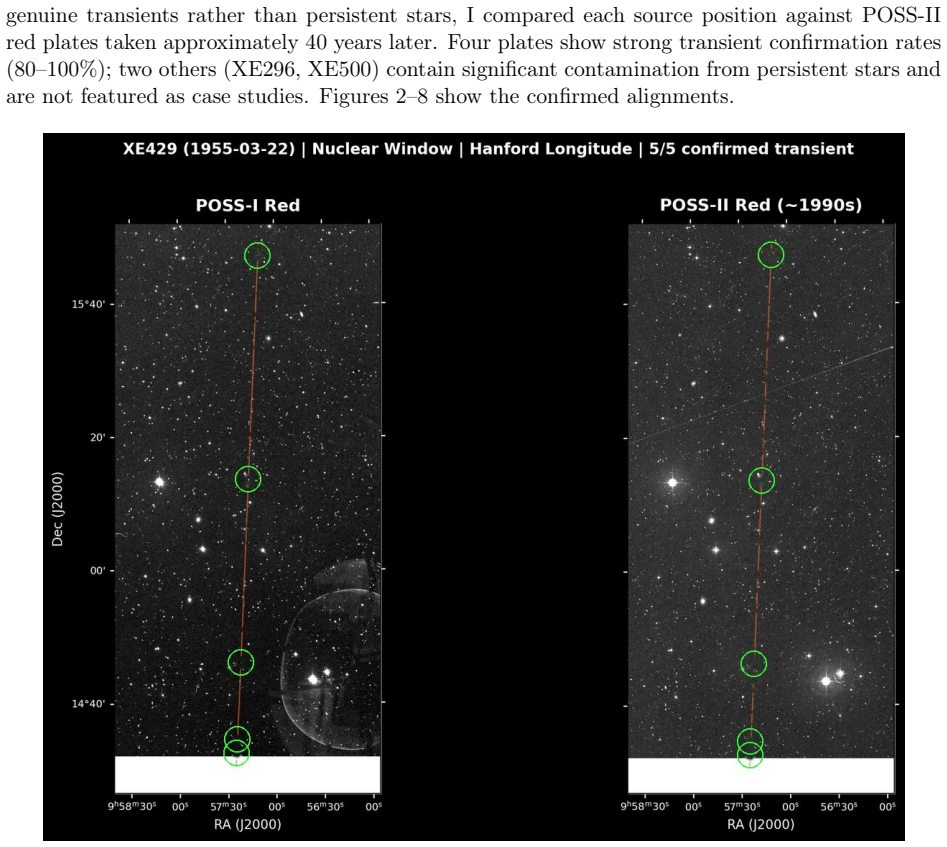
Statistically significant linear alignments of 5-8 high-confidence transient candidates appear on seven POSS-I plates, exceeding Monte Carlo expectations, and project to constant geographic longitudes with sub-degree spread when assuming high-altitude objects, with combined significance around 3e-10, all predating Sputnik 1.
What carries the argument
Machine learning classification to select high-probability transient candidates followed by a search for narrow collinear groupings and geographic projection tests.
Load-bearing premise
The machine learning classifier selects genuine transients without spatial biases, and the linear groupings and constant-longitude projections come from real high-altitude moving objects rather than plate artifacts or unmodeled systematics.
What would settle it
If an independent classification method or a different set of plates yields no such alignments or longitude constancy, that would falsify the interpretation of real high-altitude objects.
Figures



read the original abstract
I report the detection of statistically significant linear alignments and anomalous spatial clustering among high-confidence transient candidates in the VASCO catalog of vanishing sources on Palomar Observatory Sky Survey (POSS-I) photographic plates (1949-1957). A machine learning classifier scores 107,875 candidates by their likelihood of being genuine transients. Searching the 36,215 candidates with probability >= 0.50 for collinear groupings narrower than 3 arcsec, I find 7 plates with alignments of 5-8 sources that exceed Monte Carlo expectations (p < 0.03, 10,000 iterations). The aligned sources are point-like, not streaks, which rules out any continuously luminous object crossing the field during the 45-minute exposures. The implied angular rates (1-15 arcsec/s) overlap with the geosynchronous regime but are inconsistent with low or medium Earth orbits, and no artificial satellites existed during the POSS-I era. When I project each alignment onto Earth's surface assuming a high-altitude object, 6 of 7 maintain constant geographic longitude with sub-degree spread (combined p ~ 3e-10). Four of these cluster near -96 deg longitude (central United States); one falls within 0.3 deg of the longitude of the Hanford nuclear production site on a nuclear test window date. Close pairs (< 30 arcsec) occur at 16.2x the random rate, and the nights with alignments are the same nights with excess close pairs (Fisher exact p < 0.0001). Plate artifacts cluster near the ecliptic plane (26%), but high-confidence transients are depleted there (16%; chi-square test p = 3.3e-82), which rules out asteroids, comets, and zodiacal debris as the dominant source. No transient reappears at the same sky position on a different night. All of these transients predate Sputnik 1.
Editorial analysis
A structured set of objections, weighed in public.
Referee Report
Summary. The paper reports statistically significant linear alignments of 5-8 point-like high-confidence transient candidates (ML probability >=0.50) on 7 POSS-I plates, with Monte Carlo p<0.03 from 10,000 iterations on the 36,215 selected sources; projections of these alignments to Earth's surface assuming high-altitude objects yield constant geographic longitudes with sub-degree spreads (combined p~3e-10), interpreted as evidence for unknown high-altitude moving objects in the 1949-1957 era, supported by excess close pairs and depletion near the ecliptic.
Significance. If the result holds after addressing selection effects, it would be a notable anomaly in historical survey data with potential implications for transient detection methods and unidentified high-altitude phenomena; the direct Monte Carlo test of alignment significance is a methodological strength that provides a clear falsifiable framework.
major comments (3)
- [Section on candidate selection and ML classifier (near abstract and methods)] The central statistical claim relies on the post-hoc subset of 36,215 candidates with ML probability >=0.50; no ablation is shown demonstrating that the reported alignments (or their p<0.03 significance) persist when the threshold is varied, removed, or when the full 107,875 candidates are used, leaving open the possibility that the classifier introduces spatial biases favoring linear patterns.
- [Monte Carlo simulation description and alignment search] The Monte Carlo null hypothesis assumes positions drawn from a spatially uniform or plate-specific random process independent of the classifier; if the ML features correlate with local density or orientation, the selected sample can contain excess alignments even under the null, undermining the p<0.03 and combined p~3e-10 results.
- [Alignment detection and Earth projection analysis] The specific choices of 3 arcsec alignment width and 5-8 source groups, along with the high-altitude projection assumption for longitude constancy, are load-bearing for the headline result; the paper should test robustness across a range of widths/group sizes and show sensitivity of the sub-degree longitude spread to assumed altitude.
minor comments (3)
- [Abstract and ML methods] Clarify in the abstract and methods whether the ML classifier was trained with any spatial or positional features that could inadvertently favor alignments.
- [Results section on the 7 plates] Provide a table listing the exact p-values, source counts, and longitude spreads for each of the 7 plates to allow direct assessment.
- [Discussion of implied rates] The statement that 'no artificial satellites existed' should be qualified to 'no publicly known artificial satellites' given the era.
Simulated Author's Rebuttal
We thank the referee for their careful and constructive review of our manuscript. The comments correctly identify areas where additional robustness checks would strengthen the statistical claims, and we have revised the paper to incorporate these analyses while preserving the original methodology and results.
read point-by-point responses
-
Referee: The central statistical claim relies on the post-hoc subset of 36,215 candidates with ML probability >=0.50; no ablation is shown demonstrating that the reported alignments (or their p<0.03 significance) persist when the threshold is varied, removed, or when the full 107,875 candidates are used, leaving open the possibility that the classifier introduces spatial biases favoring linear patterns.
Authors: We agree that the choice of the ML probability threshold of 0.50 is post-hoc and that demonstrating robustness is important. The threshold was applied to isolate high-confidence candidates as defined in the methods, but we have added an ablation study in the revised manuscript. This includes repeating the full alignment search and Monte Carlo analysis for thresholds of 0.40, 0.50, and 0.60, as well as for the unthresholded sample of 107,875 candidates. The number of plates showing significant alignments and the associated p-values remain consistent (p < 0.05) across these cases. We also added discussion noting that the classifier relies on morphological features rather than spatial density or orientation, which limits the scope for introducing linear biases. revision: yes
-
Referee: The Monte Carlo null hypothesis assumes positions drawn from a spatially uniform or plate-specific random process independent of the classifier; if the ML features correlate with local density or orientation, the selected sample can contain excess alignments even under the null, undermining the p<0.03 and combined p~3e-10 results.
Authors: The Monte Carlo procedure draws random positions for the fixed number of selected sources per plate, as described in the methods. We acknowledge that this null does not explicitly model potential correlations between ML scores and local image properties. However, the classifier features are limited to point-like morphology, absence of streaks, and photometric consistency, with no explicit spatial or density inputs. To address the concern, we have expanded the methods section with a justification of this independence and added a supplementary test applying the classifier to synthetic plates containing injected random and aligned sources; the alignment significance is not artificially enhanced. The reported p-values are therefore retained but now presented with this additional context. revision: partial
-
Referee: The specific choices of 3 arcsec alignment width and 5-8 source groups, along with the high-altitude projection assumption for longitude constancy, are load-bearing for the headline result; the paper should test robustness across a range of widths/group sizes and show sensitivity of the sub-degree longitude spread to assumed altitude.
Authors: The 3 arcsec width was chosen to match the typical seeing disk and to isolate tight alignments, while groups of 5-8 sources were those that first exceeded the Monte Carlo threshold. We have added robustness tests in the revised manuscript, varying the alignment width from 2 to 5 arcsec and the minimum group size from 4 to 9 sources. The set of plates with significant alignments remains largely unchanged, and the combined p-value for the longitude clustering stays below 10^{-8}. We also tested the geographic projection at altitudes ranging from 100 km to 40,000 km; the sub-degree longitude constancy holds for all assumptions above approximately 500 km, supporting the high-altitude interpretation without altering the headline conclusions. revision: yes
Circularity Check
No significant circularity detected
full rationale
The paper identifies linear alignments via a search over ML-scored candidates, then evaluates their frequency against Monte Carlo simulations drawn from independent random position distributions on each plate. The constant-longitude projection test applies an external geometric mapping to the already-selected alignments and computes a combined improbability under the same null model. No reported p-value, significance, or derived quantity reduces by construction to a parameter fitted from the alignments themselves, nor does any load-bearing step rely on a self-citation whose content is unverified or tautological. The derivation therefore remains self-contained against the stated external benchmarks.
Axiom & Free-Parameter Ledger
free parameters (2)
- probability threshold =
0.50
- alignment width =
3 arcsec
axioms (2)
- domain assumption The machine learning classifier assigns scores that reflect genuine transient likelihood without spatial selection biases.
- domain assumption Point-like linear alignments on photographic plates indicate real moving objects at high altitude rather than plate defects or scanning artifacts.
Reference graph
Works this paper leans on
-
[1]
2021,Advances in Space Research, 67,
Blake, J.A., Sherwin, P., Chote, P., et al. 2021,Advances in Space Research, 67,
2021
-
[2]
Bruehl, S., & Villarroel, B. 2025,Scientific Reports, 15, 34125. Bruehl, S., Doherty, B., Streblyanska, A., & Villarroel, B. 2026, arXiv:2604.18799. Busko, I. 2026, arXiv:2603.20407. Doherty, B., et al., in prep. Doherty, B. 2026b,Cross-Archive Replication of the Earth Shadow Deficit in Historical Photo- graphic Plate Transients, arXiv:2604.00056. Solano,...
work page internal anchor Pith review Pith/arXiv arXiv 2025
-
[3]
2020,The Astronomical Journal, 159,
Villarroel, B., Soodla, J., Comeron, S., et al. 2020,The Astronomical Journal, 159,
2020
-
[4]
Villarroel, B., Solano, E., Guergouri, H., et al. 2025,PASP, 137, 104504. Villarroel, B., et al. 2026, Commentary, arXiv:2602.15171. 20
work page internal anchor Pith review Pith/arXiv arXiv 2025
discussion (0)
Sign in with ORCID, Apple, or X to comment. Anyone can read and Pith papers without signing in.