Recognition: unknown
Developing a Strong Pre-Trained Base Model for Plant Leaf Disease Classification
Pith reviewed 2026-05-09 14:48 UTC · model grok-4.3
The pith
A DenseNet201 model pre-trained on a new combined plant leaf dataset outperforms general models as a starting point for transfer learning in disease classification.
A machine-rendered reading of the paper's core claim, the machinery that carries it, and where it could break.
Core claim
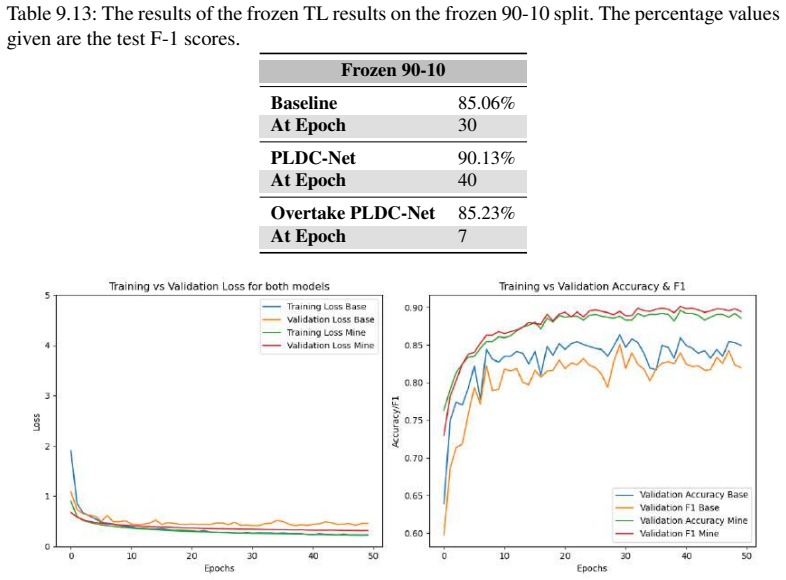
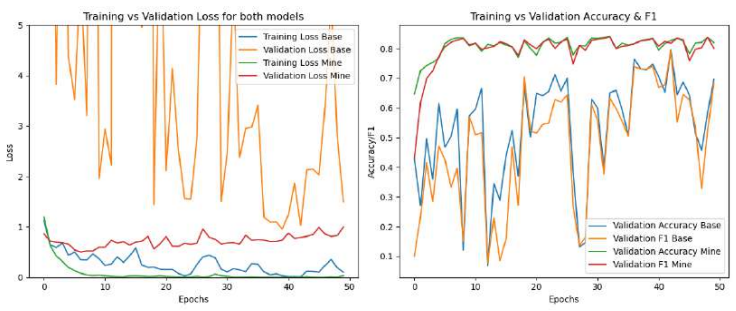
The authors benchmark existing open datasets, run an augmentation study, and assemble a new training collection that supports training a DenseNet201 architecture. This resulting base model surpasses the performance of a standard baseline both on the new dataset itself and when used for transfer learning on a separate plant leaf disease collection, delivering training runs that are faster, more robust, more stable, and effective with less data than those begun from general pre-trained models.
What carries the argument
The new DenseNet201-based base model trained on the authors' custom dataset, which supplies a domain-specific initialization that improves transfer learning outcomes for plant leaf disease tasks.
If this is right
- Transfer learning models derived from the new base require fewer labeled images to reach target accuracy on plant disease tasks.
- Training runs converge faster and with greater stability than those using generic pre-trained networks.
- The base model supports consistent performance across multiple plant species and disease types in the reported benchmarks.
- Computational resources needed to develop new classifiers for leaf disease detection are reduced.
Where Pith is reading between the lines
- The dataset curation approach could be repeated for other narrow visual domains where public data falls short of what full models need.
- Mobile or edge deployments of disease detection might become practical sooner if this base model reduces the data and compute barrier for fine-tuning.
- Combining the base with additional sensor inputs or temporal sequences of field images could extend its usefulness for ongoing crop monitoring.
Load-bearing premise
The gains arise because the new dataset and augmentation choices produce a generally superior base model rather than one that benefits from dataset-specific biases or unstated differences in the benchmark setups.
What would settle it
A transfer learning experiment on a new plant disease dataset where a model started from this base model shows no improvement in training speed, stability, or data efficiency compared with one started from a standard general pre-trained network would challenge the central claim.
Figures









read the original abstract
Plants, crops and their yields are essential to our very existence, but diseases and pests cause large losses every year. As such it is vital to ensure that diseases can be spotted early and treated accordingly and stopping the spread while still possible. Manual and traditional methods require personal to walk through the field and check for symptoms 'by hand'. This is very laborious and very time consuming, so ML methods have been applied as a result and they have garnered promising results. CNN models are especially efficient as they can automatically extract features from images without any manual feature construction before then feeding the features to a classifier. Datasets are largely influential to the final performance of the model. Despite the importance that datasets pose to the field, there still seems to be somewhat of a discrepancy between what is publicly available for use and what would be required to sufficiently train fully capable models. To overcome these shortcomings, as part of this thesis open datasets for the field of plant leaf disease classification have been identified as well as models that can be trained on them and extensive benchmarks have been carried out to identify their suitability. Then a new dataset was constructed based on those findings as well as on the findings of a augmentation applicability study, which will be used to train a new Base Model based on the DenseNet201 architecture, which managed to outperform the baseline model on said new dataset as well as outperforming it on plant leaf disease classification domain specific Transfer-Learning experiments on another new dataset. This new model manages to train models through Transfer-Learning (TL) faster, more robust, more stable, and with less data than general model would, overcoming a large number of issues that the field still suffers from.
Editorial analysis
A structured set of objections, weighed in public.
Referee Report
Summary. The manuscript identifies publicly available datasets for plant leaf disease classification, performs benchmarks to assess their suitability, constructs a new dataset informed by an augmentation study, trains a DenseNet201 base model on this dataset (claiming outperformance over baselines), and evaluates transfer learning on a second new dataset, asserting that the resulting model enables faster, more robust, stable, and data-efficient fine-tuning than ImageNet-pretrained general models.
Significance. If the empirical superiority claims hold under controlled conditions, the work could deliver a domain-adapted pre-trained model that mitigates data scarcity, training instability, and slow convergence issues common in CNN-based plant pathology tasks, providing a reusable base for downstream applications.
major comments (2)
- [Transfer learning experiments] Transfer learning experiments section: The claim that the new DenseNet201 base model trains faster, more robustly, more stably, and with less data than a general model requires explicit confirmation that fine-tuning protocols are identical between the new base model and the ImageNet baseline (same optimizer, learning-rate schedule, layer-freezing strategy, augmentation pipeline, batch size, and early-stopping rule). The abstract supplies no protocol details; any unstated differences would make the gains artifacts of setup rather than properties of the learned weights.
- [Results and evaluation] Results and evaluation sections: The abstract asserts outperformance on the new dataset and in TL experiments but supplies no concrete metrics, baselines, error bars, statistical tests, or validation protocols. This prevents independent verification of the central claims and undermines the data-efficiency and robustness assertions.
minor comments (2)
- [Abstract] Abstract: minor grammatical issues ('personal to walk through the field' should read 'personnel'; 'as part of this thesis' suggests the work may be thesis-derived and requires journal-style self-containment).
- [Dataset construction and methods] Notation and clarity: dataset names, augmentation choices, and exact baseline architectures are referenced but not tabulated or cross-referenced to specific sections, making reproducibility difficult.
Simulated Author's Rebuttal
We thank the referee for the constructive feedback on our manuscript. We have addressed each major comment by clarifying the experimental setup and enhancing the reporting of results to improve verifiability. Revisions have been made to the relevant sections.
read point-by-point responses
-
Referee: [Transfer learning experiments] Transfer learning experiments section: The claim that the new DenseNet201 base model trains faster, more robustly, more stably, and with less data than a general model requires explicit confirmation that fine-tuning protocols are identical between the new base model and the ImageNet baseline (same optimizer, learning-rate schedule, layer-freezing strategy, augmentation pipeline, batch size, and early-stopping rule). The abstract supplies no protocol details; any unstated differences would make the gains artifacts of setup rather than properties of the learned weights.
Authors: We agree that identical protocols are essential for valid comparison. The fine-tuning protocols were the same for the domain-specific DenseNet201 and the ImageNet-pretrained baseline. We have revised the Transfer Learning Experiments section to explicitly confirm this and added a table listing the shared hyperparameters (optimizer, learning-rate schedule, layer-freezing strategy, augmentation pipeline, batch size, and early-stopping rule). These details were already described in the Methods but are now highlighted for clarity. revision: yes
-
Referee: [Results and evaluation] Results and evaluation sections: The abstract asserts outperformance on the new dataset and in TL experiments but supplies no concrete metrics, baselines, error bars, statistical tests, or validation protocols. This prevents independent verification of the central claims and undermines the data-efficiency and robustness assertions.
Authors: The Results and Evaluation sections contain tables with accuracy, F1, and other metrics comparing our model to baselines on the constructed dataset, along with learning curves and metrics for the transfer learning experiments on the second dataset. Validation used 5-fold cross-validation. To address the concern about the abstract and ease of verification, we have revised the abstract to include key quantitative results and added explicit mentions of error bars (from repeated runs) and statistical comparisons in the evaluation section. revision: yes
Circularity Check
No circularity; claims rest on empirical dataset construction and benchmarking
full rationale
The paper constructs a new dataset from public sources plus an augmentation study, trains DenseNet201 on it, and reports outperformance versus ImageNet baselines on both the new dataset and downstream TL tasks on a second dataset. No equations, self-citations, or uniqueness theorems are invoked to derive the result; performance is measured directly via training and evaluation. This is self-contained empirical work with no reduction of outputs to inputs by definition or construction.
Axiom & Free-Parameter Ledger
axioms (2)
- domain assumption Convolutional neural networks can automatically extract useful features from leaf images for disease classification
- domain assumption Transfer learning from a domain-specific pre-trained model yields faster, more stable training with less data than a general model
Reference graph
Works this paper leans on
-
[1]
The State of Food Security and Nutrition in the World (SOFI)
FAO, IFAD, UNICEF, WFP and WHO, The State of F ood Security and Nutrition in the World 2024 – Financing to end hunger , food insecurity and malnutrition in all its forms, ser. The State of Food Security and Nutrition in the World (SOFI). Rome, Italy: FAO, IFAD, UNICEF, WFP , WHO, 2024, no. 2024. doi: 10.4060/cd1254en
-
[2]
FAO Statistical Y earbook – World Food and Agriculture
FAO, World F ood and Agriculture – Statistical Yearbook 2023 , ser. FAO Statistical Y earbook – World Food and Agriculture. Rome, Italy: FAO, 2023, no. 2023. doi: 10.4060/cc8166en
-
[3]
Rome, Italy: FAO, 2017
——, The Future of F ood and Agriculture: Trends and Challenges , 1st ed. Rome, Italy: FAO, 2017. [Online]. Available: https://openknowledge.fao.org/handle/20.500. 14283/i6583e
2017
-
[4]
The persis- tent threat of emerging plant disease pandemics to global food security,
J. B. Ristaino, P . K. Anderson, D. P . Bebber, K. A. Brauman, N. J. Cunniffe, N. V . Fedoroff, C. Finegold, K. A. Garrett, C. A. Gilligan, C. M. Jones et al. , “The persis- tent threat of emerging plant disease pandemics to global food security,” Proceedings of the National Academy of Sciences , vol. 118, no. 23, p. e2022239118, 2021. doi: 10.1073/pnas.2...
-
[5]
The State of Food and Agriculture (SOFA)
FAO, The State of F ood and Agriculture 2023 – Revealing the true cost of food to trans- form agrifood systems , ser. The State of Food and Agriculture (SOFA). Rome, Italy: FAO, 2023, no. 2023. doi: 10.4060/cc7724en
-
[6]
D. C. Clay, C. G. Carlson, and K. Dalsted, iGrow Wheat: Best Management Practices for Wheat Production . Brookings, S.D.: South Dakota State University, College of Agriculture and Biological Sciences. SDSU Extension, 2012, agronomy, 102 Horticulture, and Plant Science Books. 1., ISBN: 978-0-9856309-0-4. [Online]. Available: https://openprairie.sdstate.edu...
2012
-
[7]
R. O. for Europe, Monitoring and Surveillance of Cereals Pests, Diseases and Weeds, 1st ed. Sub-regional Of fi ce of FAO for Central Asia: FAO, 2012, fAO Job Number: AQ295E. [Online]. Available: https://openknowledge.fao.org/handle/20.500. 14283/aq295e
2012
-
[8]
Koyshibayev and H
M. Koyshibayev and H. Muminjanov, GUIDELINES FOR MONITORING DISEASES, PESTS AND WEEDS IN CEREAL CROPS , 1st ed. Rome, Italy: FAO, 2016. [Online]. Available: https://openknowledge.fao.org/handle/20.500.14283/i5550e
2016
-
[9]
Systematic review of deep learning techniques in plant disease detection,
M. Nagaraju and P . Chawla, “Systematic review of deep learning techniques in plant disease detection,” International journal of system assurance engineering and manage- ment, vol. 11, no. 3, pp. 547–560, 2020. doi: 10.1007/s13198-020-00972-1
-
[10]
L. Li, S. Zhang, and B. Wang, “Plant disease detection and classi fi cation by deep learning—a review,” IEEE Access , vol. 9, pp. 56 683–56 698, 2021. doi: 10.1109/AC- CESS.2021.3069646
work page doi:10.1109/ac- 2021
-
[11]
Review on convolutional neural network (cnn) applied to plant leaf disease classi fi cation,
J. Lu, L. Tan, and H. Jiang, “Review on convolutional neural network (cnn) applied to plant leaf disease classi fi cation,” Agriculture, vol. 11, no. 8, p. 707, 2021. doi: 10.3390/agriculture11080707
-
[12]
Leaf disease detection using ma- chine learning and deep learning: Review and challenges,
C. Sarkar, D. Gupta, U. Gupta, and B. B. Hazarika, “Leaf disease detection using ma- chine learning and deep learning: Review and challenges,” Applied Soft Computing, vol. 145, p. 110534, 2023. doi: 10.1016/j.asoc.2023.110534
-
[13]
Plant disease detection and classification techniques: a comparative study of the performances,
W. B. Demilie, “Plant disease detection and classi fi cation techniques: a comparative study of the performances,” Journal of Big Data , vol. 11, no. 1, p. 5, 2024. doi: 10.1186/s40537-023-00863-9
-
[14]
M. Xu, H. Kim, J. Y ang, A. Fuentes, Y . Meng, S. Y oon, T. Kim, and D. S. Park, “Embrac- ing limited and imperfect training datasets: opportunities and challenges in plant disease recognition using deep learning,” Frontiers in Plant Science, vol. 14, p. 1225409, 2023. doi: 10.3389/fpls.2023.1225409 . 103
-
[15]
D. Singh, N. Jain, P . Jain, P . Kayal, S. Kumawat, and N. Batra, “Plantdoc: A dataset for visual plant disease detection,” in Proceedings of the 7th ACM IKDD CoDS and 25th COMAD. New Y ork, NY , USA: Association for Computing Machinery, 2020, pp. 249–253. doi: 10.1145/3371158.3371196
-
[16]
Foundation models de fi ning a new era in vision: a survey and out- look,
M. Awais, M. Naseer, S. Khan, R. M. Anwer, H. Cholakkal, M. Shah, M.-H. Y ang, and F. S. Khan, “Foundation models de fi ning a new era in vision: a survey and out- look,” IEEE Transactions on Pattern Analysis and Machine Intelligence , 2025. doi: 10.1109/TPAMI.2024.3506283
-
[17]
A., Siebert, X., Cornu, O., and Vleeschouwer, C
F. Chen, M. V . Giuffrida, and S. A. Tsaftaris, “Adapting vision foundation models for plant phenotyping,” in Proceedings of the IEEE/CVF International Conference on Com- puter Vision, 2023, pp. 604–613. doi: 10.1109/ICCVW60793.2023.00067
-
[18]
D. J. Richter, M. I. Bappi, S. S. Kolekar, and K. Kim, “A systematic review of the current state of transfer learning accelerated cnn-based plant leaf disease classi fi cation,” 2025. doi: 10.1109/ACCESS.2025.3584404 ., in press
-
[19]
S. P . Mohanty, D. P . Hughes, and M. Salath ´e, “Using deep learning for image- based plant disease detection,” Frontiers in plant science , vol. 7, p. 1419, 2016. doi: 10.3389/fpls.2016.01419
-
[20]
Image-based crop disease detection with federated learning,
D. Mamba Kabala, A. Ha fi ane, L. Bobelin, and R. Canals, “Image-based crop disease detection with federated learning,” Scientifi c Reports, vol. 13, no. 1, p. 19220, 2023
2023
-
[21]
Deep residual learning for image recognition,
K. He, X. Zhang, S. Ren, and J. Sun, “Deep residual learning for image recognition,” in Proceedings of the IEEE conference on computer vision and pattern recognition , 2016, pp. 770–778
2016
-
[22]
MobileNets: Efficient Convolutional Neural Networks for Mobile Vision Applications
A. G. Howard, M. Zhu, B. Chen, D. Kalenichenko, W. Wang, T. Weyand, M. Andreetto, and H. Adam, “Mobilenets: Ef fi cient convolutional neural net- works for mobile vision applications,” arXiv preprint arXiv:1704.04861 , 2017. doi: 10.48550/arXiv.1704.04861 . 104
work page internal anchor Pith review doi:10.48550/arxiv.1704.04861 2017
-
[23]
Transforming agriculture: Federated learning cnns for wheat disease severity assessment,
S. Mehta, V . Kukreja, and A. Gupta, “Transforming agriculture: Federated learning cnns for wheat disease severity assessment,” in 2023 8th International Conference on Com- munication and Electronics Systems (ICCES) . IEEE, 2023, pp. 792–797
2023
-
[24]
A novel deep learning model for detection of severity level of the disease in citrus fruits,
P . Dhiman, V . Kukreja, P . Manoharan, A. Kaur, M. Kamruzzaman, I. B. Dhaou, and C. Iwendi, “A novel deep learning model for detection of severity level of the disease in citrus fruits,” Electronics, vol. 11, no. 3, p. 495, 2022
2022
-
[25]
Federated learning-based uavs for the diagnosis of plant diseases,
F. S. Khan, S. Khan, M. N. H. Mohd, A. Waseem, M. N. A. Khan, S. Ali, and R. Ahmed, “Federated learning-based uavs for the diagnosis of plant diseases,” in 2022 Interna- tional Conference on Engineering and Emerging Technologies (ICEET) . IEEE, 2022, pp. 1–6
2022
-
[26]
Federated learning: Crop classi fi cation in a smart farm decentralised network,
G. Idoje, T. Dagiuklas, and M. Iqbal, “Federated learning: Crop classi fi cation in a smart farm decentralised network,” Smart Agricultural Technology, vol. 5, p. 100277, 2023
2023
-
[27]
D. R. Hammou and M. Boubaker, “Tomato plant disease detection and classi fi cation using convolutional neural network architectures technologies,” in Networking, Intelli- gent Systems and Security: Proceedings of NISS 2021 . Springer, 2022, pp. 33–44. doi: 10.1007/978-981-16-3637-0 3
-
[28]
Zenseact open dataset: A large-scale and diverse multimodal dataset for autonomous driving
B. Tej, F. Nasri, and A. Mtibaa, “Detection of pepper and tomato leaf diseases us- ing deep learning techniques,” in 2022 5th international conference on advanced systems and emergent technologies (IC ASET). IEEE, 2022, pp. 149–154. doi: 10.1109/IC ASET53395.2022.9765923
work page doi:10.1109/ic 2022
-
[29]
Grapevine leaf disease identi fi cation using transfer learn- ing,
R. Nagi and S. S. Tripathy, “Grapevine leaf disease identi fi cation using transfer learn- ing,” in 2021 IEEE International Women in Engineering (WIE) Conference on Elec- trical and Computer Engineering (WIECON-ECE) . IEEE, 2021, pp. 43–46. doi: 10.1109/WIECON-ECE54711.2021.9829703
-
[30]
L. Li, S. Zhang, and B. Wang, “Apple leaf disease identi fi cation with a small and imbal- anced dataset based on lightweight convolutional networks,” Sensors, vol. 22, no. 1, p. 173, 2021. doi: 10.3390/s22010173 . 105
-
[31]
Detection and classi fi cation of chilli leaf disease using a squeeze-and-excitation-based cnn model,
B. N. Naik, R. Malmathanraj, and P . Palanisamy, “Detection and classi fi cation of chilli leaf disease using a squeeze-and-excitation-based cnn model,” Ecological Informatics, vol. 69, p. 101663, 2022. doi: 10.1016/j.ecoinf.2022.101663
-
[32]
P . Pradhan, B. Kumar, and S. Mohan, “Comparison of various deep convolutional neu- ral network models to discriminate apple leaf diseases using transfer learning,” Jour- nal of Plant Diseases and Protection , vol. 129, no. 6, pp. 1461–1473, 2022. doi: 10.1007/s41348-022-00660-1
-
[33]
M. Reda, R. Suwwan, S. Alkafri, Y . Rashed, and T. Shanableh, “Agroaid: A mobile app system for visual classi fi cation of plant species and diseases using deep learning and tensorfl ow lite,” in Informatics, vol. 9. MDPI, 2022, p. 55. doi: 10.3390/informat- ics9030055
-
[34]
Adaptive thresholding of cnn features for maize leaf disease classi fi ca- tion and severity estimation,
H. D. Mafukidze, G. Owomugisha, D. Otim, A. Nechibvute, C. Nyamhere, and F. Mazunga, “Adaptive thresholding of cnn features for maize leaf disease classi fi ca- tion and severity estimation,” Applied Sciences, vol. 12, no. 17, p. 8412, 2022
2022
-
[35]
G. Latif, S. E. Abdelhamid, R. E. Mallouhy, J. Alghazo, and Z. A. Kazimi, “Deep learn- ing utilization in agriculture: Detection of rice plant diseases using an improved cnn model,” Plants, vol. 11, no. 17, p. 2230, 2022. doi: 10.3390/plants11172230
-
[36]
Improving plant disease classi fi cation by adaptive minimal ensembling,
A. Bruno, D. Moroni, R. Dainelli, L. Rocchi, S. Morelli, E. Ferrari, P . Toscano, and M. Martinelli, “Improving plant disease classi fi cation by adaptive minimal ensembling,” Frontiers in Arti fi cial Intelligence , vol. 5, p. 868926, 2022. doi: 10.3389/frai.2022.868926
-
[37]
Deep learning-based leaf disease detection in crops using images for agricultural applications,
J. Eunice, D. E. Popescu, M. K. Chowdary, and J. Hemanth, “Deep learning-based leaf disease detection in crops using images for agricultural applications,”Agronomy, vol. 12, no. 10, p. 2395, 2022. doi: 10.3390/agronomy12102395
-
[38]
Ef fi cient attention-based cnn network (eanet) for multi- class maize crop disease classi fi cation,
S. Albahli and M. Masood, “Ef fi cient attention-based cnn network (eanet) for multi- class maize crop disease classi fi cation,” Frontiers in Plant Science, vol. 13, p. 1003152,
-
[39]
doi: 10.3389/fpls.2022.1003152 . 106
-
[40]
Deep learning ensemble-based auto- mated and high-performing recognition of coffee leaf disease,
D. Novtahaning, H. A. Shah, and J.-M. Kang, “Deep learning ensemble-based auto- mated and high-performing recognition of coffee leaf disease,” Agriculture, vol. 12, no. 11, p. 1909, 2022. doi: 10.3390/agriculture12111909
-
[41]
Improving deep learning-based plant disease classifi cation with attention mechanism,
P . Alirezazadeh, M. Schirrmann, and F. Stolzenburg, “Improving deep learning-based plant disease classifi cation with attention mechanism,” Gesunde Pfl anzen, vol. 75, no. 1, pp. 49–59, 2023. doi: 10.1007/s10343-022-00796-y
-
[42]
Logprompt: A log-based anomaly detection framework using prompts
B. A. Fulle, C. Ma, X. Shi, W. Zhu, Z. Y emataw, and E. Assefa, “Ef fi cient early warning system in identifying enset bacterial wilt disease using transfer learning,” in 2023 In- ternational Joint Conference on Neural Networks (IJCNN) . IEEE, 2023, pp. 1–8. doi: 10.1109/IJCNN54540.2023.10191617
-
[43]
Classi fi cation of rice leaf diseases using cnn-based pre-trained models and transfer learning,
M. Mavaddat, M. Naderan, and S. E. Alavi, “Classi fi cation of rice leaf diseases using cnn-based pre-trained models and transfer learning,” in 2023 6th International Confer- ence on Pattern Recognition and Image Analysis (IPRIA) . IEEE, 2023, pp. 1–6. doi: 10.1109/IPRIA59240.2023.10147178
-
[44]
In: Computer Vision – ECCV 2022 Workshops, pp
E. Paiva-Peredo, “Deep learning for the classi fi cation of cassava leaf diseases in unbal- anced fi eld data set,” in International Conference on Advanced Network Technologies and Intelligent Computing . Springer, 2022, pp. 101–114. doi: 10.1007/978-3-031- 28183-9 8
-
[45]
A precise model for accurate rice disease diagnosis: a trans- fer learning approach,
D. Mohapatra and N. Das, “A precise model for accurate rice disease diagnosis: a trans- fer learning approach,” Proceedings of the Indian National Science Academy , vol. 89, no. 1, pp. 162–171, 2023. doi: 10.1007/s43538-022-00149-3
-
[46]
An effective feature extraction method for olive peacock eye leaf disease classi fi ca- tion,
A. Diker, A. Elen, C. K ¨ozkurt, S. K ılıc ¸arslan, E. D¨onmez, K. Arslan, and E. C. Kuran, “An effective feature extraction method for olive peacock eye leaf disease classi fi ca- tion,” European F ood Research and Technology, vol. 250, no. 1, pp. 287–299, 2024. doi: 10.1007/s00217-023-04386-8
-
[47]
Modifi ed transfer learning frameworks to iden- tify potato leaf diseases,
M. G. Lanjewar, P . Morajkar, and P . P , “Modifi ed transfer learning frameworks to iden- tify potato leaf diseases,”Multimedia Tools and Applications, vol. 83, no. 17, pp. 50 401– 50 423, 2024. doi: 10.1007/s11042-023-17610-0 . 107
-
[48]
High-performance deep transfer learning model with batch normalization based on multiscale feature fusion for tomato plant disease identi fi cation and categorization,
R. Ramya and P . Kumar, “High-performance deep transfer learning model with batch normalization based on multiscale feature fusion for tomato plant disease identi fi cation and categorization,” Environmental Research Communications, vol. 5, no. 12, p. 125015,
-
[49]
doi: 10.1088/2515-7620/ace594
-
[50]
K. Shaheed, I. Qureshi, F. Abbas, S. Jabbar, Q. Abbas, H. Ahmad, and M. Z. Sajid, “Effi cientrmt-net—an ef fi cient resnet-50 and vision transformers approach for clas- sifying potato plant leaf diseases,” Sensors, vol. 23, no. 23, p. 9516, 2023. doi: 10.3390/s23239516
-
[51]
Transfer learning-based deep learning model for corn leaf disease classi fi cation,
J. An, N. Zhang, and W. H. Mahmoud, “Transfer learning-based deep learning model for corn leaf disease classi fi cation,” in International Symposium on Neural Networks . Springer, 2024, pp. 163–173. doi: 10.1007/978-981-97-4399-5 16
-
[52]
Mulberry leaf disease detection using cnn-based smart android application,
A. Salam, M. Naznine, N. Jahan, E. Nahid, M. Nahiduzzaman, and M. E. Chowdhury, “Mulberry leaf disease detection using cnn-based smart android application,” IEEE Ac- cess, 2024. doi: 10.1109/ACCESS.2024.3407153
-
[53]
R. K. Bania, N. A. Talukdar, and D. J. Bora, “Cutting-edge hybrid deep transfer learning approach for potato leaf disease classi fi cation,” International Journal of Agri- cultural and Natural Sciences , vol. 17, no. 1, pp. 111–123, 2024. doi: 10.5281/zen- odo.10727496
-
[54]
Y . Hang, X. Meng, and Q. Wu, “Application of improved lightweight network and cho- quet fuzzy ensemble technology for soybean disease identi fi cation,” IEEE Access, 2024. doi: 10.1109/ACCESS.2024.3365829
-
[55]
Comprehensive mixed-based data aug- mentation for detection of rice leaf disease in the wild,
A. L. A. Haikal, N. Y udistira, and A. Ridok, “Comprehensive mixed-based data aug- mentation for detection of rice leaf disease in the wild,” Crop Protection, p. 106816,
-
[56]
doi: 10.1016/j.cropro.2024.106816
-
[57]
Grape (vitis vinifera) leaf disease detection and classifi cation using deep learning techniques: A study on real-time grape leaf image dataset in india,
S. K. Shah, V . Kumbhar, and T. Singh, “Grape (vitis vinifera) leaf disease detection and classifi cation using deep learning techniques: A study on real-time grape leaf image dataset in india,” International Journal of Engineering , vol. 37, no. 8, pp. 1522–1533,
-
[58]
doi: 10.5829/ije.2024.37.08b.06 . 108
-
[59]
M. K. A. Mazumder, M. M. Kabir, A. Rahman, M. Abdullah-Al-Jubair, and M. Mridha, “Densenet201plus: Cost-effective transfer-learning architecture for rapid leaf dis- ease identi fi cation with attention mechanisms,” Heliyon, vol. 10, no. 15, 2024. doi: 10.1016/j.heliyon.2024.e35625
-
[60]
S. Winiarti, A. Pujiyanta et al. , “Identi fi cation of chili plant diseases based on leaves using hyperparameter optimization architecture convolutional neural network.” Interna- tional Journal of Advanced Computer Science & Applications , vol. 15, no. 11, 2024. doi: 10.14569/IJACSA.2024.0151185
-
[61]
A. Batool, J. Kim, S.-J. Lee, J.-H. Y ang, and Y .-C. Byun, “An enhanced lightweight t-net architecture based on convolutional neural network (cnn) for tomato plant leaf disease classifi cation,” PeerJ Computer Science , vol. 10, p. e2495, 2024. doi: 10.7717/peerj- cs.2495
-
[62]
J. Deng, W. Dong, R. Socher, L.-J. Li, K. Li, and L. Fei-Fei, “Imagenet: A large-scale hierarchical image database,” in 2009 IEEE conference on computer vision and pattern recognition. Ieee, 2009, pp. 248–255. doi: 10.1109/CVPR.2009.5206848
-
[63]
J. E. Bidlack and S. Jansky, Stern’s introductory plant biology , 12th ed. New Y ork, USA: McGraw-Hill New Y ork, 2010, ISBN-10: 0073040525, ISBN-13: 978- 0073040523
2010
-
[64]
Plant disease basics and diagnosis,
Penn State Extension, “Plant disease basics and diagnosis,” 2012, accessed: 2024-11-11. [Online]. Available: https://extension.psu.edu/plant-disease-basics-and-diagnosis
2012
-
[65]
A survey on the plant leaf disease detection techniques,
A. Patel and B. Joshi, “A survey on the plant leaf disease detection techniques,” Inter- national Journal of Advanced Research in Computer and Communication Engineering , vol. 6, no. 1, pp. 229–231, 2017. doi: 10.17148/IJARCCE.2017.6143
-
[66]
F. A. Guth, S. Ward, and K. McDonnell, “From lab to fi eld: An empirical study on the generalization of convolutional neural networks towards crop disease detection,” Euro- pean Journal of Engineering and Technology Research , vol. 8, no. 2, pp. 33–40, 2023. doi: 10.24018/ejeng.2023.8.2.2773 . 109
-
[67]
A. Ahmad, A. El Gamal, and D. Saraswat, “Toward generalization of deep learning- based plant disease identi fi cation under controlled and fi eld conditions,” IEEE Access , vol. 11, pp. 9042–9057, 2023. doi: 10.1109/ACCESS.2023.3240100
-
[68]
Deep learning models for plant disease detection and diagnosis,
K. P . Ferentinos, “Deep learning models for plant disease detection and diagno- sis,” Computers and electronics in agriculture , vol. 145, pp. 311–318, 2018. doi: 10.1016/j.compag.2018.01.009
-
[69]
A novel dataset of potato leaf disease in uncontrolled environment,
N. H. Shabrina, S. Indarti, R. Maharani, D. A. Kristiyanti, N. Prastomo et al., “A novel dataset of potato leaf disease in uncontrolled environment,” Data in Brief , vol. 52, p. 109955, 2024. doi: 10.1016/j.dib.2023.109955
-
[70]
An open access repository of images on plant health to enable the development of mobile disease diagnostics,
D. P . Hughes and M. Salathe, “An open access repository of images on plant health to enable the development of mobile disease diagnostics,” arXiv e-prints, pp. arXiv–1511,
-
[71]
doi: 10.48550/arXiv.1511.08060
-
[72]
Plantvillage dataset,
S. P . Mohanty, “Plantvillage dataset,” https://github.com/spMohanty/ PlantVillage-Dataset, 2016, accessed: 2024-10-21
2016
-
[73]
Plant disease detection with deep learning and feature extraction using plant village,
F. Mohameth, C. Bingcai, and K. A. Sada, “Plant disease detection with deep learning and feature extraction using plant village,” Journal of Computer and Communications , vol. 8, no. 6, pp. 10–22, 2020
2020
-
[74]
A novel deep learning method for detection and classi fi cation of plant diseases,
W. Albattah, M. Nawaz, A. Javed, M. Masood, and S. Albahli, “A novel deep learning method for detection and classi fi cation of plant diseases,” Complex & Intelligent Sys- tems, pp. 1–18, 2022
2022
-
[75]
M. Gehlot, R. K. Saxena, and G. C. Gandhi, ““tomato-village”: a dataset for end-to- end tomato disease detection in a real-world environment,” Multimedia Systems, vol. 29, no. 6, pp. 3305–3328, 2023. doi: 10.1007/s00530-023-01158-y
-
[76]
Tomato-village dataset,
M. Gehlot, “Tomato-village dataset,” https://www.kaggle.com/datasets/mamtag/ tomato-village, 2023, accessed: 2024-10-21
2023
-
[77]
Tomato leaf disease classi fi cation by combining effi cientnetv2 and a swin transformer,
Y . Sun, L. Ning, B. Zhao, and J. Y an, “Tomato leaf disease classi fi cation by combining effi cientnetv2 and a swin transformer,” Applied Sciences, vol. 14, no. 17, p. 7472, 2024. 110
2024
-
[78]
Potato disease leaf dataset(pld),
M. R. Saeed and D. J. Rashid, “Potato disease leaf dataset(pld),” 2021. doi: 10.34740/KAGGLE/DS/1562973 . [Online]. Available: https://www.kaggle.com/ds/ 1562973
-
[79]
Multi-level deep learning model for potato leaf disease recognition,
J. Rashid, I. Khan, G. Ali, S. H. Almotiri, M. A. AlGhamdi, and K. Masood, “Multi-level deep learning model for potato leaf disease recognition,” Electronics, vol. 10, no. 17, p. 2064, 2021
2064
-
[80]
A. Kimutai, Gibson; F ¨orster, “tea sickness dataset,” 2022. doi: 10.17632/j32xdt2ff5.2 . [Online]. Available: https://data.mendeley.com/datasets/j32xdt2ff5/2
discussion (0)
Sign in with ORCID, Apple, or X to comment. Anyone can read and Pith papers without signing in.