Recognition: 2 theorem links
· Lean TheoremFragmentation in the Serpens/Aquila Star-forming Region
Pith reviewed 2026-05-08 17:51 UTC · model grok-4.3
The pith
ALMA observations detect two completely starless dense cores in Aquila, matching the roughly one detection predicted by turbulent collapse simulations.
A machine-rendered reading of the paper's core claim, the machinery that carries it, and where it could break.
Core claim
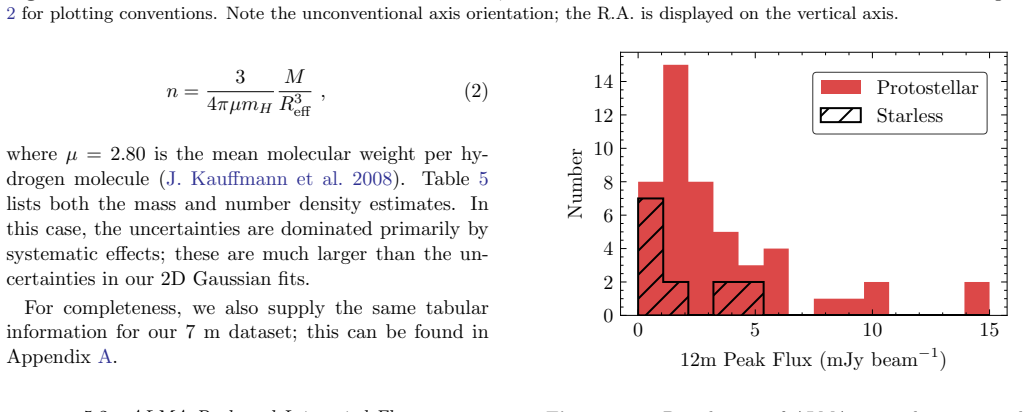
We present a population study of ALMA Cycle 6 observations of the 100 most gravitationally unstable dense cores in Aquila using a simple mass versus size analysis. We identify 66 continuum sources from ALMA 12m observations at 106 GHz and, through comparisons with known protostellar catalogs, find that two of these detected dense cores appear to be completely starless. The turbulent core collapse model is tested by conducting synthetic observations of turbulent magnetohydrodynamical simulations of collapsing starless cores, which predict at least one (1.19) detection given realistic central densities and density profiles. This prediction is consistent with the two detections of ALMA 12m emis
What carries the argument
Synthetic observations of turbulent magnetohydrodynamical simulations of collapsing starless cores, used to predict the number of detectable starless cores on the basis of central density and density profile.
If this is right
- The turbulent core collapse model successfully reproduces the observed incidence of detectable starless cores in Aquila.
- Dense cores frequently fragment into mixed populations of starless and protostellar substructures.
- The degree of fragmentation on larger spatial scales directly increases the multiplicity observed on the smallest scales.
- Turbulence shapes substructure development as dense cores collapse to form new star systems.
Where Pith is reading between the lines
- If the match holds in other regions, the fraction of starless cores detectable at millimeter wavelengths may be used to calibrate the time spent in the prestellar phase.
- Higher-resolution follow-up could test whether the simulated density profiles match the observed cores at radii smaller than those probed here.
- The scaling of multiplicity with parent fragmentation suggests that initial conditions on cloud scales influence the final stellar multiplicity function.
Load-bearing premise
The turbulent magnetohydrodynamical simulations accurately capture the central densities, density profiles, and observational selection effects of the real Aquila cores without post-hoc adjustments.
What would settle it
A comparable survey of unstable dense cores that yields either zero starless ALMA detections or a number well above two would contradict the simulation prediction of 1.19.
Figures




read the original abstract
We present a population study of Atacama Large Millimeter/submillimeter Array (ALMA) Cycle 6 observations of the 100 most gravitationally unstable dense cores in Aquila using a simple mass versus size analysis. We identify 66 continuum sources from ALMA 12m observations at 106GHz and through comparisons with known protostellar catalogs; two of these detected dense cores appear to be completely starless, without any accompanying/nearby protostar detections. Additionally, we find nine other starless ALMA 12m detections within protostellar cores that have fragmented into a mixture of starless and protostellar substructures. We test the turbulent core collapse model by conducting synthetic observations of turbulent magnetohydrodynamical simulations of collapsing starless cores in order to predict how many starless cores should be detected given their central density and density profile. The simulations predict at least one (1.19) detection, consistent with our two detections of ALMA 12m emission within completely starless cores. We also use a combination of ALMA Compact Array Cycle 4 observations and the Herschel Gould Belt Survey data to analyze how mass is distributed on three distinct spatial scales, in order to understand how turbulence shapes the evolution of substructure development as dense cores collapse to form new star systems. We find an increase in multiplicity at the smallest scales when the parent larger-scale structure also has a higher degree of fragmentation.
Editorial analysis
A structured set of objections, weighed in public.
Referee Report
Summary. The paper reports ALMA Cycle 6 12m observations at 106 GHz targeting the 100 most gravitationally unstable dense cores in Aquila, identifying 66 continuum sources including two completely starless cores and nine additional starless substructures within protostellar cores. It tests the turbulent core collapse model by performing synthetic observations on turbulent MHD simulations of collapsing starless cores, which predict 1.19 ALMA detections; this is stated to be consistent with the two observed starless cores. The work also combines ALMA Compact Array Cycle 4 data with Herschel Gould Belt Survey maps to examine mass distribution across three spatial scales and reports an increase in multiplicity at the smallest scales when the parent structure shows higher fragmentation.
Significance. If the simulation-observation agreement is robust, the work supplies a quantitative consistency test of the turbulent core collapse model through predicted versus observed detection rates of starless cores. The multiplicity trend across scales provides observational constraints on how turbulence drives substructure evolution during core collapse. The use of synthetic observations from independent MHD runs is a positive feature that makes the comparison more falsifiable than purely empirical claims.
major comments (2)
- [Section describing the turbulent MHD simulations and synthetic observations] The central consistency claim (two observed starless detections versus 1.19 predicted) depends on the simulated cores reproducing the central densities, radial density profiles, and observational selection effects (sensitivity, beam, spatial filtering) of the real Aquila sample. No quantitative metrics comparing simulated and observed core properties (e.g., central n_H2 or power-law index of the density profile) are provided to establish this match.
- [Methods section on core selection and simulation setup] The mapping from the observed sample of the 100 most unstable cores (selected via mass-size analysis) to the initial conditions of the MHD simulations is not specified. Without this, it is unclear whether the synthetic observations properly incorporate the same selection biases and core property distribution as the ALMA data.
minor comments (2)
- [Abstract] The abstract reports the numerical agreement (2 vs. 1.19) without accompanying uncertainties or details on source extraction criteria; these should be stated explicitly in the main text and abstract if space permits.
- [Title and introduction] The title references the Serpens/Aquila region while the abstract and analysis focus exclusively on Aquila; clarify the scope in the title or introduction.
Simulated Author's Rebuttal
We thank the referee for their constructive review and positive assessment of the significance of our work. We address each of the major comments point by point below. Where the comments identify areas that would strengthen the manuscript, we have made revisions to incorporate the requested details and clarifications.
read point-by-point responses
-
Referee: [Section describing the turbulent MHD simulations and synthetic observations] The central consistency claim (two observed starless detections versus 1.19 predicted) depends on the simulated cores reproducing the central densities, radial density profiles, and observational selection effects (sensitivity, beam, spatial filtering) of the real Aquila sample. No quantitative metrics comparing simulated and observed core properties (e.g., central n_H2 or power-law index of the density profile) are provided to establish this match.
Authors: We agree that explicit quantitative metrics would make the comparison more robust. The MHD simulations were initialized with central densities and radial density profiles chosen to be representative of the gravitationally unstable cores in the Aquila sample (as derived from the Herschel Gould Belt Survey data used in our core selection). In the revised manuscript, we have added a new subsection with direct comparisons: a table reporting the mean central n_H2 from the simulations (1.2 x 10^6 cm^-3) versus the observed range for the 100 cores, and a figure overlaying the average simulated density profile (power-law index ~1.8 in the inner regions) against the observed profiles. We also detail the synthetic observation pipeline, which applies the exact ALMA 12m Cycle 6 uv-coverage, primary beam, and noise levels from our data to ensure the same sensitivity and spatial filtering effects are modeled. revision: yes
-
Referee: [Methods section on core selection and simulation setup] The mapping from the observed sample of the 100 most unstable cores (selected via mass-size analysis) to the initial conditions of the MHD simulations is not specified. Without this, it is unclear whether the synthetic observations properly incorporate the same selection biases and core property distribution as the ALMA data.
Authors: The simulations are not one-to-one mappings to each of the 100 cores but use initial conditions drawn from the statistical distribution of the observed unstable cores. Specifically, the initial core masses, sizes, and central densities are sampled from the mass-size relation and density range of the 100 most unstable cores identified in our Herschel-based selection. In the revised Methods section, we have expanded the description to explicitly state this: the turbulent Mach number and magnetic field strengths are set to values consistent with Aquila observations, and the synthetic observations are performed on an ensemble of 50 simulation runs to capture the population variance. This ensures the predicted detection rate of 1.19 incorporates the same selection biases as the real sample. revision: yes
Circularity Check
No circularity: simulation prediction is independent of the new observations
full rationale
The paper's central prediction of 1.19 detections is obtained by running synthetic observations on turbulent MHD simulations of collapsing starless cores (chosen to represent the turbulent core collapse model) and counting how many would be detected at ALMA 12m sensitivity given their central densities and profiles. This number is then compared to the two starless-core detections found in the new Cycle 6 data on the 100 most unstable Aquila cores. No equation, selection criterion, or parameter in the provided text shows the simulation initial conditions, density profiles, or detection threshold being fitted or adjusted to reproduce the observed count of two; the 1.19 figure is therefore not forced by construction. The mass-size analysis, protostar catalog cross-matching, and multi-scale fragmentation statistics are likewise derived directly from the ALMA and Herschel data without reduction to prior self-citations or renamed empirical patterns. The consistency statement is a genuine external test rather than a tautology.
Axiom & Free-Parameter Ledger
axioms (1)
- domain assumption Turbulent core collapse model with given central density and density profile accurately represents real cores
Reference graph
Works this paper leans on
-
[1]
Andr´ e, P., Di Francesco, J., Ward-Thompson, D., et al. 2014, University of Arizona Press, 27, doi: 10.2458/azu uapress 9780816531240-ch002 Astropy Collaboration, Robitaille, T. P., Tollerud, E. J., et al. 2013, A&A, 558, A33, doi: 10.1051/0004-6361/201322068 Astropy Collaboration, Price-Whelan, A. M., Sip˝ ocz, B. M., et al. 2018, AJ, 156, 123, doi: 10....
work page doi:10.2458/azu 2014
-
[2]
2011, A&A, 527, A145, doi: 10.1051/0004-6361/201015733
Belloche, A., Schuller, F., Parise, B., et al. 2011, A&A, 527, A145, doi: 10.1051/0004-6361/201015733
-
[3]
Caselli, P., Pineda, J. E., Zhao, B., et al. 2019, ApJ, 874, 89, doi: 10.3847/1538-4357/ab0700
-
[4]
534, Protostars and Planets VII, ed
Chevance, M., Krumholz, M. R., McLeod, A. F., et al. 2023, in ASP Conference Series, Vol. 534 (Kyoto, Japan: Astronomical Society of the Pacific), 1, doi: 10.48550/arXiv.2203.09570
-
[5]
2009, MNRAS, 396, 1383, doi:10.1111/j.1365-2966.2009.14843.x
Dapp, W. B., & Basu, S. 2009, MNRAS, 395, 1092, doi: 10.1111/j.1365-2966.2009.14616.x di Francesco, J., Evans, II, N. J., Caselli, P., et al. 2007, University of Arizona Press, 951, 17, doi: 10.48550/arXiv.astro-ph/0602379
-
[6]
Dunham, M. M., Crapsi, A., Evans, II, N. J., et al. 2008, ApJS, 179, 249, doi: 10.1086/591085
-
[7]
Dunham, M. M., Allen, L. E., Evans, II, N. J., et al. 2015, ApJS, 220, 11, doi: 10.1088/0067-0049/220/1/11
-
[8]
Dunham, M. M., Offner, S. S. R., Pineda, J. E., et al. 2016, ApJ, 823, 160, doi: 10.3847/0004-637X/823/2/160
-
[9]
2020, ApJS, 251, 20, doi: 10.3847/1538-4365/abba26
Dutta, S., Lee, C.-F., Liu, T., et al. 2020, ApJS, 251, 20, doi: 10.3847/1538-4365/abba26
-
[10]
Feigelson, E. D., Townsley, L. K., Broos, P. S., et al. 2013, ApJS, 209, 26, doi: 10.1088/0067-0049/209/2/26
-
[11]
2026, CADC, doi: 10.11570/25.0103
Fielder, S., & Kirk, H. 2026, CADC, doi: 10.11570/25.0103
-
[12]
Fielder, S. D., Kirk, H., Dunham, M. M., & Offner, S. S. R. 2024, ApJ, 968, 10, doi: 10.3847/1538-4357/ad3d56
-
[13]
Garrett, J., Luis, E., H. -H. Peng, et al. 2023,, Zenodo doi: 10.5281/ZENODO.4106649
-
[14]
Generozov, A., Offner, S. S. R., Kratter, K. M., et al. 2025, Nature, doi: 10.1038/s41550-025-02686-5
-
[15]
Guszejnov, D., Raju, A. N., Offner, S. S. R., et al. 2023, MNRAS, 518, 4693, doi: 10.1093/mnras/stac3268
-
[16]
Gutermuth, R. A., Bourke, T. L., Allen, L. E., et al. 2008, ApJ, 673, L151, doi: 10.1086/528710
-
[17]
2011, A&A, 533, A34, doi: 10.1051/0004-6361/201117039
Hacar, A., & Tafalla, M. 2011, A&A, 533, A34, doi: 10.1051/0004-6361/201117039
-
[18]
2013, A&A, 554, A55, doi: 10.1051/0004-6361/201220090
Hacar, A., Tafalla, M., Kauffmann, J., & Kov´ acs, A. 2013, A&A, 554, A55, doi: 10.1051/0004-6361/201220090
-
[19]
Hamaguchi, K., Terada, H., Bamba, A., & Koyama, K. 1999, Astronomische Nachrichten, 320, 362, doi: 10.1002/1521-3994(199908)320:4/5⟨362::AID- ASNA362⟩3.0.CO;2-W
-
[20]
Hartmann, L., Ballesteros-Paredes, J., & Bergin, E. A. 2001, ApJ, 562, 852, doi: 10.1086/323863
-
[21]
2024, ApJ, 961, 123, doi: 10.3847/1538-4357/ad09e2
Hirano, N., Sahu, D., Liu, S.-Y., et al. 2024, ApJ, 961, 123, doi: 10.3847/1538-4357/ad09e2
-
[22]
Ishihara, K., Nakamura, F., Sanhueza, P., & Saito, M. 2025, A&A, 695, L25, doi: 10.1051/0004-6361/202452427
-
[23]
2024, AJ, 974, 95, doi: 10.3847/1538-4357/ad630f
Ishihara, K., Sanhueza, P., Nakamura, F., et al. 2024, AJ, 974, 95, doi: 10.3847/1538-4357/ad630f
-
[24]
Kauffmann, J., Bertoldi, F., Bourke, T. L., Evans, II, N. J., & Lee, C. W. 2008, A&A, 487, 993, doi: 10.1051/0004-6361:200809481
-
[25]
Kirk, H., Dunham, M. M., Di Francesco, J., et al. 2017, ApJ, 838, 114, doi: 10.3847/1538-4357/aa63f8
-
[26]
2018, ApJS, 238, 8, doi: 10.3847/1538-4365/aada7f
Kirk, H., Hatchell, J., Johnstone, D., et al. 2018, ApJS, 238, 8, doi: 10.3847/1538-4365/aada7f
-
[27]
G., & Iurevich, L
Kolesnik, I. G., & Iurevich, L. V. 1983, Astrofizika, 19, 761
1983
-
[28]
Kong, S., Tan, J. C., Caselli, P., et al. 2017, ApJ, 834, 193, doi: 10.3847/1538-4357/834/2/193 K¨ onyves, V., Andr´ e, Ph., Men’shchikov, A., et al. 2015, A&A, 584, A91, doi: 10.1051/0004-6361/201525861
-
[29]
Kuhn, M. A., de Souza, R. S., Krone-Martins, A., et al. 2021, ApJS, 254, 33, doi: 10.3847/1538-4365/abe465
-
[30]
Larson, R. B. 1969, MNRAS, 145, 271, doi: 10.1093/mnras/145.3.271 Le Gouellec, V. J. M., Hull, C. L. H., Maury, A. J., et al. 2019, ApJ, 885, 106, doi: 10.3847/1538-4357/ab43c2
-
[31]
Lee, A. T., Offner, S. S. R., Kratter, K. M., Smullen, R. A., & Li, P. S. 2019, ApJ, 887, 232, doi: 10.3847/1538-4357/ab584b
-
[32]
2021, The Journal of Open Source Software, 6, 3771, doi: 10.21105/joss.03771 Mac Low, M.-M
Li, P., Cunningham, A., Gaches, B., et al. 2021, The Journal of Open Source Software, 6, 3771, doi: 10.21105/joss.03771 Mac Low, M.-M. 1999, ApJ, 524, 169, doi: 10.1086/307784
-
[33]
Mallick, K. K., Kumar, M. S. N., Ojha, D. K., et al. 2013, ApJ, 779, 113, doi: 10.1088/0004-637X/779/2/113
-
[34]
Marton, G., T´ oth, L. V., Paladini, R., et al. 2016, MNRAS, 458, 3479, doi: 10.1093/mnras/stw398
-
[35]
2011, A&A, 535, A77, doi: 10.1051/0004-6361/201117132
Bontemps, S. 2011, A&A, 535, A77, doi: 10.1051/0004-6361/201117132
-
[36]
McKee, C. F., & Ostriker, E. C. 2007, ARA&A, 45, 565, doi: 10.1146/annurev.astro.45.051806.110602 Men’shchikov, A., Andr´ e, Ph., Didelon, P., et al. 2012, A&A, 542, A81, doi: 10.1051/0004-6361/201218797 Aquila Clusters41
-
[37]
Moon, S., & Ostriker, E. C. 2025, ApJ, 988, 82, doi: 10.3847/1538-4357/ade239
-
[38]
Murillo, N. M., van Dishoeck, E. F., Hacar, A., Harsono, D., & Jørgensen, J. K. 2022, A&A, 658, A53, doi: 10.1051/0004-6361/202141250
-
[39]
Murillo, N. M., van Dishoeck, E. F., Tobin, J. J., & Fedele, D. 2016, A&A, 592, A56, doi: 10.1051/0004-6361/201628247
-
[40]
Offner, S. S. R., Capodilupo, J., Schnee, S., & Goodman, A. A. 2012, MNRAS, 420, L53, doi: 10.1111/j.1745-3933.2011.01194.x
-
[41]
Offner, S. S. R., & Chaban, J. 2017, ApJ, 847, 104, doi: 10.3847/1538-4357/aa8996
-
[42]
Offner, S. S. R., Moe, M., Kratter, K. M., et al. 2023, in ASP Conference Series, Vol. 534 (Kyoto, Japan: Astronomical Society of the Pacific), 275, doi: 10.48550/arXiv.2203.10066
work page internal anchor Pith review doi:10.48550/arxiv.2203.10066 2023
-
[43]
Offner, S. S. R., Taylor, J., & Grud´ ıc, M. Y. 2025, ApJ, 982, 138, doi: 10.3847/1538-4357/adb71d
-
[44]
Offner, S. S. R., Taylor, J., Markey, C., et al. 2022, MNRAS, 517, 885, doi: 10.1093/mnras/stac2734 Ortiz-Le´ on, G. N., Dzib, S. A., Loinard, L., et al. 2023, A&A, 673, L1, doi: 10.1051/0004-6361/202346369 Ortiz-Le´ on, G. N., Loinard, L., Dzib, S. A., et al. 2018, ApJ, 869, L33, doi: 10.3847/2041-8213/aaf6ad
-
[45]
1994, A&A, 291, 943
Ossenkopf, V., & Henning, Th. 1994, A&A, 291, 943
1994
-
[46]
Palmeirim, P., Andr´ e, Ph., Kirk, J., et al. 2013, A&A, 550, A38, doi: 10.1051/0004-6361/201220500
-
[47]
2024, in SPIE Astronomical Telescopes + Instrumentation, Vol
Petry, D., D´ ıaz Trigo, Mar´ ıa., Kneissl, R., et al. 2024, in SPIE Astronomical Telescopes + Instrumentation, Vol. 13098 (pan: SPIE), 130980P, doi: 10.1117/12.3012662
-
[48]
Pineda, J. E., Segura-Cox, D., Caselli, P., et al. 2020, Nature, 4, 1158, doi: 10.1038/s41550-020-1150-z
-
[49]
and Arzoumanian, Doris and Andr
Pineda, J. E., Arzoumanian, D., Andre, P., et al. 2023, in ASP Conference Series, Vol. 534 (Kyoto, Japan: Astronomical Society of the Pacific), 233, doi: 10.48550/arXiv.2205.03935
-
[50]
Plunkett, A. L., Fern´ andez-L´ opez, M., Arce, H. G., et al. 2018, A&A, 615, A9, doi: 10.1051/0004-6361/201732372
-
[51]
Pokhrel, R., Myers, P. C., Dunham, M. M., et al. 2018, ApJ, 853, 5, doi: 10.3847/1538-4357/aaa240
-
[52]
Pokhrel, R., Gutermuth, R. A., Betti, S. K., et al. 2020, ApJ, 896, 60, doi: 10.3847/1538-4357/ab92a2
-
[53]
Pokhrel, R., Megeath, S. T., Gutermuth, R. A., et al. 2023, ApJS, 266, 32, doi: 10.3847/1538-4365/acbfac
-
[54]
Povich, M. S., Kuhn, M. A., Getman, K. V., et al. 2013, ApJS, 209, 31, doi: 10.1088/0067-0049/209/2/31
-
[55]
Robitaille, T. P., Whitney, B. A., Indebetouw, R., & Wood, K. 2007, ApJS, 169, 328, doi: 10.1086/512039
-
[56]
Robitaille, T. P., Whitney, B. A., Indebetouw, R., Wood, K., & Denzmore, P. 2006, ApJS, 167, 256, doi: 10.1086/508424
-
[57]
Romine, G., Feigelson, E. D., Getman, K. V., Kuhn, M. A., & Povich, M. S. 2016, AJ, 833, 193, doi: 10.3847/1538-4357/833/2/193
-
[58]
2016, MNRAS, 460, 4150, doi: 10.1093/mnras/stw1100
Rumble, D., Hatchell, J., Pattle, K., et al. 2016, MNRAS, 460, 4150, doi: 10.1093/mnras/stw1100
-
[59]
2021, ApJ, 907, L15, doi: 10.3847/2041-8213/abd3aa
Sahu, D., Liu, S.-Y., Liu, T., et al. 2021, ApJ, 907, L15, doi: 10.3847/2041-8213/abd3aa
-
[60]
2023, ApJ, 945, 156, doi: 10.3847/1538-4357/acbc26
Sahu, D., Liu, S.-Y., Johnstone, D., et al. 2023, ApJ, 945, 156, doi: 10.3847/1538-4357/acbc26
-
[61]
Sheehan, P., Tobin, J. J., Xue, R., & Fourkas, A. 2025,, Zenodo doi: 10.5281/ZENODO.17871742
-
[62]
Shu, F. H. 1977, ApJ, 214, 488, doi: 10.1086/155274
-
[63]
Shuping, R. Y., Vacca, W. D., Kassis, M., & Yu, K. C. 2012, ApJ, 144, 116, doi: 10.1088/0004-6256/144/4/116
-
[64]
Skrutskie, M. F., Cutri, R. M., Stiening, R., et al. 2006, AJ, 131, 1163, doi: 10.1086/498708 Straiˇ zys, V.,ˇCernis, K., & Bartaˇ si¯ ut˙ e, S. 1996, Baltic Astronomy, 5, 125, doi: 10.1515/astro-1996-0106 Straiˇ zys, V., Cernis, K., & Bartasiute, S. 2003, A&A, 405, 585, doi: 10.1051/0004-6361:20030599
-
[65]
Taniguchi, K., Pineda, J. E., Caselli, P., et al. 2024, ApJ, 965, 162, doi: 10.3847/1538-4357/ad2fa1 The CASA Team, Bean, B., Bhatnagar, S., et al. 2022, PASP, 134, 114501, doi: 10.1088/1538-3873/ac9642
-
[66]
2014, ApJ, 789, L4, doi: 10.1088/2041-8205/789/1/L4
Tokuda, K., Onishi, T., Saigo, K., et al. 2014, ApJ, 789, L4, doi: 10.1088/2041-8205/789/1/L4
-
[67]
2016, ApJ, 826, 26, doi: 10.3847/0004-637X/826/1/26
Tokuda, K., Onishi, T., Matsumoto, T., et al. 2016, ApJ, 826, 26, doi: 10.3847/0004-637X/826/1/26
-
[68]
Menten, K. M. 2015, A&A, 575, A27, doi: 10.1051/0004-6361/201322955
-
[69]
Valdivia-Mena, M. T., Pineda, J. E., Segura-Cox, D. M., et al. 2022, A&A, 667, A12, doi: 10.1051/0004-6361/202243310
-
[70]
2007, , 119, 855, 10.1086/521277
Ward-Thompson, D., Di Francesco, J., Hatchell, J., et al. 2007, PASP, 119, 855, doi: 10.1086/521277
-
[71]
2000, , 143, 9, 10.1051/aas:2000332
Wenger, M., Ochsenbein, F., Egret, D., et al. 2000, A&AS, 143, 9, doi: 10.1051/aas:2000332
-
[72]
Wright, E. L., Eisenhardt, P. R. M., Mainzer, A. K., et al. 2010, AJ, 140, 1868, doi: 10.1088/0004-6256/140/6/1868
-
[73]
Y., Laureijs, R
Zhang, C. Y., Laureijs, R. J., Clark, F. O., & Wesselius, P. R. 1988, A&A, 199, 170
1988
-
[74]
2015, ApJ, 804, 141, doi: 10.1088/0004-637X/804/2/141
Zhang, Q., Wang, K., Lu, X., & Jim´ enez-Serra, I. 2015, ApJ, 804, 141, doi: 10.1088/0004-637X/804/2/141
discussion (0)
Sign in with ORCID, Apple, or X to comment. Anyone can read and Pith papers without signing in.