Recognition: 3 theorem links
· Lean TheoremDesigning a Satellite Serviced Quantum Network Backbone for Concurrent Global Connectivity
Pith reviewed 2026-05-08 19:06 UTC · model grok-4.3
The pith
Anisotropic ground stations, multi-inclination orbits, and multi-party policies reduce time-to-connectivity in satellite quantum networks.
A machine-rendered reading of the paper's core claim, the machinery that carries it, and where it could break.
Core claim
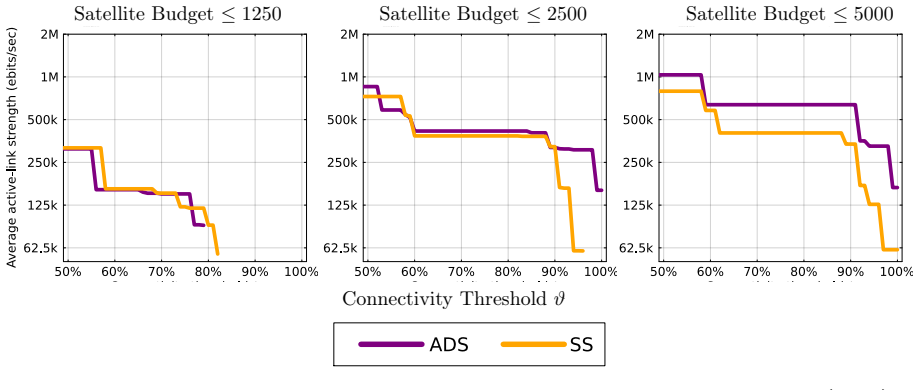
Across a broad parameter sweep, anisotropic ground-station lattices reduce time-to-connectivity relative to longitudinally collapsed and isotropic baselines by aligning ground infrastructure with latitude-dependent satellite access. Multi-inclination LEO constellations reduce waiting times for strong connectivity compared to single-inclination constellations at fixed satellite budgets by providing additional visibility for a diverse latitude set. Multi-party satellite service policies alleviate per-satellite concurrency bottlenecks and substantially reduce time-to-connectivity at stringent traffic-matrix thresholds. Satellite altitude is the dominant physical lever shaping the visibility--f,
What carries the argument
Discrete-time simulator that evaluates time-to-connectivity and latency-conditioned average active-link strength by tracking visibility windows, finite waiting-time constraints, and per-satellite concurrency limits for a traffic matrix of major population and financial centers.
Load-bearing premise
The discrete-time simulator accurately captures the interplay of visibility windows, finite waiting-time constraints, and per-satellite concurrency limits under the chosen traffic matrix of major population and financial centers.
What would settle it
Measure actual time-to-connectivity and active-link strength in a deployed small-scale satellite quantum testbed with anisotropic ground stations and multi-inclination orbits, then compare against simulator output for identical parameters and traffic matrix.
Figures




read the original abstract
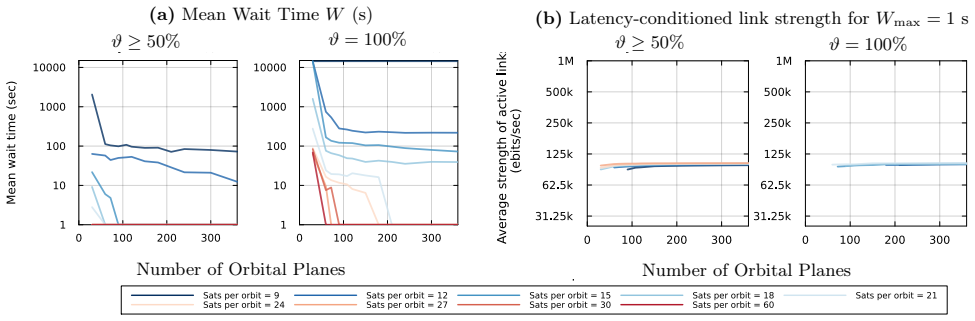
Satellite-serviced quantum networks pose an architectural problem distinct from classical satellite networking: because entanglement cannot be copied, and long-lived buffering is technologically constrained for near-term devices, useful end-to-end service requires fixed optical ground infrastructure and simultaneous multi-hop path availability. We investigate the design of a satellite-serviced quantum backbone aimed at supporting concurrent global connectivity across a traffic matrix of major population and financial centers under finite waiting-time constraints. Using a discrete-time simulator, we evaluate performance using two architecture-level metrics: (i) time-to-connectivity, and (ii) latency-conditioned average active-link strength. Across a broad parameter sweep, we identify three dominant architectural effects. First, anisotropic ground-station lattices reduce time-to-connectivity relative to longitudinally collapsed and isotropic baselines by aligning ground infrastructure with latitude-dependent satellite access. Second, multi-inclination LEO constellations reduce waiting times for strong connectivity compared to single-inclination constellations at fixed satellite budgets by providing additional visibility for a diverse latitude set. Third, multi-party satellite service policies alleviate per-satellite concurrency bottlenecks and substantially reduce time-to-connectivity at stringent traffic-matrix thresholds. We further show that satellite altitude is the dominant physical lever shaping the visibility--loss trade-off, strongly affecting both connectivity latency and achievable link strength, while orbital plane count and satellite packing provide secondary refinements at fixed altitude. Together, these results delineate the architectural conditions required for scalable, concurrent entanglement connectivity in satellite-serviced quantum networks.
Editorial analysis
A structured set of objections, weighed in public.
Referee Report
Summary. The paper uses a discrete-time simulator to study the design of a satellite-serviced quantum network backbone supporting concurrent global entanglement connectivity under finite waiting-time constraints and a fixed traffic matrix of major population/financial centers. It defines two architecture-level metrics—time-to-connectivity and latency-conditioned average active-link strength—and reports three dominant effects from parameter sweeps: (1) anisotropic ground-station lattices reduce time-to-connectivity relative to isotropic or longitudinally collapsed baselines by better aligning with latitude-dependent satellite visibility; (2) multi-inclination LEO constellations reduce waiting times for strong connectivity at fixed satellite budgets; (3) multi-party satellite service policies alleviate per-satellite concurrency limits and substantially improve performance at stringent traffic thresholds. Satellite altitude is identified as the dominant physical lever via the visibility-loss trade-off, with orbital plane count and packing as secondary factors.
Significance. If the simulator faithfully captures the interplay of visibility windows, concurrency limits, and waiting-time constraints, the results would offer concrete, actionable guidance for near-term quantum network architecture, emphasizing latitude-aware ground infrastructure and flexible service policies over simpler isotropic or single-inclination designs. The work addresses a genuine architectural distinction arising from the no-cloning theorem and limited quantum memory, and the parameter-sweep approach provides falsifiable predictions that could be tested against future hardware deployments.
major comments (3)
- [§4] §4 (Simulator description): The central claims rest entirely on simulation outputs, yet the manuscript provides neither the explicit update rules for visibility windows, per-satellite concurrency, nor the precise parameter values and ranges used in the sweeps. Without these, it is impossible to determine whether the reported dominance of the three architectural effects is robust or an artifact of unstated modeling choices (e.g., the exact form of the waiting-time constraint or the traffic-matrix threshold definition).
- [§5.2–5.3] §5.2–5.3 (Results on multi-inclination and multi-party policies): The claim that multi-inclination constellations and multi-party policies “substantially reduce” time-to-connectivity is load-bearing for the paper’s architectural recommendations, but no sensitivity analysis is shown with respect to the chosen traffic matrix or the precise definition of “strong connectivity.” A single additional figure or table varying the matrix or threshold would be required to establish that the effect is not an artifact of the specific external traffic pattern.
- [§3] §3 (Metric definitions): The latency-conditioned average active-link strength metric is introduced without an explicit formula or pseudocode. Because this metric is used to quantify the second and third effects, its precise construction (including how latency conditioning is applied and how “active” links are counted) must be stated mathematically before the quantitative comparisons can be evaluated.
minor comments (3)
- [Abstract / §1] The abstract and introduction use the term “anisotropic ground-station lattices” without a concise definition or reference to the exact latitude/longitude placement rule; a one-sentence clarification would improve readability.
- [Figures 3–6] Figure captions for the parameter-sweep plots should explicitly state the fixed values of all other parameters (satellite budget, altitude, etc.) so that each panel can be interpreted independently.
- [§4] A short discussion of computational complexity or run-time of the discrete-time simulator would help readers assess the feasibility of extending the study to larger constellations or finer time steps.
Simulated Author's Rebuttal
We thank the referee for the constructive and detailed review. We have revised the manuscript to address all major comments by adding the requested details on the simulator, metric definitions, and sensitivity analyses. Our point-by-point responses follow.
read point-by-point responses
-
Referee: [§4] §4 (Simulator description): The central claims rest entirely on simulation outputs, yet the manuscript provides neither the explicit update rules for visibility windows, per-satellite concurrency, nor the precise parameter values and ranges used in the sweeps. Without these, it is impossible to determine whether the reported dominance of the three architectural effects is robust or an artifact of unstated modeling choices (e.g., the exact form of the waiting-time constraint or the traffic-matrix threshold definition).
Authors: We agree that the original §4 lacked sufficient implementation details for reproducibility. The revised manuscript expands this section with explicit update rules for visibility windows and per-satellite concurrency, plus a table enumerating all parameter values and ranges from the sweeps. These additions enable independent verification of the reported architectural effects. revision: yes
-
Referee: [§5.2–5.3] §5.2–5.3 (Results on multi-inclination and multi-party policies): The claim that multi-inclination constellations and multi-party policies “substantially reduce” time-to-connectivity is load-bearing for the paper’s architectural recommendations, but no sensitivity analysis is shown with respect to the chosen traffic matrix or the precise definition of “strong connectivity.” A single additional figure or table varying the matrix or threshold would be required to establish that the effect is not an artifact of the specific external traffic pattern.
Authors: We have conducted the requested sensitivity analyses. The revised manuscript includes a new figure showing that the performance gains from multi-inclination constellations and multi-party policies remain consistent across alternative traffic matrices and varied thresholds for strong connectivity. This confirms the robustness of the architectural recommendations. revision: yes
-
Referee: [§3] §3 (Metric definitions): The latency-conditioned average active-link strength metric is introduced without an explicit formula or pseudocode. Because this metric is used to quantify the second and third effects, its precise construction (including how latency conditioning is applied and how “active” links are counted) must be stated mathematically before the quantitative comparisons can be evaluated.
Authors: We have added an explicit mathematical definition and pseudocode for the latency-conditioned average active-link strength metric to the revised §3. This specifies the latency conditioning procedure and the criteria for counting active links, allowing direct evaluation of the quantitative comparisons. revision: yes
Circularity Check
No significant circularity detected
full rationale
The paper presents results from a discrete-time simulator comparing architectural variants (anisotropic lattices, multi-inclination constellations, multi-party policies) against fixed external inputs: a traffic matrix of population/financial centers, physical visibility windows, and concurrency constraints. The two metrics—time-to-connectivity and latency-conditioned average active-link strength—are defined independently of the tested configurations and are not fitted or renamed from simulation outputs. No equations, first-principles derivations, or predictions are shown that reduce by construction to the inputs; the three dominant effects are direct consequences of running the same simulator across parameter sweeps. No load-bearing self-citations or ansatz smuggling appear in the abstract or description. The derivation chain is therefore self-contained against the stated modeling assumptions.
Axiom & Free-Parameter Ledger
free parameters (3)
- satellite budget
- ground-station lattice geometry
- satellite altitude
axioms (2)
- domain assumption Entanglement cannot be copied
- domain assumption Long-lived quantum buffering is technologically constrained for near-term devices
Lean theorems connected to this paper
-
Foundation/AlphaCoordinateFixation.leanalpha_pin_under_high_calibration (unrelated — same letter α, totally different role) unclear?
unclearRelation between the paper passage and the cited Recognition theorem.
d(λ) = d_eq / cos^α(λ) ... The exponent α determines how rapidly longitudinal spacing expands with latitude ... we focus on α > 0, and in particular on the range 0.5 ≤ α ≤ 1.5 in our evaluations.
What do these tags mean?
- matches
- The paper's claim is directly supported by a theorem in the formal canon.
- supports
- The theorem supports part of the paper's argument, but the paper may add assumptions or extra steps.
- extends
- The paper goes beyond the formal theorem; the theorem is a base layer rather than the whole result.
- uses
- The paper appears to rely on the theorem as machinery.
- contradicts
- The paper's claim conflicts with a theorem or certificate in the canon.
- unclear
- Pith found a possible connection, but the passage is too broad, indirect, or ambiguous to say the theorem truly supports the claim.
Reference graph
Works this paper leans on
-
[1]
Satellite quantum communications: Fundamental bounds and practical security,
S. Pirandola, “Satellite quantum communications: Fundamental bounds and practical security,”Physical Review Research, vol. 3, no. 2, p. 023130, May 2021, publisher: American Physical Society. [Online]. Available: https://link.aps.org/doi/10.1103/PhysRevResearch.3.023130
-
[2]
On approaching the ultimate limits of photon- efficient and bandwidth-efficient optical communication,
S. Dolinar, K. M. Birnbaum, B. I. Erkmen, and B. Moision, “On approaching the ultimate limits of photon- efficient and bandwidth-efficient optical communication,”2011 International Conference on Space Optical Systems and Applications (ICSOS), pp. 269–278, Jun. 2011
2011
-
[3]
Satellite-based entanglement distribution over 1200 kilometers,
J. Yin, Y. Cao, Y.-H. Li, S.-K. Liao, L. Zhang, J.-G. Ren, W.-Q. Cai, W.-Y. Liu, B. Li, H. Daiet al., “Satellite-based entanglement distribution over 1200 kilometers,”Science, vol. 356, no. 6343, pp. 1140–1144, 2017
2017
-
[4]
Entanglement-based secure quantum cryptography over 1,120 kilometres,
J. Yin, Y.-H. Li, S.-K. Liao, M. Yang, Y. Cao, L. Zhang, J.-G. Ren, W.-Q. Cai, W.-Y. Liu, S.-L. Li, R. Shu, Y.-M. Huang, L. Deng, L. Li, Q. Zhang, N.-L. Liu, Y.-A. Chen, C.-Y. Lu, X.-B. Wang, F. Xu, J.-Y. Wang, C.-Z. Peng, A. K. Ekert, and J.-W. Pan, “Entanglement-based secure quantum cryptography over 1,120 kilometres,”Nature, vol. 582, pp. 501–505, 2020
2020
-
[5]
Ground-to-satellite quantum teleportation,
J.-G. Ren, P. Xu, H.-L. Yong, L. Zhang, S.-K. Liao, J. Yin, W.-Y. Liu, W.-Q. Cai, M. Yang, L. Li, K.-X. Yang, X. Han, Y.-Q. Yao, J. Li, H.-Y. Wu, S. Wan, L. Liu, D.-Q. Liu, Y.-W. Kuang, Z.-P. He, P. Shang, C. Guo, R.-H. Zheng, K. Tian, Z.-C. Zhu, N.-L. Liu, C.-Y. Lu, R. Shu, Y.-A. Chen, C.-Z. Peng, J.-Y. Wang, and J.-W. Pan, “Ground-to-satellite quantum t...
2017
-
[6]
Towards satellite-based quantum-secure time transfer,
H. Dai, Q. Shen, C.-Z. Wang, S.-L. Li, W.-Y. Liu, W.-Q. Cai, S.-K. Liao, J.-G. Ren, J. Yin, Y.-A. Chen, Q. Zhang, F. Xu, C.-Z. Peng, and J.-W. Pan, “Towards satellite-based quantum-secure time transfer,” Nature Physics, vol. 16, pp. 848–852, 2020
2020
-
[7]
Satellites promise global-scale quantum networks,
S. Goswami, S. Dhara, N. Sinclair, M. Mohageg, J. S. Sidhu, S. Mukhopadhyay, M. Krutzik, J. R. Lowell, D. K. Oi, M. Gündoğanet al., “Satellites promise global-scale quantum networks,”Optica Quantum, vol. 3, no. 6, pp. 590–605, 2025
2025
-
[8]
Ultrafast and fault-tolerant quantum communication across long distances,
S. Muralidharan, J. Kim, N. Lütkenhaus, M. D. Lukin, and L. Jiang, “Ultrafast and fault-tolerant quantum communication across long distances,”Physical review letters, vol. 112, no. 25, p. 250501, 2014
2014
-
[9]
Rate-loss analysis of an efficient quantum repeater architecture,
S. Guha, H. Krovi, C. A. Fuchs, Z. Dutton, J. A. Slater, C. Simon, and W. Tittel, “Rate-loss analysis of an efficient quantum repeater architecture,”Physical Review A, vol. 92, no. 2, p. 022357, 2015
2015
-
[10]
Optimal architectures for long distance quantum communication,
S. Muralidharan, L. Li, J. Kim, N. Lütkenhaus, M. D. Lukin, and L. Jiang, “Optimal architectures for long distance quantum communication,”Scientific Reports, vol. 6, no. 1, p. 20463, Apr. 2016. [Online]. Available: http://www.nature.com/articles/srep20463 1
2016
-
[11]
Comparingone-andtwo-wayquantumrepeaterarchitectures,
P.Mantri, K.Goodenough, andD.Towsley, “Comparingone-andtwo-wayquantumrepeaterarchitectures,” Communications Physics, vol. 8, no. 1, p. 30, 2025
2025
-
[12]
Satellite-mediated quantum atmospheric links,
D. Vasylyev, W. Vogel, and F. Moll, “Satellite-mediated quantum atmospheric links,”Physical Review A, vol. 99, no. 5, May 2019. [Online]. Available: https://doi.org/10.1103/physreva.99.053830
-
[13]
Advances in space quantum communications,
J.S.Sidhu, S.K.Joshi, M.Gündoğan, T.Brougham, D.Lowndes, L.Mazzarella, M.Krutzik, S.Mohapatra, D. Dequal, G. Valloneet al., “Advances in space quantum communications,”IET Quantum Communication, vol. 2, no. 4, pp. 182–217, 2021
2021
-
[14]
Bell’s shadows from satellites,
S. Haldar, R. L. McDonald, S. Ducoing, and I. Agullo, “Bell’s shadows from satellites,”arXiv preprint arXiv:2412.13416, 2024
-
[15]
Satellite-Relayed Global Quantum Communication without Quantum Memory,
S. Goswami and S. Dhara, “Satellite-Relayed Global Quantum Communication without Quantum Memory,”Physical Review Applied, vol. 20, no. 2, p. 024048, Aug. 2023. [Online]. Available: https://link.aps.org/doi/10.1103/PhysRevApplied.20.024048
-
[16]
Optical ground station diversity for satellite quantum key distribution in ireland,
N. L. Anipeddi, J. Horgan, D. K. Oi, and D. Kilbane, “Optical ground station diversity for satellite quantum key distribution in ireland,”EPJ Quantum Technology, vol. 12, no. 1, p. 91, 2025
2025
-
[17]
Quantum time transfer for freespace quantum networking,
R. Lafler and R. N. Lanning, “Quantum time transfer for freespace quantum networking,” 2022. [Online]. Available: https://arxiv.org/abs/2211.00737
-
[18]
Spooky action at a global distance: analysis of space-based entanglement distribution for the quantum internet,
S. Khatri, A. J. Brady, R. A. Desporte, M. P. Bart, and J. P. Dowling, “Spooky action at a global distance: analysis of space-based entanglement distribution for the quantum internet,”npj Quantum Information, vol. 7, no. 1, p. 4, Jan. 2021, publisher: Nature Publishing Group. [Online]. Available: https://www.nature.com/articles/s41534-020-00327-5
2021
-
[19]
Connecting quantum cities: simulation of a satellite-based quantum network,
R. Yehia, M. Schiavon, V. Marulanda Acosta, T. Coopmans, I. Kerenidis, D. Elkouss, and E. Diamanti, “Connecting quantum cities: simulation of a satellite-based quantum network,” New Journal of Physics, vol. 26, no. 7, p. 073015, Jul. 2024. [Online]. Available: https: //iopscience.iop.org/article/10.1088/1367-2630/ad5b13
-
[20]
Hybrid satellite-fiber quantum network,
Y. Shao, S. Guha, and A. E. Motter, “Hybrid satellite-fiber quantum network,” Jul. 2025, arXiv:2507.12539 [quant-ph]. [Online]. Available: http://arxiv.org/abs/2507.12539
-
[21]
Handover schemes in satellite networks: State- of-the-art and future research directions
P. K. Chowdhury, M. Atiquzzaman, W. D. Ivancicet al., “Handover schemes in satellite networks: State- of-the-art and future research directions.”IEEE Commun. Surv. Tutorials, vol. 8, no. 1-4, pp. 2–14, 2006
2006
-
[22]
A user-centric handover scheme for ultra-dense leo satellite networks,
J. Li, K. Xue, J. Liu, and Y. Zhang, “A user-centric handover scheme for ultra-dense leo satellite networks,” IEEE Wireless Communications Letters, vol. 9, no. 11, pp. 1904–1908, 2020
1904
-
[23]
Survey on optimization methods for leo-satellite-based networks with applications in future autonomous transportation,
K. Çelikbilek, Z. Saleem, R. Morales Ferre, J. Praks, and E. S. Lohan, “Survey on optimization methods for leo-satellite-based networks with applications in future autonomous transportation,”Sensors, vol. 22, no. 4, p. 1421, 2022
2022
-
[24]
Handover technique in leo satellite networks: A review,
Z. Liu, Z. Yang, G. Pan, H. Zhang, G. Luo, and H. Yang, “Handover technique in leo satellite networks: A review,” in2024 13th International Conference on Communications, Circuits and Systems (ICCCAS). IEEE, 2024, pp. 364–369
2024
-
[25]
Leotcp: Low-latency and high-throughput data transport for leo satellite networks,
A. Valentine and G. Parisis, “Leotcp: Low-latency and high-throughput data transport for leo satellite networks,”arXiv preprint arXiv:2508.19067, 2025
-
[26]
Ameasurementstudyofdynamicsandliquiddatatransport in oneweb leo satellite networks,
O.Perrin, E.Gossling, D.Qiao, andH.Zhang, “Ameasurementstudyofdynamicsandliquiddatatransport in oneweb leo satellite networks,” inMILCOM 2025-2025 IEEE Military Communications Conference (MILCOM). IEEE, 2025, pp. 1–6. 2
2025
-
[27]
A single quantum cannot be cloned,
W. K. Wootters and W. H. Zurek, “A single quantum cannot be cloned,”Nature, vol. 299, no. 5886, pp. 802–803, 1982
1982
-
[28]
Quantum repeaters based on single trapped ions,
N. Sangouard, R. Dubessy, and C. Simon, “Quantum repeaters based on single trapped ions,”Physical Review A, vol. 79, no. 4, p. 042340, Apr. 2009. [Online]. Available: https: //link.aps.org/doi/10.1103/PhysRevA.79.042340
-
[29]
Diamond nv centers for quantum computing and quantum networks,
L. Childress and R. Hanson, “Diamond nv centers for quantum computing and quantum networks,”MRS Bulletin, vol. 38, no. 2, p. 134–138, 2013
2013
-
[30]
Quantum repeaters based on atomic ensembles and linear optics
N. Sangouard, C. Simon, H. de Riedmatten, and N. Gisin, “Quantum repeaters based on atomic ensembles and linear optics,”Reviews of Modern Physics, vol. 83, no. 1, pp. 33–80, Mar. 2011. [Online]. Available: https://link.aps.org/doi/10.1103/RevModPhys.83.33
-
[31]
Fast quantum logic gates with trapped-ion qubits,
V. M. Schäfer, C. J. Ballance, K. Thirumalai, L. Stephenson, T. Ballance, A. Steane, and D. Lucas, “Fast quantum logic gates with trapped-ion qubits,”Nature, vol. 555, no. 7694, pp. 75–78, 2018
2018
-
[32]
Entanglement generation in a quantum network with finite quantum memory lifetime,
V. Semenenko, X. Hu, E. Figueroa, and V. Perebeinos, “Entanglement generation in a quantum network with finite quantum memory lifetime,”AVS Quantum Science, vol. 4, no. 1, 2022
2022
-
[33]
Quantum repeaters: From quantum networks to the quantum internet,
K. Azuma, S. E. Economou, D. Elkouss, P. Hilaire, L. Jiang, H.-K. Lo, and I. Tzitrin, “Quantum repeaters: From quantum networks to the quantum internet,”Reviews of Modern Physics, vol. 95, no. 4, p. 045006, 2023
2023
-
[34]
Effective routing design for remote entanglement generation on quantum networks,
C. Li, T. Li, Y.-X. Liu, and P. Cappellaro, “Effective routing design for remote entanglement generation on quantum networks,”npj Quantum Information, vol. 7, no. 1, p. 10, 2021
2021
-
[35]
Routing entanglement in the quantum internet,
M. Pant, H. Krovi, D. Towsley, L. Tassiulas, L. Jiang, P. Basu, D. Englund, and S. Guha, “Routing entanglement in the quantum internet,”npj Quantum Information, vol. 5, no. 1, p. 25, Mar. 2019, publisher: Nature Publishing Group. [Online]. Available: https://www.nature.com/articles/s41534-019-0139-x
2019
-
[36]
Satellite quantum communications: Fundamental bounds and practical security,
S. Pirandola, “Satellite quantum communications: Fundamental bounds and practical security,”Physical Review Research, vol. 3, no. 2, p. 023130, 2021
2021
-
[37]
Satellite-based photonic quantum networks are small-world,
S. Brito, A. Canabarro, D. Cavalcanti, and R. Chaves, “Satellite-based photonic quantum networks are small-world,”Prx Quantum, vol. 2, no. 1, p. 010304, 2021
2021
-
[38]
CubeSat Design Specification Revision 14,
California-Polytechnic-State University, “CubeSat Design Specification Revision 14,” https://www.cubesat.org/cds-announcement, Last accessed: Dec. 26 2021
2021
-
[39]
CubeSat quantum communications mission,
D. K. Oi, A. Ling, G. Vallone, P. Villoresi, S. Greenland, E. Kerr, M. Macdonald, H. Weinfurter, H. Kuiper, E. Charbon, and R. Ursin, “CubeSat quantum communications mission,”EPJ Quantum Technology, vol. 4, no. 1, pp. 1–20, Dec. 2017, publisher: SpringerOpen. [Online]. Available: https://epjquantumtechnology.springeropen.com/articles/10.1140/epjqt/s40507-...
-
[40]
Entanglement demonstration on board a nano-satellite,
A. Villar, A. Lohrmann, X. Bai, T. Vergoossen, R. Bedington, C. Perumangatt, H. Y. Lim, T. Islam, A. Reezwana, Z. Tang, R. Chandrasekara, S. Sachidananda, K. Durak, C. F. Wildfeuer, D. Griffin, D. K. L. Oi, and A. Ling, “Entanglement demonstration on board a nano-satellite,”Optica, vol. 7, p. 734, 2020
2020
-
[41]
Fully on-chip photonic turnkey quantum source for entangled qubit/qudit state generation,
H. Mahmudlu, R. Johanning, A. van Rees, A. Khodadad Kashi, J. P. Epping, R. Haldar, K.-J. Boller, and M. Kues, “Fully on-chip photonic turnkey quantum source for entangled qubit/qudit state generation,” Nature Photonics, vol. 17, no. 6, pp. 518–524, Jun. 2023, publisher: Nature Publishing Group. [Online]. Available: https://www.nature.com/articles/s41566-...
2023
-
[42]
PRX Quantum5, 010102 (2024) https://doi.org/ 10.1103/PRXQuantum.5.010102
S. Simmons, “Scalable Fault-Tolerant Quantum Technologies with Silicon Color Centers,”PRX Quantum, vol. 5, no. 1, p. 010102, Mar. 2024, publisher: American Physical Society. [Online]. Available: https://link.aps.org/doi/10.1103/PRXQuantum.5.010102 3
-
[43]
On-Chip Quantum Interference between Independent Lithium Niobate-on-Insulator Photon-Pair Sources,
R. J. Chapman, T. Kuttner, J. Kellner, A. Sabatti, A. Maeder, G. Finco, F. Kaufmann, and R. Grange, “On-Chip Quantum Interference between Independent Lithium Niobate-on-Insulator Photon-Pair Sources,” Physical Review Letters, vol. 134, no. 22, p. 223602, Jun. 2025, publisher: American Physical Society. [Online]. Available: https://link.aps.org/doi/10.1103...
-
[44]
Multiple Simultaneous Optical Links for Space-Based Platforms
A. C. Aguilar, “Multiple Simultaneous Optical Links for Space-Based Platforms.”
-
[45]
using Laser Arrays for CubeSats in Low Earth Orbit (LEO) or Low Lunar Orbit (LLO)
P. M. Goorjian, “using Laser Arrays for CubeSats in Low Earth Orbit (LEO) or Low Lunar Orbit (LLO).”
-
[46]
Starlink technology,
SpaceX, “Starlink technology,” accessed January 2026. [Online]. Available: https://starlink.com/technology
2026
-
[47]
Amazon Leo,
“Amazon Leo,” https://www.aboutamazon.com/what-we-do/devices-services/amazon-leo
-
[48]
Scot20 - smallsat optical communication terminal,
TESAT-Spacecom, “Scot20 - smallsat optical communication terminal,” 2024. [Online]. Available: https://www.tesat.de/products
2024
-
[49]
Quantum internet protocol stack: A comprehensive survey,
J. Illiano, M. Caleffi, A. Manzalini, and A. S. Cacciapuoti, “Quantum internet protocol stack: A comprehensive survey,”Computer Networks, vol. 213, p. 109092, Aug. 2022. [Online]. Available: https://doi.org/10.1016/j.comnet.2022.109092
-
[50]
An in-depth investigation of leo satellite topology design parameters,
W. Zhang, Z. Xu, and S. A. Jyothi, “An in-depth investigation of leo satellite topology design parameters,” inProceedings of the 2nd International Workshop on LEO Networking and Communication, 2024, pp. 1–6
2024
-
[51]
Optimal ground station selection for low-Earth orbiting satellites,
D. Eddy, M. Ho, and M. J. Kochenderfer, “Optimal Ground Station Selection for Low-Earth Orbiting Satellites,” Mar. 2025, arXiv:2410.16282 [cs]. [Online]. Available: http://arxiv.org/abs/2410.16282
-
[52]
Robust quantum network architectures and topologies for entanglement distribution,
S. Das, S. Khatri, and J. P. Dowling, “Robust quantum network architectures and topologies for entanglement distribution,”Physical Review A, vol. 97, no. 1, p. 012335, Jan. 2018, publisher: American Physical Society. [Online]. Available: https://link.aps.org/doi/10.1103/PhysRevA.97.012335
-
[53]
Global Financial Centres Index,
“Global Financial Centres Index,” Aug. 2025, page Version ID: 1305535083. [Online]. Available: https://en.wikipedia.org/w/index.php?title=Global_Financial_Centres_Index&oldid=1305535083
2025
-
[54]
The global satellite market is forecast to become seven times bigger
“The global satellite market is forecast to become seven times bigger.” [Online]. Available: https://www. goldmansachs.com/insights/articles/the-global-satellite-market-is-forecast-to-become-seven-times-bigger
-
[55]
J. Spaander, R. Saathof, J. Guo, and E. Gill, “Free-space optical communications with multibeam laser terminals for satellites: design insights and applications,” inInternational Conference on Space Optics — ICSO 2024, vol. 13699. SPIE, Jul. 2025, pp. 2780–2804. [Online]. Available: https://www.spiedigitallibrary.org/conference-proceedings-of-spie/13699/1...
-
[56]
Supplementary materials,
“Supplementary materials,” 2026. [Online]. Available: https://github.com/mantri-prateek/ Designing-a-Satellite-Serviced-Quantum-Network-Backbone-for-Concurrent-Global-Connectivity.git
2026
-
[57]
Wavelength Selection for Satellite Quantum Key Distribution,
S. Hearne, J. Horgan, N. Boujnah, D. Kilbane, S. Hearne, J. Horgan, N. Boujnah, and D. Kilbane, “Wavelength Selection for Satellite Quantum Key Distribution,”Applied Sciences, vol. 15, no. 3, Jan. 2025, company: Multidisciplinary Digital Publishing Institute Distributor: Multidisciplinary Digital Publishing Institute Institution: Multidisciplinary Digital...
2025
-
[58]
Pastor-Satorras and A
R. Pastor-Satorras and A. Vespignani,Evolution and structure of the Internet: A statistical physics ap- proach. Cambridge University Press, 2007. 4
2007
-
[59]
J. Grotendorst and John von Neumann-Institut für Computing, Eds.,Quantum simulations of complex many-body systems: from theory to algorithms: winter school, 25 February - 1 March 2002, Rolduc Con- ference Centre, Kerkrade, the Netherlands ; lecture notes, ser. NIC series. Jülich: NIC-Secretariat, 2002, no. 10
2002
-
[60]
Practical markov chain monte carlo,
C. J. Geyer, “Practical markov chain monte carlo,”Statistical science, pp. 473–483, 1992
1992
-
[61]
A space-suitable, high brilliant entangled photon source for satellite based quantum key distribution,
E. Beckert, O. de Vries, R. Ursin, F.-O. Steinlechner, M. Gräfe, and M. G. Basset, “A space-suitable, high brilliant entangled photon source for satellite based quantum key distribution,” inFree-Space Laser Communications XXXI, vol. 10910. SPIE, 2019, pp. 260–273
2019
-
[62]
Entanglement demonstration on board a nano-satellite,
A. Villar, A. Lohrmann, X. Bai, T. Vergoossen, R. Bedington, C. Perumangatt, H. Y. Lim, T. Islam, A. Reezwana, Z. Tanget al., “Entanglement demonstration on board a nano-satellite,”Optica, vol. 7, no. 7, pp. 734–737, 2020
2020
-
[63]
Free- space reference frame independent quantum key distribution system with photonic integrated circuit-based transmitter,
K. Lim, M. Kim, B.-S. Choi, J. H. Baek, J.-S. Choe, K.-J. Kim, D. C. Kim, J. Oh, and C. J. Youn, “Free- space reference frame independent quantum key distribution system with photonic integrated circuit-based transmitter,”Journal of Lightwave Technology, vol. 44, no. 3, pp. 1079–1085, 2026
2026
-
[64]
Critical percolation on a bethe lattice revisited,
G. Braga, R. Sanchis, and T. Schieber, “Critical percolation on a bethe lattice revisited,”SIAM Review, vol. 47, pp. 349–365, 08 2006
2006
-
[65]
Going beyond bell’s theorem,
D. M. Greenberger, M. A. Horne, and A. Zeilinger, “Going beyond bell’s theorem,” inBell’s theorem, quantum theory and conceptions of the universe. Springer, 1989, pp. 69–72
1989
-
[66]
Three qubits can be entangled in two inequivalent ways,
W. Dür, G. Vidal, and J. I. Cirac, “Three qubits can be entangled in two inequivalent ways,”Phys. Rev. A, vol. 62, p. 062314, Nov 2000. [Online]. Available: https://link.aps.org/doi/10.1103/PhysRevA.62.062314
-
[67]
Distributed measurement-based quantum computation,
V. Danos, E. d’Hondt, P. Panangaden, and E. Kashefi, “Distributed measurement-based quantum computation,”Electronic Notes in Theoretical Computer Science, vol. 170, pp. 73–94, Jul 2007. [Online]. Available: https://www.sciencedirect.com/science/article/pii/S1571066107000564
2007
-
[68]
Conference key agreement in a quantum network,
A. Pickston, J. Ho, A. Ulibarrena, F. Grasselli, M. Proietti, C. L. Morrison, P. Barrow, F. Graffitti, and A. Fedrizzi, “Conference key agreement in a quantum network,”npj Quantum Information, vol. 9, no. 1, p. 82, 2023
2023
-
[69]
M. Hillery, V. Bužek, and A. Berthiaume, “Quantum secret sharing,”Phys. Rev. A, vol. 59, pp. 1829–1834, Mar 1999. [Online]. Available: https://link.aps.org/doi/10.1103/PhysRevA.59.1829
-
[70]
C. L. Degen, F. Reinhard, and P. Cappellaro, “Quantum sensing,”Reviews of Modern Physics, vol. 89, p. 035002, Jul. 2017. [Online]. Available: https://link.aps.org/doi/10.1103/RevModPhys.89.035002
-
[71]
Distributed quantum sensing using continuous-variable multipartite entanglement,
Q. Zhuang, Z. Zhang, and J. H. Shapiro, “Distributed quantum sensing using continuous-variable multipartite entanglement,”Physical Review A, vol. 97, p. 032329, Mar. 2018. [Online]. Available: https://link.aps.org/doi/10.1103/PhysRevA.97.032329
-
[72]
V. Coffman, J. Kundu, and W. K. Wootters, “Distributed entanglement,”Physical Review A, vol. 61, no. 5, p. 052306, Apr. 2000. [Online]. Available: https://link.aps.org/doi/10.1103/PhysRevA.61.052306
-
[73]
Distributed quantum computing: a survey,
M. Caleffi, M. Amoretti, D. Ferrari, D. Cuomo, J. Illiano, A. Manzalini, and A. S. Cacciapuoti, “Distributed quantum computing: a survey,” 2022. [Online]. Available: https://arxiv.org/abs/2212.10609
-
[74]
Quantum repeater for w states,
J. Miguel-Ramiro, F. Riera-Sàbat, and W. Dür, “Quantum repeater for w states,”PRX Quantum, vol. 4, no. 4, p. 040323, 2023
2023
-
[75]
Launch cost deflation and the economics of satellite deployment,
J. Christie and P. Mitic, “Launch cost deflation and the economics of satellite deployment,”Journal Insights, vol. 1, 2022. 5
2022
-
[76]
A techno-economic assessment and tradespace explo- ration of low earth orbit mega-constellations,
K. T. Li, C. A. Hofmann, H. Reder, and A. Knopp, “A techno-economic assessment and tradespace explo- ration of low earth orbit mega-constellations,”IEEE Communications Magazine, vol. 61, no. 2, pp. 24–30, 2022
2022
-
[77]
Modern small satellites-changing the economics of space,
M. N. Sweeting, “Modern small satellites-changing the economics of space,”Proceedings of the IEEE, vol. 106, no. 3, pp. 343–361, 2018. 6
2018
discussion (0)
Sign in with ORCID, Apple, or X to comment. Anyone can read and Pith papers without signing in.