Can Causal Discovery Algorithms Help in Generating Legal Arguments?
Pith reviewed 2026-05-08 19:35 UTC · model grok-4.3
The pith
Causal discovery applied to annotated homicide cases identifies probabilistic links between legal concepts that can support generation of legal arguments.
A machine-rendered reading of the paper's core claim, the machinery that carries it, and where it could break.
Core claim
some of the causal relationships help generate viable legal arguments, e.g., if one could establish that a physical assault has not taken place during a homicide, it should be a sufficient condition (with probability 1) to establish that the homicide has not been committed due to a property-related dispute.
Load-bearing premise
That the manual annotations of legal concepts in the 150 cases are accurate and complete, and that the causal discovery algorithms applied to this small observational dataset recover true causal relationships rather than spurious correlations or artifacts of annotation.
Figures
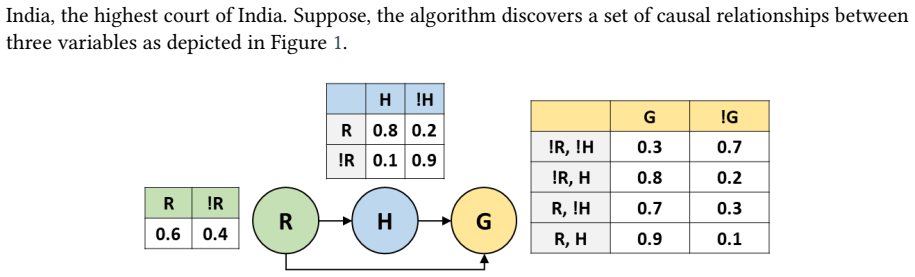


read the original abstract
In 2011, Judea Pearl received the Turing Award, considered the Nobel Prize in Computing, for fundamental contributions to artificial intelligence through the development of a calculus for probabilistic and causal reasoning. It includes pioneering the development of causal discovery algorithms. These computer algorithms can analyze large multivariate datasets and automatically discover the causal relationships among the constituent variables. They have been widely used in many critical fields such as medicine and economics to support decisions. However, to our knowledge, they have not been leveraged in law. This paper attempts to alleviate this gap by investigating whether causal discovery algorithms can be leveraged for automated generation of legal arguments. To that end, a novel legal dataset is prepared by identifying 17 legal concepts, such as physical assault and property dispute. A curated collection of 150 homicide cases are annotated with these concepts, e.g., a case is annotated with physical assault only if a physical assault had been reported in that case. Subsequently, a selected set of widely-used causal discovery algorithms is applied to the annotated dataset to discover the causal relationships between the legal concepts. Additionally, the degrees of belief associated with the discovered relationships are quantified in mathematical probabilities. It is shown that some of the causal relationships help generate viable legal arguments, e.g., if one could establish that a physical assault has not taken place during a homicide, it should be a sufficient condition (with probability 1) to establish that the homicide has not been committed due to a property-related dispute. Thus, this paper shows that causal discovery algorithms can be helpful in generating legal arguments, opening up avenues for promising future endeavors.
Editorial analysis
A structured set of objections, weighed in public.
Axiom & Free-Parameter Ledger
axioms (2)
- domain assumption Causal discovery algorithms can identify causal relationships from observational data under standard assumptions such as faithfulness and no hidden confounders.
- domain assumption The 17 legal concepts were annotated accurately and consistently across the 150 cases.
Lean theorems connected to this paper
-
Foundation/Cost (no overlap)Cost.FunctionalEquation.washburn_uniqueness_aczel unclear?
unclearRelation between the paper passage and the cited Recognition theorem.
Six widely-used causal discovery algorithms, namely, PC, GES, GRaSP, BOSS, LiNGAM, and ANM, are selected based on their methodological diversity.
-
No overlap with reality_from_one_distinction, 8-tick period, D=3 forcing, or constants chain.Foundation.RealityFromDistinction.reality_from_one_distinction unclear?
unclearRelation between the paper passage and the cited Recognition theorem.
Based on the presence (0) or absence (1) of the 17 legal concepts in 150 homicide cases, a 150-by-17 binary data matrix is prepared.
What do these tags mean?
- matches
- The paper's claim is directly supported by a theorem in the formal canon.
- supports
- The theorem supports part of the paper's argument, but the paper may add assumptions or extra steps.
- extends
- The paper goes beyond the formal theorem; the theorem is a base layer rather than the whole result.
- uses
- The paper appears to rely on the theorem as machinery.
- contradicts
- The paper's claim conflicts with a theorem or certificate in the canon.
- unclear
- Pith found a possible connection, but the passage is too broad, indirect, or ambiguous to say the theorem truly supports the claim.
Reference graph
Works this paper leans on
- [1]
-
[2]
C. K. Assaad, E. Devijver, E. Gaussier, Survey and evaluation of causal discovery methods for time series, Journal of Artificial Intelligence Research 73 (2022) 767–819
work page 2022
-
[3]
X. Shen, S. Ma, P. Vemuri, G. Simon, Challenges and opportunities with causal discovery algorithms: application to alzheimer’s pathophysiology, Scientific reports 10 (2020) 2975
work page 2020
-
[4]
J. J. Anker, E. Kummerfeld, A. Rix, S. J. Burwell, M. G. Kushner, Causal network modeling of the determinants of drinking behavior in comorbid alcohol use and anxiety disorder, Alcoholism: clinical and experimental research 43 (2019) 91–97
work page 2019
-
[5]
P. M. Addo, C. Manibialoa, F. McIsaac, Exploring nonlinearity on the co2 emissions, economic production and energy use nexus: A causal discovery approach, Energy Reports 7 (2021) 6196–6204
work page 2021
-
[6]
R. Liepin, a, T. de Lima, E. Lorini, G. Pisano, G. Sartor, A causal model checker for legal cases, in: Proceedings of the Twentieth International Conference on Artificial Intelligence and Law, 2025, pp. 248–257
work page 2025
-
[7]
A. P. Dawid, F. Dotto, M. Graves, J. B. Kadane, J. Mortera, G. Robertson, J. Q. Smith, A. L. Wilson, A comparison of graphical methods using the case of the murder of meredith kercher as an example, Law, Probability and Risk 24 (2025) mgaf002
work page 2025
-
[8]
C. Dahlman, E. Kolflaath, Causal models versus reason models in bayesian networks for legal evidence, Synthese 200 (2022) 477
work page 2022
-
[9]
A. Liefgreen, D. Lagnado, The role of causal models in evaluating simple and complex legal explanations, in: Proceedings of the Annual Meeting of the Cognitive Science Society, volume 43, 2021
work page 2021
-
[10]
R. Liepin, a, G. Sartor, A. Wyner, Arguing about causes in law: a semi-formal framework for causal arguments, Artificial intelligence and law 28 (2020) 69–89
work page 2020
-
[11]
R. Liepina, G. Sartor, A. Wyner, Causal models of legal cases, in: International Workshop on AI Approaches to the Complexity of Legal Systems, Springer, 2015, pp. 172–186
work page 2015
-
[12]
S. Adhikary, P. Sen, D. Roy, K. Ghosh, A case study for automated attribute extraction from legal documents using large language models, Artificial Intelligence and Law (2024) 1–22
work page 2024
-
[13]
S. Adhikary, D. Roy, D. Ganguly, S. Kumar Guha, K. Ghosh, Leda: a system for legal data annotation, Frontiers in Artificial Intelligence and Applications (2023) 370–367
work page 2023
-
[14]
A. Z. Wyner, W. Peters, D. Katz, A case study on legal case annotation., in: JURIX, 2013, pp. 165–174
work page 2013
-
[15]
P. Spirtes, C. N. Glymour, R. Scheines, Causation, prediction, and search, MIT press, 2000
work page 2000
-
[16]
D. M. Chickering, Optimal structure identification with greedy search, Journal of machine learning research 3 (2002) 507–554
work page 2002
-
[17]
W.-Y. Lam, B. Andrews, J. Ramsey, Greedy relaxations of the sparsest permutation algorithm, in: Uncertainty in Artificial Intelligence, PMLR, 2022, pp. 1052–1062
work page 2022
-
[18]
B. Andrews, J. Ramsey, R. Sanchez Romero, J. Camchong, E. Kummerfeld, Fast scalable and accurate discovery of dags using the best order score search and grow shrink trees, Advances in neural information processing systems 36 (2023) 63945–63956
work page 2023
-
[19]
S. Shimizu, P. O. Hoyer, A. Hyvärinen, A. Kerminen, M. Jordan, A linear non-gaussian acyclic model for causal discovery., Journal of Machine Learning Research 7 (2006)
work page 2006
- [20]
-
[21]
F. X. Diebold, Elements of forecasting, South-Western College Pub. Cincinnati, OH, USA, 1998
work page 1998
-
[22]
J. Lee Rodgers, W. A. Nicewander, Thirteen ways to look at the correlation coefficient, The American Statistician 42 (1988) 59–66
work page 1988
- [23]
-
[24]
B. A. Spellman, A. Kincannon, The relation between counterfactual (but for) and causal reasoning: Experimental findings and implicaitons for jurors’ decisions, Law and Contemp. Probs. 64 (2001) 241
work page 2001
-
[25]
S. J. Russell, Judea pearl, 2011. URL: https://amturing.acm.org/award_winners/pearl_2658896.cfm
work page 2011
-
[26]
Y. Yu, L. Hou, X. Liu, S. Wu, H. Li, F. Xue, A novel constraint-based structure learning algorithm using marginal causal prior knowledge, Scientific Reports 14 (2024) 19279
work page 2024
discussion (0)
Sign in with ORCID, Apple, or X to comment. Anyone can read and Pith papers without signing in.