Recognition: 3 theorem links
· Lean TheoremPair creation via Amplitude-Modulated Periodic and Quasiperiodic Pulse Sequences
Pith reviewed 2026-05-08 18:43 UTC · model grok-4.3
The pith
Temporal ordering of electric pulse sequences redistributes the momentum spectrum of created particle pairs while the total yield depends mainly on field strength.
A machine-rendered reading of the paper's core claim, the machinery that carries it, and where it could break.
Core claim
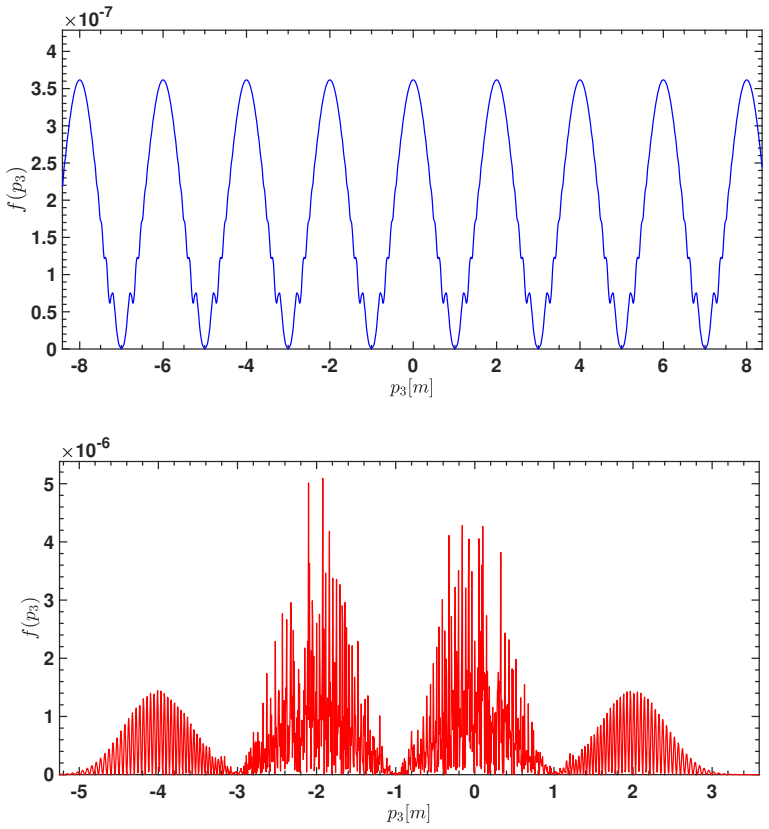
Using a quantum kinetic approach, the study shows that for N=12 and N=20 pulses, periodic amplitude-modulated trains generate regularly modulated spectra with multi-slit interference fringes that sharpen with more pulses, whereas Fibonacci quasiperiodic sequences produce fragmented structures and stronger momentum-space localization. The integrated particle yield depends nonlinearly on the field-strength ratio, with both orderings giving nearly identical yields at weak modulation and only a modest crossover at stronger modulation favoring slightly higher yields for quasiperiodic sequences. Overall, temporal ordering primarily redistributes spectral weight in momentum space while the yield is
What carries the argument
Quantum kinetic treatment of nonperturbative pair production driven by alternating-sign electric field pulse trains, comparing repeating (E1, E2) periodic patterns to Fibonacci substitution-rule quasiperiodic sequences.
If this is right
- Periodic pulse trains produce sharper and higher-contrast interference fringes in the momentum spectrum as the number of pulses increases from 12 to 20.
- Quasiperiodic Fibonacci sequences enhance momentum-space localization and increasingly irregular spectral features with larger pulse numbers.
- The particle yield exhibits a strongly nonlinear dependence on the field-strength ratio, with quasiperiodic sequences yielding slightly larger values than periodic ones only at stronger modulations.
- Long-range temporal ordering functions as an effective control parameter for the spectral distribution in multipulse Schwinger pair production.
Where Pith is reading between the lines
- Laser pulse sequences could be designed to steer produced particles toward chosen momentum ranges while keeping the overall production rate fixed by field strength.
- The distinction between periodic and quasiperiodic drives may link to localization phenomena in other driven quantum systems beyond pair production.
- Realistic laser pulse shapes that approximate the idealized trains could be tested to determine whether the predicted spectral differences survive in experiment.
- The same ordering comparison might be extended to other quasiperiodic sequences or to different pair-production regimes such as those involving magnetic fields.
Load-bearing premise
The quantum kinetic method remains accurate for the chosen pulse parameters and the idealized rectangular alternating-sign pulses adequately represent realizable high-intensity laser fields.
What would settle it
A measurement of the longitudinal momentum spectrum of produced particles in a high-intensity laser experiment using periodic versus Fibonacci-ordered pulse trains would reveal regular high-contrast interference fringes for periodic cases and fragmented irregular localization for quasiperiodic cases if the claim is correct.
Figures



read the original abstract
We study nonperturbative pair production driven by alternating-sign electric field pulse trains. Using a quantum kinetic approach, we analyze both the longitudinal momentum spectrum and the particle yield for pulse sequences with either strictly periodic temporal structure, in which the pulse amplitudes alternate in a regular and repeating (E_1, E_2) pattern, or quasiperiodic (Fibonacci-ordered) structure, where the amplitudes follow a deterministic but aperiodic sequence generated by the Fibonacci substitution rule, exhibiting long-range order without exact repetition. For N=12 pulses, periodic trains generate regularly modulated spectra characteristic of multi-slit (Ramsey-type) interference, whereas Fibonacci sequences produce fragmented structures and partial momentum-space localization. Increasing the pulse number to N=20 further enhances these effects: periodic driving yields sharper and higher-contrast interference fringes, while quasiperiodic ordering leads to stronger localization and increasingly irregular spectral features.The particle yield exhibits a strongly nonlinear dependence on the field-strength ratio. For weak modulation , both temporal orderings produce nearly identical yields. For stronger fields, a modest crossover behavior is observed, with quasiperiodic sequences yielding slightly larger values than the periodic case. Overall, temporal ordering primarily redistributes spectral weight in momentum space, while the integrated yield is governed predominantly by the effective field strength. These results establish long-range temporal ordering as an effective control parameter in multipulse Schwinger pair production and provide guidance for designing tailored pulse sequences in future high-intensity laser experiments.
Editorial analysis
A structured set of objections, weighed in public.
Referee Report
Summary. The manuscript examines nonperturbative electron-positron pair production driven by alternating-sign electric field pulse trains using a quantum kinetic approach. It compares strictly periodic sequences (regular E1-E2 alternation) with quasiperiodic Fibonacci-ordered sequences for N=12 and N=20 pulses, reporting regularly modulated momentum spectra with multi-slit interference for periodic cases versus fragmented spectra and partial momentum-space localization for Fibonacci cases. The particle yield shows a strongly nonlinear dependence on the field-strength ratio r=E2/E1, with nearly identical yields at weak modulation and a modest crossover at stronger modulation where quasiperiodic sequences yield slightly larger values. The authors conclude that temporal ordering primarily redistributes spectral weight while the integrated yield is governed predominantly by the effective field strength.
Significance. If the central comparison holds, the work establishes long-range temporal ordering as a control parameter for the momentum distribution in multipulse Schwinger pair production, with potential guidance for designing pulse sequences in high-intensity laser experiments. The concrete numerical results on spectra and yields for N=12 and N=20, obtained via the quantum kinetic method, constitute a strength by providing falsifiable predictions rather than purely analytic limits.
major comments (1)
- [Abstract and yield results] The claim that the integrated yield is governed predominantly by the effective field strength (stated in the abstract and repeated in the conclusions) requires an explicit definition of this effective field strength together with a demonstration that the periodic and quasiperiodic sequences are compared at matched effective strength. Periodic sequences contain equal numbers of E1 and E2 pulses (for even N), while Fibonacci sequences have pulse counts in the ratio of consecutive Fibonacci numbers (approaching ~0.618:0.382). Because the pair-production rate depends exponentially on field amplitude, any mismatch in the weighted effective strength could account for the reported modest crossover in yields at stronger modulation, undermining the interpretation that the difference arises from ordering per se rather than compositional imbalance.
minor comments (1)
- [Abstract] The abstract contains a typographical issue: 'For weak modulation , both' has an extraneous space before the comma.
Simulated Author's Rebuttal
We thank the referee for the careful reading of our manuscript and the constructive comments provided. We address the major comment on the effective field strength below, and we will make revisions to improve the clarity of our presentation.
read point-by-point responses
-
Referee: [Abstract and yield results] The claim that the integrated yield is governed predominantly by the effective field strength (stated in the abstract and repeated in the conclusions) requires an explicit definition of this effective field strength together with a demonstration that the periodic and quasiperiodic sequences are compared at matched effective strength. Periodic sequences contain equal numbers of E1 and E2 pulses (for even N), while Fibonacci sequences have pulse counts in the ratio of consecutive Fibonacci numbers (approaching ~0.618:0.382). Because the pair-production rate depends exponentially on field amplitude, any mismatch in the weighted effective strength could account for the reported modest crossover in yields at stronger modulation, undermining the interpretation that the difference arises from ordering per se rather than compositional imbalance.
Authors: We thank the referee for pointing out the need for an explicit definition of the effective field strength. In our work, both the periodic and quasiperiodic pulse sequences are defined using the same values of the field amplitudes E1 and E2. The term 'effective field strength' in the abstract and conclusions is used to indicate that the total yield depends primarily on these amplitudes rather than on the specific temporal ordering. However, we acknowledge that this requires clarification to ensure the sequences are compared fairly. We will revise the manuscript to provide an explicit definition of the effective field strength, for instance as the root mean square of the electric field over the entire sequence duration. We will also include a demonstration, perhaps in a new subsection or appendix, showing the calculated effective strengths for the periodic (equal E1 and E2 counts) and Fibonacci (Fibonacci ratio counts) sequences at the parameters studied. This will confirm that the modest crossover in yields at stronger modulation is not solely due to compositional imbalance but reflects the influence of ordering on the pair production dynamics. We believe this addresses the concern and strengthens the manuscript. revision: yes
Circularity Check
No significant circularity; derivations are self-contained numerical computations from externally defined sequences
full rationale
The paper explicitly constructs periodic sequences via regular (E1, E2) alternation and quasiperiodic sequences via the Fibonacci substitution rule; these definitions are independent of the computed momentum spectra or yields. The quantum kinetic approach is applied to solve for pair production under these fixed pulse trains, with results reported as direct numerical outcomes rather than fits or renamings. No load-bearing claim reduces by construction to its own inputs, self-citations, or fitted parameters. The central statement that ordering redistributes spectral weight while yield depends on effective field strength follows from the computed integrals and is not tautological.
Axiom & Free-Parameter Ledger
axioms (1)
- domain assumption Quantum kinetic equation accurately describes nonperturbative pair production for the chosen pulse parameters
Lean theorems connected to this paper
-
Constants (phi); Foundation/CKMLambdaFromPhiLadderphi_golden_ratio / phi_sq_eq unclear?
unclearRelation between the paper passage and the cited Recognition theorem.
quasiperiodic (Fibonacci-ordered) structure, where the amplitudes follow a deterministic but aperiodic sequence generated by the Fibonacci substitution rule
-
Cost (Jcost)washburn_uniqueness_aczel unclear?
unclearRelation between the paper passage and the cited Recognition theorem.
The particle yield exhibits a strongly nonlinear dependence on the field-strength ratio ξ12 = E1/E2... the integrated yield is governed predominantly by the effective field strength.
What do these tags mean?
- matches
- The paper's claim is directly supported by a theorem in the formal canon.
- supports
- The theorem supports part of the paper's argument, but the paper may add assumptions or extra steps.
- extends
- The paper goes beyond the formal theorem; the theorem is a base layer rather than the whole result.
- uses
- The paper appears to rely on the theorem as machinery.
- contradicts
- The paper's claim conflicts with a theorem or certificate in the canon.
- unclear
- Pith found a possible connection, but the passage is too broad, indirect, or ambiguous to say the theorem truly supports the claim.
Reference graph
Works this paper leans on
-
[1]
How does amplitude modulation a ffect multipulse interference patterns? Does introducing two distinct amplitudes E1 and E2 simply scale the identical-pulse results, or does it produc e qualitatively new spectral features?
-
[2]
Can quasiperiodic amplitude ordering generate interfer ence phenomena absent in periodic sequences? Does the Fibonacci sequence imprint its charact eristic singular continuous spec- trum onto the momentum distribution of created pairs?
-
[3]
Is there an optimal amplitude ratio for maximizing pair pr oduction? How do the resonant conditions depend on ξ12, and can quasiperiodic ordering outperform periodic drivi ng in certain parameter regimes?
-
[4]
The momentum spectra exhibit rich structure that depends sensitively on ξ12, with resonant peaks appearing at specific ratios (e.g., ξ12 ≈0
How does the distinction between periodic and quasiperio dic ordering scale with pulse num- ber? Does increasing N amplify or diminish the differences between the two temporal struc- 5 tures? We demonstrate several novel findings: First observation of amplitude-modulated interference fringes. The momentum spectra exhibit rich structure that depends sensitiv...
-
[5]
75, 1. 0). This reveals that the amplitude ratio is a powerful control parameter comparable to pulse separation. First evidence of quasiperiodicity-induced s pectral fragmentation. Fibonacci-ordered pulse trains produce fragmented, irregularly peaked spect ra that differ qualitatively from the clean interference combs of periodic sequences. At large ξ12, t...
-
[6]
The absence of a simple periodic pattern reflects the lack of l ong-range temporal order and the resulting breakdown of global phase matching. Neverthe less, the overall magnitude of the spectrum remains comparable to the periodic case, f (p3) ∼10−11, indicating that quasiperiodicity of amplitude modulation does not lift the strong suppressio n imposed by ...
-
[7]
H. B. G. Casimir, Indag. Math. 10 (1948) no.4, 261-263
1948
-
[8]
Heisenberg and H
W. Heisenberg and H. Euler, Z. Phys. 98, 714 (1936)
1936
-
[9]
Schwinger, Phys
J. Schwinger, Phys. Rev. 82, 664 (1951)
1951
-
[10]
G. V . Dunne, Eur. Phys. J. D 55, 327 (2009)
2009
-
[11]
Marklund and P
M. Marklund and P . K. Shukla, Rev. Mod. Phys. 78, 591 (2006)
2006
-
[12]
Sch¨ utzhold, H
R. Sch¨ utzhold, H. Gies, and G. Dunne, Phys. Rev. Lett. 101, 130404 (2008)
2008
-
[13]
Hebenstreit, R
F. Hebenstreit, R. Alkofer, and H. Gies, Phys. Rev. Lett. 102, 150404 (2009)
2009
-
[14]
B. King, A. Di Piazza, and C. H. Keitel, Nat. Photonics 4, 92 (2010)
2010
-
[15]
Heinzl, B
T. Heinzl, B. King, and A. J. MacLeod, Phys. Rev. A 81, 022125 (2010). 27
2010
-
[16]
N. F. Ramsey, Phys. Rev. 78, 695 (1950)
1950
-
[17]
Akkermans and G
E. Akkermans and G. V . Dunne, Phys. Rev. Lett. 108, 030401 (2012)
2012
-
[18]
N. F. Ramsey, Rev. Mod. Phys. 62, 541 (1990)
1990
-
[19]
Heinzl, B
T. Heinzl, B. King, and A. J. MacLeod, Phys. Rev. A 81, 022125 (2010)
2010
-
[20]
Mackenroth and A
F. Mackenroth and A. Di Piazza, Phys. Rev. Lett. 110, 070402 (2013)
2013
-
[21]
G. A. Mourou, T. Tajima, and S. V . Bulanov, Rev. Mod. Phys . 78, 309 (2006)
2006
-
[22]
Di Piazza, C
A. Di Piazza, C. M¨ uller, K. Z. Hatsagortsyan, and C. H. K eitel, Rev. Mod. Phys. 84, 1177 (2012)
2012
-
[23]
Sch¨ utzhold, H
R. Sch¨ utzhold, H. Gies, and G. V . Dunne, Phys. Rev. Lett. 101, 130404 (2008)
2008
-
[24]
Hebenstreit, R
F. Hebenstreit, R. Alkofer, and H. Gies, Phys. Rev. Lett . 102, 150404 (2009)
2009
-
[25]
G. V . Dunne, H. Gies, and R. Sch¨ utzhold, Phys. Rev. D 80, 111301 (2009)
2009
-
[26]
V . S. Popov, JETP Lett. 13, 185 (1971)
1971
-
[27]
C. Banerjee and M. P . Singh, Phys. Rev. D 105, no.7, 076021 (2022) doi:10.1103/PhysRevD.105.076021 [arXiv:1807.06951 [physics.plasm-ph]]
-
[28]
C. Banerjee and M. P . Singh, Phys. Rev. D 100 (2019) no.5, 056016 doi:10.1103/PhysRevD.100.056016 [arXiv:1809.06901 [hep-ph]]
-
[29]
S. P . Kim and D. N. Page, Phys. Rev. D 65, 105002 (2002)
2002
-
[30]
G. V . Dunne and C. Schubert, Phys. Rev. D 72, 105004 (2005)
2005
-
[31]
S. M. Schmidt, D. Blaschke, G. R¨ opke, A. V . Prozorkevich, S. A. Smolyansky, and V . D. Toneev, Int. J. Mod. Phys. E 7, 709 (1998)
1998
-
[32]
Alkofer, M
R. Alkofer, M. B. Hecht, C. D. Roberts, S. M. Schmidt, and D. V . Vinnik, Phys. Rev. Lett.87, 193902 (2001)
2001
-
[33]
Hebenstreit, R
F. Hebenstreit, R. Alkofer, and H. Gies, Phys. Rev. D 82, 105026 (2010)
2010
-
[34]
Kohlf¨ urst, R
C. Kohlf¨ urst, R. Alkofer, M. B. Hecht, and H. Gies, Phys . Rev. Lett. 112, 050402 (2014)
2014
-
[35]
Kohlf¨ urst, Phys
C. Kohlf¨ urst, Phys. Rev. D 90, 025028 (2014)
2014
-
[36]
Z. L. Li, D. Lu and B. S. Xie, Phys. Rev. D 89, no.6, 067701 (2014) doi:10.1103/PhysRevD.89.067701
- [37]
-
[38]
Z. L. Li, D. Lu, B. S. Xie, L. B. Fu, J. Liu and B. F. Shen, Phy s. Rev. D 89, no.9, 093011 (2014) doi:10.1103/PhysRevD.89.093011
-
[39]
A. Otto, H. Oppitz and B. K¨ ampfer, Eur. Phys. J. A54, no.2, 23 (2018) doi:10.1140/epja/i2018-12473- x [arXiv:1801.09943 [hep-ph]]. 28
-
[40]
2021, Reviews of Modern Physics, 93, 4, 045001
Jagannathan, A. 2021, Reviews of Modern Physics, 93, 4, 045001. doi:10.1103/RevModPhys.93.045001
- [41]
discussion (0)
Sign in with ORCID, Apple, or X to comment. Anyone can read and Pith papers without signing in.