Triplet-assisted leakage during singlet-triplet qubit readout with a quantum point contact
Pith reviewed 2026-05-08 17:53 UTC · model grok-4.3
The pith
Tunneling of triplet states into a higher-energy level of the neighboring dot creates leakage paths that modify charge and current-noise signatures during singlet-triplet qubit readout, even while ground-state Pauli blockade holds.
A machine-rendered reading of the paper's core claim, the machinery that carries it, and where it could break.
Core claim
The central claim is that triplet-assisted leakage into a higher single-particle level of the neighboring dot opens energetically allowed pathways that alter the branch-dependent charge and current-noise signatures during readout, even when the Pauli blockade remains effective within the ground-state manifold. The resulting model, based on two levels per dot, predicts a regime where this tunneling qualitatively changes the readout outcome as determined by the level spacing.
What carries the argument
The two-level-per-dot Hamiltonian that produces the singlet-triplet block structure and permits triplet tunneling to the excited level, solved via Lindblad master equation and quantum-jump simulations to track individual readout events together with Liouvillian steady-state analysis.
If this is right
- Charge and noise signatures acquire additional branch-dependent features from the leakage channel.
- The crossover to altered signatures is controlled by level spacing and identifiable through steady-state analysis.
- Quantum-jump trajectories resolve the time-resolved dynamics of individual readout events under the extended model.
- Ground-state Pauli blockade alone does not guarantee the original, unmodified readout signatures.
Where Pith is reading between the lines
- Readout fidelity estimates in experiments may need to include excited-state channels to avoid systematic misassignment of states.
- Device tuning of dot level spacing could be used to suppress or exploit the leakage for improved discrimination.
- The same leakage mechanism may appear in other multi-level quantum-dot qubit architectures whenever readout involves nearby excited states.
Load-bearing premise
Two single-particle levels per dot are enough to capture all relevant tunneling dynamics and the Lindblad master equation plus quantum-jump method fully describes the readout without higher-order or multi-level effects.
What would settle it
Measuring whether the current-noise spectrum or the charge distribution between readout branches changes when the inter-level energy spacing is swept across the predicted crossover value would confirm or refute the leakage modification.
Figures


read the original abstract
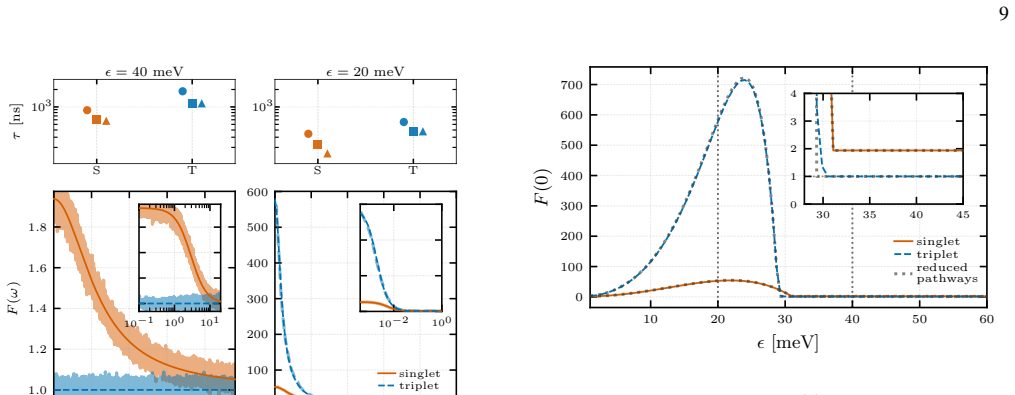
Quantum point contact readout theory for singlet-triplet qubits in a lateral double quantum dot is extended by including tunneling of triplet configurations into a higher-energy level of the neighboring dot. This additional channel creates energetically allowed leakage pathways that modify the branch-dependent charge and current-noise signatures, even when the Pauli blockade remains effective within the ground-state manifold. The model contains two single-particle levels in each dot. The resulting singlet and triplet block structure is derived together with a Lindblad master equation. Quantum-jump simulations are then used to resolve the dynamics of individual readout events. A complementary Liouvillian steady-state analysis identifies the regime in which tunneling to the excited level qualitatively changes the readout signatures, with the crossover determined by the level spacing.
Editorial analysis
A structured set of objections, weighed in public.
Referee Report
Summary. The paper extends quantum point contact readout theory for singlet-triplet qubits in lateral double quantum dots by adding tunneling of triplet configurations into a higher single-particle level of the neighboring dot. Within an explicit two-level-per-dot model, it derives the resulting singlet-triplet block structure, constructs a Lindblad master equation, performs quantum-jump trajectory simulations of individual readout events, and uses Liouvillian steady-state analysis to locate the regime in which excited-level tunneling qualitatively modifies branch-dependent charge and current-noise signatures while the ground-state Pauli blockade remains intact; the crossover is controlled by the excited-level spacing.
Significance. If the central claim holds, the work identifies a concrete, energetically allowed leakage channel that alters observable readout noise without violating ground-state blockade. This is relevant for interpreting charge-noise and current-noise data in singlet-triplet qubit experiments and for assessing readout fidelity limits. The use of quantum-jump simulations together with Liouvillian analysis provides a standard, reproducible open-system framework for such effects.
major comments (2)
- [Model Hamiltonian and block structure] Model construction (two single-particle levels per dot): The central claim that triplet-assisted tunneling into the excited level modifies branch-dependent charge and current-noise signatures rests entirely on the two-level truncation. No explicit check is supplied showing that the crossover condition set by level spacing, or the qualitative change in noise, survives the addition of a third orbital or valley degree of freedom. Because the Lindblad operators and quantum-jump trajectories are derived inside this truncation, the robustness of the reported signatures is load-bearing for the main result.
- [Steady-state analysis] Liouvillian steady-state analysis: The regime in which excited-level tunneling qualitatively changes the readout signatures is identified, but the manuscript provides no numerical values for the excited-level spacing, tunneling rates, or bias window relative to typical experimental parameters in lateral GaAs or Si DQDs. Without such anchoring, it is unclear whether the predicted crossover lies inside the experimentally accessible range where Pauli blockade is still effective.
minor comments (2)
- The abstract and introduction would benefit from a schematic energy-level diagram showing the ground-state singlet-triplet manifold, the excited level, and the QPC tunneling paths to make the leakage mechanism immediately visible.
- Notation for the Lindblad operators and the quantum-jump unraveling should be cross-referenced to the explicit form of the Hamiltonian so that the reader can trace how the additional channel enters the master equation.
Simulated Author's Rebuttal
We thank the referee for the careful reading, positive assessment of the work's relevance, and the constructive major comments. We address each point below and have revised the manuscript accordingly to improve clarity and anchoring.
read point-by-point responses
-
Referee: [Model Hamiltonian and block structure] Model construction (two single-particle levels per dot): The central claim that triplet-assisted tunneling into the excited level modifies branch-dependent charge and current-noise signatures rests entirely on the two-level truncation. No explicit check is supplied showing that the crossover condition set by level spacing, or the qualitative change in noise, survives the addition of a third orbital or valley degree of freedom. Because the Lindblad operators and quantum-jump trajectories are derived inside this truncation, the robustness of the reported signatures is load-bearing for the main result.
Authors: We agree that the two-level truncation is central to the derivation and that an explicit robustness check against additional orbitals or valleys would strengthen the result. The model was constructed as the minimal extension capable of capturing triplet-assisted leakage into a higher single-particle level while preserving the ground-state singlet-triplet block structure and effective Pauli blockade. In the parameter regime considered, higher orbitals lie several meV above the relevant states and remain off-resonant, so their inclusion would primarily renormalize effective rates without opening new low-energy leakage channels that violate blockade. We have added a dedicated paragraph in the revised Section II discussing this point and arguing that the qualitative crossover (controlled by the first excited-level spacing) persists. A full three-level numerical treatment is beyond the present scope but would not change the reported signatures. revision: partial
-
Referee: [Steady-state analysis] Liouvillian steady-state analysis: The regime in which excited-level tunneling qualitatively changes the readout signatures is identified, but the manuscript provides no numerical values for the excited-level spacing, tunneling rates, or bias window relative to typical experimental parameters in lateral GaAs or Si DQDs. Without such anchoring, it is unclear whether the predicted crossover lies inside the experimentally accessible range where Pauli blockade is still effective.
Authors: We thank the referee for highlighting the need to connect the theoretical crossover to experiment. In the revised manuscript we have inserted a new paragraph (in the discussion of the Liouvillian analysis) supplying order-of-magnitude estimates drawn from the literature on lateral GaAs and Si double quantum dots. Typical orbital spacings are 0.5–5 meV, interdot and QPC tunneling rates are tuned in the 10–100 μeV and 1–10 MHz ranges respectively, and the bias window is kept below ~1 meV to maintain blockade. Within these values the crossover occurs when the excited-level detuning becomes comparable to the effective tunneling rates, a regime that remains experimentally accessible while the ground-state Pauli blockade stays intact. These anchors make the predicted noise modifications directly relevant to existing readout experiments. revision: yes
Circularity Check
Two-level Hamiltonian derivation yields modified noise signatures without reduction to fitted inputs or self-citations
full rationale
The paper explicitly constructs a model Hamiltonian containing exactly two single-particle levels per dot, derives the resulting singlet-triplet block structure and Lindblad master equation from that Hamiltonian, and then applies quantum-jump simulations plus Liouvillian steady-state analysis to obtain the modified charge and current-noise signatures. No step reduces a claimed prediction to a fitted parameter, a self-citation chain, or an ansatz smuggled from prior work; all outputs follow directly from the stated model assumptions and the standard open-quantum-system formalism. The two-level truncation is presented as an explicit modeling choice whose consequences are explored, not as a hidden definitional loop. This is a standard self-contained theoretical derivation.
Axiom & Free-Parameter Ledger
free parameters (2)
- excited-level spacing
- tunneling rates to excited level
axioms (2)
- domain assumption Two single-particle levels per dot suffice to describe the relevant singlet-triplet manifold and leakage.
- standard math Lindblad master equation accurately captures the measurement-induced dynamics.
Reference graph
Works this paper leans on
-
[1]
Triplet-assisted leakage during singlet-triplet qubit readout with a quantum point contact
This encoding enables control through exchange [3] and magnetic field [4] gradients, suppresses sensitivity to spatially uniform magnetic field fluc- tuations because the logical states share the same spin pro- jection [ 5], and can operate at comparatively low magnetic fields, which is attractive for hybrid superconducting and spin- photon architectures ...
work page internal anchor Pith review Pith/arXiv arXiv 2026
-
[2]
D. Loss and D. P . DiVincenzo, Quantum computation with quantum dots, Phys. Rev. A 57, 120 (1998)
work page 1998
-
[3]
Levy, Universal quantum computation with spin-1/2pairs and heisenberg exchange, Phys
J. Levy, Universal quantum computation with spin-1/2pairs and heisenberg exchange, Phys. Rev. Lett. 89, 147902 (2002)
work page 2002
-
[4]
J. R. Petta, A. C. Johnson, J. M. Taylor, E. A. Laird, A. Y acoby, M. D. Lukin, C. M. Marcus, M. P . Hanson, and A. C. Gossard, Coherent manipulation of coupled electron spins in semicon- ductor quantum dots, Science 309, 2180 (2005)
work page 2005
-
[5]
S. Foletti, H. Bluhm, D. Mahalu, V . Umansky, and A. Y acoby, Universal quantum control of two-electron spin quantum bits using dynamic nuclear polarization, Nat. Phys. 5, 903 (2009)
work page 2009
-
[6]
G. Burkard, T. D. Ladd, A. Pan, J. M. Nichol, and J. R. Petta, Semiconductor spin qubits, Rev. Mod. Phys.95, 025003 (2023)
work page 2023
-
[7]
S. D. Liles, D. J. Halverson, Z. Wang, A. Shamim, R. S. Eggli, I. K. Jin, J. Hillier, K. Kumar, I. Vorreiter, M. J. Rendell, J. Y . Huang, C. C. Escott, F. E. Hudson, W. H. Lim, and D. Culcer, A singlet-triplet hole-spin qubit in MOS silicon, Nat. Commun. 15, 7690 (2024)
work page 2024
-
[8]
P . Cerfontaine, T. Botzem, J. Ritzmann, S. S. Humpohl, A. Lud- wig, D. Schuh, D. Bougeard, A. D. Wieck, and H. Bluhm, Closed-loop control of a GaAs-based singlet-triplet spin qubit with 99.5% gate fidelity and low leakage, Nat. Commun. 11, 4144 (2020)
work page 2020
-
[9]
B. M. Maune, M. G. Borselli, B. Huang, T. D. Ladd, P . W. Deelman, K. S. Holabird, A. A. Kiselev, I. Alvarado-Rodriguez, R. S. Ross, A. E. Schmitz, M. Sokolich, C. A. Watson, M. F. Gyure, and A. T. Hunter, Coherent singlet-triplet oscillations in a silicon-based double quantum dot, Nature 481, 344 (2012)
work page 2012
-
[10]
X. Wu, D. R. Ward, J. R. Prance, D. Kim, J. K. Gamble, R. T. Mohr, Z. Shi, D. E. Savage, M. G. Lagally, M. Friesen, S. N. Coppersmith, and M. A. Eriksson, T wo-axis control of a singlet– triplet qubit with an integrated micromagnet, Proc. Natl. Acad. Sci. U.S.A. 111, 11938 (2014)
work page 2014
-
[11]
R. M. Jock, N. T. Jacobson, M. Rudolph, D. R. Ward, M. S. Carroll, and D. R. Luhman, A silicon singlet-triplet qubit driven by spin-valley coupling, Nat. Commun. 13, 641 (2022)
work page 2022
-
[12]
M. D. Shulman, O. E. Dial, S. P . Harvey, H. Bluhm, V . Uman- sky, and A. Y acoby, Demonstration of entanglement of elec- trostatically coupled singlet-triplet qubits, Science 336, 202 (2012)
work page 2012
- [13]
-
[14]
K. Ono, D. G. Austing, Y . Tokura, and S. Tarucha, Current recti- fication by pauli exclusion in a weakly coupled double quantum dot system, Science 297, 1313 (2002). 11
work page 2002
-
[15]
T. Ihn, S. Gustavsson, U. Gasser, B. Küng, T. Müller, R. Schleser, M. Sigrist, I. Shorubalko, R. Leturcq, and K. En- sslin, Quantum dots investigated with charge detection tech- niques, Solid State Commun. 149, 1419 (2009)
work page 2009
-
[16]
S. Gustavsson, R. Leturcq, B. Simovič, R. Schleser, T. Ihn, P . Studerus, K. Ensslin, D. C. Driscoll, and A. C. Gossard, Counting statistics and super-poissonian noise in a quantum dot, Phys. Rev. B 74, 195305 (2006)
work page 2006
-
[17]
H.-S. Goan, G. J. Milburn, H. M. Wiseman, and H. B. Sun, Con- tinuous quantum measurement of two coupled quantum dots us- ing a point contact: A quantum trajectory approach, Phys. Rev. B 63, 125326 (2001)
work page 2001
-
[18]
T. M. Stace and S. D. Barrett, Continuous quantum measure- ment: Inelastic tunneling and lack of current oscillations, Phys. Rev. Lett. 92, 136802 (2004)
work page 2004
-
[19]
T. M. Stace and S. D. Barrett, Continuous measurement of a charge qubit with a point contact detector at arbitrary bias: the role of inelastic tunnelling (2003), arXiv:cond-mat/0309610
work page internal anchor Pith review arXiv 2003
-
[20]
S.-H. Ouyang, C.-H. Lam, and J. Q. Y ou, Backaction of a charge detector on a double quantum dot, Phys. Rev. B 81, 075301 (2010)
work page 2010
- [21]
-
[22]
S. D. Barrett and T. M. Stace, T wo-spin measurements in ex- change interaction quantum computers,Phys. Rev. B73, 075324 (2006)
work page 2006
-
[23]
L. Marcinowski, K. Roszak, P . Machnikowski, and M. Krzy- zosiak, Phonon influence on the measurement of spin states in double quantum dots using the quantum point contact, Phys. Rev. B 88, 125303 (2013)
work page 2013
- [24]
-
[25]
H. W. Liu, T. Fujisawa, Y . Ono, H. Inokawa, A. Fujiwara, K. Takashina, and Y . Hirayama, Pauli-spin-blockade transport through a silicon double quantum dot, Phys. Rev. B 77, 073310 (2008)
work page 2008
-
[26]
J. Dalibard, Y . Castin, and K. Mølmer, Wave-function approach to dissipative processes in quantum optics, Phys. Rev. Lett. 68, 580 (1992)
work page 1992
-
[27]
H. J. Carmichael, Quantum trajectory theory for cascaded open systems, Phys. Rev. Lett. 70, 2273 (1993)
work page 1993
-
[28]
Lax, Formal theory of quantum fluctuations from a driven state, Phys
M. Lax, Formal theory of quantum fluctuations from a driven state, Phys. Rev. 129, 2342 (1963)
work page 1963
-
[29]
H.-P . Breuer and F. Petruccione, The Theory of Open Quantum Systems (Oxford University Press, Oxford, 2002)
work page 2002
-
[30]
C. W. Gardiner and P . Zoller, Quantum Noise: A Handbook of Markovian and Non-Markovian Quantum Stochastic Methods with Applications to Quantum Optics, 2nd ed. (Springer, Berlin, 2000)
work page 2000
-
[31]
H. J. Carmichael, Statistical Methods in Quantum Optics 1: Master Equations and Fokker-Planck Equations (Springer, Berlin, 1999)
work page 1999
-
[32]
G. W. Ford and R. F. O’Connell, There is no quantum regression theorem, Phys. Rev. Lett. 77, 798 (1996)
work page 1996
-
[33]
G. Guarnieri, A. Smirne, and B. Vacchini, Quantum regres- sion theorem and non-markovianity of quantum dynamics,Phys. Rev. A 90, 022110 (2014)
work page 2014
-
[34]
S. Khan, B. K. Agarwalla, and S. Jain, Quantum regression theo- rem for multi-time correlators: A detailed analysis in the heisen- berg picture, Phys. Rev. A 106, 022214 (2022)
work page 2022
- [35]
-
[36]
Y . M. Blanter and M. Büttiker, Shot noise in mesoscopic con- ductors, Phys. Rep. 336, 1 (2000)
work page 2000
-
[37]
A. A. Clerk, M. H. Devoret, S. M. Girvin, F. Marquardt, and R. J. Schoelkopf, Introduction to quantum noise, measurement, and amplification, Rev. Mod. Phys. 82, 1155 (2010)
work page 2010
discussion (0)
Sign in with ORCID, Apple, or X to comment. Anyone can read and Pith papers without signing in.