Recognition: 3 theorem links
· Lean TheoremEntanglement cost in non-local quantum computation
Pith reviewed 2026-05-08 18:04 UTC · model grok-4.3
The pith
Entanglement cost in non-local quantum computation is closely tied to questions in cryptography, complexity, and gravity.
A machine-rendered reading of the paper's core claim, the machinery that carries it, and where it could break.
Core claim
The paper presents a comprehensive review of entanglement cost in NLQC, establishing that the quantity of shared entanglement required to implement joint unitaries on separated systems is a central object whose upper and lower bounds connect directly to open questions in quantum cryptography, computational complexity, communication complexity, quantum gravity, and related applications.
What carries the argument
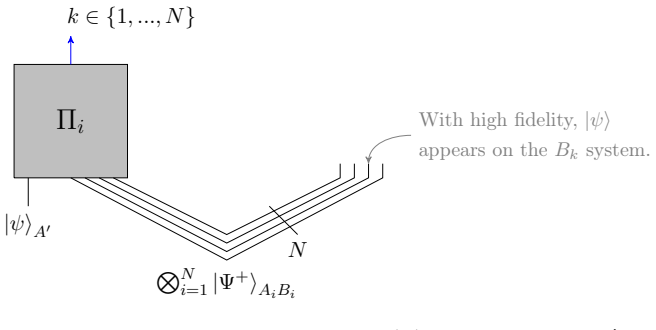
Non-local quantum computation (NLQC), the process of realizing a joint quantum operation on two systems that never interact directly, using only pre-shared entanglement together with a single round of communication.
Load-bearing premise
The literature reviewed on upper and lower bounds is accurately and comprehensively summarized without major omissions or errors in interpretation.
What would settle it
A new explicit protocol that uses strictly less entanglement than the lowest upper bound summarized for a given task, or a new impossibility proof showing that a task requires more entanglement than the highest lower bound given, would contradict the review's account of the current state.
Figures








read the original abstract
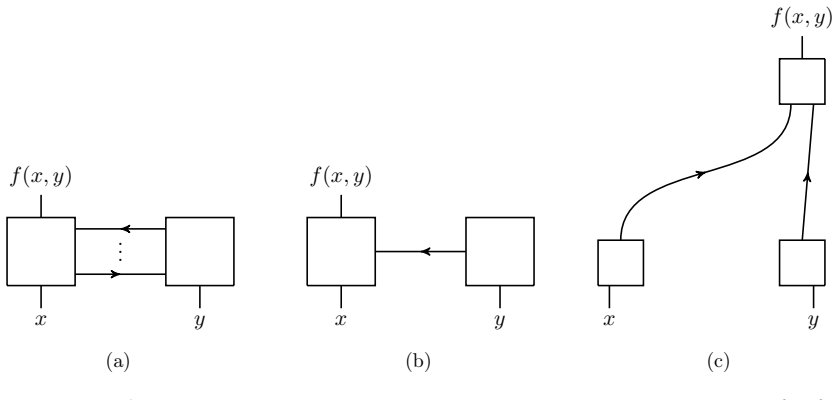
This is a book-length treatment of the subject of non-local quantum computation (NLQC). NLQC is a method for implementing quantum operations that interact two systems without directly bringing the systems together. Instead, a single round of communication and shared entanglement is used. NLQC has appeared in the context of quantum cryptography, computational complexity, communication complexity, quantum gravity, and other applications. The understanding of entanglement cost in NLQC is closely tied to questions in all of these areas. We review upper and lower bounds on entanglement cost, as well as some of the applications of NLQC and its connections to other subjects.
Editorial analysis
A structured set of objections, weighed in public.
Referee Report
Summary. The manuscript is a book-length review of non-local quantum computation (NLQC), a protocol for implementing quantum operations between two separated systems using only shared entanglement and one round of classical communication. It surveys known upper and lower bounds on the entanglement cost of such protocols and examines their connections to quantum cryptography, computational complexity, communication complexity, quantum gravity, and related applications. The central claim is that a thorough understanding of entanglement cost in NLQC is closely tied to open questions across these fields.
Significance. If the literature synthesis is accurate and comprehensive, the review provides a valuable consolidated reference for researchers working at the intersection of quantum information, cryptography, and gravity. By compiling bounds and highlighting interdisciplinary links without introducing new unverified derivations, it offers a foundation that could guide future work in these areas. The strength lies in the breadth of coverage and the explicit framing of NLQC entanglement cost as a unifying concept.
minor comments (2)
- Abstract: The abstract effectively outlines the scope but does not indicate the specific bounds or key results that will be emphasized, which would help readers assess relevance quickly.
- Given the book-length format, the manuscript would benefit from an explicit table of contents or section roadmap early in the introduction to improve navigability for readers consulting it as a reference.
Simulated Author's Rebuttal
We thank the referee for their positive summary and assessment of the manuscript as a valuable consolidated reference on non-local quantum computation and its interdisciplinary connections. We note the recommendation for minor revision. Since the report contains no specific major comments or points requiring clarification, we have no point-by-point responses to provide. We will perform a final check for any minor issues such as typographical errors or updates to references to ensure the literature synthesis remains accurate and comprehensive.
Circularity Check
No circularity: synthesis review with no original derivations
full rationale
The manuscript is explicitly a book-length review that surveys and summarizes known upper and lower bounds on entanglement cost for NLQC protocols, along with their established links to cryptography, complexity, communication complexity, and quantum gravity. No new derivations, predictions, fitted parameters, or first-principles results are introduced; the text states that it reviews existing literature without presenting original equations or claims that could reduce to self-definitions or self-citations. All load-bearing content is therefore external to the paper and independently established in the cited prior work, rendering the derivation chain self-contained with no circular steps.
Axiom & Free-Parameter Ledger
Lean theorems connected to this paper
-
Cost.FunctionalEquation (J unique calibrated cost)washburn_uniqueness_aczel unclear?
unclearRelation between the paper passage and the cited Recognition theorem.
E(U) ≤ O((68n)^T-depth(U)). The relationship between complexity and NLQC turns out to be even more rich...
-
Foundation/AlexanderDuality, Unification (spacetime emergence)alexander_duality_circle_linking unclear?
unclearRelation between the paper passage and the cited Recognition theorem.
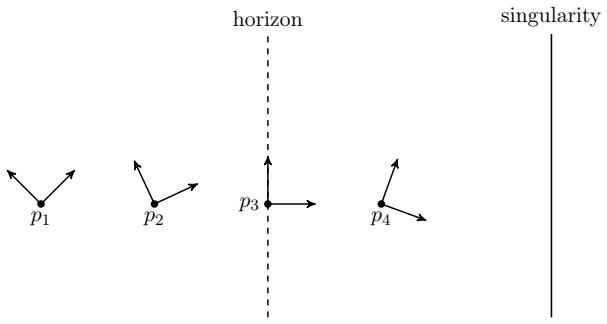
Around 2019, a connection between NLQC and quantum gravity was realized... AdS/CFT is a concrete realization of [the holographic principle]. In this context NLQC turns out to give insight into how interactions in d dimensions can be reproduced in just d−1 dimensions.
What do these tags mean?
- matches
- The paper's claim is directly supported by a theorem in the formal canon.
- supports
- The theorem supports part of the paper's argument, but the paper may add assumptions or extra steps.
- extends
- The paper goes beyond the formal theorem; the theorem is a base layer rather than the whole result.
- uses
- The paper appears to rely on the theorem as machinery.
- contradicts
- The paper's claim conflicts with a theorem or certificate in the canon.
- unclear
- Pith found a possible connection, but the passage is too broad, indirect, or ambiguous to say the theorem truly supports the claim.
Reference graph
Works this paper leans on
-
[1]
Tagging systems, July 11 2006
Adrian P Kent, William J Munro, Timothy P Spiller, and Raymond G Beausoleil. Tagging systems, July 11 2006. US Patent 7,075,438
2006
-
[2]
Quantum tasks in holography.Journal of High Energy Physics, 2019(10):1–39, 2019
Alex May. Quantum tasks in holography.Journal of High Energy Physics, 2019(10):1–39, 2019
2019
-
[3]
Holographic scattering requires a connected entanglement wedge.Journal of High Energy Physics, 2020(8):1–34, 2020
Alex May, Geoff Penington, and Jonathan Sorce. Holographic scattering requires a connected entanglement wedge.Journal of High Energy Physics, 2020(8):1–34, 2020
2020
-
[4]
Relating non-local quantum computation to information theoretic cryptography.Quantum, 8:1387, 2024
Rene Allerstorfer, Harry Buhrman, Alex May, Florian Speelman, and Philip Verduyn Lunel. Relating non-local quantum computation to information theoretic cryptography.Quantum, 8:1387, 2024
2024
-
[5]
Magic and communication complexity.arXiv preprint arXiv:2510.07246, 2025
Uma Girish, Alex May, Natalie Parham, and Henry Yuen. Magic and communication complexity.arXiv preprint arXiv:2510.07246, 2025
-
[6]
Unclonable secret sharing
Prabhanjan Ananth, Vipul Goyal, Jiahui Liu, and Qipeng Liu. Unclonable secret sharing. In International Conference on the Theory and Application of Cryptology and Information Security, pages 129–157. Springer, 2024
2024
-
[7]
Security of quantum position-verification limits hamiltonian simulation via holography
Harriet Apel, Toby Cubitt, Patrick Hayden, Tamara Kohler, and David Pérez-García. Security of quantum position-verification limits hamiltonian simulation via holography. Journal of High Energy Physics, 2024(8):1–40, 2024
2024
-
[8]
Geometry of banach spaces: a new route towards position based cryptography.Communications in Mathematical Physics, 394(2):625–678, 2022
Marius Junge, Aleksander M Kubicki, Carlos Palazuelos, and David Pérez-García. Geometry of banach spaces: a new route towards position based cryptography.Communications in Mathematical Physics, 394(2):625–678, 2022
2022
-
[9]
Erweiterung des unbestimmtheitsprinzips für die relativistische quantentheorie.Zeitschrift für Physik, 69(1):56–69, 1931
Lev Landau and Rudolf Peierls. Erweiterung des unbestimmtheitsprinzips für die relativistische quantentheorie.Zeitschrift für Physik, 69(1):56–69, 1931
1931
-
[10]
Can we make sense out of the measurement process in relativistic quantum mechanics?Physical Review D, 24(2):359, 1981
Yakir Aharonov and David Z Albert. Can we make sense out of the measurement process in relativistic quantum mechanics?Physical Review D, 24(2):359, 1981
1981
-
[11]
Instantaneous measurement of nonlocal variables.Physical review letters, 90(1):010402, 2003
Lev Vaidman. Instantaneous measurement of nonlocal variables.Physical review letters, 90(1):010402, 2003
2003
-
[12]
Location-dependent communications using quantum entanglement
Robert A Malaney. Location-dependent communications using quantum entanglement. Physical Review A—Atomic, Molecular, and Optical Physics, 81(4):042319, 2010
2010
-
[13]
Quantum tagging: Authenticating location via quantum information and relativistic signaling constraints.Physical Review A—Atomic, Molecular, and Optical Physics, 84(1):012326, 2011
Adrian Kent, William J Munro, and Timothy P Spiller. Quantum tagging: Authenticating location via quantum information and relativistic signaling constraints.Physical Review A—Atomic, Molecular, and Optical Physics, 84(1):012326, 2011
2011
-
[14]
Position-based quantum cryptography: Impossibility and constructions.SIAM Journal on Computing, 43(1):150–178, 2014
Harry Buhrman, Nishanth Chandran, Serge Fehr, Ran Gelles, Vipul Goyal, Rafail Ostrovsky, – 1 – and Christian Schaffner. Position-based quantum cryptography: Impossibility and constructions.SIAM Journal on Computing, 43(1):150–178, 2014
2014
-
[15]
A monogamy-of-entanglement game with applications to device-independent quantum cryptography.New Journal of Physics, 15(10):103002, 2013
Marco Tomamichel, Serge Fehr, Jędrzej Kaniewski, and Stephanie Wehner. A monogamy-of-entanglement game with applications to device-independent quantum cryptography.New Journal of Physics, 15(10):103002, 2013
2013
-
[16]
Conditional disclosure of secrets with quantum resources.Quantum, 9:1885, 2025
Vahid R Asadi, Kohdai Kuroiwa, Debbie Leung, Alex May, Sabrina Pasterski, and Chris Waddell. Conditional disclosure of secrets with quantum resources.Quantum, 9:1885, 2025
2025
-
[17]
The garden-hose model
Harry Buhrman, Serge Fehr, Christian Schaffner, and Florian Speelman. The garden-hose model. InProceedings of the 4th conference on Innovations in Theoretical Computer Science, pages 145–158, 2013
2013
-
[18]
Code-routing: a new attack on position verification.Quantum, 7:1079, 2023
Joy Cree and Alex May. Code-routing: a new attack on position verification.Quantum, 7:1079, 2023
2023
-
[19]
New bounds for the garden-hose model.arXiv preprint arXiv:1412.4904, 2014
Hartmut Klauck and Supartha Podder. New bounds for the garden-hose model.arXiv preprint arXiv:1412.4904, 2014
-
[20]
Communication theory of secrecy systems.The Bell system technical journal, 28(4):656–715, 1949
Claude E Shannon. Communication theory of secrecy systems.The Bell system technical journal, 28(4):656–715, 1949
1949
-
[21]
Conditional disclosure of secrets via non-linear reconstruction
Tianren Liu, Vinod Vaikuntanathan, and Hoeteck Wee. Conditional disclosure of secrets via non-linear reconstruction. InAnnual International Cryptology Conference, pages 758–790. Springer, 2017
2017
-
[22]
Protecting data privacy in private information retrieval schemes
Yael Gertner, Yuval Ishai, Eyal Kushilevitz, and Tal Malkin. Protecting data privacy in private information retrieval schemes. InProceedings of the thirtieth annual ACM symposium on Theory of computing, pages 151–160, 1998
1998
-
[23]
Communication complexity of conditional disclosure of secrets and attribute-based encryption
Romain Gay, Iordanis Kerenidis, and Hoeteck Wee. Communication complexity of conditional disclosure of secrets and attribute-based encryption. InAnnual Cryptology Conference, pages 485–502. Springer, 2015
2015
-
[24]
On the power of amortization in secret sharing: d-uniform secret sharing and CDS with constant information rate.ACM Transactions on Computation Theory (TOCT), 12(4):1–21, 2020
Benny Applebaum and Barak Arkis. On the power of amortization in secret sharing: d-uniform secret sharing and CDS with constant information rate.ACM Transactions on Computation Theory (TOCT), 12(4):1–21, 2020
2020
-
[25]
Placing conditional disclosure of secrets in the communication complexity universe.Journal of Cryptology, 34:1–45, 2021
Benny Applebaum and Prashant Nalini Vasudevan. Placing conditional disclosure of secrets in the communication complexity universe.Journal of Cryptology, 34:1–45, 2021
2021
-
[26]
Conditional disclosure of secrets: Amplification, closure, amortization, lower-bounds, and separations
Benny Applebaum, Barak Arkis, Pavel Raykov, and Prashant Nalini Vasudevan. Conditional disclosure of secrets: Amplification, closure, amortization, lower-bounds, and separations. In Annual International Cryptology Conference, pages 727–757. Springer, 2017
2017
-
[27]
Private simultaneous messages protocols with applications
Yuval Ishai and Eyal Kushilevitz. Private simultaneous messages protocols with applications. InProceedings of the Fifth Israeli Symposium on Theory of Computing and Systems, pages 174–183. IEEE, 1997
1997
-
[28]
Comparing classical and quantum conditional disclosure of secrets, 2025
Uma Girish, Alex May, Leo Orshansky, and Chris Waddell. Comparing classical and quantum conditional disclosure of secrets, 2025
2025
-
[29]
Akinori Kawachi and Harumichi Nishimura. Communication complexity of private simultaneous quantum messages protocols.arXiv preprint arXiv:2105.07120, 2021
-
[30]
Asymptotic teleportation scheme as a universal programmable quantum processor.Physical review letters, 101(24):240501, 2008
Satoshi Ishizaka and Tohya Hiroshima. Asymptotic teleportation scheme as a universal programmable quantum processor.Physical review letters, 101(24):240501, 2008. – 2 –
2008
-
[31]
Simplified instantaneous non-local quantum computation with applications to position-based cryptography.New Journal of Physics, 13(9):093036, 2011
Salman Beigi and Robert König. Simplified instantaneous non-local quantum computation with applications to position-based cryptography.New Journal of Physics, 13(9):093036, 2011
2011
-
[32]
Programmable quantum gate arrays.Physical Review Letters, 79(2):321, 1997
Michael A Nielsen and Isaac L Chuang. Programmable quantum gate arrays.Physical Review Letters, 79(2):321, 1997
1997
-
[33]
Resource quantification for the no-programing theorem.Physical review letters, 122(8):080505, 2019
Aleksander M Kubicki, Carlos Palazuelos, and David Pérez-García. Resource quantification for the no-programing theorem.Physical review letters, 122(8):080505, 2019
2019
-
[34]
Instantaneous non-local computation of low t-depth quantum circuits
Florian Speelman. Instantaneous non-local computation of low t-depth quantum circuits. arXiv preprint arXiv:1511.02839, 2015
-
[35]
Popescu-rohrlich correlations imply efficient instantaneous nonlocal quantum computation.Physical Review A, 94(2):022318, 2016
Anne Broadbent. Popescu-rohrlich correlations imply efficient instantaneous nonlocal quantum computation.Physical Review A, 94(2):022318, 2016
2016
-
[36]
Exponential separation of quantum and classical communication complexity
Ran Raz. Exponential separation of quantum and classical communication complexity. In Proceedings of the thirty-first annual ACM symposium on Theory of computing, pages 358–367, 1999
1999
-
[37]
Quantum one-way communication can be exponentially stronger than classical communication
Bo’az Klartag and Oded Regev. Quantum one-way communication can be exponentially stronger than classical communication. InProceedings of the 43rd ACM Symposium on Theory of Computing, San Jose, CA, USA, 6-8 June 2011, pages 31–40. ACM, 2011
2011
-
[38]
Exponential separations for one-way quantum communication complexity, with applications to cryptography
Dmitry Gavinsky, Julia Kempe, Iordanis Kerenidis, Ran Raz, and Ronald de Wolf. Exponential separations for one-way quantum communication complexity, with applications to cryptography. InProceedings of the 39th Annual ACM Symposium on Theory of Computing, San Diego, California, USA, June 11-13, 2007, pages 516–525. ACM, 2007
2007
-
[39]
Entangled simultaneity versus classical interactivity in communication complexity
Dmitry Gavinsky. Entangled simultaneity versus classical interactivity in communication complexity. InProceedings of the forty-eighth annual ACM symposium on Theory of Computing, pages 877–884, 2016
2016
-
[40]
Quantum versus randomized communication complexity, with efficient players.computational complexity, 31(2):17, 2022
Uma Girish, Ran Raz, and Avishay Tal. Quantum versus randomized communication complexity, with efficient players.computational complexity, 31(2):17, 2022
2022
-
[41]
One clean qubit suffices for quantum communication advantage.arXiv preprint arXiv:2310.02406, 2023
Srinivasan Arunachalam, Uma Girish, and Noam Lifshitz. One clean qubit suffices for quantum communication advantage.arXiv preprint arXiv:2310.02406, 2023
-
[42]
Quantum versus classical simultaneity in communication complexity, 2019
Dmytro Gavinsky. Quantum versus classical simultaneity in communication complexity, 2019
2019
-
[43]
Trade-offs between entanglement and communication
Srinivasan Arunachalam and Uma Girish. Trade-offs between entanglement and communication. InProceedings of the 38th Computational Complexity Conference, CCC ’23, Dagstuhl, DEU, 2023. Schloss Dagstuhl–Leibniz-Zentrum fuer Informatik
2023
-
[44]
Andreas Winter. Tight uniform continuity bounds for quantum entropies: conditional entropy, relative entropy distance and energy constraints.Communications in Mathematical Physics, 347(1):291–313, 2016
2016
-
[45]
Scott Hill and William K Wootters. Entanglement of a pair of quantum bits.arXiv preprint quant-ph/9703041, 1997
-
[46]
Entanglement of formation of an arbitrary state of two qubits.Physical Review Letters, 80(10):2245, 1998
William K Wootters. Entanglement of formation of an arbitrary state of two qubits.Physical Review Letters, 80(10):2245, 1998
1998
-
[47]
Mixed-state entanglement and quantum error correction.Physical Review A, 54(5):3824, 1996
Charles H Bennett, David P DiVincenzo, John A Smolin, and William K Wootters. Mixed-state entanglement and quantum error correction.Physical Review A, 54(5):3824, 1996. – 3 –
1996
-
[48]
Continuity bounds for entanglement.Physical review A, 61(6):064301, 2000
Michael A Nielsen. Continuity bounds for entanglement.Physical review A, 61(6):064301, 2000
2000
-
[49]
Randomized benchmarking with confidence.New Journal of Physics, 16(10):103032, 2014
Joel J Wallman and Steven T Flammia. Randomized benchmarking with confidence.New Journal of Physics, 16(10):103032, 2014
2014
-
[50]
Quantum coding.Physical review A, 51(4):2738, 1995
Benjamin Schumacher. Quantum coding.Physical review A, 51(4):2738, 1995
1995
-
[51]
Dina Abdelhadi and Joseph M Renes. On the second-order asymptotics of the partially smoothed conditional min-entropy & application to quantum compression.IEEE Journal on Selected Areas in Information Theory, 1(2):416–423, 2020
2020
-
[52]
Lower bounds on non-local computation from controllable correlation
Richard Cleve and Alex May. Lower bounds on non-local computation from controllable correlation.arXiv preprint arXiv:2602.00255, 2026
work page internal anchor Pith review Pith/arXiv arXiv 2026
-
[53]
Linear gate bounds against natural functions for position-verification.Quantum, 9:1604, 2025
Vahid Asadi, Richard Cleve, Eric Culf, and Alex May. Linear gate bounds against natural functions for position-verification.Quantum, 9:1604, 2025
2025
-
[54]
Communication complexity, 1996
Eyal Kushilevitz and Noam Nisan. Communication complexity, 1996
1996
-
[55]
Nondeterministic quantum query and communication complexities.SIAM Journal on Computing, 32(3):681–699, 2003
Ronald De Wolf. Nondeterministic quantum query and communication complexities.SIAM Journal on Computing, 32(3):681–699, 2003
2003
-
[56]
Rank lower bounds on non-local quantum computation.arXiv preprint arXiv:2402.18647, 2024
Vahid R Asadi, Eric Culf, and Alex May. Rank lower bounds on non-local quantum computation.arXiv preprint arXiv:2402.18647, 2024
-
[57]
A single-qubit position verification protocol that is secure against multi-qubit attacks.Nature Physics, 18(6):623–626, 2022
Andreas Bluhm, Matthias Christandl, and Florian Speelman. A single-qubit position verification protocol that is secure against multi-qubit attacks.Nature Physics, 18(6):623–626, 2022
2022
-
[58]
The connected wedge theorem and its consequences.Journal of High Energy Physics, 2022(11):1–65, 2022
Alex May, Jonathan Sorce, and Beni Yoshida. The connected wedge theorem and its consequences.Journal of High Energy Physics, 2022(11):1–65, 2022
2022
-
[59]
Quantum detection and estimation theory.Journal of statistical physics, 1(2):231–252, 1969
Carl W Helstrom. Quantum detection and estimation theory.Journal of statistical physics, 1(2):231–252, 1969
1969
-
[60]
Cambridge university press, 2013
Mark M Wilde.Quantum information theory. Cambridge university press, 2013
2013
-
[61]
On quantum rényi entropies: A new generalization and some properties.Journal of Mathematical Physics, 54(12), 2013
Martin Müller-Lennert, Frédéric Dupuis, Oleg Szehr, Serge Fehr, and Marco Tomamichel. On quantum rényi entropies: A new generalization and some properties.Journal of Mathematical Physics, 54(12), 2013
2013
-
[62]
Strong converse for the classical capacity of entanglement-breaking and hadamard channels via a sandwiched rényi relative entropy
Mark M Wilde, Andreas Winter, and Dong Yang. Strong converse for the classical capacity of entanglement-breaking and hadamard channels via a sandwiched rényi relative entropy. Communications in Mathematical Physics, 331(2):593–622, 2014
2014
-
[63]
Robustness of entanglement.Physical Review A, 59(1):141, 1999
Guifré Vidal and Rolf Tarrach. Robustness of entanglement.Physical Review A, 59(1):141, 1999
1999
-
[64]
Dimensional Reduction in Quantum Gravity
Gerardt Hooft. Dimensional reduction in quantum gravity.arXiv preprint gr-qc/9310026, 1993
work page Pith review arXiv 1993
-
[65]
The world as a hologram.Journal of Mathematical Physics, 36(11):6377–6396, 1995
Leonard Susskind. The world as a hologram.Journal of Mathematical Physics, 36(11):6377–6396, 1995
1995
-
[66]
A covariant entropy conjecture.Journal of High Energy Physics, 1999(07):004–004, 1999
Raphael Bousso. A covariant entropy conjecture.Journal of High Energy Physics, 1999(07):004–004, 1999
1999
-
[67]
Ultimate physical limits to computation.Nature, 406(6799):1047–1054, 2000
Seth Lloyd. Ultimate physical limits to computation.Nature, 406(6799):1047–1054, 2000. – 4 –
2000
-
[68]
Complexity and entanglement in non-local computation and holography
Alex May. Complexity and entanglement in non-local computation and holography. Quantum, 6:864, 2022
2022
-
[69]
A complexity theory for non-local quantum computation.arXiv preprint arXiv:2505.23893, 2025
Andreas Bluhm, Simon Höfer, Alex May, Mikka Stasiuk, Philip Verduyn Lunel, and Henry Yuen. A complexity theory for non-local quantum computation.arXiv preprint arXiv:2505.23893, 2025
-
[70]
Non-local quantum computation reductions beyond cliffords.to appear, 2026
Andreas Bluhm, Simon Hofer, Alex May, Florian Speelman, and Philip Verduyn Lunel. Non-local quantum computation reductions beyond cliffords.to appear, 2026
2026
-
[71]
Device-independent quantum position verification
Gautam A Kavuri, Abigail Gookin, Yanbao Zhang, Joshua C Bienfang, Honghao Fu, Yusuf Alnawakhtha, Soumyadip Patra, Dileep V Reddy, Michael D Mazurek, Carlos Abellán, et al. Device-independent quantum position verification. InQuantum 2.0, pages QM3B–3. Optica Publishing Group, 2025. – 5 –
2025
discussion (0)
Sign in with ORCID, Apple, or X to comment. Anyone can read and Pith papers without signing in.