Recognition: 2 theorem links
· Lean TheoremWave interference as the origin of the cyclic magnetorotational dynamo in accretion disks: insights from weakly nonlinear theory and local shearing box simulations
Pith reviewed 2026-05-11 00:46 UTC · model grok-4.3
The pith
Coherent interference between MRI eigenfrequencies produces the long-period cyclic dynamo reversals in unstratified accretion disks
A machine-rendered reading of the paper's core claim, the machinery that carries it, and where it could break.
Core claim
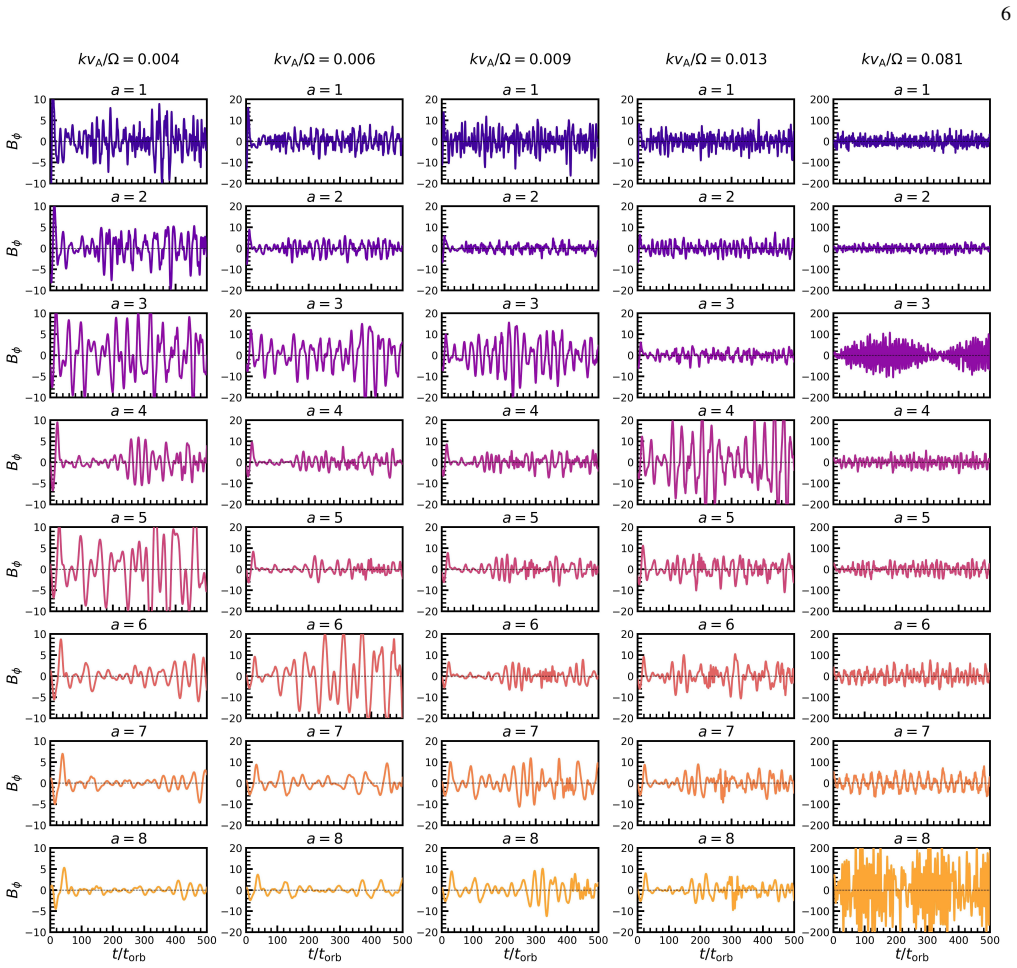
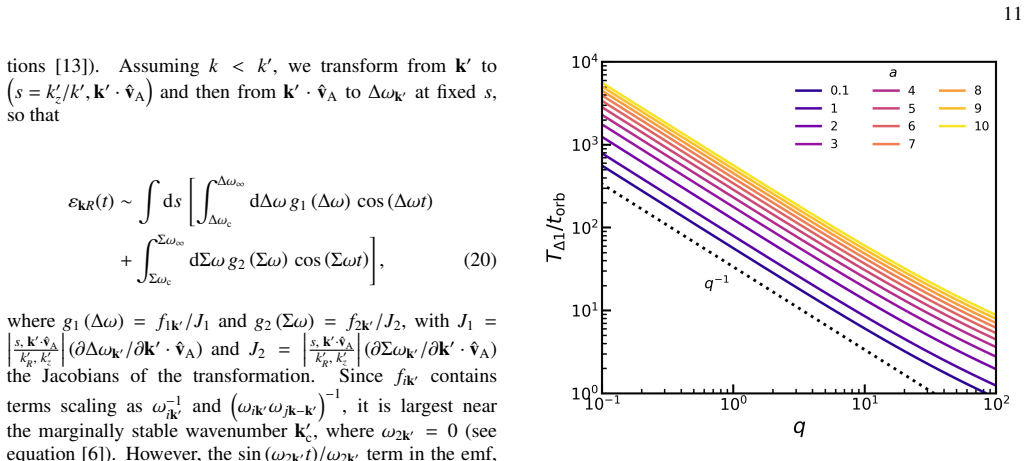
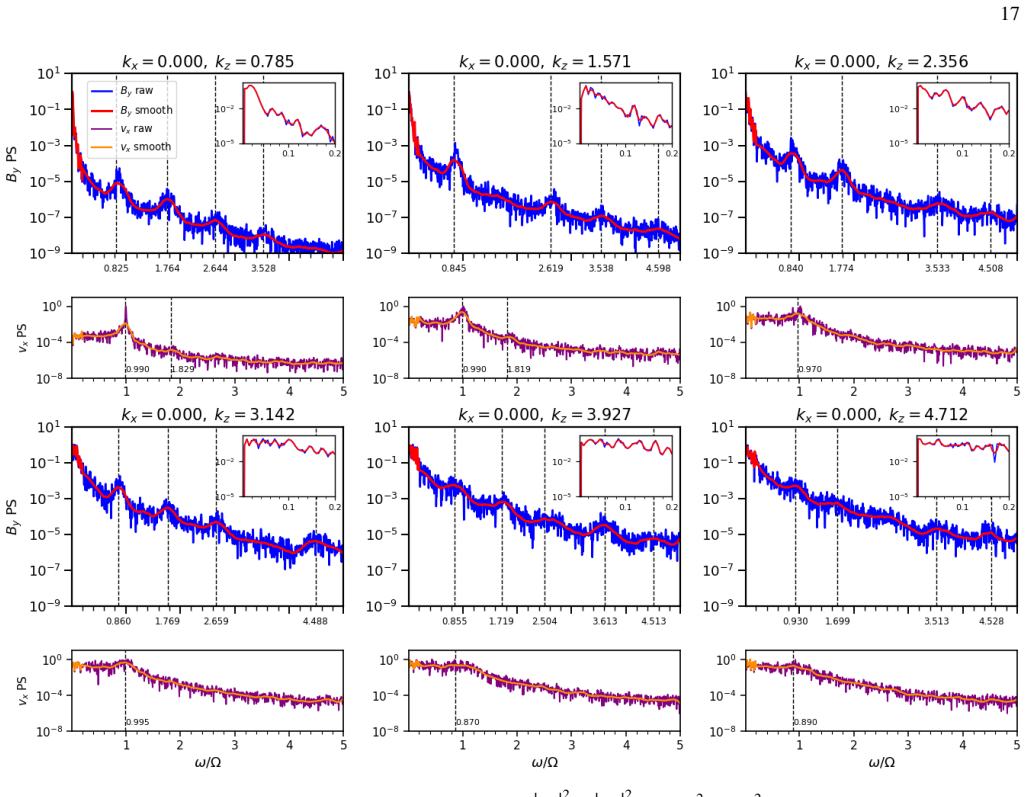
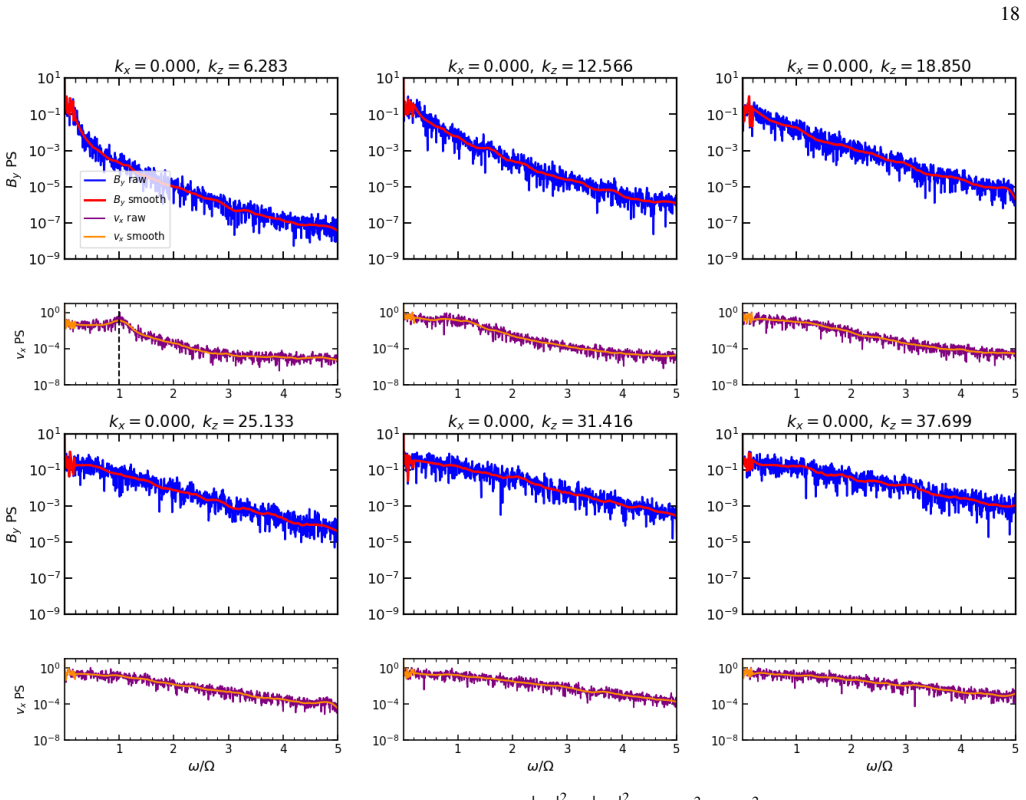
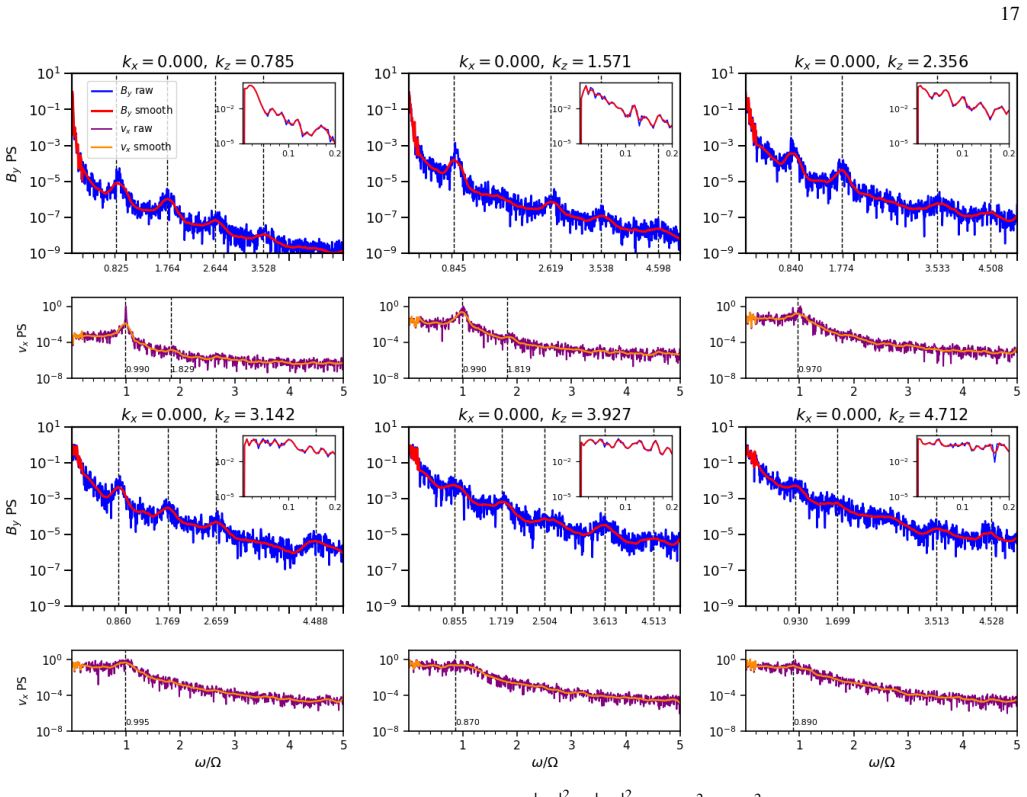
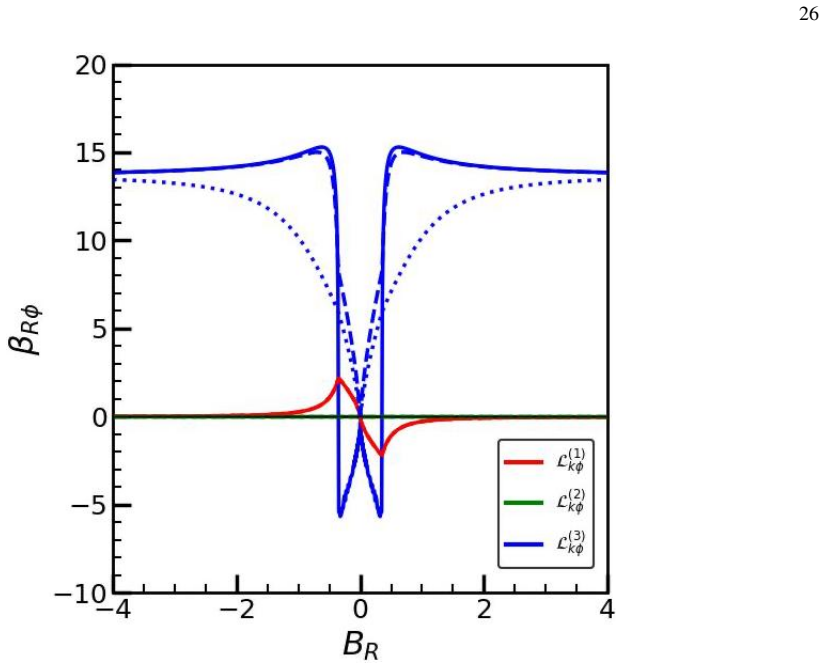
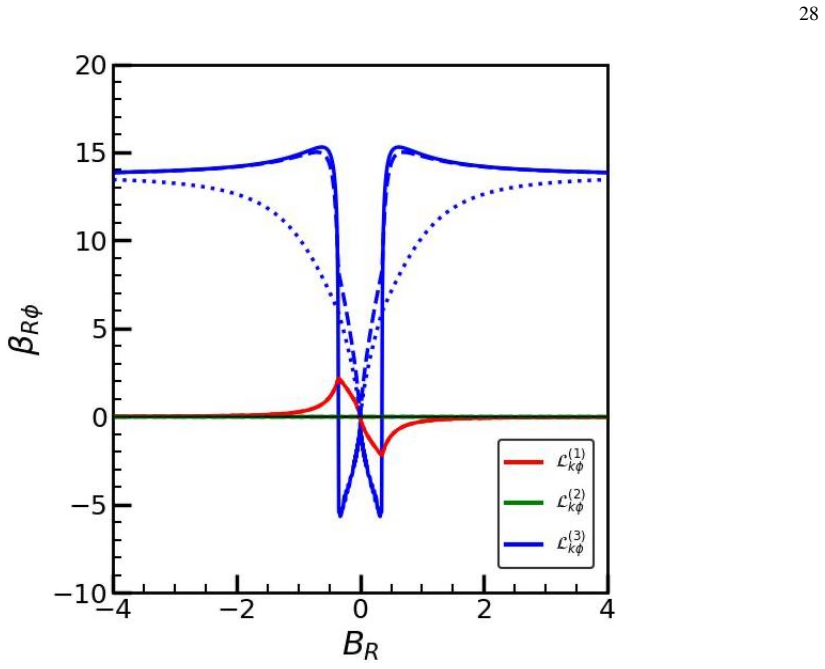
In the unstratified case the leading-order dynamo contribution is the shear-current effect: the electromotive force depends on the current as epsilon equals beta dot J, where the tensor beta oscillates because of beats between the two branches of eigenfrequencies computed under the WKB approximation. The beat frequency varies only weakly with wavenumber, so the interference stays coherent and drives the observed long-period cycle. Carrier-envelope analysis of the simulation spectra shows that higher-order combinations of eigenfrequencies continue to produce the same cycles through pairwise beats within the spectral network.
What carries the argument
The time-dependent beta tensor in the shear-current electromotive force, generated by beats between the two branches of MRI eigenfrequencies under the WKB quasilinear approximation
If this is right
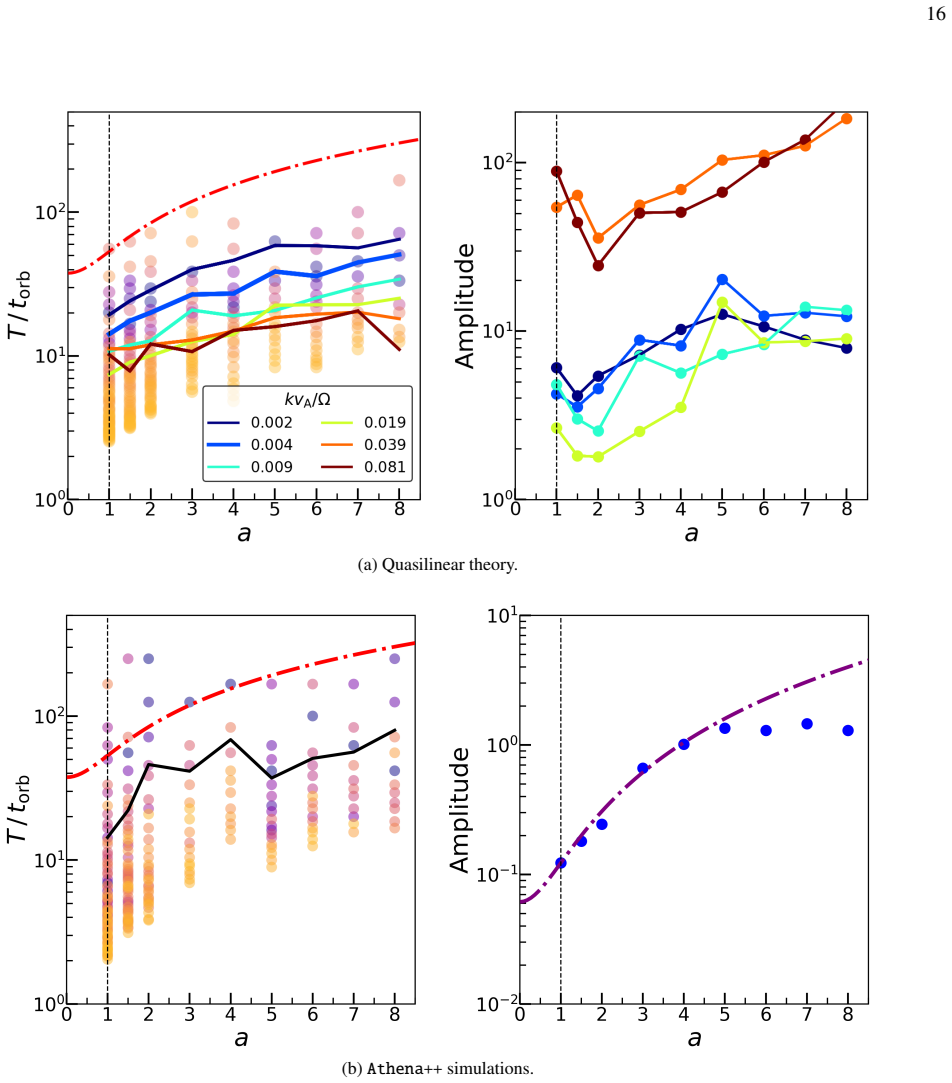
- Cycle periods scale with the square root of (1 plus a squared) where a is the vertical-to-radial aspect ratio.
- Mean-field amplitudes grow proportionally to a squared until saturation near a greater than or equal to 5.
- The same pairwise beat mechanism operates beyond strict quasilinear theory through higher-order linear combinations of eigenfrequencies.
- Carrier-envelope analysis of simulation spectra confirms that observed cycles arise from interference within a network of eigenfrequencies.
Where Pith is reading between the lines
- The quasilinear framework could be used to predict cycle properties analytically in parameter regimes that are difficult to simulate directly.
- Global disk simulations could test whether the local interference mechanism continues to produce coherent large-scale cycles once radial boundaries and curvature are included.
- If vertical stratification is added, the horizontal beat coherence might be preserved or disrupted, offering a route to understand how buoyancy modifies the cycle period.
Load-bearing premise
The beat frequency between the two eigenmode branches varies only weakly with wavenumber, so the interference pattern remains coherent long enough to sustain the observed cycles.
What would settle it
If unstratified shearing-box simulations at different aspect ratios a show cycle periods that deviate from the predicted scaling of 30 times the square root of (1 plus a squared) orbital periods, or if the spectral beats rapidly dephase at higher wavenumbers, the interference mechanism would be ruled out.
Figures







read the original abstract
Long-period cyclic reversals of the large-scale magnetic field are a prominent feature of the dynamo associated with the magnetorotational instability (MRI) in accretion disks, but their physical origin remains unclear. We develop a quasilinear theory (QLT) of the MRI dynamo where the electromotive force (emf) is computed from the linear eigenfunctions under the WKB approximation. The emf depends on the mean field $\mathbf{B}$ more generally than standard mean-field closures allow. In the unstratified case, the leading order contribution to the large-scale dynamo is the shear-current effect: the emf depends on the current $\mathbf{J}$ as $\pmb{\varepsilon} = \pmb{\beta}\cdot\mathbf{J}$, with a tensor $\pmb{\beta}(\mathbf{B},t)$ that oscillates with time $t$ and whose off-diagonal components generate the mean field. The oscillations arise from beats between the two branches of eigenfrequencies. Since the beat frequency varies only weakly with wavenumber, the beats remain coherent and drive the long-period butterfly cycle seen in local shearing box simulations. We predict a dominant cycle period $\sim 30{\left(1+a^2\right)}^{1/2}\,t_{\rm orb}$, with $a$ the vertical-to-radial aspect ratio and $t_{\rm orb}$ the orbital period, and an amplitude scaling $\sim a^2$ before saturation at $a\gtrsim 5$. Both trends agree with zero-net-flux unstratified shearing box simulations with Athena++. A carrier-envelope analysis of the simulation spectra shows that the same interference mechanism extends beyond strict QLT, through higher-order linear combinations of the eigenfrequencies, with observed cycles arising from pairwise beats within this spectral network. These results identify coherent interference between nearly degenerate eigenfrequencies as a key mechanism behind large-scale cyclic dynamos, with implications for magnetic variability in protoplanetary disks, X-ray binaries, and AGNs.
Editorial analysis
A structured set of objections, weighed in public.
Referee Report
Summary. The manuscript develops a quasilinear theory (QLT) of the MRI dynamo in unstratified accretion disks, computing the electromotive force from linear eigenfunctions under the WKB approximation. It identifies the leading-order contribution as the shear-current effect, with emf = β·J where the tensor β(B,t) oscillates due to beats between the two MRI eigenfrequency branches. The paper asserts that the beat frequency varies only weakly with wavenumber, enabling coherent long-period cycles, and derives a dominant cycle period ∼30(1+a²)^{1/2} t_orb with amplitude scaling ∼a² (saturating for a≳5). These predictions are tested against zero-net-flux Athena++ shearing-box simulations, with a carrier-envelope analysis extending the interference mechanism to higher-order eigenfrequency combinations in the simulation spectra.
Significance. If the central identification of coherent wave interference holds, the work supplies a parameter-free, falsifiable mechanistic explanation for cyclic large-scale dynamos grounded in linear eigenmode properties rather than nonlinear saturation. The direct derivation of the oscillating β tensor from WKB eigenfunctions, the explicit period and amplitude predictions, and the a-posteriori match to simulation trends constitute clear strengths. The results carry significant implications for magnetic variability in protoplanetary disks, X-ray binaries, and AGNs.
major comments (1)
- [QLT derivation of emf and beat coherence (statement following the dispersion-relation analysis)] The assertion that the beat frequency varies only weakly with wavenumber (justifying coherence of the long-period cycle) is load-bearing for the central claim but is not quantitatively demonstrated. In the section deriving the emf from the linear eigenfunctions and stating the weak-k dependence, the dispersion relation for the two MRI branches is not analyzed to show that |dω_beat/dk| ≪ 2π/(T_cycle · Δk) holds for the relevant Δk set by the simulation box size and nonlinear broadening. Without this verification, the interference mechanism cannot be unambiguously identified as the origin of the observed reversals, as a stronger k-dependence would produce dephasing on timescales shorter than the cycle period.
minor comments (3)
- [Abstract and § on simulation comparison] The abstract and simulation-comparison section should specify the numerical resolution, box aspect ratios, and exact range of wavenumbers retained in the carrier-envelope analysis to allow readers to assess the Δk entering the coherence condition.
- [QLT section] Notation for the β tensor components and the distinction between the two eigenfrequency branches should be introduced with explicit equations early in the QLT section to improve readability.
- [Figures] Figure captions for any dispersion-relation or emf time-series plots would benefit from explicit labels indicating which curves correspond to the + and − branches and to the beat envelope.
Simulated Author's Rebuttal
We thank the referee for their thorough review and for recognizing the potential significance of the wave-interference mechanism. We address the single major comment below. We agree that the weak-k dependence requires explicit quantitative verification and will add this analysis to the revised manuscript.
read point-by-point responses
-
Referee: The assertion that the beat frequency varies only weakly with wavenumber (justifying coherence of the long-period cycle) is load-bearing for the central claim but is not quantitatively demonstrated. In the section deriving the emf from the linear eigenfunctions and stating the weak-k dependence, the dispersion relation for the two MRI branches is not analyzed to show that |dω_beat/dk| ≪ 2π/(T_cycle · Δk) holds for the relevant Δk set by the simulation box size and nonlinear broadening. Without this verification, the interference mechanism cannot be unambiguously identified as the origin of the observed reversals, as a stronger k-dependence would produce dephasing on timescales shorter than the cycle period.
Authors: We agree that an explicit quantitative check of the beat-frequency dispersion is needed to confirm coherence over the relevant Δk. The original manuscript states that the beat frequency varies only weakly with wavenumber on the basis of the analytic form of the MRI dispersion relation (Eq. 12 and surrounding text), but does not compute dω_beat/dk or verify the inequality against box-size and nonlinear-broadening scales. In the revised manuscript we will insert a new subsection immediately after the WKB emf derivation. There we will (i) obtain the explicit expression for ω_beat(k) from the two MRI branches, (ii) evaluate |dω_beat/dk| numerically across the range of vertical wavenumbers excited in the simulations, and (iii) compare the resulting dephasing time 2π / (|dω_beat/dk| Δk) to the observed cycle period T_cycle for the fiducial box sizes and estimated nonlinear linewidths. This calculation will demonstrate that dephasing remains negligible over many cycles, thereby strengthening the identification of wave interference as the origin of the reversals. revision: yes
Circularity Check
No significant circularity; linear beat-frequency derivation is independent of simulations
full rationale
The paper's central derivation computes the time-dependent beta tensor and resulting emf oscillations directly from the beat frequency |ω+(k) - ω-(k)| of linear MRI eigenmodes under WKB quasilinear theory. This frequency is obtained from the dispersion relation without reference to nonlinear simulation outputs. The predicted period scaling ~30(1+a²)^{1/2} t_orb and amplitude ~a² are therefore independent calculations, with simulations used only for a-posteriori validation. The stated assumption that beat frequency varies weakly with wavenumber is an explicit premise for coherence but does not create a self-referential loop, fitted-input renaming, or load-bearing self-citation. No steps reduce by construction to the paper's own inputs or prior author results.
Axiom & Free-Parameter Ledger
axioms (2)
- domain assumption WKB approximation is valid for computing the electromotive force from linear eigenfunctions
- domain assumption Quasilinear closure suffices to capture the leading-order large-scale dynamo
Lean theorems connected to this paper
-
IndisputableMonolith/Foundation/AlexanderDuality.leanalexander_duality_circle_linking unclear?
unclearRelation between the paper passage and the cited Recognition theorem.
The oscillations arise from beats between the two branches of magnetorotational eigenfrequencies. Since the beat frequency varies only weakly with wavenumber, the beats remain coherent and drive the long-period butterfly cycle... Tcycle ∼ 30√(1 + a²) torb
-
IndisputableMonolith/Cost/FunctionalEquation.leanwashburn_uniqueness_aczel unclear?
unclearRelation between the paper passage and the cited Recognition theorem.
the emf depends on the current J as ε = β·J with β oscillating due to beats
What do these tags mean?
- matches
- The paper's claim is directly supported by a theorem in the formal canon.
- supports
- The theorem supports part of the paper's argument, but the paper may add assumptions or extra steps.
- extends
- The paper goes beyond the formal theorem; the theorem is a base layer rather than the whole result.
- uses
- The paper appears to rely on the theorem as machinery.
- contradicts
- The paper's claim conflicts with a theorem or certificate in the canon.
- unclear
- Pith found a possible connection, but the passage is too broad, indirect, or ambiguous to say the theorem truly supports the claim.
Reference graph
Works this paper leans on
-
[1]
Dynamo cycles appear ata≳3. B. Parameters and initial conditions The initial density is taken to be a uniform distribution ρ(0) =1 throughout the box. The unit of time is taken to beΩ −1 =1 and that of length to beH=c s/Ω =1. Therefore, the sound speedc s and the initial gas pressure P(0) =ρ (0)c2 s are unity. The magnetic field is initialized as B=B (0) ...
work page 2048
-
[2]
Magnetic helicity conservation and saturation The magnetic helicity flux places additional constraints on the dynamo coefficients. The helicity constraint is best under- stood by separating the large- and small-scale magnetic he- licities. For a mean-field split,B tot =B+δBand the vector potentialA tot =A+δA, the corresponding helicity equations are schem...
- [3]
-
[4]
H. Amit, R. Leonhardt, and J. Wicht, Space Science Reviews 155, 293 (2010)
work page 2010
-
[5]
D. H. Hathaway and A. J. Dessler, Icarus67, 88 (1986)
work page 1986
- [6]
- [7]
-
[8]
H. Zhou and D. Lai, arXiv e-prints , arXiv:2411.12953 (2024), arXiv:2411.12953 [astro-ph.GA]
-
[9]
S. A. Balbus and J. F. Hawley, Astrophys. J.376, 214 (1991)
work page 1991
-
[10]
S. A. Balbus, Astrophys. J.453, 380 (1995)
work page 1995
-
[11]
J. F. Hawley, C. F. Gammie, and S. A. Balbus, Astrophys. J. 440, 742 (1995)
work page 1995
-
[12]
J. F. Hawley, C. F. Gammie, and S. A. Balbus, Astrophys. J. 464, 690 (1996)
work page 1996
-
[13]
J. M. Stone, J. F. Hawley, C. F. Gammie, and S. A. Balbus, Astrophys. J.463, 656 (1996)
work page 1996
-
[14]
A. Brandenburg, A. Nordlund, R. F. Stein, and U. Torkelsson, Astrophys. J.446, 741 (1995)
work page 1995
-
[15]
Gressel, MNRAS405, 41 (2010), arXiv:1001.5250 [astro- ph.EP]
O. Gressel, MNRAS405, 41 (2010), arXiv:1001.5250 [astro- ph.EP]
- [16]
-
[17]
K. A. Miller and J. M. Stone, Astrophys. J.534, 398 (2000), arXiv:astro-ph/9912135 [astro-ph]
work page Pith review arXiv 2000
- [18]
- [19]
- [20]
-
[21]
S. Fromang and J. Papaloizou, A&A476, 1113 (2007), arXiv:0705.3621 [astro-ph]
-
[22]
S. Fromang, J. Papaloizou, G. Lesur, and T. Heinemann, A&A 476, 1123 (2007), arXiv:0705.3622 [astro-ph]
- [23]
- [24]
- [25]
- [26]
- [27]
-
[28]
J. Squire and A. Bhattacharjee, Astrophys. J.797, 67 (2014), arXiv:1407.4742 [astro-ph.HE]
-
[29]
J. Squire and A. Bhattacharjee, Phys. Rev. Lett.113, 025006 (2014), arXiv:1406.6582 [physics.plasm-ph]
- [30]
-
[31]
A. Brandenburg and K. Subramanian, Phys. Rep.417, 1 (2005), arXiv:astro-ph/0405052 [astro-ph]
-
[32]
Rädler, Astronomische Nachrichten335, 459 (2014)
K.-H. Rädler, Astronomische Nachrichten335, 459 (2014)
work page 2014
-
[33]
Brandenburg, Journal of Plasma Physics84, 735840404 (2018), arXiv:1801.05384 [physics.flu-dyn]
A. Brandenburg, Journal of Plasma Physics84, 735840404 (2018), arXiv:1801.05384 [physics.flu-dyn]
-
[34]
E. N. Parker, Astrophys. J.122, 293 (1955)
work page 1955
-
[35]
M. Steenbeck, F. Krause, and K.-H. Rädler, Zeitschrift Natur- forschung Teil A21, 369 (1966)
work page 1966
-
[36]
A. Pouquet, U. Frisch, and J. Leorat, Journal of Fluid Mechan- ics77, 321 (1976)
work page 1976
-
[37]
A. V . Gruzinov and P. H. Diamond, Phys. Rev. Lett.72, 1651 (1994)
work page 1994
- [38]
- [39]
-
[40]
K.-H. Rädler and M. Rheinhardt, Geophysical and Astrophys- ical Fluid Dynamics101, 117 (2007), arXiv:astro-ph/0606267 [astro-ph]
-
[41]
S. I. Vainshtein and F. Cattaneo, Astrophys. J.393, 165 (1992)
work page 1992
-
[42]
J. Squire and A. Bhattacharjee, Phys. Rev. E92, 053101 (2015), arXiv:1508.01566 [astro-ph.HE]
-
[43]
J. Squire and A. Bhattacharjee, Astrophys. J.813, 52 (2015), arXiv:1507.03154 [astro-ph.HE]
-
[44]
J. Squire and A. Bhattacharjee, Phys. Rev. Lett.115, 175003 (2015), arXiv:1506.04109 [astro-ph.SR]
-
[45]
J. Squire and A. Bhattacharjee, Phys. Rev. Lett.114, 085002 (2015), arXiv:1408.6793 [astro-ph.HE]
-
[46]
J. Squire and A. Bhattacharjee, Journal of Plasma Physics82, 535820201 (2016), arXiv:1512.04511 [astro-ph.HE]
-
[47]
Yoshizawa, Physics of Fluids B2, 1589 (1990)
A. Yoshizawa, Physics of Fluids B2, 1589 (1990)
work page 1990
-
[48]
B. Tripathi, A. E. Fraser, P. W. Terry, E. G. Zweibel, M. J. Pueschel, and R. Fan, Nature (London)649, 848 (2026)
work page 2026
- [49]
-
[50]
H. R. Strauss, Physics of Fluids29, 3668 (1986)
work page 1986
- [51]
-
[52]
G. Lesur and G. I. Ogilvie, MNRAS391, 1437 (2008), arXiv:0809.3871 [astro-ph]
-
[53]
F. Ebrahimi and E. G. Blackman, MNRAS459, 1422 (2016), arXiv:1509.04572 [astro-ph.HE]
-
[54]
E. P. Velikhov, Soviet Journal of Experimental and Theoretical Physics9, 995 (1959)
work page 1959
-
[55]
Chandrasekhar,Hydrodynamic and hydromagnetic stability (1961)
S. Chandrasekhar,Hydrodynamic and hydromagnetic stability (1961)
work page 1961
- [56]
-
[57]
F. Ebrahimi and A. Bhattacharjee, Phys. Rev. Lett.112, 125003 (2014), arXiv:1402.0750 [astro-ph.HE]
- [58]
- [59]
-
[60]
T. Mondal and P. Bhat, Phys. Rev. E108, 065201 (2023), arXiv:2307.01281 [astro-ph.HE]
- [61]
-
[62]
V . Skoutnev, J. Squire, and A. Bhattacharjee, MNRAS517, 526 (2022), arXiv:2203.01943 [astro-ph.SR]
- [63]
- [64]
- [65]
-
[66]
F. Nauman and M. E. Pessah, Astrophys. J.833, 187 (2016), arXiv:1609.08543 [astro-ph.SR]
-
[67]
F. Nauman and M. E. Pessah, MNRAS480, 204 (2018), arXiv:1909.04290 [astro-ph.SR]
- [68]
- [69]
-
[70]
D. Kagan and J. C. Wheeler, Astrophys. J.787, 21 (2014), arXiv:1407.4654 [astro-ph.SR]
discussion (0)
Sign in with ORCID, Apple, or X to comment. Anyone can read and Pith papers without signing in.