Recognition: unknown
Randomized and Diverse Input State Generation for Quantum Program Testing
Pith reviewed 2026-05-07 15:42 UTC · model grok-4.3
The pith
A Brick-Circuit generator using only hardware-compatible gates produces quantum input states with greater uniformity and entanglement than prior methods at shallower circuit depths.
A machine-rendered reading of the paper's core claim, the machinery that carries it, and where it could break.
Core claim
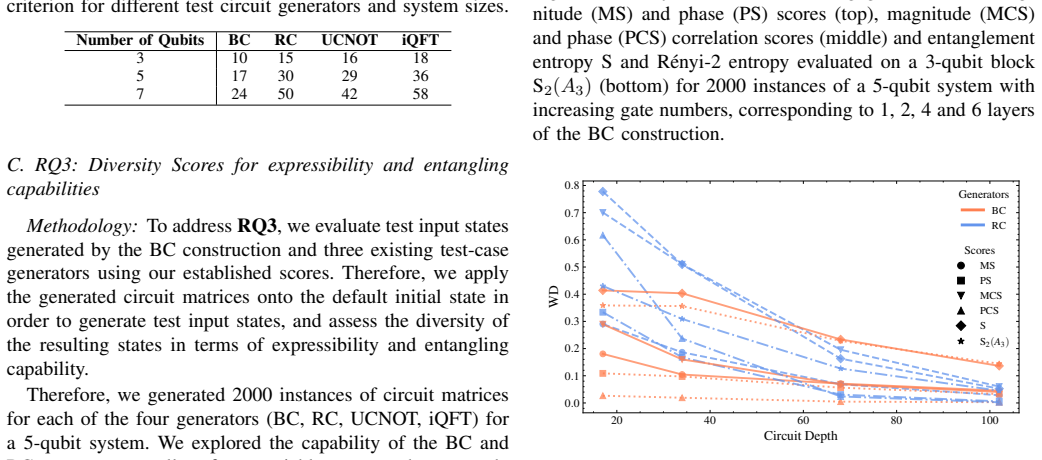
The hardware-compatible BC generator achieves higher expressibility and entanglement performance at shallower depths than existing circuit generators, as measured by extended diversity scores that quantify local correlations and global spread of magnitude, phase, and entanglement.
What carries the argument
The Brick-Circuit (BC) construction, a layered arrangement of two-qubit gates in a repeating brick pattern that approximates uniformly distributed random quantum states while using only hardware-executable operations.
If this is right
- Quantum program testers can select input states that more uniformly span the possible magnitude and phase values.
- Testing workflows can rely on shallower circuits, lowering the resource cost of generating diverse inputs on real hardware.
- Generators can now be ranked by concrete local and global metrics instead of only by circuit depth or gate count.
- Hardware-native constructions become viable candidates for inclusion in automated quantum testing frameworks.
Where Pith is reading between the lines
- Adoption could allow test suites to expose faults tied to specific entanglement patterns that current random generators miss.
- The same scores might serve as a benchmark when comparing state-preparation routines for quantum machine learning or simulation tasks.
- Integrating the Brick-Circuit method into existing quantum development kits would give practitioners a drop-in replacement for less expressive generators.
Load-bearing premise
The proposed diversity scores accurately capture the degree of quantum state-space exploration and the Brick-Circuit construction is close enough to ideal random states for the purpose of testing.
What would settle it
A side-by-side run on a quantum simulator that measures the statistical distribution of magnitude, phase, and entanglement values across thousands of generated states and finds no advantage for the BC generator over existing methods at the same depth would falsify the performance claim.
Figures




read the original abstract
With the accelerating development of quantum technologies and their growing computational potential, quantum systems are being adapted for simulations and other critical tasks across diverse domains, making the reliability of the corresponding quantum software an essential concern. Although recent efforts have started to incorporate quantum-specific properties such as magnitude, phase, and entanglement under the form of input-coverage criteria into software testing, the unique structure of the quantum state space demands for more comprehensive testing. In particular, the notion of complete state-space exploration has so far received little attention. To address this gap, we propose a framework for evaluating test circuit generators with respect to their coverage of the quantum state space. Our contribution is threefold: we develop a set of diversity scores that capture both local and global indicators of the extent to which the state space is explored; we propose a test circuit generator that produces test input states via a Brick-Circuit (BC) construction designed to approximate ideal random states using hardware-compatible gates; we compare the proposed construction with existing generators based on their ability to generate uniformly distributed random test input states. Our extended diversity scores quantify the local correlations and global spread of magnitude, phase and entanglement. Using these scores, we evaluate the expressibility, defined as the capability to span the quantum state space uniformly, and entangling capabilities of existing generators relative to the BC generator. Our results show that the hardware-compatible BC generator achieves higher expressibility and entanglement performance at shallower depths than existing circuit generators.
Editorial analysis
A structured set of objections, weighed in public.
Referee Report
Summary. The paper proposes a framework for quantum program testing that includes new diversity scores measuring local and global aspects of magnitude, phase, and entanglement in generated states. It introduces a Brick-Circuit (BC) construction using hardware-compatible gates to generate input states approximating ideal random states, and reports empirical comparisons showing that the BC generator achieves higher expressibility (uniform state-space coverage) and entanglement at shallower depths than existing circuit generators.
Significance. If the diversity scores are shown to be robust and the BC superiority holds under standard quantum metrics, the work would provide a practical advance in quantum software testing by enabling more comprehensive input coverage with hardware-feasible circuits. The emphasis on hardware compatibility strengthens potential applicability to near-term devices.
major comments (2)
- [§5] §5 (Experimental Evaluation): The abstract and results claim superior expressibility and entanglement for the BC generator, but provide no details on sample sizes, number of trials, statistical tests, error bars, or data exclusion criteria. Without these, the comparative performance claims cannot be rigorously assessed.
- [§3] §3 (Diversity Scores): The custom local/global diversity scores for magnitude, phase, and entanglement are used both to motivate the BC design and to evaluate it, yet no comparison is made to established quantum metrics such as average fidelity to the Haar measure, participation ratios, or Weingarten functions on the same ensembles. This leaves open whether reported gains reflect true state-space coverage or metric-specific sensitivity to the BC parameterization.
minor comments (2)
- [Abstract] The abstract contains minor grammatical issues (e.g., 'demands for more comprehensive testing') that should be corrected for clarity.
- [Figures in §5] Figure captions and axis labels in the evaluation section should explicitly state the number of circuits sampled and any normalization applied to the diversity scores.
Simulated Author's Rebuttal
We thank the referee for the constructive comments on our manuscript. We address each major point below and indicate the revisions planned for the next version to improve experimental rigor and metric validation.
read point-by-point responses
-
Referee: [§5] §5 (Experimental Evaluation): The abstract and results claim superior expressibility and entanglement for the BC generator, but provide no details on sample sizes, number of trials, statistical tests, error bars, or data exclusion criteria. Without these, the comparative performance claims cannot be rigorously assessed.
Authors: We agree that the experimental section requires more statistical detail for rigorous evaluation. In the revised manuscript, we will expand §5 to specify: 1000 independent trials per circuit depth and generator, generation of 10,000 states per trial, error bars as standard deviations across trials, and explicit confirmation that no data were excluded. We will also report results of statistical tests (Wilcoxon rank-sum tests with p-values) for differences in expressibility and entanglement scores. These changes will allow direct assessment of the superiority claims. revision: yes
-
Referee: [§3] §3 (Diversity Scores): The custom local/global diversity scores for magnitude, phase, and entanglement are used both to motivate the BC design and to evaluate it, yet no comparison is made to established quantum metrics such as average fidelity to the Haar measure, participation ratios, or Weingarten functions on the same ensembles. This leaves open whether reported gains reflect true state-space coverage or metric-specific sensitivity to the BC parameterization.
Authors: The diversity scores were designed to capture testing-relevant local and global properties of magnitude, phase, and entanglement rather than general quantum information measures. We will revise §3 and §5 to include direct comparisons of our ensembles against average fidelity to the Haar measure and participation ratios. Weingarten functions are computationally infeasible at the ensemble sizes used here and less relevant to our testing application; we will add an explicit discussion of this limitation and why our metrics better suit the quantum program testing context. This will clarify that the reported advantages are not artifacts of the chosen scores. revision: partial
Circularity Check
No circularity: empirical comparison using explicitly defined metrics
full rationale
The paper defines a set of diversity scores for local/global magnitude, phase, and entanglement, proposes the Brick-Circuit generator, and reports empirical results showing superior expressibility and entanglement at shallower depths. No equations or derivations are presented that reduce the claimed performance to the definitions by construction, nor is any load-bearing premise justified solely via self-citation. The evaluation is framed as an experimental comparison against existing generators, making the derivation self-contained against external benchmarks.
Axiom & Free-Parameter Ledger
axioms (1)
- domain assumption Diversity in magnitude, phase, and entanglement can be quantified to measure exploration of the quantum state space.
Reference graph
Works this paper leans on
-
[1]
A 2030 roadmap for software engineering,
M. Pezz `e, S. Abrah ˜ao, B. Penzenstadler, D. Poshyvanyk, A. Roychoud- hury, and T. Yue, “A 2030 roadmap for software engineering,”ACM Transactions on Software Engineering and Methodology, vol. 34, no. 5, pp. 1–55, 2025
2030
-
[2]
Property-based testing of quantum programs in q#,
S. Honarvar, M. R. Mousavi, and R. Nagarajan, “Property-based testing of quantum programs in q#,” inProceedings of the IEEE/ACM 42nd International Conference on Software Engineering Workshops, 2020, pp. 430–435
2020
-
[3]
Metamorphic test- ing of oracle quantum programs,
R. Abreu, J. P. Fernandes, L. Llana, and G. Tavares, “Metamorphic test- ing of oracle quantum programs,” inProceedings of the 3rd International Workshop on Quantum Software Engineering, 2022, pp. 16–23
2022
-
[4]
Qucheck: A property- based testing framework for quantum programs in qiskit,
G. Pontolillo, M. R. Mousavi, and M. Grzesiuk, “Qucheck: A property- based testing framework for quantum programs in qiskit,”arXiv preprint arXiv:2503.22641, 2025
-
[5]
On the feasibility of quantum unit testing,
A. Miranskyy, J. Campos, A. Mjeda, L. Zhang, and I. G. R. de Guzm´an, “On the feasibility of quantum unit testing,”arXiv preprint arXiv:2507.17235, 2025
-
[6]
Statistical assertions for validating patterns and finding bugs in quantum programs,
Y . Huang and M. Martonosi, “Statistical assertions for validating patterns and finding bugs in quantum programs,” inProceedings of the 46th International Symposium on Computer Architecture, 2019, pp. 541–553
2019
-
[7]
Projection- based runtime assertions for testing and debugging quantum programs,
G. Li, L. Zhou, N. Yu, Y . Ding, M. Ying, and Y . Xie, “Projection- based runtime assertions for testing and debugging quantum programs,” Proceedings of the ACM on Programming Languages, vol. 4, no. OOPSLA, pp. 1–29, 2020
2020
-
[8]
Faster and better quantum software testing through specification reduction and projective measure- ments,
N. H. Oldfield, C. Laaber, T. Yue, and S. Ali, “Faster and better quantum software testing through specification reduction and projective measure- ments,”ACM Transactions on Software Engineering and Methodology, vol. 34, no. 7, pp. 1–39, 2025
2025
-
[9]
Assessing the effectiveness of input and output coverage criteria for testing quantum programs,
S. Ali, P. Arcaini, X. Wang, and T. Yue, “Assessing the effectiveness of input and output coverage criteria for testing quantum programs,” in2021 14th IEEE Conference on Software Testing, Verification and Validation (ICST). IEEE, 2021, pp. 13–23
2021
-
[10]
Quito: a coverage-guided test generator for quantum programs,
X. Wang, P. Arcaini, T. Yue, and S. Ali, “Quito: a coverage-guided test generator for quantum programs,” in2021 36th IEEE/ACM International Conference on Automated Software Engineering (ASE). IEEE, 2021, pp. 1237–1241
2021
-
[11]
Generating failing test suites for quantum programs with search,
——, “Generating failing test suites for quantum programs with search,” inInternational symposium on search based software engineering. Springer, 2021, pp. 9–25
2021
-
[12]
Poster: Fuzz testing of quantum program,
J. Wang, F. Ma, and Y . Jiang, “Poster: Fuzz testing of quantum program,” in2021 14th IEEE Conference on Software Testing, Verification and Validation (ICST). IEEE, 2021, pp. 466–469
2021
-
[13]
Testing multi-subroutine quantum programs: From unit testing to integration testing,
P. Long and J. Zhao, “Testing multi-subroutine quantum programs: From unit testing to integration testing,”ACM Transactions on Software Engineering and Methodology, vol. 33, no. 6, pp. 1–61, 2024
2024
-
[14]
Quratest: Integrating quantum specific features in quantum program testing,
J. Ye, S. Xia, F. Zhang, P. Arcaini, L. Ma, J. Zhao, and F. Ishikawa, “Quratest: Integrating quantum specific features in quantum program testing,” in2023 38th IEEE/ACM International Conference on Auto- mated Software Engineering (ASE). IEEE, 2023, pp. 1149–1161
2023
-
[15]
Expressibility and entan- gling capability of parameterized quantum circuits for hybrid quantum- classical algorithms,
S. Sim, P. D. Johnson, and A. Aspuru-Guzik, “Expressibility and entan- gling capability of parameterized quantum circuits for hybrid quantum- classical algorithms,”Advanced Quantum Technologies, vol. 2, no. 12, p. 1900070, 2019
2019
-
[16]
Expressibility of the alternating layered ansatz for quantum computation,
K. Nakaji and N. Yamamoto, “Expressibility of the alternating layered ansatz for quantum computation,”Quantum, vol. 5, p. 434, 2021
2021
-
[17]
Expressibility, entangling power, and quantum average causal effect for causally indefinite circuits,
P. C. Azado, G. I. Correr, A. Drinko, I. Medina, A. Canabarro, and D. O. Soares-Pinto, “Expressibility, entangling power, and quantum average causal effect for causally indefinite circuits,”Physical Review A, vol. 111, no. 4, p. 042620, 2025
2025
-
[18]
Pseudo-random unitary operators for quantum information processing,
J. Emerson, Y . S. Weinstein, M. Saraceno, S. Lloyd, and D. G. Cory, “Pseudo-random unitary operators for quantum information processing,” science, vol. 302, no. 5653, pp. 2098–2100, 2003
2098
-
[19]
Random quantum circuits are approx- imate 2-designs,
A. W. Harrow and R. A. Low, “Random quantum circuits are approx- imate 2-designs,”Communications in Mathematical Physics, vol. 291, no. 1, pp. 257–302, 2009
2009
-
[20]
Exact and approximate unitary 2-designs and their application to fidelity estimation,
C. Dankert, R. Cleve, J. Emerson, and E. Livine, “Exact and approximate unitary 2-designs and their application to fidelity estimation,”Physical Review A—Atomic, Molecular, and Optical Physics, vol. 80, no. 1, p. 012304, 2009
2009
-
[21]
Local random quantum circuits are approximate polynomial-designs,
F. G. Brandao, A. W. Harrow, and M. Horodecki, “Local random quantum circuits are approximate polynomial-designs,”Communications in Mathematical Physics, vol. 346, no. 2, pp. 397–434, 2016
2016
-
[22]
Persistent entanglement in arrays of interacting particles,
H. J. Briegel and R. Raussendorf, “Persistent entanglement in arrays of interacting particles,”Physical Review Letters, vol. 86, no. 5, p. 910, 2001
2001
-
[23]
Three qubits can be entangled in two inequivalent ways,
W. D ¨ur, G. Vidal, and J. I. Cirac, “Three qubits can be entangled in two inequivalent ways,”Physical Review A, vol. 62, no. 6, p. 062314, 2000
2000
-
[24]
Mixed-state entanglement and quantum error correction,
C. H. Bennett, D. P. DiVincenzo, J. A. Smolin, and W. K. Wootters, “Mixed-state entanglement and quantum error correction,”Physical Review A, vol. 54, no. 5, p. 3824, 1996
1996
-
[25]
M. A. Nielsen and I. L. Chuang,Quantum computation and quantum information. Cambridge university press, 2010
2010
-
[26]
Entanglement entropy and quantum field theory,
P. Calabrese and J. Cardy, “Entanglement entropy and quantum field theory,”Journal of statistical mechanics: theory and experiment, vol. 2004, no. 06, p. P06002, 2004
2004
-
[27]
Measur- ing renyi entanglement entropy in quantum monte carlo simulations,
M. B. Hastings, I. Gonz ´alez, A. B. Kallin, and R. G. Melko, “Measur- ing renyi entanglement entropy in quantum monte carlo simulations,” Physical review letters, vol. 104, no. 15, p. 157201, 2010
2010
-
[28]
Measuring entanglement entropy in a quantum many-body system,
R. Islam, R. Ma, P. M. Preiss, M. Eric Tai, A. Lukin, M. Rispoli, and M. Greiner, “Measuring entanglement entropy in a quantum many-body system,”Nature, vol. 528, no. 7580, pp. 77–83, 2015
2015
-
[29]
Measuring r ´enyi entanglement entropy with high efficiency and precision in quantum monte carlo simulations,
J. Zhao, B.-B. Chen, Y .-C. Wang, Z. Yan, M. Cheng, and Z. Y . Meng, “Measuring r ´enyi entanglement entropy with high efficiency and precision in quantum monte carlo simulations,”npj Quantum Materials, vol. 7, no. 1, p. 69, 2022
2022
-
[30]
Global entanglement in multiparticle systems,
D. A. Meyer and N. R. Wallach, “Global entanglement in multiparticle systems,”Journal of Mathematical Physics, vol. 43, no. 9, pp. 4273– 4278, 2002
2002
-
[31]
An observable measure of entanglement for pure states of multi-qubit systems,
G. K. Brennen, “An observable measure of entanglement for pure states of multi-qubit systems,”arXiv preprint quant-ph/0305094, 2003
-
[32]
Multipartite entanglement signature of quantum phase transitions,
T. R. de Oliveira, G. Rigolin, M. C. de Oliveira, and E. Miranda, “Multipartite entanglement signature of quantum phase transitions,” Physical review letters, vol. 97, no. 17, p. 170401, 2006
2006
-
[33]
Random unitary matrices,
K. Zyczkowski and M. Kus, “Random unitary matrices,”Journal of Physics A: Mathematical and General, vol. 27, no. 12, p. 4235, Jun
-
[34]
Available: https://doi.org/10.1088/0305-4470/27/12/028
[Online]. Available: https://doi.org/10.1088/0305-4470/27/12/028
-
[35]
Estimating the randomness of quantum circuit ensembles up to 50 qubits,
M. Liu, J. Liu, Y . Alexeev, and L. Jiang, “Estimating the randomness of quantum circuit ensembles up to 50 qubits,”npj Quantum Information, vol. 8, no. 1, p. 137, 2022
2022
-
[36]
Introduction to haar measure tools in quantum information: A beginner’s tutorial,
A. A. Mele, “Introduction to haar measure tools in quantum information: A beginner’s tutorial,”Quantum, vol. 8, p. 1340, 2024
2024
-
[37]
N. I. Fisher,Statistical analysis of circular data. cambridge university press, 1995
1995
-
[38]
K. V . Mardia and P. E. Jupp,Directional statistics. John Wiley & Sons, 2009
2009
-
[39]
Quan- tum algorithms for inverse participation ratio estimation in multiqubit and multiqudit systems,
Y . Liu, P. Sierant, P. Stornati, M. Lewenstein, and M. Płodzie ´n, “Quan- tum algorithms for inverse participation ratio estimation in multiqubit and multiqudit systems,”Physical Review A, vol. 111, no. 5, p. 052614, 2025
2025
-
[40]
Fock-space delocalization and the emergence of the porter-thomas distribution from dual-unitary dynam- ics,
P. W. Claeys and G. De Tomasi, “Fock-space delocalization and the emergence of the porter-thomas distribution from dual-unitary dynam- ics,”Physical Review Letters, vol. 134, no. 5, p. 050405, 2025
2025
-
[41]
Random quantum circuits are approximate unitaryt- designs in depthO(nt 5+o(1)),
J. Haferkamp, “Random quantum circuits are approximate unitaryt- designs in depthO(nt 5+o(1)),”Quantum, vol. 6, p. 795, 2022
2022
-
[42]
Random unitaries in extremely low depth,
T. Schuster, J. Haferkamp, and H.-Y . Huang, “Random unitaries in extremely low depth,”Science, vol. 389, no. 6755, pp. 92–96, 2025
2025
-
[43]
Cost function dependent barren plateaus in shallow parametrized quantum circuits,
M. Cerezo, A. Sone, T. V olkoff, L. Cincio, and P. J. Coles, “Cost function dependent barren plateaus in shallow parametrized quantum circuits,” Nature communications, vol. 12, no. 1, p. 1791, 2021
2021
-
[44]
Approximate unitary t-designs by short random quantum circuits using nearest-neighbor and long-range gates,
A. W. Harrow and S. Mehraban, “Approximate unitary t-designs by short random quantum circuits using nearest-neighbor and long-range gates,”Communications in Mathematical Physics, vol. 401, no. 2, pp. 1531–1626, 2023
2023
-
[45]
Integrating structured biological data by kernel maximum mean discrepancy,
K. M. Borgwardt, A. Gretton, M. J. Rasch, H.-P. Kriegel, B. Sch ¨olkopf, and A. J. Smola, “Integrating structured biological data by kernel maximum mean discrepancy,”Bioinformatics, vol. 22, no. 14, pp. e49– e57, 2006
2006
-
[46]
How to generate random matrices from the classical compact groups,
F. Mezzadri, “How to generate random matrices from the classical compact groups,”Notices of the American Mathematical Society, vol. 54, no. 5, pp. 592–604, 2007
2007
-
[47]
PennyLane: Automatic differentiation of hybrid quantum-classical computations
V . Bergholm, J. Izaac, M. Schuld, C. Gogolin, S. Ahmed, V . Ajith, M. S. Alam, G. Alonso-Linaje, B. AkashNarayanan, A. Asadiet al., “Pennylane: Automatic differentiation of hybrid quantum-classical com- putations,”arXiv preprint arXiv:1811.04968, 2018
work page internal anchor Pith review arXiv 2018
-
[48]
Operator spreading in random unitary circuits,
A. Nahum, S. Vijay, and J. Haah, “Operator spreading in random unitary circuits,”Physical Review X, vol. 8, no. 2, p. 021014, 2018
2018
-
[49]
Black holes as mirrors: quantum information in random subsystems,
P. Hayden and J. Preskill, “Black holes as mirrors: quantum information in random subsystems,”Journal of high energy physics, vol. 2007, no. 09, pp. 120–120, 2007
2007
-
[50]
Scalable noise estimation with random unitary operators,
J. Emerson, R. Alicki, and K. ˙Zyczkowski, “Scalable noise estimation with random unitary operators,”Journal of Optics B: Quantum and Semiclassical Optics, vol. 7, no. 10, pp. S347–S352, 2005
2005
-
[51]
Scalable and robust ran- domized benchmarking of quantum processes,
E. Magesan, J. M. Gambetta, and J. Emerson, “Scalable and robust ran- domized benchmarking of quantum processes,”Physical review letters, vol. 106, no. 18, p. 180504, 2011
2011
-
[52]
Scalable randomised benchmarking of non-clifford gates,
A. W. Cross, E. Magesan, L. S. Bishop, J. A. Smolin, and J. M. Gambetta, “Scalable randomised benchmarking of non-clifford gates,” npj Quantum Information, vol. 2, no. 1, p. 16012, 2016
2016
-
[53]
Quantum circuits for exact unitary t-designs and applications to higher-order randomized benchmarking,
Y . Nakata, D. Zhao, T. Okuda, E. Bannai, Y . Suzuki, S. Tamiya, K. Heya, Z. Yan, K. Zuo, S. Tamateet al., “Quantum circuits for exact unitary t-designs and applications to higher-order randomized benchmarking,” PRX Quantum, vol. 2, no. 3, p. 030339, 2021
2021
-
[54]
Barren plateaus in quantum neural network training landscapes,
J. R. McClean, S. Boixo, V . N. Smelyanskiy, R. Babbush, and H. Neven, “Barren plateaus in quantum neural network training landscapes,”Nature communications, vol. 9, no. 1, p. 4812, 2018
2018
-
[55]
Analytic theory for the dynamics of wide quantum neural networks,
J. Liu, K. Najafi, K. Sharma, F. Tacchino, L. Jiang, and A. Mezzacapo, “Analytic theory for the dynamics of wide quantum neural networks,” Physical Review Letters, vol. 130, no. 15, p. 150601, 2023
2023
-
[56]
Characterizing quantum supremacy in near-term devices,
S. Boixo, S. V . Isakov, V . N. Smelyanskiy, R. Babbush, N. Ding, Z. Jiang, M. J. Bremner, J. M. Martinis, and H. Neven, “Characterizing quantum supremacy in near-term devices,”Nature Physics, vol. 14, no. 6, pp. 595–600, 2018
2018
-
[57]
Quantum supremacy using a programmable superconducting processor,
F. Arute, K. Arya, R. Babbush, D. Bacon, J. C. Bardin, R. Barends, R. Biswas, S. Boixo, F. G. Brandao, D. A. Buellet al., “Quantum supremacy using a programmable superconducting processor,”nature, vol. 574, no. 7779, pp. 505–510, 2019
2019
-
[58]
Quantum entanglement growth under random unitary dynamics,
A. Nahum, J. Ruhman, S. Vijay, and J. Haah, “Quantum entanglement growth under random unitary dynamics,”Physical Review X, vol. 7, no. 3, p. 031016, 2017
2017
-
[59]
[replication package] Randomized and Diverse Input State Generation for Quantum Program Testing,
M. Ernzer, S. Y . Shin, F. Pastore, and D. Bianculli, “[replication package] Randomized and Diverse Input State Generation for Quantum Program Testing,” The repository link will be made publicly available upon acceptance
discussion (0)
Sign in with ORCID, Apple, or X to comment. Anyone can read and Pith papers without signing in.