Unveiling the Atomistic Mechanisms of Shear-Induced LDAleftrightarrowHDA Transformations and Shear Banding in Amorphous Silicon under High Pressures
Pith reviewed 2026-05-08 17:26 UTC · model grok-4.3
The pith
Shear deformation in amorphous silicon drives simultaneous LDA to HDA and reverse phase transformations until steady state, lowering transition pressures by 4.36 and 5.10 GPa.
A machine-rendered reading of the paper's core claim, the machinery that carries it, and where it could break.
Core claim
The simulations reveal that LDA↔HDA shear-induced PTs occur simultaneously until reaching steady state. The developed mechanism-based analytical model well describes shear-strain-governed kinetics and steady states at all pressures, independent of shear stresses. Shear reduces the pressure for initiation and completion of LDA→HDA PT by 4.36 and 5.10 GPa, respectively. Without PT at low pressure, shear-banding occurs, which is partially suppressed by PT at higher pressure with uniform deformation-PT at 9.8 GPa. In bulk, Si deforms by atomic rearrangement in localized shear transformation zones with high nonaffine displacements, which trigger nucleation of HDA clusters within LDA and, of LDA
What carries the argument
Mechanism-based analytical model that treats phase-transformation kinetics as governed solely by accumulated shear strain, with simultaneous nucleation inside shear transformation zones and turbulent flow inside shear bands.
If this is right
- Steady-state phase fractions under shear can be predicted from pressure alone using the analytical model.
- Shear banding is suppressed and deformation becomes uniform once pressure reaches values where the phase transformation is active, such as 9.8 GPa.
- Transformation-induced plasticity in amorphous silicon arises directly from concurrent nucleation of opposite phases inside shear transformation zones.
- Inside shear bands, turbulent flow with swirls increases the rate of the reverse HDA to LDA change, producing a sharp local drop in HDA fraction.
Where Pith is reading between the lines
- The same strain-driven, stress-independent description may extend to phase changes in other amorphous materials such as silica or metallic glasses under combined pressure and shear.
- Processing routes that impose controlled shear could achieve dense amorphous phases at lower pressures than hydrostatic compression alone requires.
- The atomistic picture of nonaffine displacements and concurrent nucleation supplies input for mesoscale models of plasticity that incorporate phase change.
Load-bearing premise
The steady-state phase fractions depend only on pressure and total shear strain, remaining independent of the magnitude of shear stress.
What would settle it
If steady-state HDA fractions at fixed shear strain and pressure differ when different shear-stress levels are applied, the stress-independence claim fails.
Figures





read the original abstract
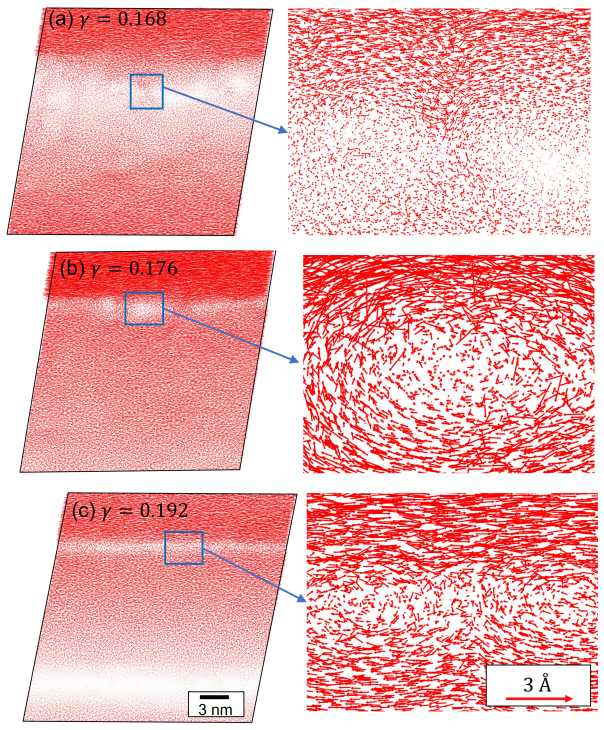
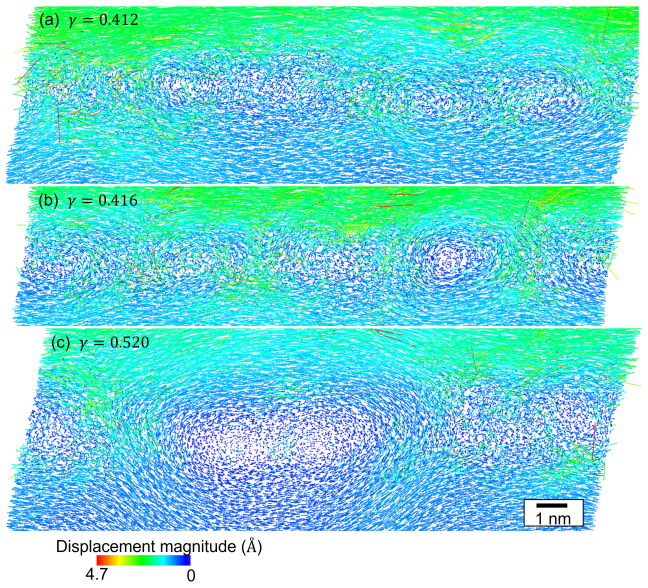
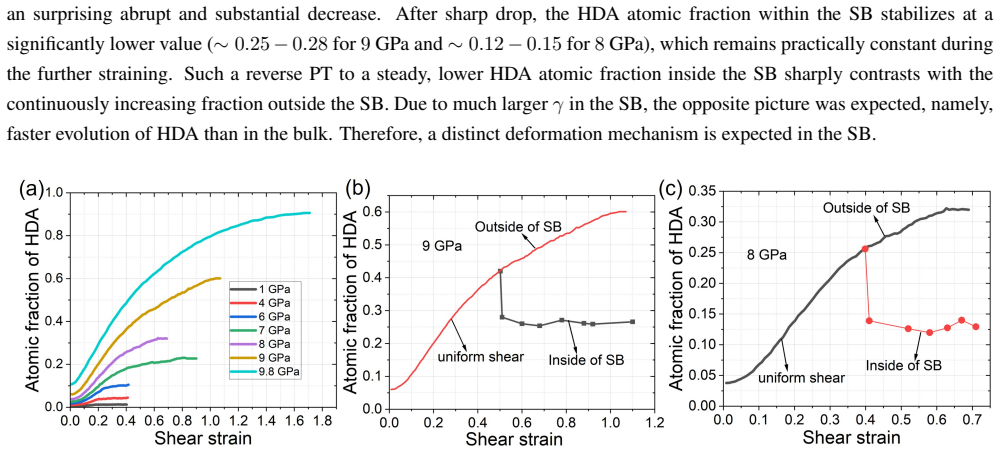
Large-scale molecular dynamics simulations of shear deformation under constant pressures of amorphous silicon, PT from low-density-amorphous (LDA) to high-density-amorphous (HDA) Si, and formation of shear bands (SBs) are performed using the state-of-the-art Gaussian Approximation Potential. The simulations reveal that LDA$\leftrightarrow$HDA shear-induced PTs occur simultaneously until reaching steady state. The developed mechanism-based analytical model well describes shear-strain-governed kinetics and steady states at all pressures, independent of shear stresses. Shear reduces the pressure for initiation and completion of LDA$\rightarrow$HDA PT by $4.36$ and $5.10$ GPa, respectively. Without PT at low pressure, shear-banding occurs, which is partially suppressed by PT at higher pressure with uniform deformation-PT at $9.8$ GPa. Despite the much larger shear and expected fraction of HDA, surprising sharp drop in the HDA atomic fraction within the SB was discovered. In bulk, Si deforms by atomic rearrangement in localized shear transformation zones with high nonaffine displacements, which trigger nucleation of HDA clusters within LDA and, concurrently, of LDA clusters within HDA, without growth and coalescence. In SB, a turbulent-like flow with swirls is revealed, which promotes reverse PT from HDA$\rightarrow$LDA more effectively. Transformation-induced plasticity in amorphous Si is revealed. The findings open up basic research into the mechanisms and kinetics of plastic strain-induced PTs in amorphous materials under high pressure, with numerous important applications.
Editorial analysis
A structured set of objections, weighed in public.
Referee Report
Summary. The manuscript reports large-scale molecular dynamics simulations of shear deformation in amorphous silicon under constant pressures using the Gaussian Approximation Potential. It finds that LDA↔HDA phase transformations occur simultaneously until a steady state is reached. A mechanism-based analytical model is developed that describes the shear-strain-governed kinetics and steady states at all pressures, claimed to be independent of shear stresses. Shear is reported to lower the LDA→HDA transformation initiation and completion pressures by 4.36 GPa and 5.10 GPa, respectively. At low pressures without PT, shear banding occurs and is partially suppressed at higher pressures (uniform deformation-PT at 9.8 GPa). Additional observations include a sharp drop in HDA fraction inside shear bands, turbulent-like flow with swirls in shear bands promoting reverse PT, and deformation via atomic rearrangements in localized shear transformation zones that nucleate HDA clusters in LDA and vice versa without growth or coalescence. Transformation-induced plasticity is noted.
Significance. If the analytical model is shown to be derived from first principles without post-hoc fitting and the pressure reductions are robust, the work would advance understanding of shear-induced phase transformations and plastic flow in amorphous materials under high pressure. The atomistic details on simultaneous forward/reverse transformations, shear transformation zones, and turbulent flow in bands provide mechanistic insights with potential applications in high-pressure processing and amorphous material design. The use of a state-of-the-art potential for large-scale simulations is a positive aspect.
major comments (1)
- The central claim that the mechanism-based analytical model 'well describes' the shear-strain-governed kinetics and steady states at all pressures independent of shear stresses (and supports the reported pressure reductions of 4.36 and 5.10 GPa) is load-bearing, yet the manuscript provides no derivation, explicit governing equations, parameter values, fitting procedure, or quantitative validation metrics such as goodness-of-fit statistics or out-of-sample tests. This leaves open the possibility that the model was calibrated to the MD data, undermining the independence assertion and the generality of the quantitative results.
minor comments (2)
- The abstract and main text would benefit from inclusion of key simulation parameters (system size, strain rate, timestep, pressure control method) and error bars or convergence checks on the reported pressure shifts and steady-state fractions to allow assessment of numerical robustness.
- Notation for LDA/HDA fractions, nonaffine displacements, and shear band identification should be defined clearly with reference to specific figures or equations when first introduced.
Simulated Author's Rebuttal
We thank the referee for the careful and constructive review of our manuscript. We address the major comment point by point below and will revise the manuscript to incorporate the requested details on the analytical model.
read point-by-point responses
-
Referee: The central claim that the mechanism-based analytical model 'well describes' the shear-strain-governed kinetics and steady states at all pressures independent of shear stresses (and supports the reported pressure reductions of 4.36 and 5.10 GPa) is load-bearing, yet the manuscript provides no derivation, explicit governing equations, parameter values, fitting procedure, or quantitative validation metrics such as goodness-of-fit statistics or out-of-sample tests. This leaves open the possibility that the model was calibrated to the MD data, undermining the independence assertion and the generality of the quantitative results.
Authors: We agree that the manuscript lacks sufficient explicit details on the analytical model, which is a valid criticism and an oversight in our presentation. In the revised version, we will add a new subsection (likely in Results or a dedicated Methods subsection) that: (1) derives the model directly from the atomistic mechanisms (simultaneous LDA↔HDA nucleation in shear transformation zones driven by accumulated shear strain, without growth/coalescence); (2) presents the explicit governing equations, which are ordinary differential equations for the time (or strain) evolution of the HDA fraction with rates linear in shear strain increment and independent of the shear stress magnitude once the pressure is fixed; (3) lists all parameter values with the procedure used to obtain them from the MD data (e.g., transformation rates extracted from the initial linear regime of fraction vs. strain curves); and (4) provides quantitative validation including R² values (>0.92 across pressures), residual plots, and direct overlays of model vs. MD kinetics/steady states. While parameters are determined from the simulations, the functional form and independence from stress follow from the mechanism rather than arbitrary fitting. The pressure reductions of 4.36 GPa and 5.10 GPa are measured directly from the MD threshold pressures with and without shear and are not outputs of the model; the model instead confirms the steady-state fractions and strain-governed kinetics at those pressures. These additions will strengthen the claim of generality. revision: yes
Circularity Check
No significant circularity detected
full rationale
The paper reports MD simulation observations of simultaneous LDA↔HDA PTs under shear, shear-band formation, and quantitative pressure shifts for PT initiation/completion. It then states that a mechanism-based analytical model describes the shear-strain-governed kinetics and steady states. No equations, parameter-fitting procedure, or derivation chain appear in the provided text that would reduce the model's outputs to its inputs by construction, rename a fit as a prediction, or rely on a self-citation load-bearing uniqueness theorem. The model is presented as capturing independent-of-stress behavior after the simulations are performed, but without explicit self-referential definitions or post-hoc tuning shown, the derivation remains self-contained against the simulation benchmarks. This is the expected honest non-finding for a simulation-plus-phenomenological-model paper.
Axiom & Free-Parameter Ledger
Reference graph
Works this paper leans on
-
[1]
An apparently first-order transition between two amorphous phases of ice induced by pressure
Mishima O, Calvert LD, Whalley E. An apparently first-order transition between two amorphous phases of ice induced by pressure. Nature 1985;314:76–8
work page 1985
-
[2]
Density-driven liquid–liquid phase separation in the system Al2O3–Y2O3
Aasland S, McMillan PW. Density-driven liquid–liquid phase separation in the system Al2O3–Y2O3. Nature 1994;369:633–6. 15
work page 1994
-
[3]
Sun Z, Zhou J, Pan Y, Song Z, Mao HK, Ahuja R. Pressure-induced reversible amorphization and an amorphous- amorphous transition in ge2sb2te5 phase-change memory material. Proceedings of the National Academy of Sciences of the United States of America 2011;108(26):10410–4
work page 2011
-
[4]
Pressure-induced amorphization and polyamorphism: Inorganic and biochemical systems
Machon D, Meersman F, Wilding M, Wilson M, McMillan P. Pressure-induced amorphization and polyamorphism: Inorganic and biochemical systems. Progress in Materials Science 2014;61:216–82
work page 2014
-
[5]
Pressure-induced amorphization and an amorphous–amorphous transition in densified porous silicon
Deb SK, Wilding M, Somayazulu M, McMillan PF. Pressure-induced amorphization and an amorphous–amorphous transition in densified porous silicon. Nature 2001;414(6863):528–30
work page 2001
-
[6]
Origins of structural and electronic transitions in disordered silicon
Deringer VL, Bernstein N, Csányi G, Ben Mahmoud C, Ceriotti M, Wilson M, et al. Origins of structural and electronic transitions in disordered silicon. Nature 2021;589(7840):59–64
work page 2021
-
[7]
Fan Z, Tanaka H. Microscopic mechanisms of pressure-induced amorphous-amorphous transitions and crystallisation in silicon. Nature Communications 2024;15(1):368
work page 2024
-
[8]
Plastic deformation in metallic glasses
Argon A. Plastic deformation in metallic glasses. Acta Metallurgica 1979;27(1):47–58
work page 1979
-
[9]
Dynamics of viscoplastic deformation in amorphous solids
Falk M, Langer J. Dynamics of viscoplastic deformation in amorphous solids. Physical Review E - Statistical Physics, Plasmas, Fluids, and Related Interdisciplinary Topics 1998;57(6):7192 – 7205
work page 1998
-
[10]
Atomic-level processes of shear band nucleation in metallic glasses
¸ Sopu D, Stukowski A, Stoica M, Scudino S. Atomic-level processes of shear band nucleation in metallic glasses. Physical review letters 2017;119(19):195503
work page 2017
-
[11]
Toward atomic-scale understanding of structure-dynamics-properties relations for metallic glasses
Zhou ZY, Yang Q, Yu HB. Toward atomic-scale understanding of structure-dynamics-properties relations for metallic glasses. Progress in Materials Science 2024;145:101311
work page 2024
-
[12]
Albaret T, Tanguy A, Boioli F, Rodney D. Mapping between atomistic simulations and eshelby inclusions in the shear deformation of an amorphous silicon model. Physical Review E 2016;93(5):053002
work page 2016
-
[13]
Phase transitions in solids under high pressure
Blank VD, Estrin EI. Phase transitions in solids under high pressure. Crc Press; 2013
work page 2013
-
[14]
Levitas VI. Recent <i>in situ</i> experimental and theoretical advances in severe plastic deformations, strain- induced phase transformations, and microstructure evolution under high pressure. MATERIALS TRANSACTIONS 2023;64(8):1866–78
work page 2023
-
[15]
Edalati K, Ahmed AQ, Akrami S, Ameyama K, Aptukov V, Asfandiyarov RN, et al. Severe plastic deformation for producing superfunctional ultrafine-grained and heterostructured materials: An interdisciplinary review. Journal of Alloys and Compounds 2024;1002:174667
work page 2024
-
[16]
Edalati K, Hidalgo-Jiménez J, Nguyen TT, Sena H, Enikeev N, Rogl G, et al. Severe plastic deformation of ceramics by high-pressure torsion: Review of principles and applications. Annual Review of Materials Research 2025;55(V olume 55, 2025):89–124
work page 2025
-
[17]
Levitas VI. Strain-induced phase transformations, chemical reactions, microstructure evolution, and severe plastic deformations under high pressure. Progress in Materials Science 2026;158:101625
work page 2026
-
[18]
Unusual plastic strain-induced phase transformation phenomena in silicon
Yesudhas S, Levitas VI, Lin F, Pandey KK, Smith J. Unusual plastic strain-induced phase transformation phenomena in silicon. Nature Communications 2024;15:7054
work page 2024
-
[19]
High-pressure mechanochemistry: Conceptual multiscale theory and interpretation of experiments
Levitas VI. High-pressure mechanochemistry: Conceptual multiscale theory and interpretation of experiments. Phys Rev B 2004;70:184118. 16
work page 2004
-
[20]
Stress-induced amorphization triggers deformation in the lithospheric mantle
Samae V, Cordier P, Demouchy S, Bollinger C, Gasc J, Koizumi S, et al. Stress-induced amorphization triggers deformation in the lithospheric mantle. Nature 2021;591:82–6
work page 2021
-
[21]
Idrissi H, Béché A, Gauquelin N, Ul-Haq I, Bollinger C, Demouchy S, et al. On the formation mechanisms of intra- granular shear bands in olivine by stress-induced amorphization. Acta Materialia 2022;239:118247
work page 2022
-
[22]
Shock-induced localized amorphization in boron carbide
Chen M, McCauley JW, Hemker KJ. Shock-induced localized amorphization in boron carbide. Science 2003;299:1563–6
work page 2003
-
[23]
Atomistic explanation of shear-induced amorphous band formation in boron carbide
An Q, Goddard WAI, Cheng T. Atomistic explanation of shear-induced amorphous band formation in boron carbide. Physical Review Letters 2014;113:095501
work page 2014
-
[24]
High-density amorphous phase of silicon carbide obtained under large plastic shear and high pressure
Levitas VI, Ma Y, Selvi E, Wu J, Patten JA. High-density amorphous phase of silicon carbide obtained under large plastic shear and high pressure. Physical Review B 2012;85:054114
work page 2012
-
[25]
Transformation-deformation bands in c60 after the treatment in a shear diamond anvil cell
Kulnitskiy BA, Blank VD, Levitas VI, Perezhogin IA, Popov MY, Kirichenko AN, et al. Transformation-deformation bands in c60 after the treatment in a shear diamond anvil cell. Materials Research Express 2016;3:045601
work page 2016
-
[26]
Nanoindentation of silicon and germanium
Kiran MS, Haberl B, Bradby JE, Williams JS. Nanoindentation of silicon and germanium. In: Semiconductors and Semimetals; vol. 91. 2015, p. 165–203
work page 2015
-
[27]
In situ observation of shear-driven amorphization in silicon crystals
He Y, Zhong L, Fan F, Wang C, Zhu T, Mao SX. In situ observation of shear-driven amorphization in silicon crystals. Nature Nanotechnology 2016;11:866–71
work page 2016
-
[28]
Amorphization and nanocrystallization of silicon under shock compression
Zhao S, Hahn E, Kad B, Remington B, Wehrenberg C, Bringa E, et al. Amorphization and nanocrystallization of silicon under shock compression. Acta Materialia 2016;103:519–33. URL: https://www.sciencedirect.com/science/article/pii/S1359645415006916. doi:https://doi.org/10.1016/j.actamat.2015.09.022
-
[29]
Zhao S, Li B, Remington B, Wehrenberg C, Park H, Hahn E, et al. Directional amorphization of covalently-bonded solids: A generalized deformation mechanism in extreme loading. Materials Today 2021;49:59–67
work page 2021
-
[30]
Amorphization by mechanical deformation
Li B, Li A, Zhao S, Meyers M. Amorphization by mechanical deformation. Materials Science and Engineering: R: Reports 2022;149:100673
work page 2022
-
[31]
Ductile-regime machining of semiconductors and ceramics
Patten JA, Cherukuri H, Yan J. Ductile-regime machining of semiconductors and ceramics. High-Pressure Surface Science and Engineering 2004;:543–632
work page 2004
-
[32]
Diamond machining of silicon: A review of advances in molecular dynamics simulation
Goel S, Luo X, Agrawal A, Reuben RL. Diamond machining of silicon: A review of advances in molecular dynamics simulation. International Journal of Machine Tools and Manufacture 2015;88:131–64
work page 2015
-
[33]
Wang H, Bai M, Wu Y, Du J, Zhang Y, Ming W. A systematic review of precision mechanical machining processes for monocrystalline silicon based on modeling and simulation. The International Journal of Advanced Manufacturing Technology 2025;136(11):4715–49
work page 2025
-
[34]
Shear localization in metallic materials at high strain rates
Yan N, Li Z, Xu Y, Meyers MA. Shear localization in metallic materials at high strain rates. Progress in Materials Science 2021;119:100755
work page 2021
-
[35]
Chen H, Levitas VI. Virtual melting and cyclic transformations between amorphous si, si i, and si iv in a shear band at room temperature. npj Computational Materials 2025;11(1):59
work page 2025
-
[36]
Amorphous shear bands in crystalline materials as drivers of plasticity
Hu X, Liu N, Jambur V, Attarian S, Su R, Zhang H, et al. Amorphous shear bands in crystalline materials as drivers of plasticity. Nature Materials 2023;22:1071–7. 17
work page 2023
-
[37]
Chen H, Levitas VI, Xiong L. Amorphization induced by 60 ◦ shuffle dislocation pileup against tilt grain boundaries in silicon bicrystal under shear. Acta Materialia 2019;179:287–95
work page 2019
-
[38]
Deformation-induced nanocrystal formation in shear bands of amorphous alloys
Chen H, He Y, Shiflet G, Poon SG. Deformation-induced nanocrystal formation in shear bands of amorphous alloys. Nature 1994;367:541–3
work page 1994
-
[39]
Nanocrystalline hexagonal diamond formed from glassy carbon
Shiell T, McCulloch D, Bradby J, Haberl B, Boehler R, McKenzie DR. Nanocrystalline hexagonal diamond formed from glassy carbon. Scientific Reports 2016;6:37232
work page 2016
-
[40]
The shear-driven transformation mechanism from glassy carbon to hexagonal diamond
Wong S, Shiell TB, Cook BA, Bradby JE, McKenzie DR, McCulloch DG. The shear-driven transformation mechanism from glassy carbon to hexagonal diamond. Carbon 2019;142:475–81
work page 2019
-
[41]
Zhang YN, Liu C, Shan ZW, Wu G. Crystal-glass nano-dual-phase alloys achieve ultrahigh strength and large homo- geneous plastic deformation. Advanced Materials 2026
work page 2026
-
[42]
Pressure-driven density match nucleates metastable r8 phases from amorphous si and ge
Haberl B, Guthrie M, Jung GS, Bayu Aji LB, Molaison JJ, Chen G, et al. Pressure-driven density match nucleates metastable r8 phases from amorphous si and ge. Materials Today 2025;89:140–9
work page 2025
-
[43]
Machine learning a general-purpose interatomic potential for silicon
Bartók AP, Kermode J, Bernstein N, Csányi G. Machine learning a general-purpose interatomic potential for silicon. Physical Review X 2018;8(4):041048
work page 2018
-
[44]
Amorphous silicon exhibits a glass transition
Hedler A, Klaumünzer SL, Wesch W. Amorphous silicon exhibits a glass transition. Nature Materials 2004;3(11):804– 9
work page 2004
-
[45]
Visualization and analysis of atomistic simulation data with ovito–the open visualization tool
Stukowski A. Visualization and analysis of atomistic simulation data with ovito–the open visualization tool. Modelling and simulation in materials science and engineering 2009;18(1):015012
work page 2009
-
[46]
Time-resolved shear transformations in the transient plastic regime of sheared amor- phous silicon
Albaret T, Boioli F, Rodney D. Time-resolved shear transformations in the transient plastic regime of sheared amor- phous silicon. Physical Review E 2020;102(5):053003
work page 2020
-
[47]
Shear bands in metallic glasses
Greer A, Cheng Y, Ma E. Shear bands in metallic glasses. Materials Science and Engineering: R: Reports 2013;74(4):71–132
work page 2013
-
[48]
Bulk metallic glasses deform via slip avalanches
Antonaglia J, Wright WJ, Gu X, Byer RR, Hufnagel TC, LeBlanc M, et al. Bulk metallic glasses deform via slip avalanches. Physical review letters 2014;112(15):155501
work page 2014
-
[49]
A new view on transformation induced plasticity (trip)
Fischer F, Reisner G, Werner E, Tanaka K, Cailletaud G, Antretter T. A new view on transformation induced plasticity (trip). International Journal of Plasticity 2000;16(7):723–48
work page 2000
-
[50]
Levitas V, Attariani H. Anisotropic compositional expansion and chemical potential for amorphous lithiated silicon under stress tensor. Scientific Reports 2013;3:1615. doi:10.1038/srep01615
-
[51]
Levitas VI, Attariani H. Anisotropic compositional expansion in elastoplastic materials and corresponding chemical potential: Large-strain formulation and application to amorphous lithiated silicon. Journal of the Mechanics and Physics of Solids 2014;69:84–111
work page 2014
-
[52]
Phase transformations, fracture, and other structural changes in inelastic materials
Levitas VI. Phase transformations, fracture, and other structural changes in inelastic materials. International Journal of Plasticity 2021;140:102914
work page 2021
-
[53]
Surface and subsurface characterisation in micro-milling of monocrystalline silicon
Huo D, Lin C, Choong ZJ, Pancholi K, Degenaar P. Surface and subsurface characterisation in micro-milling of monocrystalline silicon. The International Journal of Advanced Manufacturing Technology 2015;81(5):1319–31. 18
work page 2015
-
[54]
Reactive flow in silicon electrodes assisted by the insertion of lithium
Zhao K, Tritsaris GA, Pharr M, Wang WL, Okeke O, Suo Z, et al. Reactive flow in silicon electrodes assisted by the insertion of lithium. Nano Letters 2012;12(8):4397–403. doi:10.1021/nl302261w
-
[55]
Pandey KK, Levitas VI. In situ quantitative study of plastic strain-induced phase transformations under high pressure: example for ultra-pure zr. Acta Materialia 2020;196:338–46
work page 2020
-
[56]
Lin F, Levitas VI, Pandey KK, Yesudhas S, Park C. Rules for the crystallite size and dislocation density evolution in phases duringα−ωtransformation in zr under high-pressure and severe plastic flow. Acta Materialia 2025;295:121151
work page 2025
-
[57]
Yesudhas S, Sahu M, Levitas VI, Smith D. Coupled plastic strain- and stress-induced phase transfor- mations and microstructure evolution in fe-7%mn alloy in dynamic rotational diamond anvil cell. 2025. doi:10.48550/arXiv.2512.02380; arXiv preprint, December 2, 2025, 21 pages
-
[58]
Levitas VI, Zarechnyy OM. Modeling and simulation of strain-induced phase transformations under compression in a diamond anvil cell. Physical Review B 2010;82:174123
work page 2010
-
[59]
Feng B, Levitas VI. Coupled elastoplasticity and strain-induced phase transformation under high pressure and large strains: Formulation and application to bn sample compressed in a diamond anvil cell. International Journal of Plasticity 2017;96:156–81
work page 2017
-
[60]
Levitas VI, Zarechnyy OM. Modeling and simulation of strain-induced phase transformations under compression and torsion in a rotational diamond anvil cell. Physical Review B 2010;82:174124
work page 2010
-
[61]
Feng B, Levitas VI, Li W. Fem modeling of plastic flow and strain-induced phase transformation in bn under high pressure and large shear in a rotational diamond anvil cell. International Journal of Plasticity 2019;113:236–54
work page 2019
-
[62]
Dhar A, Levitas VI, Pandey KK, Park C, Somayazulu M, Velisavljevic N. Quantitative kinetic rules for plastic strain- inducedα-ωphase transformation in zr under high pressure. NPJ Computational Materials 2024;10:290
work page 2024
-
[63]
Fast parallel algorithms for short-range molecular dynamics
Plimpton S. Fast parallel algorithms for short-range molecular dynamics. Journal of computational physics 1995;117(1):1–19
work page 1995
-
[64]
Evans DJ, Holian B. The nose–hoover thermostat. Journal of Chemical Physics 1985;1:18. Acknowledgements:HC acknowledges support from the National Natural Science Foundation of China (No.12472097), Natural Science Foundation of Jiangsu Province (No.BK20250151), Postdoctoral Research Foundation of China (No. 2025- M771318), the Research Initiation Fund for ...
work page 1985
discussion (0)
Sign in with ORCID, Apple, or X to comment. Anyone can read and Pith papers without signing in.