Recognition: unknown
Dynamics and Radiative Signatures of Accretion Flows onto a Kerr-like Wormhole
Pith reviewed 2026-05-08 17:00 UTC · model grok-4.3
The pith
Accretion onto a Kerr-like wormhole produces dominant throat emissions that create quasi-periodic modulations in light curves.
A machine-rendered reading of the paper's core claim, the machinery that carries it, and where it could break.
Core claim
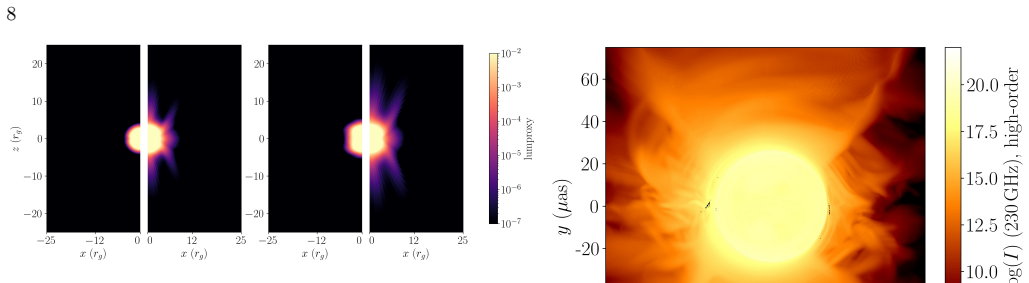
In simulations initialized with a magnetized geometrically thick torus near one mouth of the wormhole while the opposite mouth starts empty, the spin parameter alters dynamical properties on both sides through frame-dragging. The subsequent radiative transfer calculations at 230 GHz show that emissions from the immediate vicinity of the throat dominate the images and light curves, supplying the variable component and producing clear quasi-periodic modulation, in contrast to the behavior around a Kerr black hole.
What carries the argument
The throat in the Kerr black-bounce metric with fixed parameter ℓ = 2.5 M, which permits material and photon trajectories to connect two asymptotic regions and allows throat-proximal emission to dominate the observed signal.
If this is right
- Spin couples the accretion dynamics on both sides of the wormhole.
- Throat emissions supply the main variable component of the radiative signal.
- Clear quasi-periodic modulation appears in the computed light curves.
- These signatures differ from those of a Kerr black hole and could be searched for in horizon-scale data.
Where Pith is reading between the lines
- Varying the throat size parameter would test how strongly emission dominance depends on that choice.
- Adding gas flow from the second mouth could reduce or eliminate the predicted modulation.
- The same simulation pipeline could be applied to other horizonless compact objects to compare their light-curve variability.
Load-bearing premise
The opposite mouth of the wormhole remains free of gas and standard magnetohydrodynamics applies without additional effects at the throat.
What would settle it
Horizon-scale light curves at 230 GHz that lack any quasi-periodic modulation would show that throat emissions do not dominate under the modeled conditions.
Figures




read the original abstract
Wormholes are a hypothetical object that connects disparate points in spacetime. It is a theoretically well-motivated black hole alternative and offers a potential observationally testable arena for probing strong-field gravity with horizon-scale images. We perform general relativistic magnetohydrodynamic (GRMHD) simulations and general relativistic radiative transfer (GRRT) calculations of accretion flows onto a Kerr-like wormhole. Adopting a Kerr black-bounce metric with a fixed throat parameter $\ell = 2.5\,\rm M$, we explore the effects of spin using both two- and three-dimensional simulations. The accretion flow is initialized as a magnetized geometrically thick torus near one mouth of the wormhole, while the opposite mouth is initially gas-free. We find that the spin parameter influences the dynamical properties on both sides of the wormhole through the frame-dragging effects. Based on the GRMHD results, we compute ray-traced images at $230\,\mathrm{GHz}$ using \texttt{RAPTOR}, and analyze the horizon-scale image structure through higher-order photon trajectories. Our GRRT calculations show that emissions originating from the immediate vicinity of the throat can dominate, in contrast to the case of a Kerr black hole. It provides the variable component of the signal and imprints a clear quasi-periodic modulation in the light curves. These properties would be useful to either confirm or rule out such exotic compact objects through horizon-scale observations.
Editorial analysis
A structured set of objections, weighed in public.
Referee Report
Summary. The manuscript performs 2D and 3D GRMHD simulations of a magnetized torus accreting onto one mouth of a Kerr-like wormhole (black-bounce metric with fixed throat parameter ℓ = 2.5 M) while the opposite mouth starts gas-free. Varying spin, it evolves the system under standard GRMHD and then computes 230 GHz images and light curves via GRRT, claiming that throat-vicinity emission dominates the signal (unlike Kerr BHs), supplies the variable component, and imprints clear quasi-periodic modulation useful for observational tests.
Significance. If the no-crossing assumption and numerical robustness hold, the work supplies a concrete, falsifiable variability signature that could distinguish wormhole candidates from black holes at horizon scales, extending standard GRMHD/GRRT techniques to an exotic metric.
major comments (2)
- [Simulation initialization and evolution] The headline result (throat emission dominating the 230 GHz signal and producing distinct QPO modulation) is load-bearing on the opposite mouth remaining gas-free throughout the evolution. The abstract states the opposite mouth is 'initially gas-free' and the metric is traversable with frame-dragging evolved on both sides, yet no explicit check for net mass flux, density buildup, or coordinate-crossing is reported; modest crossing would populate the second mouth and weaken the claimed single-sided discriminant.
- [Numerical methods and results] No grid resolution, convergence tests, or quantitative error analysis (e.g., mass conservation across the throat or image variability convergence) are described, undermining verification of the dynamical properties and the GRRT claim that throat emission dominates.
minor comments (2)
- The abstract mentions analysis of 'higher-order photon trajectories' in the images; the manuscript should specify how these are isolated and weighted in the RAPTOR ray-tracing.
- The fixed choice ℓ = 2.5 M is stated without a sensitivity study; a brief exploration of nearby values would strengthen the robustness claim.
Simulated Author's Rebuttal
We thank the referee for their constructive and detailed comments on our manuscript. We address each major point below and will incorporate revisions to strengthen the presentation of our results.
read point-by-point responses
-
Referee: The headline result (throat emission dominating the 230 GHz signal and producing distinct QPO modulation) is load-bearing on the opposite mouth remaining gas-free throughout the evolution. The abstract states the opposite mouth is 'initially gas-free' and the metric is traversable with frame-dragging evolved on both sides, yet no explicit check for net mass flux, density buildup, or coordinate-crossing is reported; modest crossing would populate the second mouth and weaken the claimed single-sided discriminant.
Authors: We agree that explicit verification of the gas-free condition on the opposite mouth is necessary to support the single-sided accretion interpretation. Our simulations were initialized with zero density on the far side and evolved under the traversable metric, with no visible mass transfer observed in the data. However, quantitative checks were not reported. In the revised manuscript we will add time series of the integrated density and net mass flux through the throat, confirming that crossing remains negligible over the simulated duration. This will directly address the concern and reinforce the robustness of the throat-dominated emission claim. revision: yes
-
Referee: No grid resolution, convergence tests, or quantitative error analysis (e.g., mass conservation across the throat or image variability convergence) are described, undermining verification of the dynamical properties and the GRRT claim that throat emission dominates.
Authors: We acknowledge that the absence of resolution details and convergence tests limits the ability of readers to assess numerical reliability. The original manuscript omitted these elements. In the revision we will specify the grid resolutions employed for both the 2D and 3D GRMHD runs, include convergence tests for global quantities such as mass accretion rate and total energy, and demonstrate that the 230 GHz light-curve variability and image morphology converge with increasing resolution. For the GRRT post-processing we will report the ray-tracing parameters and show that the throat-emission dominance is insensitive to modest changes in resolution. revision: yes
Circularity Check
No circularity: forward GRMHD/GRRT simulations on fixed metric
full rationale
The paper initializes standard GRMHD equations on the Kerr black-bounce metric (ℓ fixed at 2.5M) with a magnetized torus on one side and explicit gas-free condition on the other, evolves the flow, then applies GRRT to compute 230 GHz images and light curves. The claimed throat-vicinity dominance and QPO modulation are direct numerical outputs under these inputs, not re-derived by fitting, self-definition, or load-bearing self-citation. No parameters are tuned to target observables; the opposite-mouth assumption is an explicit initial condition rather than a derived result. The chain is self-contained forward modeling.
Axiom & Free-Parameter Ledger
free parameters (2)
- throat parameter ℓ =
2.5 M
- spin parameter a =
varied
axioms (2)
- domain assumption General relativistic magnetohydrodynamics equations govern the accretion flow
- domain assumption The Kerr black-bounce metric with fixed ℓ describes a traversable wormhole spacetime
invented entities (1)
-
Kerr-like wormhole with throat parameter ℓ
no independent evidence
Reference graph
Works this paper leans on
-
[1]
Bardeen, J. M. 1973, in Black Holes (Les Astres Occlus), ed. C. Dewitt & B. S. Dewitt, 215–239
1973
-
[2]
2018, A&A, 613, A2, doi: 10.1051/0004-6361/201732149
Bronzwaer, T., Davelaar, J., Younsi, Z., et al. 2018, A&A, 613, A2, doi: 10.1051/0004-6361/201732149 14 Figure B1.The effective potential for models with different spin parameters at fixedℓ= 2.5. Figure C1.The time-averaged GRRT images observed from the mouth B side are shown together with the overlaid critical curve forM3Da09. We note that the different ...
-
[3]
Carter, Global structure of the Kerr family of gravitational fields, Phys
Carter, B. 1968, Physical Review, 174, 1559, doi: 10.1103/PhysRev.174.1559
-
[4]
On the Cuspy Structure of Rotating Wormhole Shadows
Cheng, P., Xu, R.-F., & Zhao, P. 2026, https://arxiv.org/abs/2602.14182
work page internal anchor Pith review Pith/arXiv arXiv 2026
-
[5]
2024, PhRvD, 109, 103034, doi: 10.1103/PhysRevD.109.103034
Combi, L., Yang, H., Gutierrez, E., et al. 2024, Phys. Rev. D, 109, 103034, doi: 10.1103/PhysRevD.109.103034 de Kleuver, J., Bronzwaer, T., Falcke, H., et al. 2024, A&A, 689, A197, doi: 10.1051/0004-6361/202348489
-
[6]
2021, PhRvD, 104, 024048, doi: 10.1103/PhysRevD.104.024048
Zheleva, R. 2021, PhRvD, 104, 024048, doi: 10.1103/PhysRevD.104.024048
-
[7]
Dihingia, I. K., Uniyal, A., & Mizuno, Y. 2025, ApJ, 978, 44, doi: 10.3847/1538-4357/ad9600 Ertola Urtubey, M., & P´ erez, D. 2025, European Physical Journal C, 85, 1178, doi: 10.1140/epjc/s10052-025-14919-y Event Horizon Telescope Collaboration, Akiyama, K.,
-
[8]
2019a, 875, L5, doi: 10.3847/2041-8213/ab0f43 Event Horizon Telescope Collaboration, Akiyama, K.,
Alberdi, A., et al. 2019a, ApJL, 875, L5, doi: 10.3847/2041-8213/ab0f43 Event Horizon Telescope Collaboration, Akiyama, K.,
-
[9]
2019b, ApJL, 875, L6, doi: 10.3847/2041-8213/ab1141 Event Horizon Telescope Collaboration, et al
Alberdi, A., et al. 2019b, ApJL, 875, L6, doi: 10.3847/2041-8213/ab1141 15 Figure D1.MRI quality factor for modelM3Da09att= 17,000 M. Event Horizon Telescope Collaboration, Akiyama, K.,
-
[10]
2022, ApJL, 930, L12, doi: 10.3847/2041-8213/ac6674
Alberdi, A., et al. 2022a, ApJL, 930, L12, doi: 10.3847/2041-8213/ac6674 Event Horizon Telescope Collaboration, Akiyama, K.,
-
[11]
2022c, ApJL, 930, L17, doi: 10.3847/2041-8213/ac6756 Event Horizon Telescope Collaboration, et al
Alberdi, A., et al. 2022b, ApJL, 930, L17, doi: 10.3847/2041-8213/ac6756
-
[12]
Gammie, C. F. 2025, ApJ, 980, 193, doi: 10.3847/1538-4357/adaea3
-
[13]
Gammie, C. F., McKinney, J. C., & Toth, G. 2003, Astrophys. J., 589, 444, doi: 10.1086/374594
-
[14]
Ishkaeva, V. A., & Sushkov, S. V. 2023, PhRvD, 108, 084054, doi: 10.1103/PhysRevD.108.084054
-
[15]
K., Liu, C., Mizuno, Y., & Zhu, T
Jiang, H.-X., Dihingia, I. K., Liu, C., Mizuno, Y., & Zhu, T. 2024a, JCAP, 2024, 101, doi: 10.1088/1475-7516/2024/05/101
-
[16]
Jiang, H.-X., Mizuno, Y., Dihingia, I. K., et al. 2024b, A&A, 688, A82, doi: 10.1051/0004-6361/202449681
-
[17]
Jiang, H.-X., Mizuno, Y., Fromm, C. M., & Nathanail, A. 2023, MNRAS, 522, 2307, doi: 10.1093/mnras/stad1106
-
[18]
2025, arXiv e-prints, arXiv:2512.07466, doi: 10.48550/arXiv.2512.07466
Karakonstantakis, A., & Klu´ zniak, W. 2025, arXiv e-prints, arXiv:2512.07466, doi: 10.48550/arXiv.2512.07466
-
[19]
2021, PhRvD, 103, 104050, doi: 10.1103/PhysRevD.103.104050
Kasuya, S., & Kobayashi, M. 2021, PhRvD, 103, 104050, doi: 10.1103/PhysRevD.103.104050
-
[20]
Simpson, A., & Visser, M. 2021, Phys. Rev. D, 103, 084052, doi: 10.1103/PhysRevD.103.084052
-
[21]
2021, JCAP, 04, 082, doi: 10.1088/1475-7516/2021/04/082
Mazza, J., Franzin, E., & Liberati, S. 2021, JCAP, 04, 082, doi: 10.1088/1475-7516/2021/04/082
-
[22]
Olivares, H., Younsi, Z., Fromm, C. M., et al. 2020, MNRAS, 497, 521, doi: 10.1093/mnras/staa1878
-
[23]
2019, ApJS, 243, 26, doi: 10.3847/1538-4365/ab29fd
Porth, O., Chatterjee, K., Narayan, R., et al. 2019, ApJS, 243, 26, doi: 10.3847/1538-4365/ab29fd
-
[24]
Prather, B. S. 2025, KHARMA: Flexible, Portable Performance for GRMHD, doi: 10.1007/978-981-97-8522-3 5
-
[25]
Sano, T., Inutsuka, S.-i., Turner, N. J., & Stone, J. M. 2004, ApJ, 605, 321, doi: 10.1086/382184
-
[26]
2018, PhRvD, 98, 024044, doi: 10.1103/PhysRevD.98.024044
Shaikh, R. 2018, PhRvD, 98, 024044, doi: 10.1103/PhysRevD.98.024044
-
[28]
2019, JCAP, 02, 042, doi: 10.1088/1475-7516/2019/02/042
Simpson, A., & Visser, M. 2019, JCAP, 02, 042, doi: 10.1088/1475-7516/2019/02/042
-
[29]
2025, arXiv e-prints, arXiv:2511.20756, doi: 10.48550/arXiv.2511.20756
Suzuki, H., Mizuno, Y., Uniyal, A., et al. 2025, arXiv e-prints, arXiv:2511.20756, doi: 10.48550/arXiv.2511.20756
-
[30]
2022, PhRvD, 105, 084036, doi: 10.1103/PhysRevD.105.084036
Tsukamoto, N. 2022, PhRvD, 105, 084036, doi: 10.1103/PhysRevD.105.084036
-
[31]
Uniyal, A., Dihingia, I. K., & Mizuno, Y. 2024, Astrophys. J., 970, 172, doi: 10.3847/1538-4357/ad5b5b
-
[32]
Urtubey, M. E., P´ erez, D., & Romero, G. E. 2024, Eur. Phys. J. C, 84, 1163, doi: 10.1140/epjc/s10052-024-13563-2
-
[33]
H., Wielgus, M., Abramowicz, M
Vincent, F. H., Wielgus, M., Abramowicz, M. A., et al. 2021, A&A, 646, A37, doi: 10.1051/0004-6361/202037787
-
[34]
Wang, H.-M., Xu, Y.-M., & Wei, S.-W. 2019, JCAP, 2019, 046, doi: 10.1088/1475-7516/2019/03/046
-
[35]
Wong, G. N., et al. 2022, Astrophys. J. Supp., 259, 64, doi: 10.3847/1538-4365/ac582e
discussion (0)
Sign in with ORCID, Apple, or X to comment. Anyone can read and Pith papers without signing in.